Research Article
Fusion Global-Local-Topology Particle Swarm Optimization
for Global Optimization Problems
Zahra Beheshti, Siti Mariyam Shamsuddin, and Sarina Sulaiman
UTM Big Data Centre, Universiti Teknologi Malaysia, Skudai, 81310 Johor, Malaysia Correspondence should be addressed to Siti Mariyam Shamsuddin; [email protected]
Received 22 February 2014; Revised 18 May 2014; Accepted 24 May 2014; Published 25 June 2014
Academic Editor: Dan Simon
Copyright © 2014 Zahra Beheshti et al. This is an open access article distributed under the Creative Commons Attribution License, which permits unrestricted use, distribution, and reproduction in any medium, provided the original work is properly cited.
In recent years, particle swarm optimization (PSO) has been extensively applied in various optimization problems because of its structural and implementation simplicity. However, the PSO can sometimes find local optima or exhibit slow convergence speed when solving complex multimodal problems. To address these issues, an improved PSO scheme called fusion global-local-topology particle swarm optimization (FGLT-PSO) is proposed in this study. The algorithm employs both global and local topologies in PSO to jump out of the local optima. FGLT-PSO is evaluated using twenty (20) unimodal and multimodal nonlinear benchmark functions and its performance is compared with several well-known PSO algorithms. The experimental results showed that the proposed method improves the performance of PSO algorithm in terms of solution accuracy and convergence speed.
1. Introduction
PSO is a population-based metaheuristic algorithm intro-duced by Kennedy and Eberhart [1] in 1995. The algorithm imitates the social behavior of bird flocking or fish schooling to find the global best solution. Due to the simple concept, having a few parameters and being easy to implement, PSO has received much more attention to solve real-world opti-mization problems [2–6] in recent years. Nevertheless, PSO may easily get trapped in local optima when solving complex multimodal problems [7]. Hence, a number of variant PSO algorithms have been proposed in the literature to avoid the local optima and to find the best solution promptly.
The algorithm applies two different topologies to find a good solution: global and local topologies. In global topology, the position of each particle is affected by the best-fitness particles of the entire population in the search space while each particle is influenced by the best-fitness particles of its neighborhood in the local topology. Kennedy and Mendes proposed local (ring) topological structure PSO (LPSO) [8] and the Von Neumann topological structure PSO (VPSO) [9]. Mendes et al. [10] introduced the fully informed particle swarm (FIPS) algorithm and Ratnaweera et al. [11] suggested self-organizing hierarchical particle swarm optimizer with time-varying acceleration coefficients (HPSO-TVAC). Other
researchers presented the several variants of PSO algorithms such as dynamic multiswarm PSO (DMS-PSO) [12], com-prehensive learning PSO (CLPSO) [13], median-oriented particle swarm optimization (MPSO) [14], centripetal accel-erated particle swarm optimization (CAPSO) [15], quadratic interpolation PSO (QIPSO) [16], quantum-behaved particle swarm optimization (QPSO) [17], and adaptive particle swarm optimization (APSO) [18].
Although the aforementioned algorithms have obtained satisfactory results, there are still some disadvantages in their utilization. For example, LPSO presents a slow convergence rate in unimodal functions [14, 15] or CLPSO is not good for solving unimodal problems [13]. Moreover, some of the algorithms have a better performance than PSO but their structures are not as simple as PSO.
To overcome the disadvantages, this study introduces fusion global-local-topology particle swarm optimization (FGLT-PSO). The proposed algorithm performs a global search over the entire search space with a fast convergence speed using hybridizing two local and global topologies in PSO to jump out from local optima.
The remainder of this paper is organized as follows. In Section 2, a brief review of PSO is provided followed by some well-known PSO algorithms. The proposed algorithm Volume 2014, Article ID 907386, 19 pages
is described in Section 3 in detail. In Section 4, FGLT-PSO is used to solve several benchmark functions and its performance is compared with the other PSO algorithms in the literature. Finally, conclusions and the future research directions are presented inSection 5.
2. Particle Swarm Optimization (PSO)
2.1. PSO Framework. The PSO algorithm is a population-based metaheuristic algorithm that applies two approaches of global exploration and local exploitation to find the optimum solution. The exploration is the ability of expanding search space, where the exploitation is the ability of finding the optima around a good solution. The algorithm is initialized by creating a swarm, that is, population of particles, with ran-dom positions. Every particle is shown as a vector( ⃗𝑋𝑖, ⃗𝑉𝑖, ⃗𝑃𝑖) in a 𝑑-dimensional search space where ⃗𝑋𝑖 and ⃗𝑉𝑖 are the position and velocity, respectively, and 𝑖⃗𝑃is the personal best position(𝑃best)found by the𝑖th particle:
⃗𝑋𝑖= (𝑥1𝑖, 𝑥2𝑖, . . . , 𝑥𝑑𝑖) for 𝑖 = 1, 2, . . . , 𝑁,
⃗𝑉
𝑖= (V1𝑖,V2𝑖, . . . ,V𝑑𝑖) for𝑖 = 1, 2, . . . , 𝑁,
⃗𝑃
𝑖= (𝑝𝑖1, 𝑝2𝑖, . . . , 𝑝𝑖𝑑) for 𝑖 = 1, 2, . . . , 𝑁.
(1)
In addition, the best position obtained by the entire popula-tion ( ⃗𝑃𝑔) is computed to update the particle velocity:
⃗𝑃𝑔 = (𝑝1
𝑔, 𝑝2𝑔, . . . , 𝑝𝑔𝑑) . (2)
Based on 𝑖⃗𝑃and ⃗𝑃𝑔, the next velocity and position of the𝑖th particle are computed using (3) and (4) as follows:
V𝑖𝑑(𝑡 + 1) = 𝑤 ×V𝑑𝑖 (𝑡) + 𝐶1×rand1× (𝑝𝑑𝑖 (𝑡) − 𝑥𝑑𝑖 (𝑡)) + 𝐶2
×rand2× (𝑝𝑔𝑑(𝑡) − 𝑥𝑑𝑖 (𝑡)) ,
(3)
𝑥𝑑𝑖 (𝑡 + 1) = 𝑥𝑑𝑖 (𝑡) +V𝑖𝑑(𝑡 + 1) , (4)
whereV𝑑𝑖(𝑡 + 1)andV𝑑𝑖(𝑡)are the next and current velocity of the𝑖th particle, respectively.𝑤is inertia weight,𝐶1and𝐶2 are acceleration coefficients, and rand1and rand2are random numbers in the interval[0, 1].𝑁is the number of particles; 𝑥𝑑
𝑖(𝑡+1)and𝑥𝑑𝑖(𝑡)are the next and current position of the𝑖th
particle.
Also, |V𝑑𝑖(𝑡 + 1)| < Vmax and Vmax is set to a constant bounded based on the search space bound. A larger value of
wencourages global exploration (searching new areas), while a smaller value provides a local exploitation.
In (3), the second and the third terms are called cognition and social term, respectively. The two models applied to choose ⃗𝑃𝑔are known as𝑔best (for global topology) and𝑙best (for local topology) models. In this paper, the𝑔best model and𝑙best model are called PSO and LPSO, respectively.
2.2. Improved PSO Algorithms. Since Kennedy and Eberhart introduced PSO algorithm, the algorithm and its improved schemes have been extensively applied in many problems [20–25]. Many researchers have proposed the variants of modified PSO through swarm topology [8, 9], parameter selection [19,26], combining PSO with other evolutionary computation (EC) techniques [27,28], integration of its self-adaptation [29], and so on.
LPSO [8] and VPSO [9] were proposed based on a local topology to avoid premature convergence rate in solving multimodal problems. FIPS algorithm [10] is another PSO algorithm which uses the information of the entire neigh-borhood to guide the particles for finding the best solution. Dynamic multiswarm PSO (DMS-PSO) [12] was suggested by Liang and Suganthan to dynamically enhance the topo-logical structure. Ratnaweera et al. [11] proposed HPSO-TVAC algorithm based on linearly time-varying acceleration coefficients where a larger 𝐶1 and a smaller 𝐶2 are set at the beginning and gradually reversed throughout the search. Liang et al. [13] presented comprehensive learning particle swarm optimization (CLPSO) which focused on avoiding the local optima by encouraging each particle to learn its behavior from other particles on different dimensions.
In another research, a selection operator for PSO was first introduced by Angeline [30]. It is similar to what was used in a genetic algorithm (GA). Other researchers used a part of crossover [31] and mutation [29] operations from GA into PSO. Pant et al. proposed a quadratic crossover oper-ator to PSO algorithm called quadratic interpolation PSO (QIPSO) [16]. An adaptive fuzzy particle swarm optimization (AFPSO) [19] was proposed to utilize fuzzy inferences for adjusting acceleration coefficients. Meanwhile, the quadratic crossover operator [16] was used in the proposed AFPSO algorithm (AFPSO-QI) [19] to have better performance in solving multimodal problems. Zhan et al. presented an adaptive particle swarm optimization (APSO) [18] using a real-time evolutionary state estimation procedure and an elitist learning strategy. A variant of PSO algorithm based on orthogonal learning strategy (OLPSO) [32] was introduced to guide particles for discovering useful information from their personal best positions and from their neighborhood’s best position in order to fly in better directions. Gao et al. [33] used PSO with chaotic opposition-based population initialization and stochastic search technique to solve complex multimodal problems. The algorithm called CSPSO finds new solutions in the neighborhoods of the previous best positions in order to escape from local optima in multimodal functions. Beheshti et al. proposed median-oriented particle swarm optimization (MPSO) [14] and centripetal accelerated particle swarm optimization (CAPSO) [15] based on Newton’s laws of motion to accelerate the learning and convergence of optimization problems.
3. FGLT-PSO: The Proposed Method
→
Xi(t)
→
Pi(t)−
→
Xi(t)
→
Pi(t)
→
Vi(t)
→
Pgbest(t)−
→
Xi(t)
→
Pgbest(t)
→
Plbest(t)−
→
Xi(t)
→
Plbest(t)
→
Xi(t + 1)
C1(t)×rand1×(Pi→ (t)−→Xi(t))
C2(t)×rand2×(
→
Plbest(t)−
→
Xi(t))
C3(t)×rand3×(
→
Pgbest(t)−
→
Xi(t))
w(t)×V→i(t)
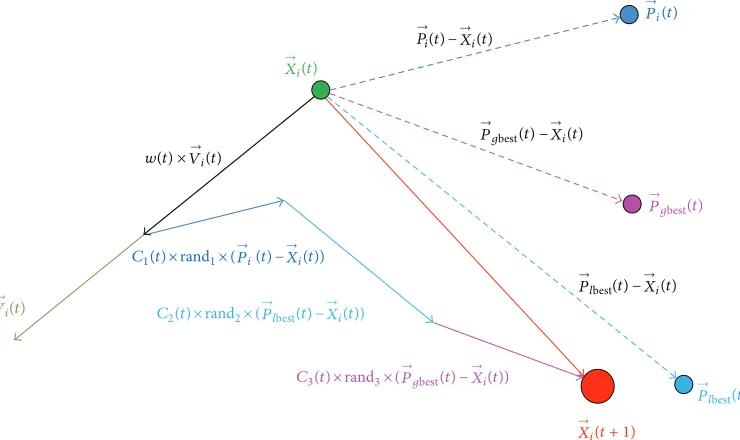
Figure 1: Graphical representation of the particle movement using FGLT-PSO algorithm.
and LPSO illustrates good results in multimodal problems. Hence, both local and global topologies are hybridized in FGLT-PSO to increase the convergence rate and to avoid trapping into local optima.
In FGLT-PSO algorithm, each particle uses the best position found by its neighbors ( 𝑙⃗𝑃best) to update the particles’
velocities: ⃗𝑃
𝑙best= (𝑝𝑙1best, 𝑝2𝑙best, . . . , 𝑝𝑙𝑑best) , (5) V𝑑𝑖 (𝑡 + 1) = 𝑤 (𝑡) ×V𝑑𝑖 (𝑡) + 𝐶1(𝑡) ×rand1
× (𝑝𝑖𝑑(𝑡) − 𝑥𝑑𝑖 (𝑡)) + 𝐶2(𝑡) ×rand2 × (𝑝𝑙𝑑best(𝑡) − 𝑥𝑑𝑖 (𝑡)) .
(6)
The next position of each particle is computed based on the current position,𝑥𝑑𝑖(𝑡), the next velocity,V𝑑𝑖(𝑡 + 1), and the best position found by the swarm, 𝑔⃗𝑃best, as follows:
𝑥𝑑𝑖 (𝑡 + 1) = 𝑥𝑑𝑖 (𝑡) +V𝑑𝑖 (𝑡 + 1) + 𝐶3(𝑡) ×rand3 × (𝑝𝑔𝑑best(𝑡) − 𝑥𝑑𝑖 (𝑡)) ,
(7)
⃗𝑃
𝑔best= (𝑝1𝑔best, 𝑝2𝑔best, . . . , 𝑝𝑑𝑔best) . (8)
In (6),𝑤is computed as
𝑤 (𝑡) = 𝑤max−𝑡 × (𝑤max𝑇− 𝑤min). (9)
Also,𝐶1(𝑡), 𝐶2(𝑡), and𝐶3(𝑡)are acceleration coefficients and modified according to (10):
𝐶𝑗(𝑡) = 𝐶𝑗min+
𝑡 × (𝐶𝑗max− 𝐶𝑗min)
𝑇 , 𝑗 = 1, 2, 3, (10) where𝑡and𝑇are the current iteration and the number of maximum iterations, respectively.
The second term in (6) is called the cognition term, and the third terms in (6) and (7) are named the social terms. In (7),|𝑥𝑑𝑖(𝑡 + 1)| < 𝑥maxand𝑥maxis set to a constant based on the search space bound.
3.2. Analysis of FGLT-PSO. A metaheuristic algorithm ex-plores new spaces to avoid trapping in a local optimum in the initial steps. Due to the poor exploration in the standard PSO (PSO), it can sometimes find local optima in multimodal problems. Sometimes, if a particle falls into a local optimum, it will not be able to get out of it. That is, if 𝑔⃗𝑃best obtained
through the population lies in a local optimum while the current position and the personal best position of particle𝑖 are in the same local optimum, the second and third terms of (3) tend to zero and 𝑤decreases linearly to near zero. Consequently, the next velocity of particle𝑖 tends to zero, and its next position in (4) does not change; thus, the particle remains in the local optimum. Hence, the main aim in FGLT-PSO is to overcome the poor exploration and to increase the convergence rate by combining the local and global searches as shown inFigure 1. The particles move in the search space based on the best solutions found by their neighbors ( 𝑙⃗𝑃best)
and the swarm ( 𝑔⃗𝑃best). At the beginning, the particles search
new spaces. By lapse of iterations, the exploration should fade out and the exploitation should fade in. It means the particles accelerate to the good solution and make search around it to find the best solution.
4. Experimental Results
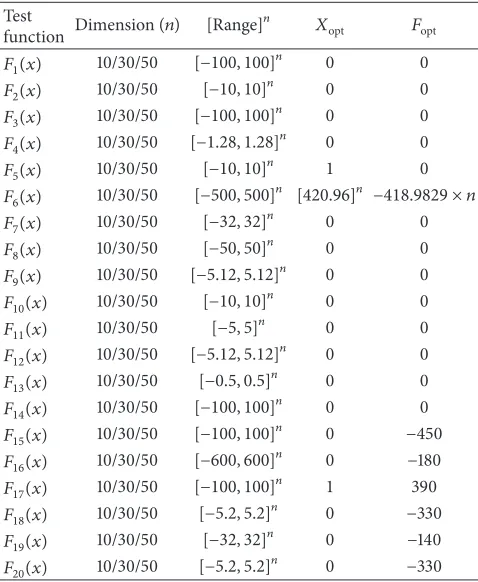
Table 1: Dimensions, ranges, and global optimum values of test functions used in the experiments.
Test
function Dimension (𝑛) [Range]
𝑛 𝑋
opt 𝐹opt
𝐹1(𝑥) 10/30/50 [−100, 100]𝑛 0 0
𝐹2(𝑥) 10/30/50 [−10, 10]𝑛 0 0
𝐹3(𝑥) 10/30/50 [−100, 100]𝑛 0 0
𝐹4(𝑥) 10/30/50 [−1.28, 1.28]𝑛 0 0
𝐹5(𝑥) 10/30/50 [−10, 10]𝑛 1 0 𝐹6(𝑥) 10/30/50 [−500, 500]𝑛 [420.96]𝑛 −418.9829 × 𝑛 𝐹7(𝑥) 10/30/50 [−32, 32]𝑛 0 0 𝐹8(𝑥) 10/30/50 [−50, 50]𝑛 0 0 𝐹9(𝑥) 10/30/50 [−5.12, 5.12]𝑛 0 0
𝐹10(𝑥) 10/30/50 [−10, 10]𝑛 0 0
𝐹11(𝑥) 10/30/50 [−5, 5]𝑛 0 0
𝐹12(𝑥) 10/30/50 [−5.12, 5.12]𝑛 0 0
𝐹13(𝑥) 10/30/50 [−0.5, 0.5]𝑛 0 0 𝐹14(𝑥) 10/30/50 [−100, 100]𝑛 0 0 𝐹15(𝑥) 10/30/50 [−100, 100]𝑛 0 −450 𝐹16(𝑥) 10/30/50 [−600, 600]𝑛 0 −180 𝐹17(𝑥) 10/30/50 [−100, 100]𝑛 1 390
𝐹18(𝑥) 10/30/50 [−5.2, 5.2]𝑛 0 −330
𝐹19(𝑥) 10/30/50 [−32, 32]𝑛 0 −140
𝐹20(𝑥) 10/30/50 [−5.2, 5.2]𝑛 0 −330
4.1. Benchmark Functions. Twenty (20) minimization func-tions are applied in the experimental study including uni-modal, multiuni-modal, rotated, shifted, and shifted-rotated functions as detailed inTable 1. In the table,Range and 𝑛 are the feasible bound and the dimension of each func-tion, respectively. 𝐹opt is the optimum value of function.
Among the benchmarks, functions (1)–(5) are unimodal functions and functions(6)–(9)are in the class of multimodal functions. Functions (10)–(14) are rotated and functions (15)–(18) are shifted unimodal and multimodal functions. Two functions (19) and (20) are shifted-rotated multimodal functions.
In unimodal functions, the convergence rate of search algorithm is more interesting than the final results because other methods have been designed to optimize these kinds of functions. In multimodal functions, finding an optimal (or a good near-global optimal) solution is important. These functions are more difficult to optimize because the num-ber of local optima exponentially increases as the dimen-sion increases. Therefore, the search algorithms should not become trapped in a local optimum and should be able to obtain good solutions.
The rotation of function increases the function complex-ity. It does not affect the shape of function. The variable ⃗𝑌is computed using an orthogonal matrix𝑀[36] and applied to obtain the fitness value of rotated function as follows:
⃗𝑌 = 𝑀 × ⃗𝑋. (11)
In shifted functions, the global optimum𝑋∗⃗ = (𝑥∗1, 𝑥2∗, . . . , 𝑥∗
𝑛)is shifted to the new position ⃗𝑂 = (𝑜1, 𝑜2, . . . , 𝑜𝑛). All
the test functions are shown as follows.
(1) Sphere Model (unimodal function).Consider
𝐹1(𝑥) =∑𝑛
𝑖=1
𝑥𝑖2. (12)
(2) Shifted’s Schwefel’s Problem (unimodal function).Consider
𝐹2(𝑥) = 𝑛
∑
𝑖=1𝑥𝑖 + 𝑛
∏
𝑖=1𝑥𝑖. (13)
(3) Schwefel’s Problem 1.2 (unimodal function). Consider
𝐹3(𝑥) =∑𝑛
𝑖=1
(∑𝑖
𝑗=1
𝑥𝑗)
2
. (14)
(4) Quartic Function, That Is, Noise (unimodal function).
Consider
𝐹4(𝑥) =∑𝑛
𝑖=1
𝑖𝑥4𝑖 +random[0, 1) . (15)
(5) Rosenbrock’s Function (multimodal function).Consider
𝐹5(𝑥) =𝑛−1∑
𝑖=1
[100(𝑥2𝑖 − 𝑥𝑖+1)2+ (𝑥𝑖− 1)2] . (16)
𝐹5 is unimodal in a 2-dimension or 3-dimension search space but can be treated as a multimodal function in high-dimensional cases.
(6) Generalized Schwefel’s Problem 2.26 (multimodal func-tion). Consider
𝐹6(𝑥) =∑𝑛
𝑖=1
−𝑥𝑖sin(√𝑥𝑖). (17)
(7) Ackley’s Function (multimodal function). Consider
𝐹7(𝑥) = −20exp(−0.2√1 𝑛
𝑛
∑
𝑖=1
𝑥2 𝑖)
−exp(1 𝑛
𝑛
∑
𝑖=1
cos2𝜋𝑥𝑖) + 20 + 𝑒.
(18)
(8) Generalized Penalized Function (multimodal function). Consider
𝐹8(𝑥) = 𝜋𝑛{10sin(𝜋𝑦1) +
𝑛−1
∑
𝑖=1
(𝑦𝑖− 1)2
× [1 + 10sin2(𝜋𝑦𝑖+1)] + (𝑦𝑛− 1)2}
+∑𝑛
𝑖=1
Table 2: Minimization results for the unimodal and multimodal functions (maximum iteration = 5000 and𝑛 = 10).
Function FGLT-PSO PSO LPSO QIPSO
𝐹1
Avg. best solution 0.000e + 000 1.405e−135 1.452e−063 1.526e−138
SD 0.000e + 000 6.789e−135 5.681e−063 5.723e−138
Median best solution 0.000e+ 000 1.243e−139 7.381e−065 3.961e−142 Avg. iteration for finding the best solution 2646 5000 5000 5000
𝐹2
Avg. best solution 2.741e−273 2.992e−077 4.130e−038 6.663e−079
SD 0.000e + 000 1.490e−076 7.564e−038 1.234e−078
Median best solution 6.578e−277 3.849e−079 9.945e−039 1.019e−079 Avg. iteration for finding the best solution 4952 5000 4999 5000
𝐹3
Avg. best solution 1.637e−116 3.215e−044 5.110e−014 3.919e−044
SD 8.969e−116 1.565e−043 1.126e−013 2.117e−043
Median best solution 2.369e−127 1.857e−048 5.320e−015 3.570e−048 Avg. iteration for finding the best solution 4630 4999 4999 4999
𝐹4
Avg. best solution 3.209e−004 4.738e−004 1.269e−003 6.514e−004 SD 3.006e−004 2.057e−004 4.861e−004 3.241e−004 Median best solution 2.114e−004 4.595e−004 1.197e−003 5.797e−004 Avg. iteration for finding the best solution 3715 4404 4414 4459
𝐹5
Avg. best solution 2.973e−001 1.820e+ 000 1.661e+ 000 2.040e+ 000
SD 1.015e + 000 1.336e+ 000 1.281e+ 000 1.622e+ 000
Median best solution 4.614e−004 2.014e+ 000 1.727e+ 000 1.862e+ 000 Avg. iteration for finding the best solution 4537 4811 4988 4837
𝐹6
Avg. best solution −3.910e + 003 −3.452e+ 003 −3.892e+ 003 −3.424e+ 003
SD 1.184e + 002 2.307e+ 002 1.843e+ 002 2.775e+ 002
Median best solution −3.953e+ 003 −3.475e+ 003 −3.834e+ 003 −3.475e+ 003 Avg. iteration for finding the best solution 2974 2726 3918 2635
𝐹7
Avg. best solution 4.441e−015 4.322e−015 4.441e−015 4.441e−015
SD 0.000e + 000 6.486e−016 0.000e + 000 0.000e + 000
Median best solution 4.441e−015 4.441e−015 4.441e−015 4.441e−015 Avg. iteration for finding the best solution 376 3147 3772 3109
𝐹8
Avg. best solution 4.712e−032 4.712e−032 4.712e−032 4.712e−032
SD 1.670e−047 1.670e−047 1.670e−047 1.670e−047
Median best solution 4.712e−032 4.712e−032 4.712e−032 4.712e−032 Avg. iteration for finding the best solution 420 3166 3895 2687
𝐹9
Avg. best solution 9.495e−002 9.667e−001 1.574e+ 000 0.000e + 000 SD 2.720e−001 4.560e+ 000 1.065e+ 000 0.000e + 000 Median best solution 9.236e−008 0.000e+ 000 2.000e+ 000 0.000e+ 000 Avg. iteration for finding the best solution 4856 3357 4366 3401
Avg. rank 1.1 2.9 3.4 2.6
Final rank 1 3 4 2
Algorithms FGLT-PSO PSO LPSO QIPSO
𝑦𝑖= 1 +𝑥𝑖+ 1
4 ,
𝑢 (𝑥𝑖, 𝑎, 𝑘, 𝑚) ={{{{ {
𝑘(𝑥𝑖− 𝑎)𝑚 𝑥𝑖> 𝑎
0 −𝑎 ≤ 𝑥𝑖≤ 𝑎
𝑘(−𝑥𝑖− 𝑎)𝑚 𝑥𝑖< −𝑎.
(19)
(9) Noncontinuous Rastrigin’s Function (multimodal function). Consider
𝐹9(𝑥) =∑𝑛
𝑖=1
[𝑦𝑖2− 10cos(2𝜋𝑦𝑖) + 10] ,
where 𝑦𝑖={{ {
𝑥𝑖 𝑥𝑖 ≤ 0.5 round(2𝑥𝑖)
2 𝑥𝑖 ≥ 0.5.
Table 3: Minimization results for the rotated and shifted unimodal and multimodal functions (maximum iteration = 5000 and𝑛 = 10).
Function FGLT-PSO PSO LPSO QIPSO
𝐹10
Avg. best solution 7.056e−208 4.585e−059 2.358e−021 1.127e−058
SD 0.000e + 000 8.736e−059 7.425e−021 5.346e−058
Median best solution 1.930e−209 7.785e−060 3.417e−022 1.023e−060 Avg. iteration for finding the best solution 4741 4999 4997 4999
𝐹11
Avg. best solution −6.602e +001 −6.645e + 001 −6.616e +001 −6.613e +001 SD 1.736e +000 1.175e + 000 9.989e−001 1.720e +000 Median best solution −6.606e +001 −6.614e +001 −6.607e +001 −6.588e +001 Avg. iteration for finding the best solution 3408 2930 3099 3185
𝐹12
Avg. best solution 1.604e + 001 2.352e +001 2.319e +001 2.278e +001
SD 2.974e + 000 3.762e +000 4.012e +000 4.387e +000
Median best solution 1.589e +001 2.358e +001 2.351e +001 2.240e +001 Avg. iteration for finding the best solution 2394 3656 3786 3660
𝐹13
Avg. best solution 0.000e + 000 1.351e +000 7.438e−008 7.957e−001
SD 0.000e + 000 3.079e +000 4.072e−007 2.428e +000
Median best solution 0.000e +000 0.000e +000 0.000e +000 0.000e +000 Avg. iteration for finding the best solution 448 3192 4877 3446
𝐹14
Avg. best solution 1.165e−001 1.032e−001 9.987e−002 1.132e−001 SD 3.790e−002 1.826e−002 0.000e + 000 3.457e−002 Median best solution 9.987e−002 9.987e−002 9.987e−002 9.987e−002 Avg. iteration for finding the best solution 1998 2916 3268 2795
𝐹15
Avg. best solution −4.500e + 002 −4.396e +002 −4.480e +002 −4.406e +002
SD 8.039e−014 7.334e +000 2.470e +000 7.991e +000
Median best solution −4.500e +002 −4.450e +002 −4.500e +002 −4.450e +002 Avg. iteration for finding the best solution 1324 757 3561 1213
𝐹16
Avg. best solution −1.798e + 002 −1.745e +002 −1.793e +002 −1.766e +002
SD 3.789e−001 8.186e +000 5.222e−001 3.309e +000
Median best solution −1.800e +002 −1.780e +002 −1.789e +002 −1.780e +002 Avg. iteration for finding the best solution 2922 2592 3398 2711
𝐹17
Avg. best solution 3.915e + 002 9.048e +006 6.752e +004 6.596e +006
SD 6.315e + 000 1.678e +007 3.676e +005 1.638e +007
Median best solution 3.900e +002 2.014e +006 3.933e +002 4.867e +002 Avg. iteration for finding the best solution 4831 3983 4884 4090
𝐹18
Avg. best solution −3.287e + 002 −3.215e +002 −3.247e +002 −3.233e +002
SD 1.113e + 000 5.979e +000 3.144e +000 4.822e +000
Median best solution −3.290e +002 −3.225e +002 −3.250e +002 −3.225e +002 Avg. iteration for finding the best solution 4809 3193 4509 3331
𝐹19
Avg. best solution −119.744 −119.745 −119.804 −119.746 SD 5.750e−002 7.142e−002 5.558e−002 6.911e−002 Median best solution −119.731 −119.748 −119.804 −119.73 Avg. iteration for finding the best solution 1849 2240 2072 2414
𝐹20
Avg. best solution −3.196e + 002 −3.091e +002 −3.137e +002 −3.078e +002
SD 4.236e + 000 7.174e +000 5.338e +000 7.995e +000
Median best solution −3.196e +002 −3.102e +002 −3.130e +002 −3.079e +002 Avg. iteration for finding the best solution 3252 3315 4721 3479
Avg. rank 1.8 3.2 2.1 2.9
Final rank 1 4 2 3
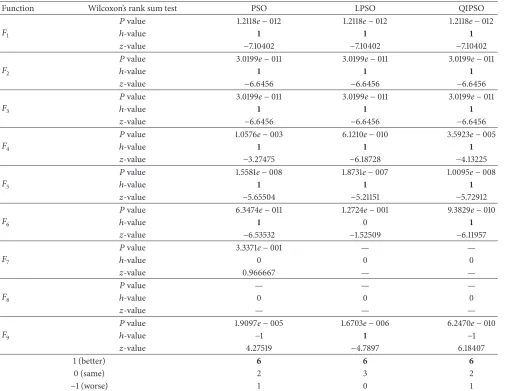
Table 4: Comparison of FGLT-PSO with PSO, LPSO, and QIPSO for the unimodal and multimodal functions using Wilcoxon’s rank sum test (𝑛 = 10).
Function Wilcoxon’s rank sum test PSO LPSO QIPSO
𝐹1 𝑃
value 1.2118e−012 1.2118e−012 1.2118e−012
ℎ-value 1 1 1
𝑧-value −7.10402 −7.10402 −7.10402
𝐹2
𝑃value 3.0199e−011 3.0199e−011 3.0199e−011
ℎ-value 1 1 1
𝑧-value −6.6456 −6.6456 −6.6456
𝐹3 𝑃
value 3.0199e−011 3.0199e−011 3.0199e−011
ℎ-value 1 1 1
𝑧-value −6.6456 −6.6456 −6.6456
𝐹4 𝑃
value 1.0576e−003 6.1210e−010 3.5923e−005
ℎ-value 1 1 1
𝑧-value −3.27475 −6.18728 −4.13225
𝐹5
𝑃value 1.5581e−008 1.8731e−007 1.0095e−008
ℎ-value 1 1 1
𝑧-value −5.65504 −5.21151 −5.72912
𝐹6 𝑃
value 6.3474e−011 1.2724e−001 9.3829e−010
ℎ-value 1 0 1
𝑧-value −6.53532 −1.52509 −6.11957
𝐹7 𝑃
value 3.3371e−001 — —
ℎ-value 0 0 0
𝑧-value 0.966667 — —
𝐹8
𝑃value — — —
ℎ-value 0 0 0
𝑧-value — — —
𝐹9 𝑃
value 1.9097e−005 1.6703e−006 6.2470e−010
ℎ-value −1 1 −1
𝑧-value 4.27519 −4.7897 6.18407
1 (better) 6 6 6
0 (same) 2 3 2
−1 (worse) 1 0 1
(10) Rotated Schwefel’s Problem 2.22 (unimodal function). Consider
𝐹10(𝑥) =∑𝑛
𝑖=1𝑦𝑖 + 𝑛
∏
𝑖=1𝑦𝑖, 𝑦 = 𝑀 × 𝑥.
(21)
(11) Rotated 2𝑛 Minima Function (multimodal function).
Consider
𝐹11(𝑥) =1 𝑛
𝑛
∑
𝑖=1
(𝑦𝑖4− 16𝑦𝑖2+ 5𝑦𝑖) , 𝑦 = 𝑀 × 𝑥. (22)
(12) Rotated Rastrigin’s Function (multimodal function). Con-sider
𝐹12(𝑥) =∑𝑛
𝑖=1
[𝑦2𝑖 − 10cos(2𝜋𝑦𝑖) + 10] , 𝑦 = 𝑀 × 𝑥. (23)
(13) Rotated Weierstrass’ Function (multimodal function). Consider
𝐹13(𝑥) =∑𝑛
𝑖=1
(𝑘∑max
𝑘=0
[𝑎𝑘cos(2𝜋𝑏𝑘(𝑦𝑖+ 0.5))])
− 𝑛𝑘∑max
𝑘=0
[𝑎𝑘cos(2𝜋𝑏𝑘× 0.5)] ,
𝑦 = 𝑀 × 𝑥, 𝑎 = 0.5, 𝑏 = 3, 𝑘max= 20.
(24)
(14) Rotated Salomon’s Function (multimodal function). Con-sider
𝐹14(𝑥) = 1 −cos(2𝜋√
𝑛
∑
𝑖=1
𝑦2
𝑖) + 0.1√ 𝑛
∑
𝑖=1
𝑦2
𝑖, 𝑦 = 𝑀 × 𝑥.
Table 5: Comparison of FGLT-PSO with PSO, LPSO, and QIPSO for the rotated and shifted unimodal and multimodal functions using Wilcoxon’s rank sum test (𝑛 = 10).
Function Wilcoxon’s rank sum test PSO LPSO QIPSO
𝐹10 𝑃
value 3.0199e−011 3.0199e−011 3.0199e−011
ℎ-value 1 1 1
𝑧-value −6.6456 −6.6456 −6.6456
𝐹11
𝑃value 4.1191e−001 7.3940e−001 8.4180e−001
ℎ-value 0 0 0
𝑧-value 0.820536 0.33265 0.19959
𝐹12 𝑃
value 1.8567e−009 1.8500e−008 5.5329e−008
ℎ-value 1 1 1
𝑧-value −6.00987 −5.62547 −5.43328
𝐹13 𝑃
value 2.1577e−002 2.1577e−002 8.1523e−002
ℎ-value 1 1 0
𝑧-value −2.29773 −2.29773 −1.74192
𝐹14
𝑃value 1.1439e−001 1.4425e−004 7.7181e−001
ℎ-value 0 −1 0
𝑧-value 1.57878 3.80076 0.290007
𝐹15 𝑃
value 1.5553e−011 1.2883e−011 1.7966e−008
ℎ-value 1 1 1
𝑧-value −6.74264 −6.76995 −5.63053
𝐹16 𝑃
value 1.2755e−010 1.9667e−003 5.5338e−010
ℎ-value 1 1 1
𝑧-value −6.43006 −3.09521 −6.20317
𝐹17
𝑃value 7.3270e−011 3.6443e−008 5.0030e−010
ℎ-value 1 1 1
𝑧-value −6.51381 −5.50727 −6.21901
𝐹18 𝑃
value 5.7512e−006 3.5043e−007 4.0269e−005
ℎ-value 1 1 1
𝑧-value −4.53533 −5.09408 −4.10593
𝐹19
𝑃value 9.2344e−001 2.3885e−004 8.6499e−001
ℎ-value 0 −1 0
𝑧-value 0.0960988 3.67393 0.170021
𝐹20
𝑃value 5.2991e−008 9.2051e−005 4.6756e−008
ℎ-value 1 1 1
𝑧-value −5.44097 −3.91064 −5.46322
1 (better) 8 8 7
0 (same) 3 1 4
−1 (worse) 0 2 0
(15) Shifted Schwefel’s Problem 2.21 (unimodal function). Con-sider
𝐹15(𝑥) =max𝑖{𝑧𝑖, 1 ≤ 𝑖 ≤ 𝑛} + 𝑓bias15,
𝑓bias15= −450, 𝑧 = 𝑥 − 𝑜. (26)
(16) Shifted Generalized Griewank’s Function (multimodal function). Consider
𝐹16(𝑥) = 40001 ∑𝑛
𝑖=1
𝑧𝑖2−∏𝑛
𝑖=1
cos(𝑧𝑖
√𝑖) + 1 + 𝑓bias16,
𝑓bias16= −180, 𝑧 = 𝑥 − 𝑜. (27)
(17) Shifted Rosenbrock’s Function (multimodal function). Consider
𝐹17(𝑥) =𝑛−1∑
𝑖=1
[100(𝑧2𝑖 − 𝑧𝑖+1)2+ (𝑧𝑖− 1)2] + 𝑓bias17,
𝑓bias17= 390, 𝑧 = 𝑥 − 𝑜 + 1. (28)
(18) Shifted Rastrigin’s Function (multimodal function). Con-sider
𝐹18(𝑥) =∑𝑛
𝑖=1
[𝑧2𝑖 − 10cos(2𝜋𝑧𝑖) + 10] + 𝑓bias18,
𝑓bias18= −330, 𝑧 = 𝑥 − 𝑜.
Table 6: Minimization results for the unimodal and multimodal functions (maximum iteration = 10000 and𝑛 = 30).
Function FGLT-PSO PSO LPSO QIPSO
𝐹1
Avg. best solution 0.000e + 000 5.397e−069 2.747e−028 3.502e−069
SD 0.000e + 000 1.161e−068 4.078e−028 1.664e−068
Median best solution 0.000e +000 2.321e−070 1.047e−028 2.727e−072
𝐹2
Avg. best solution 7.598e−110 7.000e +000 3.849e−028 2.333e +000
SD 4.085e−109 7.944e +000 9.015e−028 4.302e +000
Median best solution 1.684e−136 1.000e +001 1.331e−031 1.188e−071
𝐹3
Avg. best solution 5.959e−020 1.189e +004 1.399e +002 5.733e +003
SD 1.762e−019 6.605e +003 9.380e +001 5.484e +003
Median best solution 5.483e−021 1.083e +004 1.254e +002 5.000e +003
𝐹4
Avg. best solution 6.415e−003 1.320e−003 9.664e−003 1.635e−003 SD 2.858e−003 8.008e−004 3.621e−003 9.357e−004 Median best solution 5.941e−003 1.088e−003 9.106e−003 1.333e−003
𝐹5
Avg. best solution 5.718e−001 1.129e +003 1.751e +001 3.858e +002
SD 1.225e + 000 3.023e +003 2.041e +001 1.832e +003
Median best solution 1.707e−001 7.428e +001 9.494e +000 2.139e +001
𝐹6
Avg. best solution −1.048e + 004 −9.095e +003 −9.858e +003 −9.227e +003 SD 5.996e +002 7.444e +002 4.872e +002 7.524e +002 Median best solution −1.058e +004 −9.051e +003 −9.828e +003 −9.232e +003
𝐹7
Avg. best solution 7.771e−002 1.013e−014 2.931e−014 8.941e−015 SD 2.015e−001 3.312e−015 1.433e−014 2.457e−015 Median best solution 7.994e−015 7.994e−015 2.576e−014 7.994e−015
𝐹8
Avg. best solution 5.164e−003 1.037e−002 1.160e−025 1.571e−032 SD 2.274e−002 3.163e−002 3.552e−025 5.567e−048 Median best solution 1.571e−032 1.591e−032 3.737e−027 1.571e−032
𝐹9
Avg. best solution 2.136e + 001 5.827e +001 4.281e +001 4.310e +001
SD 8.612e + 000 3.080e +001 2.064e +001 2.901e +001
Median best solution 2.212e +001 5.450e +001 3.753e +001 3.500e +001
Avg. rank 1.8 3.3 2.6 2.3
Final rank 1 4 3 2
Algorithms FGLT-PSO PSO LPSO QIPSO
(19) Shifted Rotated Ackley’s Function (multimodal function). Consider
𝐹19(𝑥) = −20exp(−0.2√1 𝑛
𝑛
∑
𝑖=1
𝑧2 𝑖)
−exp(1 𝑛
𝑛
∑
𝑖=1
cos2𝜋𝑧𝑖) + 20 + 𝑒 + 𝑓bias19, (30)
where 𝑓bias19 = −140; 𝑧 = (𝑥 − 𝑜) × 𝑀 is a linear transformation matrix with condition number = 100.
(20) Shifted Rotated Rastrigin’s Function (multimodal func-tion). Consider
𝐹20(𝑥) =∑𝑛
𝑖=1
[𝑧𝑖2− 10cos(2𝜋𝑧𝑖) + 10] + 𝑓bias20, (31)
where 𝑓bias20 = −330; 𝑧 = (𝑥 − 𝑜) × 𝑀 is a linear transformation matrix with condition number = 2.
4.2. Results of FGLT-PSO. The results of FGLT-PSO are provided in three sections. InSection 4.2.1, the acceleration coefficients 𝐶1, 𝐶2, and 𝐶3 in the proposed method are changed according to (10) and inSection 4.2.2, these factors are constant. In these sections, FGLT-PSO is evaluated using the benchmark functions with dimensions 10, 30, and 50. The number of maximum iterations is set at 5000 for𝑛 = 10, at 10000 for𝑛 = 30, and at 15000 for𝑛 = 50. The population size is set to 50 (𝑁 = 50). Also,𝑤decreases linearly from 0.9 to 0.4.
InSection 4.2.3, the results of FGLT-PSO are compared with those of several well-known PSO algorithms from [19] on the common functions. In this section, the population size is set to 30 (𝑁 = 30),𝑛is 30, and the number of maximum iterations is set at 10000.
Table 7: Minimization results for the rotated and shifted unimodal and multimodal functions (maximum iteration = 10000 and𝑛 = 30).
Function FGLT-PSO PSO LPSO QIPSO
𝐹10
Avg. best solution 8.707e−020 3.422e+ 002 7.818e+ 000 5.318e+ 001
SD 4.547e−019 1.556e+ 003 2.173e+ 001 1.986e+ 002
Median best solution 4.028e−043 1.332e−006 2.267e−003 8.579e−020
𝐹11
Avg. best solution −4.963e+ 001 −4.981e+ 001 −4.933e+ 001 −4.993e + 001 SD 1.098e+ 000 1.324e+ 000 1.417e+ 000 1.489e+ 000 Median best solution −4.930e+ 001 −4.985e+ 001 −4.927e+ 001 −4.968e+ 001
𝐹12
Avg. best solution 1.514e + 002 1.935e+ 002 1.902e+ 002 1.886e+ 002
SD 8.330e + 000 1.509e+ 001 1.246e+ 001 1.233e+ 001
Median best solution 1.511e+ 002 1.978e+ 002 1.899e+ 002 1.850e+ 002
𝐹13
Avg. best solution 7.160e−001 3.101e+ 001 1.185e+ 001 2.046e+ 001
SD 9.412e−001 1.248e+ 001 1.136e+ 001 1.804e+ 001
Median best solution 2.067e−001 3.613e+ 001 5.997e+ 000 3.319e+ 001
𝐹14
Avg. best solution 4.065e−001 3.465e−001 3.632e−001 3.599e−001 SD 1.230e−001 5.074e−002 5.561e−002 7.240e−002 Median best solution 3.999e−001 2.999e−001 3.999e−001 3.499e−001
𝐹15
Avg. best solution −4.280e+ 002 −4.044e+ 002 −4.175e+ 002 −4.500e + 002 SD 7.441e+ 000 7.592e+ 000 8.860e+ 000 2.151e−006 Median best solution −4.266e+ 002 −4.056e+ 002 −4.155e+ 002 −4.500e+ 002
𝐹16
Avg. best solution −1.794e + 002 −8.340e+ 001 −1.705e+ 002 −9.806e+ 001
SD 1.112e + 000 4.560e+ 001 4.344e+ 000 3.839e+ 001
Median best solution −1.798e+ 002 −9.269e+ 001 −1.704e+ 002 −1.053e+ 002
𝐹17
Avg. best solution 4.225e + 002 1.658e+ 009 8.168e+ 007 1.549e+ 009
SD 5.410e + 001 1.409e+ 009 5.644e+ 007 1.599e+ 009
Median best solution 3.940e+ 002 1.136e+ 009 6.932e+ 007 1.205e+ 009
𝐹18
Avg. best solution −2.874e + 002 −2.174e+ 002 −2.455e+ 002 −2.219e+ 002
SD 1.680e + 001 2.897e+ 001 1.196e+ 001 2.614e+ 001
Median best solution −2.902e+ 002 −2.199e+ 002 −2.458e+ 002 −2.227e+ 002
𝐹19
Avg. best solution −1.1912e+ 002 −1.1912e+ 002 −1.1915e + 002 −1.1913e+ 002 SD 5.597e−002 5.015e−002 5.377e−002 6.957e−002 Median best solution −1.1911e+ 002 −1.1911e+ 002 −1.1915e+ 002 −1.1913e+ 002
𝐹20
Avg. best solution −2.367e + 002 −1.237e+ 002 −1.499e+ 002 −1.375e+ 002
SD 2.561e + 001 3.612e+ 001 2.719e+ 001 4.160e+ 001
Median best solution −2.427e+ 002 −1.256e+ 002 −1.481e+ 002 −1.374e+ 002
Avg. rank 1.8 3.5 2.4 2.4
Final rank 1 3 2 2
Algorithms FGLT-PSO PSO LPSO QIPSO
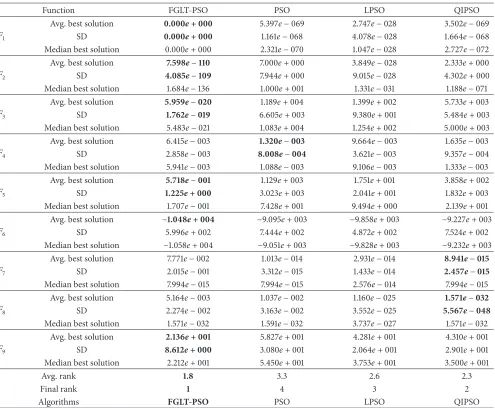
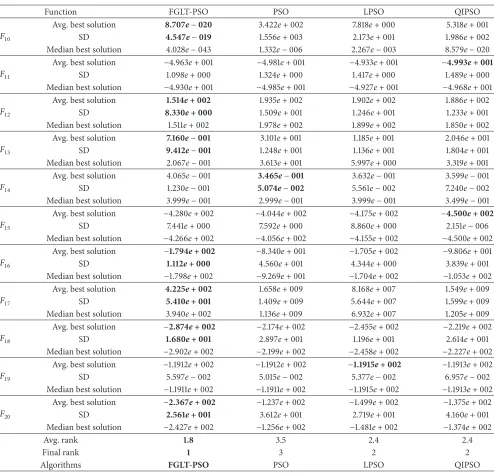
4.2.1. The Results of Proposed Method with Variable Accelera-tion Coefficients. Four algorithms of FGLT-PSO, PSO, LPSO, and QIPSO are randomly initialized and run on benchmark functions. The average best solution, the standard deviation (SD), and the median of the best solution in the last iteration are reported in Tables2, 3,6,7,10, and11. The best results from among the algorithms are shown in bold numbers. In the tables, the algorithms are ranked based on the average best results.
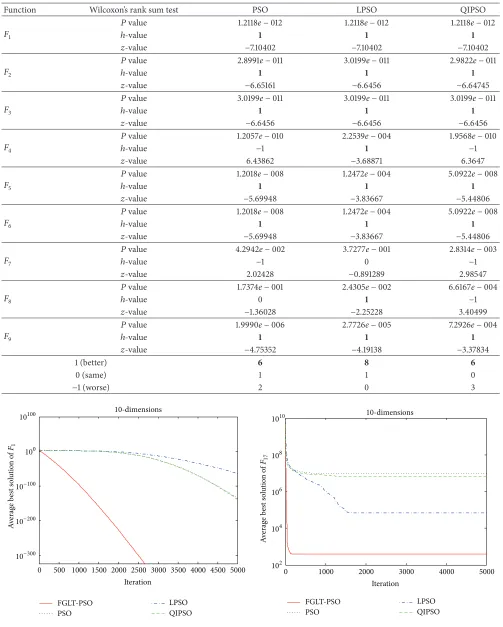
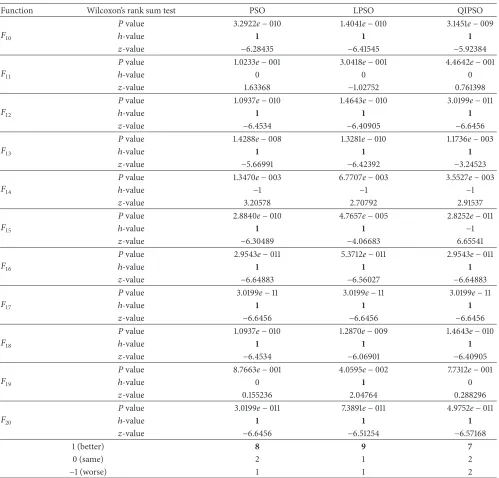
Moreover, Wilcoxon’s rank sum test [37] is conducted in order to determine whether the results obtained by the FGLT-PSO are different from those generated by other algorithms with a statistical significance. The tests are shown in Tables 4, 5, 8, 9, 12, and13, where ℎ-value = 1 indicates the case
in which proposed algorithm significantly outperformed the compared algorithm with 95% certainty, ℎ-value = −1 represents that the compared algorithm is significantly better than the proposed algorithm, andℎ-value = 0 denotes that the results of the two considered algorithms are not significantly different. In these tables, rows 1 (better), 0 (same), and −1 (worse) give the number of functions that the FGLT-PSO performs significantly better than, almost the same as, and significantly worse than the compared algorithm, respectively.
Table 8: Comparison of FGLT-PSO with PSO, LPSO, and QIPSO for the unimodal and multimodal functions using Wilcoxon’s rank sum test (𝑛 = 30).
Function Wilcoxon’s rank sum test PSO LPSO QIPSO
𝐹1 𝑃
value 1.2118e−012 1.2118e−012 1.2118e−012
ℎ-value 1 1 1
𝑧-value −7.10402 −7.10402 −7.10402
𝐹2
𝑃value 2.8991e−011 3.0199e−011 2.9822e−011
ℎ-value 1 1 1
𝑧-value −6.65161 −6.6456 −6.64745
𝐹3 𝑃
value 3.0199e−011 3.0199e−011 3.0199e−011
ℎ-value 1 1 1
𝑧-value −6.6456 −6.6456 −6.6456
𝐹4
𝑃value 1.2057e−010 2.2539e−004 1.9568e−010
ℎ-value −1 1 −1
𝑧-value 6.43862 −3.68871 6.3647
𝐹5
𝑃value 1.2018e−008 1.2472e−004 5.0922e−008
ℎ-value 1 1 1
𝑧-value −5.69948 −3.83667 −5.44806
𝐹6 𝑃
value 1.2018e−008 1.2472e−004 5.0922e−008
ℎ-value 1 1 1
𝑧-value −5.69948 −3.83667 −5.44806
𝐹7
𝑃value 4.2942e−002 3.7277e−001 2.8314e−003
ℎ-value −1 0 −1
𝑧-value 2.02428 −0.891289 2.98547
𝐹8
𝑃value 1.7374e−001 2.4305e−002 6.6167e−004
ℎ-value 0 1 −1
𝑧-value −1.36028 −2.25228 3.40499
𝐹9 𝑃
value 1.9990e−006 2.7726e−005 7.2926e−004
ℎ-value 1 1 1
𝑧-value −4.75352 −4.19138 −3.37834
1 (better) 6 8 6
0 (same) 1 1 0
−1 (worse) 2 0 3
0 500 1000 1500 2000 2500 3000 3500 4000 4500 5000
10-dimensions 10-dimensions
FGLT-PSO PSO
LPSO QIPSO
FGLT-PSO PSO
LPSO QIPSO Iteration
0 1000 2000 3000 4000 5000
Iteration 10−300
10−200
10−100
100
10100
102
104
106
108
1010
A
verag
e b
est s
o
lu
tio
n o
f
F1
A
verag
e b
est s
o
lu
tio
n o
f
F17
Table 9: Comparison of FGLT-PSO with PSO, LPSO, and QIPSO for the rotated and shifted unimodal and multimodal functions using Wilcoxon’s rank sum test (𝑛 = 30).
Function Wilcoxon’s rank sum test PSO LPSO QIPSO
𝐹10 𝑃
value 3.2922e−010 1.4041e−010 3.1451e−009
ℎ-value 1 1 1
𝑧-value −6.28435 −6.41545 −5.92384
𝐹11
𝑃value 1.0233e−001 3.0418e−001 4.4642e−001
ℎ-value 0 0 0
𝑧-value 1.63368 −1.02752 0.761398
𝐹12 𝑃
value 1.0937e−010 1.4643e−010 3.0199e−011
ℎ-value 1 1 1
𝑧-value −6.4534 −6.40905 −6.6456
𝐹13 𝑃
value 1.4288e−008 1.3281e−010 1.1736e−003
ℎ-value 1 1 1
𝑧-value −5.66991 −6.42392 −3.24523
𝐹14
𝑃value 1.3470e−003 6.7707e−003 3.5527e−003
ℎ-value −1 −1 −1
𝑧-value 3.20578 2.70792 2.91537
𝐹15 𝑃
value 2.8840e−010 4.7657e−005 2.8252e−011
ℎ-value 1 1 −1
𝑧-value −6.30489 −4.06683 6.65541
𝐹16 𝑃
value 2.9543e−011 5.3712e−011 2.9543e−011
ℎ-value 1 1 1
𝑧-value −6.64883 −6.56027 −6.64883
𝐹17
𝑃value 3.0199e−11 3.0199e−11 3.0199e−11
ℎ-value 1 1 1
𝑧-value −6.6456 −6.6456 −6.6456
𝐹18 𝑃
value 1.0937e−010 1.2870e−009 1.4643e−010
ℎ-value 1 1 1
𝑧-value −6.4534 −6.06901 −6.40905
𝐹19 𝑃
value 8.7663e−001 4.0595e−002 7.7312e−001
ℎ-value 0 1 0
𝑧-value 0.155236 2.04764 0.288296
𝐹20
𝑃value 3.0199e−011 7.3891e−011 4.9752e−011
ℎ-value 1 1 1
𝑧-value −6.6456 −6.51254 −6.57168
1 (better) 8 9 7
0 (same) 2 1 2
−1 (worse) 1 1 2
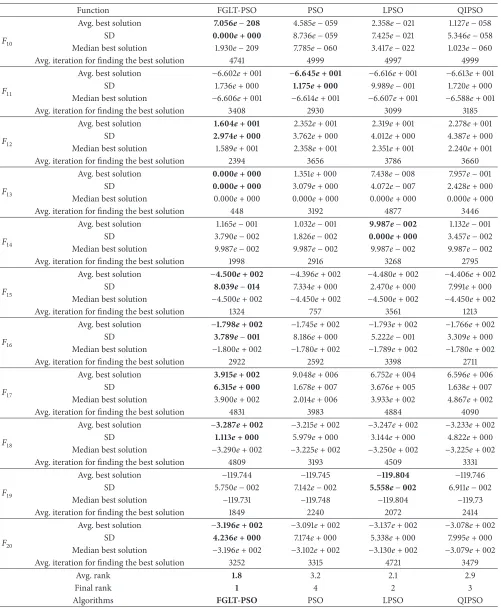
In these tables, the benchmark functions are divided to two categories:(1)unimodal and multimodal functions and (2)rotated, shifted, and shifted-rotated unimodal and multimodal functions. The experimental results demonstrate that FGLT-PSO performs superior results for most of the functions in all tested dimensions.
Tables 2 and 3 show the experimental results for all benchmark functions with dimension𝑛 = 10. As illustrated, the FGLT-PSO algorithm surpasses the PSO, LPSO, and QIPSO algorithms in minimizing functions (1)–(6), (10), (12), (13), (15)–(18), and (20). Moreover, the proposed method provides significant improvements in functions(1), (2), (3), (10), (13), (17), and (18). In these functions, the
Table 10: Minimization results for the unimodal and multimodal functions (maximum iteration = 15000 and𝑛 = 50).
Function FGLT-PSO PSO LPSO QIPSO
𝐹1
Avg. best solution 5.239e−232 7.5857e−049 7.297e−020 2.446e−049
SD 0.000e + 000 2.1243e−048 7.695e−020 8.478e−049
Median best solution 2.541e−251 4.5415e−050 4.843e−020 1.395e−050
𝐹2
Avg. best solution 9.246e−075 3.400e +001 2.194e−015 1.367e +001
SD 3.646e−074 1.714e +001 1.439e−015 1.159e +001
Median best solution 2.684e−080 3.000e +001 1.881e−015 1.000e +001
𝐹3
Avg. best solution 1.098e−008 4.167e +004 2.775e +004 3.585e +004
SD 2.405e−008 1.404e +004 8.532e +003 1.967e +004
Median best solution 5.928e−009 4.002e +004 2.859e +004 3.434e +004
𝐹4
Avg. best solution 5.070e−002 6.015e +000 6.452e−002 2.055e−002 SD 2.802e−002 5.352e +000 1.488e−002 4.363e−003 Median best solution 4.205e−002 5.385e +000 6.409e−002 1.971e−002
𝐹5
Avg. best solution 6.128e + 000 1.568e +003 6.024e +001 4.700e +002
SD 5.716e + 000 3.409e +003 3.032e +001 1.817e +003
Median best solution 5.080e +000 8.179e +001 7.397e +001 7.942e +001
𝐹6
Avg. best solution −1.505e + 004 −1.364e +004 −1.470e +004 −1.339e +004 SD 9.481e +002 9.581e +002 8.491e +002 1.025e +003 Median best solution −1.515e +004 −1.349e +004 −1.445e +004 −1.343e +004
𝐹7
Avg. best solution 1.299e +000 2.049e +000 1.145e−005 1.782e−014 SD 5.560e−001 4.661e +000 6.223e−005 3.695e−015 Median best solution 1.282e +000 2.220e−014 1.782e−009 1.510e−014
𝐹8
Avg. best solution 1.061e−001 1.451e−002 3.831e−012 2.074e−003 SD 1.935e−001 3.535e−002 1.984e−011 1.136e−002 Median best solution 2.081e−005 1.308e−032 2.881e−015 9.423e−033
𝐹9
Avg. best solution 4.759e + 001 1.980e +002 1.872e +002 1.546e +002
SD 2.294e + 001 4.888e +001 3.958e +001 5.192e +001
Median best solution 4.636e +001 1.890e +002 1.850e +002 1.475e +002
Avg. rank 1.7 3.7 2.3 2.3
Final rank 1 3 2 2
Algorithms FGLT-PSO PSO LPSO QIPSO
0 2000 4000 6000 8000 10000
Iteration
30-dimensions 30-dimensions
0 2000 4000 6000 8000 10000
0 50 100
Iteration
FPSO PSO
LPSO QIPSO
FPSO PSO
LPSO QIPSO 10−20
10−15
10−10
10−5
100
105
1010
−100 −50
−150
−200
−250
−300
A
verag
e b
est s
o
lu
tio
n o
f
F3
A
verag
e b
es
t s
o
lu
tio
n o
f
F18
Table 11: Minimization results for the rotated and shifted unimodal and multimodal functions (maximum iteration = 15000 and𝑛 = 50).
Function FGLT-PSO PSO LPSO QIPSO
𝐹10
Avg. best solution 9.936e−031 6.202e +009 5.150e +003 3.989e +006
SD 5.442e−030 2.576e +010 1.153e +004 1.825e +007
Median best solution 1.121e−048 1.763e +005 1.184e +002 5.637e−007
𝐹11
Avg. best solution −4.401e + 001 −4.328e +001 −4.357e +001 −4.385e +001
SD 1.043e + 000 1.331e +000 9.431e−001 1.329e +000
Median best solution −4.391e +001 −4.344e +001 −4.339e +001 −4.367e +001
𝐹12
Avg. best solution 3.155e + 002 4.234e +002 3.995e +002 4.045e +002
SD 1.166e + 001 3.689e +001 1.813e +001 2.468e +001
Median best solution 3.171e +002 4.236e +002 3.995e +002 4.062e +002
𝐹13
Avg. best solution 1.660e + 001 6.640e +001 5.210e +001 4.946e +001
SD 6.875e + 000 2.371e +000 1.517e +001 2.599e +001
Median best solution 1.759e +001 6.697e +001 6.163e +001 6.361e +001
𝐹14
Avg. best solution 7.599e−001 5.899e−001 8.067e−001 6.099e−001 SD 3.103e−001 8.030e−002 9.046e−002 8.847e−002 Median best solution 6.999e−001 5.999e−001 7.999e−001 5.999e−001
𝐹15
Avg. best solution −3.976e +002 −3.795e +002 −4.019e +002 −4.499e + 002 SD 5.964e +000 1.974e +001 6.096e +000 1.849e−003 Median best solution −3.974e +002 −3.815e +002 −4.021e +002 −4.50e +002
𝐹16
Avg. best solution −1.791e + 002 8.313e +001 −1.551e +002 6.894e +001
SD 1.212e + 000 9.121e +001 1.216e +001 7.896e +001
Median best solution −1.797e +002 7.911e +001 −1.565e +002 7.481e +001
𝐹17
Avg. best solution 4.260e + 002 8.648e +009 3.341e +008 8.196e +009
SD 7.188e + 001 4.442e +009 2.597e +008 5.588e +009
Median best solution 3.977e +002 8.332e +009 2.599e +008 6.614e +009
𝐹18
Avg. best solution −1.920e + 002 −4.497e +001 −9.832e +001 −3.612e +001
SD 2.634e + 001 4.206e +001 1.963e +001 4.934e +001
Median best solution −1.944e +002 −4.804e +001 −9.679e +001 −2.665e +001
𝐹19
Avg. best solution −1.189e +002 −1.189e +002 −1.190e + 002 −1.189e +002 SD 4.303e−002 4.364e−002 5.121e−002 5.576e−002 Median best solution −1.189e +002 −1.189e +002 −1.190e +002 −1.189e +002
𝐹20
Avg. best solution −1.016e + 002 1.537e +002 5.974e +001 1.082e +002
SD 4.898e + 001 8.906e +001 5.117e +001 9.020e +001
Median best solution −1.004e +002 1.539e +002 6.594e +001 1.035e +002
Avg. rank 1.5 3.6 2.3 2.7
Final rank 1 4 2 3
Algorithms FGLT-PSO PSO LPSO QIPSO
Figure 2. The results in this figure illustrate that FGLT-PSO tends to find the global optimum in𝐹1and 𝐹17 faster than PSO, LPSO, and QIPSO and obtains the highest accuracy for these functions from among all the algorithms.
The minimization results of the benchmark functions with dimension 𝑛 = 30 are presented in Tables 6 and 7. As seen in these tables and Tables8 and 9, the FGLT-PSO outperforms the FGLT-PSO, LFGLT-PSO, and QIFGLT-PSO algorithms in functions(1),(2),(3),(5),(6),(9),(10),(12),(13),(16),(17), (18), and(20). The largest difference in performance between the proposed algorithm with PSO, LPSO, and QIPSO occurs for the functions(1),(2),(3),(5),(16),(17),(18), and(20). Figure 3illustrates the progress of the average best solution over 30 runs for𝐹3and𝐹18. As demonstrated, the FGLT-PSO shows a higher convergence rate than the other algorithms.
Tables10and11present the results of algorithms for the test functions with dimension𝑛 = 50. As illustrated in these tables and regarding the results of Wilcoxon’s rank sum in Tables12and13, the performance of proposed method is the best in most of the functions especially for functions(1),(2), (3), (5),(6),(9),(10), (11), (12),(13), (16), (17),(18), and (20). The superior convergence rate of FGLT-PSO is shown inFigure 4. The results in this figure show that the FGLT-PSO performs the best for the test functions𝐹16and𝐹20with 𝑛 = 50.
Table 12: Comparison of FGLT-PSO with PSO, LPSO, and QIPSO for the unimodal and multimodal functions using Wilcoxon’s rank sum test (𝑛 = 50).
Function Wilcoxon’s rank sum test PSO LPSO QIPSO
𝐹1
𝑃value 3.0199e−011 3.0199e−011 3.0199e−011
ℎ-value 1 1 1
𝑧-value −6.6456 −6.6456 −6.6456
𝐹2 𝑃
value 2.9673e−011 3.0199e−011 2.9229e−011
ℎ-value 1 1 1
𝑧-value −6.64819 −6.6456 −6.65041
𝐹3
𝑃value 3.0199e−011 3.0199e−011 3.0199e−011
ℎ-value 1 1 1
𝑧-value −6.6456 −6.6456 −6.6456
𝐹4 𝑃
value 2.5306e−004 3.9881e−004 3.1589e−010
ℎ-value 1 1 −1
𝑧-value −3.65915 −3.54087 6.29077
𝐹5 𝑃
value 6.1210e−010 9.7555e−010 1.2870e−009
ℎ-value 1 1 1
𝑧-value −6.18728 −6.11336 −6.06901
𝐹6
𝑃value 2.8790e−006 9.3341e−002 2.5711e−007
ℎ-value 1 0 1
𝑧-value −4.67927 −1.67803 −5.15244
𝐹7 𝑃
value 7.7050e−006 3.0199e−011 1.4811e−011
ℎ-value −1 −1 −1
𝑧-value 4.47322 6.6456 6.74974
𝐹8 𝑃
value 7.7087e−002 8.2796e−003 1.4193e−007
ℎ-value 0 −1 −1
𝑧-value 1.76784 2.64045 5.26273
𝐹9
𝑃value 3.3384e−011 3.3384e−011 4.6159e−010
ℎ-value 1 1 1
𝑧-value −6.63081 −6.63081 −6.23164
1 (better) 7 6 6
0 (same) 1 1 0
−1 (worse) 1 2 3
0 5000 10000 15000
0 100 200 300 400 500
Iteration
50-dimensions 50-dimensions
0 5000 10000 15000
0 200 400 600 800 1000 1200 1400 1600
Iteration −100
−200 −200
FPSO PSO
LPSO QIPSO
FPSO PSO
LPSO QIPSO
A
verag
e b
est s
o
lu
tio
n o
f
F16
A
verag
e b
es
t s
o
lu
tio
n o
f
F20
Table 13: Comparison of FGLT-PSO with PSO, LPSO, and QIPSO for the rotated and shifted unimodal and multimodal functions using Wilcoxon’s rank sum test (𝑛 = 50).
Function Wilcoxon’s rank sum test PSO LPSO QIPSO
𝐹10 𝑃
value 3.0199e−011 3.0199e−011 3.0199e−011
ℎ-value 1 1 1
𝑧-value −6.6456 −6.6456 −6.6456
𝐹11
𝑃value 3.0317e−002 6.5671e−002 6.7350e−001
ℎ-value 1 0 0
𝑧-value −2.16592 −1.84066 −0.421356
𝐹12 𝑃
value 3.0199e−011 3.0199e−011 3.0199e−011
ℎ-value 1 1 1
𝑧-value −6.6456 −6.6456 −6.6456
𝐹13 𝑃
value 3.0199e−011 1.2057e−010 1.8916e−004
ℎ-value 1 1 1
𝑧-value −6.6456 −6.43862 −3.73307
𝐹14
𝑃value 7.3131e−003 3.0749e−002 3.0494e−002
ℎ-value −1 1 −1
𝑧-value 2.68224 −2.16031 2.16361
𝐹15 𝑃
value 2.2256e−004 5.4038e−004 2.7547e−011
ℎ-value 1 −1 −1
𝑧-value −3.69193 3.4599 6.65912
𝐹16 𝑃
value 3.0142e−011 3.0123e−011 3.0142e−011
ℎ-value 1 1 1
𝑧-value −6.64588 −6.64597 −6.64588
𝐹17
𝑃value 3.0199e−011 3.0199e−011 3.0199e−011
ℎ-value 1 1 1
𝑧-value −6.6456 −6.6456 −6.6456
𝐹18 𝑃
value 3.0199e−011 4.0772e−011 3.0199e−011
ℎ-value 1 1 1
𝑧-value −6.6456 −6.60125 −6.6456
𝐹19
𝑃value 2.3399e−001 5.8737e−004 9.2344e−001
ℎ-value 0 −1 0
𝑧-value 1.19015 3.43738 0.0960988
𝐹20
𝑃value 3.3384e−011 1.3289e−010 8.9934e−011
ℎ-value 1 1 1
𝑧-value −6.63081 −6.42383 −6.48297
1 (better) 9 8 7
0 (same) 1 1 2
−1 (worse) 1 2 2
the proposed algorithm, FGLT-PSO, is more powerful and robust than the others for solving unimodal and multimodal functions.
4.2.2. The Results of Proposed Method with Constant Accel-eration Coefficients. In this section, the 𝐶1, 𝐶2, and 𝐶3 as acceleration coefficients are set at constant values to compare with the presented results in theSection 4.2.1. The coefficient of cognition term (𝐶1) and social terms (𝐶2 and 𝐶3) are considered as𝐶1 = 2and𝐶2 = 𝐶3 = 1.Table 14shows the results of proposed method for the benchmark functions with dimensions 10, 30, and 50. As seen, the FGLT-PSO with the constant acceleration coefficients performs well in most of the functions. As the dimension increases, the FGLT-PSO with
the variable acceleration coefficients (Section 4.2.1) shows the better performance than the constant one for functions(1), (2),(3),(5),(17), and(20). Also, the FGLT-PSO with the con-stant acceleration coefficients presents a better performance for functions(7),(13), and(18).
Table 14: The results of FGLT-PSO with constant acceleration coefficients and different dimensions (𝑁 = 50).
Functions Iteration = 5000,𝑛 = 10 Iteration = 10000,𝑛 = 30 Iteration = 15000,𝑛 = 50 Avg. best solution±SD Avg. best solution±SD Avg. best solution±SD 𝐹1 0.000e +000±0.000e +000 1.936e−067±1.060e−066 1.687e−038±5.602e−038 𝐹2 6.678e−160±3.658e−159 4.922e−049±2.305e−048 7.064e−032±3.167e−031
𝐹3 7.520e−035±3.579e−034 2.026e−003±9.321e−003 2.062e +000±2.616e +000 𝐹4 1.621e−004±8.583e−005 9.078e−004±3.306e−004 1.930e−003±6.461e−004
𝐹5 3.086e +000±1.772e +000 3.542e +001±2.864e +001 7.854e +001±4.435e +001 𝐹6 −3.957e +003±1.375e +002 −1.052e +004±4.069e +002 −1.643e +004±7.233e +002
𝐹7 4.086e−015±1.084e−015 5.507e−015±1.656e−015 9.484e−002±3.612e−001 F8 4.712e−032±1.670e−047 4.492e−002±1.379e−001 7.063e−002±1.508e−001
F9 2.567e +000±9.714e−001 2.040e +001±6.100e +000 5.183e +001±1.117e +001
F10 6.599e−249±0.000e +000 3.539e−066±1.939e−065 4.923e−019±2.696e−018 F11 −6.620e +001±1.111e +000 −5.036e +001±9.041e−001 −4.482e +001±9.061e−001
F12 1.659e +001±4.479e +000 1.602e +002±1.096e +001 3.369e +002±1.585e +001 F13 0.000e +000±0.000e +000 0.000e +000±0.000e +000 1.5294e−007±1.1896e−007
F14 9.987e−002±2.247e−017 3.932e−001±1.081e−001 3.065e−001±2.537e−002 F15 −4.500e +002±1.493e−014 −4.268e +002±1.016e +001 −4.420e +002±3.137e +000
F16 −1.799e +002±2.005e−001 −1.787e +002±3.851e +000 −1.775e +002±3.055e +000 F17 4.001e +002±2.060e +001 4.661e +002±1.083e +002 5.748e +005±1.022e +006
F18 −3.283e +002±8.796e−001 −2.956e +002±8.540e +000 −2.396e +002±1.763e +001 F19 −1.1974e +002±5.990e−002 −1.191e +002±6.798e−002 −1.189e +002±3.710e−002
F20 −3.196e +002±4.136e +000 −1.994e +002±2.829e +001 −2.684e +001±4.506e +001
Table 15: Some well-known PSO algorithms in the literature.
Algorithm Topology Parameter settings
PSO Global star 𝜔: 0.9–0.4,𝐶1= 𝐶2= 2.0
QIPSO Global star 𝜔: 0.9–0.4,𝐶1= 𝐶2= 2.0
FIPS Local U-ring 𝜒=0.729,∑ 𝑐𝑖=4.1
DMS-PSO Dynamic multiswarm 𝜔: 0.9–0.2,𝐶1= 𝐶2= 2.0, 𝑚 = 3, 𝑅 = 5
CLPSO Comprehensive learning 𝜔: 0.9–0.4,𝐶 = 1.49445, 𝑚 = 7
AFPSO Global star 𝜔: 0.9–0.4,C1, C2are based on fuzzy rule [19]
AFPSO-QI Global star 𝜔: 0.9–0.4,C1, C2are based on fuzzy rule [19]
FGLT-PSO Global star and local ring 𝜔: 0.9–0.4,C1: 0.5–2,C2: 1-2,C3: 0.5–1.5
solutions and the SD of results for eight common multimodal benchmark functions are compared with the reported results by [19] as illustrated inTable 16. The maximum iteration is 10000,𝑛 = 30, and𝑁 = 30. As seen, the FGLT-PSO provides better results than the other algorithms for the majority of functions (functions(11),(12),(13),(14),(17), and(20)) and has the first rank.
5. Conclusions
In this study, a fusion global-local-topology PSO algorithm (FGLT-PSO) has been presented to extend the search capa-bility and to improve convergent efficiency by combining local and global topologies. The algorithm is a global search algorithm with several advantages. The benefits of algorithm can be summarized as the following: FGLT-PSO has a simple
concept and structure; it is easy to implement and is not sensitive to increase of the dimension.
A set of standard benchmarks, including unimodal, multimodal, rotated, shifted, and shifted-rotated unimodal and multimodal functions, have been used to evaluate the proposed algorithm. The average best results obtained by the FGLT-PSO have been compared with PSO, LPSO, QIPSO, FIPS, DMS-PSO, CLPSO, AFPSO, and AFPSO-QI. The experimental results show that the proposed FGLT-PSO algorithm enhances the accuracy of results compared with the other algorithms.