MANAGING SOFTWARE EVOLUTION THROUGH MIDLEWARE AND POLICY-BASED SOFTWARE ADAPTATION FRAMEWORK
NOR HAZILAWATI AWANG
A thesis submitted in fulfilment of the requirements for the award of the degree of
Doctor of Philosophy (Computer Science)
Faculty of Computing Universiti Teknologi Malaysia
DEDICATION
Dedicated to a great family that I have.
“I sustain myself with the love of family.”
ACKNOWLEDGEMENT
This challenging journey of completing my thesis would not become a reality without the help from numerous kind people around me. It is a great pleasure for me to thank these people. I would like to express my utmost gratitude to my main supervisor, Prof. Dr. Shamsul Shahibuddin for his trust in me and his vital support. I am forever indebted to Assoc. Prof. Dr. Wan Mohd Nasir Wan Kadir, my co-supervisor for his guidance, patience, and abundance of support throughout this research. Without his constant encouragement, the path would be extremely hard for me.
I would like to thank the management of HeiTech Padu Berhad for fully sponsoring my research. My special thanks go to En. Ahmad Abdul Ghani, CEO of HeiTech Academy for all his assistance, support and “just enough” pressure to keep me going. My sincere appreciation goes to Padusoft team, especially to the ex-Chief Operating Officer, En. Khairol Amin Mohd. Salleh for providing all supports I needed, from providing technical advice to allowing me to test the framework using the systems they developed.
ABSTRACT
ABSTRAK
Evolusi perisian adalah satu proses yang perlu kerana perisian berevolusi untuk kekal berguna. Proses ini perlu dirancang dan dikawal untuk mengelakkan kesan negatif kepada organisasi. Salah satu cara bagi mengawal kesan negatif ini ialah melalui adaptasi perisian. Kebanyakan kajian tentang adaptasi perisian tertumpu kepada bidang aplikasi mudah alih dan rangkaian kerana keperluan konteks kepekaan dan kualiti perkhidmatan. Walau bagaimanapun, masih terdapat kekurangan kajian di dalam bidang sistem perusahaan yang mempunyai pelbagai saluran penyampaian dan memfokuskan tentang adaptasi bagi pertukaran yang berlaku pada peranti. Tujuan tesis ini ialah membina satu rangka kerja adaptasi yang berteraskan konsep
middleware dan polisi bagi mengawal kesan negatif evolusi perisian di dalam sistem
TABLE OF CONTENTS
CHAPTER TITLE PAGE
DECLARATION ii
DEDICATION iii
ACKNOWLEDGEMENT iv
ABSTRACT v
ABSTRAK vi
TABLE OF CONTENTS vii
LIST OF TABLES xiii
LIST OF FIGURES xiv
LIST OF ABBREVIATIONS xvi
LIST OF APPENDICES xvii
1 INTRODUCTION 1
1.1 Introduction 1
1.2 Background of the Problem
1.2.1 Issues related to software evolution 1.2.2 The needs for adaptive software 1.2.3 Software Evolution and Software
Maintenance 1.3 Statement of the Problem 1.4 Objectives of the Study 1.5 Scope of the Study 1.6 Significance of the Study 1.7 Thesis Organization
2 4 5
2 LITERATURE REVIEW 13
2.1 Software Evolution
2.1.1 Approaches in Minimizing the Effect of Software Evolution 2.1.2 Why Software Adaptation
Approach 2.2 Software Adaptation
2.3 Relationship between Software Evolution and Software Adaptation 2.4 Adaptation Management
2.4.1 Close-Loop Control System 2.4.2 IBM Autonomic Computing 2.4.3 Policy Based
2.5 Related Software Adaptation Approaches 2.5.1 Agent-oriented
2.5.2 Architecture-based 2.5.3 Component-based 2.5.4 Middleware-based 2.6 Comparing the Approaches 2.7 Summary
13 15 17 20 21 23 23 24 26 27 27 29 31 32 36 37
3 COMPARATIVE EVALUATION OF
APPROACHES IN DEVELOPING ADAPTIVE
SOFTWARE 38
3.1 Evaluation Criteria 3.1.1 Scalability
3.1.2 Context-awareness 3.1.3 Performance 3.1.4 Applicability 3.1.5 Heterogeneity
3.1.6 Dynamic Evolvability 3.2 Result of the Comparative Evaluation
3.2.1 Scalability
3.2.2 Context-awareness
3.2.3 Performance 3.2.4 Applicability 3.2.5 Heterogeneity
3.2.6 Dynamic Evolvability 3.2.7 Summary of Result
3.3 Pros and Cons of the Current Middleware-based Approach
3.4 Summary
43 44 45 46 46 47 48
4 RESEARCH METHODOLOGY 49
4.1 Research Design and Procedure 4.2 Operational Framework
4.3 Instrumentation
4.4 Assumptions and Limitations 4.5 Methods for Evaluation 4.6 Case Study
4.6.1 Evaluation Steps 4.6.2 Evaluation Setting
4.6.3 Relationship between MiPAF and UTS System
4.6.4 Objects of the Case Study 4.7 Summary
49 51 53 53 54 55 55 57 58 59 62
5 THE MiPAF APPROACH 63
5.1 The Rationale behind MiPAF 5.2 Overview of MiPAF
5.2.1 Key approaches used in the Development of MiPAF
5.2.2 Unit Trust System Example 5.2.3 MiPAF Building Blocks
5.2.4 MiPAF Collaboration Diagram and the process of adaptation
5.2.5 MiPAF Policy Language 5.3 Summary
6 MiPAF DETAIL DESCRIPTION,
FORMALIZATION, PROCESSES AND
POLICY LANGUAGE
6.1 MiPAF Detail Description 6.1.1 Service Manager 6.1.2 Adaptation Manager 6.1.3 Service Infrastructure 6.1.4 Policy Repository 6.1.5 Device Controller 6.1.6 Context Monitor
6.2 Related processes in using MiPAF
6.3 Introduction to Software Process Engineering Metamodel
6.3.1 Conceptual Model of SPEM 6.4 The MiPAF Process
6.4.1 Requirement Phase 6.4.2 Analysis Phase 6.4.3 Design Phase 6.4.4 Development Phase 6.5 Policy Language
6.6 MiPAF Policy Language
6.6.1 MPL Ontology and Description 6.7 Summary
87 88 89 96 104 105 108 111 114 115 116 117 117 118 119 119 120 120 121 125
7 USING MiPAF IN INDUSTRIAL-BASED
CASE STUDIES AND EVALUATION 127
7.1 Overview of MiPAF Runtime
7.2 Adaptation Requirements of UTS Front-end and Web-based UTS
7.3 Analysis of existing UTS Front-end printing components
7.4 Changes required to be done to UTS Front-end System
7.5 Design of the adaptation policy for UTS
127
128
130
Front-end using MiPAF Policy Language 7.5.1 Policy Editor
7.5.2 Implementation of Service Manager 7.5.3 Communication between UTS
front-end and Service Manager
7.6 Implementation of the Adaptation Manager 7.6.1 Pseudo code for Adaptation Manager 7.6.2 Sample Codes for Storing Data in the
Shared Memory 7.6.3 Expat XML Parser
7.7 Implementation of the Policy Repository 7.8 Implementation of the Device Controller 7.9 Implementation of the Context Monitor 7.10 Implementation of the Service Infrastructure 7.11 Test Scenario for Adaptability of the
Industrial-Based Case Study 7.12 Analysis of the result
7.12.1 Scalability
7.12.2 Context Awareness 7.12.3 Performance 7.12.4 Applicability 7.12.5 Heterogeneity
7.12.6 Dynamic Evolvability 7.13 Summary
132 136 136 137 139 139 142 143 145 145 146 151 152 154 154 155 155 156 157 157 157
8 CONCLUSION AND FUTURE WORKS 158
8.1 Summary of the Research
8.2 Summary of Research Contributions 8.3 Future Works
LIST OF TABLES
TABLE NO. TITLE PAGE
2.1 Criteria for comparison of selected approaches 37 3.1 Summary of result on the comparison analysis of the
selected approaches to software adaptation 46
LIST OF FIGURES
FIGURE NO. TITLE PAGE
1.1 High-Level View of Enterprise System Architecture 3 2.1 High Level Process in a Comprehensive, General Purpose
Approach to Adaptive Software System
22
2.2 Basic Close Loop Control System 23
2.3 Functional Details of an Autonomic Manager 25
2.4 Format of SOAP Messages 35
2.5 Web Service Model 35
4.1 Research Flowchart 51
4.2 Evaluation Steps 56
4.3 Evaluation Settings 57
4.4 MiPAF Context Diagram for Case Study Implementation 59
5.1 MiPAF Context Diagram 67
5.2 High-Level Architecture of UTS 72
5.3 MiPAF Class Diagram 76
5.4 Changes Notification 81
5.5 MiPAF Collaboration Diagram 83
6.1 Communication Channels between Service Manager and Business Application
90
6.2 High-Level Component of Service Manager 91
6.3 Flow of Listener Component for Socket-based
Communication 92
6.4 Flow of Information to and from Adaptation Manager 96
6.5 Components of Adaptation Manager 97
6.6 Basic Flow of Information to Adaptation Manager 98
6.8 High Level Component of Service Infrastructure 104
6.9 The Flow of Register Policy 106
6.10 High Level Components of Device Controller 109 6.11 Relationship between Context Monitor and Other MiPAF
Components
112
6.12 SPEM Conceptual Model 116
6.13 Requirement Phase 118
6.14 Analysis Phase 118
6.15 Design Phase 119
6.16 Development Phase 119
6.17 MiPAF Policy Language Ontology 122
6.18 Sample of Default Policy 124
6.19 Sample of Reactive Policy 125
7.1 MiPAF Policy Language Editor 136
7.2 Sample Data Sent to the Service Manager 138
7.3 Code Snippet for Listener Implementation in C Language 139 7.4 Code Snippet for Storing Data into Named Shared
Memory
142
7.5 Expat XML Parser Flow 143
7.6 Code Snippet for using Expat XML Parser to Parse XML Buffer
144
LIST OF ABBREVIATIONS
ADL – Architecture Definition Language
AOM – Aspect-Oriented Modeling
AOP – Aspect-Oriented Programming
COM – Component Object Model
CORBA – Common Object Request Broker Architecture
CRM – Customer Relationship Management
DCOM – Dynamic Component Object Model
EJB – Enterprise Java Bean
ERP – Enterprises Resource Planning EBNF – Extended Backus-Naur Notation HTTP – Hyper-Text Transfer Protocol IBM – International Business Machine
IPC – Inter-Process Communication
JADE – Java Agent Development Framework
MOP – Meta-Object Protocol
MAPE – Monitor, Analyze, Plan, Execute
MiPAF – Middleware and Policy-based Adaptation Framework
MPL – MiPAF Policy Language
OCL – Object Constraint Language
OOP – Object Oriented Programming RFID – Radio Frequency Identification SOA – Service Oriented Architecture SOAP – Simple Object Access Protocol
SPEM – Software Process Engineering Metamodel
LIST OF APPENDICES
APPENDIX TITLE PAGE
A Initial Questionnaires to Validate Research Background 173
B Rubric for the Evaluation Criteria 176
C Data Type Specification for MiPAF 178
D EBNF Specification for MiPAF Policy Language 182
E Details on UTS Case Study 187
F Questionnaires on MPL Editor Usability 190
CHAPTER 1
INTRODUCTION
This chapter consists of the introduction to this research. A brief introduction on software evolution is presented. Subsequently, background of the problem is described. Next, problem statements, objective; scope and significance of the research are discussed.
1.1 Introduction
The issue of software evolution has its root back in the 1970s based on the work done by Lehman and Belady [1]. In essence, software evolution refers to required changes in software due to changes in operating environment and/or user requirements. With the advancement of technology and dynamic business environment, changes mentioned above become more complex and difficult to manage.
Software evolution phenomenon has the potential to present huge problems to software projects as it affects all phases of software process. For long term survival, software evolution is inevitable [2]. Due to this, effective approach to software evolution has fired much interest in research community as organizations have a growing dependency on software [3].
adaptive software. Changes in user requirements, the need for faster delivery of
software, addition of features or bugs removal, are some of the factors driving the needs for software adaptation [4]. These needs are further emphasized currently due to the heterogeneity and complexity of computing environment; such as pervasive environment, varieties in software delivery channels and different type of networks and operating platforms.
Managing software evolution via software adaptation has been the subject of many researches such as in [4-9]. Software evolution and software adaptation are connected processes. Inter-connectedness between evolution management and adaptation management is described extensively in [10].
1.2 Background of the Problem
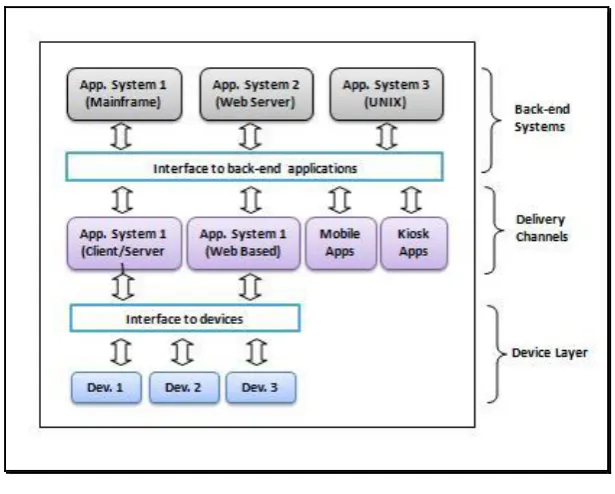
Figure 1.2 High Level View of Enterprise System Architecture In a typical environment of an enterprise system, 3 main levels exist, Device
layer, Delivery Channels layer, and Back-end Systems layer. This architecture is
observed to exist in large organizations in Malaysia such as financial institutions and public services. The observation is backed-up by a guided interview conducted with IT personnel of specific organizations and IT personnel from System Integrator (SI) Company. Please refer to Appendix A for the questionnaire used for the guided interview and analysis of the result. The description of each layer is as follows:-
Device Layer
Enterprise applications, especially counter-based systems use variety of devices such as printer, biometric reader, scanner and barcode reader. These devices are logically group in Device Layer and are used by application systems at Delivery Channels.
Delivery Channels Layer
applications that adopt client/server architecture, web-based application (thin client), mobile application and application deployed on kiosks.
Back-end Systems Layer
The Back-end System level consists of various enterprise systems that need to interact with the delivery channels. The systems may include core systems of the organization such as Banking System, Enterprise Resource Planning (ERP) system, and Customer Relationship Management (CRM) system.
1.2.1 Issues related to software evolution
Enterprise systems will evolve [12-14] due to changes in user requirements or operating environment. Unplanned evolution of an enterprise system will incur high cost and risk [15]. In some organizations, the Delivery Channel Layer of an enterprise system evolves over time, but some of the devices evolve at a slower rate. For instance, although the application system at the Delivery Channel Layer is changed, the related devices are not. However, the new application system is expected to work with these legacy devices. Problems arise when the new system fail to support legacy devices due to lack of supported interfaces provided by the Application Programming Interface (API) of the devices.
Another possible problem that is foreseeable is when the Device Layer evolves. The evolution will happen when a new device is added to the Device Layer. Addition of a new device can happen in two scenarios. The first scenario is the replacement of existing devices with new devices from different vendors. Devices from different vendors come with different set of API. Therefore, applications at the Delivery Channel layer must adapt accordingly in order to use the devices.
difficult and costly [16]. When any of these scenarios happen, application systems that use the device must adapt to this changes with minimal impact to its operation at lowest cost and minimum risk.
Changes in user requirements such as the need to reduce cost by sharing devices, can also lead to system evolution [13]. Less problems will be faced if the device sharing is supported by the operating system. However, for some proprietary devices, the sharing mechanism is not supported by the operating system. Examples of such devices are IBM4722 and IBM9068 passbook printers. Application systems that were designed to use device exclusively must be changed in order to adapt to this type of requirement. The problem becomes more profound if the same device needs to be shared by different applications. Worst, if the need to share the device only arises after these systems have been implemented. Changes introduced to any system at a later lifecycle are costly [17].
Application systems evolve due to technology advancement and changes in business requirements [12, 14]. As a result of the evolution, different type of client architecture existed such as thick-client, thin-client and smart-client. These client architectures require different ways of device integration. Problems will be further exacerbated when applications adopting different type of client-architecture need to share the same devices.
As the ecosystem of an enterprise system evolves over the time, the back-end systems become heterogeneous in-terms of operating platforms. These back-end systems may interact with other systems using different communication protocols such as SNA protocols, TCP/IP or SOAP. However, the evolution problems at the back-end system level are not within the scope of this research.
1.2.2 The needs for adaptive software
support both upward scalability and downward scalability. This is due to different requirements of the application systems at delivery channels level.
The adaptive software is required due to heterogeneity of devices used by enterprise systems. The software need to adapt with the changes of devices, able to detect when a device fails and perform necessary reconfiguration. Furthermore, the adaptability of software in enterprise system must not be restricted in terms of its client architecture.
In an environment where the enterprise systems provide services to the public, performance of the system is critical. Device failure can affect performance of service delivery and in the end, may affect customer satisfaction. The enterprise system should be able to detect failed devices and adapt necessarily such as enabling users to use other devices in the network without halting the operations. The adaptive enterprise system must have an acceptable performance, based on user requirement. Apart from that, an adaptive enterprise system should not be too cumbersome to develop.
1.2.3 Software Evolution and Software Maintenance
The term software evolution and software maintenance are used interchangeably in a number of publications. Both terms revolve around changes subjected to software. However, according to Priyadarshiv and Kshivasagar [18], there are differences between software evolution and software maintenance. They argued that software maintenance comprises bug fixing activities to rectify defects in order to ensure the software meet its development purpose. The bug fixing activities happen after implementation phase and the functionalities of the software remain unchanged.
In this research, we treat software maintenance as a subset of software evolution.
1.3 Statement of the Problem
The aim of this research is to provide an adaptation framework to manage software evolution based on compositional and parameterized adaptation approach in the domain of enterprise system. The framework will increase the adaptability of an enterprise system in the changing operating environment and user requirements. The problem statement brings about the main research problem that is:-
“How to manage software evolution by creating an adaptation framework
using appropriate technique in compositional and parameterized adaptation
approach?”
To answer the main research problem, a set of related questions must be addressed. The questions are as follows:-
1. What are compositional approach and parameterized approach and why these two approaches are selected?
a. What are the state-of-the art for both approach?
b. What are usage suitability of both approach – when, where to use?
c. What are advantages and disadvantages of both approaches?
a. What are the main problems need to be addressed in an enterprise systems related to changes in operating environment and user requirements?
3. What are opportunities for improvement in both approaches that can be translated into the framework to manage software evolution?
4. How to make the framework easy to be used by software developers?
5. How to validate the framework to ensure its success in meeting the defined adaptability criteria?
1.4 Objectives of the Study
This research has the following objectives:-
To investigate major techniques with respect to adaptation approaches in order to manage software evolution
To develop a new adaptation framework in managing software evolution using compositional and parameterized adaptation approach.
To demonstrate the applicability of the proposed approach using an industrial-based case study and the development of its supported tool.
1.5 Scope of the Study
Software evolution
The focus of this research is to manage software evolution. The term
evolution in software context refers to changes that happen to software
during its lifetime [19]. This research will adopt the above definition of software evolution. To prevent a system from becoming unreliable, software evolution must be managed in software development process [15]. More explanation on software evolution can be found in Section 2.1.
Software adaptation
Software adaptation is a popular research area of late. There are many existing approaches to software adaptation. Researchers are looking at software adaptation from many angles such as from software architecture point of view [20, 21], component-based software development [22] and agent-oriented software engineering [23, 24].
Two promising approaches to software adaptation are middleware and policy based approach. Middleware is said to be an important building block that impede software development [25]. Adaptive middleware on-the-other hand, allows modification to application systems when there are changes in user or operating environment [26]. Middleware can be designed to allow for separation between adaptive behavior and non-adaptive behavior in an enterprise system. This research has the interest to adopt middleware approach in developing the proposed framework. Sub-section 2.5.4 present a discussion on the topic of middleware
is important since it promotes low coupling between the two, hence changes in can be implemented in a controlled manner.
Case Study
Lehman in his work in Laws of Software Evolution coined the term E-type software [27]. E-E-type software can be defined as software that addresses real world problem. Therefore, the enterprise system described in the problem background is an instance of E-type software and thus, the system is subjected to software evolution.
Based on the researcher experience in developing and integrating enterprise systems, the proposed approach will be demonstrated using an industrial-based, E-type, case studies that is a Unit Trust System that has been implemented throughout Malaysia. The reason for selecting this system is that its Device Layer is always subjected to changes and there exist two type of front-end architecture or the system i.e. client-server based and web based.
1.6 Significance of the Study
There are other efforts towards software adaptation ranging from research specific for mobile devices [28, 29], multimedia systems [30], and network adaptability [29] to generic domain [31, 32]. However, there is lack of specific research that focuses on adaptability of an enterprise system. As technology evolves, more delivery channels and more new devices are introduced in an enterprise system. Enterprise systems must adapt to this changes to deliver required services. As the enterprise grows, more systems are added to the whole ecosystem. Existing application systems need to communicate with the new added systems at the lowest cost and lowest risk.
This study will contribute in providing an adaptation framework to overcome the above challenges faced by enterprise systems by enabling the systems to be more adaptive to the changing environments. The framework, Middleware and Policy-based Framework to Manage Software Evolution (MiPAF) is developed to enable software evolution to be planned and managed so that, the life of enterprise software can be increased and the maintenance cost can be reduced.
1.7 Thesis Organization
This thesis has the aim to develop an adaptation framework to manage software evolution. The chapters are organized as follows:-
Chapter 1: This chapter describes the background of the problem. Issues related to software evolution and the needs for software adaptation are also discussed. Problem statement, objective of the study and significance of the study are described.
Chapter 3: This chapter further describes the evaluation criteria introduced in
Chapter 2. Comparative evaluation of the four approaches are presented based on the chosen criteria. Critical discussion is included in this chapter in order to evaluate which approach is best suited to be used in the development of MiPAF. Result of the evaluation is presented at the end of this chapter.
Chapter 4: This chapter describes research procedure, operational framework
and instrumentation used to deliver the thesis objectives. Research assumptions and limitations and methods for evaluation are also described. This chapter also details up the case study to be used and approach for MiPAF evaluation using the said case study.
Chapter 5: This chapter starts with the rationale behind MiPAF and it proceeds with the overview of MiPAF. Key approaches used in MiPAF development is described. Next, MiPAF building block and collaration digram are discussed. The chapter also describes MiPAF Policy Language.
Chapter 6: This chapter describes in detail about MiPAF. Each component is
presented formally using Z Notation. Next, the sub-sections in this chapter describe processes used to govern the application of MiPAF in order to manage software evolution. This chapter also includes description of MiPAF Policy Language (MPL) and ontology of MPL is also presented.
Chapter 7: This chapter discusses on the implementation of MiPAF using industrial-based case study. It focuses on adaptation requirements of the case studies, the design of adaptation policy and implementation of MiPAF runtime in order to test the adaptation behaviour of the case study. Towards the end of the chapter, case study result is analysed based on the evaluation criteria mentioned in Chapter 2.
Chapter 8: This chapter concludes the research. It provides research summary
REFERENCES
1. Jayazeri, M. Species evolve, individuals age. Eighth International Workshop
on Principles of Software Evolution. :IEEE. 2005.3-9.
2. Mens, T. and S. Demeyer, eds. Software Evolution. Berlin: Springer-Verlag Berlin Heidelberg, 2008.
3. Lehman, M.M. and J.F. Ramil. An Approach to a Theory of Software Evolution. in Proceedings of the 4th International Workshop on Principles of
Software Evolution. 2001. New York:.ACM. 2001, 70-74.
4. Nary, S. and C. Lawrence. Software architecture adaptability: an NFR approach. in Proceedings of the 4th International Workshop on Principles of
Software Evolution. 2001. New York: ACM.2001. 52-61.
5. Cazzola, P.D.W., A.M.A. Ghoneim, and P.D.G. Saake, eds. Software Evolution through Dynamic Adaptation of Its OO Design. in Lecture Notes in Computer
Science. Vol. 2975/2004.Berlin: Springer Berlin/Heidelberg. 2004.67-80.
6. Ghoneim, A.M.A., Reflective and Adaptive Middleware for Software Evolution of Information Systems. in Fakultät für Informatik 2007. Germany: Otto-von-Guericke-Universität Magdeburg. 2007. 154.
7. Oreizy, P., N. Medvidovic, and R.N. Taylor. Architecture-Based Runtime Software Evolution. in Proceedings of the 1998 (20th) International
Conference on Software Engineering. 1998. Kyoto: IEEE Computer
Society.1998.177-186.
8. Perez, J., et al. Dynamic Evolution in Aspect-Oriented Architectural Models. in
Lecture Notes in Computer Science. 2005. Berlin: Springer Berlin/Heidelberg.
2005.59-76.
Conference forYoung Computer Scientists.November 18-21. :IEEE.2008.1145-1149.
10. Oreizy, P., Medvidovic, N., Taylor, R.N., Gorlick, M.M., Heimbigner, D., Johnson, G., Quilici, A., Rosenblum, D.S., Wolf, A.L. An Architecture Based Approach to Self-Adaptive Software. IEEE Intelligent System.1999.14(3):54 - 62.
11. Iacob, M.-E. and H. Jonkers. Quantitaive Analysis of Enterprise Architectures.
in Interoperability of Enterprise Software and Applications. :Springer London.
239-252;2006.
12. Godfrey, M.W. and D.M. German. The past, present, and future of software evolution. in Frontiers of Software Maintenance. 2008. FoSM 2008. Sept 28 - Oct 4, 2008. :IEEE. 2008. 129-138.
13. Hu, H. Software Evolution Based on Software Architecture. in The Fourth
International on Computer and Information Technology, 2004. CIT '04. :IEEE.
2004. 1092-1097.
14. Roland, T.M., Software evolution: let's sharpen the terminology before sharpening (out-of-scope) tools. in Proceedings of the 4th International
Workshop on Principles of Software Evolution. 2001. :ACM. 2001. 114-121.
15. Subramanyam, R. Position Statement: How Well Technology Supports Software Evolution. in COMPSAC '08 Proceedings of the 32nd Annual IEEE
International Computer Software and Application Conference. 2008.
Washington: IEEE Computer Society. 2008. 3
16. de Deugd, S., et al. SODA: Service Oriented Device Architecture. Pervasive
Computng, :IEEE, 2006. 5(3): 94-96.
17. Stephens, M. and D. Rosenberg. Extreme Programming Refactored: The Case
Against XP. :Apress. 3;2003.
18. Priyadarshi Tripathy, K.N. Software Evolution and Maintenance. Hoboken, New Jersey: John Wiley & Sons. 416; 2014.
19. Reiss, S.P. Evolving Evolution [software evolution]. in Eighth International
Workshop on Principles of Software Evolution. September 5-6, 2005. :IEEE.
2005. 136-139.
20. Fayad, M.E., H.S. Hamza, and H.A. Sanchez. Towards scalable and adaptable software architectures. in IEEE International Conference on Information Reuse
21. Xiong, X. and Z. Weishi. A Framework of Software Component Adaptation. in
Algorithms and Architectures for Parallel Processing. 2007, Berlin: Springer
Berlin/Heidelberg. 2007. 153-164.
22. Holger, K., N. Dirk, and R. Andreas, A component model for dynamic adaptive systems. in International workshop on Engineering of software services for pervasive environments: in conjunction with the 6th ESEC/FSE joint meeting.
2007, Dubrovnik, Croatia :ACM. 2007. 21-28.
23. Qureshi, N.A. and A. Perini. An Agent-Based Middleware for Adaptive Systems.in The Eighth International Conference on Quality Software. 2008. 24. Seungwok, H., S. Sung Keun, and Y. Hee Yong. Dynamic Software Adaptation
with Dependence Analysis for Multi-Agent Platform. in International
Conference on Computational Science and its Applications. 2007. :IEEE
Computer Society. 2007. 185-191.
25. Newcomer, E. and G. Lomow. Understanding SOA with Web Services. : Pearson Education, 2005.
26. Sadjadi, S.M. A Survey of Adaptive Middleware. Technical Report, Computer
Science and Engineering. : Michigan State University. 2003.
27. Lehman, M.M. Laws of Software Evolution Revisited. in Proceedings of the
5th European Workshop on Software Process Technology. : Springer-Verlag.
1996. 108-124.
28. Maciel da Costa, C., M. da Silva Strzykalski, and G. Bernard. An Aspect Oriented Middleware Architecture for Adaptive Mobile Computing Applications. in 31st Annual International. Computer Software and
Applications Conference. COMPSAC 2007. July 24-27, 2007. : IEEE. 2007.
81-86.
29. Mukhija, A. and M. Glinz. A framework for dynamically adaptive applications in a self-organized mobile network environment. in Proceedings of 24th
International Conference on Distributed Computing Systems Workshops. March
23-14, 2004. : IEEE. 2004. 368-374.
30. Vu Hoang, H. and H. Hoang Dang. An Application-aware Adaptive Middleware Architecture for Distributed Multimedia Systems. in First
International Conference on Communications and Electronics. ICCE '06. Oct
31. Curry, E. Adaptive and Reflective Middleware (Middleware for
Communications). 2004: 29-52.
32. Gjorven, E., et al. Self-Adaptive Systems: A Middleware Managed Approach.
in Lecture Notes in Computer Science. 2006. 3996: 15-27.
33. Dictionary, M.-W.s.O. Merriam-Webster's Online Dictionary 2009 [cited 2009 29 January]; Available from:
http://www.merriam-webster.com/dictionary/evolution.
34. Yang, H. and M. Ward. Successful Evolution of Software Systems: Artech House. 2002.
35. Canfora, G. Software Evolution in the Era of Software Services. in Proceedings
of 7th International Workshop on Principles of.Software Evolution. : IEEE.
2004.
36. Bennet. K.H. , Rajlich, V.T. Software Evolution: A Roadmap. in Proceedings of the Conference on IEEE International Conference on the Future of Software
Engineering. 2000. Limerick, Ireland: ACM. 2000. 73-87.
37. Qianxiang, W., et al. A component-based approach to online software evolution: Research Articles.J. Softw. Maint. Evol., 2006. 18(3): 181-205. 38. Michele Ceccarelli, L.C., Gerardo Canfora, Massimiliano Di Penta. An Eclectic
Approach for Change Impact Analysis. in 2010 ACM/IEEE 32nd International
Conference on Software Engineering. 2010. Cape Town : IEEE. 2010.
163-166.
39. Vora, U. Change Impact Analysis and Software Evolution Specification for Continually Evolving Systems. in 2010 Fifth International Conference on
Software Engineering Advances. 2010. Nice, France : IEEE. 2010. 238-243.
40. Mens, T., et al. Challenges in Software Evolution. in Eighth International
Workshop on Principles of Software Evolution. September 5-6, 2005. : IEEE.
2005. 13-22.
41. Madhavji, N.H., J.F. Ramil, and D.E. Perry. Editors. Software Evolution and
Feedback: Theory and Practice. 2006 : John wiley and Sons. 2006.
42. Ciraci, S., P. van den Broek, and M. Aksit. A Taxonomy for a Constructive Approach to Software Evolution.Journal of Software. 2007. 2(2): 84-97. 43. Robbes, R., M. Lanza, and M. Lungu. An Approach to Software Evolution
Based on Semantic Change. in Fundamental Approaches to Software
44. Riling, J., et al. Story-driven Approach to Software Evolution. Software. August, 2008. : IET. 2008. 2(4): 304 - 320.
45. Pandey, D., U. Suman, and A.K. Ramani. An Effective Requirement Engineering Process Model for Software Development and Requirements Management. in International Conference on Advances in Recent Technologies
in Communication and Computing (ARTCom). Oct 16 -17, 2010. :IEEE. 2010.
287-291.
46. Ferreira, M.G. and J.C.S. do Prado Leite. Requirements Engineering with a
Perspective of Software Evolution. 2011.
47. Souza, V.S., et al. Requirements-driven software evolution. Computer Science -
Research and Development, 2013. 28(4): 311-329.
48. Garlan, D., et al. Rainbow: Architecture-Based Self-Adaptation with Reusable Infrastructure.IEEE Computer Society, 2004: 46 - 54.
49. Lundesgaard, S.A., et al. Constriction and Execution of Adaptable Applications Using an aspect-Oriented and Model Driven Approach. in Lecture Notes in
Computer Science. 2007. : Springer Berlin/Heidelberg. 2007. 76-89.
50. Kell, S. A Survey of Practical Software Adaptation Techniques. J. UCS, 2008. 14(13): 2110-2157.
51. Harker, S.D.P., K.D. Eason, and J.E. Dobson. The change and evolution of requirements as a challenge to the practice of software engineering. in
Proceedings of IEEE International Symposium on Requirements Engineering.
1993. : IEEE. 1993.
52. McKinley, P.K., et al. Composing adaptive software. Computer, 2004. 37(7): 56-64.
53. John, C.G. and N.T. Richard, Policy-based self-adaptive architectures: a feasibility study in the robotics domain. in Proceedings of the 2008 international workshop on Software engineering for adaptive and
self-managing system. 2008, Leipzig, Germany : ACM. 2008.
54. Tomasz, S., S. Robert, and Z. Krzysztof. Policy-based Context-aware Adaptable Software Components for Mobility Computing. in 10th IEEE International Enterprise Distributed Object Computing Conferenc. 2006 :
IEEE. 2006.
reflective middleware ACM International Conference Proceeding Series. 2006. : ACM. 2006. 1-6.
56. Shang-Wen Cheng ; Garlan, D.S., B. Evaluating the effectiveness of the Rainbow self-adaptive system. in ICSE Workshop on Software Engineering for
Adaptive and Self-Managing Systems. 2009. : IEEE. 2009. 132-141.
57. Michael, B. Introduction to Close Loop Control. Embedded System Design. July 31st,2002. [cited 2010 12th march 2010]; Available from: http://www.embedded.com/story/OEG20020726S0044.
58. Team, I.A.C. An architectural Blueprint for Autonomic Computing. Autonomic
Computing White Paper. June 2006 [cited 2010 10th March 2010]; 4th
Edition:[Available from:
http://www-01.ibm.com/software/tivoli/autonomic/pdfs/AC_Blueprint_White_Paper_4th.pd
f.
59. Jennings, N.R., Agent-Oriented Software Engineering. in Lecture Notes in
Computer Science. 2004: Springer Berlin/Heidelberg.2004. 4-10.
60. Henderson-Sellers, B. and P. Giorgini. Agent-Oriented Methodolgies. : IGI Publishing. 2005.
61. Paek, K. and T. Kim. AOM: An Agent Oriented Middleware Based on Java. in
Lecture Notes in Computer Science. 1999. : Springer Berlin/Heidelberg. 1999.
62. Tarkoma, S. and M. Laukkanen. Adaptive Agent-Based Service Composition for Wireless Terminals. in Lecture Notes in Computer Science. 2003. : Springer Berlin/Heidelberg. 2003.
63. Markus, C.H., Julie, A. McCann. A survey of autonomic computing - degrees, models and applications.ACM Comput. Survey. 2008. 40(3): 1-28.
64. Jeff, M. and K. Jeff. Dynamic structure in software architectures. in Proceedings of the 4th ACM SIGSOFT symposium on Foundations of software
engineering. 1996. San Francisco, California, United States: ACM. 1996.
65. Michel, W., L. Antonia, and L. Jose, Fiadeiro. A graph based architectural (Re)configuration language. in Proceedings of the 8th European software engineering conference held jointly with 9th ACM SIGSOFT international
symposium on Foundations of software engineering. 2001. Vienna, Austria:
66. Morin, B., et al. An Aspect-Oriented and Model-Driven Approach for Managing Dynamic Variability, in Lecture Notes in Computer Science. 2008. :Springer-Verlag Berlin Heidelberg. 2008. 782-796.
67. Kienzle, J., et al., Models in Software Engineering. 2008. : Springer Berlin/Heidelberg. 2008. 1-6.
68. Bekker, C. and P. Putter. Reflective architectures: requirements for the future distributed environments. in Proceedings of the Fourth Workshop on Future
Trends of Distributed Computing Systems. 1993. : IEEE. 1993.
69. Kurt, G., et al.Modeling of component-based adaptive distributed applications,
in Proceedings of the 2006 ACM symposium on Applied computing. 2006,
Dijon, France: ACM. 2006.
70. Batista, T., A. Joolia, and G. Coulson. Managing Dynamic Reconfiguration in Component-Based Systems. in Software Architecture. 2005. : Springer Berlin/Heidelberg. 2005. 1-17.
71. Frei, A., A. Popovici, and G. Alonso. Event based systems as adaptive middleware platforms. in Workshop of the 17th Europeean Conference for
Object-Oriented Programming.July 21-23, 2003. : IEEE. 2003.
72. Afandi, R., J. Zhang, and C.A. Gunter. AMPol-Q: Adaptive Middleware Policy to Support QoS. in Lecture Notes in Computer Science - Service-Oriented
Computing – ICSOC 2006, 2006. 165-178.
73. Colman, A., et al. Adaptive application-specific middleware. in Proceedings of the 3rd workshop on Adaptive and reflective middleware. Proceedings of the
1st workshop on Middleware for Service Oriented Computing (MW4SOC 2006)
ACM International Conference Proceeding Series. : ACM. 2006. 6-11.
74. Deitel, H.M., et al. Web Services A Technical Introduction : Prentice Hall. 2003.
75. Meyer-Wegener, K. Thirty Years of Server Technology - from Transaction Processing to Web Services. in Lecture Notes in Computer Science. 2005, :Springer Berlin / Heidelberg. 2005. 51-65.
76. San-Yih, H., et al. On Composing a Reliable Composite Web Service: A Study of Dynamic Web Service Selection. in IEEE International Conference on Web
Services, 2007, ICWS 2007. : IEEE. 2007.
77. Noh-sam, P. and L. Gil-haeng. Agent-based Web service middleware. in Global
78. UDDI. UDDI 101. 2006 [cited 2009 29 January]; Available from:
http://uddi.xml.org/uddi-101.
79. WSDL. Web Service Description Language (WSDL). 2006 [cited 2009 29 January]; Available from: http://www.w3.org/TR/wsdl.
80. Khosrow-Pour, M.. Encyclopedia of E-Commerce, E-Government, and Mobile, : IGI Publishing. 2006.
81. SOAP. Simple Object Access Protocol (SOAP). 2006 [cited 2009 29 January ]; Available from: http://www.w3.org/TR/soap12-part1/.
82. Arora, G. and S. Kishore. XML Web Services Professional Projects, :Premier Press. 2002.
83. Foggon, D., et al. Programming Microsoft .NET XML Web Services, :Microsoft Press. 2004.
84. Software Sustainability Institute. 2014 [cited 2014 19/11/2014]; Available
from: http://www.software.ac.uk/.
85. Gordon, I.. Essential Software Architecture. 2012, Heidelberg, Germany : Springer. 2012. 304.
86. Hong, J.-y., E.-h. Suh, and S.-J. Kim. Context-aware systems: A literature review and classification.Expert Systems with Applications. 2009. 36(4): 8509-8522.
87. Floch, J., et al. Using Architecture Model for Runtime Adaptability. IEEE
Computer Society. 2006. 23(262-70).
88. Parra, C. and L. Duchien. Model-Driven Adaptation of Ubiquitous Applications. Electronics Communicaion of EASST. 2008. :EASST. 2008. 11(2008).
89. Michael, C., et al. An Efficient Component Model for the Construction of Adaptive Middleware, in Proceedings of the IFIP/ACM International
Conference on Distributed Systems Platforms Heidelberg. 2001. :
Springer-Verlag. 2001.
90. Clements, P., et al. The Duties, Skills, and Knowledge of Software Architects.
in The Working IEEE/IFIP on Conference Software Architecture, 2007. WICSA
'07.2007. : IEEE. 2007.
91. Vickers, B. Architecting a software architect. 2004. in Proceedings Aerospace
92. Staehli, R., F. Eliassen, and S. Amundsen. Designing adaptive middleware for reuse. in ACM International Conference Proceeding Series; Proceedings of the
3rd workshop on Adaptive and reflective middleware. 2004. : ACM. 2004. 80:
189-194.
93. Christine, J. and P. Dewayne. Composable context-aware architectural connectors, in Proceedings of the 1st international workshop on Software
architectures and mobility. 2008, Leipzig, Germany : ACM. 2008.
94. Mubarak, H. Developing Flexible Software Using Agent-Oriented Software Engineering.Software. : IEEE, 2008. 25(5): 12-15.
95. Cazzola, W., A. Ghoneim, and G. Saake. RAMSES: a reflective middleware for software evolution. in Proceedings of ECOOP Workshop on Reflection, AOP
and Meta-Data for Software Evolution, Oslo, Norway. 2004. 5-63.
96. Lázaro, M., and Marcos, E. Research in Software Engineering: Paradigms and Methods. in Proceedings of the 17th International Conference on Advanced
Information System (CAiSE'05). 2005. 517-522.
97. Leedy, P.D.a.O., J.E. Practical Research: Planning and Design 8th ed. New Jersey: Prentice Hall. 2005.
98. Streb, C.K., Exploratory Case Study. Encyclopedia of Case Study Research.
SAGE Publications, Inc, Thousand Oaks, CA: SAGE Publications, Inc.2009.
373-375.
99. Garger, J. Using the Case Study Method in PhD Research. 2013 20th August 2013 [cited 2014 8th July 2014].
100. Flint, S. A Conceptual Model of Software Engineering Research Approaches, in Software Engineering Conference, 2009. ASWEC '09. Australian. April 14-17,
2009. 229-236.
101. Potts, C. Software-engineering research revisited. Software. : IEEE. 1993. 10(5): 19-28.
102. Spivey, J.M. The Z Notation : A Reference Manual. United Kingdom: Prentice Hall International (UK) Limited. 1992.
103. Schuppenies, R. and S. Steinhauer. Software Process Engineering Metamodel. : OMG Group. 2002.
104. Damianou, N.C. A Policy Framework for Management of Distributed System.
Ph. D Thesis. Department of Computing, Imperial College of Science,
105. Keeney, J. Completely Unanticipated Dynamic Adaptation of Software, Ph. D Thesis.Trinity College. University of Dublin: Dublin; 2004
106. XML Validation. [cited 2nd February 2013]; Available from:
http://www.w3schools.com/xml/xml_dtd.asp.
107. Shirrell, J. XML: A Deeper Understanding. [cited 2nd February 2013]. Available from: http://www.xmlbook.info
108. Type-Length-Value. [cited 2013 4th February ]; Available from:
http://en.wikipedia.org/wiki/Type-length-value#cite_note-1.
109. TLV Page Info. [cited 2013 4th of February ]; Available from: https://cwiki.apache.org/DIRxASN1/tlv-page-info.html.
110. Operating System Design/Processes/SharedMemory. 2011 18th December 2011
[cited 2013 6th February ]; Available from:
http://en.wikibooks.org/wiki/Operating_System_Design/Processes/SharedMem
ory.
111. Shared Memory. 2005 August 2005 [cited 2013 6th February]; Available from:
http://searchcio-midmarket.techtarget.com/definition/shared-memory.