ABSTRCT
CATHCART, STEPHEN MICHAEL. A Case Study of Human Resource Development Professionals’ Decision Making in Vendor Selection for Employee Development: A Degrees-of-Freedom Analysis. (Under the direction of Dr. James Bartlett II)
Much literature on training and development examines the aspects of why and how organizations train employees. While there are a number of models on assessment, design, development, implementation, and delivery (variation on the ADDIE model [Analysis, Design, Development, Implementation, and Evaluation]), very little literature pertains to deciding on the selection of vendors from who organizations purchase training. After the analysis phase it is possible that the human resource development (HRD) professional might not want to design and deliver the training. In that case, there is an option for the
organization to purchase training through vendors. Understanding the administrative decision-making HRD professionals use to make organizational training purchases is important. In addition to building theory in administrative decision-making to better understand organizational purchase, this study develops understanding of the process HRD professionals use to purchase training. This will benefit the HRD professional as well as the vendors selling training solutions. The decision to develop or purchase training in
This mixed method study examines HRD professionals’ decision-making processes when making an organizational purchase of training. The study uses a case approach with a degrees of freedom analysis. The data to analyze will examine how HRD professionals in manufacturing select outside vendors human resource development programs for training, coaching, and developing employees.
The purpose of this study is to better understand how HRD professionals select training once the decision has been made to purchase rather than design internally.
Specifically, the study will (a) Identify the theory (rational, bounded rationality, political, or garbage can) that best describes HRD professionals decision-making in relation to external vendor use for training and development; (b) Describe the counts on a prediction matrix based on theories of decision- making regarding how HRD professionals select external vendors for training and development; and (c) Describe the process used in relation to the theory most often used by HRD professionals when deciding which external vendor to use for training and development.
A Case Study of Human Resource Development Professionals’ Decision Making in Vendor Selection for Employee Development: A Degrees-of-Freedom Analysis
by
Stephen Michael Cathcart
A dissertation submitted to the Graduate Faculty of North Carolina State University
in partial fulfillment of the requirements for the Degree of
Doctor of Education
Adult & Community College Education
Raleigh, North Carolina 2016
APPROVED BY:
___________________________________ _________________________________
Dr. James Bartlett, II Dr. Kevin Brady
Committee Chair
___________________________________ _________________________________
DEDICATION
BIOGRAPHY
ACKNOWLEDGMENTS
I would sincerely like to thank my dissertation chairman, Dr. James E. Bartlett, for his guidance and support. Also, I would like to thank the rest of my dissertation committee members Dr. Michelle Bartlett, Dr. Kevin Brady, and Dr. Brad Mehlenbacher for their enthusiasm about my research and dissertation topic.
To my mother, Doris J. Cathcart, thank you for understanding and believing in my “vision.” Thank you to Spaniel Kelly for talking me out of quitting and the rest of “The Crew”: Kelly Fant-Kelly, Vicco Barringer, Renita Barringer, and Tina Wallace for all of the laughs which kept me somewhat sane during this process!
Thank you to my wife and children for putting up with my grouchiness and my late nights of writing and over-sleeping in the morning. Many thanks to Keisha Sanders for always driving me around and cooking for me when I was in Raleigh.
TABLE OF CONTENTS
LIST OF TABLES ... viii
LIST OF FIGURES... ix
CHAPTER ONE ...1
INTRODUCTION ...1
Role of HRD Professionals ...2
Statement of the Problem ...8
Purpose ...9
Research Questions... 10
Significance of the Study ... 11
Conceptual Framework ... 13
Definition of Terms ... 15
Limitations/Delimitations ... 16
Summary ... 16
CHAPTER TWO... 18
LITERATURE REVIEW ... 18
Instructional Design and Training Models ... 18
The Pebble-In-The-Pond Model ... 20
The Training Performance Systems (TPS) Model ... 23
The ADDIE Model ... 25
Analysis phase ... 27
Design phase ... 27
Development phase ... 28
Implementation phase ... 28
Evaluation phase. ... 28
Decision Making ... 30
Decision-Making Theories ... 32
Rational Model ... 32
Bounded Rationality ... 34
The Political Model ... 35
The Garbage Can Model ... 38
CHAPTER THREE ... 44
METHODS ... 44
Degrees of Freedom Analysis ... 45
Participants ... 50
Research Design ... 51
Data Collection and Coding ... 55
Summary ... 57
CHAPTER FOUR ... 58
DATA ANALYSIS ... 58
Inter-judge Reliability ... 58
Research Question One ... 64
Research Question Two ... 73
Case 1 ... 74
Case 2 ... 76
Case 3 ... 77
Case 4 ... 79
Research Question Three ... 80
CHAPTER FIVE ... 84
SUMMARY ... 84
Conclusions ... 85
Research Question One ... 85
Research Question Two ... 88
Research Question Three ... 93
Recommendations for Practice and Research ... 94
Practice ... 95
Recommendation one ... 95
Recommendation two ... 99
Recommendation three ... 100
Recommendation four... 100
Future Research ... 101
Recommendation one ... 101
Recommendation two ... 101
Recommendation three ... 101
Recommendation four... 102
Recommendation six ... 102
Limitations ... 103
REFERENCES ... 104
APPENDICES ... 109
Appendix A ... 110
Appendix B ... 111
Appendix C ... 112
Appendix D ... 114
Appendix E ... 116
Appendix F ... 118
LIST OF TABLES
Table 1. The Five (5) Phases of Human Resource Development, Training & Development,
and Organizational Development ... 13
Table 2. Steps within the Process of the Training for Performance Systems ... 25
Table 3. Sources of Power ... 37
Table 4. Predictions of Four Models on Decision Process Activities in Vendor Selection ... 54
Table 5. Case 1 Inter-judge Reliability ... 60
Table 6. Case 2 Inter-judge Reliability ... 61
Table 7. Case 3 Inter-judge Reliability ... 62
Table 8. Case 4 Inter-judge Reliability ... 63
Table 9. Case 1: Box Score Results for Hiring Vendors—Absolute and Percentage Matches (Hits) to Predictions ... 75
Table 10. Case 2: Box Score Results for Hiring Vendors—Absolute and Percentage Matches (Hits) to Predictions ... 77
Table 11. Case 3: Box Score Results for Hiring Vendors—Absolute and Percentage Matches (Hits) to Predictions ... 78
Table 12. Case 4: Box Score Results for Hiring Vendors—Absolute and Percentage Matches (Hits) to Predictions ... 80
Table 13. Predictions of Four Models on Decision Process Activities in Vendor Selection.. 82
LIST OF FIGURES
Figure 1. Conceptual model of human capital theory ...8
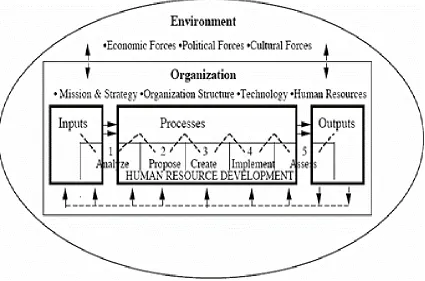
Figure 2. Human resource development in context of the organization and environment. ... 12
Figure 3. Conceptual framework of vendor selection decision making during ADDIE... 14
Figure 4. Merrill’s conceptual model of instructional design. ... 21
Figure 5. Pebble-In-The-Pond model... 23
Figure 6. Original ADDIE model ... 26
Figure 7. Updated ADDIE model ... 30
Figure 8. Overview of DFA as a research process. ... 49
Figure 9. Case 1 observed hits versus expected hits. ... 67
Figure 10. Case 2 observed hits versus expected hits. ... 69
Figure 11. Case 3 observed hits versus expected hits. ... 70
CHAPTER ONE INTRODUCTION
Human resource development professionals have very complex jobs with a wide variety of roles based on the organizations in which they work. One role that human resource development professionals (training mangers and/or human resource managers) conduct in their positions is making administrative decisions to purchase training for organizations. For the purposes of this research, training managers, human resource
managers, and senior training specialists will be referred to as human resource development (HRD) professionals. While there are many definitions of HRD, the definition used in this study is: “HRD is a process of developing and unleashing expertise for the purpose of improving individual, team, work process, and organizational system performance” (Holton & Swanson, 2009, p.4). The HRD professional works to ensure that employees in an
organization are professionally developed in order to be more productive in their roles. This professional development not only benefits organizations but also benefits employees in terms of marketability and upward mobility.
This study specifically examined the manufacturing sector to understand how HRD professionals make administrative decisions for the selection of outside vendors that help professionally develop employees to improve individuals and organizations. Manufacturing was chosen because training and development initiatives are common in current
This chapter provides background that serves as context to the study. Following the background is the statement of the problem and the significance for both HRD professionals in organizations purchasing training, as well as vendors providing the training options. The purpose of the study provides a foundation for the research questions. Following the research questions is a brief overview of the conceptual framework and description of the research design; the significance of the study is presented to explain the importance of the research followed by the limitations, delimitations, and summary.
Role of HRD Professionals
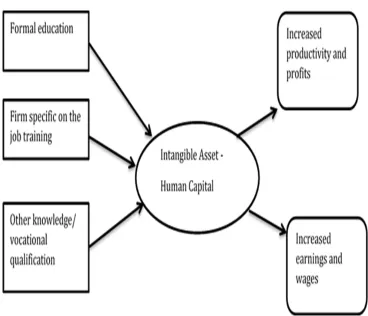
Training employees is a critical function of many organizations for which the HRD professional is essential. The need for organizations to conduct quality training programs that provide significant return on investment (ROI) is important: “Well trained employees benefit organizations in increased productivity and profits while also benefitting employees in the form of increased earnings and wages” (Philip, 2010, p. 1177). By developing individuals and organizations with effective training it is possible to gain a competitive advantage in the market:
the overall competitive struggle may most strongly depend. (Frahm, L., Kathawala, Y., & Motwani, J., 1994, p.35)
As organizations strive to gain a competitive edge in the new, global economy there is a need to examine why and how employees are developed. Training and development is more often than not the first casualty of a down economy, but this may be the wrong approach:
The continued need for individual and organizational development can be traced to numerous demands, including maintaining superiority in the marketplace, enhancing employee skills and knowledge, and increasing productivity. Training is one of the most pervasive methods for enhancing the productivity of individuals and
communicating organizational goals to new personnel. In 2000, U.S. organizations with 100 or more employees budgeted to spend $54 billion on formal training. (Arthur, Bell, Bennett, & Edens, 2003, p. 234)
The aforementioned needs to develop employees are always present whether the economy is thriving or not.
Human capital theory was first researched and presented by Schultz in 1961. Human capital theory was further developed by Becker beginning in 1964 with the book Human Capital: A Theoretical and Empirical Analysis, with Special Reference to Education. In his writings, Becker differentiated the concept of specific human capital from general human capital. Swanson and Holton (2009) stated, “General human capital development increases the skills and productivity of people by the same amount in organizations providing the training as it would if they went to work for another organization” (p.122). Examples of specific human capital development include training of explicit company policies, software that a company uses, and on-the-job-training for skills that are needed for a particular organization. Examples of general human development capital are leadership, soft-skills, customer service, teamwork, and critical thinking.
Human capital theory has not only been used in the study of human resource
development but is a theory that has been used in multidisciplinary research. Human capital refers to the studies of investments by individuals, organizations, or nations that accumulate stocks of productive skills and cognitive or technical knowledge. Human capital theory was initially introduced as an explanation for individual decision-making related to education and training choices. Later it was broadened to encompass more wide-ranging economic
decisions.
Human capital theory posits that the development of employees is seen as an
increased value of human capital derived from human resource development is likely to influence productivity, wages, prices, and other factors at an aggregate level of the economy” (Holton & Swanson, 2009, p.125).
Many times HRD professionals make the decision to purchase training to develop the workforce rather than developing and delivering the training internally. The HRD
professional is often the person in the organization that selects or is part of the selection process for purchasing employee development programs. The selection of training is an administrative decision-making process that is critical to ensure quality employee
development is offered to improve individuals and organizations. To better understand the HRD professionals’ selection of purchased training, administrative decision-making theory can provide a framework.
Administrative decision-making theory was developed by Herbert Simon and can be viewed through the lens of organizational design: “Organizational design is the process of first diagnosing and then selecting the structure and formal system of communication, authority, and responsibility to achieve organizational goals” (Holton & Swanson, 2009, p. 83). Individuals who work from this core belief realize how both work tasks and the organization structure impact the development of the organization’s human resources.
is nonetheless true that all organizations are made up of people. People manage
organizations, people do the work of organizations, and people provide the knowledge that organizations use to grow and develop” (p. 5). If employees are not provided training and development, they will not be as likely to reach their potential which in turn negatively impacts the individual and the organization. The importance of training and development can be difficult to measure at times. However, the literature stresses the importance and need for training and development.
Before conducting training in an organization many decisions are made by the HRD professionals. Many organizations follow a variety of models that help guide the HRD professionals’ role in training and development. The most widely adopted model is the ADDIE model which includes assessing needs, designing training, developing training, implementing training, and evaluating training (Swanson & Holton, 2009). When going through this model decisions such as whether or not to train, the desired outcomes, when to conduct training, and if training is formal or informal need to be answered. These decisions are fluid based on a number of factors including who makes the decision and the economic landscape at the time: “The ability to respond flexibly to changing circumstances is
Training may supply the trainee with the facts necessary in dealing with these decisions, it may provide him a frame of reference for his thinking, it may teach him "approved" solutions, or it may indoctrinate him with the values in terms of which his decisions are to be made. (Simon, 1944, p.24)
Figure 1. Conceptual model of human capital theory
Statement of the Problem
organizations. For example, well trained business professionals, such as accountants, may need soft skills training in order to function as supervisors.
If accurate assessment of how vendors are selected is not determined then
organizations may not be able to ascertain who the most qualified providers of services are for their organizations. Selecting poor vendors may have a negative effect on return on investment (ROI) of employee development initiatives, and organizations may then be less likely to implement employee development initiatives. Also, if vendors do not understand how organizations are making decisions they will not know how to market, sell, and, produce the necessary trainings for organizations. If research is not conducted, this will remain an area that is not understood in the role of the HRD professional.
Purpose
The purpose of this study is to understand the decision-making process HRD
professionals use when selecting external vendors to conduct training for their organizations and ultimately to try to determine and subsequently predict how HRD professionals decide which vendors to use for training and development of their employees. To that end, a degrees of freedom analysis (DFA) was used to understand the decision-making process. “The research technique of DFA was introduced by the noted psychologist, experimental methodologist, and philosopher of science Donald Campbell, in the late 1960s” Wilson & Woodside, 1999, p. 217). The purpose of DFA is not to generalize to a specific population, but to better understand theory. Completion of this study will help to develop theory on decision-making for organizations and specifically the decision-making of HRD
The use of DFA to examine cases helps predict how decisions are made about which external vendors are hired to conduct training. This study also seeks to further the research in the use of DFA in making business decisions based on Wilson and Woodside’s (1999) work. DFA can be useful but has been used very little: “While it has been mentioned in passing by other case methodologists there are few published examples of applications of this technique” (Wilson & Woodside, 1999, p. 216). DFA is a method that was specifically useful in answering the research questions for this study.
Research Questions
The overarching goal for this study was to examine the decision-making process of HRD professionals in selecting outside vendors. To do this, the study sought to determine the theory that best describes the decision-making process of HRD professionals and to report the methods they use in the process. There are three specific questions that provide the underpinning for this research:
1. Do the decisions that HRD professionals make about which external vendors to use for training and development fall into any of the four models that are being studied: rational, bounded rationality, political, or garbage can?
2. What are the counts (hits and misses) compared to the prediction matrix for decision-making on how HRD professionals select external vendors for training and
development?
Significance of the Study
There is an abundance of literature on the assessment and development of training. Needs assessment, design models, implementation, and evaluation have been researched and written about thoroughly. There is also a significant amount of literature on decision-making theory as it applies to marketing, management of employees, and capital expenditures. However, the literature does not do a good job of addressing how decisions on selection of training vendors are made. This study contributes to the knowledge of how decisions are made to select vendors and conduct training and will help build theory around decision-making when deciding who conducts training.
Critics typically state that single cases offer a poor basis for generalizing. However, such critics are implicitly contrasting the situation to survey research, in which a “sample” (if selected correctly) readily generalizes to a larger universe. This analogy to samples and universes is incorrect when dealing with case studies. This is because survey research relies on statistical generalization [from a sample to a population], whereas case studies (as with experiments) rely on analytic generalization. In analytic generalization, the investigator is striving to generalize a particular set of results to some broader theory. (Wilson & Woodside, p. 221, 1999)
Scholars have accomplished a great deal to date to broaden and strengthen the theoretical foundation of the relatively young academic field of HRD. Nonetheless, there is little doubt that more theoretical research is needed to advance our
understanding of the human and organizational phenomena of interest to HRD. (Torraco, 2004, p.172)
This study not only furthers research into HRD but also adds to theory building surrounding HRD and decision-making given varying organizational environments. Figure 2 conceptualizes the role of HRD in relation to an organization and the environment.
Conceptual Framework
The conceptual framework for this studyfocused on the relationship of one aspect of the ADDIE model to the administrative decision-making process to purchase employee training and development. HRD is interconnected with training development (T&D) as well as organizational development (OD) (Holton & Swanson, 2009). Human resource
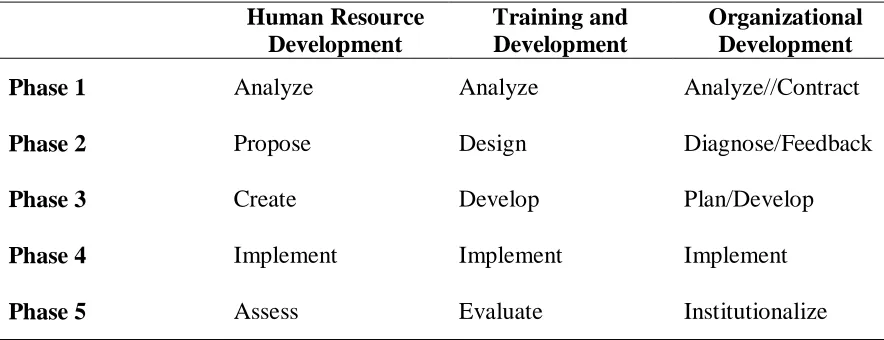
development, training development, and organizational development all have five phases that describe the processes conducted in each field of study. As Table 1 shows, while there are slight differences in the wording for the HRD, T&D, and OD processes there is a
commonality that runs through all of them (Holton & Swanson, 2009). Table 1
The Five (5) Phases of Human Resource Development, Training & Development, and Organizational Development
Human Resource Development
Training and Development
Organizational Development
Phase 1 Analyze Analyze Analyze//Contract
Phase 2 Propose Design Diagnose/Feedback
Phase 3 Create Develop Plan/Develop
Phase 4 Implement Implement Implement
Phase 5 Assess Evaluate Institutionalize
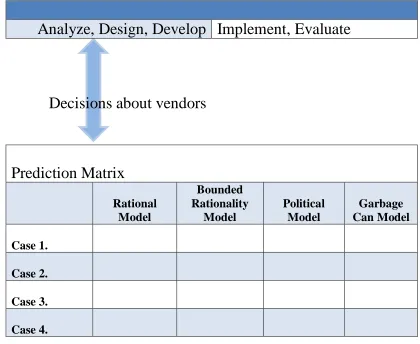
vendor to select when conducting training is made at a variety of points. The decision can be made before an analysis is conducted, during the analysis, during design, and/or during development phases. The conceptual model in Figure 3 illustrates the decision-making timing as it relates to the ADDIE training process and the creation of a prediction matrix.
Figure 3. Conceptual framework of vendor selection decision making during ADDIE.
Analyze, Design, Develop Implement, Evaluate
Decisions about vendors
Prediction Matrix
Rational Model
Bounded Rationality
Model
Political Model
Garbage Can Model Case 1.
Definition of Terms
ADDIE—The dominant instructional systems design (ISD) model with five distinct phases: Analysis, Design, Development, Implementation, and Evaluation.
Chi-Squared—A test statistic for categorical data use to test the difference between observed data and the hypothesis. “As a test statistic it is used as a test of independence, but is also used as a goodness-of-fit test. The chi-squared test statistic can be converted into one of several measures of association, including the phi coefficient, the contingency coefficient, and Cramér's V” (Vogt, W., 2005, p. 43).
Decision-making—“Decision-making may be defined in very general terms as a process or set of processes that result in the selection of one item from a number of possible alternatives” (Fox et al., 2013, p. 2).
Human Resource Development (HRD)—“Training and development, career development, and organization development. Training and development included both classroom training as well as coaching” (Werner, 2014, p. 128).
Instructional Systems Design (ISD)—The dominant methodology for developing training programs is more often than not called instructional systems design (ISD).
Bounded Rationality Model—“Decision makers try to be rational but, they are constrained by cognitive limitations, habits, and biases (i.e., human nature)” (Wilson & Woodside, 1999, p. 218).
Political Model—“Decision makers are competing to satisfy their own goals, and choice is a function of an individual’s power” (Wilson & Woodside, 1999, p. 218).
Rational Model—“Derived from microeconomics, posits that members of
organizations will make decisions that will provide maximum benefit (i.e., utility) to the firm.” (Wilson & Woodside, 1999, p. 218)
Limitations/Delimitations
The purpose of the analysis of a case study is not to make generalization to a
population but to better understand the specific case that is being studied. The results of this study are not generalizable to a population, but are able to help develop administrative decision-making theory. These results would be able to provide an initial understanding of which theory can best describe the purchase of employee training and development.
The results of this study are bound by the population, which comprised four HRD professionals all within the manufacturing environment. Additionally, the study is bound by the four theories that were selected to be examined in relation to the decision-making for the organizational purchase of employee training and development: rational model, bounded rationality model, political model, and garbage can model. This study is further delimited by the fact that DFA analysis only requires a small population.
Summary
This study is divided into five chapters. The first chapter discussed the importance of training in organizations and presented the need to understand how decisions are made by HRD professionals regarding which vendors are hired to conduct trainings for their
the research questions, the conceptual framework used to guide the study, and the limitations and delimitations of the study. Chapter two begins with a discussion of the ADDIE model and how the model is used to design and implement training. There is a review and summary of the extant literature on training design and development as well as the four
decision-making models used for the DFA: the rational model, bounded rationality model, political model, and garbage can model. The third chapter includes a detailed description of the DFA research methodology. Data collection methods are described as well. Chapter four includes a description of the four case studies used for this study and the presentation of findings from the analyzed case. A complete review of the prediction matrix is also included. The fifth and final chapter presents an overall summary of the study. Furthermore, the fifth chapter
CHAPTER TWO LITERATURE REVIEW
This literature review provides an understanding of the process of training and development and the role of the HRD professional. Specifically, the role of instructional design and training models is presented. The review will examine the process of decision-making and specifically how it can relate to administrative decision-decision-making in the selection of vendors to provide training. The review provides an overview of the theoretical
frameworks in the decision-making model. The chapter ends with a summary of the literature.
Instructional Design and Training Models
The literature clearly shows that assessment and development of training are
important to any organization. Training is not only a way to develop employees, it is also a way to increase employee productivity, wages, and satisfaction, and to influence their decision-making processes as well. Additionally, the literature explains that training is one of the primary forms of communication in organizations.
The dominant methodology for developing training programs is more often than not instructional systems design (ISD).
Early ISD models were designed and implemented throughout the 1960s. During the 1970s there was an explosion of instructional design (ID) models. According to Andrews and Goodson (1980, pp. 3-4), instructional design models serve four purposes:
1. Improving learning and instruction by means of the problem-solving and feedback characteristics of the systematic approach.
2. Improving management of instructional design and development by means of the monitoring and control functions of the systematic approach.
3. Improving evaluation processes by means of the designated components and
sequence of events, including the feedback and revision events, inherent in models of systematic instructional design.
4. Testing or building learning or instructional theory by means of theory-based design within a model of systematic instructional design.
Andrews and Goodson (1980) also asserted that instructional design typically entails 14 overarching tasks:
1. Formulation of broad goals and detailed sub goals stated in observable terms. 2. Development of pretest and posttest matching goals and sub goals.
3. Analysis of goals and sub goals for types of skills/learning required. 4. Sequencing of goals and sub goals to facilitate learning.
5. Characterization of learner population.
6. Formulation of instructional strategy to match subject matter and learner requirements.
8. Development of courseware and strategies.
9. Empirical tryout of courseware with learner population, diagnosis of learning and courseware failures, and revision of courseware based on diagnosis.
10.Development of materials and procedures for installing, maintaining, and periodically repairing the instructional program.
11.Assessment of need, problem identification, occupational analysis, competence, or training requirements.
12.Consideration of alternative solutions to instruction.
13.Formulation of system and environmental descriptions and identification of constraints.
14.Costing instructional programs. (p. 5)
However, there are thousands of instructional design models. While many encompass the aforementioned steps, others have five steps or fewer.
The Pebble-In-The-Pond Model
The Pebble-In-The-Pond model is just one of the many ISD models used for training development. This model, like many others, stresses the need for instructional design to be problem-based. The design of the instruction is meant to serve as a solution to the problem which needs to be solved.
Many current instructional models suggest that the most effective learning products or environments are those that are problem-centered and involve the student in a cycle of learning with four distinct phases:
• Demonstration of skills • Application of skills
• Integration of these skills into real-world activities. (Merrill 2015, pp.42-43) Also, Merrill’s conceptual model is meant to illustrate how these phases should be viewed in relation to instructional design (see Figure 4).
Figure 4. Merrill’s conceptual model of instructional design. (Merrill, 2015, p. 43)
The Pebble-In-The-Pond model is predicated on what Merrill calls the first principles of instruction:
descriptive. They relate to creating learning environments and products rather than describing how learners acquire knowledge and skill from these environments or products. (Merrill, 2015, pp. 42-43)
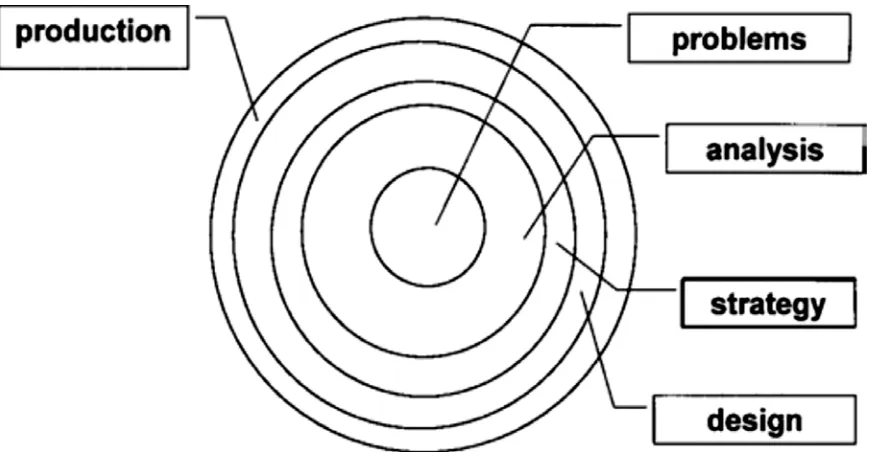
As Figure 5 shows, the Pebble-In-The-Pond model has 5 stages known as ripples: 1. The first ripple is identification of the initial problem.
2. The second ripple in the design pond is to identify a progression of such problems of increasing difficulty or complexity such that if learners are able to do all of the whole tasks thus identified, they would have mastered the knowledge and skill to be taught. 3. The third ripple, which is also part of analysis, in the design pond is to identify the
component knowledge and skill required to complete each task or solve each problem in the progression.
4. The forth ripple is to determine the instructional strategy that will be used to engage learners in the problems and help them acquire the component knowledge and skill required to complete the tasks or solve the problems.
5. The fifth ripple is interface design. It is at this point in the design process that the content to be learned and the strategy used to engage learners is adapted to the delivery system and instructional architecture of the learning situation or product. (Merrill, 2015, p. 43)
Figure 5. Pebble-In-The-Pond model.
The Training Performance Systems (TPS) Model
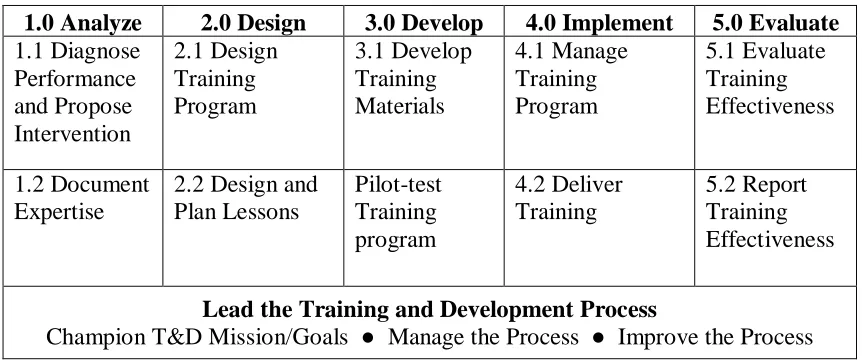
The Training Performance Systems (TPS) Model is a variation of the ADDIE model and encompasses the same five phases of Analyze, Design, Develop, Implement, and Evaluate with two subheadings added to each phase (see Table 2). TPS is described as “a process for developing human expertise for the purpose of improving organization, process, and individual performance” (Holton & Swanson, 2009, p. 233).
Phase 1—Analyze: “Diagnose the performance requirements of the organization that can be implemented through training, and document the expertise required to perform in the workplace” (Holton & Swanson, 2009, p. 237).
program design level, the overall design strategy must be economically, systematically, and psychologically sound. Critical information that will influence the design is gathered (Holton & Swanson, 2009, p. 238).
Phase 3—Develop: “Develop and/or acquire participant and instructor training materials needed to execute the training design” (Holton & Swanson, 2009, p. 241).
Phase 4—Implement: Manage individual training programs and their delivery to participants. The issues around managing and delivering T&D to participants suggests that the strategies for both have been thought through and planned into the program materials (Holton & Swanson, 2009, p. 242).
Table 2
Steps within the Process of the Training for Performance Systems
1.0 Analyze 2.0 Design 3.0 Develop 4.0 Implement 5.0 Evaluate
1.1 Diagnose Performance and Propose Intervention 2.1 Design Training Program 3.1 Develop Training Materials 4.1 Manage Training Program 5.1 Evaluate Training Effectiveness 1.2 Document Expertise
2.2 Design and Plan Lessons Pilot-test Training program 4.2 Deliver Training 5.2 Report Training Effectiveness
Lead the Training and Development Process
Champion T&D Mission/Goals ● Manage the Process ● Improve the Process
The ADDIE Model
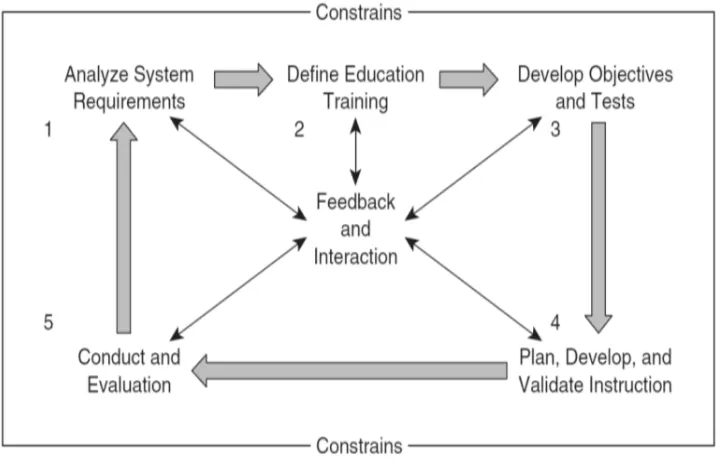
The ADDIE model was initially designed as a training model for use in the military. It was meant to be an efficient and organized method of designing and implanting training (see Figure 6):
When the ADDIE process was originally defined, it represented the then state-of-the-art specification for the design and development of systematic training within a military context of learning highly specified job tasks by a continuous cadre of
Figure 6. Original ADDIE model.
The original goal of ADDIE was to increase the effectiveness and efficiency of education and training by fitting instruction to jobs—eliminating peripheral knowledge from courses while ensuring that students acquired the necessary knowledge and expertise to do the job. Instruction was to be provided in the areas most critical to job performance and was not to be wasted in areas having a low probability of meeting immediate or critical long-term needs. The ADDIE process prescribed a series of procedures that addressed decisions about exactly what, where, how, and when to teach the skills, knowledge, and attitudes needed to perform every task selected for instruction. (Allen, 2006, p.431)
There are more than 100 different variations of the model; however, almost all of them reflect the generic “ADDIE” process - analysis, design, develop, implement, and evaluate. The ADDIE approach provides a systematic, process for the
determination of training needs, the design and development of training programs and materials, implementation of the program, and the evaluation of the effectiveness of the training. (Allen, 2006, p.432)
The ADDIE model has five phases:
Analysis phase. Course content should be tied to preparing class participants to do a job or perform certain tasks. Instructional developers analyze the job performance
requirements and key performance indicators (KPIs) to develop learning objectives. The developer then analyzes the job tasks and KPIs and compares them with the knowledge, skills, and abilities of the participants. “The difference between what they already know and can do and what the job requires them to know and be able to do determines what instruction is necessary. The activities of formative evaluation begin” (Allen, 2006, p. 436).
Design phase. “In the design phase, the instructional developer develops a detailed plan of instruction that includes selecting the instructional methods and media and
Development phase. In this phase, the participant materials and facilitator guides are developed. Method of delivery is decided on and the media that will be used is either
designed or acquired. If the media selected in the design phase included items such as
videotapes, sound and/or slides, interactive courseware (ICW), and training devices, these are developed. If a training information management system was developed for the instructional system, it is installed in this phase. As a final step in this phase, the implementation plan is revised. During this phase, instructional developers also validate each unit and/or module of instruction and its associated instructional materials as they are developed. They correct any deficiencies that may be identified. Validation includes
• internal review of the instruction and materials for accuracy,
• individual and small-group tryouts,
• operational tryouts of the “whole” system, and
• revision of units and/or modules occurs as they are validated, based on feedback from formative and summative evaluation activities.
The final step in this phase is to finalize all training materials (Allen, 2006, p.437).
Implementation phase. “With the instructional system designed and developed, the actual system is ready to become operational in the implementation phase. In this phase, the instructional system is fielded under operational conditions” (Allen, 2006, p. 437).
• formative evaluation, consisting of process and product evaluations conducted during the analysis and design phases, and validation that are conducted during the development phase;
• summative evaluation, consisting of operational tryouts conducted as the last step of validation in the development phase; and
• operational evaluation, consisting of periodic internal and external evaluation of the operational system during the implementation phase.
Each form of evaluation should be used during development, update, and revision of instruction, if possible, and if the form of evaluation is applicable. “Evaluation done to improve or change a program while it is in progress is termed formative evaluation. When evaluation focuses on results or outcomes of a program, it is called summative” (Caffarella, 2002, p. 186).
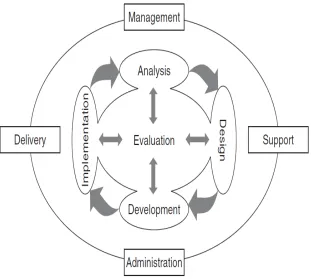
The conceptual phases of systematic training—analyze, design, develop, implement, and evaluate—have stood the test of time. Part of the reason for their resilience is that they have allowed adaptation and revision (see Figure 7).
Figure 7. Updated ADDIE model.
Decision Making
Four decision-making models were used to support the research of this topic: the rational model, bounded rationality, the political model, and the garbage can model.
Decision-making may be defined in very general terms as a process or set of processes that result in the selection of one item from a number of possible
as in deliberate choice amongst alternatives, but also unconscious (as in selecting the grip to use when grasping an object) or artificial (as in an expert system offering decision support). Moreover, decisions can be about what to do (action), but also about what to believe (opinion). (Fox et al., 2013, p. 2)
Understanding these theories provides the underpinnings for this research as the goal is to create a prediction matrix of which decision model is used most often when HRD
professionals select vendors for employee development initiatives. Future research may add other decision-making models. A clear understanding of these theories is necessary in order for scholars, researchers, and vendors to be able to apply what is learned from predicting which decision-making model is most commonly used among the political, rational, bounded rationality, and garbage can models.
Since decision-making is a key function for any organization it is important to gain an understanding of the methods used. A simple six-step process can be used to illustrate how decisions can be made.
1. Identify problem.
2. Clarify and prioritize goals. 3. Generate options.
4. Evaluate options.
5. Compare predicted consequences of each option with goals.
Decision-Making Theories
Each of the four models (rational, bounded rationality, political, and the garbage can model) explains decision making differently as it relates to behavior in relation to outcomes and processes.
The rational model, derived from microeconomics, posits that members of
organizations will make decisions that will provide maximum benefit (i.e., utility) to the firm. The bounded rationality model proposes that while decision makers try to be rational, they are constrained by cognitive limitations, habits, and biases (i.e., human nature). According to the political model, decision makers are competing to satisfy their own goals, and choice is a function of an individual’s power. Finally, in the garbage can model, decisions are the result of an unsystematic process. That is, problem definitions can change, preferences are unclear, and people may come and go from the decision group. (Wilson & Woodside, 1999, p. 218)
Rational Model
The rational model suggests that decisions are made in a rational manner that is
beneficial to the organization and is more a function of pure effectiveness than anything else. According to the best encyclopedic definitions, the term ‘rationality’ comes from the Latin word ratio, and it is ‘the principle governing the activity of knowing’:
something is rational if it proceeds from reason, if it is founded on logically sound procedures, on scientific method. (Grandori, 2010, p. 628)
process to gather and analyze information that will be used in decision making. According to the rational Model all available information should be used in order to make sound decisions. This logic should be applied to every step in the decision-making process: “Rationality has little to do with knowing everything, but a lot to do with following good rather than bad procedures in data gathering, hypothesis testing, assessing probabilities, and comparing options” (Grandori, A., 2010, p. 628). In order to follow the rational model it must be assumed that only logical choices are available and that decision makers will only act in the most logical manner regardless of the environment or circumstances. Behavioral sciences, in particular economics, have trusted the principles of rationality to understand human behavior for quite some time. “Rational-choice theory assumes that the individual is a self-interested expected utility maximizer, and has well-defined, stable, and consistent preferences or tastes. Further assumed is the strict application of these preferences to final outcomes (but not to changes)” (Marnet, 2005, p.195). It is assumed that decision makers have access to all relevant information, including all barriers and potential changes. Further, it is assumed that decision makers can predict any and all potential outcomes of their decisions.
Bounded Rationality
Rationality is customarily interpreted as a normative idea: it endorses certain actions, or even declares what actions should be taken. Bounded Rationality accounts for external influences that affect why and how decision makers determine what decisions will be made:
It may therefore not surprise that these principles of rationality are not universally obeyed in everyday choices. Bounded Rationality accounts for the fact that
environment also plays a part in decision-making and that it cannot be strictly based on rationality. (Grüne-Yanoff, 2007, p.535)
Simply put, bounded rationality is the idea that the choices people make are decided by not just some constant global objective and the components of their environments, but by other internal and external factors that drive the decision-making process.
The knowledge that decision makers do and don't have of the world, their ability or inability to evoke that knowledge when it is relevant, to work out the consequences of their actions, to conjure up possible courses of action, to cope with uncertainty
(including uncertainty deriving from the possible responses of other actors), and to adjudicate among their many competing wants. Rationality is bounded because these abilities are severely limited. Consequently, rational behavior in the real world is as much determined by the "inner environment" of people's minds, both their memory contents and their processes, as by the "outer environment" of the world on which they act, and which acts on them. (Simon, 1959, p.25)
First, there is abundant empirical evidence that it is important. Second, models of bounded rationality have proved themselves in a wide range of impressive work. Third, the standard justifications for assuming unbounded rationality are
unconvincing; their logic cuts both ways. Fourth, deliberation about an economic decision is a costly activity, and good economics requires that we entertain all costs. (Conlisk, 1996, p. 669)
Additionally, there are four uses of bounded rationality that have been deemed important, “1) To criticize standard theory; 2) To enrich behavioral models and theory; 3) To provide appropriate rational advice; 4) To explicate the concept of rationality” (Grüne-Yanoff, 2007, pp. 534–535).
The Political Model
According to the political model, decision makers are competing to satisfy their own goals and choice is a function of an individual’s power: “Power has been defined as the ability of an actor A to influence an actor B over some period of time with respect to some set of activities” (Pfeffer & Salancik, 1974, p. 142). There are two primary groups that play key roles in the politics of organizations and society in general. These groups are partisans and authorities. “By virtue of their positions, authorities are entitled to make decisions binding their subordinates. Any member of the coalition who wants to exert bottom-up pressure is a potential partisan” (Bolman & Deal, 2008, p.201). The authority-partisan relationship can be illustrated by using a family as an example:
toy. Parents initiate social control, and children are the recipients of parental
decisions. Children in turn try to influence the decision makers. They argue for later bedtime or point out the injustice of giving one child something another wants. They try to split authorities by lobbying one parent after the other has refused. They may form a coalition (with siblings, grandparents, and so on) in an attempt to strengthen their bargaining position. (Bolman & Deal, 2008, p.201)
Table 3
Sources of Power
Source of power Description
Position power (authority) Power based on title, designation and/or tenure. Control of rewards The ability to deliver jobs, money, political support, or
other rewards.
Coercive power The ability to constrain, block, interfere, or punish. Information and expertise Experts that have information and know how to solve
problems.
Reputation Building on information and expertise to produce a track of getting positive outcomes.
Personal power
Individuals who are attractive and socially adept because of charisma, energy, stamina, political smarts, gift of gab, and vision for the future, or some characteristic are imbued with power independent of other sources. Alliances and networks Building a network of friends and allies in complex
organizational structures in order to achieve goals.
Access and control of agendas
A by-product of alliances and networks. Having access to decision arenas. When decisions are made those with “a seat at the table” are well represented while the views and needs or those that are not present are distorted or ignored completely.
Framing: control of and meaning of symbols
Establishing the framework within issues will be viewed and decided is often tantamount to deterring the result. Elites and opinion leaders often have substantial ability to shape meaning and articulate myths that express identity, beliefs and values. This can either foster meaning and hope or convince others to support things not in their own bet interest.
Both authorities and partisans exercise political influence, navigate the political landscape, and ultimately make decisions based on their sources of power or the sources of power of those that they have access to. Thus, the struggle for power links to the political model as individuals and groups jockey for control.
The political frame views organizations as roiling arenas hosting ongoing contests of individual and group interests. Five propositions summarize this perspective:
1. Organizations are coalitions of assorted individuals and interest groups. 2. Coalition members have enduring differences in values, beliefs, information,
interests, and perceptions of reality.
3. Most important decisions involve allocating scarce resources—who gets what. 4. Scarce resources and enduring differences put conflict at the center of day-to-day
dynamics and make power the most important asset.
5. Goals and decisions emerge from bargaining and negotiation among competing stakeholders jockeying for their own interests. (Bolman & Deal, 2008, pp.194–195)
The Garbage Can Model
Finally, in the garbage can model, decisions are the result of an unsystematic process. That is, problem definitions can change, preferences are unclear, and people may come and go from the decision group. “The garbage can (GC) model is a framework for analyzing decision making in ‘organized anarchies’—organizations characterized by problematic preferences, unclear technologies, and fluid participation” (Ansell, 2001, p. 5883).
These properties of organized anarchy have been identified often in studies of organizations. They are characteristic of any organization in part of the time. They are particularly conspicuous in public, educational, and illegitimate organizations. A theory of organized anarchy will describe a portion of almost any organization's activities, but will not describe all of them. (Cohen, March, & Olsen, 1972, p. 1) It is important to understand the concept of organized anarchies and their relationship to other decision-making theories as applied to organizations. The previous theories discussed (rational, bounded rationality, and political model) assume that organizations operate in a logical, interdependent manner. Even bounded rationality, which accounts for environmental stimuli in decision-making, assumes that rationality is dependent on environment. In order to expand current behavioral theories and to explain the idea of organized anarchy, two critical points are necessary and must be examined. “The first is the manner in which organizations make choices without consistent, shared goals. Situations of decision making under goal ambiguity are common in complex organizations” (Cohen et al., 1972, pp. 2–3). Decisions are made under ever-changing market conditions, unclear reporting structures, and rapidly changing social, political, and economic environments.
The rational model, bounded rationality model, and political model decision-making theories depend on factors that are dependent on one another in order for the decisions to be made. On the other hand, in the case of the garbage can model a decision is an outcome or interpretation of several relatively independent streams within an organization (Cohen et al., 1972, pp. 1–2). Goals, technology, and employee participation in organizational decision-making are seen as unclear, dynamic, and independent of each other.
The model conceives of organizations as conglomerates of semiautonomous decision arenas or ‘garbage cans’ through which problems and solutions flow as independent streams. Decision outcomes are sensitive to the precise mix of problems and
solutions represented in a garbage can at the moment of decision. This mix, in turn, depends on the number of decision arenas, the structure of access to them, the overall organizational load of problems and solutions, and the allocation of energy and attention across arenas. (Ansell, 2001, p. 5883)
There are four critical streams that are necessary to understand for the garbage can model and four variables that are considered. The streams are problems, solutions,
participants, and choice opportunities:
• Problems—The concerns of all stakeholders in an organization.
• Solutions—The products that are created in order to address problems.
• Participants—Those in the organization that dedicate time, energy, and other resources to solving problems.
The four variables that need to be considered are just as important as the streams themselves and consider the time and energy it takes to navigate the four streams:
Each participant is characterized by a time series of energy available for
organizational decision-making. Thus, in each time period, each participant can provide some specified amount of potential energy to the organization. (Cohen et al., 1972, p. 3).
Literature addressing the garbage can model also suggests that the chaotic and
ambiguous nature of organized anarchies can be altered to become orderly environments. “It is very possible, for instance, that disorder and ambiguity may be tidied up on the output side of decision-making processes: order and certainty then represent post hoc rationalizations of essentially ad hoc decisions” (Ansell, 2001, p. 5885). The two other means by which anarchies organize according to the literature are leadership and learning. This is especially pertinent to this study because leadership, in terms of decision makers, and learning in terms of employee development initiatives, are at the heart of this study.
With respect to leadership, this literature suggests that unobtrusive leadership that embraces rather than rejects the disorder and ambiguity of decision-making may be successful in steering organized anarchies toward collective purposes. Learning in organized anarchies is problematic because the lessons we should draw from
Summary
The extantliterature on instructional system design, decision-making, and four decision-making theories (rational, bounded rationality, political, and garbage can model) was reviewed. The literature review began with an examination of the most widely used instructional systems design method: the ADDIE (Analysis, Design, Develop, Implement, and Evaluate) model. ADDIE was first used as the primary ISD model for the United States military before becoming the mostly widely used instructional design model in use today.
CHAPTER THREE METHODS
The purpose of this chapter is to outline the specific methods used to complete the study. This chapter provides a summary of the purpose and research methods. The research design, which utilized degree of freedom analysis, is described. In addition, the application of degree of freedom analysis in reference to this specific study of HRD decision-making in terms of vendor selection is explained. Specifically, the methods section describes the participants of the study, the instrumentation, data collection, and data analysis.
Purpose and Research Questions
The purpose of this study is to understand how human resource development professionals make decisions in the selection of vendors for employee training and professional development. Three research questions are answered by this study:
1. Do the decisions that HRD professionals make about which external vendors to use for training and development fall into any of the four models that are being studied: rational, bounded rationality, political, or garbage can?
2. What are the counts (hits and misses) compared to the prediction matrix for decision-making on how HRD professionals select external vendors for training and development?
Degrees of Freedom Analysis
The research design for this study is a study of cases that integratesdegrees of freedom analysis (DFA). This mixed methods approach uses the quantitative analysis of qualitative case data in order to gain a better understanding of case data. The DFA requires that the researcher create a prediction matrix to record case data. This predication matrix gives the researcher the ability to quantify case data.
Given the richness of case data and its prevalence in business marketing research, degrees of freedom analysis has the potential to become an important addition to one’s “research workbench” (Wilson & Woodside, 1999, p. 216). The technique, first proposed by Donald Campbell in Degrees of Freedom and the Case Study is described in detail by Wilson and Woodside (1999). Since then the technique has not been wildly used. Wilson and Woodside duplicated Dean’s study in the context of organizational buying decisions. This study builds on the work of Wilson and Woodside to further the understanding of
administrative decision-making in the context of organizational buying of training. The most detailed literature on the DFA technique is the work of Wilson and Woodside (1999) and this implemented their approach to DFA.
data” (Wilson & Woodside, 1999, p. 217). This understanding of the qualitative data can then be used to examine, understand, and potentially expand on theories. The theories may then be better understood and applied in practice.
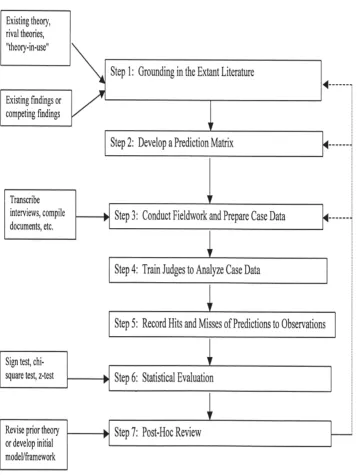
The heart of DFA is the development and testing of a “prediction matrix”. The prediction matrix sets up the “pattern,” based on theory, to be either confirmed or disconfirmed by the case data. The statements in the prediction matrix are analogous to hypotheses in the sense of traditional statistical hypothesis testing. Campbell states that “one should keep a record of all the theories considered in the creative puzzle-solving process. To represent the degrees of freedom from multiple implications, one should also keep a record of the implications against which each was tested, and the box score of hits and misses.” (Wilson & Woodside, 1999, p. 217)
The creation of the prediction matrix and the identification of patterns helps to establish a reliable means from which to begin to understand qualitative data.
An example that illustrates DFA is a doctor examining a sick patient. Upon
examining a sick child, the doctor, after a series of questions, determines symptoms of fever, irritability, loss of appetite, nausea, and a dull pain in the lower, right
quadrant of the abdomen. The pattern of observed symptoms (quantitative data) leads the doctor to diagnose her patient as suffering from appendicitis (the theoretical condition). In the same fashion, case data collected in social science contexts can be examined to note the degree of match to a pattern that is set forth by theory. Related to the medical diagnosis example, a key problem found in the literature is the
most easily retrieved knowledge; this may not represent sufficient coverage of issues to indicate a pattern of responses. (Wilson & Woodside, 1999, p. 218)
As a result, the wrong conclusions are drawn which leads to misdiagnosis. To put it simply, when more patterns can be identified, categorized, and subsequently matched, the confidence level in the correctness of the diagnosis increases and the concerns about subject bias
decrease.
Campbell maintains that this pattern-matching activity is analogous to having
degrees-of-freedom in a statistical test: In a case study done by an alert social scientist who has thorough local acquaintance, the theory he uses to explain the focal
difference also generates predictions or expectations on dozens of other aspects of the culture, and he does not retain the theory unless most of these are also confirmed. In some sense, he has tested the theory with degrees of freedom coming from the multiple implications of one theory. For such analysis, case data are considered quantitatively because the researcher notes the degree of match to the theory in terms of “hits and misses.” (Wilson & Woodside, 1999, p. 216)
The ultimate goal of the degrees of freedom analysis is the construction of a prediction matrix. Construction of the prediction matrix allows the researcher to generalize to a theory but not necessarily to a population.
the behavior of a decision maker, and theories-in-use are usually stated implicitly rather than explicitly” (Wilson & Woodside, 1999, p. 217). With that in mind, the first step in DFA is for the researcher to have an understanding of the existing knowledge base surrounding what is to be studied. Fieldwork can begin after the development of the prediction matrix. “Data may be in the form of personal interviews, document analysis, participant or nonparticipant observation, or other case data collection methods” (Wilson & Woodside, 1999, p. 217).
This particular study used personal interviews for data collection. The interviews were recorded to reduce the risk of misinterpreting the data. After data collection the researcher and two trained judges reviewed the interview information to note hits or misses to items in the prediction matrix. The box-score of hits and misses was then subjected to a Chi-square test to note the significance of the ratio of confirmed versus unconfirmed predictions found in the data.
Chi-Square is a test statistic for categorical data. As a test statistic it is used as a test of independence, but is also used as a goodness-of-fit test. The chi-square test statistic can be converted into one of several measures of association, including the phi coefficient, the contingency coefficient, and Cramér's V. (Vogt, 2005, p. 43) Chi-square was used in this research to test the hypothesis of which decision-making model is used most often. In other words, is there a goodness-of-fit between observed data and the prediction matrix? As is this case with this study,
confirmed predictions can be noted to see which theory tends to be supported relative to hers. (Wilson & Woodside, 1999, pp. 217-218)
This study used DFA to analyze and predict how HRD professionals make decisions as to what vendors will be used to conduct employee development for their organizations.
Dean applied DFA to examine the degree of support for four theories of
organizational decision-making in the context of adoption decisions of advanced manufacturing technology. Because Dean’s research is focused on adopting and acquiring new manufacturing technologies, his empirical application of DFA may be of particular interest for industrial purchasing and marketing researchers. From the literature, the four theories include: (1) the rational model of decision making; (2) the bounded rationality model; (3) the political model; and (4) the garbage can model. Dean’s central finding was that while no single theory was supported in all cases, one theory, the bounded rationality model, tended to have more of its predictions
confirmed while the be garbage can model tended to have the fewest confirmed predictions. (Wilson & Woodside, 1999, p. 218)
Participants
Research Design
The research design for this study implemented a degrees of freedom case study approach. This study used the four decision-making theories: rational, bounded rationality, political, and garbage can model. The theories were examined in the context of vendor selection for employee training and development in manufacturing. The steps in the process included instrumentation, data collection, data coding, and data analysis. Instrumentation was based on the theoretical frameworks and the prediction matrix. The interview protocol probed for questions related to the prediction matrix.
“The four theories are a mixture of similar, complementary, competing, and orthogonal predictions about organizational decision-making behavior” (Wilson & Woodside, 1999, p. 218). The prediction matrix was developed based on seven basic decision activities:
1. Problem definition—the conceptualization of the decision problem or process by HRD professionals.
2. Solution search—the existence, degree, and type of search for alternative solutions to the problem(s).
3. Data collection, analysis, and use—the extensiveness, type, and function of attempts to collect and use information.
4. Information exchange—the ways in which HRD professionals share information during the decision process.
6. Evaluation criteria—how decision criteria are developed and used.
7. Final choice—how, when, and why choices between vendors are made.” (Wilson & Woodside, 1999, p. 219)
Consequently, each theory or model of organizational decision-making has predictions for HRD professional behavior in each of the seven aspects.
The following discussion of these behaviors is adapted from Wilson and Woodside (1999) in the HRD vendor selection context. According to the rational model, HRD
professionals would be expected to develop comprehensive problem definitions, conduct an exhaustive information search, develop an a priori evaluation criteria, and exchange
information in an unbiased manner. Individual preferences and final vendor selection should reflect the alternative that offers the maximum benefit to the organization.
Under the bounded rationality model, HRD professionals simplify the problem definition, the search is sequential and limited to familiar areas, and information exchange is biased by individual preferences. Preferences originate from either personal or departmental sub-goals for each HRD professional. Evaluation of alternatives follows a conjunctive decision rule where criteria are expressed in terms of cutoff levels. Choice depends on which alternative first exceeds the minimum cutoff levels of the evaluative criteria.
The Political model proposes that HRD professionals will compete for decision outcomes to satisfy personal and/or departmental interests. Preferences are based on these interests and formed early in the decision process. Problem definition, search, data
Finally, the garbage can model suggests that HRD professionals’ decisions are analogous to garbage cans into which problems, solutions, and choice opportunities are dumped. Problem definitions are variable, changing as new problems or people are attached to choice opportunities. Data are often collected and not used. Preferences are unclear and may have little impact on choice. Evaluation criteria are discovered during and after the process, and choices are mostly made when problems are either not noticed or are attached to other choices. A prediction matrix can be constructed given the outcomes of each model across the seven decision phases.
Rather than have a general statement for each model and decision phase, operational items may be developed to make the data judging task clear. Such is the case for assessing the need for employee development and the actual development initiatives; two operational items for each decision phase were developed. The resulting 56-cell table (2 statements x 7 phases x 4 models) contains the predictions that a theory is confirmed (Y), partially confirmed (P), or not confirmed (N). (Wilson & Woodside, 1999, p. 219)