7
PERFORMANCE MEASUREMENT OF
PROFESSIONAL SERVICES:
A CASE OF MALAYSIA
Mohd Noor Azli biN Ali KhAN
rohAizAt biN bAhAruN
KAMAruzzAMAN biN Abdul rAhiM
INTRODUCTION
Performance measures allow companies to allocate economic responsibilities and decision rights, set performance targets, and reward target achievement (Merchant & Van der Stede, 2007). information for performance measurement and control can serve for decision-making, planning and control, signalling, education and learning, and external communication (Simons, 2000). Performance
measurement and management refer to goal definition, strategy
development, benchmarking, human resource management, and
feedback processes of learning organizations (Otley, 1999).
Performance measurement is an integral part of the planning
and control cycle (Barnard, 1962) since a long time ago and managers must have been planning and controlling the deployment of resources since the first organization was established (Neely, 1999).
the importance of performance measurement has been recognised
and many frameworks have been developed such as Performance Measurement Matrix (Keigen et al., 1989), SMART (Cross & Lynch, 1989), Performance Measurement Questionnaire (Dixon et al., 1990) and Balance Scorecard (Kaplan & Norton, 1992). Furthermore, the Balance Scorecard is probably the best known of the raft of
late 1980s and early 1990s (Bourne, 2008).
The need to measure performance in ways that are different from those used to measure productivity in manufacturing has
attracted considerable research. Some studies have sought to illustrate the conceptual limitations of existing procedures for measurement
of productivity of service firms (Hjern, 1990; Stanback and Noyelle, 1990; Mellander, 1992; Gummesson, 1991,1992, 1994; Gordon, 1996). Other studies have addressed the technical problems of productivity
measurement for particular service industries and demonstrated the limitations of measures based on manufacturing paradigms for these
industries (Berg, 1991; Berg et al., 1989; Bjurek et al., 1992). Unique characteristics of professional services may limit the validity of the research which addresses service productivity in general to productivity measurement of these industries. Professional
knowledge is their core resource, and it is both the input and output in their production processes. besides, the clients of professional service
firms are other firms, organization or government departments, and
their output is used as an intermediate input in the production processes
of these firms or organizations. This differs from manufacturing in
which its output is used as consumer product. this difference implies a different role for the client in the production process and a need for
different ways to assess the output (Nachum, 1999).
therefore, this research was conducted to investigate the
practice of performance measurements of the services industry in general and in accounting and audit firms specifically. The focus of
the research is on the practice of performance measurement among
bumiputera audit firms in Malaysia. The main objectives of this study are to identify the method applied by bumiputera audit firms
to measure their performance, and the factors or variables that affect
the firms’ performance.
the remainder of this research is organized as follows. the next section provides literature review. Section three explains the
research method and data analysis, followed by the empirical results in section four. The final section discusses conclusions and provides
LITERATURE REVIEW
Part I – Overview of Performance
In recent years, interest in performance measures has grown, as evidenced by the large portion of literature investigating some aspects such as “benchmarking”, “total quality” measures and “balanced
scorecards” (Md. Mostaque & zahirul, 2002) as new performance
measurement systems after many past criticisms prompted a reappraisal and development of performance systems. The increased attention to such systems by managers, consultants, and academics reflects the pressures that result from vigorous competition. This trend
has forced organizations to improve their performance to survive in their environment and industries. the literature on performance
measurement systems offers many examples of procedures for identifying, selecting and implementing appropriate performance measures (Neely et al., 1995). Dixon et al. (1990) suggested that by
using appropriate performance measures will enable organizations
to achieve their objectives.
Ideally, a well developed, broad-based performance measurement system could be used to improve the organizations strategic focus (Kaplan & Norton, 1996). According to Chandler and Hanks (1993), relevant, reliable, and valid measures of performance
are essential in order to explore vital relationships between independent variables and success and to develop sound performance
theory. Performance can be evaluated using non-judgmental (or outcome) and judgmental measures (Campbell, 1991). The non-judgmental measures use objective data that do not need abstraction or synthesis by the person collecting the data and are extern such as sales volume. The judgmental measure, however require an individual to make a judgment about the performance level of another individual
or of themselves and used to measure both outcomes and behaviour.
According to Van De Ven and Morgan (1980 in MacDougall, 1993), they argued with regard to organizational performance that:
“Performance is a complex construct that reflects
the criteria and standards used by decision makers to access the functioning of an organization. As this
definition suggests, performance is a value Judgement
on the result desired from the organization at different
level of analysis… and… often change over time”
the purpose of performance measurement is to help guide
the performance of tasks (Benham, 1981 in MacDougall, 1993). He
argued that the role of the expert in the performance measurement was to help managers but not to tell them how to run their businesses.
According to Dess and Robinson (1984), research that includes a consideration of organizational performance must address two issues: (1) the selection of a conceptual framework from which to define performance and identification of accuracy, and (2) available measures
that operationalise performance.
Part II – Factors that Affect Performance
A considerable number of researches have been carried out relating to performance measurement, in which some of them have proposed
different perspectives of performance model (eg. Lee et al., 2001; Makhamreh, 2000). In particular, different researches employed different types of performance measures (Weiner and Mahoney, 1981),
thus the performance model should be interpreted with caution. the results of testing the same set of independent variables on different
types of performance measure that serves as the dependent variables may be varied. For example, in Makhamreh (2000), of the four types
of performance measures (return on investment (roi), earnings per share (EPS), stock prices and stock value) that have been tested against
the independent variables, no significant effect of the independent
selection of appropriate performance measure rarely exist (Lewin and Minton, 1986), the selection of performance measure should be justified based on the type of organization and the objectives of the measurement (Hunger & Wheelen, 1997). Further, in the case of service sector, Healey and Potter (1987) suggested that performance
measurement must concentrate on the actual achievement of the services offered and the accomplishment of meeting the consumer requirements.
The selection of performance measure is one issue, but yet the
factors affecting performance is another issue that attracted the interest of researchers. Prior researches have approached on the possible factors from the narrower perspective to the wider perspective. in the narrower perspective studies, performance has been tested to a
single or few factors. For examples, Siu (2000) found that there is relationship between marketing practices and company performance, while Lee et al. (2001) found that close business relationships (guanxi) positively affects business performance. On the contrary, in the wider
perspective studies, the researchers tested a combination of factors to
business or company performance. In Makhmareh (2000), nine factors that were classified under four variables (organizational, leadership, environmental and managerial) have been tested against company performance, but only organizational and leadership variables found to have significant impact on performance. The organizational variable in Makhmareh (2000) study is represented by the size of the company whereas the leadership variable is represented by debt/equity ratio
and retained earnings.
Other researches such as Hise et al. (1983) and Flynn (2001)
also studied a number of factors affecting performance. Among
the factors that affected performances are number of employees, inventory level, fixed assets, manager’s years with present employer, manager’s years in the same position (Hise et al., 1983), demographic,
environmental, information processing, structural and decision
making (Flynn, 2001). In conclusion, there is a variety of factors that might affect company performance and the effect itself might also
RESEARCH METHODOLOGY Research Design
our paper is aimed at gaining a better understanding of performance measurement among the professional services organization in the
context of audit firms in Malaysia. This is an exploratory study in an attempt to identify the performance measurement practices among Malay firms (the highest ethnic population in Malaysia). Like previous
studies on performance measurement such as Atkinson and brown
(2001) and Nachum (1999), questionnaire distribution was used to
data collection. the questionnaire is divided into two parts. Part one
is about the firm and respondent’s background. Part two is about the performance measurement practices in the firms and includes some
questions which related to the possible factors that might affect the
performance of the firms such as staff turnover and ability to comply
to certain requirements and needs.
This study focuses on the firms which offer services in accounting, taxation, auditing and secretary in the five states in Malaysia as shown in Table 1. Overall, a total of 32 firms were selected as the samples for this study. The questionnaires were distributed and filled during interviews with respondents, who were either the owners or the managers of the firm. The advantages of interviewing respondents are that we were able (1) to provide explanation on the questionnaires to the respondents and (2) to verify on certain issues that we might miss in the questionnaire such as “Why does the firm
not measure its performance?”
Finally, data gathered from questionnaires were analysed using ‘Statistical Packages for Social Sciences’ (SPSS). We ran a descriptive analysis that consisted of min arithmetic and simple percentage, and statistical analysis of correlation analysis to identify the relationship
No. State No. of Sample Percentage
1 Johor 8 25.00
2 Pahang 8 25.00
3 terengganu 10 31.25
4 Kelantan 4 12.50
5 Pulau Pinang 2 6.25
total 32 100
Table 1: Number of Respondents by State
FINDINGS
Performance Measurement
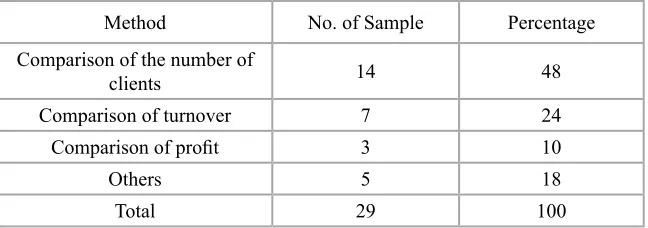
The first objective of the study is to find out the performance measurement method adopted by the firms. Surprisingly, our findings reveal that of the 32 firms, only 29 firms measured their performance and the method adopted were actually not documented and formalized. Table 2 shows the ‘informal’ method of performance measurement practiced by the 29 firms.
Table 2:Performance Measurement Method
Method No. of Sample Percentage
Comparison of the number of
clients 14 48
Comparison of turnover 7 24
Comparison of profit 3 10
others 5 18
The comparison of the number of clients between financial years is the most popular method among the firms (representing 48% of the samples). This method is implied by the notion that “if the number of clients increased in the current financial year as compared to the previous financial year, then the firm’s performance
could be considered increased and vice versa”. the same principle was also applied for the comparison of turnover and comparison of
profit method. As the questionnaires were answered during face-to-face interview, we were able to verify the reason of informal practice of performance measurement in those firms. Almost all of the respondents were of the same opinion that they do not have ample time to really measure the performance of their firms due to time constraint. They also stressed that as long as they observed the increase in the number of clients or turnover or profit, they would be satisfied with their firms’ performance.
Factors that Affect Performance of the Firms
The absence of any formal method of performance measurement by those firms was a drawback to our studies. However, in order to achieve the next objective of the study that is to determine the factors that affect the performance of the firms, we converted the performance measurement method practiced by the firms into a more
meaningful method. instead of comparing the number of clients, we convert the data available to us to gain the clients growth rate using
the following formula:
Clients growth rate = No. of new clients – No. of clients discontinue
Current no. of clients
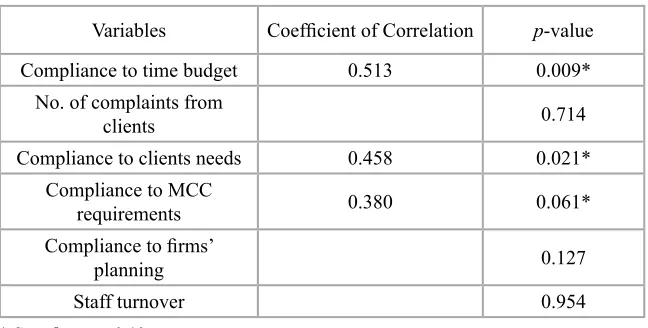
(MCC), compliance to firms’ planning and staff turnover. The results of “Pearson Correlation Analysis” show that compliance to time budget, compliance to customer needs and compliance to the MCC requirements are positively related to the clients’ growth rate (see Table 3 for the significant value for each factor). Those factors are closely related to clients and the finding agrees with prior studies (eg. Mital and Lassar, 1998) that satisfactory services to clients or customers should be the main focus of any businesses particularly in service industry where the client factor is critical.
Table 3: Correlation Analysis between Dependent and Independent
Variables
Variables Coefficient of Correlation p-value
Compliance to time budget 0.513 0.009*
No. of complaints from
clients 0.714
Compliance to clients needs 0.458 0.021*
Compliance to MCC
requirements 0.380 0.061*
Compliance to firms’
planning 0.127
Staff turnover 0.954
* Significant at 0.10
CONCLUSION
Performance and productivity are two important aspects in business today. There are many parties interested in performance and productivity according to their own interests. Investors, shareholders,
interested with firm performance and productivity. Many government agencies are also interested in finding out the overall performance and productivity for many reasons. Furthermore, most companies
recognize the need to use performance indices or “metrics” to help monitor and improve all aspects of product development, as helping
to improve the accuracy of future development plans.
This is an exploratory study with a relatively small sample size. Nevertheless, the findings are broadly consistent with those presented by other researchers who have attempted to analyse the
diverse range of interrelated factors associated with performance. this
study suggests that client satisfaction factor influence the performance of accounting firms’ owners.
As mentioned previously, measurement problems are present in any study of performance and productivity. Wide variety of productivity measures has been reported in the literature. However,
based on limitations of data and information about accounting and
auditing service industry in Malaysia, performance was viewed as dependent upon factors representing subjective measurement by comparing the overall performance of a firm with other firms in similar size and year and objective measurement by using number of clients, income and profit. In particular, these measures were based upon nonproprietary data available to the interviewed personnel.
On the other hand, we did not suggest that only the measurements mentioned above are suitable for accounting and auditing industry
or in other business or service sectors. A measurement technique
that considers only one or a few of the resources used may result in limitations and potentially inaccurate performance measurements. However, by combining different measures of performance, a better
understanding of accounting and auditing sector could be gained, thus enabling better decision-making for accountants or managers and owners.
Finally, advanced management practice, using enhanced
performance measurement techniques, could enable accounting
should also be paid to the measurement of the importance of produced
data which is more amenable to parametric statistical analysis. Refinements such as these were not possible in the current study
because of the nature of the research, the state of knowledge at the time and space restraints on the questionnaire.
Future research could improve and extend our findings. For extending this exploratory study in future researchs it is suggested
that we could include replication on other geographic regions or
in the whole country, using data from other sector, using larger
data sets, introducing extra variables, or using the more deeper or
detailed of independent variables/external or internal environmental factors. Lastly, the growing body of empirical studies in performance and productivity may offer opportunities for meta analysis. This methodology has not received much attention (Cooper, 1993).
ACKNOWLEDGEMENT
the authors would like to acknowledge with thanks the assistance
and the financial support provided by Research Management Center (RMC) and Department of Management, Faculty of Management and Human Resource Development, Universiti Teknologi Malaysia. We
are grateful for comments received from the participants of the Small
Enterprise of Australia and New Zealand (SEAANZ) Conference 2004, 26th – 29th September 2004 at Queensland University of Technology (QUT), Brisbane, Australia.
REFERENCES
Atkinson, H. and Brown, J.B. (2001). “Rethinking performance measures: assessing progress in UK hotels.” International
128-135.
Barnard, C.I. (1962). “The functions of the executive.” Harvard University Press, Cambridge, MA.
Berg, S.A. (1991). “Mergers, efficiency and productivity growth in Norwegian banking 1984-1989.” Norgers Bank Research Paper 1991/3. Oslo.
Berg, S.A., Forsund, F.R. and Jansen, E.S. (1989). “Bank output
measurement and the construction of best practice frontiers.”
Norges Bank Research Paper 1989/6. Oslo.
Bourne, M. (2008). “Performance measurement: learning from the past and projecting the future.” Measuring Business
Excellence, Vol. 12(4). 67-72.
Campbell, John P. (1991). “Modelling the Performance Prediction Problem in Industrial and Organizational Psychology.” In Handbook of Industrial and Organizational Psychology. Vol 1 CA: Consulting Psychology Press, 687-732.
Cooper, A.C. (1993). “Challenges in Predicting New Firm
Performance.” Journal of Business Venturing. Vol. 8. 241-253.
Cross, K.F. and Lynch, R.L. (1989). “The SMART way to define and
sustain success.” National Productivity Review. 8(1). 23-33. Dess, Gregory G. and Robinson Jr, Richard B. (1984). “Measuring
Organizational Performance in the Absence of Objective Measures: The Case of the Privately-held Firm and Conglomerate Business Unit.” Management Journal. Vol.
5. 265-273.
Dixon, J.R., Nanni, A.J., and Vollmann, T.E. (1990). “The New Performance Challenge – Measuring Operations For World – Class Competition.” Dow Jones – Irwin, Homewood, IL. Flynn, D. (2001). “Life Cycles of New Venture Organizations:
Different Factors Affecting Performance.” Journal of Developmental Entrepreneurship. Vol. 6. April. 41-59. Gordon, R.J. (1996). “Problems in the measurement and performance
Working Paper no. 5519. NBER. Cambridge. MA.
Gummesson, E. (1991). “Service quality – A holistic view.” in Gummesson, E., Edvardsson, B. and Gustavsson, B.O. (Eds.). Service Quality, New York: Lexington Books. 52-75.
Gummesson, E. (1992). “Service productivity: a blasphemous
approach.” Paper presented at 2nd international research Seminar in Service Management. France. June.
Gummesson, E. (1994). “Service management: An evaluation and
the future.” The International Journal of Service Industry Management. 5(1). 64-78.
Healey, M. and Potter, J. (1987). “Making Performance Measurement Work for Consumer.” In Performance Measurement and the Consumer. National Consumer Council. London.
Hise, R.T., Kelly, J.P., Gable, M. and McDonald, J.B. (1983). “Factors Affecting the Performance of Individual Chain Store Units: An Empirical Analysis.” Journal of Retailing. Summer. Vol.
59. 22-40.
Hjern, B. (1990). “The private service sector: the problem of productivity development.” Karlstad. CTF. Laporan penyelidikan 90:2.
Kaplan, R.S. and Norton, D.P. (1992). “The balanced scorecard –
measures that drive performance.” Harvard Business Review.
70(1). 71-79.
Kaplan, R.S. and Norton, D.P. (1996), “The balanced scorecard –
measures that drive performance.” Harvard Business Review,
January-February. 71-79.
Keegan, D.P., Eiler, R.G. and Jones, C.S. (1989). “Are your
performance measures obsolute?” Management Accounting
(USA). June. 45-50.
Lee, Dong Jin, Pae, Jae H. and Wong, Y.H. (2001). “A Model of Close Business Relationship in China (guanxi).” European Journal of Marketing. Vol. 35, no1/12, 51-69.
Levy, Michael and Sharma, Arun. (1993). “Relationship among
Academy of Marketing Science (Summer), 231-238.
Lewin, A. and Minton, J. (1986). “Determining Organizational Effectiveness: Another Look and an Agenda for Research.”
Management Science. 32, 539-553.
MacDougall, James Clark. (1993). Performance Contracts and Quality Management. PhD Thesis, University of Stirling.
Makhamreh, M. (2000). “Corporate Performance in Jordan: A Study
of the banking Sector.” The Arab Bank Review. Vol. 2(2).
October. 40-48.
Md. Mostaque Hussain and A. Gunasekaran. (2002). “Non-financial management accounting measures in Finnish financial
institutions.” European Business Review. 14(3). 210-229. Mellander, E. (1992). “An indirect approach to measuring productivity
in private services.” Proceedings of a symposium on
productivity concepts and measurement problems. uppsala
1991. 229-244.
Merchant, K.A. & Van der Stede, W. (2007). ”Management Control Systems: Performance Measurement, Evaluation and Incentives.” Pearson/Prentice Hall, London.
Mittal, Banwari and Lassar, W.M. (1998), “Why Do Customer Switch? The Dynamics of Satisfaction Versus Loyalty.” The
Journal of Service Marketing. Vol.12(3). 177-194.
Nachum, L. (1999). “Measurement of productivity of professional services – an illustration on Swedish management consulting firms.” International Journal of Operations & Production Management. 19(9). 922-949.
Neely, A. D. (1999). “The performance measurement revolution: why
now and what next?” International Journal of Operations & Production Management. 19(2). 205-228.
Otley, D. (1999). “Performance management: a framework for management control systems research.” Management Accounting Research, 10(4). 363-382.
Saddle river, NJ.
Siu, Wai-Sum. (2000). “Marketing and Company Performance of Chinese Small Firms in Hong Kong.” Marketing Intelligence
and Planning. 18(5), 292-307.
Stanback, T.M. and Noyelle, T. (1990). “Productivity in services: A valid measure of economic performance?” in. Noyelle, T. (Ed.). “Skills, Wages and Productivity in the Service Sector.” Oxford: Westview Press. 215-245.
Weiner, N. and Mahoney, T. (1981). “A Model of Corporate Performance as a Function of Environmental, Organizational