MATHEMATICAL THINKING IN DIFFERENTIAL EQUATIONS THROUGH A COMPUTER ALGEBRA SYSTEM
FERESHTEH ZEYNIVANNEZHAD
A thesis submitted in fulfilment of the requirements for the award of the degree of Doctor of Philosophy (Mathematics Education)
Faculty of Education Universiti Teknologi Malaysia
ACKNOWLEDGEMENTS
ABSTRACT
ABSTRAK
TABLE OF CONTENTS
CHAPTER TITLE PAGE
DECLARATION ii
DEDICATION iii
ACKNOWLEDGMENTS iv
ABSTRACT v
ABSTRAK vi
TABLE OF CONTENTS vii
LIST OF TABLES xi
LIST OF FIGURES xii
LIST OF APPENDICES xiv
LIST OF ABBREVIATION xv
1 INTRODUCTION 1
1.1 Introduction 1
1.2 Background of the Problem 5
1.2.1 Mathematical Thinking in Differential
Equations 5
1.2.2 Students Understanding of
Differential equations 7
1.2.3 Issues in Teaching and Learning
Differential Equations 10
1.2.4 Learning Environment in Differential
Equations Classrooms 11
1.3 Statement of the Problem 13
1.4 Objectives of the Study 15
1.5 Research Questions 16
1.6 Theoretical Framework 16
1.6.1 APOS Theory: a Constructivist Theory
of Learning Mathematics 17
1.6.2 Three Worlds of Mathematics 19
1.6.4 Using CASs to Promote Mathematical
Thinking in Differential Equations 26
1.7 Conceptual Framework 29
1.8 Significant of the Study 31
1.9 Scope of the Study 33
1.10 Definition of Terms 33
1.11 Summary 34
2 LITERATURE REVIEW 36
2.1 Introduction 36
2.2 Teaching and Learning in Differential Equations 36 2.2.1 Procedural and Conceptual Learning in
Differential Equations 41
2.2.2 Students' Difficulty in Differential
Equations 43
2.3 Mathematical Thinking 43
2.3.1 Mathematical Thinking as a Process 49 2.3.1.1 Specializing and
Generalizing 52
2.3.1.2 Conjecturing and
Convincing 53
2.3.1.3 Other mathematical
Thinking Powers 55
2.3.2 Dynamic Process of Mathematical
Thinking 56
2.3.3 Questions and Prompts to Make Explicit the Students' Mathematical
Thinking 58
2.3.3.1 Mathematical Themes 59 2.3.3.2 Mathematical Powers 60 2.3.3.3 Mathematical Heuristics 61
2.4 Computer Algebra System 61
2.5 The Effectiveness of CASs 63
2.6 Integrating Computer Algebra System and
Mathematical Thinking 65
2.6.1 Issues in Integrating CASs into
Mathematics Instruction 65
2.7 Summary 69
3 METHODOLOGY 70
3.2 Research Design 70
3.3 Teaching Experiment Structure 73
3.3.1 Conjecture 73
3.3.2 Curriculum 76
3.3.3 Classroom Interaction 77
3.3.4 The Role of the Teacher 78
3.3.5 Assessment 79
3.4 Participants 79
3.5 Data Collection 81
3.5.1 Semi-Structured Task Based
Interview 81
3.5.1.1 Tasks 82
3.5.2 Observation 85
3.5.3 Students' Written Activity 87 3.5.4 Researchers' Thinking Notes 87 3.6 Designing Worksheets to Provoke Mathematical
Thinking Using CAS 88
3.7 Trustworthiness 90
3.7.1 Intercoder Reliability Index 94
3.8 Data Analysis 95
3.9 Ethical Issues 100
3.10 Preliminary Investigation 101
3.11 Summary 103
4 FINDINGS 105
4.1 Introduction 105
4.2 Approach to Mathematical Thinking Instruction 105 4.2.1 Background of the Participants 108 4.3 Observation of the Intervention Sessions 109
4.3.1 Thinking Mathematically in Maxima
Environment 111
4.3.2 Students' Difficulty During
Intervention sessions 116
4.3.3 Instrumentalization of Maxima 116 4.4 Reflection on Observation of the Intervention
Sessions 121
4.5 Findings from the Interviews 124
4.5.1 The case of Ade 125
4.5.3 The case of John 149
4.5.4 The case of Philip 159
4.5.5 The case of Una 177
4.5.6 The case of Wendy 189
4.6 Findings on to what extent do students use mathematical thinking powers to make sense of
basic concepts of differential equations 202 4.7 Findings on to what extent are mathematical
thinking powers fostered while students work
with a CAS in differential equations 220 4.8 Findings on the proper factors to support
students’ mathematical thinking powers in differential equations through a computer
algebra system 226
4.9 Summary 229
5 DISCUSSION, CONCLUSION AND
RECOMMENDATIONS 230
5.1 Introduction 230
5.2 Discussion of Findings 230
5.3 Conclusion 245
5.4 Implication of the Research 249
5.5 Limitation of the Research 250
5.6 Recommendation for Future Study 251
5.7 Summary 253
REFRENCES 254
LIST OF TABLES
TABLE NO. TITLE PAGE
2.1 The major research in teaching and learning differential
equations 40
2.2 Mathematical questions and prompts 60
2.3 Comparison of computer algebra systems 62
2.4 Modification of traditional approach in a CAS environment 66 3.1 Tasks used to explicate students' mathematical thinking 83
3.2 Guide line to observation 86
3.3 Groups of mathematics activities associated to mathematical
thinking 88
3.4 The items associated to mathematical thinking skills 90
3.5 Techniques to enhance trustworthiness 92
3.6 Reliability agreement percentage 94
3.7 The code book used to coding data 97
3.8 Data analysis according to research questions 100 3.9 The percentage of mathematical thinking use of participants 103
4.1 Student's demography in main study 108
4.2 Students score during the main study 109
4.3 Graphs of I- 2 and I-3 produced by Ckin in doing task 1 140 4.4 Ade's use of mathematical thinking powers during the
follow up study 220
4.5 Ckin's use of mathematical thinking powers during the
follow up study 221
4.6 John's use of mathematical thinking power during the
follow up study 222
4.7 Philip's use of mathematical thinking powers during the
follow up study 223
4.8 Una's use of mathematical thinking powers during the
follow up study 223
4.9 Wendy's use of mathematical thinking powers during the
LIST OF FIGURES
FIGURE NO. TITLE PAGE
1.1 Encapsulation of Mathematics Knowledge 19
1.2 Three worlds of Mathematics in learning differential
equations 21
1.3 Instrumentation of two instrumentation and
instrumentalization 24
1.4 Instrumental genesis process including all parts 25
1.5 Theoretical framework for mathematical thinking in
differential equations through computer algebra system 28
1.6 Conceptual framework of the research 30
2.1 Mathematical thinking activities 47
2.2 Student's sue of the specializing powers to do worksheet 3 53
2.3 Conjecturing process 54
2.4 Students' use of conjecturing and convincing powers 55
2.5 The dynamic process of mathematical thinking 57
3.1 Research procedure 72
3.2 Teaching experiment 73
3.3 The students 'percentages for the answers to differential
equations
102
4.1 Student's answer to the worksheet based on mathematical
thinking approach 106
4.2 Student's answer with embedded prompts and questions in
worksheet 10 107
4.3 Students answer to verify the solution of a DE in
worksheet 1 111
4.4 Verification of solution of a DE in worksheet 1 112
4.5 Solving of task 2 done by Ckin manually 144
4.6 Philips' manual answer to task 1 160
4.7 Philip’s rule to identify the damping situation in second
order DEs 163
4.9 Ade 's made sense of the mathematical structures using
the interviews 202
4.10 Ade' s use of mathematical thinking powers during the
interviews 203
4.11 Ade’s use of maathematical thinking powers to make
sense of mathematical structures 205
4.12 Ckin 's made sense of the mathematical structures using
during interviews 206
4.13 Ckin' s use of mathematical thinking powersduring the
interviews 207
4.14 Ckin's use of mathematical thinking powers to make sense
of mathematics structures 208
4.15 John's made sense of the mathematical structures using
during interviews 209
4.16 John' s use of mathematical thinking powersduring the
interviews 210
4.17 John's use of mathematical thinking powers to make sense
of mathematics structures 211
4.18 Philip's made sense of mathematical structures during
interviews 212
4.19 Philip's use of mathematical thinking powers during the
interviews 213
4.20 Philip's use of mathematical thinking powers to make
sense of mathematical structures 214
4.21 Una 's make sense of mathematical thinking structures
during interviews 214
4.22 Una's use of mathematical thinking powers during
interviews 215
4.23 Una's use of mathematical thinking powers to make sense
of mathematics structures 216
4.24 Wendy 's made sense of mathematical structures during
interviews 217
4.25 Wendy's use of mathematical thinking powers during
interviews 218
4.26 Wendy's use of mathematical thinking powers to make
sense of mathematics structures 219
4.27 The pattern of the mathematical structures made sense by
the participants 225
4.28 The pattern of use mathematical thinking powers to make
sense of mathematical structures 226
4.29 Factors influencing mathematical thinking powers in DEs
LIST OF APPENDICES
APPENDIX TITLE PAGE
A Prompts and question for eliciting mathematical thinking 269
B Prompt and question to make explicit mathematical
thinking in DEs 270
C A set of item to know students’ mathematical thinking level 271
D Course outline 275
E Worksheets to promote mathematical thinking using a
computer algebra system 276
F Specification table 287
G Expert point of views 288
H A typical instruction to use Maxima to solve a differential
equation 294
I Intervention sessions 295
J The course outline for every session to promote
mathematical thinking powers 296
K The excerpt of the interview protocol to be evaluated 301
L Interview protocol 305
M Students' use of mathematical thinking powers to make
sense of mathematics
306
N The most frequent mathematical structures and
LIST OF ABBREVIATIONS
ABBREVIATON TITLE PAGE
DE Differential Equation 4
CAS Computer Algebra System 4
APOS Action-Process-Object-Schema 17
ODE Ordinary Differential Equation 37
CHAPTER 1
INTRODUCTION
1.1 Introduction
Mathematical thinking is one of the most critical aims of mathematics
education and has an extremely crucial role in enhancing the conceptual learning
(Stacey, 2006). However, only a few students leave the education system with
mathematical success, while others display an inherent lack of mathematical thinking
due to more emphasis being placed on content rather than process (Burton, 1984;
Ferri, 2012).
Mathematical thinking is one of the special features of ordinary thinking in
that it has a particular language and includes pure mathematical features. If one is
going to teach or evaluate mathematical thinking, one should first understand the
definition of mathematical thinking. However, there are a number of views of
mathematical thinking including psychometric (Carroll, 1996), cognitive-educational
(Ginsburg, 1996), cognitive-information-processing (Mayer and Hegarty, 1996),
cognitive-cultural (Miller and Paredes, 1996), and mathematical approaches (Dreyfus
and Eisenberg, 1996). The nature of mathematical thinking process is interesting for
psychologists, while computer scientists are interested in simulating mathematical
thinking. For educators, teaching and testing mathematical thinking is important.
How and why the quality of mathematical thinking differs across cultures has been
investigated by anthropologists, and while philosophers have tried to realize the
quantitative aspects of logical thinking, mathematical thinking is interesting for
laypeople just to think mathematically to solve problems (Sternberg and Ben-Zeev,
various mental activities – exemplifying, specializing, logical analysis,
symbolization, completing, deleting, correcting, comparing, sorting, organizing,
changing, varying, reversing, altering, generalizing, conjecturing, observation of
patterns, explaining, justifying, verifying, convincing, and refuting – characterize
mathematical thinking (Watson et al., 1998; Karadag, 2010). Therefore,
mathematical thinking is a complex process that enables students to expand the
complexities of their ideas (Mason et al., 2010).
The procedural-formalist paradigm (PFP) is related to the traditional models
for mathematics education and comprises an objective set of facts, skills, and
procedures that are rationally organized and are apart from human experience (Ellis
and Berry, 2005). A paradigm shift in mathematics education was started in the mid
to late 1980s when many documents were published about the tendency to use more
technology in mathematics due to the poor performance of American students. Thus,
in the new paradigm, the cognitive-cultural paradigm (CCP) considers mathematics
as a set of concepts that are derived from human experience, thought, and interaction,
which are logically organized and interconnected. Hence, flexibility in teaching
strategies is needed. Mathematical learning, which emphasizes mathematical
thinking is a significant shift in mathematics education (Pea, 1987). The focus of
process-oriented instruction (In the CCP paradigm) is on teaching the strategies of
thinking and domain-specific knowledge in coherence with one another (Vermunt,
1995). There has been difficulty in separating the process from the content in the
classroom. Mastering both new mathematical content and mathematical process,
such as mathematical thinking, is crucial (Breen and O’Shea, 2011).
All the concepts in advanced mathematics are related to the abstraction of
definitions and deduction. One of the most distinctive aspects between elementary
and advanced mathematical thinking is the complexity and how it is dealt with
(Dreyfus, 1991). Considerable effort was made by the Working Group of the
Advanced Mathematical Thinking of the International Group for the Psychology of
Mathematics Education to describe the advanced mathematical thinking, of which
the most important discussion was the distinction between the process and object that
Mathematical thinking is considered as four central powers including
specializing, generalizing, conjecturing, and convincing in the mathematics
classroom (Burton, 1984; Mason et al., 2010). Although every human being
possesses these powers, whether they are employed is another matter, they are also
processes because they take place in time. Therefore, they can be seen as processes
to be initiated or undertaken and as powers to be activated, more or less skillfully.
Specializing is about physical manifestations or ideas. The identification of pattern is
related to generalization, which helps learners to develop the meaning of data.
Generalizing will be tested for convincing the learner and the public. The question
now is: can mathematical thinking be taught? Creating an atmosphere is the key to
recognizing and using mathematical thinking, which builds the confidence to
question, challenge, and reflect. Therefore, posing questions, making conjectures,
justifying and providing convincing arguments are acknowledged as essential aspects
(Burton, 1984). For instance, Mason and Johnston-Wilder (2006) believe that the
questions posed for exemplifying, specializing, completing, deleting, correcting,
comparing, sorting, organizing, changing, varying, reversing, altering, generalizing,
conjecturing, explaining, justifying, verifying, convincing, refuting are processes and
actions that mathematicians do when attempting mathematical problems.
The current educational environment is rarely supportive of the way in which
mathematical thinking can be enhanced, in that the lecture is still the main format to
teach mathematics at the undergraduate level (Bergsten, 2007). Studies have shown
that students are passive listeners rather than active learners during lectures (Fritze
and Nordkvelle, 2003); therefore, mathematics education cannot be viewed as a
human social activity that can be colored by creativity (Alsina, 2002; Weber, 2004),
great effort, and other emotional aspects including in mathematics activities; and
students learn much less from traditional lectures as students are not stimulating
higher-order thinking effectively (Leron and Dubinsky, 1995; Paraskakis, 2003; Breen and O’Shea, 2011).
Using computers is one of the different ways to develop advanced
mathematical thinking due to certain possibilities and constraints. There are
systems (CASs) can manipulate both symbolic and numerical computations. A CAS
or symbol manipulation system refers to a computer program that carries out
mathematical operations in symbolic ways (Cohen, 2003). However, symbolic
manipulators have not been widely used in educational activities. It is hypothesized
that using a computer is successful in education if the computer is applied for explicit
conceptual purposes. This hypothesis is based on the development of new software
capabilities and programming that support both teaching mathematics and research in
the area of mathematics. However, it is not successful when it is attached to the
mathematics curriculum without a specific objective in mind. (Dubinsky and Tall,
2002). Mathematical concepts can be constructed using programming (Maat and
Zakaria, 2011; Salleh and Zakaria, 2011; Marshall, 2012).
The advent of powerful technologies in education, such as CASs, has led to a
transformation in the teaching and learning of mathematics concepts. However, the
integration these kinds of technologies in the curriculum at the university level has
been much slower than was predicted in the late 1980s (Lavicza, 2010). It has been
proven that computers are useful at any stage of mathematical thinking, especially in
conjecturing. In the final level of mathematical thinking, formal proof, computers
can be applied to investigate algorithmically a question when it is divided into
various questions (Dubinsky and Tall, 2002).
The computer algebra system is a tool that can provide data to discover
mathematical relationships (Krantz, 1999). Using a CAS in some courses like
differential equations is undeniable due to the facilities provided for the calculation
and visualization of solutions. Differential equations (DEs) play an important role in
the courses for undergraduates in Science and Engineering majors. However, some
people are strongly opposed to using computer algebra systems in mathematics
education. The biggest objection is programming to learn mathematics. However, the
syntax of the programming languages today is simple and engineering students use
them in their courses (Gieschke and Serafin, 2014, Young and Mohlenkamp, 2011).
This study involves integrating a CAS in teaching differential equations to identify
1.2 Background of the Problem
There is a high discrepancy between the applications for DEs and the current
situation in teaching and learning DEs. The current situation of differential equations
involves the blind manipulation of formulae to obtain the solution. Reviewing the
research in DEs, the background is divided several parts including mathematical
thinking in differential equations, students understanding of differential equations,
issues in teaching and learning differential equations, visualization, and learning
environment.
1.2.1 Mathematical Thinking in Differential Equations
In most cases, the teaching of differential equations is done in a very
procedural manner (Paraskakis, 2003; Zeynivandnezhad et al., 2013). Thus, recently,
DEs have attracted interest from researchers. However, a few studies have been
conducted to promote mathematical thinking in differential equations using a CAS.
Keene et al. (2011) proposed a framework to categorize the conceptual thinking for
applying in solving ordinary differential equations, but the framework was not for a
technological environment. Instead of the procedural skill for solving the equations,
the framework included knowing why procedures work, what to expect from a
solution, how to read graphical representations, and how to check answers. The
framework included the categories of concepts that students require to know to
develop the understanding for solving a differential equation; for example, students
can anticipate the output of carrying out the procedures and they can identify the
appropriate time to use the specific procedures, which include identifying the type of
equation for identifying the procedure. Additionally, the framework showed that
students understood the reasons why the procedures work overall. Moreover, the
framework consisted of verifying the solution symbolically and graphically and the
students could connect three representations – symbolic, graphical and numeric. The
differential equation concepts investigated in this framework comprised three
techniques – first order differential equations, separation of variables, and the Euler
Advanced mathematical thinking from Tall’s point of view (1992) comprised
two components including the specification of mathematics concepts by precise
definitions, and the logical deductions of theorem based on these definitions and the
statements of axioms. Therefore, he believed that to take students toward advanced
mathematical thinking, it should be considered that the formalization and
systematization of mathematics is the final stage of mathematical thinking, and not
the whole activity. According to this belief, Rasmussen et al. (2005) offered an
alternative characterization of advanced mathematical thinking, which emphasizes
important mathematical practices and qualitatively various kinds of activities within
these mathematical practices. Advancing mathematical activity refers to advanced
mathematical thinking and is not limited to a specific grade or content level in their
characterization.
The term advancing is preferred rather than to advanced because they concentrate on the students’ progress of total activity rather than the final stage addressed by Tall. Therefore, this shift presents aspects of students’ reasoning
evolution and progression in relation to their previous activity. It is worth noting that
this shift confines the evaluative nature that comes with the term advanced. In particular, they avoided characterizing individuals as “advanced” or “not advanced”.
Since this classification minimizes the learners’ potential to progress in their
mathematics sophistication at any level not just for undergraduate courses. Although
the term thinking is used by psychologists to describe mathematical growth, they
used the term activity rather than thinking. This shift reveals the characterization of students’ mathematical thinking progress in terms of the participants’ actions in a
variety of socially or culturally situated mathematical practices including
symbolizing, algorithmatizing, and defining activities. These three activities cover
both doing and thinking.
The term activity from their point of view presents mathematics as first and
foremost a human activity in which doing and thinking are dualities situated within
particular social or cultural practices (Rasmussen et al., 2005). They developed the
advancing mathematical activity based on the adaption and modification of the
vertical mathematization (e.g., formalizing, justifying, generalizing, and extrapolating) of
Tereffer (1987). In addition, they elaborated on the horizontal and vertical
mathematizing activities within the practices of symbolizing, algorithmatizing and
defining, for example, in a differential equation. The conflict between horizontal and
vertical mathematizing provides a way to characterize both the student's activity and
the progression of the activity. The three activities mentioned facilitate progression
of the mathematization, generalization, and the development of new mathematics
realities. However, this characterization of mathematical thinking has not been
converted to the teaching and learning process. Furthermore, the explanations and
justifications in the differential equation classrooms is an emerging area of interest
illustrating both teaching and research pertaining to how undergraduate students can
learn mathematics with understanding. Therefore, many instructors at the university
level are increasing the ability of the students to communicate their thinking and
reasoning (Stephan and Rasmussen, 2002; Rasmussen et al., 2004). Research
findings have shown that the significant role of explanation and justification is a
normal part of discussion in differential equation classrooms.
1.2.2 Students Understanding of Differential Equations
Arslan (2010 a) conducted a study because of the limited studies on students
understanding and conceptions of DEs and their foundation concepts. He also
undertook research to reveal the students' understanding, difficulties, and weaknesses
concerning the concepts of DEs and their solutions. His findings showed that those
students who showed proficiency in algebraic solutions did not fully understand the
related concepts, and they had serious difficulties in relation to these concepts. In
addition, he explored the students' nature of learning in traditional courses on DEs.
He also clarified the relationship between procedural and conceptual in respect of
students' learning. The findings suggested that in the context of traditional instruction and content the participants’ learning was primarily procedural. In addition,
procedural knowledge did not lead them to develop the conceptual knowledge, which
levels in both procedural and conceptual learning, it was concluded that conceptual
learning supports and generates procedural learning but that procedural learning does
not support conceptual learning. Arslan's research concerned the relationship
between the conceptual and procedural understanding in the DE classroom. The
interdependence of procedural and conceptual knowledge is complex in which it is
claimed that while procedural knowledge is necessary for conceptual knowledge, it is
neither sufficient nor necessary (Engelbrecht et al., 2009). Although there are rich
bodies of research that investigate procedural and conceptual knowledge in
mathematics education, few studies proposed an alternative to support conceptual
knowledge.
Raychaudhuri (2008) developed a framework to make explicit the dynamic
structure of certain mathematical definitions by means of the four facets of context,
entity, process, and object. Thus, these facets and their interrelations were used to
obtain and describe specific aspects of students' constructions of solution concepts in
first order differential equations. The initial findings from interviews showed that the
context was considered as a symbolic representation of facts, a relation to connect
two or more variables, and mathematics expression involving variables. The solution
as an entity was regarded as without a proper context. For example, they are given
x=2, y=0 as a solution to the system x+y=2, x-y=2, a student mentioned that the
solution is the line not a point. Students used that solution as the entity satisfying the
equation as the defining process to portray the meaning of the solution and to
validate it. Although there were some language differences applied to define an
object, a solution, students realized that the solution is something that would make
the equation hold, therefore, they used the process of defining (solution is something
that satisfies in the equation). It explored the four mentioned aspects in the DE classroom under study to create a framework to analyze students’ construction of the
solution concept in a first order differential equation.
Upton (2004) probed the understanding of undergraduate students in two
concepts of differential equations, slope fields and equilibrium solutions, in solving
complex problems in mathematical and non-mathematical contexts. In the research,
both slope fields and equilibrium solutions. In addition, problems in a mathematical
context are those problems described purely in mathematical terms. In contrast, a
non- mathematical context problem refers to real-world applications settings. A
simple problem only refers to problems in mathematical context. She investigated students’ performance on complex problems in different contexts (mathematical,
non-mathematical).
Moreover, on the one hand, it aimed to investigate whether those participants
who responded to the problem in one context correctly were more likely to answer
the corresponding problem in another context. On the other hand, Upton tried to predict students’ performance on complex problems from simple problems.
Therefore, in order to answer these three research questions, a written test was
designed. This included four complex problems of which two were in the
mathematical context for each of which there was one corresponding problem in a
non-mathematical context, six simple problems, three pertaining to slope fields, and
three pertaining to equilibrium solutions. The data obtained from this test for 91
participants and the interviews with 13 people showed that students performed
significantly better on complex problems in non-mathematical contexts than on
complex problems in mathematical contexts. The difference between performance on
a problem in a mathematical context and performance on an isolated problem in the
context of population growth was significant. In contrast, there was no significant
difference between a different pair of isomorphic problems, one in a mathematical
context and the other in the context of learning. However, the participants presented
a preference for algebraic rather than geometric methods, even though a geometric
approach was a more appropriate method to solve all the complex problems. The
performance on simple problems was not a strong predictor of performance on complex problems. However, the simple problem elicited the students’ difficulties
with aspects of slope fields and equilibrium solutions. For instance, students
over-generalized that the equilibrium solutions are any straight line and as existing at all
values where a differential equation equals zero. The use of a CAS was suggested as
an alternative to promote conceptual understanding due to the capabilities of this
1.2.3 Issues in Teaching and Learning Differential Equations
Furthermore, studies have addressed the issues in teaching and learning
differential equations, which show a lack of conceptual knowledge (Upton, 2004;
Habre and Abboud, 2006; Rasmussen and Kwon, 2007). For example, visualization
of the slope fields is important to see the behavior of the general solutions as well as
a particular solution for a specific point; however, students just manipulate DEs
symbolically without any image of the behavior of the solution, which plays a role in
the interpretation of the solutions. Habre (2000) conducted a study with several
objectives including examining solving first-order ordinary differential equations
(ODEs) using slope (or direction) fields; studying students' reading information from
the slope fields; and investigating the abilities of students to convert symbolic
information into graphical and vice-versa. He concluded that students need more
time to assimilate the idea of thinking visually. Although some students have learned
how to think visually, they have not shown that they have achieved it. Ideally,
students should understand that an improvement in visualization skills is necessary to
acquire a broader picture of the problems in mathematics. In addition, he mentioned
that the study cannot be completed without an evaluation of the role of computers in
the learning process. The visualization tools can engage students effectively and
explore non-trivial concepts in mathematics (Liang and Sedig, 2010). Integrating
software programs has not always been a complete success. This research was the
pioneer in investigating the slope fields of the solutions of a given differential
equation.
Moreover, a framework was offered to interpret students’ difficulties and
understanding of mathematical ideas according to new directions in differential
equations by Rasmussen (2001). These new directions tried to guide students into a
more interpretive form of thinking and to develop their ability to graphically and
numerically analyze differential equations. He proposed two major themes in his
framework – the function-as-solution dilemma theme and students’ intuition and
image theme (Rasmussen and Kwon, 2007). This framework was suggested based on
previous research done at the secondary school and collegiate level in the differential
students' learning situation within the students’ learning environment (Rasmussen,
2001).
Another issue, students’ retention in knowledge and skills in differential
equations concepts was studied by Kown et al. (2005), who concluded that students
retained conceptual knowledge in the inquiry oriented class in modeling problems,
and maintained equal proficiency in procedural problems compared with students in
the traditionally taught classes. The findings of this research support the claim that
teaching for conceptual understanding can lead to longer retention of mathematical
concepts.
1.2.4 Learning Environment in Differential Equations Classrooms
According to the use of a CAS in the differential equation classroom to
promote conceptual understanding, Maat and Zakaria (2011) conducted a study to
explore the understanding of students in ordinary differential equations (ODEs) using
a traditional method as well as a computer algebraic system, such as Maple. Their
findings revealed that the Maple environment could help students in understanding
the differential equation concepts, specifically in excluding tedious calculations as
well as producing interactive activities while learning mathematics. Generally,
students were able to understand the relationship between mathematical
understanding and engineering applications in real-life. Additionally, Zaleha (2008)
found that the use of a cognitive tool may develop the relational and conceptual
understanding. For the effectiveness of CASs in differential equations, Klein (1993)
conducted a study to determine the effects of a computer algebra system on students’ achievement in solving differential equations. Data for analysis were
collected from 110 students in four sections of ordinary differential equations classes
at a large private university. A common posttest was given to all students in four
groups, along with questionnaires and interviews with students in the CAS classes.
Klein found no significant difference in the ability of students to solve ordinary
differential equations. This finding may not be surprising due to the fact that the
skills that are necessary to solve ordinary differential equations analytically
(Rasmussen and Whitehead, 2003).
In brief, visualization, modeling and interpretation of solutions symbolically
and graphically are the most important issues in differential equations. Some of the
extant descriptions of mathematical thinking concentrate on problem-solving
heuristics while others relate more directly to the development of conceptual
understanding in mathematics (Watson, 2001). Therefore, these issues in differential
equations may originate from the lack of a mathematical thinking process, such as
specializing, generalizing, conjecturing, and convincing. However, promoting
mathematical thinking faces several challenges (Yudariah and Tall, 1998; Sam and
Yong, 2006; Roselainy et al., 2012a; Roselainy et al., 2012b). According to Sam and
Yong (2006), resources such as a framework and the role of the cognitive technology
such as CASs are two important challenges to promote students' mathematical
thinking.However, no framework has been provided to consider the factors that help
to promote mathematical thinking in differential equations using a computer algebra
system, such as Maxima. This is because of the lack of studies investigating how
students use their mathematical thinking powers in a computer algebra system.
Symbolic-software packages help student to make appropriate connection amongst
graphical, symbolic, and numerical representations of mathematical concepts, which
in turn amplifying their understanding (Nasari, 2008). Since DEs have a crucial role
in engineering courses to model the natural phenomena; CAS capabilities can support conceptual understanding in differential equations; and the study of students’
conceptual understanding cannot be complete without an evaluation of the role of
technology, such as computers in the learning process, this study intends to integrate
a CAS, with appropriate discourse to promote the mathematical thinking process in
DEs. The problem statement will explain the problem that is clearly based on the
1.3 Statement of the Problem
Advances in computer algebra systems and the interest of mathematicians in
dynamical systems are currently promoting some changes in the course on
differential equations at the undergraduate level. In the differential equations
classrooms, conventional approaches emphasize analytic techniques, which seek to
find closed form expressions for solution functions. However, the current reform
efforts stress the graphical and numerical approaches to analyze and understand the
behavior of solution functions (Stephan and Rasmussen, 2002). The research
findings indicate that the approach to teaching differential equations can be
transformed to focus on a more student centered and more technology rich
curriculum (Artigue, 1992; Rasmussen, 2001; Habre, 2003).
Studies have addressed differential equations in several areas including the
understanding of the solutions to differential equations, such as understanding
equilibrium solution functions (Stephan and Rasmussen, 2002; Rasmussen et al.,
2004); student thinking about differential equation systems in the context of the
reasoning of students for solutions to differential equations (Artigue, 1992; Zandieh
and McDonald, 1999; Rasmussen, 2001; Rasmussen et al., 2004); the differential
equations classroom itself and learning in a social environment (Artigue, 1992;
Rasmussen, 1999; Trigueros, 2000; Allen, 2006); and technology in differential
equations (Rasmussen and Blumenfeld, 2007; Maat and Zakaria, 2011). The findings
of the research are crucial to ascertain the current situation in the differential
equations classrooms. However, no studies have explored to what extent
mathematical thinking in differential equations can be developed using a computer
algebra system. Although Hubbard (1994) investigated the equations studied in Habre’s research to emphasize the role of technology to solve differential equations
that cannot be solved using the usual numerical or symbolic strategies, there are a
few studies that investigated the role of technology in the development of students
understanding in respect of differential equations. For example, Zaleha (2008)
showed that the active learning environment incorporating the use of a cognitive tool
of mathematics education, particularly in differential equations to probe more about
the difficulties of slope fields among undergraduate students. In addition, the role of technology has not been found to overcome this problem. Rasmussen’s framework for students’ difficulties in differential equations is comprehensive, which is essential
for subsequent research. Nevertheless, the research was not conducted in naturalistic situations. Students’ difficulties in differential equations include other points that
have not been considered in the research to date with or without technology. In
general, the role of a computer algebra system as well as its syntax has not been
explored for enhancing mathematical thinking or the retention of differential
equations.
The research shows the low use of mathematical thinking in DE courses as
one of the most important credits for undergraduates in Science and Engineering
majors (Zeynivandnezhad et al., 2013). The entire teaching relates to the symbolic
modes of solving specific differential equations in DE classrooms. This means that
the ways differential equations are taught is so procedural or symbolic that the staff
and students rarely have a clue as to how to do anything other than teach procedures
to solve specific types of equation (Habre, 2003; Arslan, 2010b). The studies have
shown the difficulties of students in understanding a DE including the abilities of
students in converting symbolic information into graphical, and also the
understanding of students in ordinary differential equations by using traditional and
computer assisted environments (Rasmussen, 2001; Habre, 2003; Kwon et al., 2005;
Arslan, 2010b; Arslan, 2010a). However, few studies have been done to integrate
mathematical thinking in differential equations within or without a computer algebra
system (Rasmussen et al., 2005, Raychaudhuri, 2008). Mathematical thinking is
considered as certain mental activities such as representing, operating, conjecturing,
and convincing, which are required in the interpreting of solutions and their graphs in
differential equations. Therefore, integrating technology, particularly computer
algebra systems in teaching and learning differential equations, which reduces
tedious computations, as well as plays a role in the visualization of mathematics
concepts, can improve the link between procedural and conceptual knowledge in
DEs. Studies indicate that applying a CAS in mathematics teaching and learning may
enhance mathematical thinking. Since existing software packages, such as CASs,
mathematics concepts in symbolic and graphical representations, which can enhance
mental activities in mathematics, such as visualization (Gibson, 2008; Marshall et al.,
2012).
Considering the studies mentioned in section 1.2, the main problem in
teaching and learning DEs is a lack of mathematical thinking to model, solve, and
interpret the solutions. Promoting mathematical thinking in the classes faces various
issues and challenges (Roselainy et al., 2012a; Roselainy et al., 2012b; Yudariah and
Tall, 1998), such as no clear understanding of mathematical thinking, examination
oriented culture and the syndrome of finishing the syllabus, lack of appropriate
assessment instrument, lack of resources and know-how in promoting mathematical
thinking, and the role of technology in promoting mathematical thinking (Sam and
Yong, 2006). Within the CASs learning environment students have more time to
enhance other mathematical powers, such as mathematical thinking. CASs, such as
Maxima, the language of which is close to that of mathematics in differential
equations, and which is also free, can be applied to promote mathematical thinking.
The capabilities of Maxima are similar to other CASs, such as Maple and
Mathematica, for solving differential equation problems and drawing the graph of the
functions. This research intends to take advantage of the high-speed calculation and
visualization in the Maxima environment to enhance mathematical thinking. This
study intends to integrate CASs, such as Maxima, into differential equations
instruction to identify to what extent students use mathematical thinking powers to
solve a differential equation in first order differential equations, second differential
equations with constant coefficients, and Laplace transforms. This identification
applies to identify the factors to enhance mathematical thinking powers in
differential equations using computer algebra systems.
1.4 Objectives of the Study
1. To identify how students use the mathematical thinking powers to make
sense of mathematical structures in differential equations through a
computer algebra system.
2. To identify the enhancement of the mathematical thinking powers in
learning differential equations through a computer algebra system.
3. To identify the factors for developing the mathematical thinking powers of
students in learning differential equations through a computer algebra
system.
1.5 Research Questions
This research is conducted to answer the following questions:
1. To what extent do students use mathematical thinking powers to make
sense of basic concepts of differential equations?
2. To what extent are mathematical thinking powers fostered while students
work with a CAS in differential equations?
3. What are the proper factors to support students’ mathematical thinking
powers in differential equations through a computer algebra system?
1.6 Theoretical Framework
The theoretical framework is defined as any empirical or quasi-empirical
theory of social and psychological processes that can be used for understanding
phenomena (Anfara and Mertz, 2006). Certainly, a theoretical framework is required
in order to design the teaching, understanding, learning, and improving mathematics
education (Arslan, 2010b; Drijvers et al., 2010). When a researcher accepts a
particular theory to apply in a theoretical framework of the research, the researcher is
associated with the theory. This conformation facilitates communication, encourages
systematic research programs, and demonstrates progress among scholars with like
mind working on the same research problem (Lester, 2010). For developing
mathematical thinking in learning differential equations through a computer algebra
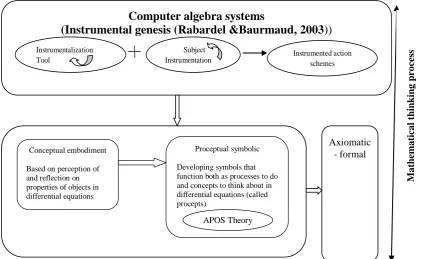
system, it is suggested to have a theoretical framework including instrumental
genesis (Rabardel and Bourmaud, 2003) and the Three Worlds of Mathematics (Tall,
2008), which consists of constructivism. The Three Worlds of Mathematics includes
the APOS Theory (Cornu and Dubinsky, 1989) to construct mathematics knowledge
by students. The Three Worlds of Mathematics is a mature theory that includes the
APOS Theory(Action-process-object-schema); however, the APOS Theory focuses
almost exclusively on symbolic compression and not on visual insight. Instrumental
genesis facilitates this shortcoming.
1.6.1 APOS Theory: a Constructivist Theory of Learning Mathematics
The common constructivist belief reflects that mathematics can be
constructed by the autonomous minds of students, and, in reality, there is not much
difference between their struggle with mathematics and that of mathematicians and
scientists (Czarnocha and Maj, 2006). Constructivism is the theory of the acquisition
of the knowledge in which pupils construct their knowledge using interactions,
conflicts and re-equilibrations consisting of mathematical concepts, other students,
and problems. Teachers manage the interactions as the fundamental choice (Tall,
1991).
Reflective abstraction is a powerful tool to study the mathematical thinking,
which explains the construction of mathematical knowledge by a person during the
cognitive development process. Originally, it was introduced by Piaget (Dubinsky,
1991) who noted that it was important for higher mathematics and that it was related
to the construction of the mental objects and mental actions concerning those objects.
The APOS theory was an attempt to realize the mechanism of reflective abstraction,
which tries to explain a child's development of logical thinking and extend it to
problems is considered as the student’s mathematical knowledge through reflecting
on mathematical problems and their solutions in a social context and through
constructing or re-constructing mathematical actions, processes, and objects and
organizing these into schemas to deal with the situations (Asiala et al., 1996).
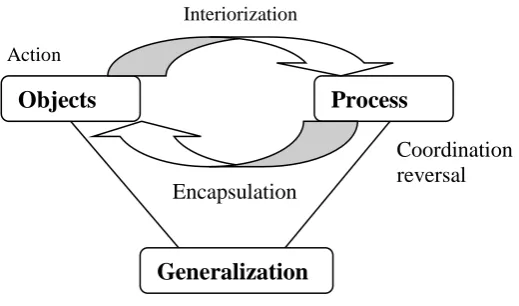
Based on the APOS Theory, an action is considered to be a physical or
mental change of objects to construct other objects, which may be a multi-step
response to an external stimulus that the individual perceives. The individual may
establish conscious control concerning the responses, which is called interiorized
action and will become a process. Therefore, a process is a transformation of objects,
which, by the individual reflections, will become an object. Consequently, the
encapsulation of a process leads to the construction of an object when the individual
is becoming aware of the process (Cottrill et al., 1996). A set of objects and processes is considered as a schema. An individual’s subject plays a critical role in
promoting a schema to understand a perceived situation, which forms an individual
mathematics concept. Therefore, a person has various kinds of schemas; for example,
number, arithmetic, function, and proof by induction (Dubinsky, 1991).
The organization of a schema is shown in Figure 1.1. Some internal
constructions, interiorized action, are developed in relation to an action. Thus, an
interiorized action is a process that allows one to be conscious of an action and
combine it to other actions. Reversing is another way to work with an existing
process to form new ones. If two or more processes are combined, then a new
process will be formed (Tall, 1991). These four components have been presented in
an ordered list; in some sense, each concept in the list must be constructed before the
next step is possible. However, in reality the construction of a concept is not actually
in such a linear manner (Dubinsky and Mcdonald, 2002).
The teaching and learning process, particularly in differential equations,
cannot be improved automatically using a computer in differential equations. It is
necessary to have a cognitive theory as an inseparable part of the design using a
computer in teaching and learning mathematics. Mathematics knowledge is
processes, in which the object explains the main aspect of mathematical
epistemology. Additionally, the time of reconstruction could be different due to the
requirements of the particular situation.
Figure 1.1 Encapsulation of Mathematics Knowledge (Dubinsky, 1991:33)
On one side, within the APOS Theory, teachers help learners to construct
appropriate mathematical mental structures. Moreover, students are guided to
construct their conceptual understanding of mathematics using the structures. On the other side, learning is assisted if the student’s mental structures are appropriate to a
given concept of mathematics. They discuss the results that they found and listen to
explanations of fellow students or the lecturer, which are about the meaning of the
mathematical concepts that they are working on (Dubinsky and Mcdonald, 2002). A
genetic decomposition assumes the particular actions, processes, and objects that
have an important role in constructing a mental schema for dealing with a given
mathematical situation.
1.6.2 Three Worlds of Mathematics
The recent work of Tall (2008) is about the transition in thinking from school
mathematics to formal mathematics at the university level, which is formulated as the
framework of the Three Worlds of Mathematics. Within the framework,
mathematical thinking develops in three different ways including conceptual
Objects Action
Process
Generalization
Coordination reversal
Interiorization
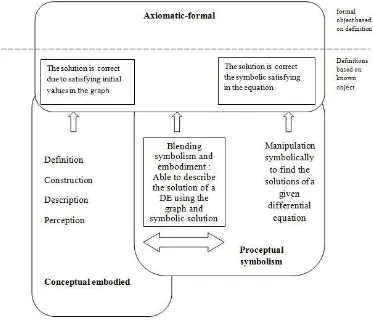
embodiment, operational symbolism, and axiomatic formalism. The conceptual
embodied world includes the perception of mathematics concepts, mathematical
action and thought, while the proceptual symbolic world comprises the calculations
based on mathematical symbols, and axiomatic-formal world including mathematical
abstraction and proofs.
Gray and Tall (2001) explained three (or possibly four) critical different types
of object. Empirical abstraction, which is the intended study of objects to discover
their properties, the pseudo-empirical abstraction that emphasizes actions, which are
symbolized and mentally understood as concepts. The last one is found in the
modern formalist approach to mathematics, which is formulated reflective abstraction based on Piaget’s belief. This can be seen as a refined version of
pseudo-empirical abstraction, which is the action on mental objects processed at a higher
level. The set-before refers to the mental structure that one was born with, for
example, the biological system to recognize a small number, up, down, and social
ability to interact with others. It can be classified set-befores into three parts that
mathematical development is based on them, including recognition of patterns,
similarities and differences; repetition of sequences of actions until they become
automatic; and the language for explaining and refining the way of thinking about
things (Tall, 2008). While personal development is based on previous experiences
that have been met before. A met-before is a structure that we have in our brains now
as a consequence of experiences that have been met before, such as prior knowledge,
the current knowledge in mathematics, and our expectation of learning mathematics
(Tall, 2013).
Sometimes a met-before, the current mental facility, based on an individual’s
previous experiences, are consistent with a new situation that can be supportive in a
new situation, and sometimes inconsistent, which causes mental confusion that
hinders the learning process of new concepts (Tall, 2008). Conceptual embodiment
develops as the individual matures constructing from objects perception, description,
and through construction and definition, for example, the definition and order of a
differential equation. Other embodied concepts, such as a graph, follow next. It is
axioms using set-theoretic formal proof that the cognitive development of a concept
moves fully to a formal-axiomatic approach. Therefore, conceptual embodiment
refers not only to how thinking is embodied, but more particularly to proceptual
representations of mathematical concepts, as shown in Figure 1.2. Three worlds
describe movement form
Figure 1.2 Three Worlds of Mathematics in learning differential equations (Tall,
1992:8)
multiple representation in mathematics. The use of symbols that arise from
performing an action schema is referred to as proceptual symbolism; for example,
counting is a thinkable concept, such as numbers. For example, 3+2 shows the
process to become a thinkable concept generated by that process. Symbol, process,
and concept are combined through constructing the process, which is called an
elementary procept; a collection of elementary procepts with the same output concept
by Dubinsky in the APOS Theory based on the theory of Piaget and was used in
programming mathematical constructions in a symbolic development (Dubinsky and
Mcdonald, 2002). Axiomatic formalism considers the formalism of Hilbert, which is
beyond the formal operations of Piaget (Tall, 2008).
The main distinction between the elementary mathematics of embodiment
and symbolism is that the definitions in elementary mathematics come from
experience with objects whose properties are described and used as definitions, while
formal presentations in formal mathematics start with set-theoretic definitions and
deduce other properties using formal proof (Tall, 2013). Students do not cope with
moving into the Three Worlds of Mathematics in the same manner. For example,
some operate procedurally within the world of operational symbolism. However,
they may be less proficient in dealing with symbols as manipulatable concepts.
While some students may build naturally from embodied and symbolic experience,
others may build naturally based on written definitions. Other students may try to
pass examinations by learning proofs procedurally in an axiomatic formal world
(Kaput, 1992).
1.6.3 Instrumental Genesis
Before the advent of the computer, the teaching philosophy was based on the French “didactic triangle”, which showed the relationship between the pupil, the
teacher and mathematics. The introduction of the computer adds a new dimension
into the learning situation. Now, there are four components, which may form a
tetrahedron in an appropriate educational context
(student-teacher-mathematics-learner). It is assumed that the computer has appropriate software that represents
mathematics and makes it as explicit as possible. It shows the processes of the
mathematics as well as the final results of any calculation (Tall, 1986b).
In respect of using ICT, seven out of nine papers that were submitted to ICMI
Study 17 offered an instrumental approach as the main part of the theoretical
were used in research including CASs or educational studies linked to computer
technologies. However, they tended to be somewhat distant from the constructivism
approaches. They believed that anthropological socio-cultural approaches were more
sensitive to the role that instruments play in mathematical activities and rehabilitate
in technical work (Artigue, 2002). The theoretical underpinnings of the instrumental
approach to use tools consist of elements from both the anthropological theory of
didactics (Bosh and Chevallard, 1999) and cognitive ergonomics (Verillon and
Rabardel, 1995). There are two directions within instrumental genesis that are linked
with these two frameworks. Along the line of the cognitive ergonomic framework,
the development of schemes is central for instrumental genesis, which is related to
the cognitive and psychological perspectives. Researchers in the line with an
anthropological focus on the techniques by which users develop during use
technological tools and in social interaction (Artigue, 2002). Chevallard’s (1999)
anthropological approach has been viewed by French CAS researchers, Artigue
(2002) and Lagrange (1999), in mathematical activities and practices in which
techniques have found wider meaning in that the practices are described in terms of
tasks, techniques, technology and theory. These Ts can be categorized into two sets:
technology and theory are referred to as knowledge itself; and task and technique, which focuses on “know-how” related to a specific theory and technology
(Monaghan, 2007). Therefore, they believe that the technique refers to the manner
for solving a task including a complex assembly of reasoning and routine action
(Drijvers et al., 2010).
Clearly, the use of a tool does not happen in a vacuum, in that tools are
applied in an act, practice or a context. However, how individuals look at activities
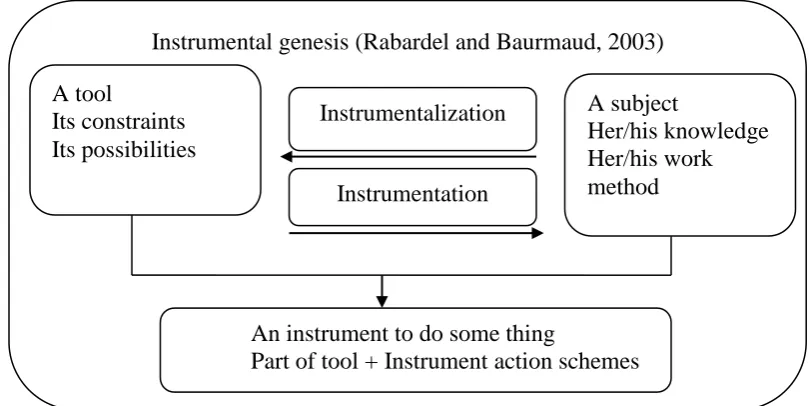
and practices is very important. Instrumental genesis is formed through duality
between the instrumentalization and instrumentation processes. The former is
directed toward the artifact and the latter is directed toward the behavior of the
subject (See Figure 1.3). Precisely, an instrument can be regarded as an extension of
two components. First, the body, which is a functional organ formed of an artifact
component, such as an artifact or part of an artifact organized in the activity, and,
second, the psychological component, made up of this organ called instrumental
genesis, which is a complex process related to the characteristics of the artifact, such
former method of working. The psychological component is referred to as a scheme,
which is as invariant organization of behavior in a situation.
Figure 1.3 Instrumentation of two instrumentations and instrumentalization (Trouche, 2004:144)
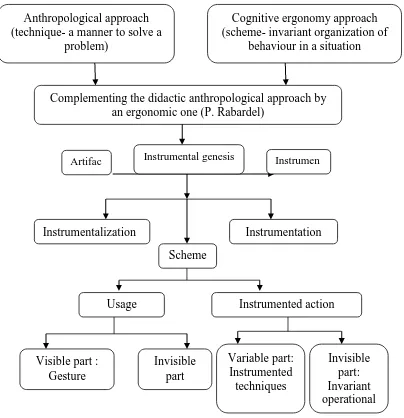
A scheme has some main functions: a pragmatic function, which allows the
agent to do something; a heuristic function that allows the agent to anticipate and
plan actions; and an epistemic function, which allows the agent to understand what
they are doing (Trouche, 2004). A scheme has a purpose and an aim, which
constitutes a dynamic functional entity (see Figure 1.4). These function and
dynamics can be understood through considering all of the components, such as the
goal and the anticipation, the rule of action, of gathering information, of control
taking and the operative invariants.
The implicit knowledge within the schemes are referred to as the operative
invariants, on the other hand, theorem-in-action, which are related to the concepts,
are believed to be implicitly relevant and supposed to be true (Trouche, 2003). The
utilization schemes have two levels: the usage scheme of an artifact, which refers to
the management of the artifact, such as turning on a calculator, adjusting the screen
contrast, choosing a particular key; and the instrumented action scheme, which is
related to carrying out a specific task or is oriented by activity (Verillon and
Rabardel, 1995; Trouche, 2004), such as computing a function’s limit. Some parts of Instrumental genesis (Rabardel and Baurmaud, 2003)
A A tool
Its constraints Its possibilities
Instrumentalization
Instrumentation
A subject
Her/his knowledge Her/his work method
An instrument to do some thing
the formation of schemes are visible; for example, a gesture is an elementary
behavior of students,
Figure 1.4 Instrumental genesis process including all parts
which may be observed in usage schemes, moreover, instrumented technique
as observable of instrumented action schemes (Trouche, 2003). For example, what
can be described for limit computation by teachers in a CAS environment (Trouche,
2005).
Visible part : Gesture
Invisible part
Variable part: Instrumented
techniques
Invisible part: Invariant operational Anthropological approach
(technique- a manner to solve a problem)
Cognitive ergonomy approach (scheme- invariant organization of
behaviour in a situation
Complementing the didactic anthropological approach by an ergonomic one (P. Rabardel)
Instrumental genesis Artifac
t
Instrumen
t
Instrumentation Instrumentalization
Scheme s
Instrumented action schemes Usage