The problem of ontology alignment on the web: a first report
Davide Fossati and Gabriele Ghidoni and Barbara Di Eugenio
and Isabel Cruz and Huiyong Xiao and Rajen Subba
Computer Science University of Illinois
Chicago, IL, USA
[email protected], [email protected], [email protected] [email protected], [email protected], [email protected]
Abstract
This paper presents a general architec-ture and four algorithms that use Natu-ral Language Processing for automatic on-tology matching. The proposed approach is purely instance based, i.e., only the instance documents associated with the nodes of ontologies are taken into account. The four algorithms have been evaluated using real world test data, taken from the Google and LookSmart online directories. The results show that NLP techniques ap-plied to instance documents help the sys-tem achieve higher performance.
1 Introduction
Many fundamental issues about the viability and exploitation of the web as a linguistic corpus have not been tackled yet. The web is a massive reposi-tory of text and multimedia data. However, there is not a systematic way of classifying and retrieving these documents. Computational Linguists are of course not the only ones looking at these issues; research on the Semantic Web focuses on pro-viding a semantic description of all the resources on the web, resulting into a mesh of information linked up in such a way as to be easily process-able by machines, on a global scale. You can think of it as being an efficient way of representing data on the World Wide Web, or as a globally linked database.1 The way the vision of the Semantic Web will be achieved, is by describing each doc-ument using languages such as RDF Schema and OWL, which are capable of explicitly expressing the meaning of terms in vocabularies and the rela-tionships between those terms.
1http://infomesh.net/2001/swintro/
The issue we are focusing on in this paper is that these languages are used to define ontologies as well. If ultimately a single ontology were used to describe all the documents on the web, sys-tems would be able to exchange information in a transparent way for the end user. The availability of such a standard ontology would be extremely helpful to NLP as well, e.g., it would make it far easier to retrieve all documents on a certain topic. However, until this vision becomes a reality, a plu-rality of ontologies are being used to describe doc-uments and their content. The task of automatic ontology alignmentormatching(Hughes and Ash-pole, 2005) then needs to be addressed.
The task of ontology matching has been typi-cally carried out manually or semi-automatitypi-cally, for example through the use of graphical user in-terfaces (Noy and Musen, 2000). Previous work has been done to provide automated support to this time consuming task (Rahm and Bernstein, 2001; Cruz and Rajendran, 2003; Doan et al., 2003; Cruz et al., 2004; Subba and Masud, 2004). The various methods can be classified into two main categories: schema based and instance based.
Schema basedapproaches try to infer the seman-tic mappings by exploiting information related to the structure of the ontologies to be matched, like their topological properties, the labels or descrip-tion of their nodes, and structural constraints de-fined on the schemas of the ontologies. These methods do not take into account the actual data classified by the ontologies. On the other hand,
instance basedapproaches look at the information contained in the instances of each element of the schema. These methods try to infer the relation-ships between the nodes of the ontologies from the analysis of their instances. Finally, hybrid
methods into integrated systems.
Neither instance level information, nor NLP techniques have been extensively explored in pre-vious work on ontology matching. For exam-ple, (Agirre et al., 2000) exploits documents (in-stances) on the WWW to enrich WordNet (Miller et al., 1990), i.e., to compute “concept signatures,” collection of words that significantly distinguish one sense from another, however, not directly for ontology matching. (Liu et al., 2005) uses doc-uments retrieved via queries augmented with, for example, synonyms that WordNet provides to im-prove the accuracy of the queries themselves, but not for ontology matching. NLP techniques such as POS tagging, or parsing, have been used for ontology matching, but on the names and defini-tions in the ontology itself, for example, in (Hovy, 2002), hence with a schema based methodology.
In this paper, we describe the results we ob-tained when using some simple but effective NLP methods to align web ontologies, using an instance based approach. As we will see, our results show that more sophisticated methods do not necessar-ily lead to better results.
2 General architecture
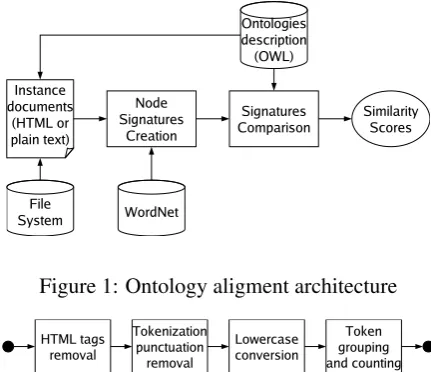
The instance based approach we propose uses NLP techniques to compute matching scores based on the documents classified under the nodes of ontologies. There is no assumption on the struc-tural properties of the ontologies to be compared: they can be any kind of graph representable in OWL. The instance documents are assumed to be text documents (plain text or HTML).
The matching process starts from a pair of on-tologies to be aligned. The two onon-tologies are traversed and, for each node having at least one instance, the system computes a signature based on the instance documents. Then, the signatures associated to the nodes of the two ontologies are compared pairwise, and a similarity score for each pair is generated. This score could then be used to estimate the likelihood of a match between a pair of nodes, under the assumption that the se-mantics of a node corresponds to the sese-mantics of the instance documents classified under that node. Figure 1 shows the architecture of our system.
The two main issues to be addressed are (1) the representation of signatures and (2) the def-inition of a suitable comparison metric between signatures. For a long time, the Information
Re-Ontologies description (OWL)
Instance documents
(HTML or plain text)
Node Signatures
Creation
Signatures
Comparison SimilarityScores
File
[image:2.595.307.523.62.248.2]System WordNet
Figure 1: Ontology aligment architecture
HTML tags removal
Tokenization punctuation removal
Lowercase conversion
Token grouping and counting
Figure 2: Baseline signature creation
trieval community has succesfully adopted a “bag of words” approach to effectively represent and compare text documents. We start from there to define a general signature structure and a metric to compare signatures.
Asignature is defined as a functionS : K → R+, mapping a finite set of keys (which can be complex objects) to positive real values. With a signature of that form, we can use thecosine sim-ilaritymetric to score the similarity between two signatures:
simil(S1, S2) =
P
pS1(kp)S2(kp)
q P
iS1(ki)2·
q P
jS2(kj)2
kp∈K1∩K2, ki∈K1, kj ∈K2
The cosine similarity formula produces a value in the range [0, 1]. The meaning of that value de-pends on the algorithm used to build the signa-ture. In particular, there is no predefined thresh-old that can be used to discriminate matches from non-matches. However, such a threshold could be computed a-posteriori from a statistical analysis of experimental results.
2.1 Signature generation algorithms
For our experiments, we defined and implemented four algorithms to generate signatures. The four algorithms make use of text and language process-ing techniques of increasprocess-ing complexity.
2.1.1 Algorithm 1: Baseline signature
HTML tags removal
Tokenization punctuation
removal
Lowercase conversion
[image:3.595.310.525.61.130.2]Noun grouping and counting POS tagging
Figure 3: Noun signature creation
HTML tags are first removed from the in-stance documents. Then, the texts are tokenized and punctuation is removed. Everything is then converted to lowercase. Finally, the tokens are grouped and counted. The final signature has the form of a mapping tabletoken→frequency.
The main problem we expected with this method is the presence of a lot of noise. In fact, many “irrelevant” words, like determiners, prepo-sitions, and so on, are added to the final signature.
2.1.2 Algorithm 2: Noun signature
To cope with the problem of excessive noise, people in IR often use fixed lists of stop words
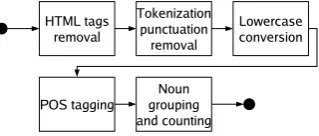
to be removed from the texts. Instead, we intro-duced a syntax based filter in our chain of pro-cessing. The main assuption is that nouns are the words that carry most of the meaning for our kind of document comparison. Thus, we introduced a part-of-speech tagger right after the tokeniza-tion module (Figure 3). The results of the tagger are used to discard everything but nouns from the input documents. The part-of-speech tagger we used –QTAG 3.1 (Tufis and Mason, 1998), readily available on the web as a Java library– is a Hidden Markov Model based statistical tagger.
The problems we expected with this approach are related to the high specialization of words in natural language. Different nouns can bear simi-lar meaning, but our system would treat them as if they were completely unrelated words. For exam-ple, the words “apple” and “orange” are semanti-cally closer than “apple” and “chair,” but a purely syntactic approach would not make any difference between these two pairs. Also, the current method does not include morphological processing, so dif-ferent inflections of the same word, such as “ap-ple” and “apples,” are treated as distinct words.
In further experiments, we also considered verbs, another syntactic category of words bearing a lot of semantics in natural language. We com-puted signatures with verbs only, and with verbs and nouns together. In both cases, however, the
HTML tags removal
Tokenization punctuation removal
Lowercase conversion
Synsets grouping and counting POS tagging
Noun lookup on WordNet
Synsets hierarchical
expansion Noun
grouping and counting
Figure 4: WordNet signature creation
performance of the system was worse. Thus, we will not consider verbs in the rest of the paper.
2.1.3 Algorithm 3: WordNet signature
To address the limitations stated above, we used the WordNet lexical resource (Miller et al., 1990). WordNet is a dictionary where words are linked together by semantic relationships. In Word-Net, words are grouped into synsets, i.e., sets of synonyms. Each synset can have links to other synsets. These links represent semantic relation-ships like hypernymy, hyponymy, and so on.
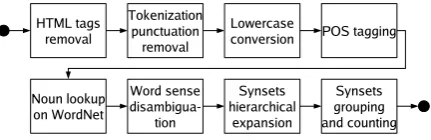
In our approach, after the extraction of nouns and their grouping, each noun is looked up on WordNet (Figure 4). The synsets to which the noun belongs are added to the final signature in place of the noun itself. The signature can also be enriched with the hypernyms of these synsets, up to a specified level. The final signature has the form of a mappingsynset→value, wherevalueis a weighted sum of all the synsets found.
Two important parameters of this method are related to the hypernym expansion process men-tioned above. The first parameter is the maximum level of hypernyms to be added to the signature (hypernym level). A hypernym level value of 0 would make the algorithm add only the synsets of a word, without any hypernym, to the signature. A value of 1 would cause the algorithm to add also their parents in the hypernym hierarchy to the sig-nature. With higher values, all the ancestors up to the specified level are added. The second parame-ter,hypernym factor, specifies the damping of the weight of the hypernyms in the expansion process. Our algorithm exponentially dampens the hyper-nyms, i.e., the weigth of a hypernym decreases ex-ponentially as its level increases. The hypernym factor is the base of the exponential function.
[image:3.595.102.262.62.130.2]HTML tags removal
Tokenization punctuation removal
Lowercase conversion
Synsets grouping and counting POS tagging
Noun lookup on WordNet
Synsets hierarchical
expansion Word sense
[image:4.595.74.290.61.131.2]disambigua-tion
Figure 5: Disambiguated signature creation
sense is the most appropriate, so all the senses of a word are added to the final signature, with a weight inversely proportional to the number of possible senses of that word. This fact poten-tially introduces semantic noise in the signature, because many irrelevant senses might be added to the signature itself.
Another limitation is that a portion of the nouns in the source texts cannot be located in WordNet (see Figure 6). Thus, we also tried a variation (al-gorithm 3+2) that falls back on to the bare lexi-cal form of a noun if it cannot be found in Word-Net. This variation, however, resulted in a slight decrease of performance.
2.1.4 Algorithm 4: Disambiguated signature
The problem of having multiple senses for each word calls for the adoption of word sense dis-ambiguation techniques. Thus, we implemented a word sense disambiguator algorithm, and we inserted it into the signature generation pipeline (Figure 5). For each noun in the input documents, the disambiguator takes into account a specified number of context words, i.e., nouns preceding and/or following the target word. The algorithm computes a measure of thesemantic distance be-tween the possible senses of the target word and the senses of each of its context words, pair-wise. A sense for the target word is chosen such that the total distance to its context is minimized. Thesemantic distancebetween two synsets is de-fined here as the minimum number of hops in the WordNet hypernym hierarchy connecting the two synsets. This definition allows for a rela-tively straightforward computation of the seman-tic distance using WordNet. Other more sophisti-cated definitions of semantic distance can be found in (Patwardhan et al., 2003). The word sense disambiguation algorithm we implemented is cer-tainly simpler than others proposed in the litera-ture, but we used it to see whether a method that is relatively simple to implement could still help.
The overall parameters for this signature
cre-ation algorithm are the same as the WordNet sig-nature algorithm, plus two additional parameters for the word sense disambiguator: left context lengthandright context length. They represent re-spectively how many nouns before and after the target should be taken into account by the dis-ambiguator. If those two parameters are both set to zero, then no context is provided, and the first possible sense is chosen. Notice that even in this case the behaviour of this signature generation al-gorithm is different from the previous one. In a WordNet signature, every possible sense for a word is inserted, whereas in a WordNet disam-biguated signature only one sense is added.
3 Experimental setting
All the algorithms described in the previous sec-tion have been fully implemented in a coherent and extensible framework using the Java program-ming language, and evaluation experiments have been run. This section describes how the experi-ments have been conducted.
3.1 Test data
The evaluation of ontology matching approaches is usually made difficult by the scarceness of test ontologies readily available in the community. This problem is even worse for instance based ap-proaches, because the test ontologies need also to be “filled” with instance documents. Also, we wanted to test our algorithms with “real world” data, rather than toy examples.
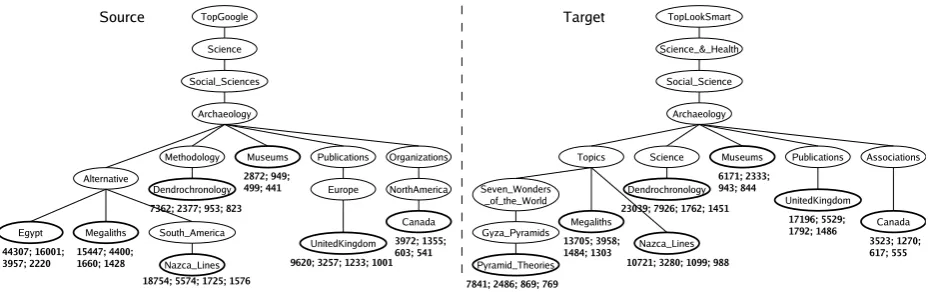
Fig-ure 6. The darker outlined nodes are those filled with instance documents. For the sake of readabil-ity, the names of the nodes corresponding to real matches are the same. Of course, this informa-tion is not used by our algorithms, which adopt a purely instance based approach. Figure 6 also re-ports the size of the instance documents associated to each node: total number of words, noun tokens, nouns, and nouns covered by WordNet.
3.2 Parameters
The experiments have been run with several com-binations of the relevant parameters: number of instance documents per node (5 or 10), algorithm (1 to 4), extracted parts of speech (nouns, verbs, or both), hypernym level (an integer value equal or greater than zero), hypernym factor (a real num-ber), and context length (an integer number equal or greater than zero). Not all of the parameters are applicable to every algorithm. The total number of runs was 90.
4 Results
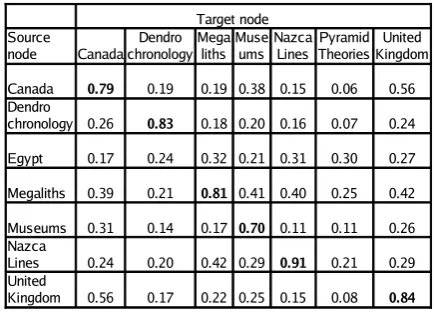
Each run of the system with our test ontologies produced a set of 49 values, representing the matching score of every pair of nodes containing instances across the two ontologies. Selected ex-amples of these results are shown in Tables 1, 2, 3, and 4. In the experiments shown in those ta-bles, 10 instance documents for each node were used to compute the signatures. Nodes that ac-tually match (identified by the same label, e.g., “Canada” and “Canada”) should show high sim-ilarity scores, whereas nodes that do not match (e.g., “Canada” and “Dendrochronology”), should have low scores. Better algorithms would have higher scores for matching nodes, and lower score for non-matching ones. Notice that the two nodes “Egypt” and “Pyramid Theories,” although intu-itively related, have documents that take different perspectives on the subject. So, the algorithms correctly identify the nodes as being different.
Looking at the results in this form makes it dif-ficult to precisely assess the quality of the algo-rithms. To do so, a statistical analysis has to be performed. For each table of results, let us parti-tion the scores in two distinct sets:
A={simil(nodei, nodej)|real match=true}
B ={simil(nodei, nodej)|real match=f alse}
Target node
Canada
Canada 0.95 0.89 0.89 0.91 0.87 0.86 0.92
0.90 0.97 0.91 0.90 0.88 0.87 0.92
Egypt 0.86 0.89 0.91 0.87 0.86 0.88 0.90
Megaliths 0.90 0.91 0.99 0.93 0.95 0.94 0.93
Museums 0.89 0.88 0.90 0.93 0.88 0.87 0.90
0.88 0.88 0.95 0.91 0.99 0.93 0.91
0.87 0.87 0.86 0.88 0.82 0.82 0.96 Source
node chronologyDendro Megaliths Museums Nazca Lines Pyramid TheoriesKingdomUnited
Dendro chronology
[image:5.595.308.525.80.234.2]Nazca Lines United Kingdom
Table 1: Results – Baseline signature algorithm
Target node
Canada
Canada 0.67 0.20 0.14 0.35 0.08 0.08 0.41
0.22 0.80 0.15 0.22 0.09 0.09 0.25
Egypt 0.13 0.23 0.26 0.22 0.17 0.24 0.25
Megaliths 0.28 0.20 0.85 0.37 0.22 0.27 0.33
Museums 0.30 0.19 0.18 0.58 0.08 0.14 0.27
0.13 0.12 0.26 0.18 0.96 0.14 0.17
0.42 0.20 0.17 0.26 0.09 0.11 0.80 Source
node chronologyDendro Megaliths Museums Nazca Lines TheoriesPyramid KingdomUnited
Dendro chronology
[image:5.595.308.524.313.467.2]Nazca Lines United Kingdom
Table 2: Results – Noun signature algorithm
Target node
Canada
Canada 0.79 0.19 0.19 0.38 0.15 0.06 0.56
0.26 0.83 0.18 0.20 0.16 0.07 0.24
Egypt 0.17 0.24 0.32 0.21 0.31 0.30 0.27
Megaliths 0.39 0.21 0.81 0.41 0.40 0.25 0.42
Museums 0.31 0.14 0.17 0.70 0.11 0.11 0.26
0.24 0.20 0.42 0.29 0.91 0.21 0.29
0.56 0.17 0.22 0.25 0.15 0.08 0.84 Source
node chronologyDendro Megaliths Museums Nazca Lines Pyramid TheoriesKingdomUnited
Dendro chronology
Nazca Lines United Kingdom
[image:5.595.307.525.544.700.2]TopGoogle
Science
Social_Sciences
Archaeology
Egypt
Alternative
Megaliths South_America
Nazca_Lines Methodology
Dendrochronology
Museums Publications
Europe
UnitedKingdom
Organizations
NorthAmerica
Canada
TopLookSmart
Science_&_Health
Social_Science
Archaeology
Pyramid_Theories Topics
Megaliths
Nazca_Lines Science
Dendrochronology
Museums Publications
UnitedKingdom
Associations
Canada Seven_Wonders
_of_the_World
Gyza_Pyramids
Source Target
44307; 16001;
3957; 2220 15447; 4400;1660; 1428
18754; 5574; 1725; 1576 7362; 2377; 953; 823
2872; 949; 499; 441
9620; 3257; 1233; 1001 3972; 1355;
603; 541 3523; 1270;617; 555
23039; 7926; 1762; 1451
13705; 3958; 1484; 1303
6171; 2333; 943; 844
10721; 3280; 1099; 988
7841; 2486; 869; 769
[image:6.595.73.538.61.207.2]17196; 5529; 1792; 1486
Figure 6: Ontologies used in the experiments. The numbers below the leaves indicate the size of instance documents: # of words; # of noun tokens; # of nouns; # of nouns in WordNet
Target node
Canada
Canada 0.68 0.18 0.13 0.33 0.12 0.05 0.44
0.23 0.79 0.15 0.20 0.14 0.07 0.23
Egypt 0.15 0.23 0.28 0.22 0.27 0.31 0.27
Megaliths 0.30 0.18 0.84 0.37 0.34 0.27 0.33
Museums 0.29 0.16 0.15 0.60 0.11 0.10 0.24
0.20 0.17 0.38 0.26 0.89 0.21 0.26
0.45 0.17 0.18 0.24 0.15 0.08 0.80 Source
node chronologyDendro Megaliths Museums Nazca Lines TheoriesPyramid KingdomUnited
Dendro chronology
Nazca Lines United Kingdom
Table 4: Results – Disambiguated signature al-gorithm (hypernym level=0, left context=1, right context=1)
With our test data, we would have 6 values in set A and 43 values in setB. Then, let us com-pute average and standard deviation of the values included in each set. The average ofArepresents the expected score that the system would assign to a match; likewise, the average ofB is the ex-pected score of a non-match. We define the fol-lowing measure to compare the performance of our matching algorithms, inspired by “effect size” from (VanLehn et al., 2005):
discrimination size= avg(A)−avg(B)
stdev(A) +stdev(B)
[image:6.595.75.289.269.424.2]Higher discrimination values mean that the scores assigned to matches and non-matches are more “far away,” making it possible to use those scores to make more reliable decisions about the matching degree of pairs of nodes.
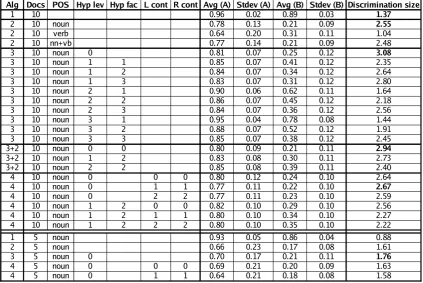
Table 5 shows the values of discrimination size (last column) out of selected results from our ex-periments. The algorithm used is reported in the first column, and the values of the other relevant parameters are indicated in other columns. We can make the following observations.
• Algorithms 2, 3, and 4 generally outperform the baseline (algorithm 1).
• Algorithm 2 (Noun signature), which still uses a fairly simple and purely syntactical technique, shows a substantial improvement. Algorithm 3 (WordNet signature), which in-troduces some additional level of semantics, has even better performance.
• In algorithms 3 and 4, hypernym expansion looks detrimental to performance. In fact, the best results are obtained with hypernym level equal to zero (no hypernym expansion).
• The word sense disambiguator implemented in algorithm 4 does not help. Even though disambiguating with some limited context (1 word before and 1 word after) provides slightly better results than choosing the first available sense for a word (context length equal to zero), the overall results are worse than adding all the possible senses to the sig-nature (algorithm 3).
• Using only 5 documents per node signifi-cantly degrades the performance of all the al-gorithms (see the last 5 lines of the table).
5 Conclusions and future work
Alg Docs POS Hyp lev Hyp fac L cont R cont Avg (A) Stdev (A) Avg (B) Stdev (B) Discrimination size
1 10 0.96 0.02 0.89 0.03 1.37
2 10 noun 0.78 0.13 0.21 0.09 2.55
2 10 verb 0.64 0.20 0.31 0.11 1.04 2 10 nn+vb 0.77 0.14 0.21 0.09 2.48 3 10 noun 0 0.81 0.07 0.25 0.12 3.08
3 10 noun 1 1 0.85 0.07 0.41 0.12 2.35 3 10 noun 1 2 0.84 0.07 0.34 0.12 2.64 3 10 noun 1 3 0.83 0.07 0.31 0.12 2.80 3 10 noun 2 1 0.90 0.06 0.62 0.11 1.64 3 10 noun 2 2 0.86 0.07 0.45 0.12 2.18 3 10 noun 2 3 0.84 0.07 0.36 0.12 2.56 3 10 noun 3 1 0.95 0.04 0.78 0.08 1.44 3 10 noun 3 2 0.88 0.07 0.52 0.12 1.91 3 10 noun 3 3 0.85 0.07 0.38 0.12 2.45 3+2 10 noun 0 0 0.80 0.09 0.21 0.11 2.94
3+2 10 noun 1 2 0.83 0.08 0.30 0.11 2.73 3+2 10 noun 2 2 0.85 0.08 0.39 0.11 2.40 4 10 noun 0 0 0 0.80 0.12 0.24 0.10 2.64 4 10 noun 0 1 1 0.77 0.11 0.22 0.10 2.67
4 10 noun 0 2 2 0.77 0.11 0.23 0.10 2.59 4 10 noun 1 2 0 0 0.82 0.10 0.29 0.10 2.56 4 10 noun 1 2 1 1 0.80 0.10 0.34 0.10 2.27 4 10 noun 1 2 2 2 0.80 0.10 0.35 0.10 2.22 1 5 noun 0.93 0.05 0.86 0.04 0.88 2 5 noun 0.66 0.23 0.17 0.08 1.61 3 5 noun 0 0.70 0.17 0.21 0.11 1.76
[image:7.595.87.511.65.348.2]4 5 noun 0 0 0 0.69 0.21 0.20 0.09 1.63 4 5 noun 0 1 1 0.64 0.21 0.18 0.08 1.58
Table 5: Results – Discrimination size
some more specific and some more general. As regards the more specific issues,
• Algorithm 2 does not perform morphological processing, whereas Algorithm 3 does. How much of the improved effectiveness of Algo-rithm 3 is due to this fact? To answer this question, Algorithm 2 could be enhanced to include a morphological processor.
• The effectiveness of Algorithms 3 and 4 may be hindered by the fact that many words are not yet included in the WordNet database (see Figure 6). Falling back on to Algorithm 2 proved not to be a solution. The impact of the incompleteness of the lexical resource should be investigated and assessed more precisely. Another venue of research may be to exploit different thesauri, such as the ones automati-cally derived as in (Curran and Moens, 2002).
• The performance of Algorithm 4 might be improved by using more sophisticated word sense disambiguation methods. It would also be interesting to explore the application of the unsupervised method described in (Mc-Carthy et al., 2004).
As regards our long term plans, first, structural properties of the ontologies could potentially be exploited for the computation of node signatures. This kind of enhancement would make our system move from a purely instance based approach to a combined hybrid approach based on schema and instances.
More fundamentally, we need to address the lack of appropriate, domain specific resources that can support the training of algorithms and models appropriate for the task at hand. WordNet is a very general lexicon that does not support domain spe-cific vocabulary, such as that used in geosciences or in medicine or simply that contained in a sub-ontology that users may define according to their interests. Of course, we do not want to develop by hand domain specific resources that we have to change each time a new domain arises.
abootstrappedmodel (Riloff and Jones, 1999; Ng and Cardie, 2003)—in ML, bootstrapping requires to seed the classifier with a small number of well chosen target examples. We could develop a web spider, based on the work described on this paper, to automatically retrieve larger amounts of train-ing and test data, that in turn could be processed with more sophisticated NLP techniques.
Acknowledgements
This work was partially supported by NSF Awards IIS–0133123, IIS–0326284, IIS–0513553, and ONR Grant N00014–00–1–0640.
References
Eneko Agirre, Olatz Ansa, Eduard Hovy, and David Martinez. 2000. Enriching very large ontologies
using the WWW. In ECAI Workshop on Ontology
Learning, Berlin, August.
Isabel F. Cruz and Afsheen Rajendran. 2003.
Ex-ploring a new approach to the alignment of
ontolo-gies. In Workshop on Semantic Web Technologies
for Searching and Retrieving Scientific Data, in co-operation with the International Semantic Web Con-ference.
Isabel F. Cruz, William Sunna, and Anjli Chaudhry.
2004. Semi-automatic ontology alignment for
geospatial data integration. GIScience, pages 51–
66.
James Curran and Marc Moens. 2002.
Improve-ments in automatic thesaurus extraction. In
Work-shop on Unsupervised Lexical Acquisition, pages 59–67, Philadelphia, PA, USA.
AnHai Doan, Jayant Madhavan, Robin Dhamankar, Pe-dro Domingos, and Alon Halevy. 2003. Learning to
match ontologies on the semantic web. VLDB
Jour-nal, 12(4):303–319.
J´erˆome Euzenat, Heiner Stuckenschmidt, and
Mikalai Yatskevich. 2005. Introduction
to the ontology alignment evaluation 2005.
http://oaei.inrialpes.fr/2005/results/oaei2005.pdf.
Eduard Hovy. 2002. Comparing sets of semantic rela-tions in ontology. In R. Green, C. A. Bean, and S. H. Myaeng, editors,Semantics of Relationships: An In-terdisciplinary Perspective, pages 91–110. Kluwer.
T. C. Hughes and B. C. Ashpole. 2005. The semantics
of ontology alignment. Draft Paper, Lockheed
Mar-tin Advanced Technology Laboratories, Cherry Hill, NJ. http://www.atl.lmco.com/projects/ontology/ pa-pers/ SOA.pdf.
Thomas K. Landauer, Peter W. Foltz, and Darrell La-ham. 1998. Introduction to Latent Semantic Analy-sis.Discourse Processes, 25:259–284.
Shuang Liu, Clement Yu, and Weiyi Meng. 2005.
Word sense disambiguation in queries. In ACM
Conference on Information and Knowledge Man-agement (CIKM2005), Bremen, Germany.
Diana McCarthy, Rob Koeling, Julie Weeds, and John Carroll. 2004. Finding predominant word senses in
untagged text. In 42nd Annual Meeting of the
As-sociation for Computational Linguistics, Barcelona, Spain.
G. A. Miller, R. Beckwith, C. Fellbaum, D. Gross, and K. J. Miller. 1990. Introduction to wordnet: an on-line lexical database. International Journal of Lexi-cography, 3 (4):235–244.
Vincent Ng and Claire Cardie. 2003. Bootstrapping coreference classifiers with multiple machine
learn-ing algorithms. In The 2003 Conference on
Em-pirical Methods in Natural Language Processing (EMNLP-2003).
Natalya Fridman Noy and Mark A. Musen. 2000.
Prompt: Algorithm and tool for automated ontology
merging and alignment. InNational Conference on
Artificial Intelligence (AAAI).
Siddharth Patwardhan, Satanjeev Banerjee, and Ted
Pedersen. 2003. Using semantic relatedness for
word sense disambiguation. InFourth International
Conference on Intelligent Text Processing and Com-putational Linguistics (CiCLING-03), Mexico City.
Erhard Rahm and Philip A. Bernstein. 2001. A sur-vey of approaches to automatic schema matching.
VLDB Journal, 10(4):334–350.
Ellen Riloff and Rosie Jones. 1999. Learning dic-tionaries for information extraction by multi-level
bootstrapping. InAAAI-99, Sixteenth National
Con-ference on Artificial Intelligence.
Rajen Subba and Sadia Masud. 2004. Automatic gen-eration of a thesaurus using wordnet as a means to map concepts. Tech report, University of Illinois at Chicago.
Dan Tufis and Oliver Mason. 1998. Tagging romanian texts: a case study for qtag, a language independent probabilistic tagger. In First International Confer-ence on Language Resources & Evaluation (LREC), pages 589–596, Granada, Spain.