Simple Information Extraction (SIE):
A Portable and Effective IE System
Claudio Giuliano and Alberto Lavelli and Lorenza Romano ITC-irst
Via Sommarive, 18 38050, Povo (TN)
Italy
{giuliano,lavelli,romano}@itc.it
Abstract
This paper describes SIE (Simple Infor-mation Extraction), a modular inforInfor-mation extraction system designed with the goal of being easily and quickly portable across tasks and domains. SIE is composed by a general purpose machine learning algo-rithm (SVM) combined with several cus-tomizable modules. A crucial role in the architecture is played by Instance Filter-ing, which allows to increase efficiency without reducing effectiveness. The re-sults obtained by SIE on several standard data sets, representative of different tasks and domains, are reported. The experi-ments show that SIE achieves performance close to the best systems in all tasks, with-out using domain-specific knowledge.
1 Introduction
In designing Information Extraction (IE) systems based on supervised machine learning techniques, there is usually a tradeoff between carefully tun-ing the system to specific tasks and domains and having a ”generic” IE system able to obtain good (even if not the topmost) performance when ap-plied to different tasks and domains (requiring a very reduced porting time). Usually, the former alternative is chosen and system performance is often shown only for a very limited number of tasks (sometimes even only for a single task), af-ter a careful tuning. For example, in the Bio-entity Recognition Shared Task at JNLPBA 2004 (Kim et al., 2004) the best performing system obtained a considerable performance improvement adopt-ing domain specific hacks.
A second important issue in designing IE sys-tems concerns the fact that usually IE data sets are
highly unbalanced (i.e., the number of positive ex-amples constitutes only a small fraction with re-spect to the number of negative examples). This fact has important consequences. In some ma-chine learning algorithms the unbalanced distri-bution of examples can yield a significant loss in classification accuracy. Moreover, very large data sets can be problematic to process due to the com-plexity of many supervised learning techniques. For example, using kernel methods, such as word sequence and tree kernels, can become prohibitive due to the difficulty of kernel based algorithms, such as Support Vector Machines (SVM) (Cortes and Vapnik, 1995), to scale to large data sets. As a consequence, reducing the number of instances without degrading the prediction accuracy is a cru-cial issue for applying advanced machine learning techniques in IE, especially in the case of highly unbalanced data sets.
In this paper, we present SIE (Simple Informa-tion ExtracInforma-tion), an informaInforma-tion extracInforma-tion system based on a supervised machine learning approach for extracting domain-specific entities from docu-ments. In particular, IE is cast as a classification problem by applying SVM to train a set of classi-fiers, based on a simple and general-purpose fea-ture representation, for detecting the boundaries of the entities to be extracted.
SIE was designed with the goal of being easily and quickly portable across tasks and domains. To support this claim, we conducted a set of exper-iments on several tasks in different domains and languages. The results show that SIE is competi-tive with the state-of-the-art systems, and it often outperforms systems customized to a specific do-main.
How-ever, a key difference between the two algorithms is the capability of SIE to drastically reduce the computation time by exploiting Instance Filtering (Gliozzo et al., 2005a). This characteristic allows scaling from toy problems to real-world data sets making SIE attractive in applicative fields, such as bioinformatics, where very large amounts of data have to be analyzed.
2 A Simple IE system
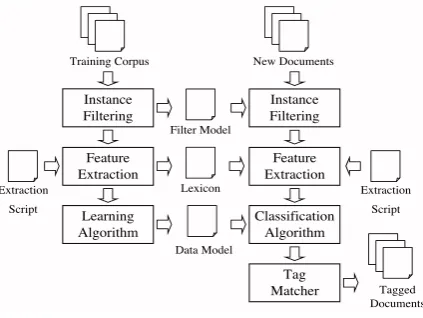
SIE has a modular system architecture. It is com-posed by a general purpose machine learning algo-rithm combined with several customizable com-ponents. The system components are combined in a pipeline, where each module constrains the data structures provided by the previous ones. This modular specification brings significant ad-vantages. Firstly, a modular architecture is sim-pler to implement. Secondly, it allows to easily integrate different machine learning algorithms. Finally, it allows, if necessary, a fine tuning to a specific task by simply specializing few mod-ules. Furthermore, it is worth noting that we tested SIE across different domains using the same basic configuration without exploiting any domain spe-cific knowledge, such as gazetteers, and ad-hoc
pre/post-processing.
Instance Filtering
Feature Extraction
Learning Algorithm
Tag Matcher Classification
Algorithm Instance Filtering
Feature Extraction
Lexicon
Training Corpus New Documents
Data Model
Tagged Documents Filter Model
Extraction Script
Extraction Script
Figure 1: The SIE Architecture.
The architecture of the system is shown in Fig-ure 1. The information extraction task is per-formed in two phases. SIE learns off-line a set of data models from a specified labeled corpus, then the models are applied to tag new documents.
In both phases, the Instance Filtering module (Section 3) removes certain tokens from the data set in order to speed-up the whole process, while
Feature Extraction module (Section 4) is used to extract a pre-defined set of features from the to-kens. In the training phase, the Learning Mod-ule (Section 5) learns two distinct models for each entity, one for the beginning boundary and an-other for the end boundary (Ciravegna, 2000; Fre-itag and Kushmerick, 2000). In the recognition phase, as a consequence, the Classification mod-ule (Section 5) identifies the entity boundaries as distinct token classifications. A Tag Matcher mod-ule (Section 6) is used to match the boundary pre-dictions made by the Classification module. Tasks with multiple entities are considered as multiple independent single-entity extraction tasks (i.e. SIE only extracts one entity at a time).
3 Instance Filtering
The purpose of the Instance Filtering (IF) mod-ule is to reduce the data set size and skewness by discarding harmful and superfluous instances without degrading the prediction accuracy. This is a generic module that can be exploited by any supervised system that casts IE as a classification problem.
Instance Filtering (Gliozzo et al., 2005a) is based on the assumption that uninformative words are not likely to belong to entities to recognize, being their information content very low. A naive implementation of this assumption consists in fil-tering out very frequent words in corpora because they are less likely to be relevant than rare words. However, in IE relevant entities can be composed by more than one token and in some domains a few of such tokens can be very frequent in the corpus. For example, in the field of bioinformatics, protein names often contain parentheses, whose frequency in the corpus is very high.
To deal with this problem, we exploit a set of In-stance Filters (calledStop Word Filters), included in a Java tool called jInFil1. These filters per-form a “shallow” supervision to identify frequent words that are often marked as positive examples. The resulting filtering algorithm consists of two stages. First, the set of uninformative tokens is identified by training the term filtering algorithm on the training corpus. Second, instances describ-ing “uninformative” tokens are removed from both the training and the test sets. Note thatinstances
are not really removed from the data set, but just
1http://tcc.itc.it/research/textec/
marked as uninformative. In this way the learning algorithm will not learn from these instances, but they will still appear in the feature description of the remaining instances.
A Stop Word Filter is fully specified by a list of stop words. To identify such a list, different fea-ture selection methods taken from the text rization literature can be exploited. In text catego-rization, feature selection is used to remove non-informative terms from representations of texts. In this sense, IF is closely related to feature selection: in the former non-informative words are removed from theinstance set, while in the latter they are removed from thefeature set. Below, we describe the different metrics used to collect a stop word list from the training corpora.
Information Content (IC) The most commonly used feature selection metric in text categoriza-tion is based on document frequency (i.e, the num-ber of documents in which a term occurs). The basic assumption is that very frequent terms are non-informative for document indexing. The fre-quency of a term in the corpus is a good indica-tor of its generality, rather than of its information content. From this point of view, IF consists of removing all tokens with a very low information content2.
Correlation Coefficient (CC) In text catego-rization theχ2statistic is used to measure the lack of independence between a term and a category (Yang and Pedersen, 1997). The correlation coef-ficientCC2 =χ2
of a term with the negative class can be used to find those terms that are less likely to express relevant information in texts.
Odds Ratio (OR) Odds ratio measures the ra-tio between the odds of a term occurring in the positive class, and the odds of a term occurring in the negative class. In text categorization the idea is that the distribution of the features on the rel-evant documents is different from the distribution on non-relevant documents (Raskutti and Kowal-czyk, 2004). Following this assumption, a term is non-informative when its probability of being a negative example is sensibly higher than its prob-ability of being a positive example (Gliozzo et al., 2005b).
2The information content of a wordwcan be measured
by estimating its probability from a corpus by the equation I(w) =−p(w) logp(w).
An Instance Filter is evaluated by using two metrics: the Filtering Rate (ψ), the total percent-age of filtered tokens in the data set, and the Pos-itive Filtering Rate (ψ+), the percentage of
pos-itive tokens (wrongly) removed. A filter is opti-mized by maximizingψand minimizingψ+; this allows us to reduce as much as possible the data set size preserving most of the positive instances. We fixed the accepted level of tolerance () onψ+
and found the maximum ψby performing 5-fold cross-validation on the training set.
4 Feature Extraction
The Feature Extraction module is used to extract for each input token a pre-defined set of features. As said above, we consider each token an instance to be classified as a specific entity boundary or not. To perform Feature Extraction an applica-tion called jFex3 was implemented. jFex gener-ates the features specified by a feature extraction script, indexes them, and returns the example set, as well as the mapping between the features and their indices (lexicon). If specified, it only ex-tracts features for the instances not marked as “un-informative” by instance filtering. jFex is strongly inspired by FEX (Cumby and Yih, 2003), but it introduces several improvements. First of all, it provides an enriched feature extraction language. Secondly, it makes possible to further extend this language through a Java API, providing a flexi-ble tool to define task specific features. Finally, jFex can output the example set in formats di-rectly usable by LIBSVM (Chang and Lin, 2001), SVMlight (Joachims, 1998) and SNoW (Carlson et al., 1999).
4.1 Corpus Format
The corpus must be prepared inIOBEnotation, a extension of theIOBnotation. Both notations do not allow nested and overlapping entities. Tokens outside entities are tagged with O, while the first token of an entity is tagged withB-entity-type, the last token is tagged E-entity-type, and all the to-kens inside the entity boundaries are tagged with
I-entity-type, where entity-type is the type of the marked entity (e.g. protein, person).
Beside the tokens and their types, the nota-tion allows to represent general purpose and task-specific annotations defining new columns. Blank
3http://tcc.itc.it/research/textec/
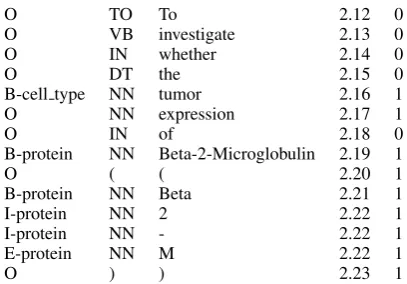
lines can be used to specify sentence or document boundaries. Table 1 shows an example of a pre-pared corpus. The columns are: the entity-type, the PoS tag, the actual token, the token index, and the output of the instance filter (the “uninforma-tive” tokens are marked with0) respectively.
O TO To 2.12 0
O VB investigate 2.13 0 O IN whether 2.14 0
O DT the 2.15 0
B-cell type NN tumor 2.16 1 O NN expression 2.17 1
O IN of 2.18 0
B-protein NN Beta-2-Microglobulin 2.19 1
O ( ( 2.20 1
B-protein NN Beta 2.21 1 I-protein NN 2 2.22 1 I-protein NN - 2.22 1 E-protein NN M 2.22 1
O ) ) 2.23 1
Table 1: A corpus fragment represented inIOBE
notation.
4.2 Extraction Language
As input to the beginandendclassifiers, we use a bit-vector representation. Each instance is rep-resented encoding all the following basic features for the actual token and for all the tokens in a con-text window of fixed size (in the reported experi-ments, 3 words before and 3 words after the actual token):
Token The actual token.
POS The Part of Speech (PoS) of the token.
Token Shapes This feature maps each token into equivalence classes that encode attributes such ascapitalization,numerals,single char-acter, and so on.
Bigrams of tokens and PoS tags.
The Feature Extraction language allows to formally encode the above problem description through a script. Table 2 provides the extraction script used in all the tasks4. More details about the Extraction Language are provided in (Cumby and Yih, 2003; Giuliano et al., 2005).
4In JNLPBA shared task we added some orthographic
fea-tures borrowed from the bioinformatics literature.
-1 inc loc: w [-3, 3]
-1 inc loc: coloc(w,w) [-3, 3] -1 inc loc: t [-3, 3]
-1 inc loc: coloc(t,t) [-3, 3] -1 inc loc: sh [-3, 3]
Table 2: The extraction script used in all tasks.
5 Learning and Classification Modules
As already said, we approach IE as a tion problem, assigning an appropriate classifica-tion label to each token in the data set except for the tokens marked as irrelevant by the instance fil-ter. As learning algorithm we use SVM-light5. In particular, we identify the boundaries that indi-cate the beginning and the end of each entity as two distinct classification tasks, following the ap-proach adopted in (Ciravegna, 2000; Freitag and Kushmerick, 2000). All tokens that begin(end) an entity are considered positive instances for the be-gin(end) classifier, while all the remaining tokens are negative instances. In this way, two distinct models are learned, one for the beginning bound-ary and another for the end boundbound-ary. All the pre-dictions produced by thebeginandendclassifiers are then paired by the Tag Matcher module.
When we have to deal with more than one en-tity (i.e., with a multi-class problem) we train2n
binary classifiers (wherenis the number of entity-typesfor the task). Again, all the predictions are paired by the Tag Matcher module.
6 Tag Matcher
All the positive predictions produced by thebegin
andendclassifiers are paired by the Tag Matcher module. If nested or overlapping entities occur, even if they are of different types, the entity with the highest score is selected. The score of each entity is proportional to the entity length probabil-ity (i.e., the probabilprobabil-ity that an entprobabil-ity has a certain length) and the scores assigned by the classifiers to the boundary predictions. Normalizing the scores makes it possible to consider the score function as a probability distribution. The entity length distri-bution is estimated from the training set.
For example, in the corpus fragment of Table 3 the beginandend classifiers have identified four possible entity boundaries for the speaker of a seminar. In the table, the left column shows the
Table 3: A corpus fragment with multiple predic-tions.
O The
O speaker O will
O be
B-speaker Mr. B-speaker (0.23)
I-speaker John B-speaker (0.1), E-speaker (0.12)
E-speaker Smith E-speaker (0.34)
O .
Table 4: The length distribution for the entity
speaker.
entity len 1 2 3 4 5 ...
P(entity len) 0.10 0.33 0.28 0.02 0.01 ...
actual label, while the right column shows the pre-dictions and their normalized scores. The match-ing algorithm has to choose among three mutu-ally exclusive candidates: “Mr. John”, “Mr. John Smith” and “John Smith”, with scores 0.23 × 0.12×0.33 = 0.009108,0.23×0.34×0.28 = 0.021896and0.1×0.34×0.33 = 0.01122, re-spectively. The length distribution for the entity
speakeris shown in Table 4. In this example, the matcher, choosing the candidate that maximizes the score function, namely the second one, extracts the actual entity.
7 Evaluation
In order to demonstrate that SIE is domain and language independent we tested it on several tasks using exactly the same configuration. The tasks and the experimental settings are described in Sec-tion 7.1. The results (SecSec-tion 7.2) show that the adopted filtering technique decreases drastically the computation time while preserving (and some-times improving) the overall accuracy of the sys-tem.
7.1 The Tasks
SIE was tested on the following IE benchmarks:
JNLPBA Shared Task This shared task (Kim et al., 2004) is an open challenge task proposed at the “International Joint Workshop on Natural Language Processing in Biomedicine and its Ap-plications”6. The data set consists of2,404 MED-LINE abstracts from the GENIA project (Kim et
6http://research.nii.ac.jp/∼collier/
workshops/JNLPBA04st.htm.
al., 2003), annotated with five entity types: DNA,
RNA, protein, cell-line, and cell-type. The GE-NIA corpus is split into two partitions: training (492,551 tokens), and test (101,039 tokens). The fraction of positive examples with respect to the total number of tokens in the training set varies from 0.2% to 6%.
CoNLL 2002 & 2003 Shared Tasks These shared tasks (Tjong Kim Sang, 2002; Tjong Kim Sang and De Meulder, 2003)7 concern language-independent named entity recognition. Four types of named entities are considered: persons (PER), locations (LOC), organizations (ORG) and names of miscellaneous (MISC) en-tities that do not belong to the previous three groups. SIE was applied to the Dutch and English data sets. The Dutch corpus is divided into three partitions: training and validation (on the whole 258,214tokens), and test (73,866 tokens). The fraction of positive examples with respect to the total number of tokens in the training set varies from1.1%to2%. The English corpus is divided into three partitions: training and validation (on the whole274,585tokens), and test (50,425 to-kens). The fraction of positive examples with re-spect to the total number of tokens in the training set varies from1.6%to3.3%.
TERN 2004 The TERN (Time Expression Recognition and Normalization) 2004 Evaluation8 requires systems to detect and normalize temporal expressions occurring in English text (SIE did not address the normalization part of the task). The TERN corpus is divided into two partitions: train-ing (249,295 tokens) and test (72,667 tokens). The fraction of positive examples with respect to the total number of tokens in the training set is about 2.1%.
Seminar Announcements The Seminar An-nouncements (SA) collection (Freitag, 1998) con-sists of 485 electronic bulletin board postings. The purpose of each document in the collection is to announce or relate details of an upcoming talk or seminar. The documents were annotated for four entities: speaker, location, stime, andetime. The corpus is composed by156,540tokens. The frac-tion of positive examples varies from about1%to
7http://www.cnts.ua.ac.be/conll2002/
ner/, http://www.cnts.ua.ac.be/conll2003/ ner/.
Metric ψtrain/test R P F1 T
0 66.4 67.0 66.7 615 CC 1 64.1/62.3 67.5 67.3 67.4 420 2.5 80.1/78.0 66.6 69.1 67.8 226 5 88.9/86.4 64.8 68.1 66.4 109 OR 1 70.7/68.9 68.3 67.3 67.8 308 2.5 81.0/79.1 67.5 68.3 67.9 193 5 87.8/85.6 65.4 68.2 66.8 114 IC 1 37.3/36.9 58.5 65.7 61.9 570 2.5 38.4/38.0 56.9 65.4 60.9 558 5 39.5/38.9 55.6 65.5 60.1 552 Zhou and Su (2004) 76.0 69.4 72.6 baseline 52.6 43.6 47.7
Table 5: Filtering Rate, Micro-averaged Recall, Precision,F1and Time forJNLPBA.
Metric ψtrain/test R P F1 T
0 73.6 78.7 76.1 134 CC 1 64.4/64.4 71.6 79.9 75.5 70
2.5 75.1/73.3 72.8 80.3 76.4 50 5 88.6/84.2 66.6 64.7 65.6 24 OR 1 71.5/71.6 72.0 78.3 75.0 61 2.5 82.1/80.7 73.6 78.9 76.2 39 5 90.5/86.1 66.8 64.5 65.6 19 IC 1 47.3/47.5 67.0 79.2 72.6 101
2.5 51.3/51.5 65.9 79.3 72.0 95 5 55.7/56.0 63.8 78.9 70.5 89 Carreras et al. (2002) 76.3 77.8 77.1 baseline 45.4 81.3 58.3
Table 6: Filtering Rate, Micro-averaged Recall, Precision, F1 and total computation time for
CoNLL-2002 (Dutch).
about2%. The entire document collection is ran-domly partitioned five times into two sets of equal size, training and test (Lavelli et al., 2004). For each partition, learning is performed on the train-ing set and performance is measured on the corre-sponding test set. The resulting figures are aver-aged over the five test partitions.
7.2 Results
The experimental results in terms of filtering rate, recall, precision, F1, and computation time for
JNLPBA,CoNLL-2002, CoNLL-2003, TERN and
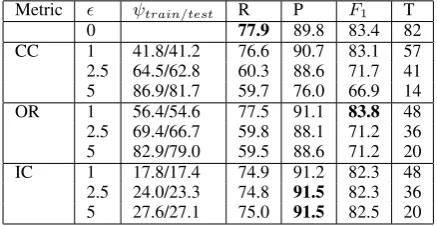
SAare given in Tables 5, 6, 7, 8 and 9 respectively. To show the differences among filtering strategies for JNLPBA, CoNLL-2002, TERN 2004 we used CC, OR and IC filters, while the results for SA
andCoNLL-2003 are reported only for OR filter (which usually produces the best performance). For all filters we report results obtained by set-ting four different values for parameter, the max-imum value allowed for the Filtering Rate of pos-itive examples.= 0means that no filter is used.
Metric ψtrain/test R P F1 T
0 76.7 90.5 83.1 228 OR 1 70.4/83.9 78.2 88.1 82.8 74
2.5 83.6/95.6 76.4 62.6 68.8 33 5 90.5/97.2 75.3 66.5 70.7 14 Florian et al. (2003) 88.5 89.0 88.8 baseline 50.9 71.9 59.6
Table 7: Filtering Rate, Micro-averaged Recall, Precision, F1 and total computation time for
CoNLL-2003 (English).
Metric ψtrain/test R P F1 T
0 77.9 89.8 83.4 82 CC 1 41.8/41.2 76.6 90.7 83.1 57 2.5 64.5/62.8 60.3 88.6 71.7 41 5 86.9/81.7 59.7 76.0 66.9 14 OR 1 56.4/54.6 77.5 91.1 83.8 48 2.5 69.4/66.7 59.8 88.1 71.2 36 5 82.9/79.0 59.5 88.6 71.2 20 IC 1 17.8/17.4 74.9 91.2 82.3 48 2.5 24.0/23.3 74.8 91.5 82.3 36 5 27.6/27.1 75.0 91.5 82.5 20
Table 8: Filtering Rate, Micro-averaged Recall, Precision, F1 and total computation time for
TERN.
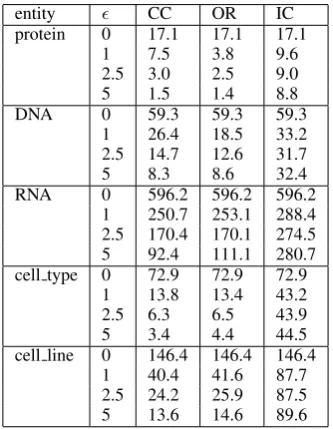
The results indicate that both CC and OR do ex-hibit good performance and are far better than IC in all the tasks. For example, in theJNLPBAdata set, OR allows to remove more than 70% of the in-stances, losing less than 1% of the positive exam-ples. These results pinpoint the importance of us-ing a supervised metric to collect stop words. The results also highlight that both CC and OR are ro-bust against overfitting, because the difference be-tween the filtering rates in the training and test sets is minimal. We also report a significant reduction of the data skewness. Table 10 shows that all the IF techniques reduce sensibly the skewness ratio, the ratio between the number of negative and positive examples, on the JNLPBA data set9. As expected, both CC and OR consistently outperform IC.
The computation time10 reported includes the time to perform the overall process of training and testing the boundary classifiers for each entity11. The results indicate that both CC and OR are far superior to IC, allowing a drastic reduction of the time. Supervised IF techniques are then
particu-9
We only report results for this data set as it exhibits the highest skewness ratios.
10
All the experiments have been performed using a dual 1.66 GHz Power Mac G5.
11Execution time for filter optimization is not reported
Metric ψtrain/test R P F1 T
0 81.3 92.5 86.6 179 OR 1 53.6/86.2 81.5 92.1 86.5 91
2.5 69.1/90.8 81.6 90.5 85.9 44 5 74.7/90.8 81.0 85.0 83.0 31
Table 9: Filtering Rate, Micro-averaged Recall, Precision,F1and total computation time forSA.
entity CC OR IC protein 0 17.1 17.1 17.1
1 7.5 3.8 9.6 2.5 3.0 2.5 9.0 5 1.5 1.4 8.8 DNA 0 59.3 59.3 59.3
1 26.4 18.5 33.2 2.5 14.7 12.6 31.7 5 8.3 8.6 32.4 RNA 0 596.2 596.2 596.2
1 250.7 253.1 288.4 2.5 170.4 170.1 274.5 5 92.4 111.1 280.7 cell type 0 72.9 72.9 72.9
1 13.8 13.4 43.2 2.5 6.3 6.5 43.9 5 3.4 4.4 44.5 cell line 0 146.4 146.4 146.4
1 40.4 41.6 87.7 2.5 24.2 25.9 87.5 5 13.6 14.6 89.6
Table 10: Skewness ratio of each entity for
JNLPBA.
larly convenient when dealing with large data sets. For example, using the CC metric the time re-quired by SIE to perform theJNLPBAtask is re-duced from 615 to 109 minutes (see Table 5).
Both OR and CC allow to drastically reduce the computation time and maintain the prediction accuracy12 with small values of . Using OR, for example, with = 2.5%on JNLPBA,F1 in-creases from 66.7% to 67.9%. On the contrary, for CoNLL-2002 and TERN, for > 2.5% and
> 1% respectively, the performance of all the filters rapidly declines. The explanation for this behavior is that, for the last two tasks, the differ-ence between the filtering rates on the training and test sets becomes much larger for > 2.5% and
> 1%, respectively. That is, the data skewness changes significantly from the training to the test set. It is not surprising that an extremely aggres-sive filtering step reduces too much the informa-tion available to the classifiers, leading the overall
12For JNLPBA, CoNLL 2002 & 2003 and Tern 2004,
re-sults are obtained using the official evaluation software made available by the organizers of the tasks.
performance to decrease.
SIE achieves results close to the best systems in all tasks13. It is worth noting that state-of-the-art IE systems often exploit external, domain-specific information (e.g. gazetteers (Carreras et al., 2002) and lexical resources (Zhou and Su, 2004)) while SIE adopts exactly the same feature set and does not use any external or task dependent knowledge source.
8 Conclusion and Future Work
The portability, the language independence and the efficiency of SIE suggest its applicability in practical problems (e.g. semantic web, infor-mation extraction from biological data) in which huge collections of texts have to be processed ef-ficiently. In this perspective we are pursuing the recognition of bio-entities from several thousands of MEDLINE abstracts. In addition, the effective-ness of instance filtering will allow us to experi-ment with complex kernel methods. For the fu-ture, we plan to implement more aggressive in-stance filtering schemata for Entity Recognition, by performing a deeper semantic analysis of the texts.
Acknowledgments
SIE was developed in the context of the IST-Dot.Kom project (http://www.dot-kom. org), sponsored by the European Commission as part of the Framework V (grant IST-2001-34038). Claudio Giuliano and Lorenza Romano have been supported by the ONTOTEXT project, funded by the Autonomous Province of Trento under the FUP-2004 research program.
References
Andrew J. Carlson, Chad M. Cumby, Jeff L. Rosen, and Dan Roth. 1999. SNoW user’s guide. Technical Report UIUCDCS-DCS-R-99-210, Department of Computer Science, University of Illinois at Urbana-Champaign, April.
Xavier Carreras, Llu´ıs M´arques, and Llu´ıs Padr´o. 2002. Named entity extraction using adaboost. In
Proceedings of CoNLL-2002, Taipei, Taiwan.
Chih-Chung Chang and Chih-Jen Lin, 2001. LIB-SVM: a library for support vector machines.
13Note that the TERN results cannot be disclosed, so no
Software available athttp://www.csie.ntu. edu.tw/∼cjlin/libsvm.
Fabio Ciravegna. 2000. Learning to tag for infor-mation extraction. In F. Ciravegna, R. Basili, and R. Gaizauskas, editors, Proceedings of the ECAI workshop on Machine Learning for Information Ex-traction, Berlin.
Corinna Cortes and Vladimir Vapnik. 1995. Support-vector networks. Machine Learning, 20(3):273– 297.
Chad Cumby and W. Yih. 2003. FEX user guide. Technical report, Department of Computer Science, University of Illinois at Urbana-Champaign, April.
Aidan Finn and Nicholas Kushmerick. 2004. Multi-level boundary classification for information extrac-tion. InProceedings of the 15th European Confer-ence on Machine Learning, Pisa, Italy.
Radu Florian, Abe Ittycheriah, Hongyan Jing, and Tong Zhang. 2003. Named entity recognition through classifier combination. In Walter Daele-mans and Miles Osborne, editors, Proceedings of CoNLL-2003, pages 168–171. Edmonton, Canada.
Dayne Freitag and Nicholas Kushmerick. 2000. Boosted wrapper induction. In Proceedings of the 17th National Conference on Artificial Intelligence (AAAI 2000), pages 577–583.
Dayne Freitag. 1998. Machine Learning for Informa-tion ExtracInforma-tion in Informal Domains. Ph.D. thesis, Carnegie Mellon University.
Claudio Giuliano, Alberto Lavelli, and Lorenza Ro-mano. 2005. Simple information extraction (SIE). Technical report, ITC-irst.
Alfio Massimiliano Gliozzo, Claudio Giuliano, and Raffaella Rinaldi. 2005a. Instance filtering for en-tity recognition. SIGKDD Explorations (special is-sue on Text Mining and Natural Language Process-ing), 7(1):11–18, June.
Alfio Massimiliano Gliozzo, Claudio Giuliano, and Raffaella Rinaldi. 2005b. Instance pruning by fil-tering uninformative words: an Information Extrac-tion case study. InProceedings of the Sixth Interna-tional Conference on Intelligent Text Processing and Computational Linguistics (CICLing-2005), Mexico City, Mexico, 13-19 February.
T. Joachims. 1998. Making large-scale support vector machine learning practical. In A. Smola B. Sch¨olkopf, C. Burges, editor, Advances in Ker-nel Methods: Support Vector Machines. MIT Press, Cambridge, MA.
J. Kim, T. Ohta, Y. Tateishi, and J. Tsujii. 2003. Ge-nia corpus - a semantically annotated corpus for bio-textmining. Bioinformatics, 19(Suppl.1):180–182.
J. Kim, T. Ohta, Y. Tsuruoka, Y. Tateisi, and N. Col-lier. 2004. Introduction to the bio-entity recog-nition task at JNLPBA. In N. Collier, P. Ruch, and A. Nazarenko, editors, Proceedings of the In-ternational Joint Workshop on Natural Language Processing in Biomedicine and its Applications (JNLPBA-2004), pages 70–75, Geneva, Switzer-land, August 28–29.
A. Lavelli, M. Califf, F. Ciravegna, D. Freitag, C. Giu-liano, N. Kushmerick, and L. Romano. 2004. IE evaluation: Criticisms and recommendations. In
AAAI-04 Workshop on Adaptive Text Extraction and Mining (ATEM-2004), San Jose, California.
Bhavani Raskutti and Adam Kowalczyk. 2004. Extreme re-balancing for SVMs: a case study.
SIGKDD Explor. Newsl., 6(1):60–69.
Erik F. Tjong Kim Sang and Fien De Meulder. 2003. Introduction to the CoNLL-2003 shared task: Language-independent named entity recognition. In Walter Daelemans and Miles Osborne, editors, Pro-ceedings of CoNLL-2003, pages 142–147. Edmon-ton, Canada.
Erik F. Tjong Kim Sang. 2002. Introduction to the CoNLL-2002 shared task: Language-independent named entity recognition. In Proceedings of CoNLL-2002, pages 155–158. Taipei, Taiwan.
Yiming Yang and Jan O. Pedersen. 1997. A compara-tive study on feature selection in text categorization. In Douglas H. Fisher, editor, Proceedings of the 14th International Conference on Machine Learning (ICML-97), pages 412–420, Nashville, US. Morgan Kaufmann Publishers, San Francisco, US.