Towards Automatic Grammar Acquisition from a Bracketed
Corpus
Thanaruk Theeramunkong
Japan Advanced Institute of
Science and Technology
Graduate School of Information Science
15 Asahidai Tatsunokuchi
Nomi Ishikawa 923-12 Japan
ping~j a i s t . ac. j p
Manabu Okumura
Japan Advanced Institute of
Science and Technology
Graduate School of Information Science
15 Asahidai Tatsunokuchi
Nomi Ishikawa 923-12 Japan
0ku@j a i s t . ac. j p
A b s t r a c t
In this paper, we propose a method to group brackets in a bracketed corpus (with lexical tags), according to their local contextual information, as a first step towards the automatic acquisition of a context-free grammar. Using a bracketed corpus, the learning task is reduced to the problem of how to determine the nonterminal label of each bracket in the corpus. In a grouping process, a single nonterminai label is assigned to each group of brackets which are similar. Two techniques,
distributional analysis and hierarchical Bayesian clustering, are applied to exploit local contextual information for computing similarity between two brackets. We also show a technique developed for determining the appropriate n u m b e r of bracket groups based on the concept of entropy analysis. Finally, we present a set of experimental results a n d evaluate the obtained results with a model solution given by humans.
1
I n t r o d u c t i o n
Designing and refining a n a t u r a l language g r a m m a r is a diiBcult and time-consuming task and re- quires a large amount of skilled effort. A hand-crafted grammar is usually not completely satisfactory and frequently fails to cover many unseen sentences. Automatic acquisition of grammars is a solu- tion to this problem. Recently, with the increasing availability of large, machine-readable, parsed corpora, there have been numerous attempts to automatically acquire a CFG g r a m m a r through the application of enormous existing corporaILar90][Mi194][Per92][Shi95 ].
Lari and Young[Lar90] proposed so-called inside-outside algorithm, which constructs a g r a m m a r from an unbracketed corpus based on probability theory. The grammar acquired by this method is assumed to be in Chomsky normal form and a large amount of computation is required. Later, Pereira[Per92] applied this algorithm to a partially bracketed corpus to improve the c o m p u t a t i o n time. Kiyono[Kiy94b][Kiy94a] combined symbolic a n d statistical approaches to extract useful gram- m a r rules from a partially bracketed corpus. To avoid generating a large n u m b e r of g r a m m a r rules, some basic grammatical constraints, local boundaries constraints and X bar-theory were applied. Kiyono's approach performed a refinement of an original g r a m m a r by adding some additional rules while the inside-outside algorithm tries to construct a whole grammar from a corpus based on Max- imum Likelihood. However, it is costly to obtain a suitable grammar from an unbracketed corpus and hard to evaluate results of these approaches. As the increase of the construction of brack- eted corpora, an a t t e m p t to use a bracketed (tagged) corpus for grammar inference was made by Shiral[Shi95]. Shirai constructed a Japanese g r a m m a r based on some simple rules to give a name (a label) to each bracket in the corpus. To reduce the grammar size and ambiguity, some hand-encoded knowledge is applied in this approach.
a bracketed corpus (with lexical tags), according to their local contextual information, as a first step towards the a u t o m a t i c acquisition of a context-free grammar. In the grouping process, a single nontermina] label is assigned to each group of brackets which are similar. To do this, we apply
and compare two types of techniques called distributional analysis[HarSl] and hierarchical Bayesian
clustering[Iwa95] for setting a measure representing similarity among the bracket groups. We also
propose a method to determine the appropriate number of bracket groups based on the concept of entropy analysis. Finally, we present a set of experimental results and evaluate our methods with a model solution given by humans.
2
G r a m m a r A c q u i s i t i o n w i t h a B r a c k e t e d C o r p u s
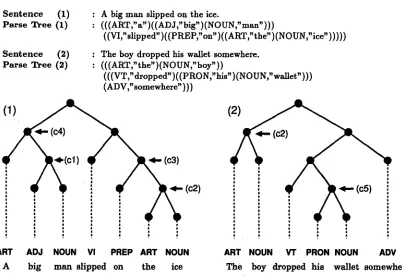
In this section, we give a brief explanation of g r a m m a r acquisition using a bracketed corpus. In this work, the g r a m m a r acquisition utilizes a lexical-tagged corpus with bracketings. An example of the parse structures of two sentences in the corpus is shown graphically in Figure 1.
S e n t e n c e (1) P a r s e T r e e (1)
S e n t e n c e (2) P a r s e T r e e (2)
: A big m a n slipped on the ice.
: ( ( ( A R T , " a " ) ((ADJ," b i g ' ) (NOUN," man")))
((VI," s l i p p e d " ) ( ( P R E P , " o n " ) ((ART,"the") (NOUN," i c e ' ) ) ) ) )
: The boy d r o p p e d his wallet somewhere. : ( ( ( A R T , " t h e " ) ( N O U N , " b o y ' ) )
( ( ( V T , " d r o p p e d " ) ( ( P R O g , " h i s " ) ( N O U N , " w a l l e t ' ) ) )
(AVV,"somewhere")))
m m • |
| t i |
ART ADJ NOUN Vl PREP ART NOUN ART NOUN VT PRON NOUN ADV
A b i g m a n s l i p p e d on t h e ice T h e boy d r o p p e d h i s w a l l e t s o m e w h e r e
F i g u r e 1: T h e g r a p h i c a l r e p r e s e n t a t i o n o f t h e p a r s e s t r u c t u r e s o f a big m a n slipped on the ice a n d the
boy dropped his wallet somewhere
In the parse structures, each terminal category (leaf node) is given a name (tag) while there is no label for each nonterminal category (intermediate node). W i t h this corpus, the g r a m m a r learning task corresponds to a process to determine the nonterminal label of each bracket in the corpus. More precisely, this t a s k is concerned with the way to classify the brackets into some certain groups and give each group a label. For instance, in Figure 1, it is reasonable to classify the brackets 1 (c2),(c4) and (c5) into a same group and give them a same label (e.g., NP(noun phrase)). As the result, we obtain three g r a m m a r rules: N P ~ ( A R T ) ( N O U N ) , N P ~ ( P R O N ) ( N O U N ) and
N P ~ ( A R T ) ( e l ) . To perform this task, our g r a m m a r acquisition algorithm operates in five stages
as follows.
1. Assign a unique label to each node of which lower nodes are assigned labels. At the initial step, such node is one whose lower nodes are lexical categories 2. This process is performed throughout all parse trees in the corpus.
1A bracket corresponds to a node in Figure 1.
~In Figure 1, there are three unique labels derived: el---~(ADJ)(NOUN), cc2-*(ART)(NOUN) and
[image:2.612.98.500.231.507.2]2. Calculate the similarity of every pair of the derived labels.
3. Merge the most similar pair to a single new label(i.e., a label group) and recalculate the similarity of this new label with other labels.
4. Repeat (3) until a termination condition is detected. As the result of this step, a certain set of label groups is derived.
5. Replace labels in each label group with a new label in the corpus. For example, if (ART)(NOUN) and (PRON)(NOUN) are in the same label group, we replace them with a new label (such as NP) in the whole corpus.
6. Repeat (1)-(5) until all brackets(nodes) in the corpus are assigned labels.
In this paper, as a first step of our grammar acquisition, we focus on step (1)-(4), t h a t is how to group nodes of which lower nodes are lexical categories. Figure 2 depicts a n example of the grouping process.
G3
I
(ADJ){NOUN) C1
•
- - - ~ - g l (rip without an article)(NOUN)(NOUN) C7 t
(ART)(NOUN) C2 t
(PRON)INOUN) C5 g2 (rip with an article) (INDEF)(NOUN) C6
I |
INDEF = { both, some, any .... }
ART = { a , the .... }
PRON = { my, his, her, their .... }
NOUN = {trip, newspaper .... }
ADJ = {high, available .... }
F i g u r e 2: A p a r t of t h e b r a c k e t g r o u p i n g process
To compute the similarity of a pair of labels(in step 2), we propose two types of techniques called
distributional analysis and hierarchical Bayesian cbtstering
as shown in section 3. In section 4, we introduce the concept ofdifferential entropy as
the termination condition used in step (4).3
L o c a l C o n t e x t u a l I n f o r m a t i o n a s S i m i l a r i t y M e a s u r e
I n this section, we describe two techniques which utilize "local context information" to calculate similarity between two labels. The term "local contextual information" considered here is repre- sented by a pair of words immediately before a n d after a label. In the rest of this section, we first describe
distributional analysis
in subsection 3.1. Next, we give the concept ofBayesian clustering
in subsection 3.2.
3 . 1 D i s t r i b u t i o n a l A n a l y s i s
Distributional analysis is a statistical method originally proposed by Harris[Harbl] to uncover reg- ularities in the distributional relations among the features of speech. Applications of this technique are varied[Bri92][Per93]. In this paper, we apply this technique to group similar brackets in a bracketed corpus. The detail of this technique is illustrated below.
Let P1 and P2 be two probability distributions over environments. The relative entropy between P1 a n d P2 is:
Pl(e)
D(PIlIP2)
= ~ P z ( e ) x logP~(e)
• E E n v ~ i r o ~ m ¢ ~ ' t s
R e l a t i v e e n t r o p y
D(PIlIP2 )
is a m e a s u r e o f t h e a m o u n t o f e x t r a i n f o r m a t i o n b e y o n d P 2 neededa pair of words immediately before and after a label(bracket). A pair o f labels is considered to be identical when they are distributionaliy similar, i.e., the divergence of their probability distributions over environments is low.
The probability distribution can be simply calculated by counting the occurrence of (c~) and
(word1 c~ words).
For the example in Figure 1, the numbers of appearances of (c1), (c2), (c5),(ART cz VI), (PREP c2 NULL) and (VT es ADV) are
collected from the whole corpus.NULL
stands for a blank tag representing the beginning or ending mark of a sentence.
S p a r s e D a t a C o n s i d e r a t i o n s
Utilizing divergence as a similarity measure, there is a serious problem caused by the sparseness of existing d a t a or the characteristic of language itself. In the formula of relative entropy, there is a possibility t h a t P2(e) becomes zero. In this condition, we cannot calculate the divergence of two probability distributions. To cope with this problem, we extend the original probability to one shown in the following formula.
P(ac~ b) = A N(ac~b) ~.(l_A)Nt~g
N(~)
s 2where,
N(a)
is the occurrence frequency of o~,Ntag8
is the number of terminal categories and A isa interpolation coefficient. The first term in the right part of the formula is the original estimated probability. The second term is generally called a uniform distribution, where the probability of an unseen event is estimated to a uniform fixed number. A is applied as a balancing weight between the observed distribution and the uniform distribution. Intuitively, when the size of d a t a is large, the small number should be used as A. In the experimental results in this paper, we assigned A with a value of 0.6.
3.2
Hierarchical Bayesian Clustering Method
As a probabilistic method, hierarchical Bayesian clustering was proposed by Iwaya~na[Iwa95] to automatically classify given texts. It was applied to improve the efficiency and the effectiveness of
text retrieval/categorization. Referring to this m e t h o d , w e try to make use of
Baycsiar~ posterior
probability as
another similarity measure for grouping the similar brackets. In this section, we conclude the concept of this measure as follows.Let's denote a posterior probability with
P(GIC),
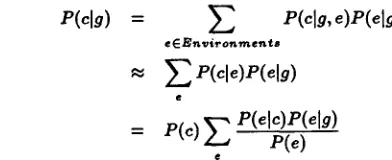
where C is a collection of d a t a (i.e., in Figure2, C = {c1,e2, ..., CN}) and G is a set of groups(clusters) (i.e., G =
{gz,g2,
...}). Each group(cluster) gj is a set of d a t a and the groups are mutually exclusive. In the initial stage, each group is a singleton set; g~ = {~} for all i. The m e t h o d tries t o select and merge the group pair t h a t brings about themaximum value of the posterior probability ~
P(GIC).
T h a t is, in each step of merging, this methodsearches for the most plausible situation t h a t the d a t a in C are partitioned in the certain groups G. For instance, at a merge step h + 1 (0 < b < N - 1), a d a t a collection C has been partitioned into a set of groups G~. T h a t is each d a t u m e belongs to a group g E Gk. The posterior probability at the merging step/¢ + 2 can be calculated using the posterior probability at the merging step/¢ + 1 as shown below (for more detail, see[Iwa95]).
PC(Gh)
SC(g=)SC(g,)
Here
PC(G~)
corresponds to the prior probability that N random d a t a are classified in to a set ofgroups O~. As for the factor of ~ P C ( G ~ ) ' a well known estimate[Ris89] is applied and it is reduced
to a constant value A -1 regardless of the merged pair. For a certain merging step,
P(G~IC )
isidentical independently of which groups are merged together. Therefore we can use the following measure to select the best group pair to merge. The similarity between two bracket groups(labels),
g= and gv, can be defined by
SIM(g=,gv).
Here, the largerSIM(g=,g~)
is, the more similar twobrackets are.
SO(g, U g,)
S I M ( g = , g , ) =
SC(g= )SC(g, )
SC(g) = I ~ P(elg)
cEg
=
~
P(clg, e)P(elg)
P(clg)
e E E n v i ~ o n w t c ~ t a ,~, E P(cle)p(elg)
e
P(elc) P(elg)
= P(c)
P(e)
where SC(g) expresses the probability that all the labels in a group g are produced from the group, an elementai probability P(c[g) means the probability that a group g produces its member c a n d
P(elc ) denotes a relative frequency of an environment e of a label e, P(elg ) means a relative frequency of an environment e of a group g and P(e) is a relative frequency of an environment e of the entire label set. I n the calculation of SIM(g=,gv), we can ignore the value of P(c) because it occurs Ig= U gvl times in both denominator and numerator. Normally, SIM(g=,gy) is ranged between 0 and 1 due to the fact t h a t P(c[g= U gy) _< P(clg= ) when c E g=.
4
D i f f e r e n t i a l E n t r o p y as T e r m i n a t i o n C o n d i t i o n
During iteratively merging the most similar labels, all labels will finally be gathered to a single group. Due to this, it is necessary to provide a criterion for determining whether this merging process should be continued or terminated. In this section, we describe a criterion n a m e d differential entropy which is a measure of entropy (perplexity) fluctuation before and after merging a pair of labels, Let cl a n d c2 be the most similar pair of labels based on divergence or Bayesia~u posterior probability. Also let c3 be the result label. P~i (e), Pc= (e) and Pc3(e) are probability distributions over environment e of cl, e2 and c3, respectively. Pc1, Pc= and P~3 are estimated probabilities of cl, c2 and c3, respectively. The differentiaJ entropy (Z~E) is defined as follows.
~ E = Consequence Entropy - Previous Entropy
= - P0~ x ~ P o ~ ( e ) l o g P o ~ ( e )
e
+ Po, x Po,(e)logPo,(e)
+ Po= x P0,(e)logPo,(e)
• e
where ~ , Pc~ (e) log Pc, (e) is the total entropy over various environments of label c~. The larger ~ E is, the larger the information fluctuation before aad after merging becomes. Generally, we prefer a small fluctuation to a larger one. When ZXE is large, the current merging process introduces a large amount of information fluctuation and its reliability should be low. From this viewpoint, we apply this measure as a criterion for determining the termination of the merging process which will be given in the next section.
5
P r e l i m i n a r y E x p e r i m e n t a l R e s u l t s
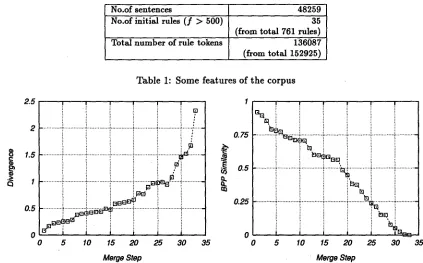
In this section, we show some results of our preliminary experiments to confirm effectiveness of the proposed techniques. The corpus we used is constructed by E D R and includes nearly 48,000 bracketed, tagged sentences[EDR94]. As mentioned in the previous sections, we focus on only the rules with lexical categories as their right hand side 4. For instance, cx --~ (ADJ)(NOUN), e2 --* (ART)(NOUN) and cs --* ( P R O N ) ( N O U N ) in Figure 1. To evaluate our method, we use the rule tokens which appear more t h a n 500 times in the corpus. Table I gives some characteristics of the corpus.
From the 35 initial rules, we calculate the similarity between any two rules (i.e., any rule pair) based on divergence and Bayesian posterior probability (BPP). For the divergence measure, the smaller the vaiue is, the more similar the rule pair is. Inversely, for BPP, the larger the value is, the more similar the pair looks. After calculating all pairs' similarities, we merge the most similar pair (the m i n i m u m divergence or the m a x i m u m B P P ) to a new label and recalculate the similarity of the new label with other remaining labels. The merging process is carried out in an iterative way. Figure 3 shows the m i n i m u m divergence (left) and the m a x i m u m Bayesian posterior probability (right) of each merge step.
[image:5.612.212.408.51.131.2]No.of sentences 48259
No.of initial rules (.f > 500) 35
(from total 761 rules)
Total n u m b e r of rule tokens 136087
(from total 152925)
Table 1: Some features of the corpus
8
==
2.5
i []
2 . . . ' . . . 4 . . . ~ . . . , . . . , . . . , . . . : . . .
1 5 . . . . .. ... .. ... . . . . . . . . . . .
1 . . . . . .
I
0.5 , ~ -" ~ B E ] ~
i
|
0 5 10 15 20 25 30 35
0.75
0.5
0.25
%
i ~ a G a "
0 5 10 15 20 25 30 35
Merge Step " Merge Step
Figure 3: The minimum divergence (left) and the maximum Bayesian posterior probability (right) of
each merge step
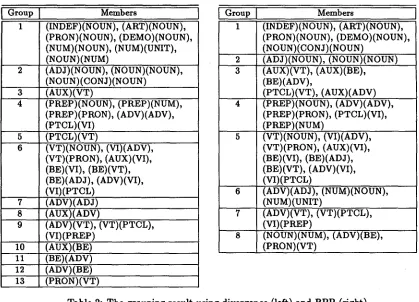
Two graphs in Figure 4 indicate the results of differential entropy (LXE calculated by the formula in section 4) when the merging process advanced with divergence and B P P as its similarity measures. There are some sharp peaks indicating the rapid fluctuation of entropy in the graphs. In this work, we use these peaks as a clue to find the timing we should to terminate the merging process. As the result, we halt up the process at the 22nd step and the 27th step for the cases of divergence and BPP, respectively. Table 2 shows the obtained grouping results. In these tables, there axe 13 groups for divergence and 8 groups for Bayesian posterior probability. To clarify the result in the tables, Some sample words of each label axe given in the appendix.
0.5
0.4
O.3
o.e
0 . 1
0
I
0 5 10 15 20 25 30 35
0.2 i
i
0.15 . . . "; ... ~'"'"J ...
i
/
/
0 5 10 15 20 25 30 35
Merge Step Merge Step
Figure 4: Differential entropy during the merging processes using divergence (left) and BPP (right)
[image:6.612.81.504.57.320.2] [image:6.612.89.504.471.638.2]Members
(INDEF)(NOUN), (ART)(NOUN), (PRON)(NOUN), (DEMO)(NOUN),
(NUM)(NOUN), (NUM)(UNIT),
(NOUN)(NUM)
(ADJ)(NOUN), (NOUN)(NOUN),
(NOUN)
(CONJ)(NOUN)
3 (AUX)(VT)
(PREP)(NOUN), (PREP)(NUM),
(PREP)(PRON), (ADV)(ADV),
(PTCL)(VI)
m I[ gDI
(VT)(NOUN), (VI)(ADV),
(VT)(PRON), (AUX)(VI),
(BE)(VI),
(BE)(VT),
(BE)(ADJ),
(ADV)(VI),
(VI)(PTCL)
7
(ADV)(ADJ)
8 (AUX)(ADV)
9 (ADV)(VT), ( V T ) ( P T G L ) ,
( V I ) ( P R E P )
10
(AUX)(BE)11 (BE)(ADV)
12
(ADV)(BE)
13
(PRON)(VT)
Members
1
(INDEF)(NOUN),
(ART)(NOUN),
(PRON)(NOUN), (DEMO)(NOUN),
(NOUN)(CONJ)(NOUN)
2
(ADJ)(NOUN),
(NOUN)(NOUN)
3
(AUX)(VT),
(AUX)(BE),
(BE)(ADV),
(PTCL)(VT), (AUX)(ADV)
4 ( P R E P ) ( N O U N ) , (ADV)(ADV),
(PREP)(PRON), (PTCL)(VI),
(PREP)(NUM)
5
(VT)(NOUN),
(Vl)(ADV),
(VT)(PRON), (AUX)(VI),
(BE)(Vl), (BE)(ADJ),
(BE)(VT), (ADV)(VI),
(VI)(PTCL)6
(ADV)(AD3),
(NUM)(NOUN),
(NUM)(UNIT)
7
(ADV)(VT),
(VT)(PTCL),
(VI)(PREP)
8
(NOUN)(NUM),
(ADV)(BE),
(PRON)(VT)
T a b l e 2: T h e g r o u p i n g r e s u l t u s i n g d i v e r g e n c e (left) a n d B P P ( f i g h t )
T h e system says Yes T h e system says No
T h e Evaluator's Answer
Yes ' No
a b
e d
Table 3: T h e n u m b e r o f e n t r y p a i r s for e v a l u a t i n g a c c u r a c y
To evaluate the system with the model solutions, we applied a contingency table model as one shown in Table 3. This table model was introduced in [Swe69] and widely used in Information Retrieval and Psychology. In the table, a is the number of the label pairs which an evaiuator assigned in the same group and so did t h e system, b is the number of the pairs which an evaluator did not assign in the same group but the system did, e is the number of the pairs which an evaluator assigned but t h e system did not, and d is the number of the pairs which b o t h an evaluator and t h e system did not assign in the same group. From this table, we define seven measures, as shown below, for evaluating performance of the proposed methods. This evaluation technique was also applied p a r t l y for computing "closeness" between a system's answer and an evaluator's answer in [Hat93][Aga95][Iwa95]
• P o s i t i v e R e c a l l ( P R ) :
• P o s i t i v e P r e c i s i o n ( P P ) :
d
• N e g a t i v e R e c a l l ( N R ) : ~+---~ • N e g a t i v e P r e c i s i o n ( N P ) : 7 ~
P R ~ N R
• A v e r a g e d R e c a l l ( A R ) : 2
PP.~.NP
• A v e r a g e d P r e c i s i o n ( A P ) : 2
(fl3-1-1)×PPxPR
• F - m e a s u r e ( F M ) : fla×PP+PR
[image:7.612.100.519.59.361.2] [image:7.612.210.421.383.432.2]Evaluator A
Evaluator B
Evaluator C
Averaged
Similaxity Measures
P R I P P NR NP A R A P FM
Divergence 0.91 i 0.70 0.96 0.99 0.93 0.84 0.79
B P P 0.63 i 0.46 0.92 0.96 0.77 0.71 0.53
Divergence 0.73 i 0.66 0.95 0.97 0.84 0.81 0.69
B P P 0.68 i 0.59 0.94 0.96 0.81 0.78 0.63
Divergence 0.89 i 0.66 0.95 0.99 0.92 0.82 0.76
B P P 0 . 8 0 0.57 0.94 0.98 0.87 0.77 0.66
Divergence 0.84 0.67 0.95 0.98 0.90 0.82 0.75
B P P 0 . 7 0 0.54 0 . 9 3 0.971 0.82 0.75 0.61
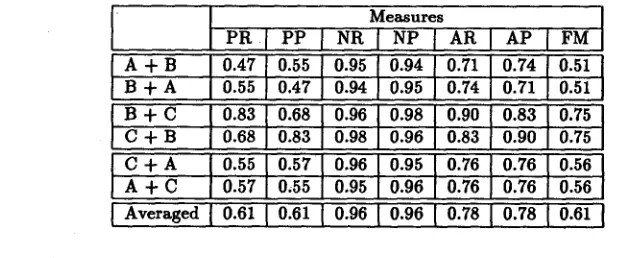
Table 4: Eva~luation results using three h u m a n eva~uators' solutions
From these results, we observe some features as follows. The divergence gives a better solution than Bayesian posterior probability does. Normally, the positive measures (PR and P P ) have smaller values than the negative ones (NR and NP) do. This means that it is difficult to judge two labels to be in a same group rather than to judge them to be in a separate group. Using divergence as a similarity measure, we get, on average, 84 % positive recall and 67 ~ positive precision and up to 90 ~ and 82 % when considering both positive and negative measures. Even for the worst result(Evaluator B), we can get up to 84 % and 8 1 % for averaged recall and precision. In order to confirm the performance of the system, the evaluators' results axe compared with each other. This comparison is useful for investigating the difficulty of the grouping problem. The comparison result is shown in Table 5. At this point, we can observe that the label grouping process is a hard problem that may make an evaluator's solution inconsistent with the others' solutions. However, our proposed method seem to give a reconciliation solution between those solutions. Especially, the method which applies divergence as the similarity measure, has a good performance in grouping brackets in the bracketed corpus.
A + B B + A
B + C C + B
C + A A + C
l
Measures
l
P R [ P P [ NR [ NP [ A R A P [ FM
0.55 0.47 0 ~ 9 4 0 . 9 5 0.74 0.71 0.51
0.68 0.83 0.98 0.96 0.83 0.90 0.75
0.57 0,55 0.95 0.96 0.76 0.76 0.56
I, Averaged10"6110"61[ 0"96 [ 0"96 [ 0"78 0"78[0"61l
Table 5: C o m p a r i n g t h e grouping results o b t a i n e d by t h e evaluators(A,B,C)
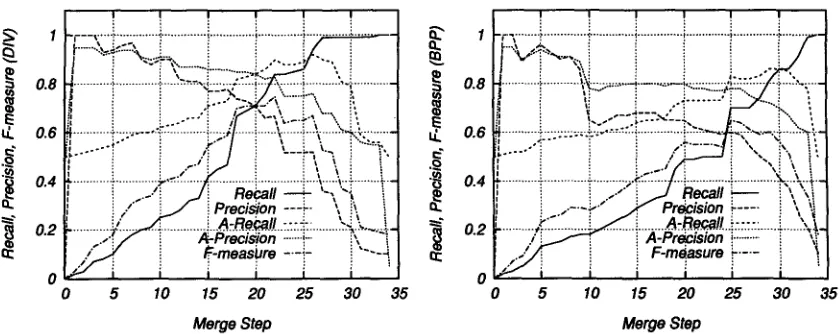
We also make an experiment to evaluate whether divergence is a better measure than BPP, and whether the application of differential entropy to cut off the merging process is appropriate. This examination can be held by plotting values of recall, precision and F-measure during each step of merging process. Figure 5 shows the fluctuation of positive recall(PR), positive preclsion(AP), averaged recall(AR), averaged precision and F-measure (FM).
[image:8.612.138.454.88.203.2] [image:8.612.118.428.413.542.2]0.8
E
tL 0.6
"~ 0.4
~ 0.2
0 0
r - - v ' - " i ... ! . . . ! ... ~ ... 7 . . .
[image:9.612.105.525.58.225.2]~- ...,...~...\ ~... ~ ~/ !
... ~....,~ . . . ~...p ...:.,,...w...~ ... ~ . ~ ... i " " ~ ', . - " ~ ~ i ~, P..:..,.~..
... ~/i'~ ... P'~: ... ~ ~ i i ~ {... ~ ... !--..v---.~.-÷ ... ~--- .
', / : : • " _ _ - L ~ :~ :
, . L . . / ' ~ , ~ % , ~
i," ~ : A : : .... ~:~,.},--4.
... : ~ : . : : : F " i,, "'i
. ~ ' i l l ~-measbre - - i - i .... 4
~ f i i i i i
5 10 15 2 0 2 5 3 0 3 5
i 0.8
0.6
~,
0.4" 0.2 Q:
0 0
I I I I I
i ! i i i
r ~ - ~ ... ? ... I ... I ... ! ... t ...
b,', _,¢,.., ~ ~ ~ ! ~ /
... [ ... );!~ ... J . . . i ... ~:,,::: t ~ ,~ ... " ~ " .
F ,
... ~. ... $ . , ~ , * , : : t . . ~ ... ~ ~ : : ~ . . ~ [ i i : ~ . , ~ . . ~ ' . ~ - . ~ _ , . : ..t~.,,.~...~....:~.,
i ~ ~ . / : ! X ! \
... ~ ... ~- ... ~.~::::--/-.~-.- ---i-.- .---.:~.-\-.
~ .,. ~ . , , J R e c a l l i i \ \
i ~ . - - ~ " jPI, P r ~ i s i o n ~ . . . . i \
... 7 " ~ . : : .... ...
5 10 15 2 0 2 5 3 0
M e r g e Step M e r g e Step
35
F i g u r e 5: T h e t r a n s i t i o n of P R , P P , A R , AP, F M d u r i n g t h e m e r g i n g process using divergence(left) a n d B P P ( r i g h t ) as t h e similarity measures
6
C o n c l u s i o n
There has been an increase of the construction of many types of corpora, including bracketed cor- pora. In this work, we attempt to use a bracketed (tagged) corpus for grammar inference. Towards the automatic acquisition of a context-free grammar, we proposed some statistical techniques to group brackets in a bracketed corpus (with lexical tags), according to their local contextual infor- mation. Two measures, divergence and Bayesian posterior probability, were introduced to express the similarity between two brackets. Merging the most similar bracket pair iteratively, a set of label groups was constructed. To terminate a merging process at appropriate timing, we proposed differential entropy as a measure to represent the entropy difference before and after merging two brackets and stopl~ed the merging process at a large fluctuation. From the experimental results compared with the model solutions given by three human evaluators, we observed that divergence gave a better solution than Bayesian posterior probability. For divergence, we obtained 84 % recall and 67 % precision, and up to 90 ~ and 82 % when considering both positive and negative measures. We also investigated the fitness of using differential entropy for terminating the merging process by way of experiment and confirmed it.
In this paper, we focus on only rules with lexical categories as their right hand side. As a further work, we are on the way to introduce the techniques introduced here to acquire the other rules(rules with nonterminal categories as their right hand side). At that time, it is also necessary for us to develop some suitable evaluation techniques for assessing the obtained grammar.
R e f e r e n c e s
[Aga95] Agarwal, R.: Evaluation of Semantic Clusters, in Proceeding of 33th Annual Meeting of
the AGL, pp. 284-286, 1995.
[Bri92] BrlU, E.: Automatically Acquiring Phrase Structure using Distributional Analysis, in Pro¢.
of Speech and Natural Language Workshop, pp. 155-159, 1992.
[EDR94] EDR: Japan Electronic Dictionary Research Institute: EDR Electric Dictionary User's
Manual (in Japanese), 2.1 edition, 1994.
[Har51] Harris, Z.: Structural Linguistics, Chicago: University of Chicago Press, 1951.
[Hat93] Hatziwassiloglou, V. and K. It. McKeown: Towards the Automatic Identification of Ad-
jectival Scales: Clustering Adjectives according to Meaning, in Proceeding of 31st Annual
Meeting of the ACL, pp. 172-182, 1993.
[Iwa95] Iwayama, M. and T. Tokunaga: Hierarchical Bayesian Clustering for Automatic Text
Classification, in IJCAI, pp. 1322-1327, 1995.
[Kiy94a] Kiyono, M. and J. Tsujii: Combination of Symbolic and Statistical Approaches for Gram-
matical Knowledge Acquisition, in Proc. of 4th Conference on Applied Natural Langnage
[Kiy94b]
[Larg0]
[Mi194]
[Per92]
[Per93]
[Ris89]
[Shi95]
[Swe69]
Kiyono, M. and J. Tsujii: Hypothesis Selection in Grammar Acquisition, in
COLING.g~,
pp. 837-841, 1994.
Lari, K. and S. Young: "The Estimation of Stochastic Context-free Grammars Using the Inside-Outside Algorithm",
Computer speech and languages,
Vol. 4, pp. 35-56, 1990. Miller, S. and H. J. Fox: Automatic Grammar Acquisition, inProc. of the Human Language
Technology Workshop,
pp. 268-271, 1994.Pereira, F. and Y. Schabes: Inside-Outside reestimatlon from partially bracketed corpora, in
Proceeding of 30th Annual Meeting of the ACL,
pp. 128-135, 1992.Pereira, F., N. Tishby, and L. Lee: Distributional Clustering of English Words, in
Pro.
ceeding of 31st Annual Meeting of the ACL,
pp. 183-190, 1993.Rissanen, J.:
Stochastic Complexity in Statistical Inquiry,
World Scientific Publishing, 1989.Shirai, K., T. Tokunaga, and H. Tanaka: Automatic Extraction of Japanese Grammar from
a Bracketed Corpus, in
Natural Language Processing Pacific Rim Symposium(NLPRS'gs),
pp. 211-216, 1995.
Swets, J.: Effectiveness of Information Retrieval Methods,
American Documentation,
Vol. 20, pp. 72-89, 1969.
Appendix
labels
(ADJ)
(ADV)
(ART)
(AUX)
(BE)
(CON J)
(DEMO)
(INDEF)
(NOUN)
(NUM)
(PREP)
(PRON)
(PTCL)
(UNIT)
(VI)
(VT)
some instances
'specific' 'commercial' 'adequate' 'structural' 'old' 'explicitly' 'enormously' 'quite' 'not'
'the' 'a' 'an'
'may' 'should' 'did' 'could' 'will' 'have' 'be' 'is' 'are'
'and' 'when' 'or'
'this' 'that' 'these' 'such' 'few' 'one' 'any' 'some'
'member' 'Japan' 'merchant' 'tour' 'area' '2' '0.5' '60 billion'
'with' 'in' 'to' 'of' 'I' 'my' 'me' 'your' 'us'
'up'
'to (to V)' 'down' 'out'
'centimeter' 'percent' '%' ' m m ' 'dollar' 'grow' 'delay' 'feed' 'go' 'went' 'gone' ,give' 'gave' 'given'