Lara Borin
Uppsala University
Center fo r Computational Linguistics Box 513
S-751 20 UPPSAU Sweden
WAT IS A LSnCAL BBPBESBHTATIOH?
1. I n t r o d u o t io n
In th is paper, I w ill discuss one aspect of the lex icon , namely it s morphological organization.
p rin cip le. It makes i t very hard to describe discontinuous dependencies within word forms; one is forced either to duplicate a considerable amount of Information in the lexicon o r , at lea st in the tw o-level model, le t the tw o-level rules take care o f some o f the morphotax descrip tion , which is not th eir primary purpose ( c f . Karttunen 1984, pp 178-181).
In the m inilexicons, stems and a ffix e s are grouped in to conceptually motivated co lle ctio n s and the links between them describe the morphotax o f the language in question. It is not only morphotax, however, that is described by the lexicon linkages: alternations that comprise more than a sin gle segment are often taken care o f in separate m inilexicons, and in th is way one tends to mix lin g u is tic a lly motivated categories with categories that are introduced to ease the work of the lexicon w riter; c f . the ” technical stems” in H ellb erg's system fo r Swedish morphology (Hellberg 1978, p 13ff; Doherty et al
1986).
2. The problem
I t seems that one would need a more sophisticated lexicon system to take care o f a number of important morphological phenomena that, fo r differen t reasons, should not f a l l in the domain of morphophonological ru les, be they of the generative kind or tw o-level ru les. Here is a representative, even i f not exhaustive, l i s t of the kind o f phenomena I have in mind:
- Discontinuous morphs, lik e in Sw. fö r s tora 'e n la r g e '; Ger. gesagt 's a id '; Po. najstzu^szy 'o l d e s t '.
- In fle ctio n of certain compound types, lik e in F i. kolmekymmenta- v iis i ' t h i r t y - f i v e ', Adessive kolme lla kymmenellä v iid e l l ä ; Ru. vagon-restoran 'restaurant c a r '. Genitive vagon^-restorana.
- Reduplication, lik e in Gr. Ielp6 'le a v e '. Perfect le lo ip a .
-26-- Suprasegpiental features, lik e accent, as far as they are re fle cte d in the morphology, lik e in Ru. bol* soj 'b ig * , bol* si J
' bigger' .
I am currently working on a lexicon system fo r the tw o-level model that should be capable of dealing with these phenomena, in a formalism that is in ten tion a lly in lin e with trad ition a l lin g u is tic taxonomy. In my view, one should aim at a clear separation o f the conceptual organization o f the lexicon description from implementational d e ta ils . The former is important from a th eoretica l lin g u is tic point of view, while the status of the la tte r is at best uncertcdn.
3. The L e x lo o n F c r e a lla e
F ig. 1 shows a small sample lexicon in the format I propose to use<1>. As can be seen, morphotax is e x p lic it ly s p e c ifie d , in the form of regular expressions. The f i r s t morphotax sp e cific a tio n in f i g . 1 states that the category Adj (fo r a d jectiv e) has the constituents Stem, Comp (comparative s u ffix ) and Final (gender/number/case port manteau morphs), in the order they are given. The constituent Comp is op tional, which is signalled by the parentheses around i t . The category AdJ has two alternative constituent structures, which are separated by a comma in the s p e c ific a tio n . The other possible structure given in f i g . 1 is : Sup (superlative p r e fix ). Stem, Comp and F in al, where none o f the parts are op tion a l. The constituents in the morphotax sp e cifica tio n s correspond to (groups o f) m inilexicons, where the minllexlcons have names of the form ' category .co n s titu e n t', e .g . things that can f i l l the Stem position in category Adj aire found in
<1> Since th is particular lexicon 1s used only to illu s tr a t e the lexicon formeilism, I have taken the lib e r ty to mix Polish
MORPHOTAX
Adj = Stem (Comp; (Degree: Poa )) : (Degree; Comp) Final, Sup Stem Comp Final;
Noun = Stem (Case: (Case:Nom)),
Stem (Case: (Case:Nom)) Hyphen Stem (Case: (Case:Nom)); END
LEXICON Adj.Stem ;(C at;A dj) = ENTRIES
star (Type;Qual), now (Type:Qual), rad (Type;Short); LEXICON Adj.Sup : (Degree:Sup) =
ElflRIES naj+ ;
LEHCON Adj .Comp :(Type:Qual) = ENTRIES
•i-sz ;
LEXICON Adj.Final ;(Type:Qual) = ENTRIES
•«-y (Numb:Sg GendtMasc Case:Nom), •»-a (NiiDb:Sg Gend:Fem Case:Nom), +e (Numb:Sg Gend:Neut Case:Nom); LEHCON Adj.Final ; (Type;Short) =
ENTRIES
0 (Nunb:Sg Gend:Masc Case:Nom), ^o (Nimb:Sg Gend:Neut Case:NQm), 4a (Numb:Sg Gend:Fem Case:Nom); LEXICON Noun.Stem i(Cat;Noun) =
SUBLEX Dim : (Form:Dim) = Ek ;
ENTRIES vagon , restoran , zegar Dim, ogon Dim, dub , velikan ; LEXICON Noun .Case =
ENTRIES
4a (Case:Gen), 4U (Case:Dat), 4e (Case;Loc); LE)d(X)N Noun.Hyphen =
ENTRIES END
Fl0ir« 1.
-the lexioonCa) AdJ . Stem<2>. Thus, the minilexlcons are Intended to group morph(eme)s of similar morphological categories. In addition, there i s the concept of sublexicons. These were Introduced fo r the sake o f space and work economy. In an In fle ctio n a l morphology, the sublexicons can be used to c o lle c t e .g . word endings (lik e derivational su ffix e s) with special in fle c tio n s , lik e in the lexicon Noun .Stem in f i g . 1, where the sublexicon Dim contains a diminutive s u ffix .
To account fo r phenomena lik e discontinuous morphs and agreement phenomena within words there is another mechanism apart from the morphotax sp e cific a tio n s , namely feat ure-value graphs (directed a c y c lic graphs, or DAG;s), that are checked fo r mutual consistency and added on to as the analysis routine moves through the le x ico n . The DAG: s can appear at various points in the lexicon;
1) On a constituent in the morphotax sp e c ific a tio n s . 2) In a m inilexicon or sublexicon as a whole.
3) In an individual le x ica l entry.
The addlng-on procedure i s a kind of unlficatlon<3>, as described in e .g . Karttunen 1984. This ensures that word forms lik e Ru. •vagon- restorana w ill not get any an alysis, since (Case; Nom) in the f i r s t part w ill not unify with (CcisezGen) in the second part. The fin a l DAG of a successful analysis is produced as part of the output.
The morphotax sp e cifica tio n s and the DAG; s together succeed very n icely in capturing the trad ition al lin g u is tic concept of markedness;
<2> I . e . , there may be arbltreirily many lexicons with the label AdJ.Stem, grouped according to e .g . declensions.
with optional constituents one may specify a DAG that is added to the
structure being built only if the constituent is not Included in the
analysis. This mechanism is used for assigning the positive degree to
adjectives in the lexicon in fig. 1; if no material is taken from the
lexicon AdJ .Comp during analysis, the anailysed adjective gets the
positive degree by default.
Like the variuos versions we have of the two-level system, this
extension to its lexicon is written in PASCAL.
4. Future Plans
Tne preceding section gave a brief overview over the current status of
the lexicon system. Among the things that have not yet been
Implemented, but are due for inclusion in the system in the near
future are:
- Negative value specifications in the DAG:s, e.g. (Case: -Pat). - Disjunction of values in the DAG:s, e.g. (Case: (Ack OR Gen)). - Full regular expression capability in the morphotax speci fications .
For handling the last two problems in the list in section 2, I am
currently exploring the possibility of using a formalism that is
reminiscent of and largely inspired by the ones used in autosegpiental
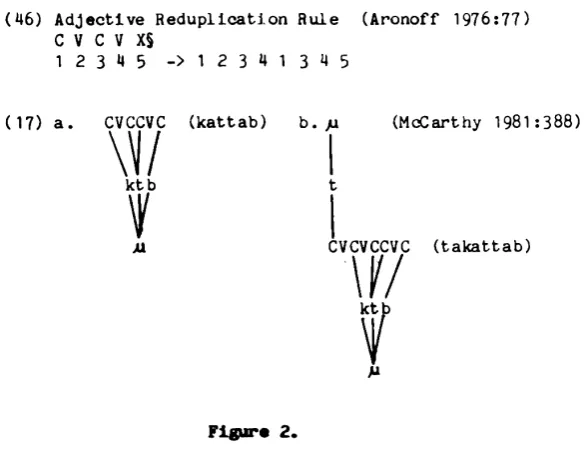
phonology (Goldsmith 1976; McCarthy 1981; 1982), or Aronoff's (1976)
word formation rules (see fig. 2). Tne main idea in both these
approaches (even though the details differ) could be interpreted as a
kind of constraint equation for lexical entries. Reduplication would
be handled in something like the following manner: With the
mlnilexicon for stems that reduplicate would follow a template
specifying the kind of reduplication and the conditions under which it
applies:
-30-TE MPU-30-TE : (Tense:Perfect) = C V <C V »>
1
2
1
2
The notation is a cross between McCarthy's and Aronoff's. The part
within angle brackets is a condition on the stem: it should begin with
a CV sequence. The expression as a whole states that this initial CV
sequence may be reduplicated if the word form can be interpreted as
perfect tense. These templates would act as filters, or constraint
mechanisms, between the lexical cind surface representations, quite
independent of and in parallel to any morphophonological rules in the
description. What the exact form and power of these templates would be
is not entirely clecir at the moment, but material on linguistic
uni vers als, like the data on the possible forms of reduplicative
constructions collected by Moravcsik (1978), obviously has an
Important role to play here.
(U6) Adjective Reduplication Rule (Aronoff 1976:77) C V C V X§
1 2 3 * 4 5 - > 1 2 3 * 4 1 3 * 4 5
(17) a. CVCCVC (kattab) b. ju (McCarthy 1981 :388)
ktb
I
JU CVCVCCVC (takattab)\r/
F ig u re 2 .
The original motivation behind the development of autosegoental
[image:7.595.145.439.403.630.2]relevant for the problem of accentually conditioned morphological
alternations of the type cited last in the list in section 2.
5. ■aw ProbIcBS
While the approach with feature-value graj>h3 that are unified together
solves some of the original problems in the list in section 2, they
unfortunately introduce some new ones that, furthermore, are
principally interesting.
One problem concerns word formation. Compounds of the type
represented by the Finnish minerals can be handled very nicely with
the proposed method, since the case agreement is enforced
automatically in the lexicon. Some other kinds of word formation
become very hard to handle in this framework, however. Category
shifting affixes are prohibited at present, since a stem with e.g.
(Cat:Noun) will not unify with a suffix that tries to assign
(Cat:Verb) to the derived word form. If one subscribes to the view of
e.g. Aronoff, that word formation is a process that operates on words
to form new words, where the category of the word in question may or
may not change in the process, there must be some further mechanism to
account for this.
Another problem is more specifically connected with the framework
this lexicon system was developed in, viz. two-level morphology. It is
the problem of how the two-level rules should Interact with the
feature-value graphs. It is a characteristic trait of the two-level
model that morphological features are segmentalized in the lexical
representations (Nyman 1984, p 473)» because this is the only way in
which the two-level rules can access features that trigger some
alternation, e.g. Tense;Perfect in the template in section 4 above.
One could imagine that the morphologioal features, or rather, the
DAG: s that contain them, be treated as lexical segnents by the rules.
-l.e. be accessible only at specific points in the lexical
representation. On the other hand, one could try to restrict the
domain of the rules, something that is needed on independent grounds:
some alternation types comprise only specific word categories, e.g,
Swedish apophony, which concerns only verbs.
6. CooolusloD
In conclusion, I would like to stress that even if the tilings
mentioned above are an important part of a lexical representation,
they are still only a part of what is needed in a lexicon system for
full-fledged natural language processing. In addition, the lexicon
should reflect our knowledge aa language users about productivity and
prototypes in morphology. Certainly, the lexicon must also contain
some structured semantic information.
Beferenoes
Aronoff, M. 1976. Word Formation in Generative Grammar. Linguistic Inquiry Monograph 1. Cambridge, Mass, and London.
Blåberg, 0. 1984. Svensk böjningsmorfologl - En tvånivåbeskrlvning. Unpublished Master* s Thesis. University of Helsinki, Dept, of General Linguistics.
Borin, L. 1985. Tvånivåmorfologi. - Introduktion och användar handledning. UCDL-L-3. Uppsala University, Center for Computational Linguistics.
Doherty, P., Rankin, I. & Wirén, M. 1986. Erf su'en he t er av en implement er ing av Hellbergs system fÖr svensk morfologi. In this volume.
Goldsmith, J.A. 1976. Autosegmentai Phonology. Indiana University Linguistics Club. Bloomington.
Hellberg, S. 1978. The Morphology of Present-Day Swedish. Stockholm.
Hockett, C.F. 1958 ( 1954). Two Models of Grammatical Description. In: Joos, M. (ed.). Readings in Linguistics. New York.
--- 1984. Features and Values. Chapter 2 of Shleber, S., Karttunen, L. and Pereira, F.C.N. Notes from the Unification Underground. SRI International Technical Note 327. Menlo Park, Calif.
Koskenniemi, K. 1983. Two-level Morphology - A General Computational Model for Word-Form Recognition and Production. Publications No.
11. University of Helsinki, Dept, of General Linguistics.
McCarthy, J.J. 1981. A Prosodic Theory of Nonconcatenatlve Morphology. Linguistic Inquiry, Vol. 12, No. 3.
--- 1982. Prosodic Templates, Morphemic Templates and Morphemic Tiers. In; Hulst/Smlth (eds.). The Structure of Phonological Representations, Part I. Dordrecht - Cinnaminson.
Moravcslk, E. 1978. Reduplicative Constructions. In; Greenberg, J. (ed.). Universals of Hunan Language, Vol. 3f Word Structure.
Nyman, M. 1984. Sananmuotojen tunnlstuksen Ja tuoton malllntamista (Review of Koskenniemi 1983). Virittaja 4/1984. Helsinki.