Fleshing it out: A Supervised Approach to MWE-token and MWE-type
Classification
Richard Fothergill and Timothy Baldwin
Department of Computer Science and Software Engineering The University of Melbourne
VIC 3010 Australia
[email protected], [email protected]
Abstract
Although some multiword expressions (MWEs) likeHow do you do? have ex-clusively idiomatic meaning, other MWE-types like the phrasekick the bucket may be idiomatic or literal depending on con-text. The recently developed OpenMWE
corpus provides the largest freely avail-able collection of annotated MWE-tokens suitable for supervised classification, but so far its potential has only been super-ficially investigated and only for classifi-cation of MWE-types in the corpus. In-stead, we train and evaluate classifiers for crosstype classification and introduce novel features specialised to this task. Our best crosstype classifiers performed as well on non-trained MWE-types as a ma-jority class baseline which has knowledge of the MWE-type.
1 Introduction
Amultiword expression (MWE) is an idiosyn-cratically interpreted linguistic unit which con-sists of more than a single word (or “crosses word boundaries”) (Sag et al., 2002; Baldwin and Kim, 2009). The nature of these idiosyncrasies can vary greatly — from traffic light and street light
which are remarkable only in that they are not in-terchangeable — tohow do you do?, the meaning of which is non-compositional in modern English. MWEs will typically resist lexico-syntactic variation to some extent (Fazly et al., 2009). For example, the phrasea picture is worth a thousand wordsdoes not allow the freedom of lexical substi-tution and modification that its constituent words would usually enjoy, making otherwise equivalent
variations —an image is worth fifty score words,a picture is worth approximately a thousand words
— sound wrong or at least unnatural to a native speaker.
The meaning of a MWE as a whole may not derive literally from the composition of its con-stituent words (Baldwin et al., 2003). For exam-ple, the English expressionkick the bucketmay be used to refer todeathin any number of ways un-related to either kicking or buckets. In these cases we say the MWE has an idiomatic interpretation.
When talking about MWEs we make a dis-tinction between an MWE lexeme out of context, which we call an MWE-type, and specific in-stances of the MWE in context, which we call an
MWE-token.
Some MWE-types have only an idiomatic meaning, such as the English greetingHow do you do?, interpretation of which can be perplexing if attempted literally. However for others, the literal uses are still perfectly valid, and individual MWE-tokens may be ambiguous between an idiomatic and literal meaning. For example,kick the bucket
may indeed refer to a violent act against a bucket and have nothing to do with death at all.
Relation to Word Sense Disambiguation
MWE-token disambiguation can be approached as if it were a word sense disambiguation (WSD) task where the MWE-types correspond to word types and MWE-tokens to word tokens (Hashimoto and Kawahara, 2009). In this conception, the analogue of word senses are the idiomatic and literal classes for an MWE-type.
In WSD, supervised methods are by far the most successful but large amounts of data are required foreachword type to be disambiguated (Navigli, 2009). However, unlike in WSD, we can expect to
findsomelinguistic commonality between the id-iomatic senses of distinct MWE-types. This leads us to hope for more general crosstype classifica-tion algorithms, which might alleviate the knowl-edge acquisition bottleneck. In this paper we will refer to WSD (more specifically “word expert”) style classification of ambiguous MWE-tokens as
type-specialised classification.
The first sense ormajority class baseline, in which a word is always labelled with its predomi-nant sense, is known to perform very well at WSD due to a Zipfian distribution of senses (Preiss et al., 2009). We expect no different for the MWE-token disambiguation task where the two-class problem is virtually guaranteed a majority class baseline accuracy of over 50%. There has been work in un-supervised first sense learning for WSD using lex-ical resources (McCarthy et al., 2007), but the de facto baseline in WSD is a supervised first sense baseline (Navigli, 2009). We make use of a type-specialised baseline, which is a supervised ma-jority class baseline modelled on the WSD first sense baseline. We also introduce acorpus base-linewhich, calculated based on idiomatic and lit-eral counts of a collection of MWE-types, is the type-specialised baseline’s crosstype analogue.
Our Contribution
In this paper we explore the supervised classifica-tion of ambiguous MWE-tokens using the Open-MWEcorpus of Japanese idioms (Hashimoto and Kawahara, 2009). We introduce new features tai-lored to the crosstype classification task and re-fine features for type-specialised classification. To our knowledge, our experiments are the largest in supervised MWE-token classification to date. We explore more deeply the interaction between several aspects of the task, including differences between crosstype and type-specialised classifica-tion; combinations of major classes of features; and finally, the size of the training corpus.
We find that:
1. Our new WSD inspired features offer consis-tent improvements in performance, and our new idiom features usually offer marginal improvements. The extended WSD and idiom features used together for type-specialised classification yield state-of-the-art results in terms of raw performance.
2. Our new features for crosstype classification interact with the task and with other features
in interesting ways, and in some cases give substantial improvements to performance.
3. Our best results in crosstype classification useonlyour extended WSD features. Despite using no tagged data for the target MWE-types, they achieved a performance in excess of the (supervised) type-specialised baseline.
This last result is significant because it demon-strates the readiness of our crosstype classifiers to work on previously unseen MWE-types. It is also interesting because it uses only semantic features and none of the lexico-syntactic fixedness features widely expected to be effective for MWE classifi-cation (Fazly et al., 2009; Hashimoto et al., 2006; Li and Sporleder, 2010).
2 Related Work
The OpenMWE corpus was compiled by Hashimoto and Kawahara (2009). To our knowledge it is by far the largest freely available gold-standard corpus of ambiguous MWE-tokens in any language, comprising 146 ambiguous types with 102,856 annotated MWE-tokens in total.
Apart from the enormous task of constructing theOpenMWEcorpus, Hashimoto and Kawahara (2009) also used it to perform some experiments with supervised MWE-token classification. Not-ing the similarities between this task and WSD, they employed the most effective WSD features and machine learning algorithm surveyed by Lee and Ng (2002). They also included linguistic features explored by Hashimoto et al. (2006) de-signed to capture the relative fixedness of Japanese idioms, which we will refer to as idiom features. The machine learning algorithm used wasSupport Vector Machinesand models were trained on the WSD features with various combinations of the idiom features. Type-specialised classifiers were trained for the90MWE-types which were deemed to have sufficient idiomatic and literal examples in the corpus. The model trained on WSD fea-tures was found to improve greatly on the type-specialised baseline, with some additional perfor-mance added by one of the idiom features.
limita-tion by training classifiers which work on MWE-types on which they have not been trained. To that end, we have extended the features used by Hashimoto and Kawahara (2009) with comple-mentary features and introduced a new class of features designed for crosstype classification.
Li and Sporleder (2010) conducted a thor-ough investigation of features used for supervised MWE-token classification. Context features simi-lar to the WSD features of Hashimoto and Kawa-hara (2009) were used, as were a number of lin-guistically motivated features. Like us, Li and Sporleder (2010) performed crosstype classifica-tion. Unfortunately many of the features were too sparse to have a significant effect and only the context features produced significant results. This may have been due to the relatively small size of the corpus used, which comprised around 4000 MWE-tokens across 13 MWE-types. In our re-sults the context features still dominate, but the ef-fects of idiom based features can be seen and those features hold up well on their own as well.
Diab and Bhutada (2009) described a novel su-pervised MWE-token classification system based on a sequence labelling model. Unlike our method, their model identifies the position of the token in the text as part of the process. Like Li and Sporleder (2010), the size of the corpus is small ( 2500 MWE-tokens of 53 MWE-types), and clas-sifiers were trained on collections of MWE-types. Anecdotally, the classifiers were able to pick some MWEs out of running text without even knowing their constituents beforehand, however their per-formance at this was not tested. A major find-ing of Diab and Bhutada (2009) was that reduc-ing the feature space of context features by re-placing word lemmas with their named-entity cat-egory had a significant positive effect on classifi-cation performance, a finding that is consolidated by Diab and Krishna (2009).
Fazly et al. (2009) observed that idiomatic uses of MWEs tend to occur in one of a small set of canonical forms, and developed an unsupervised method for learning these canonical forms, based on a set of linguistically-motivated features which built on the work of Cook et al. (2007). They applied the learned set of canonical forms to the task of MWE-token identification with remarkable success. Our method similarly uses linguistically-motivated features to perform MWE-token identi-fication, but using a cross-type supervised model.
3 Feature Extraction
We extracted features in three main groups: WSD features, idiom (token) features and idiom type features. The first two categories include the fea-tures used by Hashimoto and Kawahara (2009) and our own extensions. The third category was introduced by us and is specialised to crosstype classification.
3.1 Preprocessing
Our feature extraction makes extensive use of the Japanese dependency parserKNP(Kurohashi and Nagao, 1994),1however features should be repro-ducible in other languages with a suitable depen-dency parser, morphological analyser, and elec-tronic thesaurus or ontology. Each instance in the corpus was preprocessed by running it through
KNPto extract specific linguistic information.2To help elucidate both the details of our feature ex-traction and how it might be replicated for an-other language, we will look at the information extracted for the sentence in Example (1):
(1) 桂子さんは、
keiko-saN-wa, Keiko-TOPIC
サッカーの sakk¯a-no soccer-GEN
腕を
ude-o arm-OBJ
上げた。
ageta. raised.
# “Keiko raised her soccer arm.” (literal) “Keiko improved her skills at soccer.” (id-iomatic)
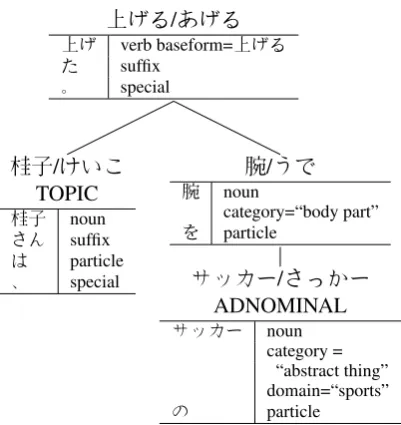
Japanese is a non-segmenting language in that it has no clearly marked word boundaries. In Fig-ure 1, Example (1) has been segmented byKNP
into tokens3 which are then grouped into chunks. Each chunk has a parent link to a higher chunk describing the dependency parse of the sentence. In the conventional word order for Japanese, de-pendency links are always forwards so the head of a phrase is also its rightmost (final) chunk. From Figure 1, we see thatkeiko“Keiko” andude“arm” are the dependents of ageta “raised”, withsakk¯a
“soccer” modifying ude “arm”. This gives rise
1http://nlp.ist.i.kyoto-u.ac.jp/EN/
?KNP
2KNP’s memory usage is high and on some sentences
ex-ceeded the available memory in our machine (32GB). Those instances were excluded from our analysis.
3In fact,KNPdelegates the initial segmentation and token
上げる/あげる 上げ verb baseform=上げる
た suffix
。 special
桂子/けいこ
TOPIC 桂子 noun さん suffix は particle
、 special
腕/うで
腕 noun
category=“body part” を particle
サッカー/さっかー
ADNOMINAL
サッカー noun
category = “abstract thing” domain=“sports”
の particle
Figure 1: English summary of the select parts of the output of KNP when run on the sentence in Example (1)
to the incorrect literal interpretation#Keiko raised her soccer arm. In fact,ude-o ageru“to improve one’s skills” is an ambiguous MWE.
In this paper when we refer towordswe are in fact referring to the chunks returned byKNP. This is the most appropriate level of segmentation for our purposes because it is the level at which the dependency parse exists and because the tokeni-sation level includes affixes and particles which would need filtering.KNPlabels each chunk with a normalised form, which we use as thelemmaof the word for our feature extraction. We also ex-tract the part of speech, category and domain of tokens corresponding most closely to the lemma, as additional features of the word.
The category and domain information performs a similar function to the named entity informa-tion used by Diab and Bhutada (2009): it collapses classes of words into a single feature while retain-ing relevant semantic information. An information source such as an ontology or thesaurus could be substituted for use in other languages. Hashimoto and Kawahara (2009) translate thecategoryoutput ofKNPashypernym, and we will adopt the same terminology hereafter.
Returning to Figure 1, take note of theTOPIC
flag on the first chunk and the ADNOMINAL flag on the second. KNPproduces many chunk anno-tations; we made use of five main kinds:
ADNOMINAL appearing on adnominal modi-fiers;
TOPIC appearing on sentential topics and em-phasised chunks;
VOICE of inflected verbs;
NEGATED denoting negation; and
VOLITIONAL denoting a volitional modality.
For all but the volitional modality group,KNP out-puts only one or two annotation variants (e.g. there are two voices in Japanese: passive and causative). For the volitional modality, Hashimoto and Kawa-hara (2009) used five classes: request, invitation, order, volition and prohibition. We made use of the same subset of modalities output byKNP.
The KNP chunk annotations we used chiefly capture inflections on words in the text, something which Diab and Bhutada (2009) approximate with a charactern-gram feature. For implementation in
other languages, then-gram heuristic or any
avail-able morphological analyser might be used.
3.2 Word sense disambiguation features
We adopted the WSD inspired features of Hashimoto and Kawahara (2009) and extended them with our own new features.
Hashimoto and Kawahara (2009) features
Hashimoto and Kawahara (2009) put together a set of features based on WSD best practice as es-poused by Lee and Ng (2002). They included:
1. full context, in the form of bag features for lemma, hypernym and domain of single words in the full surrounding context.4
2. local context, in the form of part of speech and lemma features for indexed word offsets to each side of the MWE.
3. syntactic context, in the form of lemmas and POS for context words in a syntactic relation-ship with either the first or last constituent word of the MWE.
For more details on implementation of these fea-tures, see Hashimoto and Kawahara (2009).
4Note that due to the way the corpus was constructed, the
full context features
lemma keiko, majime, ...
hypernym abstract thing, body part, person. domain sports, familial associations.
local context features
lemma majime−3, reNsh¯u−2, sakk¯a−1, ... (majime,sakk¯a)−3,−1, ...
POS adjective−3, noun−2, noun−1, ... (adjective,noun)−3,−1, ...
hypernym abstract thing−2, abstract thing−1, ... (NULL,abstract thing)−3,−1, ...
hypernym abstract thingchild
domain sportschild
Figure 2: A sample of the WSD inspired features extracted for Example (2).
New WSD features
We introduce hypernym and domain features for the local and syntactic contexts. Use of hyper-nym and domain features in the syntactic context is particularly interesting. The intent of the syn-tactic features is to capture selectional restrictions involving constituents of the MWE. Violation of selectional restrictions for or by constituents of the MWE leads us to strongly suspect an idiomatic us-age. In the case of Example (2) we see that having
sakk¯a “soccer” modifying ude“arm” is strongly indicative of the idiomatic ude-o ageru “to raise skills”. For this MWE, any sport has the same im-plication. We can see from Figure 1 thatKNPhas extracted the domainsportsforsakk¯a“soccer” so a classification algorithm can use this feature to make a valid generalisation. Our local context hy-pernym and domain features are less targeted, but we consider them to be worthwhile in light of the success of named-entity features in the literature (Diab and Bhutada, 2009).
Note that we use the same definitions of lo-cal and syntactic context as Lee and Ng (2002), with the specialisations to MWEs outlined by Hashimoto and Kawahara (2009).
Figure 2 contains a sample of all original and new WSD features, extracted for the MWE-token in Example (2), which expands Example (1):
(2) 桂子さんは
“Keiko practised diligently and improved her skills at soccer. Her mother was pleased.”
3.3 Idiom token features
As with the WSD features, we adopted the idiom features of Hashimoto and Kawahara (2009) with additional features of our own.
Hashimoto and Kawahara (2009) features
The idiom features of Hashimoto and Kawahara (2009) included a single binary feature for each of theKNPchunk annotation groups listed at the end of Section 3.1. For each of the groups, the feature fires if one of the annotations appears on a relevant word in the MWE. Details of each are given in the outline of our extensions below.
The final idiom feature of Hashimoto and Kawahara (2009) was the adjacency feature. This feature fires if the constituents of the MWE are contiguous, i.e., there are no intervening chunks. They found that this feature had a greater impact on classification performance than the other idiom features combined.
New idiom features
Each of the boolean idiom features of Hashimoto and Kawahara (2009) captures some variation of the form of the MWE. We introduce features cap-turing details on the kind of variation:
• The ADNOMINAL modification feature fires if a non-constituent adnominal modifies a noun in the MWE. We include features for the lemma, POS, hypernym and domain of such a modifier whenever it exists.
• The TOPIC feature fires if a constituent noun is marked as a sentential topic. In this case we include features for the lemma, POS, hy-pernym and domain of the constituent.
• The VOICE, NEGATION and
verb and it has voice marking or is negated. We include features specifying what for of voice, negation or volitional marking is used.
• Finally for the adjacency feature, we include
lemma, POS, hypernym and domain features from a single intervening chunk where any existed. When more than one is found, we take the rightmost.
In the sentence of Example (2), features only fire for adnominal modification. Sincesakk¯a “soc-cer” modifies the constituent ude “arm”, the ad-nominal modification boolean feature fires, as do our lemma, POS, hypernym and domain features for the modifier: sakk¯a, noun,abstract thing and
sportsrespectively. As was the case when sakk¯a
“soccer” was considered in its role as a modifier ofude“arm”, we note that it is in fact informative that the adnominal modifier is a sport and not, for example, a person.
3.4 Type features
The features we have discussed so far have, for the most part, ignored the constituent words of the MWE-type itself. For type-specialised classi-fiers this is inconsequential since the constituents are constant. However features of the MWE-type may be important for crossMWE-type classification where similarities between different MWEs could be leveraged. Therefore, for each MWE-type, we use the lemma, POS, hypernym and domain of the headword in particular and a bag feature for each across all words in the MWE.
One motivation for these features is to allow a crosstype classifier to make more informed de-cisions when confronted with tokens of types it was trained on. For example, if a collection of constituents has been encountered in training, a supervised statistical classifier may capture the prior probability for idiomaticity of the training MWE-type. For crosstype classification, some constituents — in particular the headword — may be indicative of the relative idiomaticity of an id-iom. For example, common verbs such astakeand
make are common in idioms such as take a shot
andmake a stand.
4 Results
We evaluated classifiers using combinations of the three main classes of features. For all tasks, a ten-fold cross-validation partitioning was used, and a
Feature Types Accuracy
idiom type wsd basic extended
∗ 0.623 –
∗ 0.630 0.627
∗ ∗ 0.626 0.651
∗ 0.737 0.745
∗ ∗ 0.736 0.743
∗ ∗ 0.738 0.746
∗ ∗ ∗ 0.739 0.745
corpus baseline 0.612 –
type-specialised baseline 0.741 –
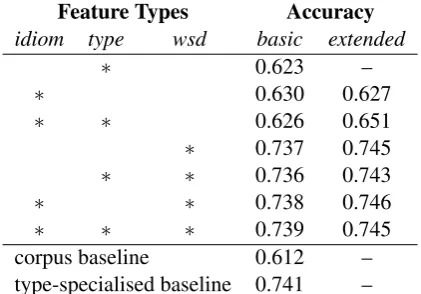
Table 1: Results of combining different features for crosstype classification. “Basic” results re-strict the idiom and WSD features to those of Hashimoto and Kawahara (2009); “extended” re-sults include our extensions.
feature count cutoff of one was used to filter out uninformative features. Given the binary classifi-cation nature of the task we used accuracy as our performance metric, microaveraging across all in-stances in the corpus.
For statistical significance we used the sign test because our crosstype classification testing parti-tions were unevenly weighted, making a t-test in-appropriate. Unless otherwise stated, comparisons were significant withp <0.05.
We constructed two kinds of majority class baseline using class counts from the corpus: the corpus baseline, which achieved an accuracy of 0.612, and the type-specialised baseline, with an
accuracy of0.741. All other systems were linear
kernelSupport Vector Machinemodels trained us-ing thelibSVMpackage.5
4.1 Crosstype classification
For the purposes of testing crosstype classification we partitioned the set of 90 MWE-types for cross-validation. Thus classifiers were trained on the in-stances of 81 types and tested on the inin-stances of the 9 unseen types. Note that since the corpus con-tains a different number of instances for each type, the partition size was not strictly constant. Results across all feature combinations appear in Table 1.
The idiom type and token features did manage to improve on the corpus baseline by a little over one percentage point each. However, this is over
5We initially used the TinySVM package and quadratic
Feature Types Accuracy
idiom type wsd basic extended
∗ 0.741 –
∗ ∗ 0.748 0.752
∗ 0.630 0.639
∗ 0.844 0.847
∗ ∗ 0.851 0.854
∗ ∗ 0.847 0.849
∗ ∗ ∗ 0.854 0.856
corpus baseline 0.612 –
type-specialised baseline 0.741 –
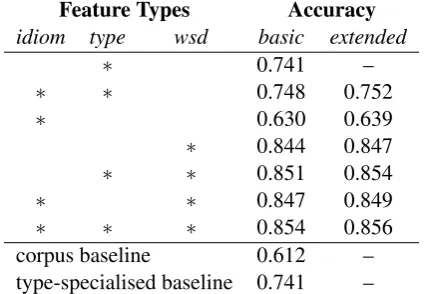
Table 2: Results for classification of MWE-tokens of MWE-types seen in the training corpus. As in Table 1, “Basic” results restrict the idiom and WSD features to those of Hashimoto and Kawa-hara (2009).
ten percentage points behind the results when us-ing WSD features alone. In fact, the WSD fea-tureswith our extensionsachieved effectively our best results. The addition of idiom features with our extensions achieved fractionally better perfor-mance without statistical significance and all fea-ture combinations which did not include our full complement of WSD features had lower perfor-mance. The WSD features’ performance exceeds even the type-specialised baseline, which was built on gold-standard data which the crosstype classi-fier has no access to.
It is a surprising result, for two reasons: first, that idiom features are widely assumed to be a key information source, particularly for unsupervised disambiguation (Cook et al., 2007), and second, that WSD features — paragraph context in partic-ular — are typically used as a model of the mean-ing of a token. It is counterintuitive that els of semantics are more informative than mod-els of lexico-syntactic variations when the testing and training sets that are explicitly disjoint with respect to MWE-type.
The idiom token or type features alone did not stand up well in comparison. However, we note that combining our type features with the complete idiom token features provided a disproportionate boost to a classification accuracy of almost four percentage points above the baseline.
What happens when a nominally crosstype clas-sifier encounters an instance of a MWE-type which ithasseen in its training set? To test this, we partitioned the corpus stratified across types.
Feature Types Accuracy
idiom wsd basic extended
∗ 0.768 0.769
∗ 0.882 0.886
∗ ∗ 0.886 0.890
type-specialised baseline 0.741 –
Table 3: Results of combining different features for type-specialised classifiers. “Basic” results restrict the idiom and WSD features to those of Hashimoto and Kawahara (2009); “extended” re-sults include our extensions.
That is, classifiers were trained on 90% of in-stances from all MWE-types in the corpus and tested on the remaining 10%. The results are shown in Table 2.
The idiom features once again improved a cou-ple of percentage points on the baseline. In this instance, the type features produced much better results, achieving the same results as the type-specialised majority class baseline. It is not possi-ble for any deterministic classifier to do better on the same input because the idiom type features are constant across all instances of a MWE-type.
Once again the WSD features did far better than any of the others at 23 percentage points over the corpus baseline and over ten points above even the type-specialised baseline. This is more to be expected than the equivalent result for crosstype classification since, by their origin, WSD features are designed to capture differences in semantics for known types.
The indisputable dominance of WSD features observed in these experiments warrants further in-vestigation, which we leave for future work.
4.2 Type-specialised classification
If a known MWE-type can be explicitly detected, the general crosstype classifier need not be used: we can fall back on type-specialised classifiers like those of Hashimoto and Kawahara (2009). To see how much better we can do by selecting an appropriate type-specialised classifier, we trained and tested classifiers on the same partitioning as the previous task but restricted to instances of one MWE-type at a time. The results appear in Ta-ble 3.
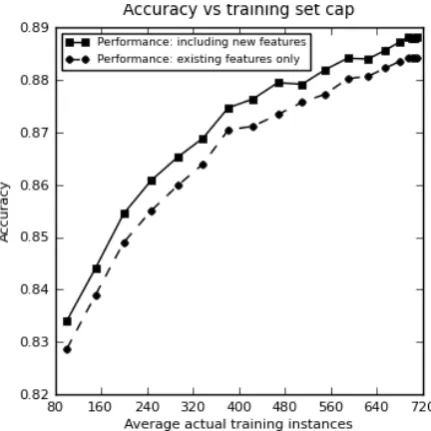
Figure 3: Results for type-specialised classifiers with capped training set sizes.
not generalise well across types.
The WSD features achieved close to the best re-sults seen across all our experiments. An improve-ment of four percentage points is seen compared to the previous task, which is indicative of the noise introduced by simultaneously training on data of 90 idioms. Our best results were achieved using all of the idiom and WSD features together, hit-ting an even0.890.
Finally, we used the type-specialised task to in-vestigate the significance of the size of the Open-MWE corpus. To do this we measured cross-validation accuracy while limiting the total num-ber of training instances. Training set size caps ranging between 100 and 1000 instances were used, but in practice most of the MWE-types had between500and1000available training instances, so the average actual training instances used was less than the cap. We performed these experi-ments using our complete WSD and idiom tures and, for comparison, with the original fea-tures of Hashimoto and Kawahara (2009). The re-sults appear in Figure 3.
Even with 100 instances per MWE-type, we achieved an accuracy of0.834, which is an
appre-ciable improvement on the type-specialised base-line. However the data show a definite positive trend with the number of instances, reaching0.884 under a cap of650instances (and589average ac-tual instances) per MWE-type.
Setting the maximum number of instances per
MWE-type to1000achieved an accuracy of0.888. Additionally, when restricted to the original fea-tures used by Hashimoto and Kawahara (2009) a performance of 0.884 is observed. Since Hashimoto and Kawahara (2009) also capped in-stance counts at 1000 this is our most comparable result to their best of 0.893. We note that with
our new features, results were consistently around half a percentage point higher, so consider this to be state of the art performance.
5 Conclusions
We have shown that crosstype classification of ambiguous MWE-tokens can surpass the type-specialised baseline while alleviating the require-ment on labelled token instances, thus enabling classification of tokens of previously unseen MWE-types.
Our type features and new idiom features, working in concert with the idiom features of Hashimoto and Kawahara (2009), substantially in-crease crosstype classification performance over the baseline. However their effect is wholly sub-sumed by the inclusion of WSD features. On type-specialised classification, our new idiom and WSD features achieve more consistent gains.
Finally, we conclude that the size of the Open-MWEcorpus raises potential performance by leaps and bounds, but additional performance is still to be had by more data.
For future work we would like to investigate the dominance of WSD features at crosstype classifi-cation. The success of semantic features where the training and test sets have — by design — differ-ent semantics, making this an intriguing counter-intuitive result, as does the relatively poor perfor-mance of features targeted at linguistic properties of MWEs.
Acknowledgements
This research was supported by Australian Re-search Council grant no. DP0988242.
References
Timothy Baldwin and Su Nam Kim. 2009. Multiword expressions. In Nitin Indurkhya and Fred J. Dam-erau, editors, Handbook of Natural Language Pro-cessing, pages 267–292. CRC Press, Boca Raton, USA, 2nd edition.
of multiword expression decomposability. In Pro-ceedings of the ACL 2003 Workshop on Multiword Expressions: Analysis, Acquisition and Treatment, pages 89–96, Sapporo, Japan.
Paul Cook, Afsaneh Fazly, and Suzanne Stevenson. 2007. Pulling their weight: Exploiting syntactic forms for the automatic identification of idiomatic expressions in context. InProceedings of the Work-shop on A Broader Perspective on Multiword Ex-pressions, pages 41–48, Prague, Czech Republic.
Mona T. Diab and Pravin Bhutada. 2009. Verb noun construction MWE token supervised classification. InMWE ’09: Proceedings of the Workshop on Mul-tiword Expressions, pages 17–22, Singapore.
Mona T. Diab and Madhav Krishna. 2009. Handling sparsity for verb noun MWE token classification. In GEMS ’09: Proceedings of the Workshop on Ge-ometrical Models of Natural Language Semantics, pages 96–103, Athens, Greece.
Afsaneh Fazly, Paul Cook, and Suzanne Stevenson. 2009. Unsupervised type and token identification of idiomatic expressions. Computational Linguistics, 35(1):61–103.
Chikara Hashimoto and Daisuke Kawahara. 2009. Compilation of an idiom example database for su-pervised idiom identification. Language Resources and Evaluation, 43:355–384.
Chikara Hashimoto, Satoshi Sato, and Takehito Utsuro. 2006. Detecting Japanese idioms with a linguisti-cally rich dictionary.Language Resources and Eval-uation, 40:243–252.
Sadao Kurohashi and Makoto Nagao. 1994. KN parser: Japanese dependency/case structure ana-lyzer. InProceedings of the Workshop on Sharable Natural Language Resources, Nara, Japan.
Yoong Keok Lee and Hwee Tou Ng. 2002. An empiri-cal evaluation of knowledge sources and learning al-gorithms for word sense disambiguation. InEMNLP ’02: Proceedings of the 2002 Conference on Empiri-cal Methods in Natural Language Processing, pages 41–48, Philadelphia, USA.
Linlin Li and Caroline Sporleder. 2010. Linguistic cues for distinguishing literal and non-literal usages. In Coling 2010: Posters, pages 683–691, Beijing, China.
Diana McCarthy, Rob Koeling, Julie Weeds, and John Carroll. 2007. Unsupervised acquisition of pre-dominant word senses. Computational Linguistics, 33(4):553–590.
Roberto Navigli. 2009. Word sense disambiguation: A survey. ACM Computing Surveys, 41(2).
Judita Preiss, Jon Dehdari, Josh King, and Dennis Mehay. 2009. Refining the most frequent sense
baseline. In Proceedings of the Workshop on Se-mantic Evaluations: Recent Achievements and Fu-ture Directions, pages 10–18, Boulder, USA.