Syntactic Parsing for Ranking-Based Coreference Resolution
Altaf Rahman and Vincent Ng
Human Language Technology Research Institute University of Texas at Dallas
Richardson, TX 75083-0688
{altaf,vince}@hlt.utdallas.edu
Abstract
Recent research efforts have led to the de-velopment of a state-of-the-art supervised coreference model, the cluster-ranking model. However, it is not clear whether the features that have been shown to be useful when employed in traditional coreference models will fare similarly when used in combination with this new model. Rather than merely re-evaluate them using the cluster-ranking model, we examine two in-teresting types of features derived from syntactic parses, tree-based features and path-based features, and discuss the chal-lenges involved in employing them in the cluster-ranking model. Results on a set of Switchboard dialogues show their effec-tiveness in improving the cluster-ranking model: using them to augment a baseline coreference feature set yields a 8.6–11.7% reduction in relative error.
1 Introduction
Coreference resolution is the task of determining which noun phrases (NPs) in a text or dialogue refer to the same real-world entity. According to Webber (1979), coreference resolution can be de-composed into two complementary subtasks: “(1) identifying what a text potentially makes avail-able for anaphoric reference and (2) constraining the candidate set of a given anaphoric expression down to one possible choice”. These two subtasks are commonly known as anaphoricity
determina-tion and anaphora resoludetermina-tion, both of which have
recently been tackled using machine learning tech-niques. More specifically, anaphoricity determina-tion is typically tackled by training an
anaphoric-ity classifier, which determines whether an NP is
anaphoric or not (e.g., Poesio et al. (2004), Zhou and Kong (2009)). If so, the NP is passed to the
second component, the resolution system, which identifies an antecedent for the NP. This resolver is typically implemented by training a mention-pair (MP) model, which is a binary classifier that deter-mines whether a pair of NPs are co-referring or not (e.g., Soon et al. (2001), Ng and Cardie (2002b)).
While this architecture is popularly adopted by coreference researchers and was implemented even within recently developed coreference re-solvers (e.g., Bengtson and Roth (2008), Stoy-anov et al. (2009)), neither the architecture it-self nor its aforementioned implementation is sat-isfactory for at least two reasons. First, in this pipeline architecture, anaphoricity determination is performed prior to coreference resolution, so er-rors in anaphoricity determination can propagate to the downstream coreference component and ad-versely affect its performance (Ng and Cardie, 2002a). Second, the MP coreference model is fun-damentally weak in that (1) the information ex-tracted from two NPs may not be sufficient for making an informed coreference decision and (2) since the model is trained to compare the NP to be resolved (henceforth the active NP) against a can-didate antecedent, it only determines how good the candidate is relative to the active NP, not how good the candidate is relative to other candidates.
In light of the aforementioned problems, re-searchers have proposed a number of solutions:
• To address the error propagation problem, researchers have proposed joint inference (Denis and Baldridge, 2007) and joint
learn-ing (Rahman and Ng, 2009) for anaphoricity
determination and coreference resolution. • To address the expressiveness problem
re-sulting from making a coreference decision based on only two NPs, researchers have pro-posed the entity-mention model, where coref-erence decisions are made by determining whether an NP belongs to a preceding coref-erence cluster (e.g., Luo et al. (2004), Yang
et al. (2008)).
• To address the failure to directly compare candidate antecedents and determine the best one, researchers have proposed the
mention-ranking model, which imposes a mention-ranking on
the candidate antecedents and therefore cap-tures the competition among them (e.g., De-nis and Baldridge (2008), Iida et al. (2009)).
Recent research efforts have led to the develop-ment of a state-of-the-art supervised coreference model that can address all of the aforementioned problems, namely the joint cluster-ranking (CR) model (Rahman and Ng, 2009). However, other than its superior empirical performance to compet-ing coreference models (such as the MP model), little is known about the joint CR model. In partic-ular, most of the linguistic features for coreference resolution were developed and evaluated in the context of the MP model, and thus it is not clear whether these features would fare similarly when used in combination with the joint CR model.
Motivated by this observation, our goal in this paper is to examine the value of features derived from syntactic parses for the joint CR model. Note that parse-based features have been investigated extensively for the MP model. For example, they have been used to implement Binding Constraints (e.g., Luo and Zitouni (2005)) and encode syn-tactic salience (e.g., Haghighi and Klein (2009)). Rather than re-evaluate them for the CR model, we investigate two types of parse-based features that we believe are particularly interesting.
First, we employ parse trees directly as
struc-tured features for the joint CR model. The main advantage of employing tree-based struc-tured features is simplicity: we no longer need to design heuristics to extract the desired fea-tures (e.g., salience, Binding Constraints) from the parse trees, as designing heuristics can be time-consuming and sometimes difficult for cer-tain tasks. Note, however, that previous attempts have employed structured features to train an MP model for anaphora resolution (Yang et al., 2006; Versley et al., 2008) and an anaphoricity classifier in the aforementioned pipeline architecture (Zhou and Kong, 2009). In both cases, the structured fea-tures are combined with their non-structured (i.e.,
flat) counterparts via a composite kernel and used
to train a classification model. What is interesting for us to investigate in this paper, however, is the question of how to combine flat and structured
fea-tures in a ranking model that employs joint learn-ing. With the increasingly important role struc-tured features and ranking models play in natural language learning, we believe that a method for combining flat and structured features for training a ranker would be of particular interest to natural language processing (NLP) researchers.1
Second, motivated in part by lexical semantics research (Lin and Pantel, 2001), we investigate
path-based features, which encode the contextual
relationship between an active NP and a candidate antecedent as the shortest path between the cor-responding nodes in the parse tree. As with other NLP tasks, the effectiveness of a given type of fea-tures for coreference resolution depends in part on how the linguistic information it intends to capture is represented. We seek to investigate the extent to which a joint CR model can benefit from this path-based representation of context.
Unlike the vast majority of English coreference resolvers, which were evaluated using the MUC and ACE corpora, our resolver was evaluated on a set of Switchboard dialogues. To our knowl-edge, we are among the first to report results for the full coreference task on this dataset. As a re-sult, our work contributes to the establishment of a baseline using a state-of-the-art supervised coref-erence model against which future work can be compared. Our experimental results indicate that while both the tree-based and path-based features improve coreference performance when applied to a Baseline feature set in isolation, the best perfor-mance is achieved when they are applied in com-bination. In particular, these two types of features yield an improvement of 2.2–3.7% in F-measure over the Baseline joint CR model, which corre-sponds to a 8.6–11.7% reduction in relative error.
The rest of the paper is organized as follows. Section 2 discusses our implementation of the joint CR model. Section 3 describes tree-based and path-based features and how they can be in-tegrated into the CR model. We present evaluation results in Section 4 and conclude in Section 5.
2 The Baseline Coreference Model
This section describes the Baseline CR model. Since the CR model is a natural extension of the
1The dual form of Collins and Duffy’s (2002) ranking
MP model, in order to understand the CR model, it helps to first understand the MP model.
2.1 The Mention-Pair Model
As noted before, the MP model is a classifier that determines whether two NPs are co-referring or not. Each instance i(NPj,NPk)corresponds to two NPs, NPj and NPk, and is represented by 39 fea-tures (see Table 1 of Rahman and Ng (2009) for a description of these features). Linguistically, these features can be divided into four groups: string-matching, grammatical, semantic, and positional. However, they can also be categorized based on whether they are relational or non-relational: re-lational features capture the relationship between NPj and NPk, whereas non-relational features
cap-ture the linguistic properties of one of them. We follow Soon et al.’s (2001) method for creat-ing traincreat-ing instances. Specifically, we create (1) a positive instance for each anaphoric NPNPkand its closest antecedentNPj; and (2) a negative instance for NPk paired with each of the intervening NPs,
NPj+1, NPj+2, . . ., NPk−1. The classification as-sociated with a training instance is either positive or negative, depending on whether the two NPs are coreferent. To train the MP model, we use the SVM learner from SVMlight(Joachims, 1999).2
After training, the classifier is used to identify an antecedent for an NP in a test text. Each NP, NPk, is compared in turn to each preceding NP,
NPj, from right to left, andNPjis selected as its
an-tecedent if the pair is classified as coreferent. The process ends as soon as an antecedent is found for NPkor the beginning of the text is reached.
2.2 The Cluster-Ranking Model
The CR model addresses two weaknesses of the MP model, one concerning expressiveness and the other concerning its failure to compare can-didate antecedents directly and capture the com-petition among them. It does so by combin-ing the strengths of the entity-mention model and the mention-ranking model. As discussed before, the mention-ranking model addresses the failure to compare candidate antecedents by training a ranker to impose a ranking on the candidate an-tecedents for an active NP. On the other hand, the entity-mention model addresses the expres-siveness problem by determining whether an
ac-2For this and subsequent uses of the SVM learner in our
experiments, we set all parameters to their default values.
tive NP belongs to a preceding, possibly partially-formed, coreference cluster. Its increased expres-siveness stems from its ability to employ
cluster-level features (i.e., features that are defined over
any subset of NPs in a preceding cluster). Com-bining the entity-mention model and the mention-ranking model yields the CR model, which ranks the preceding clusters for an active NP so that the highest-ranked preceding cluster is the one to which the active NP should be linked.
Since the CR model ranks preceding clusters, a training instance i(cj, NPk) represents a
preced-ing clustercj and an anaphoric NPNPk. Each
in-stance consists of two types of features: (1) fea-tures that are computed based solely on NPk, and (2) cluster-level features, which describe the rela-tionship betweencj andNPk. Motivated in part by
Culotta et al. (2007), we create cluster-level fea-tures from the relational feafea-tures in our 39-feature set using four logical predicates: NONE, MOST -FALSE, MOST-TRUE, and ALL. Specifically, for each relational feature X, we first convert X into an equivalent set of binary-valued features if it is multi-valued. Then, for each resulting binary-valued feature Xb, we create four binary-valued cluster-level features: (1) NONE-Xb is true when Xb is false between NPk and each NP in cj; (2)
MOST-FALSE-Xb is true whenXb is true between NPkand less than half (but at least one) of the NPs incj; (3) MOST-TRUE-Xb is true when Xb is true
between NPk and at least half (but not all) of the NPs incj; and (4)ALL-Xb is true whenXb is true
betweenNPkand each NP incj.
We follow Rahman and Ng’s (2009) method for creating training instances. Specifically, for each NP,NPk, we create a training instance betweenNPk and each preceding cluster cj using the features
described above. Since we are training a model for jointly learning anaphoricity determination and coreference resolution, we need to provide the ranker with the option to start a new cluster by cre-ating an additional training instance that contains features that solely describe NPk. The rank value of a training instance i(cj, NPk) created forNPk is
the rank of cj among the competing clusters. If
NPkis anaphoric, the rank of i(cj,NPk) is HIGHif NPkbelongs tocj, and LOW otherwise. However,
if NPk is non-anaphoric, the rank of i(cj, NPk) is
ranker-learning algorithm.
After training, the cluster ranker processes the NPs in a test text in a left-to-right manner. For each active NP,NPk, we create test instances for it by pairing it with each of its preceding clusters. To allow for the possibility thatNPkis non-anaphoric, we create an additional test instance containing features that solely describe the active NP (as dur-ing traindur-ing). All these test instances are then pre-sented to the ranker. If the additional test instance is assigned the highest rank value by the ranker, thenNPkis classified as non-anaphoric and will not be resolved. Otherwise,NPkis linked to the cluster that has the highest rank.
3 Tree-Based and Path-Based Features
In this section, we describe the tree-based and path-based features in detail and show how they can be exploited by the joint CR model.
3.1 Path-Based Features
As mentioned before, a path-based feature en-codes the contextual relationship between an ac-tive NP and a candidate antecedent as the shortest path between the corresponding nodes in the parse tree. More formally, a path between an active NP, NPk, and a candidate antecedent, NPj, in a parse
tree is defined as the shortest sequence of nodes in the tree that need to be traversed in order to reach NPj fromNPk, and is represented as a sequence of non-terminal symbols,s1s2. . . sm, wheresi (1≤ i≤m) is the non-terminal symbol associated with the ith node being traversed in the path, with s1 andsm being the non-terminal symbol associated
with the nodes spanningNPkandNPj, respectively.
Given this representation, a path captures the shal-low syntactic context in which two NPs appear.
There is a caveat, however. If the active NP and a candidate antecedent appear in different stences, there will be no path between them. To en-able the application of path-based features to these NPs, we create an additional “root” node with a random label (e.g., R) that connects the root nodes of the two trees containing these NPs. This allows a path to be established even if the two NPs appear in different sentences.
Now, to employ these paths for coreference res-olution, two questions need to be answered. First, which paths should be used? In our implemen-tation, we collect from each training text a path between each NP and each of its preceding NPs.
This yields approximately 512K paths. For effi-ciency reasons, we reduce the number of paths be-ing considered by removbe-ing those paths that oc-cur less than seven times in the training set. Af-ter this filAf-tering process, only approximately 22K paths remain. Each resulting path is represented as a binary-valued feature for coreference resolution. Second, how can we compute the value of a path-based feature? If we were to train an MP model, its value is 1 if the path between the two NPs under consideration is the same as the path represented by the feature. Otherwise, its value is 0. Since we are training a joint CR model, where each instance corresponds to an NP,NPk, and a pre-ceding cluster, cj, rather than two NPs, we
com-pute its feature value as follows: its value is 1 if the path betweenNPk and one of the NPs incj is
the same as the path represented by the feature; otherwise, its value is 0.
We hypothesize that by capturing shallow syn-tactic context, path-based features can improve the performance of a coreference system. The reason is that through these features, a learner can poten-tially learn to distinguish between good paths (i.e., paths that are likely to connect coreferent NPs) and bad paths (i.e., paths that are likely to connect non-coreferent NPs), thus improving the resulting model’s ability to identify the correct antecedent or preceding cluster for an active NP.
3.2 Tree-Based Features
Not only can parse trees be exploited to identify coreference relations via the extraction of paths, but they can be used to determine the anaphoric-ity of an NP. Specifically, we aim to identify
non-anaphoric NPs by employing parse trees as
struc-tured features. While previous work has employed parse trees as structured features (Zhou and Kong, 2009), it does so in a pipeline architecture where anaphoricity determination is performed prior to coreference resolution. In contrast, we are faced with the challenge of integrating tree-based struc-tured features with flat features in a model that in-volves both joint learning and ranking.
To understand how this can be done, recall that in the joint CR model, joint learning for anaphoric-ity determination and coreference resolution is achieved by introducing an additional training in-stance, i(NULL,NPk), which is formed between an
new cluster. Since we aim to use tree-based fea-tures to identify non-anaphoric NPs, we augment the set of features for i(NULL, NPk), which cur-rently contains the flat features derived from NPk,
with these (structured) tree-based features. Of course, having an SVM learner learn a rank-ing model from both the flat and tree-based fea-tures requires more than just adding the tree-based features to the feature set. In particular, we need to implement the three steps below.
Step 1: Specifying the Parse Substructure
While we want to use a parse tree directly as a feature, we do not want to use the entire tree as a feature. The reason is that a complex tree may make it difficult for the SVM learner to make gen-eralizations: the more complex the tree is, the less likely it is to find similar trees in other instances.
To strike a better balance between having a rich representation of context and improving the learner’s ability to generalize, we extract a sub-structure from a parse tree and use it as the value of the structured feature of an instance. This sub-structure was previously shown to be useful when used as a structured feature for training a classi-fier for determining the information status of an NP (Rahman and Ng, 2011). Given an instance
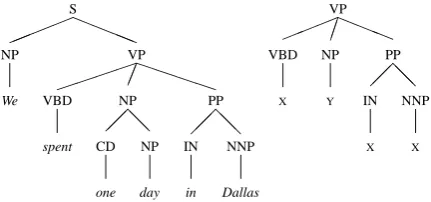
i(NULL,NPk), we extract the substructure from the parse tree containingNPkas follows. Letn(NPk) be the root of the subtree that spans all and only the words inNPk, and letP arent(n(NPk)) be its imme-diate parent node. We (1) take the subtree rooted atP arent(n(NPk)), (2) replace each leaf node in
this subtree with a node labeled X, (3) replace the child nodes of n(NPk) with a leaf node labeled Y, and (4) use the subtree rooted atP arent(n(NPk)) as the structured feature for i(NULL, NPk). Fig-ure 1 illustrates this substructFig-ure extraction proce-dure via an example.
Intuitively, the first three steps aim to provide generalizations by simplifying the tree. For exam-ple, step (1) allows us to focus on using a small window surrounding NPk as its context. Steps (2) and (3) help generalization by ignoring the words withinNPkand its context. Note that using two la-bels,XandY, helps distinguish the active NP from its context within this substructure. Also note that we simply use one node (Y) to represent the ac-tive NP, since NP-internal information (e.g., gen-der) has been captured by the flat features.
While this parse substructure ignores the words in NPk, these unigrams could be useful for
deter-S
aaaa ! ! ! !
NP
We
VP
PPPP
VBD
spent
NP
@@
CD
one
NP
day
PP
@@
IN
in
NNP
Dallas
VP
aaa ! ! !
VBD
X
NP
Y
PP
@@
IN
X
NNP
[image:5.595.307.523.65.166.2]X
Figure 1: A parse tree (left) and the parse substruc-ture extracted for the NP “one day” (right).
mining its anaphoricity, as a learner may learn from coreference-annotated data that “it” only has a moderate probability of being anaphoric, and that “the contrary” from the phrase “on the con-trary” is never anaphoric. As a result, we augment the set of flat features in i(NULL,NPk)with the un-igrams extracted fromNPk.
Step 2: Recasting Ranking as Classification
Existing implementations of SVMs, such as SVMlight-TK (Moschitti, 2004), allow us to com-bine flat and (structured) tree-based features to train a classifier by designing appropriate kernels. Hence, if we were to train an SVM classifier, all we need to do is to design a kernel. However, we are given a ranking problem, and it is not immedi-ately clear how an SVM can learn a ranking model in the presence of tree-based features.
Our approach to this problem is to reduce the given ranking problem to an equivalent classifica-tion problem. Once we have a classificaclassifica-tion prob-lem, all we need to do is to design a kernel for training a classifier, as mentioned above. To re-duce a ranking problem to an equivalent classifi-cation problem, we need to convert the training set for the joint CR model to an equivalent training set that can be used to train a classifier.
Before describing the conversion process, let us first recall how the training set for a joint CR model is created. Given a training textD, we cre-ate fromDa set of training instancesT for a joint CR model by taking the union ofT1, T2, . . . , Tn,
where Tk (1 ≤ k ≤ n) is the set of training
in-stances generated from NPk inD. If NPk has |C| preceding clusters,Tkwill contain exactly|C|+ 1
ranker-learning algorithm aims to learn how to rank pre-ceding clusters for an active NP by learning how to rank the instances within eachTk.
As noted before, to facilitate learning a ranker from both flat and tree-based features, we refor-mulate the given ranking problem as a set of wise ranking problems. The reason is that a pair-wise ranking problem is essentially a binary
clas-sification problem, since pairwise ranking merely
involves ranking two objects. Not surprisingly, this reformulation requires that we convert T into an equivalent training set T′, which consists of pairwise ranking problems and can therefore be used to train a classifier (i.e., a pairwise ranker). Below we describe how to convertT toT′.
For eachTkinT, we create a training instance inst for T′ from each pair of training instances in Tk that have different rank values. For
exam-ple, if i(ci, NPk) and i(cj, NPk) inTk have ranks r1andr2 respectively wherer1 6=r2, we create a training instance forT′whose feature vector is ob-tained by subtracting i(cj,NPk)from i(ci,NPk). If
both feature vectors contain only flat features, the subtraction is straightforward, since each flat fea-ture is real-valued. However, if one of the feafea-ture vectors has a tree-based feature3 (which happens whenciorcj isNULL), we handle the flat features and the tree-based feature separately. Specifically, we first perform subtraction for the flat features as described above, and then append the tree-based feature to the feature set ofinst. If r1 > r2, the class value ofinstis 1; otherwise, it is−1.
In sum, eachTkinTconstitutes a ranking
prob-lem, and we described how to convert this ranking problem into a set of pairwise ranking problems in
T′. As noted before, a pairwise ranking problem is a binary classification problem. Hence, the result-ing trainresult-ing set,T′, can be used to train a (binary) SVM classifier that minimizes the number of vio-lations of pairwise rankings inT′.
Step 3: Designing the Composite Kernel
To train an SVM classifier onT′, we need to define a kernel function for computing the similarity be-tween a pair of instances. If both instances contain only flat features, we simply employ a normalized linear kernel, which computes similarity as the co-sine of their feature vectors. However, if one or both of them has a tree-based feature, a linear
ker-3Note that at most one of these two feature vectors has
a tree-based feature. The reason is that exactly one of the instances inTkhas a tree-based feature, namely the one
cor-responding to theNULLcluster.
nel is not directly applicable. In this case, we need to (1) compute the similarity of their flat features and the similarity of their tree-based features sep-arately, and then (2) employ a composite kernel,
Kc, to combine the two similarity values.
Specifi-cally, we defineKc as follows:
Kc(F1, F2) =K1(F1, F2) +αK2(F1, F2),
whereF1 andF2 are the full set of features (con-taining both flat and structured features) that rep-resent the two instances under consideration. K1 is a linear kernel, which operates on the flat fea-tures.K2is a convolution tree kernel (Collins and Duffy, 2001), which operates on the tree-based features. Specifically,K2 computes the similarity of two parse trees by efficiently enumerating the number of common substructures in them. To pre-vent the kernel value returned by Kc from being
consistently dominated by one of the component kernels (i.e., K1 and K2), we normalize the ker-nel values returned byK1andK2 so that they fall between 0 and 1. α is as a weight parameter that allows the two kernel values to be combined lin-early, providing the flexibility to vary the relative importance of the component kernels. We will de-termineαempirically on the development set.
3.3 Applying the Pairwise Ranker
So far, we have described a method for training a (pairwise) ranker when the feature set contains both flat and tree-based features, which involves converting training setT to training setT′. A nat-ural question, then, is: do we have to similarly per-form this conversion on the test set so that the pair-wise ranker can be applied to it?
It turns out that the answer is no. Given a set of test instances Tk to be ranked, all we need to do
is to apply the pairwise ranker to each instance in
Tk. The ranker produces one real value for each
instance. According to the values provided by the ranker, these test instances can be ranked: the most positive value corresponds to the highest rank.
pairwise rankings. To do so, SVMlight needs to position the hyperplane so that an instance with a higher rank inT is assigned a more positive value by the hyperplane than one with a lower rank inT. Consequently, we can apply the pairwise ranker to each test instance to be ranked, and use the value returned by the ranker for each instance to impose a ranking on the test instances.
4 Evaluation
In this section, we examine the effectiveness of the tree-based and path-based features in improving the joint CR model.
4.1 Experimental Setup
Corpus. We employ in our evaluation a dataset comprising 147 coreference-annotated Switch-board dialogues, which contain a total of 68,992 NPs.4We partition the dialogues into a training set (117 dialogues) and a test set (30 dialogues). We extract the NPs and the parse trees directly from the gold-standard annotations, but the coreference features are computed entirely automatically.
Scoring programs. We employ two commonly-used coreference scoring programs, B3 (Bagga and Baldwin, 1998) and φ3-CEAF (Luo, 2005), both of which report results in terms of recall (R), precision (P), and F-measure (F).
4.2 Results and Discussion
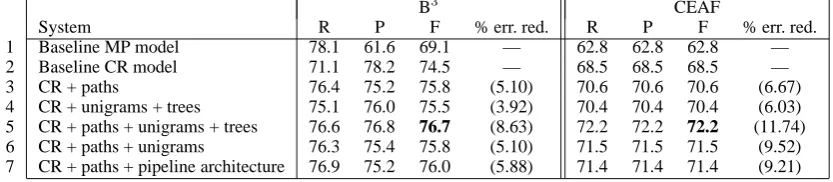
The baseline mention-pair model. We employ as our first baseline the MP model, which is trained using the procedure described in Section 2.1. Given that our goal is to examine the ef-fectiveness of the tree-based and path-based fea-tures for the joint CR model, one may wonder why the results of the MP model are relevant to our investigation. Recall from the introduction that we chose to improve the joint CR model with the two types of features derived from syntactic parses because the joint CR model has been shown to achieve state-of-the-art performance on the ACE corpus. To ensure that the joint CR model also out-performs the MP model on our Switchboard cor-pus (and is therefore the strongest baseline we can use), we show the results of the MP model in row 1 of Table 1. As we can see, it achieves F-measure scores of 69.1 (B3) and 62.8 (CEAF).5
4
This dataset is released by the LDC as part of the NXT corpus (Calhoun et al., 2010).
5Since gold-standard NPs are used in our coreference
ex-periments, CEAF recall, precision, and F-measure will all be
The baseline joint cluster-ranking model. Our second baseline is the joint CR model, which is trained using the method described in Section 2.2. In particular, this baseline model does not employ any tree-based or path-based features. Results are shown in row 2 of Table 1. In comparison to the MP model in row 1, we can see that B3F-measure rises from 69.1 to 74.5 and CEAF F-measure rises from 62.8 and 68.5. These results are consistent with our hypothesis that the joint CR model is in-deed a stronger baseline than the MP model.
Incorporating path-based features. Next, we incorporate the path-based features into the Base-line joint CR model. Results are shown in row 3 of Table 1. In comparison to the results of the Baseline joint CR model in row 2, we can see that adding the path-based features into the feature set improves the joint CR model according to both scorers. In particular, B3 and CEAF F-measure scores rise by 1.3% and 2.1%, respectively, sug-gesting the usefulness of the path-based features.
In addition to the R, P and F columns, Table 1 has two columns labeled “% err. red.”, which show the error reduction of a system relative to the Baseline joint CR model. Here, we compute the error of a system by subtracting its F-measure score from the perfect F-measure (i.e., 100). With the addition of path-based features, we can see that relative error is reduced by 5.1 and 6.7 according to B3and CEAF, respectively.
Incorporating tree-based features. Next, we incorporate the tree-based features into the Base-line joint CR model. Recall that from a tree, we extract both flat features (i.e., unigrams) and struc-tured features (i.e., parse substructures), so both types of features are used to augment the Base-line feature set. Because both types of features are involved, we need to tuneαin the composite ker-nel. To ensure a fair comparison among different systems, we do not employ additional labeled data for tuningα. Rather, we use 75% of the available training data for training the joint CR model and reserve the remaining 25% for parameter tuning.
Results are shown in row 4 of Table 1. In com-parison to the results of the Baseline joint CR model in row 2, we can see that adding the trees and the unigrams into the feature set improves the joint CR model according to both scorers. In par-ticular, B3 and CEAF F-measure scores rise by 1.0% and 1.9%, respectively.
B3 CEAF
System R P F % err. red. R P F % err. red.
1 Baseline MP model 78.1 61.6 69.1 — 62.8 62.8 62.8 —
2 Baseline CR model 71.1 78.2 74.5 — 68.5 68.5 68.5 —
3 CR + paths 76.4 75.2 75.8 (5.10) 70.6 70.6 70.6 (6.67)
[image:8.595.93.510.64.155.2]4 CR + unigrams + trees 75.1 76.0 75.5 (3.92) 70.4 70.4 70.4 (6.03) 5 CR + paths + unigrams + trees 76.6 76.8 76.7 (8.63) 72.2 72.2 72.2 (11.74) 6 CR + paths + unigrams 76.3 75.4 75.8 (5.10) 71.5 71.5 71.5 (9.52) 7 CR + paths + pipeline architecture 76.9 75.2 76.0 (5.88) 71.4 71.4 71.4 (9.21)
Table 1: Coreference results on the test set obtained using B3and CEAF.
Incorporating tree- and path-based features.
Next, we incorporate both tree-based (i.e., un-igrams and parse substructures) and path-based features into the Baseline joint CR model. As in the previous experiment, we reserve 25% of the available training data for tuning α. Results are shown in row 5 of Table 1. In comparison to the results of the Baseline joint CR model in row 2, we can see that adding both types of features improves F-measure by 2.2% (B3) and 3.7% (CEAF), which is equivalent to a relative error reduction of 8.6% (B3) and 11.7% (CEAF).
In comparison to the results in rows 3 and 4, we can see that better results can be obtained by applying the two types of features in combination than in isolation to the Baseline joint CR model. This suggests that although both types of features are derived from parse trees, they provide comple-mentary information for the CR model.
Understanding the value of parse substruc-tures. So far, we have always applied the uni-grams and the parse substructures in combination in our experiments. To better understand the value of the parse substructures, we perform an ablation experiment in which we repeat the previous exper-iment without using the parse substructures.
Results are shown in row 6 of Table 1. In comparison to the results in row 5, we can see that F-measure drops by 0.9% (B3) and 0.7% (CEAF). Since the difference in results between the two rows can be attributed entirely to the pres-ence/absence of the parse substructures, the drop in F-measure suggests that the parse substructures are indeed useful features for the joint CR model.
Pipeline vs. joint modeling. One challenge we addressed here involves enabling the integration of structured and flat features in a ranker that performs joint learning. A natural question is: is this joint learning architecture indeed better than the traditional pipeline architecture in which anaphoricity determination is performed prior to
coreference resolution? To answer this question, we show in row 7 of Table 1 the results ob-tained using the pipeline architecture, where (1) an anaphoricity classifier is trained with all the features used to represent an instance involving the NULL antecedent in the joint CR model in row 5 and (2) the joint CR model is trained using the Baseline and path-based features. This setup would therefore allow us to determine whether the joint architecture or the pipeline architecture can better exploit the structured features. In compari-son to the results in row 5, we see that F-measure drops by 0.6–0.8%. These results suggest that joint learning is indeed better than pipeline learn-ing in terms of exploitlearn-ing structured features.
5 Conclusions
We have examined the effectiveness of tree-based and path-based features in improving a state-of-the-art supervised coreference model, the cluster-ranking model. Results on 147 Switchboard dia-logues, show that both types of features are effec-tive at improving the performance of the cluster-ranking model. In particular, when they are ap-plied in combination, we see a reduction in rela-tive error by 8.6–11.7%. One challenge that we addressed during the course of this investigation involves enabling flat and structured features to be employed simultaneously in a ranking model that employs joint learning. With the increasingly im-portant role structured features and ranking mod-els play in natural language learning, we believe that our method for combining flat and structured features for training a ranker would appeal to re-searchers working in different areas of NLP.
Acknowledgments
References
Amit Bagga and Breck Baldwin. 1998. Algorithms for scoring coreference chains. In Proceedings of the
LREC Workshop on Linguistic Coreference, pages
563–566.
Eric Bengtson and Dan Roth. 2008. Understanding the values of features for coreference resolution. In
Proceedings of EMNLP, pages 294–303.
Sasha Calhoun, Jean Carletta, Jason Brenier, Neil Mayo, Dan Jurafsky, Mark Steedman, and David Beaver. 2010. The NXT-format Switchboard cor-pus: A rich resource for investigating the syntax, se-mantics, pragmatics and prosody of dialogue.
Lan-guage Resources and Evaluation, 44(4):387–419.
Michael Collins and Nigel Duffy. 2001. Convolution kernels for natural language. In Advances in NIPS, pages 489–496.
Michael Collins and Nigel Duffy. 2002. New rank-ing algorithms for parsrank-ing and taggrank-ing: Kernels over discrete structures, and the voted perceptron. In
Pro-ceedings of the ACL, pages 263–270.
Aron Culotta, Michael Wick, and Andrew McCallum. 2007. First-order probabilistic models for corefer-ence resolution. In Proceedings of NAACL/HLT, pages 81–88.
Pascal Denis and Jason Baldridge. 2007. Global, joint determination of anaphoricity and coreference reso-lution using integer programming. In Proceedings
of NAACL/HLT, pages 236–243.
Pascal Denis and Jason Baldridge. 2008. Specialized models and ranking for coreference resolution. In
Proceedings of EMNLP, pages 660–669.
Aria Haghighi and Dan Klein. 2009. Simple corefer-ence resolution with rich syntactic and semantic fea-tures. In Proceedings of EMNLP, pages 1152–1161.
Ryu Iida, Kentaro Inui, and Yuji Matsumoto. 2009. Capturing salience with a trainable cache model for zero-anaphora resolution. In Proceedings of
ACL-IJCNLP, pages 647–655.
Thorsten Joachims. 1999. Making large-scale SVM learning practical. In Bernhard Scholkopf and Alexander Smola, editors, Advances in Kernel
Meth-ods - Support Vector Learning, pages 44–56. MIT
Press.
Dekang Lin and Patrick Pantel. 2001. DIRT: Discov-ery of inference rules from text. In Proceedings of
KDD, pages 323–328.
Xiaoqiang Luo and Imed Zitouni. 2005. Multi-lingual coreference resolution with syntactic features. In
Proceedings of HLT/EMNLP, pages 660–667.
Xiaoqiang Luo, Abe Ittycheriah, Hongyan Jing, Nanda Kambhatla, and Salim Roukos. 2004. A mention-synchronous coreference resolution algorithm based on the Bell tree. In Proceedings of the ACL, pages 135–142.
Xiaoqiang Luo. 2005. On coreference resolution per-formance metrics. In Proceedings of HLT/EMNLP, pages 25–32.
Alessandro Moschitti. 2004. A study on convolution kernels for shallow statistic parsing. In Proceedings
of the ACL, pages 335–342.
Vincent Ng and Claire Cardie. 2002a. Identifying anaphoric and non-anaphoric noun phrases to im-prove coreference resolution. In Proceedings of
COLING, pages 730–736.
Vincent Ng and Claire Cardie. 2002b. Improving ma-chine learning approaches to coreference resolution. In Proceedings of the ACL, pages 104–111.
Massimo Poesio, Olga Uryupina, Renata Vieira, Mijail Alexandrov-Kabadjov, and Rodrigo Goulart. 2004. Discourse-new detectors for definite description res-olution: A survey and a preliminary proposal. In
Proeedings of the ACL Workshop on Reference Res-olution.
Altaf Rahman and Vincent Ng. 2009. Supervised mod-els for coreference resolution. In Proceedings of
EMNLP, pages 968–977.
Altaf Rahman and Vincent Ng. 2011. Learning the information status of noun phrases in spoken dia-logues. In Proceedings of EMNLP, pages 1069– 1080.
Wee Meng Soon, Hwee Tou Ng, and Daniel
Chung Yong Lim. 2001. A machine learning ap-proach to coreference resolution of noun phrases.
Computational Linguistics, 27(4):521–544.
Veselin Stoyanov, Nathan Gilbert, Claire Cardie, and Ellen Riloff. 2009. Conundrums in noun phrase coreference resolution: Making sense of the state-of-the-art. In Proceedings of ACL-IJCNLP, pages 656-664.
Yannick Versley, Alessandro Moschitti, Massimo Poe-sio, and Xiaofeng Yang. 2008. Coreference systems based on kernels methods. In Proceedings of
COL-ING, pages 961–968.
Bonnie Lynn Webber. 1979. A Formal Approach to
Discourse Anaphora. Garland Publishing, Inc.
Xiaofeng Yang, Jian Su, and Chew Lim Tan. 2006. Kernel based pronoun resolution with structured syntactic knowledge. In Proceedings of
COLING-ACL, pages 41–48.
Xiaofeng Yang, Jian Su, Jun Lang, Chew Lim Tan, and Sheng Li. 2008. An entity-mention model for coref-erence resolution with inductive logic programming. In Proceedings of the ACL, pages 843–851.
GuoDong Zhou and Fang Kong. 2009. Global learn-ing of noun phrase anaphoricity in coreference res-olution via label propagation. In Proceedings of