A L o g i c - B a s e d G o v e r n m e n t - B i n d i n g P a r s e r f o r M a n d a r i n C h i n e s e
ttsin-Hsi CHEN
Department of Computer Science and Information Engineering National Taiwan University
Taipei, Taiwan 10764, R.O.C. NTUTO46@TWNMO E l O.BITN ET
Abstract
Mandarin Chinese is a highly flexible and context-sensitive language. It is difficult to do the case marking and index assignment during the parsing of Chinese sentences. This paper proposes a logic-based Government-Binding approach to treat this problem. The grammar formalism is specified in a formal way. Uniform treatments of movements, arbitrary number of movement non-terminals, automatic detection of grammar errors beforehand, and clear declarative semantics are its specific features. Many common linguistic phenomena of Chinese sentences are represented with this fornmlism. For example, topic-comment structures, the ba-constructions, the bei-constructions, relative clause constructions, appositive clause constructions, and serial verb constructions. A simple pronot,n resolution is touched upon. The expressive capabilities and the design methodologies show this mechanism is also suitable for other flexible and context-sensitive languages.
1. Introduction
Chinese is a highly flexible language, The same meaning may be represented in many different Chinese patterns. In other words, Chinese provides many ways for the native speakers to express their feelings. For example, a sentence like "I have told Mr. Lee that they want these books" in English, we can form multiple different patterns in Chinese:
(a) ~ ~ i ~ ~ [np ~ Z l
Is ~f~] ~
~ - ~ ~ 1 °I have told [np Mr. Lee] [s that they want these books]. (b) [ n p - : ~
li,~J~
~ - ~ ~ ti [s t ~ ~ ~ {~]o[tap Mr. Leeli, I have told t i [s that they want these books]. (c) ~ ~}=~ ~ [np ~ q g ~ ] [s [np ~ ~ :~ ]j {I.~ ~] ~ tj] 0
I have told [tap Mr. Lee] [s that [np these books]j they want tj].
(d) [np i ~ l i , ~ ~ ~ ti Is [tap ~ ~ ~ ] j 4 ~ ] ~ tj]o [np Mr. Lee] i, I have told t i [s that [np these books]j they want tj].
(e) [rip ~ : ¢ i ~ ]i, [tap i~-~-~ ~]j, ~ ~
i~ t i [s { ~ t ~ tj]o
[tap Mr. Lee] i, [np these books]j, I have told t i Is that they want tj].In reality, it shows the specific pattern: topic-comment structure in Mandarin Chinese. Topicalization may be deemed one of the movement transformations. Examples (b) and (c) specify an object is moved to the topic position. Examples (d) and (e) are
sentences with multiple topics. We can realize that the more predicates a sentence includes, the more topic positions it has. And thus, the more complicated patterns may be generated. It is good for the language users, however, it is difficult to process this type of languages in computer.
Chinese is also a highly context-sensitive hmguage. There are so many phenomena, e.g. index assigmnent, case marking, etc., depending on the context information even within a Chinese sentence. The index assignments in the topic-comment patterns shown above explain this point. Examples (d) attd (e) are legal interpretations. However, their bindings are different. The former is a serial binding, and the latter is a crossed binding. Serial binding is qot always true. For example, the index assignment cannot be
* Inp-Z'~-~Ji]t=L=li , [np Lff. a:- ~ ~ l j , ~[J~ ~-~d~ i~,.'~ tj Is ~ : ~ ti]o
* [np Mr. Lee] i, [tap these books]j, I have told tj [s that they want ti].
This is because the object that someone told must be an animate. Therefore, the index assignment, which is a necess,'uy step toward correct interpretation of natural language sentences, is difficult in computer.
This paper proposes a Government-Binding approach to deal with these highly flexible and context-sensitive languages such as Mandarin Chinese. It is organized as follows. Section 2 specifies the concepts of Government-Binding Theory. Section 3 gives a fortnal definition of Government-Binding based logic grammars. Section 4 demonstrates a Chinese parser from several context-sensitive constructions, and touches on the simple pronoun resolution within a Chinese sentence. Section 5 concludes the remarks.
2. G o v e r n m e n t - B i n d i n g T h e o r y
Government-Binding (GB) Theory/Chomsky 1981, Sells 1985/is the descendant of Transformation Grammars/Radford 1981/. Its simplified organization is shown in Figure 1. Move - c~ , which is a general operation, moves anything anywhere between d-structure and s-structure, and between s-structure and logical foma. GB Theory includes a series of modules that contain constraints and principles which govern the movement transformation.
1. Projection Principle
d-structure s-structure - logical form
2. Empty Category 3. Binding Theory
Fil;ure 1. Government-Binding Theory
Thus, we must have the capabilities to verify the relationship between the moved constituent and the empty constituent. GB Theory provides several mechanisms for the verification. The Empty Category Principle (ECP) says "A trace must be properly governed." That is, we must find some cx that c-commands the trace /3 . A n d cx binds /3 iff (a) c, c - c o m m a n d s / 3 , and (b) a and /3 are co-indexed. Their d e f i n i t i o n s are based on C - C o m m a n d Condition. The C-Command Condition states the following:
a c-eomman&/3 if and only if the first branchit,g ~,ode dominating et also dominates /3, and ct does not itselJ dominate t3.
It states a co-reference relation between a moved element and its mtce. The Subjaeency Condition is given in the following:
Any application of Move - e~ may not cross more than one bounding node.
[t specifies island consuaints on the moved constituents. The Binding Theory/Sells 1 9 8 5 / s h o w n b e l o w is used for simple pronoun resolution:
(Principle A) An anaphor is bound in its Governing Category. (Principle B) A pronominal is free in its Governing Category. (Principle C) An R-expression is free.
Anaphors include reflexive and reciprocals, pronominals include pronouns, and R-expressions include all other noun phrases.
3 . A G o v e r n m e n t - B i n d i n g B a s e d L o g i c G r a m m a r F o r m a l i s m
The formal definition of Government-Binding based Logic G r a m m a r s ( G B L G s ) is specified i n c r e m e n t a l l y in the following.
Definition 1. A Government-Binding based Logic Grammar
is a 6-tuple GBLG = (T,2,B,S,C,R) where:
(1) T is the set of lexical terminals. Each lexical terminal is denoted by an atomic formula with lexical category as its predicate symbol.
(2) ,'~ is the set of non-terminals. Y. = ZI' U ~]v k) ]~M k) ~G where:
(a) Zp is the set of phrasal non-terminals. Each phrasal non-terminal is represented by an atomic formula with phrasal category as its predicate symbol.
(b)Y. V is the set of virtual non-terminals. Each virtual non-terminal is specified by an atomic formula.
(c)Y. M is the set of m o v e m e n t non-terminals. A movement :non-terminal is one of the following two forms:
A < < < B o r B > > > A w h e r e A E T k ) ~ p t 9 ~ v , a n d
B E ~V" ]~-7'LM and ~RM denote the set of non-terminals A
<<< B and the set of non-terminals B >>> A, respectively. ( d ) ~ G is the set of goals. Each goal is denoted by a literal.
(3) B C ~ p is the set of bounding non-terminals. A botmding non-terminal is a phrasal non-terminal with bounding node as its predicate symbol.
(,4) S E ~ p is the start non-terminal.
(5) C is the set of logic connectives 'and' and 'or' that are denoted by ',' and ';' respectively. A grammar element is defined rccursivcly in terms of logic connectives as follows:
(a) A lexical tm'minal L E T is a grammar element. (b)A phrasal non-terminal P E ~ p is a grammar element. (c) A virtual non-terminal V E .~v is a grammar element. (d)A movement non-terminal M ~ ~M is a grammar
element.
(e)A goat E ~JG is a grammm" element.
(f) If A and B are grammar elements, then (A,B) and (A;B) are g,ammar elements.
The first five types are called basic grammar elements, and the last one is a compound grammar element. Let G t and G E be the set of basic granmaar elements and the set of c o m p o u n d grammar elements, respectively.
(6) R is the set of production rules. A production rule is of the following form:
X 0 °-> X l C l X 2 C 2 ... C(m.l) Xm where X 0 < ~l,,
X i E G E for 1 _< i _< m, and C i g2 C for I £ i _< (m-1).
It is obvious each production rule can be translated into a sequence of production rules with the logical operator 'and' only.
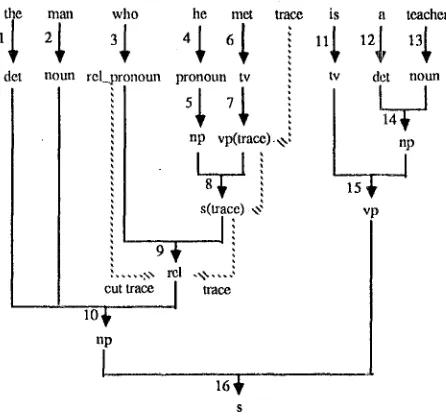
An example written with this formalism is shown as follows. It captures the relative clauses in English like "The man who he met is a teacher."
(rl) s - - > n p , vp. (r2) np --> pronoun. (r3) np --> det, notm. (r4) n p - - > det, noun, rel. (r5) vp -.-> tv, np. (r6) vp --> tv, trace. (rT) vp --> iv.
(r8) rel --> tel pronoun <<< trace, s.
where T = {pronoun, det, noun, tv, iv, rel pronoun}, £ p = {s, np, vp, rel},
£ v = {trace },
~ m = {rel_pronot, n <<< trace}, and
B = {s, np}.
The rule (r8) describes a constituent in phrase structure s is extraposed to the rel pronoun position. Which constituent may be moved from which position is specified by rule (r6).
D e f i n i t i o n 2. ][:or X E ~p, Y E ~ v and TR is a transitive relation, X TR Y if
(1) X is tile rule head of a production rule, and Y is a
grammar clement in its ntle body, or
(2) X is tile rule head of a production rule, 1 {- Y.p is a grammar element in its rule body, and I TR Y, or
TR 12 TR ... TR I n T R Y .
The transitive relation TR is also a dominate relation. This is because TR is a dominate relation between a phrasal non-temfinal and a virtual non-terminal.
Definition
3. A production rule X 0 --> X 1, X 2 . . . X m (where X i E G I for I < i < m) is significant if it satisfies the extra restrictions:(1) for any grammar element X i = (A <<< B) E ]~LM, there must exist some Xj, i < j -< m, such that (Xj, B) E TR.
(2) for any grammar element X i = (B >>> A) E ~RM' there must exist some Xj, 1 _<j < i, such that (Xj, B) E TR.
A logic grammar GBLG is significant if each production rule E R is significant. The above sample grammar is significant for the following reasons:
(1) The rules (rl) - (r7) are significant trivially. (2) The rule
tel --> rel pronoun <<< trace, s
is significant because there exists a transitive relation T R 1 such that s TR 1 vp TR l trace.
Proposition
1. The c - c o m m a n d condition is e m b e d d e d implicitly in GBLGs if these grammars are significant. P r o o f . For a significant production rule:X 0 --> X l, X 2 ... X m
if X i = (A <<< B) E ~LM then there must exist some Xj (i < j < m), such that Xj dominates the virtual non-terminal B in the other production rule. The phrasal non-terminal X 0 is the first branching node that dominates A and Xj, and thus also dominates B. Therefore, A c-commands B. X i = (B >>> A) E ~RM has the similar behavior.
This property can be used to check the con'ectness of granmwas automatically before parsing.
Definition 4. The transitive relation TRsubjacency is a subset of TR and satisfies the restrictions: for X E ~p, Y E Y~V, X TRsubjacency Y if X TR I l TR 12 TR ... TR I n TR Y, and there does not exist more than one Ij such that lj E B.
P r o p o s i t i o n 2. A significant logic grammar is a restrictive context sensitive grammar. This is because the truth value of a movement non-terminal depends on the appearance of a virtual non-temainal preceding or following it.
/Chen 1988/ proposes a bottom-up parsing system for GBLGs. Figure 2 shows the execution of our sample grammar for the sentence "The man who he met is a teacher". The label on the are indicates the step number during parsing. The empty constituent trace is generated in phrase vp, then passed to phrase s, and finally cut in phrase rel. Comp,'tred with other logic programming a p p r o a c h e s / M a t s u m o t o 1983, McCord 1987, Pereira 1981, Stabler 1987/, especially R L G s / S t a b l e r 1987/, GBLGs have the following features:
(1) the uniform treatments of leftward movement and the rightward movement,
(2) the arbitrary n u m b e r of movement non-terminals in
t h e
det
man who
2
3
w w
noun rel_gronoun
c u t t r a c e 10~
np
J
he met trace
4~ 6~
pronoun tv
np vp(trace).\x~
8
s(trace) ,,',"tel .\~, ,..,'
I ~ce
t6,~
Sis a teacher
tv det noun
np . . . .
i
ts;~
vpFigure 2. Sample Parsing
the rule body,
(3) automatic detection of grammar errors befi)re parsing. The former two features are useful to express the highly flexible languages like Chinese.
4. A Chinese Parser
4.1 Topic-comment Structures
Topic-comment structure is one of the specific features in Mandarin Chinese. There are several interesting linguistic phenomena concerning these structures:
(1) Topic may be moved from the argument positions in the comment - as subject, direct object, or indirect object.
(2) Many categories may appear in the topic position, e.g. n", s', v", or p".
(3) There may be multiple topics in a sentence.
(4) The comment may not contain a constituent which is anaphorically related to the element in the topic.
Under the above observations, topic may be represented as: topic(topic(N2bar),n2bar,Semanfic,Index,Case) -->
n2bar(N2bar,Semantic,Index,Case,Classifier).
The second argument of predicate topic specifies the phrasal category of the topic, i.e., n 2 b a r in this example. It is important for tile parser to decide whether the constituent may co-index with a trace.
Next, the production rules for generating sentences are shown as follows:
s 1 bar(s 1 bar(Topic 1 ,Topic2,S)) --> topic (Topic 1 ,Cat 1 ,S 1,I 1 ,Case 1)
<<< trace(topic,info(Cat 1,S 1,I1,Case 1)), topic(Topic2,Cat2,S 2,I2,Case2)
<<< trace(topic,info(Cat2,S2,I2,Case2)),
s(S).
s 1 bar(s 1 bar(Topic,S)) --> topic(Topic,Cat,S,I,Case)
<<< trace(topic,info(Cat,S,I,Case)),
s(S).
[image:3.596.314.537.62.271.2]()1' these three production rules, the first two define the "topie-comnrent" pattern, and the last one is a rule without topic.
Finally, the phrasal non-terminal s is introduced. s(s(N2bar,V2bar)) -->
n2bar(N2bar,Semantic,lndex,Case,Classifier), v2bar(V2bar,Semantic,lndex,Case,subj,nonbei). s(s(t(Case,lndex),V2bar)) -->
mtce(X ,in fo(n2bar,Semantic,lndex,Case)),
v2bar(V2bt~r,Semantic,lndex,Case,subj,nonbei).
s(s(N2bar,V2bar)) --.>
n2bar(N2bar,S,I,C,Classifier) <<< tracc(bei,info(n2bar,S,l,C)), v2bar(V2bar,S 1,11 ,C 1 ,subj,bei). s(s(t(C,l),V2bar)) -->
trace(lelative,info(n2bar, S,I,C)) <<< Irace(bmj ~lo(n2bm,S,,,C)), v2bar(V2bar,S 1,11,C 1,subj,bei).
s(s(V2bar)) --> v2b u(V2bar, . . . nosubj nonbei). "llhe first s rule is a nornutl case, i.e., no movement. Semantic
denotes the semantic feature of tire head noun, It must be unifiable with tt~e semantic feature prey dec by the matrix verb with the type tree matching/McCord 198'7/. The same logical variable Case appears in the phrasal non-temfinals n2bar and v2bar. It means tire case of subjcct is assigned by tire maltix vcrb externally according to 0 - theory, The second s rule captures one I¢f tile movement transfornralions - relativizaticm, topiealizalion, ha-Ira r s [ o II ttion, or bci-transformat on An (,' err llorlll phFas(? is lllovcd via the foFlrlCr o p e r a t i o t l , [hlis ii v i r t u a l n o l l - t e r n r i n a l tlTI( (:(X
in/(;(n2hdr,5'emavtic,lnde.r, Cave))
i:¢ left at the empty sile. It specific:; onb' n2bar can appear herc, a~d what ki :Is i ) no;.'ements are not concerned. Tile semantic t~.:ature and case arc confined by the matrix verb. The third s rule deals with beiqra rst'o m~ tie ~. Vet example,(The tiller i is arrested t i by, tire t'o]ice.)
~'he thief (')J['; {[;~;l dxl'l~ ') is m}t a lo.,qcal subject of v2bar. The r~:al subject is tile object af bci ( ~ : ) , i.e., the police. Thus, at different group <S,I,C> of vaiab!es is used. The ti2bar acts as the ".' o,]cct of if)/)or .. or the subicct of lhe embedded sentence. "l'he tol1I-I]1 5" rtl!e ctlpItlrcs double movements for fill tl2bar, l:or
3 c G~irll I le,
(The thief i arrested t i by tire police escaped again.) A left-moved constituent (')]lt {N ,~]x{~]'~', the thief) is moved rightward furthermore. In this rule, two virtual non-terminals appear art both sides of movement operator '<<<'. Tim fifth s nile describes those sentences without subject. An atom nosut)j
ins/cad of ,wd.~/,~pecilics StlC}l ii silualioli. 4 . 2 Nnt,n P h r a s e
A rlo/lrl p h r a s e ca~l be a protlOtll?~ a s i m p l e n o u n , o r a noHn phls other elements that act as pre-modifiers of that noun. Those clements are (1) classifier phrases, (2) associative phrases, and (3) modifying phrases. Only associative phrase, relative clause, and appositive clause atre listed in the tbllowing. Associative phrase denotes two noun phrases are linked by a special Chinese word tie ('f19 '). For example,
~-t ~ ~d ~J .X. V] (the population of China). 'I he rule
n2bar(n2bar(A,N2bar),Semantic,Index,Case,Classifier)--> asc(A),
n2bar(N2bar,Semantic,Index,Case,Chtssifier)
represents this constnmtion. The definition of associative
clause is:
asc(asc(N2bar,De)) -->
n2bar(N2bar,Semantic,Index,Case,Classifier), * de(De).
Both relative clause and appositive clause are nominalization in the form: n o m i n a l i z a t i o n + head noun, and are defined as follows:
ret(rel(S,De)) --> s(S), * de(De). app(app(S,De)) -.> s(S), * de(De).
ttowever, they are different in the restricting the reference of tire head noun. The head noun that a rehttive chmse modifies refers to some unspecified participant in the nominalization part. l:or example,
(the former i who t i grows fluits), ',rod
4lt~]'tJ N
t i[l',J
:/k-~¢ i(the fluits i that they grow ti).
The head uoun 'Zk-~ -~' (tire fruits) refers to an empty constituent (either subjcct or object) in the relative clause. This type of constructions can be considered a rightward movement. For appositive clause and head noun pair, tile head noun does not refer to any entity in the modifying clause, i.e., appositive clause, t;or example,
;fJ~ {l'g
~It
N::e: fl',J N(the matter concerning our renting a house).
The nominalization ,~.~ ¢lj ;fll . ~ - ~ ' (our renting it house) serves as a complement to the head noun -:~' (the matter). This type of constrllctiorrs c a n n o t be regarded as a 111ovcrllerlt transformation. Two rules are specitied for them:
n2bar(n2bar(Re],N2bar),S,I,C,Classifier) -..> rel(Rel),
trace(relative, in tb(n2bar,S,I,C 1 )) >>> n2bar(N2bar,S,I,C,Classifier). n2bar(n2bar(Atlp,N2bar),S,I,C,Classifier) -->
app(App),
n2bar(N2bar,S,I,C,Classifier).
The only difference between these two rules is a trace has to be found i"n rehltive clause. Note the cases of the empty constituent and the overt constituent may be different in relative clause + head noun cot}strut/ion. For tire sake of space, the
nlbar is neglected in this paper. 4 . 3 V e r b P h r a s e
Different from a noun phrase, a verb phrase may have pre-modifiers and post-modifiers. The preverbal specifiers are ha-phrases, bei-phrases, adverbial phrases, degree phrases, preposition phrases, quantifier phrases, aspect, and modal. The postverbal modifiers are semential constructions, adverbial phrases, quantifier phzascs, classifier phrases, prepositional ph,ases, and aspect. Only Serial Verb Constructions (SVCs) are abom to discuss in detail. The rule
v2bar(v2bar(Va 1 bar, V b 1 bar),S,I,[C l,C2],subj) --> v 1 bar(Va 1 bar,S,I,C 1 ,sub j),
vl bar(Vb 1 bar,S,I,C2,su b j)
means two separate events juxtaposed together, e.g. ~'J~ i v ' - ~ ] Iv' i~2-2J~] (I Iv' bought a ticket] and iv' went inD. It is one of the SVCs. The two events have tile identical subject, but cases may be different. The other groups of SVCs are:
(1) One verb phrase or clause serving as the direct object of another verb, e.g.
(I entrust him to take care of an affair.) (3) Descriptive clauses, e.g.
(She cooked a dish that I very much enjoyed eating.) Only the former two are considered. Tile verbs with first use are classified into t2 attd t3, attd the verbs with the second use, i.e., pivotal construction, are classified into t8. It is not easy to define descriptive clauses with a rule or a new category, e.g. P O S S E S S I V E / Y a n g 1987/. This is because tile descriptive clause is optional. Without this clause, the original sentence is acceptable too. Furthermore, many verbs may be used with the descriptive clauses.
The lowest level vlbar (v') touches on the uses of the subcategorization frames of the specified verb. According to the frames and ECP, a virtual non-terminal trace is placed wherever it is needed. For example,
v 1 bar(v 1 bar(T l,N2bar),Semantic,Index,Case,HasSubj)-->
* t 1 (T l,HasSubj:Semantic:Case,Semantic 1 :Casel), n2bar(N2bar,Semantic l,lndex l,Casel,Classifier). v 1 bar(v 1 bar(T1 ,t(Case 1 ,I ndex 1 )), Semantic,Index ,Case,
tIasSubj) -->
* tl(T1,HasSubj:Semantic:Case,Semanticl :Casel), trace(X,in fo(n2bar,Semantic 1 ,Indexl,Casel)). v 1 bar(v 1 bar(T2,pseudoS (e(Case 1 ,Index),V2bar)),
Semantic,lndex,Case,subj) --> * t2(T2,subj :Semantic:Case),
v2bar(V2bar,Semantic,l ndex,Case 1,sub j).
The lexical category tl denotes transitive verb. Here, the trace may be generated by any movement transformation. The third rule is for SVCs. Note v2bar should have a subject and share it (Index) with the matrix verb. Thus, the semantic features of the two are the same. However, cases may be different. That is, one is assigned by the matrix verb, and the other one by the embedded verb. The rules for other lexical categories are omitted in this paper. The details can refer to/Lin 1989/.
4.4 Ba-construction
Ba-construction is usually generated by ba-transformation, which is one of the movement transformations. Tile direct object is placed immediately after '|P2' (ba) and before the verb like:
subject
'~'
(ba) _direct ~ verb. For example,~J~ }~, -~)'~',: N:i ~l~ ~ t i -]" o (I sold all three books.) t Iowever, there is another pattern for ba-construction:
subject '][.q' (ba) ~ verb ~ .
It is not constructed by movement transfom]ation becanse some noun phrase appears after verb, i.e., ot!ject 2. For example,
~J~
}U ~ ~
!aZ T =_:Z ~ o (I ate three of apples.) It shows a part-whole relation between object 1 and object 2. In the well-performed parsing systems, all the two patterns must be treated. It is also easy to represent this construction with our formalism.4.5 Bei-construction
Bei-construction is a familiar Chinese pattern like the following:
n o n n ~ ~gU (bei) noun phrase 2 verb. For example,
(The bird was let go (by me).)
Bei-construction has disposal shown as below similar to
ba-construction:
~I~ ~
I"1 ~ ¢ ~ } l~} T ~I~I il~
o(That door was kicked (by naB) and a hole is left.) The rules in Section 4.1 (topic-comment structure) capture the above phenomena.
4 . 6 P r o n o u n R e s o l u t i o n
Binding T h e o r y can be rephrased in the f o l l o w i n g procedures. Assume /3 is an anaphor, a pronominal, or an R-expression depending on which principle is used. Each element/3 may have two sets: set of possible pairs and set of flnpossible pairs. These two sets are denoted by possible-pair and impossible-pair respectively, and are defined in the following:
possible-pair(B )={ a I cx can co-index with/3 }, impossible-pair(/3 )={ a I ca cannot co-index with 13 }. (Principle A) For an acceptable sentence, try to find some such that ca is i n / 3 's Governing Category and c--commands /3. Each a that is outside of this range should not have a co-index relationship with 13. This principle defines two sets f o r / 3 . For example,
(* Mr. Lee i said [s that you saw yourselfiJ. ) possible-pair('~l ~ ')-- { '4~g' }
(possible-pair(self)= { you }), and impossible-pair('l~ ~ ')= { ~ 5~,*-~" ' } (impossible-pair(self)={Mr. Lee]).
Both '4~;' (you) and ' ~ 5 ~ J_~.= ' (Mr. Lee) c-command ' ~ t ~ ' (self). The former is in the governing category of the reflexive ' ~ ~ ' (self), but the latter is outside. So the index assignment is not acceptable.
(Principle B) Those a s that are in tile range of Governing Category and c-command /3 should not co-index with /3. This principle just says which a s cannot be in the candidate set. However, we cannot determine whether those cx s that are in its range and do not c - c o m m a n d / 3 , co-index with/3 or not. If such an a co-indexes w i t h / 3 , it must satisfy other criteria, e.g. other binding principles, the same semantic feature, and so on. Thus, this principle says only the i,qmssible-pair. For example,
* [ s ~ i ~ - ~ T ~2i ]o (* [s Mr. Lee i saw himi]. ) impossible-pair('{ tg') = [ ~ 3~ ~ ' }
(impossible-pair(him)= { Mr. Le e }).
The phrase ~ 3~t5'-~.' (Mr. Lee) c-commands ' ~ ' (him), thus they cannot be co-indexed based on Principle B. Consider a~othcr example:
* [s {lgi~..~, 71" ~ R - ~ i ] o (* [ s H e i saw Mr. Leeil.) The R-expressiort does not c - c o m m a n d the pronominal. According to Principle B, we have no way to detemfine their binding relationship. But if Principle C is applied, it can tell t,s the index assignment is wrong,
(Principle C) For any ca where a c - c o m m a n d s / 3 , a ought not to have co-index relationship w i t h / 3 . This principle says nothing for those a s that do not c - c o m m a n d /3. A set impossible-pair is defined from this principle. For example,
impossible-pair(-'-4 !g~ 3~ ~'~ ') = { "(t~', 'gJ~' )
(impossible-pair(Mr. Lee)={he, you }).
The pronominal ' ~ ' (he) c-commands '~-3~'35' (Mr. Lee), so they should have different indices.
Based on these three principles, a post-processing routine embedded in the parser is used to determine the co-index relationship between constituents from the parse tree. The algorithm is sinai:de: Traverse the parse tree, generate the relations possible-pair and impossible-pair. If it is unknown up to now, a rehttion unknown is given temporarily. When a new relation possible-pair or impossible-pair is got, use it to check all the unknown relations. Retract the unknowns accordingly. Finally, assign the anaphors and pronominals suitable indices based on the relations possible-pair and irtwossible-pair. 5 . Conclusion a n d R e m a r k s
Many natural langt, ages are flexible and context-sensitive. Mandarin Chinese is a famous example. It is difficult to capture tile linguistic phenoinena lot these languages in computer. This paper adopts GB Theory to deal with this problcm. According to GB Theory, the rule of 'move - a ' moves anything anywhere, and the universal princil~les operate interactively to rule out the illegal movements. Thus, the only things shoukt be declared in tim grammars ree:
(1) which phrases are the possible empty constituents, (2) which positions are their possible empty sites, (3) which positions are their possible landing sites, (4) which phrasal categories are bounding nodes. In such cases, a robnst parser for n:ttural hmguages can be designed. As an example, we represent many context-sensitive constructions in Mandarin Chinese, and do case marking and index assignment for Chinese sentences. An experime,mfl Chinese parser is running under the euvironments: (1) Vax-I 1/785, (2) Quintus Prolog, (3) lexicon with about 200 words (about 33K bytes), and (4) about 150 production rules (about l I2K bytes). Besides movement transformation, pronotm resolution is another index assignment. For well treatment o[ pronoun resolt, tion, the syntactic knowledge is not enough. This is because the Binding Theory tells us much the impossible pair, but little the possible pair. Much more semantic information should be included.
Moreover, our GB approach is also useft,1 when we would like to compose logical formulae from their syntactic counterparts. The idea is that the mapping between d-structure and s-struc.ture, as well as between s-structure and logical form are treated in the similar way. The movement transformation between d-structure and s-structure tells us the relationship anaong verb and its accolnpanying arguments. The skeleton of the given 'verb is defined in tile lexicon, and base-generated in the d-structure. For example,
' N '(Subject,Object) (buy(Subject,Object)).
The index assignment relates ~ ' (book) to the verb '.~:~ ' (buy) in the following sentence:
(There is one bcmk i that every student bought ti.) Because the variable of the type -~- ' (book) and the second argument of the template ' N '(Subject, Object) (buy(Subject, Object)) should be the same in the logical form, the index (a unique integer) can be changed into a variable, say X. That is, they share the same variable shown below:
exist(X,'i~ '(X),forall(Y,'-~ ~ L ' ( Y ) , ' N '(Y,X))) (exist(X,book(X),forall(Y,student(Y),buy(Y,X)))).
The formtfla tells us the SVO-SOV inversion in the logical tbrm. This phenomenon can be added into our parser easily with our formalism. The details concerning the logical interpretation of Chinese sentences refer to/Chen 1989/. R e f e r e n c e s
Chcn, tI.1t., I.P. Lin and C.P. Wu (1988) 'A New Design of P r o l o g - h a s e d B o t t o m - u p P a r s i n g S y s t e m with Government-l:linding Theory.' Proceedings of tile 12th lnternatio¢~al Conference on Computational Lingtdstics, pp.
112-116.
Chen, H.tl. (1989) 'The I,ogical Interpretation of Chinese Sentences.' Computer Processing of Chinese attd Oriental Languages 4(2,3), pp. 171-184.
Chomsky, A.N. (1981) Lectures on Government-Binding. Foris Publication, Dordrecht, I Iothmd.
Lin, I.P., S.F. IIuang, [I.H. Chen and K.W. Chui (1989) 77w Study qf the Knowledge Base in Mandarin Syntax (ll). Project Report, Department of Computer Science and Information Engineering, National Taiwan University, Taipei, Taiwan, R.O.C.
Matsumoto, Y., 1t. Tanaka, et al. (1983) 'BUP: A Bottom-up Parser Embedded in Prolog.' New Generation Computing 1(2), pp. 145-158.
McCord, M.C. (1987) 'Natural Language Processing in Prolog.' In: Walker, A. (Editor) A Logical Approach to Expert Systems and Natural Language ProcessMg. Addison-Wesley Publishing Company, Inc., pp. 291-402. Pereira, F. (1981) 'Extraposition Grammars.' American
Journal of Computational Liltguistics 7(4), pp. 243-256. P, adford, A. (1981) TratisJbrmation Sytltax. The Cambridge
[Jnivcrsity Press.
Sells, P. (1985) Lectures on Contemporary Syntactic Theories. Stanford, Center fix' the Study of l.anguage and Information.
Stabler, E.P., Jr. (1987) 'Restricting I,ogic Grammars with Government-Binding Theory.' Computational Linguistics
13(1-2), pp. 1-10.