A Method for Automatically Generating a Mediatory
Summary to Verify Credibility of Information on the Web
Hideyuki Shibuki and Takahiro Nagai and Masahiro Nakano Rintaro Miyazaki and Madoka Ishioroshi and Tatsunori Mori
Graduate School of Environment and Information Sciences, Yokohama National University
{shib, nagadon, nakano, rintaro, ishioroshi, mori}@forest.eis.ynu.ac.jp
Abstract
In this paper, we propose a method for mediatory summarization, which is a novel technique for facilitating users’ assessments of the credibility of infor-mation on the Web. A mediatory sum-mary is generated by extracting a pas-sage from Web documents; this sum-mary is generated on the basis of its relevance to a given query, fairness, and density of keywords, which are fea-tures of the summaries constructed to determine the credibility of informa-tion on the Web. We demonstrate the effectiveness of the generated me-diatory summary in comparison with the summaries of Web documents pro-duced by Web search engines.
1 Introduction
Many pages on the Web contain incorrect or unverifiable information. Therefore, there is a growing demand for technologies that can en-able us to obtain relien-able information. How-ever, it would be almost impossible to auto-matically ascertain the accuracy of informa-tion presented on the Web. Hence, the second-best approach is the development of a sup-porting method for judging the credibility of information on the Web.
Presently, when we wish to judge the credi-bility of information on the Web, we often read some relevant Web documents retrieved via Web search engines. However, Web search en-gines do not provide any suggestions in cases where the content of some documents conflicts with the content of other documents. Further-more, the retrieved documents are too many
to read and may not be ranked according to the credibility of the information they provide. In other words, information retrieval is not sufficient to support users’ assessments of the credibility of information, and therefore, ad-ditional techniques are required for the same. Several previous researches have been con-ducted for developing such techniques. Juffin-ger et al. (2009) ranked blogs in terms of their concurrence with well-verified informa-tion from sources such as a news corpus. Miyazaki et al. (2009) devised a method for extracting the description of the information sender, namely, the person or organization providing texts in Web pages. Ohshima et al. (2009) proposed a method for reranking Web pages according to users’ regionality, which depends on two factors: uniformity and proximity. While the abovementioned stud-ies mainly facilitate users’ assessments of the credibility of individual Web pages, the fol-lowing studies deal with the issues of cred-ibility of information in multiple documents on the Web. Murakami et al. (2009) pro-posed a method to analyze semantic rela-tionships such as agreement, conflict, or ev-idence between texts on the Web. Kawahara et al. (2009) reported a method for present-ing overviews of evaluative information such as positive/negative opinions.
Although the above techniques facilitate users’ assessments of credibility of information on the Web, there is still room for methods that support users’ judgment. For example, when the truth of a statement1 “Diesel
en-gines are harmful to the environment” is to
1In this paper, astatementis defined as text such
z^͕ĚŝĞƐĞůŝƐƉŽůůƵƚŝŶŐƚŚĞĞŶǀŝƌŽŶŵĞŶƚǀĞƌLJ
ŵƵĐŚĂŶĚƌĞůĞĂƐĞĐĂƌďŽŶŵŽŶŽdžŝĚĞ͘ EŽƉĞ͕ƚŚĞLJĞŵŝƚďůĂĐŬƐŵŽŬĞ͕ďƵƚĂƌĞŶŽƚŚĂnjĂƌĚŽƵƐƚŽĞŶǀŝƌŽŶŵĞŶƚ͕ƵŶůŝŬĞƉĞƚƌŽůĞƵŵ͘
ŵĞƌŝĐĂŶƐĐŽŶƚŝŶƵĞƚŽƉĞƌĐĞŝǀĞĚŝĞƐĞůĂƐĂΗĚŝƌƚLJΗĨƵĞů͕ƚŚŽƵŐŚƚŽĚĂLJƚŚĂƚŝŵĂŐĞŝƐŽŶůLJƉĂƌƚůLJ ĚĞƐĞƌǀĞĚ͘ĞĐĂƵƐĞŽĨƚŚĞŝƌůŽǁĞƌƉĞƌͲŵŝůĞĨƵĞůĐŽŶƐƵŵƉƚŝŽŶ͕ĚŝĞƐĞůĞŶŐŝŶĞƐŐĞŶĞƌĂůůLJƌĞůĞĂƐĞůĞƐƐ
ĐĂƌďŽŶĚŝŽdžŝĚĞͲ ƚŚĞŚĞĂƚͲƚĂƉƉŝŶŐŐĂƐƉƌŝŵĂƌŝůLJƌĞƐƉŽŶƐŝďůĞĨŽƌŐůŽďĂůǁĂƌŵŝŶŐͲ ĨƌŽŵƚŚĞƚĂŝůƉŝƉĞ͘ ^ŽƚŚĂƚΖƐĂĐŚĞĐŬŽŶƚŚĞŐŽŽĚƐŝĚĞŽĨƚŚĞƉŽůůƵƚŝŽŶĐŚĂƌƚ͘ƵƚǁŚĞŶŝƚĐŽŵĞƐƚŽƐŵŽŐͲĨŽƌŵŝŶŐ ƉŽůůƵƚĂŶƚƐĂŶĚƚŽdžŝĐƉĂƌƚŝĐƵůĂƚĞŵĂƚƚĞƌ͕ĂůƐŽŬŶŽǁŶĂƐƐŽŽƚ͕ƚŽĚĂLJΖƐĚŝĞƐĞůƐĂƌĞƐƚŝůůĂůŽƚĚŝƌƚŝĞƌ ƚŚĂŶƚŚĞĂǀĞƌĂŐĞŐĂƐŽůŝŶĞĐĂƌ͘
ǀƐ͘
dŚĞĂďŽǀĞƐĞŶƚĞŶĐĞƐĂƉƉĞĂƌƚŽĐŽŶƚƌĂĚŝĐƚĞĂĐŚŽƚŚĞƌĂƚĨŝƌƐƚŐůĂŶĐĞ͘
ZĞĂĚƚŚĞĨŽůůŽǁŝŶŐƚĞdžƚ͕ĂŶĚũƵĚŐĞǁŚĞƚŚĞƌƚŚĞLJĐĂŶĐŽĞdžŝƐƚƵŶĚĞƌƚŚĞƐŝƚƵĂƚŝŽŶ͘
WŽƐŝƚŝǀĞKƉŝŶŝŽŶ EĞŐĂƚŝǀĞKƉŝŶŝŽŶ
'ƵŝĚĂŶĐĞĨŽƌ/ŶƚĞƌƉƌĞƚĂƚŝŽŶ
ŽŵŵĞŶƚ͗dŚĞLJŵĂLJĚĞƐĐƌŝďĞĚŝĨĨĞƌĞŶƚƚLJƉĞƐŽĨ͞ƚŚĞĞŶǀŝƌŽŶŵĞŶƚ͘͟
ŽƚŚĞƚĞƌŵƐ͞ƐŵŽŐͲĨŽƌŵŝŶŐƉŽůůƵƚĂŶƚƐĂŶĚƚŽdžŝĐƉĂƌƚŝĐƵůĂƚĞŵĂƚƚĞƌ͟ĂŶĚ͞ĐĂƌďŽŶ ĚŝŽdžŝĚĞ͟ĚĞƐĐƌŝďĞƚŚĞƐĂŵĞƚŚŝŶŐ͍
ƌĞĚŝĞƐĞůĞŶŐŝŶĞƐŚĂƌŵĨƵůƚŽƚŚĞĞŶǀŝƌŽŶŵĞŶƚ͍ YƵĞƌLJ͗
Figure 1: An example of the mediatory summary.
be verified, the following two contradictory groups of Web documents are obtained: one stating that “Diesel engines are harmful to the environment” and the other stating that “Diesel engines are not harmful to the envi-ronment.” How does one resolve this conflict? Are the contents of one group that contains a less reasonable description wrong? On the other hand, if contents of both these groups are correct, then why do they appear to be contradictory to each other? A display of only the overview of statements in Web doc-uments and the relationships between these statements does not always provide sufficient information to answer these questions.
In order to direct users to a reasonable in-terpretation written by one author, Kaneko et al. (2009) proposed the notion of a mediatory summary for pseudo conflicts, which are rela-tionships between statements that appear to contradict each other at first glance but can coexist under a certain situation. However, Kaneko et al.did not describe any algorithms for automatically generating the mediatory sum-mary. Therefore, in this paper, we propose a method for automatically generating the me-diatory summary and demonstrate the effec-tiveness of generated mediatory summaries.
The rest of this paper is organized as fol-lows. In Section 2, we describe the concept of a mediatory summary and the features re-quired for automatically generating it. In Sec-tion 3, we describe an algorithm for generaSec-tion of the mediatory summary. In Section 4, we present experimental results to demonstrate the effectiveness of the generated mediatory summary. Section 5 provides the conclusion.
2 Mediatory Summary
The generation of the mediatory summary is a type of informative summarization based on passage extraction. Figure 1 shows an exam-ple of the ideal mediatory summary for the query “Are diesel engines harmful to the en-vironment?” The text in boxes with thick lines is extracted from Web documents, and the italicized text is generated through tem-plates. The user is shown both positive and negative responses to the query and appropri-ately guided on how to interpret them. One of the most difficult issues in the automated generation of the mediatory summary is the extraction of the most suitable passage that is used for interpretation.2
2Owing to space limitations, we have omitted the
Nakano et al. (2010) constructed a text summarization corpus for determining the credibility of information on the Web. Their corpus contains six query statements, the Web document collections retrieved for each query, and 24 summaries made by four persons per query. We analyzed these summaries from the viewpoint of mediatory summary generation and observed that mediatory summaries usu-ally display the following three features.
The first feature is the high relevance to a given query. We can approximately determine whether the text displays this feature by ex-amining whether or not it contains content words in the query such as “diesel,” as in Fig-ure 1. The second featFig-ure is fairness, or in other words, evenly describing both positive and negative opinions. We can approximately determine whether the text displays this fea-ture by examining whether or not it contains words for both opinions and having different, typically opposite meanings such as “lot” and “less,” as in Figure 1. It should be noted that words with opposite meanings are not lim-ited to antonyms. In the case of the query “Are diesel engines harmful to the environ-ment?,” “carbon dioxide” and “smog-forming pollutants” should be also regarded as words with opposite meanings. The third feature is the high density of words of the above two types in a text. In addition to appropriateness of a text with high density as a summary, such a text is likely to be a text contrasting both sides of contents.
3 Proposed Method
3.1 Outline
We propose a method for generating media-tory summaries by extracting passages that display the features described in the previous section. First, we define the content words related to the topic of a query as topic key-words.3 Next, we define the content words
cor-3Although topic words are not restricted to words
in the given query, we use only the words in the given query as topic words in this paper. Inclusion of words other than those in the given query is a topic for future research.
/ŶǀĞƌƐĞYƵĞƌLJ'ĞŶĞƌĂƚŝŽŶ
tĞďŽĐƵŵĞŶƚZĞƚƌŝĞǀĂů
ŽĐƵŵĞŶƚƐ ZĞƚƌŝĞǀĞĚďLJ
YƵĞƌLJ
ŽĐƵŵĞŶƚƐ ZĞƚƌŝĞǀĞĚďLJ /ŶǀĞƌƐĞYƵĞƌŝĞƐ ŽĐƵŵĞŶƚƐ
ZĞƚƌŝĞǀĞĚďLJ ŽƚŚYƵĞƌŝĞƐ
<ĞLJǁŽƌĚdžƚƌĂĐƚŝŽŶ
WĂƐƐĂŐĞdžƚƌĂĐƚŝŽŶ
DĞĚŝĂƚŽƌLJ ^ƵŵŵĂƌLJ
/ŶǀĞƌƐĞYƵĞƌŝĞƐ YƵĞƌLJ
tĞďŽĐƵŵĞŶƚZĞƚƌŝĞǀĂů
WŽƐŝƚŝǀĞ
<ĞLJǁŽƌĚƐ <ĞLJǁŽƌĚƐdŽƉŝĐ <ĞLJǁŽƌĚƐEĞŐĂƚŝǀĞ
Figure 2: Outline of the proposed method.
responding to the positive and negative opin-ions as positive keywords and negative key-words, respectively. Although topic keywords appear in the given query, positive/negative keywords hardly appear in the given query. Therefore, positive/negative keywords have to be extracted from other text.
3.2 Inverse Query Generation
Inverse queries are generated by simply re-placing a word in the given query with an antonym of the word using a dictionary for antonyms. For example, if the query is “Is safety of LASIK operation high?,” and if “risk” and “low” are input into the dictionary as antonyms of “safety” and “high,” respec-tively, then the two generated inverse queries are “Is risk of LASIK operation high?” and “Is safety of LASIK operation low?” Positive keywords are words in the given query that are to be replaced with their opposite words in the inverse queries. On the other hand, the newly introduced opposite words in the inverse queries are regarded as negative key-words. In the above example, “safety” and “high” are positive keywords, whereas “risk” and “low” are negative ones. If there is no re-placeable word, the inverse query is not gen-erated.
3.3 Web Document Retrieval
Using a given query and the corresponding inverse queries, Web documents are retrieved via TSUBAKI (Shinzato et al., 2008); TSUB-AKI is an open-search engine with aninfras-tructure based on deep Japanese natural lan-guage processing, and it can accept a natural-language sentence as a query. The number of documents retrieved per query is tentatively set to 100 in our experiment described in Sec-tion 4.
The retrieved documents are classified into the following three document sets: one con-taining documents retrieved by the given query but not retrieved by the inverse queries, one containing documents retrieved by the in-verse queries but not retrieved by the given query, and one containing documents re-trieved by both the given query and the in-verse queries. These three document sets are termed Dquery, Dinverse, and Dboth, respec-tively. Words appearing frequently in Dquery are likely to be positive keywords, and those appearing frequently inDinverse, negative key-words.
TSUBAKI has an optional function for
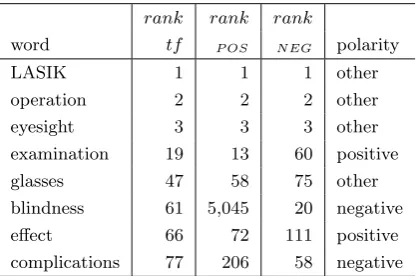
au-Table 1: An example of extracted keywords.
rank rank rank
word tf P OS NEG polarity
LASIK 1 1 1 other
operation 2 2 2 other
eyesight 3 3 3 other
examination 19 13 60 positive glasses 47 58 75 other blindness 61 5,045 20 negative effect 66 72 111 positive complications 77 206 58 negative
tomatically expanding a submitted query by including the negative form of the main verb in the query. For example, if “Is safety of LASIK operation high?” is the submitted query, then the expanded query is “Is safety of LASIK operation not high?” The documents retrieved for the expanded query derived from the given query are regarded as documents retrieved for inverse queries. Similarly, the documents retrieved for the expanded query derived from the inverse queries are regarded as documents retrieved for the given query. Hence, even if there is no inverse query, pos-sibly conflicting documents can be retrieved.
3.4 Keyword Extraction
Positive and negative keywords are extracted from the retrieved Web documents as follows. First, the positive score scP OS(w) and nega-tive scorescN EG(w) of a wordware calculated by Equations (1) and (2), respectively:
scP OS(w) = df(w, Dquery)·tf(w)
df(w, Dinverse) + 1 (1)
scN EG(w) =
df(w, Dinverse)·tf(w) df(w, Dquery) + 1
(2)
used to express these scores in order to con-sider the global importance ofw in the entire retrieved document set.
Because words such as “LASIK” in the query “Is safety of LASIK operation high?” have high scores in terms of both scP OS(w) and scN EG(w), such words should not be ex-tracted as positive or negative keywords. Be-cause the number of documents in Dquery is different from that in Dinverse, scP OS(w) cannot be directly compared with scN EG(w). Hence, scP OS(w) and scN EG(w) are nor-malized, and rankP OS(w) and rankN EG(w) are compared. The ranking functions rankP OS(w) and rankN EG(w) are defined as thenth place ranks when all words are ranked in the descending order of scP OS(w) and scN EG(w), respectively. We consider the top Crank words on the tf() ranking as candi-dates for possible keywords. IfrankP OS(w)− rankN EG(w) orrankN EG(w)−rankP OS(w) is greater thanCdif, then we regardw as a pos-itive or negative keyword, respectively. Ta-ble 1 shows an example of the extracted key-words when the given query is “Is safety of LASIK operation high?” In this paper, Crank and Cdif are tentatively set to 100 and 20, re-spectively, in a preliminary experiment using several queries except the ones described in Section 4.4 Finally, the positive/negative key-words, mentioned in Section 3.2, are respec-tively added to the positive/negative keyword sets described above.
The topic keywords are the words in the given query excluding the positive/negative keywords.
3.5 Passage Extraction
Passages suitable for a mediatory summary are extracted through the following four stages.
For all sentences in the document sets de-scribed in Section 3.3, the first stage involves the recognition of sentences that are useless for mediatory summary. We regard
insuffi-4The parameters used in this paper are set
tenta-tively. Determining the optimal parameters is a topic for future research.
cient or incomplete sentences as useless sen-tences. We simply consider a sentence to be sufficient when the sentence has, at least, one verb phrase and one noun phrase and when the sentence contains more than two verb/noun phrases. We simply consider a sen-tence to be insufficient if it is not a sufficient sentence. When the expression “...,” which indicates an omission, appears at the end of a sentence, then we consider the sentence in-complete. This recognition of sentences plays an important role in the calculation of scores in subsequent stages.
The second stage involves the calculation of the score of each sentence. When KW is defined as a set of all the topic, positive, and negative keywords, the basic scorescBAS(s) of sentencesis calculated by Equation (3).
scBAS(s) =
w∈KWappear(w, s)
|KW| (3)
where appear(w, s) is a function whose value is 1 if w appears in s and 0 otherwise. If s contains many different keywords, scBAS(s) acquires a high value. If s is recognized as a useless sentence, then scBAS(s) is multi-plied by Cuseless as a penalty. In this pa-per, Cuseless is tentatively set to 0.5 in the case of ungrammatical sentences and 0 in the case that the end of the sentences is omitted. When the score of a sentence is calculated, the fairness described in Section 2 is deter-mined in the following manner. Ifs contains positive/negative keywords besides topic key-words, the scBAS(s) is multiplied by Cbasic. The negative form of positive/negative key-words is considered, and Cbasic is tentatively set to two if either a positive or negative ex-pression appears insand to three if both pos-itive and negative expressions appear ins.
function, whose window length isL.
scSM O(si) =
L
2
j=−L
2
(scBAS(si+j)·hf(j)) (4)
hf(k) = 0.5 + 0.5 cos 2πk
L (5)
The value of L is tentatively set as 5 in this study. Insufficient sentences may con-vey useful information to readers when they are embedded in an appropriate context. On the other hand, incomplete sentences do not. Therefore, scSM O(s) of such omitted sen-tences is set as 0 even after smoothing. If all types of keywords appear in the Hann win-dow, then scSM O(s) is multiplied by Csmooth because a passage containing sis likely to be a part of a mediatory summary. The value of Csmooth is tentatively set as 2 in this study.
The fourth stage involves the extraction and ranking of passages. Every series of sentences with scSM O(s) greater than N1 of the maxi-mum score in the document is extracted as a passage. N is tentatively set as 3. The scorescP AS(p) of passagepis the highest score scSM O(s) of sentence s in the passage. If all types of keywords appear in p, the scP AS(p) is multiplied byCpassage, as in the third stage. Note that the length of the extracted passages is not set to L sentences and that passages that contain sentences multiplied by Csmooth are not always multiplied byCpassage. Cpassage is tentatively set as 3 in this study. Be-cause of summarization, the passages whose lengths are nearer to the ideal length Clength are ranked higher. The final score scF IN(p) is calculated by Equation (6).
scF IN(p) = exp (scP AS(p)−α·er(p)) (6) er(p) =|Clength−nc(p)| (7)
where nc(p) is the number of characters in p, and α is a coefficient. Clength and α are ten-tatively set to 300 and 0.02, respectively.
4 Experiment
4.1 Conditions
Because the proposed method is the first method for automated generation of
media-tory summary, there is no existing method to directly compare our proposed method with. Therefore, we compare the proposed method with the following three methods. The first method,KWtf, uses frequent words instead of the three types of keywords described in Sec-tion 3.4. The second method,LinT SU, uses an existing summarization module for summariz-ing the top documents in order of the score in which TSUBAKI retrieves them. The third method, LinscF IN, uses the same existing summarization module for summarizing docu-ments containing the top passages in order of the scorescF IN() described in Section 3.5. We employ Lingua::JA::Summarize::Extract5 as a summarization module, which extracts sen-tences containing more characteristic words; this extraction is based on the word frequency and word bigram frequency in a given docu-ment.
KWtf is compared with the proposed method in order to investigate the effective-ness of keywords in terms of polarity. One of the functions of the proposed method is the classification of the top Crank words on the tf() ranking into positive keywords, negative keywords, and others in order to determine the fairness described in Section 2. KWtf is simply based on frequent words and does not classify them. In other words, all of the top Crank words on the tf() ranking are used as keywords without polarity. It should be noted that no rewards can be obtained usingCbasic, Csmooth, and Cpassage in the passage extrac-tion described in Secextrac-tion 3.5, although penal-ties can be obtained usingCuselessandClength. LinT SU is compared with the proposed method in order to clarify the difference be-tween the summarization by our method and that by a method used for general purposes. In other words, we investigate whether or not the extraction of sentences containing more characteristic words is sufficient for generat-ing mediatory summaries.
LinscF IN is compared with the proposed method in order to investigate the
appropri-5
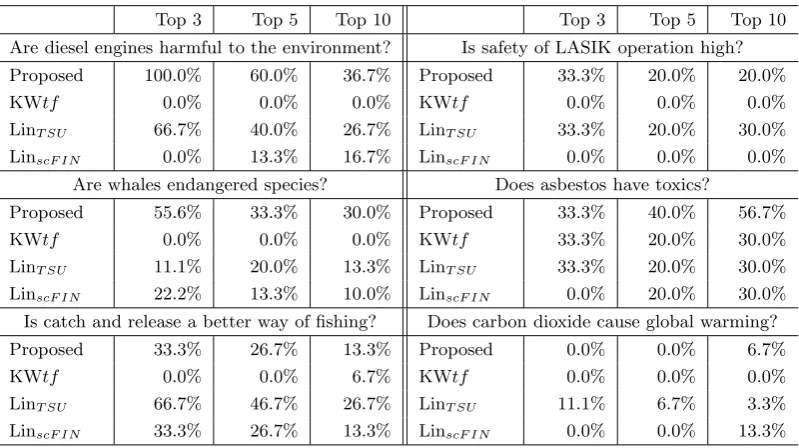
Table 2: Average precision of appropriateness of summaries generated by each query.
Top 3 Top 5 Top 10 Top 3 Top 5 Top 10 Are diesel engines harmful to the environment? Is safety of LASIK operation high? Proposed 100.0% 60.0% 36.7% Proposed 33.3% 20.0% 20.0%
KWtf 0.0% 0.0% 0.0% KWtf 0.0% 0.0% 0.0%
LinT SU 66.7% 40.0% 26.7% LinT SU 33.3% 20.0% 30.0% LinscF IN 0.0% 13.3% 16.7% LinscF IN 0.0% 0.0% 0.0%
Are whales endangered species? Does asbestos have toxics?
Proposed 55.6% 33.3% 30.0% Proposed 33.3% 40.0% 56.7% KWtf 0.0% 0.0% 0.0% KWtf 33.3% 20.0% 30.0% LinT SU 11.1% 20.0% 13.3% LinT SU 33.3% 20.0% 30.0% LinscF IN 22.2% 13.3% 10.0% LinscF IN 0.0% 20.0% 30.0% Is catch and release a better way of fishing? Does carbon dioxide cause global warming? Proposed 33.3% 26.7% 13.3% Proposed 0.0% 0.0% 6.7%
KWtf 0.0% 0.0% 6.7% KWtf 0.0% 0.0% 0.0%
LinT SU 66.7% 46.7% 26.7% LinT SU 11.1% 6.7% 3.3% LinscF IN 33.3% 26.7% 13.3% LinscF IN 0.0% 0.0% 13.3%
ateness of the extracted passages. Another function of the proposed method is the rerank-ing of passages regardless of the order of doc-uments containing the passages during docu-ment retrieval. Therefore, a set of docudocu-ments summarized by the proposed method may be different from the set of documents summa-rized byLinT SU. Therefore, it is observed that LinscF IN handles the same documents as the proposed method.
Because the mediatory summary is a novel concept, methods for evaluating it have not been developed yet. Although ROUGE (Lin and Hovy, 2003) is one of the most popular methods for evaluation of summaries, it may not be appropriate for the evaluation of the mediatory summary because the scoring based on N-gram in this method cannot be used to consider the fairness described in Section 2. Therefore, we evaluate the methods through the binary judgment of three human asses-sors, If the top summaries produced by each method are deemed to be appropriate by the three human assessors, we will be able to fa-cilitate users’ assessments of the contradictory opinions that are relevant to the given query. Because we consider that filling a passage with all the information necessary to
facili-tate users’ assessments is more important than shortening the passage under conditions for generation of mediatory summary, we imposed no limitation on the length of passages but the resultant penalty is obtained using Equations (6) and (7). The average length of all sum-maries generated by the proposed method and KWtf was 288.4 characters, and none of the summaries exceeded 500 characters. There-fore, we allowedLinT SU andLinscF IN to gen-erate summaries as long as 500 characters, which is about 200 characters longer than summaries generated by the proposed method andKWtf. We instructed the assessors to not judge the appropriateness of the summaries on the basis of their length.
For the experiment, we prepared the follow-ing six queries: “Are diesel engines harmful to the environment?,” “Is safety of LASIK operation high?,” “Are whales endangered species?,” “Does asbestos have toxics?,” “Is catch and release a better way of fishing?,” and “Does carbon dioxide cause global warm-ing?” We used the Japanese morphological analyzer, MeCab.6
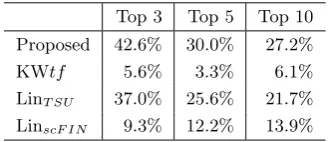
Table 3: Average precision of assessors in terms of appropriateness of overall summaries.
Top 3 Top 5 Top 10 Proposed 42.6% 30.0% 27.2% KWtf 5.6% 3.3% 6.1% LinT SU 37.0% 25.6% 21.7% LinscF IN 9.3% 12.2% 13.9%
4.2 Result and Consideration
The kappa values between each pair of asses-sors’ judgments on the appropriateness of the summaries were 0.79, 0.77, and 0.76, respec-tively; these values indicate a high level of agreement among assessors’ judgments.
Table 2 shows the average precision7 of the
assessors in terms of appropriateness of sum-maries on the basis of responses to each query, and Table 3 shows the overall precision. The columns in Tables 2 and 3 show the precision of appropriateness for the top 3, top 5, and top 10 summaries produced by each method. It should be noted that there are only a few passages suitable for mediatory summary in all of the retrieved documents, and therefore a method for placing such suitable passages at a higher rank is more effective. We confirmed that the proposed method provided the best overall results among all the compared meth-ods.
The difference between the proposed method and KWtf shows that classification of frequent words into positive keywords, neg-ative ones, and others, in other words, the fair-ness described in Section 2 contributed to gen-eration of appropriate mediatory summaries.
The difference between LinT SU and LinscF IN indicates that the order of the score scF IN() described in Section 3.5 was different from that of the score of TSUB-AKI. Lingua::JA::Summarize::Extract could not extract the appropriate passages from
7We use precision, which represents #correct
out-puts/#total outputs, as an evaluation measure because it is difficult to calculate the recall of the mediatory summaries that are dynamically generated from Web documents and because users tend to read just a few of the summaries generated by the system.
document sets on the basis of scF IN(), even though the document sets contained the same appropriate passages that were extracted by the proposed method. Therefore, summa-rization for a general purpose is insufficient for generation of mediatory summaries, and the proposed method can provide more appropriate mediatory summaries.
However, the results of the queries “Is catch and release a better way of fishing?” and “Does carbon dioxide cause global warming?” in Table 2 show that the proposed method could not extract all the appropriate passages that were extracted by LinT SU. We aim to im-prove the proposed method in future research.
5 Conclusion
We proposed a method for automated genera-tion of mediatory summaries in order to facil-itate users’ assessment of the credibility of in-formation on the Web. A mediatory summary is generated by extracting a passage from Web documents on the basis of their relevance to a given query, fairness, and density of key-words, which are features of the summaries constructed to determine the credibility of in-formation on the Web. We demonstrated the effectiveness of the generated mediatory sum-mary in comparison with the summaries of Web documents produced by Web search en-gines.
Acknowledgement
This research is partially supported by the Na-tional Institute of Information and Communi-cations Technology, Japan.
References
Juffinger, Andreas, Michael Granitzer, and Elisa-beth Lex. 2009. Blog credibility ranking by ex-ploiting verified content. In Proceedings of the Second Workshop on Information Credibility on the Web (WICOW 2009), pages 51–57.
generation: Summary-passage extraction for in-formation credibility on the web. In Proceed-ings of the 23rd Pacific Asia Conference on Lan-guage, Information and Computation (PACLIC 23), pages 240–249.
Kawahara, Daisuke, Tetsuji Nakagawa, Takuya Kawada, Kentaro Inui, and Sadao Kurohashi. 2009. Summarizing evaluative information on the web for information credibility analysis. In
Proceedings of the 3rd International Univer-sal Communication Symposium (IUCS 2009), pages 187–192.
Lin, Chin-Yew and Eduard Hovy. 2003. Au-tomatic evaluation of summaries using n-gram co-occurrence statistics. In Proceedings of the Human Language Technology Conference 2003 (HLT-NAACL-2003), pages 71–78.
Miyazaki, Rintaro, Ryo Momose, Hideyuki Shibuki, and Tatsunori Mori. 2009. Using web page layout for extraction of sender names. InProceedings of the 3rd International Univer-sal Communication Symposium (IUCS 2009), pages 181–186.
Murakami, Koji, Eric Nichols, Suguru Matsuyoshi, Asuka Sumida, Shouko Masuda, Kentaro Inui, and Yuji Matsumoto. 2009. Statement map: Assisting information credibility analysis by vi-sualizing arguments. InProceedings of the Sec-ond Workshop on Information Credibility on the Web (WICOW 2009), pages 43–50.
Nakano, Masahiro, Hideyuki Shibuki, Rintaro Miyazaki, Madoka Ishioroshi, Koichi Kaneko, and Tatsunori Mori. 2010. Construction of text summarization corpus for the credibility of in-formation from the web. InProceedings of the 7th Language Resources and Evaluation Confer-ence (LREC 2010), pages 3125–3131.
Ohshima, Hiroaki, Satoshi Oyama, Hiroyuki Kondo, and Katsumi Tanaka. 2009. Web infor-mation credibility analysis by geographical so-cial support. In Proceedings of the 3rd Inter-national Universal Communication Symposium (IUCS 2009), pages 193–196.