Evaluation of Direct Speech Translation Method Using Inductive Learning
for Conversations in the Travel Domain
Koji MURAKAMI Makoto HIROSHIGE
Kenji ARAKI
Graduate school of Engineering Hokkaido University, Japan
{mura, hiro, araki}@media.eng.hokudai.ac.jp
Koji TOCHINAI
Graduate school of Business Administration Hokkai Gakuen University, Japan [email protected]
Abstract
This paper evaluates a direct speech trans-lation Method with waveforms using the Inductive Learning method for short con-versation. The method is able to work without conventional speech recognition and speech synthesis because syntactic ex-pressions are not needed for translation in the proposed method. We focus only on acoustic characteristics of speech wave-forms of source and target languages with-out obtaining character strings from ut-terances. This speech translation method can be utilized for any language because the system has no processing dependent on an individual character of a specific language. Therefore, we can utilize the speech of a handicapped person who is not able to be treated by conventional speech recognition systems, because we do not need to segment the speech into phonemes, syllables, or words to realize speech translation. Our method is real-ized by learning translation rules that have acoustic correspondence between two lan-guages inductively. In this paper, we deal with a translation between Japanese and English.
1 Introduction
Speech is the most common means of communi-cation for us because the information contained in
!#"$&%'")(+*&' %'"),-. %"
.)/0'.1'2
"". "
/0.3",-.%" 450678".9'.
"";:<"
4= 5->?%#@ ' "..3.; 1#/0'. ;:% "
!#A:% ")B.
%'"),-.% "
!A".&%'")(+*3$
"". &"-CD &". 1+33".EF3""..;G.8"1'2
/0.'",H % "
!#"$&%'")(+*&' %'"),-. %"
.)/0'.1'2
"". "
/0.3",-.%" /0.3",-.%" 450678".9'.
"";:<"
4= 5->?%#@ ' "..3.; 1#/0'. ;:% "
!#A:% ")B.
%'"),-.% "
!A".&%'")(+*3$
"". &"-CD &". 1+33".EF3""..;G.8"1'2 "..3.; 1#/0'. ;:% "
!#A:% ")B.
%'"),-.% "
!A".&%'")(+*3$
"..3.; 1#/0'. ;:% " !#A:% ")B. "..3.; 1#/0'. ;:% "
!#A:% ")B.
%'"),-.% "
!A".&%'")(+*3$
%'"),-.% "
%'"),-.% "
!A".&%'")(+*3$
"". &"-CD &". 1+33".EF3""..;G.8"1'2 "". &"-CD &".
1+33".EF3""..;G.8"1'2
[image:1.612.319.535.203.368.2]/0.'",H % " /0.'",H % "
Figure 1: Comparison of conventional and our ap-proach.
speech is sufficient to play a fundamental role in conversation. Thus, it is much better that the pro-cessing deals with speech directly. However, con-ventional approaches of speech translation need a text result, obtained by speech recognition, for ma-chine translation although several errors or unrecog-nized portions may be included in the result.
A text is translated through morphological anal-ysis, syntactic analanal-ysis, and parsing of the sentence of the target language. Finally, the speech synthesis stage produces speech output of the target language. Figure 1(A) shows the whole procedure of a tradi-tional speech translation approach.
The procedure has several complicated processes that do not give satisfying results. Therefore, the lack of accuracy in each stage culminates into a poor final result. For example, character strings obtained by speech recognition may represent different
IKJLNMOP.QRST#ROL3UWVXL3RMP$U
Y TNL3OUMU.Z VRL[Z.T QMOV&R
VRT3J
\]_^a`Hb cedf
\gh^ib
j
d#k VTlNP Um
V&RT3J
lNP$n7n<P UoJL3ORV m.MQQT3OT3UR.JL3ORV \I ^qprb
s0dt
\.uv^ib
w
dx lNP n7n)P UoJ.L[ORV
mMQQT3OT3URJL3ORV
y
y
y
IeJLNMO P.QzRRT3OL3UlNT0VL[n7JXTV
z$U.{U.P$|0UMUJzR MUL+VP zOlNT XL3U.Z$zL[ZT
}.TNL[Ol3SMU.Z7V&zMRL3~XT TNXT3n)T3URV;P.QOzXTVMU z.XT+mMl3RMP UL3O T[JOPm zl3RMP U7P.QRST+MUJzR~ lP n7~MU.MU.ZoTXT3n)T3URVP.QOzXT V
I f
p
u
k
p
P n7~MU.MU.Z-RSTATXT[n<T3URVP.QOzXT VlNP OOT V&JP UmTNm |HMRS<V&zMRL3~XTATNXT3n<T[URVMUoRST#RL3O&Z.T3RWXL3U.Z zL[Z.T IomP JRTNm-OzXT V
I) p0N f
u N k
OL3UWVXL[RMP U IolN zMVMRMP UPQTNXT3n<T3U.RV
QPOROL[UVXL3RMP UHOzXTV
IKJ.LMO P.Qz.RRT3OL3UlNT0VL3n7JXT V VMmT VMm$T
IHlN zMVMRMP UP.QTNXT3n)T3URV QP OROL3UVXL3RMP UHO&z.XTV T[Z.MVRT3OMU.ZolNP$n7n<P UL3UmHm.MQQT3OT3URJL3ORV
lNP$n7n<P UoJL3ORV mMQQT3OT[U$RJL[ORV
OL3UWVXL[RMPU V&RL[Z.T lP n7n)PUoJL3O&RV mMQQT3OT[UR.JL3ORV Y TNL[OUMUZ
lNP nn<P UHJL3ORV
mMQQT3OT3URJL3ORV A[3N' \I ^prb \u)^ib
zXT
zXT[ zXTN
x
w
s
t
#[[ .@7 ¡o¢@£ . ¤ IKJLNMOP.QRST#ROL3UWVXL3RMP$U
Y TNL3OUMU.Z VRL[Z.T QMOV&R
VRT3J
\]_^a`Hb cedf
\gh^ib
j
d#k VTlNP Um
V&RT3J
lNP$n7n<P UoJL3ORV m.MQQT3OT3UR.JL3ORV \I ^qprb
s0dt
\.uv^ib
w
dx lNP n7n)P UoJ.L[ORV
mMQQT3OT3URJL3ORV
lNP$n7n<P UoJL3ORV m.MQQT3OT3UR.JL3ORV lNP$n7n<P UoJL3ORV m.MQQT3OT3UR.JL3ORV \I ^qprb
s0dt
\.uv^ib
w
dx lNP n7n)P UoJ.L[ORV
mMQQT3OT3URJL3ORV lNP n7n)P UoJ.L[ORV mMQQT3OT3URJL3ORV
y
y
y
IeJLNMO P.QzRRT3OL3UlNT0VL[n7JXTV
z$U.{U.P$|0UMUJzR MUL+VP zOlNT XL3U.Z$zL[ZT
}.TNL[Ol3SMU.Z7V&zMRL3~XT TNXT3n)T3URV;P.QOzXTVMU z.XT+mMl3RMP UL3O T[JOPm zl3RMP U7P.QRST+MUJzR~ lP n7~MU.MU.ZoTXT3n)T3URVP.QOzXT V
I f
p
u
k
p
P n7~MU.MU.Z-RSTATXT[n<T3URVP.QOzXT VlNP OOT V&JP UmTNm |HMRS<V&zMRL3~XTATNXT3n<T[URVMUoRST#RL3O&Z.T3RWXL3U.Z zL[Z.T IomP JRTNm-OzXT V
I) p0N f
u N k IomP JRTNm-OzXT V
I) p0N f
u N k
I) p0N f
u N k
OL3UWVXL[RMP U IolN zMVMRMP UPQTNXT3n<T3U.RV
QPOROL[UVXL3RMP UHOzXTV
IKJ.LMO P.Qz.RRT3OL3UlNT0VL3n7JXT V VMmT VMm$T
IHlN zMVMRMP UP.QTNXT3n)T3URV QP OROL3UVXL3RMP UHO&z.XTV T[Z.MVRT3OMU.ZolNP$n7n<P UL3UmHm.MQQT3OT3URJL3ORV
lNP$n7n<P UoJL3ORV mMQQT3OT[U$RJL[ORV lNP$n7n<P UoJL3ORV mMQQT3OT[U$RJL[ORV
OL3UWVXL[RMPU V&RL[Z.T lP n7n)PUoJL3O&RV mMQQT3OT[UR.JL3ORV lP n7n)PUoJL3O&RV mMQQT3OT[UR.JL3ORV Y TNL[OUMUZ
lNP nn<P UHJL3ORV
mMQQT3OT3URJL3ORV A[3N' \I ^prb \u)^ib
zXT \I ^prb \u)^ib
zXT \u)^ib
zXT
zXT
zXT[ zXTN
x
w
s
t
[image:2.612.131.479.25.217.2]#[[ .@7 ¡o¢@£ . ¤
Figure 2: Processing structure.
mation than the original speech.
Murakami et al.(1997) attempted to recognize several vowels and consonants using Neural Net-works that had different structures with TDNN (ATR Lab., 1995), however, they could not obtain a high accuracy of recognition. They confirmed that distinguishing the boundaries of words, syllables, or phonemes is a task of great difficulty. Then, they only focused on speech waveform itself, not charac-ter strings obtained by speech recognition to realize speech translation. Murakami et.al decided on deal-ing with the correspondence of acoustic characteris-tics of speech waveform instead of character strings between two utterances.
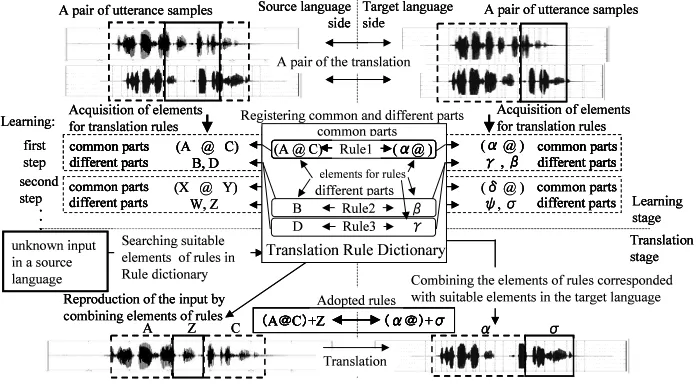
Our approach handles the acoustic characteris-tics of speech without lexical expression through a much simpler structure than the reports of Tak-izawa et al.(1998) , M¨uller et al.(1999) or Lavie et al.(1997) because we believe that simplification of the system would prevent inaccuracies in the trans-lation. Figure 1(B) shows the processing stages of our approach. If speech translation can be realized by analyzing the correspondence in character strings obtained by speech recognition, we can also build up speech translation by dealing with the correspon-dence in acoustic characteristics. In our method, we extract acoustic common parts and different parts by comparing two examples of acoustic characteris-tics of speech between two translation pairs within the same language. Then we generate translation rules and register them in a translation dictionary.
The rules also have the location information of ac-quired parts for speech synthesis on time-domain. The translation rules are acquired not only by com-paring speech utterances but also using the Inductive Learning Method (K. Araki et al., 2001), still keep-ing acoustic information within the rules. Decidkeep-ing the correspondence of meaning between two lan-guages is a unique condition to realize our method. In a translation phase, when an unknown utterance of a source language is applied to be translated, the system compares this sentence with all acoustic in-formation of all rules within the source language. Then several matched rules are utilized and referred to their corresponding parts of the target language. Finally, we obtain roughly synthesized target speech by simply concatenating several suitable parts of rules in the target language according to the infor-mation of location. Figure 2 shows an overview of the processing structure of our method.
morpholog-ical analysis and syntactic analysis are dependent on each individual character of language completely.
Any difference in language has no affect on the ability of the proposed method, fundamentally be-cause we focus on the acoustic characteristics of speech, not on the character strings of languages. It is very important to approach speech translation with a new methodology that is independent of indi-vidual characters of any language.
We also expect our approach can be utilized in speech recuperation systems for people with a speech impediment because our method is able to deal with various types of speech that is not able to be treated by conventional speech recognition sys-tems for normal voice.
Murakami et al.(2002) have successfully ob-tained several samples of translation by applying our method using local recorded speech data and spon-taneous conversation speech.
In this paper, we adopt speech data of travel con-versations to the proposed method. We evaluate the performance of the method through experiments and offer discussion on behaviors of the system.
2 Speech processing
2.1 Speech data
It is necessary to extract time-varying spectral char-acteristics in utterances and apply them to the sys-tem. We used several conversation sets from an English conversation book (GEOS Publishing Inc., 1999). The Japanese speech data was recorded with a 48kHz sampling rate on DAT, and downsampled to 8kHz. All speech data in the source language was spoken by Japanese male students of our lab-oratory. The speech data was spoken by 2 people in the source and target languages, respectively.
[image:3.612.324.527.499.649.2]The content of the data sets consists of conversa-tions between a client and the front desk at a hotel and conversations between a client and train station staff.
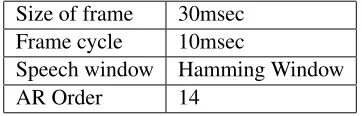
Table 1: Experimental conditions of speech process-ing.
Size of frame 30msec Frame cycle 10msec
Speech window Hamming Window
AR Order 14
2.2 Spectral characteristics of speech
In our approach, the acoustic characteristics of speech are very important because we must find common and different acoustic parts by comparing them. It is assumed that acoustic characteristics are not dependent on any language. Table 1 shows the conditions for speech analysis. The same conditions and the same kind of characteristic parameters of speech are used throughout the experiments.
In this report, the LPC coefficients are applied as spectral parameters because Murakami et al.(2002) could obtain better results by using these parameters than other representations of speech characteristics.
2.3 Searching for the start point of parts between utterances
When speech samples were being compared, we had to consider how to normalize the elasticity on time-domain. Many methods were investigated to resolve this problem. We tried meditating a method that is able to obtain a result similar to dynamic pro-gramming (H. Sakoe et al., 1978; H. F. Silverman et al., 1990) to execute time-domain normalization. We adopted a method to investigate the difference between two characteristic vectors of speech sam-ples for determining common and different acous-tic parts. The Least-Squares Distance Method was adopted for the calculation of the similarity between these vectors.
Two sequences of characteristic vectors named “test vector” and “reference vector” are prepared. The “test vector” is picked out from the test speech by a window that has definite length. At the time, the
¥-¦N§&¦[¨¦N©ª ¦
«
¦NªN¬$¨
®
®
¯
°± ²³´µ
¶
·.¸$¹º¸ »¼½$¾N¿À+Á ¹ÂWÃN¼Ä¹'¼¹Â¹¾$Å'¹Æ ¹3ŽÃ[Â.Ç$Ã3½»Ã[¾ Ȧ ɬ
«
¦ ª[¬$¨
ÊKË
.Ì©¬WÍ7̬ÎÏ)Ì©ÌÏ<ÐÏ ÑÌɬÒ[©ª¦0Ì©<Ò+Ó¨ÒË Î Ô$Ë
¦ª[¬¨&ÐÏ
Ñ
ÌɬÒ[©ª ¦ ¥-¦N§&¦[¨¦N©ª ¦
«
¦NªN¬$¨
®
®
¯
°± ²³´µ
¶
·.¸$¹º¸ »¼½$¾N¿À+Á ¹ÂWÃN¼Ä¹'¼¹Â¹¾$Å'¹Æ ¹3ŽÃ[Â.Ç$Ã3½»Ã[¾ Ȧ ɬ
«
¦ ª[¬$¨
ÊKË
.Ì©¬WÍ7̬ÎÏ)Ì©ÌÏ<ÐÏ ÑÌɬÒ[©ª¦0Ì©<Ò+Ó¨ÒË Î Ô$Ë
¦ª[¬¨&ÐÏ
Ñ
[image:3.612.94.275.622.680.2]ÌɬÒ[©ª ¦
Õ Ö ×Õ × Ö Ø0Õ Ø-Ö ÙAÕÚÙ#Ø
Õ
Ö
×Õ × Ö Ø+Õ Ø-Ö ÙAÕ Ù#Ø
Û+Ü ÝÞ3Üß&àáâãäæåÝ.ç-èàAé)ç[ÝàÝ.ç3ÝâêÝ)ë Ýêáèç+ìèWç'áßèâ
í
îïð îñòó
ô õ
ö
÷ïø
ù
ò
ú
ó
ï
ð
ó
ûïü
ó
ù
ø
ý
ù
ø
ó
ñ
ù
ô
Õ Ö ×Õ × Ö Ø0Õ Ø-Ö ÙAÕÚÙ#Ø Õ Ö ×Õ × Ö Ø0Õ Ø-Ö ÙAÕÚÙ#Ø
Õ
Ö
×Õ × Ö Ø+Õ Ø-Ö ÙAÕ Ù#Ø
Õ
Ö
×Õ × Ö Ø+Õ Ø-Ö ÙAÕ Ù#Ø
Û+Ü ÝÞ3Üß&àáâãäæåÝ.ç-èàAé)ç[ÝàÝ.ç3ÝâêÝ)ë Ýêáèç+ìèWç'áßèâ
í
îïð îñòó
ô õ
ö
÷ïø
ù
ò
ú
ó
ï
ð
ó
ûïü
ó
ù
ø
ý
ù
ø
ó
ñ
ù
ô
Figure 4: Difference between utterances(1): ”All right, Mr. Brown.”
þ ÿ þ ÿ +þ -ÿ +þ
þ
ÿ
þ ÿ +þ
!"#$# %&' !%() ("*(
+
,
-.
,/01
2 3
4
5-6
7
0
8
1
-.
1
9-:
1
7
6
;
7
6
1
/
7
2
þ ÿ þ ÿ +þ -ÿ +þ þ ÿ þ ÿ +þ -ÿ +þ
þ
ÿ
þ ÿ +þ
þ
ÿ
þ ÿ +þ
!"#$# %&' !%() ("*(
+
,
-.
,/01
2 3
4
5-6
7
0
8
1
-.
1
9-:
1
7
6
;
7
6
1
/
7
2
Figure 5: Difference between utterances(2):”All right, Mr. Brown.” - ”Good afternoon.”
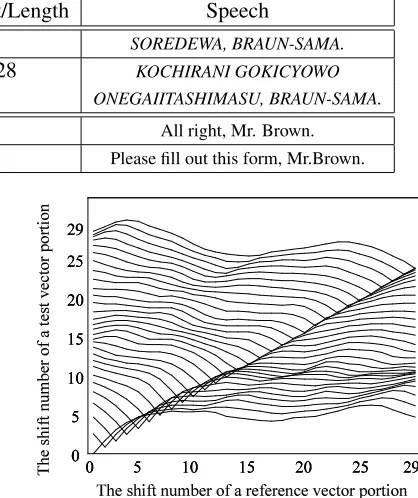
[image:4.612.91.279.23.185.2]“reference vector” is also prepared from the refer-ence speech. A distance value is calculated by com-paring the present “test vector” and a portion of the “reference vector”. Then, we repeat the calculation between the current “test vector” and all portions of the “reference vector” picked out and shifted in each moment with constant interval on time-domain. When a portion of the “reference vector” reaches the end of the whole reference vector, a sequence of dis-tance values is obtained as a result. The procedure of comparing two vectors is shown as Figure 3. Next, the new “test vector” is picked out by the constant interval, then the calculation mentioned above is re-peated until the end of the “test vector”. Finally, we should get several distance curves as the result be-tween two speech samples.
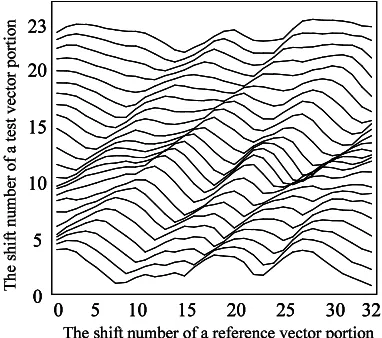
Figure 4 and Figure 5 show examples of the differ-ence between two utterances. These applied speech samples are spoken by the same speaker. The con-tents of the compared utterances are the same in Fig-ure 4, and are quite different in FigFig-ure 5. The hori-zontal axis shows the shift number of reference vec-tor on time-domain and the vertical axis shows the shift number of test vector, i.e., the portion of test speech. In the figures, a curve in the lowest loca-tion has been drawn by comparing the top of the test speech and whole reference speech. If a distance value in a distance curve is obviously lowest than other distance values, it means that the two vectors have much acoustic similarity.
As shown in Figure 5, the obvious local minimum distance point is not discovered even if there is the lowest point in each distance curve. On the other hand, as shown in Figure 4, when the test and refer-ence speech have the same content, the minimum distance values are found sequentially in distance curves. According to these results, if there is a po-sition of the obviously smallest distance point in a distance curve, that portion should be regarded as a “common part”. Moreover, if these points sequen-tially appear among several distance curves, they will be considered a common part. At the time, there is a possibility that the part corresponds to sev-eral semantic segments, longer than a phoneme and a syllable.
2.4 Evaluation of the obvious minimal distance value
To determine that the obviously lowest distance value in the distance curve is a common part, we adopt a threshold calculated by statistical informa-tion. We calculate the variance of distance values shown as σ and the mean value within the curve. The threshold is conducted as θ = 4σ2 from the equation of the Gaussian distribution and the stan-dardized normal distribution.
[image:4.612.89.280.231.400.2]dif-ferent part and represented by “1”. If several com-mon parts are decided continuously, we deal with them as one common part, and the first point in that part will be the start point finally. In our method, the acoustic similarities evaluated by several calcu-lations are only the factor for judgment in classifying common or different parts in the speech samples.
3 Generation and application of translation rule
3.1 Correction of acquired parts
The two reference speech samples are divided into several common and different parts by comparison. However, there is a possibility that these parts in-clude several errors of elasticity normalization be-cause the distance calculation is not perfect to re-solve this problem on time-domain. We attempt to correct incomplete common and different parts us-ing heuristic techniques when a common part is di-vided by a discrete different part, or a different part is divided by a discrete common part.
3.2 Acquisition of translation rules
Common and different parts corrected in 3.1 are ap-plied to determine the rule elements needed to gen-erate translation rules. Figure 6 and 7 show the re-sults of comparing utterances. In the first case, a part containing continuous values of “0” represents a common part. In the second case, a part consisting of only “1” is regarded as a different part. In Fig-ure 6, two utterances are calculated as a long com-mon part. On the contrary, two utterances are cal-culated as a long different part in Figure 7. These results are comparable with lexical contents because the syntactic sentence structures are the same in both cases.
Moreover, when a sentence structure includes common and different parts at the same time, we can treat this structure as a third case. We deal with these three cases of sentence structure as rule types. In all the above-mentioned cases, several sets of common and different parts are acquired if those utterances were almost matching or did not match at all. Com-bining sets of common parts of the source and target languages become elements of the translation rules for its generation. At this time, the set of common parts extracted from the source language, that have
<
=>@?A?B> CEDGF(HJILK <M NPOQRQJS
H
S
CPITDGF(HJILKVU
M
WX YZ[]\$Z ^_` acbcdfe[#gh_Pij`[V\$`k [&l#`*hVgh(am`^dn[&opch(dqi!^a
<
=>@?A?B> CEDGF(HJILK <M NPOQRQJS
H
S
CPITDGF(HJILKVU
M
WX YZ[]\$Z ^_` acbcdfe[#gh_Pij`[V\$`k [&l#`*hVgh(am`^dn[&opch(dqi!^a
Figure 6: Common and different parts(1):”All right, Mr. Brown.”
r st
u vwAwBv xEy{zV|J}~ r "JR
|
xP}TyGz(|J}L~(
]$ f Pj($ !*V(m*q!"c(n&
r st
u vwAwBv xEy{zV|J}~ r "JR
|
xP}TyGz(|J}L~(
]$ f Pj($ !*V(m*q!"c(n&
Figure 7: Common and different parts(2). ”All right, Mr. Brown.” - ”Good afternoon.”
a correspondence of meaning with a set of common parts in target language, are kept. The sets of differ-ent parts become elemdiffer-ents of the translation rules as well.
Finally, these translation rules are generated by completing all elements as below. It is very im-portant the rules are acquired if the types of sen-tences in both languages are the same. When the types of sentence structures are different, it is im-possible that translation rules are obtained and reg-istered in the rule dictionary because we can not decide the correspondence between two languages samples uniquely. Acquired rules are categorized in the following types:
Rule type 1: those with a very high sentence simi-larity
Rule type 2: those with sentences including com-mon and different parts
Rule type 3: those with very low sentence similar-ity
When a new rule containing the information of sev-eral common parts is generated, the rule should keep the sentence form so that different parts in the speech sample are replaced as variables. Informa-tion that a translaInforma-tion rule has are as follows:
• rule types as mentioned above
• index number of a source language’s utterance
• sets of start and end points of each common and
"®¯°±"²³
"®¯°±´ ³
G¦JµJ!¢"¬£§L#(¡R ¡ ¶j¡$§¬¢ £(§!¡$·n¬ §&¢" $¬¥§G& ¡£¢
{¦Rµ£&¢"¬£§(¡R ¡$¶j¡ §¥¬¢ J§&¡$·¸¬$§!¢" $¬£§G# ¡J¢ ¹ ¡ ¨#¢¬¡$§&¨{¦R¥¶L¶j£§$§&©{©¥¡ ¡ §¥¬!# ¬¢
º»½¼ »¿¾ À ÁÃÂ
¦R£¶L¶j¥§G&$¬¢ ©¥¡ ¡ §¥¬!# ¬¢ º »ÅÄÆ»m¾
ÇÉÈËÊ ¦R£¶¶j£§G& ¬¢
©¡$*¡$§¬&&$¬¢
¦R£¶L¶j¥§G& ¬¢ ©¡ ¡$§¬&&$¬¢
¦R£¶¶j£§G& ¬¢ ©¡$*¡$§¬&&$¬¢ º »Ì»ÍÄG¾
ÎBÈÏ
ºc¼Æ»½»¿¾
Ð
ȸÑ
Ç
Ò ¡$·n! ¡ Ð ÈGÑ Î]È¥Ï
º »Ó»ÔÄG¾ º¼E»Ì»Õ¾
Ò
¡ ·n& ¡
Ò
¡ ·n& ¡ º »ÖÄ×»Õ¾
º»Ø¼E»Õ¾ Ò ¡$·n& ¡
ÀÕÁ& ÇqÈ¥Ê
Ù{ÚRÛVÜPÝ¥ÞÛVß"àá Ünâ]ãÞäånàæ!ß$àá Ü@ÛVÚ$ç æVá Ú ÚRäÝ èá Ü@éä(Ü@æ(ä
"®¯°±"²³
"®¯°±´ ³
G¦JµJ!¢"¬£§L#(¡R ¡ ¶j¡$§¬¢ £(§!¡$·n¬ §&¢" $¬¥§G& ¡£¢
{¦Rµ£&¢"¬£§(¡R ¡$¶j¡ §¥¬¢ J§&¡$·¸¬$§!¢" $¬£§G# ¡J¢ ¹ ¡ ¨#¢¬¡$§&¨{¦R¥¶L¶j£§$§&©{©¥¡ ¡ §¥¬!# ¬¢
G¦JµJ!¢"¬£§L#(¡R ¡ ¶j¡$§¬¢ £(§!¡$·n¬ §&¢" $¬¥§G& ¡£¢
{¦Rµ£&¢"¬£§(¡R ¡$¶j¡ §¥¬¢ J§&¡$·¸¬$§!¢" $¬£§G# ¡J¢ ¹ ¡ ¨#¢¬¡$§&¨{¦R¥¶L¶j£§$§&©{©¥¡ ¡ §¥¬!# ¬¢
º»½¼ »¿¾ À ÁÃÂ
¦R£¶L¶j¥§G&$¬¢ ©¥¡ ¡ §¥¬!# ¬¢ º »ÅÄÆ»m¾
ÇÉÈËÊ ¦R£¶¶j£§G& ¬¢
©¡$*¡$§¬&&$¬¢
¦R£¶L¶j¥§G& ¬¢ ©¡ ¡$§¬&&$¬¢
¦R£¶¶j£§G& ¬¢ ©¡$*¡$§¬&&$¬¢ º »Ì»ÍÄG¾
ÎBÈÏ
ºc¼Æ»½»¿¾
Ð
È¸Ñ º»½¼ »¿¾
À ÁÃÂ
¦R£¶L¶j¥§G&$¬¢ ©¥¡ ¡ §¥¬!# ¬¢ º »ÅÄÆ»m¾
ÇÉÈËÊ ¦R£¶¶j£§G& ¬¢
©¡$*¡$§¬&&$¬¢
º»½¼ »¿¾ À ÁÃÂ
¦R£¶L¶j¥§G&$¬¢ ©¥¡ ¡ §¥¬!# ¬¢ ¦R£¶L¶j¥§G&$¬¢ ©¥¡ ¡ §¥¬!# ¬¢ º »ÅÄÆ»m¾
ÇÉÈËÊ ¦R£¶¶j£§G& ¬¢
©¡$*¡$§¬&&$¬¢ ¦R£¶¶j£§G& ¬¢ ©¡$*¡$§¬&&$¬¢
¦R£¶L¶j¥§G& ¬¢ ©¡ ¡$§¬&&$¬¢
¦R£¶¶j£§G& ¬¢ ©¡$*¡$§¬&&$¬¢ º »Ì»ÍÄG¾
ÎBÈÏ
ºc¼Æ»½»¿¾
Ð
È¸Ñ ¦R£¶L¶j¥§G& ¬¢
©¡ ¡$§¬&&$¬¢
¦R£¶¶j£§G& ¬¢ ©¡$*¡$§¬&&$¬¢ º »Ì»ÍÄG¾
ÎBÈÏ
ºc¼Æ»½»¿¾
Ð
È¸Ñ ¦R£¶L¶j¥§G& ¬¢
©¡ ¡$§¬&&$¬¢ ¦R£¶L¶j¥§G& ¬¢ ©¡ ¡$§¬&&$¬¢
¦R£¶¶j£§G& ¬¢ ©¡$*¡$§¬&&$¬¢ ¦R£¶¶j£§G& ¬¢ ©¡$*¡$§¬&&$¬¢ º »Ì»ÍÄG¾
ÎBÈÏ
ºc¼Æ»½»¿¾
Ð
ȸÑ
Ç
Ò ¡$·n! ¡ Ð ÈGÑ Î]È¥Ï
º »Ó»ÔÄG¾ º¼E»Ì»Õ¾
Ò
¡ ·n& ¡
Ò
¡ ·n& ¡ º »ÖÄ×»Õ¾
º»Ø¼E»Õ¾ Ò ¡$·n& ¡
ÀÕÁ& ÇqÈ¥Ê
Ù{ÚRÛVÜPÝ¥ÞÛVß"àá Ünâ]ãÞäånàæ!ß$àá Ü@ÛVÚ$ç
Ç
Ò ¡$·n! ¡ Ð ÈGÑ Î]È¥Ï
º »Ó»ÔÄG¾ º¼E»Ì»Õ¾
Ò
¡ ·n& ¡
Ç
Ò ¡$·n! ¡ Ð ÈGÑ Î]È¥Ï
Ç
Ò ¡$·n! ¡ Ð ÈGÑ Î]È¥Ï
º »Ó»ÔÄG¾ º¼E»Ì»Õ¾
Ò
¡ ·n& ¡
º »Ó»ÔÄG¾ º¼E»Ì»Õ¾
Ò
¡ ·n& ¡
Ò
¡ ·n& ¡ º »ÖÄ×»Õ¾
º»Ø¼E»Õ¾ Ò ¡$·n& ¡
ÀÕÁ& ÇqÈ¥Ê
Ò
¡ ·n& ¡ º »ÖÄ×»Õ¾
º»Ø¼E»Õ¾
Ò
¡ ·n& ¡ º »ÖÄ×»Õ¾
º»Ø¼E»Õ¾ Ò ¡$·n& ¡
ÀÕÁ& ÇqÈ¥Ê Ò ¡$·n& ¡
ÀÕÁ& ÇqÈ¥Ê
[image:6.612.135.473.25.163.2]Ù{ÚRÛVÜPÝ¥ÞÛVß"àá Ünâ]ãÞäånàæ!ß$àá Ü@ÛVÚ$ç æVá Ú ÚRäÝ èá Ü@éä(Ü@æ(ä
Figure 8: Rule aquisition using the Inductive Learning Method
• index number of an utterance in the target
lan-guage
3.3 Translation and speech synthesis
When an unknown speech utterance of a source lan-guage is adapted to get the result of translation, acoustic information of acquired parts in the trans-lation rules are compared in turn with the unknown speech, and several matched rules become the candi-dates to translate. The inputted utterance should be reproduced by a combination of several candidates of rules. Then, the corresponding parts of the tar-get language in candidate rules are referred to obtain translated speech. Although the final synthesized target speech may be produced roughly, speech can directly be concatenated by several suitable parts of rules in the target language using the location infor-mation on time-domain in rules.
4 The Inductive Learning Method
The Inductive Learning that Araki et al.(2001) pro-posed acquires rules by extracting common and dif-ferent parts through the comparison between two samples. This method is designed from an assump-tion that a human being is able to find out common and different parts between two samples although these are unknown. The method is also able to ob-tain rules by repetition of the acquired rules regis-tered in the rule dictionary.
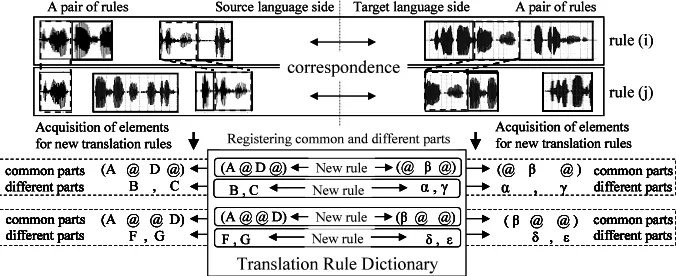
Figure 8 shows an overview of recursive rule quisition by this learning method. Two rules ac-quired as rule(i) and rule(j) are prepared and com-pared to extract common and different acoustic parts as well as comparisons between speech samples.
Then, these obtained parts are designed as new rules. If the compared rules consist of several common or different parts, the calculation is repeated within each part. It is assumed that these new rules are much more reliable for translation.
If several rules are not useful for translation, they will be eliminated by generalizing the rule dictio-nary optimally to keep a designed size of memory. The ability of optimal generalization in the Induc-tive Learning Method is an advantage, as less exam-ples have to be prepared beforehand. Much sample data is needed to acquire many suitable rules with conventional approaches.
5 Evaluation Experiments
5.1 Experiments of rule acquisition
All data in experiments are achieved through several speech processes explained in 2.1. Table 2 shows the conditions for experiments. The parameters con-cerning frame settings have been decided from the results of several preliminary experiments for rule acquisition.
Table 2: Conditions for experiments. Frame length of test vector 400msec
Frame rate of both vectors 50msec The rate of agreement 95%
for adopting rules
Table 3: Translation rules. Set of data Utterances Registed rules
Hotel 50 8,500
Table 4: Appropriately acquired parts with correspondence. Sentence ID Rule Type Corresponded Part/Length Speech
ja110g common (22-40)/41 SOREDEWA, BRAUN-SAMA.
ja110t common (106-124)/128 KOCHIRANI GOKICYOWO ONEGAIITASHIMASU, BRAUN-SAMA.
en110g common (17-32)/33 All right, Mr. Brown.
en110t common (57-69)/71 Please fill out this form, Mr.Brown.
Many sets of common and different parts were extracted by comparing acoustic characteristics of speech in each language, and translation rules were registered in the translation rule dictionary. Table 3 shows the number of speech utterances and regis-tered translation rules between two languages.
5.2 Experimental results of translation
If an unknown speech utterance of a source language can be replaced with acoustic information from rules in the dictionary, the speech will be translated and synthesized roughly without losing it’s meaning. Each matched rule includes certain equivalent cor-respondence parts of the target language. The sys-tem needs to decide the most suitable candidates of rules from the rule dictionary for each translation. If the level of similarity between the whole applied unknown speech and all parts of the rules is higher than a rate of agreement as in Table 2, the rules that include appropriate parts can become candidates for current translation.
82 utterances of limited domain have been ap-plied to the system for translation. Regretfully, we could not obtain any complete translated utterances, although several samples have been incompletely translated by adapting translation rules.
5.3 Discussion
We have to investigate several sources of the exper-imental results. The first cause of the failure in the translation can be found in speech data utilized in these experiments. The contents of these utterances do not exactly include the same expression because
Table 5: Failures of rule acquisition. whole rule the case of the acquisition same content The number
of failure 527 22
êë ìí$ëîïð ñcòcóô ìõöïP÷jõ ìVï"ìõ ìñø&ìjù ì!øð*ö(õúö(õðîö(ñ
û
üýþ
üÿ
ý
ý
þ
ý
ÿ
êë ìí$ëîïð ñcòcóô ìõöïP÷jõ ìVï"ìõ ìñø&ìjù ì!øð*ö(õúö(õðîö(ñ
û
üýþ
üÿ
ý
ý
þ
ý
ÿ
êë ìí$ëîïð ñcòcóô ìõöïP÷jõ ìVï"ìõ ìñø&ìjù ì!øð*ö(õúö(õðîö(ñ
û
üýþ
üÿ
ý
ý
þ
ý
ÿ
[image:7.612.312.521.49.298.2]
Figure 9: Difference between utterances: ”Good af-ternoon.”
"!$#&%('*) +-,/.(.$0
!
0
1#23"!(#4%"56)
' 515
5"758
5"9 719 7;: 7-<
=->@?BAC>DFEHGIJKML?N;OE1PQGH?"ACGR?TSGUO6N;O"IVGUDKW?TX/YZO"K[P\DI "!$#&%('*)
+-,/.(.$0
!
0
1#23"!(#4%"56)
' 515
5"758
5"9 719 7;: 7-<
=->@?BAC>DFEHGIJKML?N;OE1PQGH?"ACGR?TSGUO6N;O"IVGUDKW?TX/YZO"K[P\DI
Figure 10: A failed result of parts extraction:”Good afternoon.”
contents of speech samples are prepared with vari-ous ways of speaking even if the semantic informa-tion is the same among them.
Moreover, a small amount of speech data also is another factor because more translation rules should be acquired and adapted for translation.
The system has performed the task because many suitable rules are registered in the rule dictionary. A sample of parts acquired properly is shown as Ta-ble 4. In this taTa-ble, Japanese words are expressed with an italic font. These parts are successfully ac-quired through the learning stage, so that many suit-able rules can be applied to other unknown speech utterances.
[image:7.612.317.533.339.397.2]utter-ances for more effective rule acquisition and appli-cation.
In addition, we have paid attention to the parts themselves acquired as translation rules. We have to consider several causes where the same type of sentences is not determined correctly even when the contents are the same. Table 5 shows the number of failures in whole rule acquisition and in the case of comparisons of the same utterances. The types of sentences are determined by the results of the parts extraction stage. In this stage, thresholds have a much important role for deciding common and dif-ferent parts. Figure 9 shows the distance curves of the same utterances that were not determined as a common part by a threshold. And Figure 10 shows the result of the extraction of common and different parts. Several minimum points of distance curves have been determined as different parts by thresh-old although two portions of utterances also have the highest similarity in these points. This kind of fail-ure means that the definition of the threshold has a problem. Therefore, the definition of the threshold needs to be reconsidered for extracting common and different parts much more correctly.
6 Conclusion and future works
In this paper, we have described the proposed method and have evaluated the translation perfor-mance for conversations on travel English. We have confirmed that much appropriate acoustic informa-tion is extracted by comparing speech, and rules have been generated even if no target speech was obtained through the system.
Many rules have been decided as candidates for each translation by calculating all registered rules with a high calculation cost. Therefore, we will need to apply a method for selecting most suitable rules from candidates and a clustering algorithm to decrease the number of registered rules and the cal-culation cost.
We will consider adopting a new approach for re-alizing a more effective threshold without statistical information.
We will also consider a possibility of the direct speech translation system from speech by a person with a handicap in the speech production organ to normal speech because conventional speech
recog-nition methods are not able to assist those with a speech impediment.
Acknowledgement This work is partially sup-ported by the Grants from the Government subsidy for aiding scientific researches (No.14658097) of the Ministry of Education, Culture, Sports, Science and Technology of Japan.
References
A. Lavie, A. Waibel, L. Levin, M. Finke, D. Gates and M. Gavald`a. 1997. Janus-iii: Speech-to-speech transla-tion in multiple languages. InProceedings of ICASSP ’94, pages 99–102.
ATR Lab. 1995. Application of Neural Network. GEOS Publishing Inc., 1999.English for Salespeople. H. F. Silverman and D. P. Morgan. 1990. The
appli-cation of dynamic programming to connected speech recognition. InIEEE, ASSP Magazine, pages 6–25. H. Sakoe and S. Chiba. 1978. Dynamic programming
algorithm optimization for spoken word recognition. InIEEE, Trans. on ASSP, pages 43–49.
J. M¨uller and H. Stahl. 1999. Speech understanding and speech translation by maximum a-posteriori semantic decoding. InProceedings of Artificial Intelligence in Engineering, pages 373–384.
K. Araki and K. Tochinai. 2001.Effectiveness of natural language processing method using inductive learning. InArtificial Intelligence and Soft Computing(ASC)’01, pages 295–300.
K. Murakami, M. Hiroshige, K. Araki and K. Tochi-nai. 2002. Evaluation of rule acquisition for a new speech translation method with waveforms using in-ductive learning. InProceedings of Applied Informat-ics ’02, pages 288–293.
K. Murakami, M. Hiroshige, K. Araki and K. Tochinai. 2002. Behaviors and problem of the speech machine translation system for various speechdata. In Pro-ceedings of the 2002 spring meeting of the ASJ, pages 385–386.
K. Murakami, M. Hiroshige, Y. Miyanaga and K. Tochi-nai. 1997. A prototype system for continuous speech recognition using group training based on neural net-work. InProc. ITC-CSCC ’97, pages 1013–1023. T. Takizawa, T. Morimoto, Y. Sagisaka, N. Campbell, H.