A Mongrel Approach For Enhancing Security In Iot
Using Rsa Algorithm
1
Chaganti.Jhansi Rani,
2Challpalli.Jhansi Rani,
Assistant Professor
Kkr&Ksr Institute Of Technology And Sciences Vinjanam Padu,Guntur
Abstract:In rapid development of internet of things, IOT devices are used in different areas like health, home appliances, transport, agriculture and industrial purpose etc. Bulk amount of data is generated from these IOT devices. Storing that large amount of data generating from IOT device locally is unwise decision because that end devices storage spaces is limited and many Threats because of unreliable devices and networks. Now days we are using cloud to store data generating form IOT devices in secure and confidentially. So, taking the privacy and security as a criteria we need to provide a secure algorithm to protect the communication over the internet from cryptanalyst. In previously provided security for IOT data using symmetric key techniques. In this paper we proposed a Mongrel approach for providing secure for data generating from IOT in cloud using private security techniques. One of security algorithm to encrypt the data is RSA algorithm. In this paper, an overviewof the hybrid RSA algorithm is explained.
Index Terms:Different approaches in cryptography
1. INTRODUCTION
The term cryptography means that to produce a confidentiality to a message or information that's send over a network. Cryptography springs from Greek that stands for secret writing. The most objective of the cryptography is to produce the confidentiality. . the 2 vital words employed in cryptography are secret writing and secret writing. Secret writing means that to encipher a secret message employing a key. Secret writing means that to decipher the encrypted secret message to induce the first message. There are 2 sorts of cryptologic measures To realize these objectives: stellate Cryptography and uneven Cryptography. There are several algorithms to produce the safety like AES, DES, RSA, Rail fence, DSA, Elgamal.AES, DES, Rail fence comes un- der stellate cryptography and RSA, DSA, and Elgamal comes below uneven cryptography. the most objective of those algorithms is to produce a secure manner of communication over a network. For associate degree uneven cryptography there's a key distribution happens between the users on the each
ends. Key distribution means that the transfer of keys between the top users.
2. DIFFERENT APPROACHES OF
CRYPTOGRAPHY ASYMMECTRIC CRYPTOGRAPHY
Asymmectric Cryptography:
Fig. 1. ASYMMECTRIC CRYPTOGRAPHY:
3. SYMMETRIC CRYPTOGRAPHY:
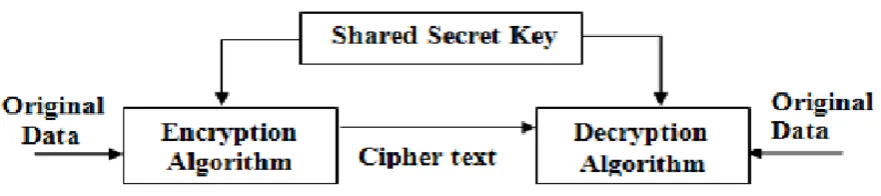
Symmetric algorithmic program deals with just one shared key. The Shared key are going to be used each for coding and also the decryption. The sender encrypts the message with the shared key and sends the encrypted message to the receiver. The receiver rewrites the message with the shared key to decrypt the message. Here if the secret’s compromised then the attack are going to be
simple. So, here the safety is principally committed the confidentiality with the shared key. It is a 2 manner algorithmic program because it deals with just one key that's shared between the sender and also the receiver. it's otherwise known as as secure-key algorithmic program. the sole advantage is that the coding of the information are going to be stronger. The process of parallel coding goes as follows
Fig. 2. SYMMETRIC CRYPTOGRAPHY
we can clearly see that both the cryptographic approaches does the same thing but the only change is in the key, one uses the shared key and the other uses two keys. 2 In this paper , we have a tendency to progressing to use a uneven algorithmic program and that we are progressing to increase the protection to the RSA algorithmic program. the most advantage of the RSA algorithmic program has one key to write and having one key to decode.
4. RELATED WORKS
A. Overview Of Rsa Algorithm:
RSA is AN uneven science formula utilized by the pc devices for the cryptography and secret writing of the message for the secure transfer and it's one in every of the initial systems. The most necessary properties of public key cryptography theme are :
a property that's applicable for this formula than the stellate cryptography formula
• The receiver can desires a novel key for the secret writing which secret is referred as a personal key and therefore the receiver desires a novel key for cryptography which secret is referred as a public key.
• This formula is advanced by the attackers to spot the plain text from the cipher text and therefore the public key
• Even although this public key personal and personal key are generated mathematically it's not such a straightforward to spot the private key from the general public key.
Generation of public key and personal key in RSA:
When the person are coming to begin communication victimization cryptography then there's a requirement of generation of the uneven largest variety and it's at a minimum of 512 bits.
• To notice derived number(e) 1) e ought to be bigger than one and fewer than (p-1)(q-1). 2) The 2 numbers e and (p-1)(q-1) ought to be co-primes
• Public key generation
• The module and therefore the derived variety (n, e) can creates the general public key
• The strength of the RSA is that the attackers cannot notice the n price a part of public key in
finite time because it is obtained from the 2 primes p and letter.
• Private key generation
• The non-public key d is calculated from p, q and e.
1) d is that the inverse of This relationship is written mathematically as follows – male erectile dysfunction = one mod (p-1)(q-1) Here each the primes p and letter ought to be co primes. RSA formula is incredibly sturdy as a result of it takes a heap of days to decipher those prime numbers. It involves numerous resolution ways . The process of the RSA formula goes as follows Example:
Let’s say P and letter are seventeen and
Message encryption: Receiver provide her public key n and e to sender and keeps her non-public key secret. Sender desires to send message M to procedure for calculating effectively is created, at that point RSA will never again be sheltered.
6. PROPOSED ALGORITHM
As we all know that the RSA algorithmic program is principally involved non-public key. So, we have a tendency to area unit reaching to offer the protection for the non-public key. Our model is that we have a tendency to area unit reaching to offer a countersign that mixes 2 elements. One half
are going to be directly far-famed with the sender and therefore the alternative half are going to be generated by the algorithmic program. this implies user can generate 0.5 countersign and therefore the remaining 0.5 are going to be generated by the algorithmic program. This counter sign are going to be send to the user before encrypting .
As we tend to all understand that the RSA rule is mainly concerned personal key. So, we've got a bent to square measure progressing to provide the protection for the personal key. Our model is that we've got a bent to square measure progressing to provide a countersign that mixes a pair of parts. One 0.5 are progressing to be directly known with the sender and thus the choice 0.5 are progressing to be generated by the rule. this means user will generate zero.5 countersign and thus the remaining 0.5 are progressing to be generated by the rule. This countersign are progressing to be send to the user before encrypting.
7. CONCLUSION
In this section, we conclude in our paper we provide security for data generating from IOT on cloud As we know that the RSA algorithm is mainly involved with private key. So, we are going to provide the security for the private key. Our model is that we are going to provide a password that combines two parts. One part will be directly known with the sender and the other part will be generated by the algorithm. This means user will generate half password and the remaining half will be generated by the algorithm. This password will be send to the user before encrypting .
REFERENCES
[1] J. Gubbi, R. Buyya, S. Marusic, and M. Palaniswami. Internet of Things (IoT): A vision, Architectural Elements, and Future .
[2] Y. Liu, Y. Peng, B. Wang, X. Bai, X. Yuan, and G. Li. IOT secure transmission based on integration of IBE and PKI/CA [J]. International Journal of Control & Automation, 6(2), pp. 245-254, 2013. [3] D.E. Bakken, R. Parameswaran, D.M. Blough, A.A. Franz, and T.J. Palmer. Data obfuscation: Anonymity and desensitization of usable data sets [J]. IEEE Security & Privacy, 2(6), pp. 34-41, 2004.
[4] P. Xu, T. Jiao, Q. Wu, W. Wang, and H. Jin. Conditional Identity-based Broadcast Proxy Re-Encryption and Its Application to Cloud Email [J]. IEEE Transactions on Computers, 65(1), pp. 66-79, 2016.
[5] R. Roman, P. Najera, and J. Lopez. Securing the Internet of Things [J]. Computer, 44(9), pp. 51-58, 2011.
[6] K. T. Nguyen, M. Laurent, and N. Oualha. Survey on Secure Communication Protocols for the Internet of Things [J]. Ad Hoc Networks, 32, pp. 17-31, 2015.
Cloud. Transaction on IoT and Cloud Computing, 2(3), pp. 11-17, 2014.
[8] J. Singh, T. Pasquier, J. Bacon, H. Ko, and D. Eyers. Twenty Security Considerations for Cloud-supported Internet of Things. IEEE Internet of Things Journal, 3(3), pp. 269-284, 2016.
[9] Z. Sheng et al., “A Survey on the IETF Protocol Suite for the Internet of Things: Standards, Challenges, and Opportunities,” IEEE Wireless Commun., vol. 20, no. 6, 2013, pp. 91–98.
[10] X. Li et al., “Smart Community: An Internet of Things Application,“ IEEE Commun. Mag., vol. 49, no. 11, 2011, pp. 68–75.
[11] R. Roman, P. Najera, and J. Lopez, “Securing the Internet of Things,” Computer, vol. 44, no. 9, 2011, pp. 51–58.
[12] X. Lin et al., “TSVC: Timed Efficient and Secure Vehicular Communications with Privacy Preserving,” IEEE Trans. Wireless Common., vol. 7, no. 12, 2008, pp. 4987–98.
[13] X. Lin and X. Li, “Achieving Efficient Cooperative Message Authentication in Vehicular Ad Hoc Networks,” IEEE Trans. Vehic. Tech., vol. 62, no. 7, 2013, pp. 3339–48.
[14] J. Zhou et al., “4S: A Secure and Privacy-Preserving Key Management Scheme for Cloud-Assisted Wireless Body Area Network in m-Healthcare Social Networks,“ Info. Sciences, vol. 314, 2015, pp. 255–76.
[15] J. Sen, “Privacy Preservation Technologies in Internet of Things,” Proc. Int’l. Conf. Emerging Trends in Mathematics, Technology, and Management, 2011.
[16] R. Roman et al., “Key Management Systems for Sensor Networks in the Context of the Internet of Things,” Computer & Electrical Engineering, vol. 37, no. 2, 2011, pp. 147–59.