Coreference Resolution on Math Problem Text in Japanese
Takumi Ito and Takuya Matsuzaki and Satoshi Sato
Graduate School of Engineering, Nagoya University, Japan
{takumi i,matuzaki,ssato}@nuee.nagoya-u.ac.jp
Abstract
This paper describes a coreference res-olution system for math problem text. Case frame dictionaries and a math tax-onomy are utilized for supplying domain knowledge. The system deals with var-ious anaphoric phenomena beyond well-studied entity coreferences.
1 Introduction
There is a growing interest in the natural language processing of mathematical problem text (e.g., Mitra and Baral, 2016; Upadhyay et al., 2016; Matsuzaki et al., 2017) because it serves as a pro-totypical example of a natural language interface for intelligent systems. In this paper, we describe a coreference resolution system for math problem text. In order to solve a math problem, all the anaphoric expressions including those referring to a proposition, as well as those referring to an en-tity, must be correctly analyzed. Although much research has been done on coreference resolution for texts such as newspaper, few researches have been done on math problems text.
Previous studies mainly focused on the relation between pronouns or definite noun phrases and their antecedents, and the resolution of zero (i.e., omitted) arguments of verbs. For instance, Iida et al. (2016) investigated zero anaphoric resolution on news text in Japanese and they considered only the zero arguments of a predicate.
On the other hand, in math problems, the ar-guments of unsaturated nouns are often omit-ted. This phenomenon is called bridging anaphora (Clark, 1975). For instance, in the following pas-sage:
There is a right triangleABCwith̸ C= 90◦. Let the length of the hypotenuse (ofϕ) bec.
the argument of “hypotenuse” is omitted and
has to be identified as “triangle ABC”. There are studies that focus on such phenomena in Japanese (Sasano and Kurohashi, 2009) and En-glish (Gerber and Chai, 2010). Our task includes theirs, but we need to consider issues peculiar to math problems. For example, we need to be stricter in detecting a zero pronoun, as in:
x2= 1has a positive solution∗(ofϕ).
One may be tempted to posit the existence of a zero argument of “a positive solution” that refers to “x2 = 1”. The principle of compositionality
suggests that “a positive solution ofx2 = 1” has
“1” as its denotation, but “x2 = 1 has 1” does
not make sense. That is, we mustnotsupply the “omitted” argument to “a solution” in this sen-tence to derive a correct semantic representation, e.g.,∃x(x2 = 1∧x > 0). No previous work,
in-cluding Iida et al’s, has dealt with such “syntacti-cally determined” zero arguments as far as we are aware of. It is partly because most previous work has focused on the resolution of zero arguments of a predicate and there is no Japanese predicate that syntactically determines the antecedent of its zero argument.
Table 1 shows the types and the numbers of anaphoric expressions in math problems. For the survey, we randomly chose 100 problems from the entrance exam problems of seven top-ranked national universities in Japan from 1990 to 2014 (EEP) and 88 problems from the national stan-dardized test for university admission in the even years from 1998 to 2014 (NST).
Table 1 reveals that there are few cases where (definite) common nouns are used anaphorically. One reason is that a symbol is often assigned to an entity as soon as it is introduced in a problem, such as in: “LetCbe the circle that is ...” and the entity is thereafter referred to by the symbol but not by
Table 1: Type of Anaphoric Expression
Type Example NSTCountEEP
Demonstrative Pronoun soresorera“it”,“they” 3 2 Determiner konokorerano“this”,“these” 28 14 Zero pronoun as
argu-ment of unsaturated noun (“radius (ofϕ-no) hankeiϕ)” 121 61 Common Noun houteishiki“(the) equation” 1 5
Conditional Demonstrative konotoki“for this case” 57 33
Others ippoutahou“the other”“one”, 29 16
a definite noun. On the other hand, the number of occurrences of zero pronouns is very large. How-ever, in 69% of them, the antecedents are syntac-tically determined. We need to discern them from the others so that heuristics-based antecedent de-termination isnotapplied to them. We can also see there are many conditional demonstratives, which refer not to entities but to propositions. There are several previous works that address them, such as Bejan and Harabagiu (2014), but it is much less studied compared to entity coreference resolution. In the rest of the paper, we describe our corefer-ence resolution system (§2) and provide some ex-perimental results (§3). We then explain typical remaining errors (§4).
2 Methods
Our system handles four types of anaphoric ex-pressions: pronouns, demonstrative determiner + nouns, zero pronouns, and conditional demonstra-tives. The first two types are analyzed according to a basic processing flow (§2.1). Zero pronouns are handled by slightly modifying the basic flow (§2.2). Conditional demonstratives are processed differently than the others since they refer to a proposition but not to an entity (§2.3).
2.1 Basic Processing Flow
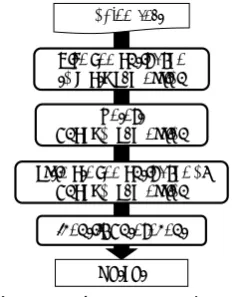
An overview of the coreference resolution system is shown in Fig. 1. The input is a math problem in which math expressions are encoded in MathML1.
The system first tags each math expression with a label indicating its semantic type based on the syntactic pattern of the MathML expression. The semantic types are categories of mathematical ob-jects such as “integer”, “real number”, “circle”, “ellipse”, etc. We currently have 543 semantic
1https://www.w3.org/TR/MathML3/
ProblemText
Identify Antecedent Give Semantic Type to Math Expression
Output Detect Anaphor Expression
Estimate Semantic Type of Anaphor Expression
Figure 1: Overview of System
types. The distribution is very long-tailed and we observed only 106 of these types in the experiment presented in the current paper. For example, if the math expression is △ABC, a label “triangle” is given. If the math expression isy = 2x, three la-bels, “function”, “equation”, and “line”, are given. Next, anaphoric expressions are detected by a regular expression and the semantic types and the number of their antecedents are determined. If a noun appears immediately after a demonstrative such as in “this function”, the semantic type is de-termined by the noun. Otherwise, it is dede-termined using a case frame dictionary. For example, in the case of “it intersects with the circle”, we know the semantic type of “it” is a type of “Shape” by the case frame of the predicate “intersect”.
The antecedents are then identified among the nouns, math expressions, and symbols that match the semantic type and are closest to the anaphoric expression. When a plural anaphoric expression includes a specific number (e.g., “these two trian-gles”), we identify as many antecedents as speci-fied in all the preceding context from the closest to the anaphor. In contrast, for a plural anaphora including no specific number (e.g.,“these trian-gles”), if we consider all the candidates in all the preceding context, there would be many false-positives. We thus need to limit the range of the context in which we identify the antecedents. Based on observation, we chose the window of two sentences as the range.
(Shape,sg-ga Point,sg-o) tooru [Shape-NOM Point-ACC pass] (Vec,sg-to) (Vec,sg-ga) chokkou-suru [Vec-COM Vec-NOM perpendicular]
(Circle,sg-no) hankei [Circle,sg-GEN radius] (Integer,pl-no) kobaisu
[Integer,pl-GEN common multiple]
Figure 2: Case Frame Dictionary (top: verbs, bot-tom: unsaturated nouns)
Bounded area Line or Curve
Circle Polygon Line Curve Shape
Figure 3: Math Taxonomy
planar figure passes through a point”, for instance. We also use a math taxonomy to test if the type of an antecedent candidate is compatible with an anaphoric expression. A small part of the math taxonomy is shown in Fig. 3. The number of nodes of the taxonomy is 130.
2.2 Zero Pronoun
Processing of zero pronouns is almost the same as the basic processing flow. However, the detection of anaphoric expressions and the determination of their semantic types and plurality are done differ-ently. In the detection of anaphoric expressions, firstly all the words in the dictionary of unsaturated nouns are extracted from a problem. The system judges that there is a zero argument of an unsatu-rated noun if none of the following conditions are met:
1. There is an overt genitive argument of the unsaturated noun that matches the semantic type of the argument (e.g., radius of a circle) 2. The unsaturated noun is in a relative clause and the noun modified by the relative clause matches the semantic type of the argument of the unsaturated noun
3. The unsaturated noun is an argument of a prescribed set of predicates, such as motsu
“have” andtoru“take”.
Case 2 and 3 exclude the cases where the an-tecedent of the zero argument is syntactically de-termined. A typical example of case 2 is hankei-ga 3-no en “a circle whose radius is 3”. In
En-glish, the relativizer “whose” specifies the geni-tive relation between “circle” and “radius” but in Japanese no such grammatical relations are speci-fied by the (zero) relativizer. Therefore, the detec-tion rule becomes complicated. Case 3 excludes the cases such as “f(x) = 0has a real solution (of
ϕ)”, where the coreferential relation is controlled by the head verb (e.g., “has”) and hence the reso-lution is done in syntactic/semantic parsing stage. Next, the semantic type and the number of the antecedent(s) are determined using the case frame dictionary. For example, when the unsaturated noun is “initial term (ofϕ)”, the type of the zero argument is assumed to be “number sequence” and the number is singular.
2.3 Conditional Demonstrative
In math problems, coreferential expressions such as “for this case”, “in case of (1)”, and “the follow-ing condition” refer to propositions. We call them
conditional demonstrativesin this paper. Our sys-tem handles three types of such expressions as de-scribed below.
First type iskono/sono-toki“for this/that case”. There are two usages of it. One indicates that all the previous conditions given in a problem are ef-fective, and the other refers to a specific proposi-tion, as in:
1. There is△ABCwithAB=BC=CA= 1.
Kono-toki, △ABC-no menseki-o motomeyo. For this case △ABC-GEN area-ACC calculate. For this case, calculate the area of△ABC.
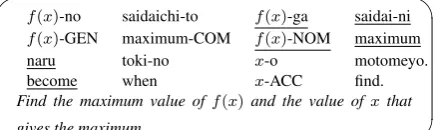
2.f(x)-no saidaichi-to sono-toki-no x-o f(x)-GEN maximum-and for that case x-ACC motomeyo.
find.
Find the maximum value off(x)and the value ofxthat gives the maximum
The underlined part, Kono-toki“for this case”, in the problem 1 indicates all the conditions given so far for△ABC have to be taken into consider-ation in solving it. As the English translconsider-ation sug-gests,Kono-toki(andSono-toki) in this usage can be omitted without changing the meaning of the problem. On the other hand, the underlined part
f(x)-no saidaichi-to f(x)-ga saidai-ni f(x)-GEN maximum-COM f(x)-NOM maximum naru toki-no x-o motomeyo. become when x-ACC find.
Find the maximum value off(x)and the value ofx that gives the maximum
To identify what is referred to by a phrase such as “in the case of (1)”, we have to extract a propo-sition or a condition from the sub-problem desig-nated by the problem number. To that end, we seek for a key phrase in the sub-problem that typically marks such a proposition. For example,P-youna
“such that P”,P-tame-no“so that P”,P-toki“when P” andP-to-suru“assume that P” (P : proposition) are such key phrases. We rewrite the referring ex-pression with the proposition identified by the key phrase as in:
(1) f::::::(x)-no::::::::::saidaichi-ga:::::3-ni::::naru you-ni a-o sadameyo.
(1) Determine the value of a so that the::::::::::maximum
::::
value::of::::f(x)::is:3.
(2) (1)-no baai-nif(x)-no saisyouchi-o motomeyo. (2) In the case of (1), find the minimum value off(x). After rewriting (2)
(2) f(x)-no saidaichi-ga 3-ni naru-toki f(x)-no saisyouchi-o motomeyo.
(2) When the maximum value of f(x) is 3, find the minimum value off(x).
For a referring expression such as tsugino-shiki/joken“the following formula/condition”, the referents are searched from the succeeding con-text. Specifically, the sentence or math expres-sion just after the sentence including “the follow-ing condition” is identified as the referent and the referring expression is rewritten as follows:
Tsugi-no houteishiki-o mitasu△ABC-o kangaeru : sinA= sinB
Consider △ABC which satisfies the following equation :sinA= sinB
After rewriting
sinA= sinB-o mitasu△ABC-o kangaeru. Consider△ABCwhich satisfiessinA= sinB
3 Evaluation
We evaluated the system performance using three data sets. The first is 20 mock tests of Japanese national standardized test for university admis-sion (MockNST) that consists of 74 problems. MockNST was also used for the system test while the development; hence it is a closed test data. The
Table 2: Accuracy of Zero Pronoun Detection
Precision Recall F1
MockNST 74% (32/43) 84% (32/38) 79%
MockUT 89% (8/9) 100% (8/8) 93%
Table 3: Accuracy of antecedent identification
Demons-trative ZeroPronoun Condi-tional Total MockNST 12/20 31/32 3/5 46/57 (81%)
MockUT 2/3 6/8 2/4 10/15 (67%)
second is 20 mock tests of the entrance exam of the University of Tokyo (MockUT) that consists of 41 problems. MockUT was kept unseen while the system development. We additionally used EEP data (see§1) for the evaluation of the resolution of conditional demonstratives.
Table 2 shows the accuracy of zero pronoun de-tection. The low precision means that unneces-sary zero pronoun detection was performed. There were in total twelve such cases on MockNST and MockUT. Two thirds of them were due to an error in syntactic dependency analysis, which resulted in a failure in the recognition of the construction that determines the zero arguments of the unsatu-rated noun syntactically (§2.2). Table 3 shows the accuracy of the identification of antecedents.
Table 4 presents the accuracy at the problem level (i.e., perfect match) on MockUT. Approxi-mately one third of the problems in MockUT in-clude at least one coreference. About half of them could be completely resolved.
We also evaluated the accuracy of the resolution of conditional demonstratives on the 100 problems of EEP data set because conditional demonstra-tives were not frequently used in MockUT. In EEP, ten problems required coreference resolution of conditional demonstratives. Table 5 provides the details.
4 Remaining Problems
We found three types of frequent errors in the out-put of the current system. The first is due to an error in the dependency analysis, such as in:
x4−ax−a= 0-ga, kyojiku-jou-no fukusosuu-o kai-ni motsu youna jissuua-o subete motomeyo.
Find all real numbersasuch thatx4−ax−a= 0
has a solution on the imaginary axis of the complex plane.
In this problem, the dependency parser selected
motomeyo“find” as the head of “x2−ax−a= 0”
Table 4: Evaluation at Problem level
#Coreferences %Problems Correct ≥1 32% (13/41) 54% (7/13)
None 68% (28/41) —
Table 5: Evaluation of Conditional Demonstrative
“for this case” “in case of (1)” Total
Accuracy 8/8 1/2 9/10 (90%)
the system cannot detect the patternX-ga Y-o kai-ni motsu“X has a solution in Y” and unnecessary zero anaphora resolution was done.
The second is due to a kind of polymorphism in the natural language:
△ABC-no menseki-o S(a)-de arawasu-toki kono-kansuu-no gurafu-o kake.
Letting S(a) be the area of △ABC, draw the graph of this function.
In this problem, S(a) is first defined as a real number (area) but later referred to as a function. Due to this type mismatch, antecedent detection forkono-kansuu“this function” was failed.
The third is due to a failure in the recognition of the plurality of the zero pronoun.
En O-to houbutsusen C-ga ten P(√3,0)-o kyouyuu-shi, sarani P-ni okeru (ϕ-no) sessen-ga icchi-siteiru.
CircleOand parabolaCshare the pointP(√3,0)
and the tangent lines (ofϕ) atPcoincide.
In this problem, a zero argument of sessen “tan-gent line” was successfully detected but it was wrongly interpreted as singular while it actually refers to “O and C”. Thus only C was identi-fied as the antecedent. This is because there is no morphological indication of the number of a noun (such as -s in English) in Japanese. To solve this problem, we could utilize the case frame of icchi-suru “coincide”, which specifies a plural noun phrase as its subject. By this, we know sessen
“tangent line(s)” actually signifies more than one entities and so is its zero argument.
5 Conclusion
This paper described a coreference resolution sys-tem for math problem text. The syssys-tem deals with various anaphoric phenomena such as conditional demonstratives referring to propositions and syn-tactically controlled zero arguments. Evaluation showed the accuracy of the coreference resolution at the problem level was 54%. Our future work in-cludes accurate recognition of the plurality of the
zero pronouns and fixing the error of the depen-dency analysis.
Acknowledgments
This research was supported by Todai Robot Project at National Institute of Informatics. We are gratefully acknowledge Gakko Hojin Takamiya Gakuen Yoyogi Seminar, Benesse Co., and Suken Shuppan Co., Ltd. for the math problem text data.
References
Cosmin Adrian Bejan and Sanda Harabagiu. 2014. Un-supervised event coreference resolution. Computa-tional Linguistics40(2):311–347.
Herbert H Clark. 1975. Bridging. In Proceedings of the 1975 workshop on Theoretical issues in natu-ral language processing. Association for Computa-tional Linguistics, pages 169–174.
Matthew Gerber and Joyce Y Chai. 2010. Beyond nombank: A study of implicit arguments for nom-inal predicates. InProceedings of the 48th Annual Meeting of the Association for Computational Lin-guistics. Association for Computational Linguistics, pages 1583–1592.
Ryu Iida, Kentaro Torisawa, Jong-Hoon Oh, Cana-sai Kruengkrai, and Julien Kloetzer. 2016. Intra-sentential subject zero anaphora resolution using multi-column convolutional neural network. In Pro-ceedings of the 2016 Conference on Empirical Meth-ods in Natural Language Processing. pages 1244– 1254.
Takuya Matsuzaki, Takumi Ito, Hidenao Iwane, Hi-rokazu Anai, and Noriko H. Arai. 2017. Semantic parsing of pre-university math problems. In Pro-ceedings of the 55th Annual Meeting of the Associa-tion for ComputaAssocia-tional Linguistics. Association for Computational Linguistics, pages 2131–2141. Arindam Mitra and Chitta Baral. 2016. Learning to
use formulas to solve simple arithmetic problems. In
Proceedings of the 54th Annual Meeting of the Asso-ciation for Computational Linguistics. pages 2144– 2153.
Ryohei Sasano and Sadao Kurohashi. 2009. A prob-abilistic model for associative anaphora resolution. InProceedings of the 2009 Conference on Empirical Methods in Natural Language Processing: Volume 3-Volume 3. Association for Computational Linguis-tics, pages 1455–1464.