Dataset for a Neural Natural Language Interface for Databases (NNLIDB)
Florin Brad1, Radu Iacob2, Ionel Hosu2, and Traian Rebedea2 1Bitdefender Romania
2University Politehnica of Bucharest
{radu.iacob23, ionel.hosu, traian.rebedea}@gmail.com
Abstract
Progress in natural language interfaces to databases (NLIDB) has been slow mainly due to linguistic issues (such as language ambiguity) and domain portability. More-over, the lack of a large corpus to be used as a standard benchmark has made data-driven approaches difficult to develop and compare. In this paper, we revisit the problem of NLIDBs and recast it as a se-quence translation problem. To this end, we introduce a large dataset extracted from the Stack Exchange Data Explorer web-site, which can be used for training neural natural language interfaces for databases. We also report encouraging baseline re-sults on a smaller manually annotated test corpus, obtained using an attention-based sequence-to-sequence neural network. 1 Introduction
Natural language interfaces have received atten-tion as tools for simplifying the interacatten-tion be-tween users and computers. These interfaces often exclude or complement input devices, such as key-board or touch screens, or even specific languages used for interacting with an application. A more focused area is composed of Natural Language In-terface to Databases (NLIDB), which would allow a person to retrieve useful information from any database without knowledge of specific query lan-guages such as structured query language (SQL) for relational databases.
Despite initial efforts into NLIDBs started decades ago, research has advanced slowly and at this moment there are no commercial solutions or widespread prototypes. The main difficulties in solving this problem stem from linguistic failures and the inability to develop general-purpose
solu-tions that are portable to different databases and schemas.
Due to the recent success of deep neural ap-proaches in natural language processing, our aim is twofold. First, we hope to rejuvenate interest in the NLIDB problem by proposing a large dataset, called the Stack Exchange Natural Language In-terface to Database (SENLIDB) corpus, for de-veloping data-driven machine learning models and for reporting progress. The training set consists of24,890pairs (textual description, SQL snippet) crawled using the Stack Exchange API that we fil-tered and cleaned. A smaller test set consisting of
780pairs that were manually created by two anno-tators is also available for comparing solutions.
Second, we report results on a neural base-line that uses an attention-enhanced sequence-to-sequence (SEQ2SEQ) architecture (Bahdanau et al., 2014) to model the conditional probability of an SQL query given a natural language descrip-tion. This model is trained on the aforementioned dataset and its performance is computed both us-ing cross-validation and on the manually labeled test set. Qualitative results reveal code that is syn-tactically correct most of the times and closely re-lated to the user’s intention. Moreover, we report results on two smaller tasks, which we call the ta-bles and columns identification tasks. These re-sults suggest that our dataset is indeed valuable for training end-to-end neural natural language inter-faces for databases (NNLIDB).
The paper continues with a short overview of related work in natural language interfaces for databases and in similar tasks where deep net-works have been successfully employed. Section 3 contains a detailed description of the large SEN-LIDB dataset created for training, together with the smaller dataset used for testing and comparing various NLIDB systems. Preliminary results using a SEQ2SEQ neural model with attention trained
on the dataset proposed in this paper are presented in Section 4. We then propose alternative indi-cators for assessing the correctness of generated SQL queries in Section 5, while Section 6 con-cludes the paper by highlighting the key insights and future work.
2 Related Work
As all current NLIDB solutions are using mainly dependency and semantic parsing together with rule-based or constraint-based algorithms, we also present similar problems which inspired our ap-proach, where deep networks have achieved state of the art results. In the last part of the section, we introduce the most frequently used corpora for evaluating the performance of NLIDB systems.
2.1 Current approaches for NLIDB
Natural language interfaces for databases have been studied for decades. Early solutions pro-posed using dictionaries, grammars and dialogue systems for guiding the user articulate the query in natural language on a step by step basis (Codd, 1974;Hendrix et al.,1978). Most systems devel-oped until mid-90s used a mix of pattern matching, syntactic parsing, semantic grammar systems, and intermediate representation languages for generat-ing the query from text (Androutsopoulos et al., 1995). The most important problems encoun-tered by NLIDBs were related to ambiguity in semantics and pragmatics present in natural lan-guage: modifier attachment, understanding quan-tifiers, conjunction and disjunction, nominal com-pounds, anaphora, and elliptical sentences (An-droutsopoulos et al.,1995).
In more recent studies, Popescu et al. (2004) combine syntactic parsing and semantic interpre-tation for natural language queries to change parse trees such that, by changing the order of some nodes in a tree, it will be correctly interpreted by the semantic analyzer. Then they use a maxi-mum flow algorithm and dictionaries for semantic alignment between the text and several SQL can-didates. One of their main contributions is that they introduce a subset of semantically tractable text queries, for which the proposed method gen-erates correct SQL queries in most cases.
NaLIR (Li and Jagadish, 2014) uses depen-dency parse trees generated with CoreNLP (Man-ning et al.,2014) and several heuristics and rules to generate mappings from natural language to
can-didate SQL queries. Given the dependency tree, the database schema and associated semantic map-pings, the system proceeds in building alternative query trees which can be easily translated to SQL. To determine the best query tree, the system com-bines a scoring mechanism and an interaction with the user to select the best choice (from a list of reformulations of the query tree into natural lan-guage). The scoring for each query tree takes into account the number of alterations performed on the dependency tree in order to generate it, the database similarity/proximity between nodes adja-cent in the query tree, and the syntactic correctness of the generated SQL query.
The most promising results reported on several databases used for validating NLIDBs have been recently achieved by Sqlizer (Yaghmazadeh et al., 2017). Its main contributions are related to the fact that it uses a semantic parser to generate a query sketch, which is then completed using a rule based system, and iteratively refined and repaired using rules and heuristics until the score of the generated SQL query cannot be improved. Sqlizer is one of the few systems which employs machine learning and Word2Vec (Mikolov et al.,2013) for generat-ing the query sketch - a general form of the query, including clauses, but which does not contain any specific database schema information (e.g. table and column names).
2.2 Deep learning solutions for NLIDB and related problems
Mou et al.(2015) introduced a case study for code generation from problem descriptions using re-current neural networks (RNN). They trained a SEQ2SEQ architecture with a character-level de-coder and produced program snippets that are syn-tactically correct most of the times and retain func-tionality. Moreover, they showed that the RNN generates novel code alternatives compared to the programs seen during training, thus ruling out the possibility that the network merely memorizes the input examples. Ling et al.(2016) combined the SEQ2SEQ approach with a pointing mechanism (Vinyals et al.,2015) in order to generate Python and Java code using textual descriptions auto-matically extracted from collectible trading card games.
descrip-tions, which then get mapped deterministically to the target source code. The decoder is guided by a predefined grammar, so their solution is agnostic of the target programming language. Using this syntax aware decoding mechanism, they show to improve the SEQ2SEQ baseline for code genera-tion.
Another related topic is semantic parsing using deep neural networks. Semantic parsing focuses on converting natural language into logical forms which are used for querying knowledge bases (Be-rant et al., 2013). Neural approaches for seman-tic parsing use a SEQ2SEQ network to map natu-ral language text to logical forms (Dong and La-pata, 2016;Herzig and Berant, 2017). Other so-lutions bypass the need for ground truth logical forms and instead train a supervised neural model from query-answer pairs (Yin et al., 2015; Nee-lakantan et al., 2016). Iyer et al. (2017) are the first to use a SEQ2SEQ network to map natural language directly to SQL language. They leverage feedback-based learning to continuously improve the parser accuracy.
2.3 Existing corpora for NLIDB evaluation
Solutions to the NLIDB problem have been tradi-tionally evaluated against databases with few ta-bles and on validation datasets with a small num-ber of entries.
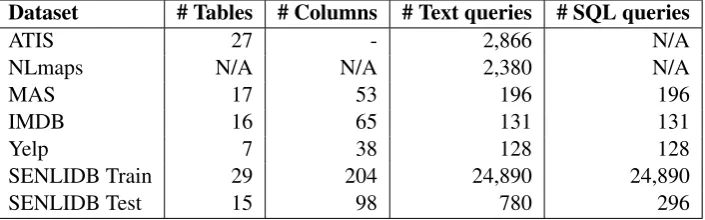
One of the most complex databases for NLIDB evaluation is ATIS (Air Travel Information Cor-pus) (Hemphill et al., 1990), which stores in-formation about data flights and features 27 ta-bles. However, it only has 2,886 natural language queries and no corresponding SQL statements, making it unsuitable for a data-driven approach. Most recent systems have moved to validation datasets which contain both the natural language query and the corresponding SQL snippet, such as MAS (Microsoft Academic Search), IMDB, and Yelp. For example, Sqlizer (Yaghmazadeh et al., 2017) achieves 80% accuracy on MAS, while NaLIR (Li and Jagadish,2014) obtains only 32% accuracy on the same data. There also exist some slightly larger corpora for querying geolocation databases, the largest being NLmaps (Haas and Riezler, 2016) which contains 2,380 text queries but with no corresponding SQL code (instead they use machine readable language - MRL for ex-pressing queries).
The training set (SENLIDB Train) proposed in
this paper is by far larger than any of the existing datasets, as can be seen from Table 1. This makes it extremely useful for training solutions using ma-chine learning, including neural NLIDBs. More, the test set (SENLIDB Test), which has been man-ually annotated by two experts, is twice as large as current validation corpora and contains several text formulations for the same SQL query.
3 Dataset construction
A deep neural architecture, such as SEQ2SEQ, requires a large number of input-output pairs to produce qualitative results. The next subsections describe the steps taken to build the SENLIDB dataset, including our attempts to correct some of the problems inherent with crowdsourced data.
3.1 Data crawling and preprocessing
The Stack Exchange Data Explorer allows users to query the entire database of the well-known question-answering platform through a public API 1. The database uses Microsoft SQL Server, there-fore users query it using the SQL extension devel-oped by Microsoft, called Transact-SQL (T-SQL). For each query to the Stack Exchange database is-sued by a user, the web interface enforces the user to add a title and also an optional longer descrip-tion. The main rationale for these two fields is for users to provide an accurate textual descrip-tion for each query they make. However, there is no method to ensure that the title or the description entered for a query are actually relevant in describ-ing it.
The list of all user queries is available online 2 and Stack Exchange offers various sorting and filtering capabilities including most upvoted or viewed queries. An important characteristic is that all available queries are correct, meaning that they do not throw any errors when querying the Stack Exchange database. Moreover, some of them are ”interactive” - users can input values in the web interface for temporary variables enclosed by ’##’ or ’#’ in the SQL query.
In order to build the proposed dataset, we started by crawling all user queries from Stack Ex-change, as they appear in the section ’Everything’ in descending order by creation date.
1http://data.stackexchange.com/
stackoverflow/query/new
2http://data.stackexchange.com/
Dataset # Tables # Columns # Text queries # SQL queries
ATIS 27 - 2,866 N/A
NLmaps N/A N/A 2,380 N/A
MAS 17 53 196 196
IMDB 16 65 131 131
Yelp 7 38 128 128
SENLIDB Train 29 204 24,890 24,890
SENLIDB Test 15 98 780 296
Table 1: Comparison of existing datasets and the SENLIDB corpora for NLIDB systems
First of all, we discarded SQL snippets longer than 2,000 characters as we considered them to be too complex. This step resulted in about
2,000,000 queries. The next step was to create pairs of textual description (which included the ti-tle and the actual description of a query) and cor-responding SQL snippet. We then removed du-plicate pairs (identical SQL code and description) and approximately 600,000 pairs were left. After this step, we removed items with SQL code in the description using simple empirical rules (descrip-tions starting with ’select’ and containing ’from’). The remaining dataset was reduced to roughly 170,000 pairs.
Afterwards, we removed the comments from the SQL snippets and eliminated the entries that now had void snippets. Finally, we took away items with identical textual descriptions and dif-ferent SQL snippets. For description d and cor-responding SQL snippets s1, ..., sn, we kept the
code snippetsi of median length, as we consider
that an average length description is probably bet-ter than very long and very short ones which are probably outliers. This resulted in a dataset with 24,890 items, each having an unique textual de-scription and an associated SQL query.
Although descriptions in this dataset are unique, there are2,225identical SQL queries with differ-ent descriptions.
3.2 Large dataset for training and validation
We consider that the previously described dataset can be used effectively for training machine learn-ing models for NLIDB, includlearn-ing more data-hungry models such as neural NLIDBs. As this corpus was created by a large number of users from the Stack Exchange data portal, one might expect that the quality of the entries to be simi-lar to other corpora created using various crowd-sourcing mechanisms. To this extent, although this
dataset can also be used for validation (using ei-ther cross-validation or a hold-out set), the results will be impacted by the inherent biases, noise and errors collected through crowdsourcing. Some of the particularities of these data are addressed next. First, most of the SQL snippets are relatively simple, containing at most 10 distinct tokens, as can be easily seen in Table 2. In contrast, textual descriptions are more evenly distributed, based on the number of tokens, with 2,003 of the en-tries in the dataset having more than 100tokens. Thus although some queries might have an incom-plete textual description, most of them are well ex-plained.
Second, the Stack Exchange database schema available in the dataset contains 29 tables. Inter-estingly, their actual appearances in the dataset, judging by the number of occurrences in individ-ual queries, follows Zipf’s law (Zipf, 1949) as it can be observed in Table 3. We note that a large majority of queries refer to the ’Posts’ and ’Users’ tables, while other tables make almost no appear-ance in the dataset (e.g. ’PostNotices’, ’PostNo-ticeTypes’). In Table 4 we present the most fre-quent SQL expressions in the datasets. Half of the queries contain ordering clauses and almost a third include multiple joined tables and group by clauses.
Third, the dataset contains samples of varied difficulty, from simple select operations to com-plex nested queries. We computed the Halstead complexity metrics (Halstead,1977) to gain an in-sight into the difficulty of the SQL snippets in our datasets. To measure the difficulty of a snippet we used the formula (Halstead,1977):
Difficulty = η21 ·Nη
2 (1)
whereη1 is the number of distinct operators,η2is
# SQL query tokens # text tokens 1-10 11-25 26-50 51-100 100+ Total
2-4 2094 3321 2634 1536 605 10190
5-10 641 2547 3182 2306 742 9418
11-20 121 724 1150 876 318 3189
21-50 21 239 470 584 266 1580
51+ 1 10 35 99 72 217
Total 2878 6841 7471 5401 2003
(a) Length statistics for the training dataset
#SQL query tokens # text tokens 1-10 11-25 26-50 51-100 Total
2-4 88 1 0 0 89
5-10 270 69 8 4 351
11-20 77 181 23 4 285
21-50 1 34 18 2 55
Total 436 285 49 10
(b) Length statistics for the test dataset
Table 2: Overview of the number of tokens from the SQL snippet and the textual description for the SENLIDB corpora
Table name # occur. train # occur. test
Posts 15159 383
Users 7672 229
Tags 4765 134
Posttags 3370 39
Votes 2476 22
Comments 1583 41
Posthistory 1214 2
Badges 625 16
Posttypes 616 4
Votetypes 336 6
Other tables 1080 16
Table 3: Most frequent table names in SENLIDB sorted descending by occurrences in training set
SQL expr. # occur. train # occur. test
select 22145 295
from 21982 295
where 18894 203
order 13114 77
count 8294 57
join 7943 29
group 7366 27
Table 4: Most frequent SQL expressions in SENLIDB
number of operands.
Finally, we used an off-the-shelf library3to de-tect the language of the query descriptions. More than 95% were classified as English, followed at a great distance by French and Russian with less than 100 entries each. We remarked that some of the descriptions contain table and column names, which could affect the language identification per-formance (with a small bias towards English).
3.3 Manually annotated test dataset
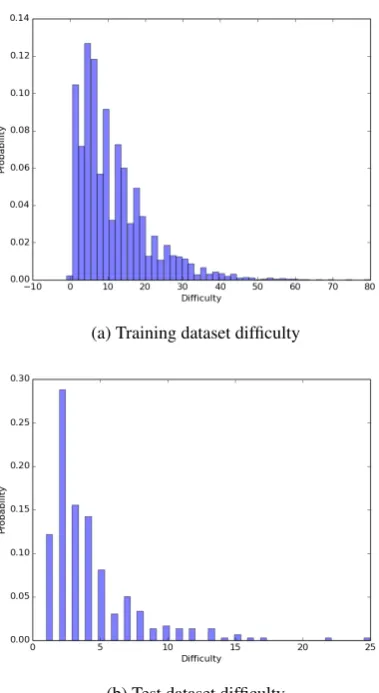
(a) Training dataset difficulty
(b) Test dataset difficulty
Figure 1: Histograms of the Halstead difficulty measure for the training (a) and test (b) sets
tual annotations is 780, averaging to 2.63 textual reformulations per query.
In order to facilitate the annotation process, the annotators used an application which allowed the user to view a SQL query from the original dataset and add one or more possible descriptions. The SQL queries chosen for manual annotation were randomly selected from those with a very short textual description in the original corpus, consist-ing of only 1-2 tokens. These items were con-sidered not informative enough to be included in the training set and were thus added to the human-annotated test set.
In order to achieve a better understanding of how similar or different the produced annotations are, for each sample we computed the BLEU score (Papineni et al.,2002), with the smoothing func-tion proposed inChen and Cherry(2014), between the descriptions of one annotator and those pro-duced by the other annotator. The average of the scores obtained for each sample was57.10, which
Dataset Perplexity BLEU
Validation 1.16 16.9
Test-original 1.24 13.5 Test-annotated 1.23 18.2
Table 5: Perplexity and BLEU score of the gener-ated SQL statements on the validation set, original test set and annotated test set descriptions
is consistent with inter-translator BLEU scores ob-served in machine translation. It is important to notice that there are some differences between the train and test dataset. The most important one is highlighted in Figure 1 where the Halstead diffi-culty score for the test set is concentrated between 0-5 as opposed to the train dataset where the mode is at 8. This means that the queries in the test dataset are slightly less complex than the queries in the train dataset. There are also some other dif-ferences between the two datasets, such as the dis-tribution of query and description sizes (see Table 2) and most frequent table names (see Table 3); these arise from how the test SQL queries were subsampled and annotated.
4 Model and experiments
We trained a SEQ2SEQ model with attention on the (description, SQL) pairs in the SENLIDB train set. We used the open-source neural ma-chine translation toolkit OpenNMT (http:// opennmt.net/) (Klein et al., 2017). This system implements a standard SEQ2SEQ model with global-general-attention (Luong et al.,2015). Both the encoder and the decoder are long short-term memory (LSTM) cells with two hidden lay-ers and 500 neurons. The word embedding layer has 500 neurons. We used batches of maximum size 64. We trained the models with Stochas-tic Gradient Descent (SGD) for 25 epochs with a learning rate of 1.0 and a learning decay of 0.5 if perplexity did not decrease on the validation set. We generated SQL statement using a beam search of size 5.
Natural language description Predicted SQL query
top 50 users from india select top 50 id , displayname , reputation , web-siteurl , location from users where location like india order by reputation desc
top 100 users with no of gold badge select top 100 b . userid , u . displayname , count ( * ) as gold from badges b inner join users u on u . id = b . userid group by b . userid , u . displayname order by count ( b . name ) desc user rep select reputation , count ( * ) from users group by
reputation order by reputation
text of highest - scored comment select top 100 id as [ comment link ] , score , text from comments order by score desc
questions with most view select top 500 id as [ post link ] , viewcount from posts order by viewcount desc
Table 6: Examples of SQL queries generated by the SEQ2SEQ model with attention
Dataset Precision Recall F1 score
Validation 0.71 0.55 0.62
Test-original 0.51 0.41 0.45 Test-annotated 0.82 0.72 0.76
Table 7: Precision, recall and F1 score for the tables identification task
Dataset Precision Recall F1 score
Validation 0.65 0.47 0.54
Test-original 0.35 0.29 0.31 Test-annotated 0.55 0.47 0.50
Table 8: Precision, recall and F1 score for the columns identification task
and for the test set, using both the original and the manually annotated texts. We notice similar per-plexities for SQL code generated from the original test titles and from the manually annotated ones, which means that both generate likely code. This is to be expected as the decoder is trained on SQL select statement therefore it will probably gener-ate some sort of select stgener-atement even for short in-put texts given to the encoder. However, the orig-inal titles are much shorter compared to the an-notated titles, and so the more informative natural language descriptions yield a SQL query that re-sembles more closely the ground truth SQL under a BLEU score. Thus, although both shorter (in-complete) and longer (and more descriptive) texts generate likely SQL statements, the manually an-notated texts generate queries significantly more similar to the ground truth (BLEU score 18.2 vs
13.5, as reported in Table 5) than the original de-scriptions.
The initial vocabulary for the encoder (text de-scriptions) had6,000tokens, while the vocabulary of the decoder (SQL queries) consisted of16,000
tokens. This resulted in a very large embedding matrix, thus we decided to restrict the number of tokens for both encoder and decoder to 500 and
2,000, respectively, by keeping only the most fre-quent tokens and replacing the others with the UNK token. Reducing the size of the vocabular-ies for both encoder and decoder resulted in a sig-nificant improvement for the performance of the model (BLEU score 18.2 vs13.06 for the anno-tated test set).
From a qualitative perspective, Table 6 provides several examples of SQL queries generated for the validation set. The generated SQL statement are syntactically correct most of the time even when the textual description is incomplete or use abbre-viations (e.g. ”no” for ”number). More, in the sec-ond example, we can also observe that the model learns to use table aliases correctly in complex queries with joined tables. On another hand, al-though the generated queries are syntactically cor-rect, in most cases they fail to return the desired re-sults when they are executed against the database. When the system fails to generate the correct SQL query for a description, it still generates a query related to the natural language description.
the baseline model. Thus the model is not explic-itly provided with the database schema, however it can infer it from the training set. However, we be-lieve that more complex approaches that integrate schema information and are syntax-aware can pro-duce better results than a SEQ2SEQ model.
5 Discussion
Generating SQL queries from natural language can be broken down to a number of independent sub-problems. For example, in order to retrieve the desired information from a database, the ap-propriate table columns need to be instantiated in the SELECT clauses, and the correct tables need to be instantiated in the FROM clause. Breaking down the complex task of automatically generat-ing SQL in multiple simpler tasks and workgenerat-ing on each task separately can, in our opinion, yield sig-nificant improvements faster.
Apart from the BLEU score, we propose two new tasks that are easier than the NLIDB problem. This approach stemmed from the difficulty of the problem and the need for a more structured grasp of the performance of a certain system on this task. Therefore, we chose to also evaluate the ability of the proposed NNLIDB to correctly instantiate ta-bles and columns from the database schema. For these two tasks, the most important metrics are precision and recall. For example, given a sam-ple from the dataset, we compare the SQL query generated by the neural network architecture with the correct SQL statement and count existing and missing table and column names.
In Tables 7 and 8 we evaluate the performance of our baseline on the tables and columns identi-fication tasks. We observe that on the validation and annotated test set, precision and recall scores are significantly higher, due to the fact that these are more informative than the original test set de-scriptions. Given the fact that the database schema contains a total of 29 entities (table names) and 204 attributes (column names), the precision and recall scores prove that the baseline model delivers decent performance on these tasks and moreover, that both tasks are representative for measuring the performance of a system on the NLIDB problem. It is important to mention that, for the sake of sim-plicity, for the columns identification task we ig-nored the fact that in different tables there may be columns with the same name (e.g. ”id”).
Both the tables and columns identification tasks
can be made more difficult using stricter eval-uation. For example, for the table task, one could consider only the entities that are instanti-ated strictly in the FROM clause and the attributes that are instantiated in the SELECT clause. 6 Conclusions
In this paper we have introduced new datasets for training and validating natural language interfaces to databases. The SENLIDB train dataset is the first large corpus designed to develop data-driven NLIDB systems and it has been successfully used to train an end-to-end neural NLIDB (NNLIDB) using a SEQ2SEQ model with attention. Although the generated SQL output may sometimes be syn-tactically invalid and is rarely the desired SQL statement for the given textual query, we hope the dataset will prove valuable for future research.
The pursuit of a successful NNLIDB is still at the beginning and we hope that the current re-search will provide the first steps needed to in-vestigate more complex solutions. Future research will investigate whether using a stacked decoder -one for generating a query sketch (e.g. subclauses) and one for the elements related to the database schema - will provide a better solution.
In comparison with existing approaches for NLIDB systems, our solution does not use any rules, heuristics or information about the underly-ing database schema or SQL syntax. On the other hand, the generated SQL queries are more often than not inaccurate and thus we have not com-pared the accuracy of the NNLIDB with existing solutions. However, we have focused on verify-ing how similar the generated SQL queries are to the annotated ones using measures from machine translation (BLEU) and also precision and recall for simpler tasks, such as generating the correct table and column names in a SQL statement. Acknowledgments
We would like to thank Laurent¸iu Pantelimon and Alexandru-Robert Velcu for their help in annotat-ing the test set. This work has been funded by the project Text2NeuralQL (PN-III-PTE-2016-0109).
References
Dzmitry Bahdanau, Kyunghyun Cho, and Yoshua Bengio. 2014. Neural machine translation by jointly learning to align and translate. CoRR, abs/1409.0473.
Jonathan Berant, Andrew Chou, Roy Frostig, and Percy Liang. 2013. Semantic parsing on freebase from question-answer pairs. In Proceedings of the 2013 Conference on Empirical Methods in Natural Lan-guage Processing, EMNLP 2013, 18-21 October 2013, Grand Hyatt Seattle, Seattle, Washington, USA, A meeting of SIGDAT, a Special Interest Group of the ACL, pages 1533–1544.
Boxing Chen and Colin Cherry. 2014. A systematic comparison of smoothing techniques for sentence-level bleu.ACL 2014, page 362.
E. F. Codd. 1974. Seven steps to rendezvous with the casual user. InIFIP Working Conference Data Base Management, pages 179–200. IBM Research Re-port RJ 1333, San Jose, California.
Li Dong and Mirella Lapata. 2016.Language to logical form with neural attention.CoRR, abs/1601.01280. Carolin Haas and Stefan Riezler. 2016. A corpus
and semantic parser for multilingual natural lan-guage querying of openstreetmap. InProceedings of NAACL-HLT, pages 740–750.
Maurice Howard Halstead. 1977.Elements of software science, volume 7. Elsevier New York.
Charles T Hemphill, John J Godfrey, George R Dod-dington, et al. 1990. The atis spoken language sys-tems pilot corpus. In Proceedings of the DARPA speech and natural language workshop, pages 96– 101.
Gary G. Hendrix, Earl D. Sacerdoti, Daniel Sagalow-icz, and Jonathan Slocum. 1978. Developing a natu-ral language interface to complex data. ACM Trans. Database Syst., 3(2):105–147.
Jonathan Herzig and Jonathan Berant. 2017. Neu-ral semantic parsing over multiple knowledge-bases. CoRR, abs/1702.01569.
Srinivasan Iyer, Ioannis Konstas, Alvin Cheung, Jayant Krishnamurthy, and Luke Zettlemoyer. 2017.
Learning a neural semantic parser from user feed-back.
Guillaume Klein, Yoon Kim, Yuntian Deng, Jean Senellart, and Alexander M. Rush. 2017. Opennmt: Open-source toolkit for neural machine translation. CoRR, abs/1701.02810.
Fei Li and H. V. Jagadish. 2014. Constructing an interactive natural language interface for relational databases.VLDB, 8(1):73–84.
Wang Ling, Edward Grefenstette, Karl Moritz Her-mann, Tomas Kocisky, Andrew Senior, Fumin Wang, and Phil Blunsom. 2016. Latent predictor networks for code generation.Acl, pages 1–13.
Minh-Thang Luong, Hieu Pham, and Christopher D Manning. 2015. Effective approaches to attention-based neural machine translation. arXiv preprint arXiv:1508.04025.
Christopher D. Manning, Mihai Surdeanu, John Bauer, Jenny Finkel, Steven J. Bethard, and David Mc-Closky. 2014. The stanford corenlp natural lan-guage processing toolkit. InAssociation for Compu-tational Linguistics (ACL) System Demonstrations, pages 55–60.
Tomas Mikolov, Ilya Sutskever, Kai Chen, Greg Cor-rado, and Jeffrey Dean. 2013. Distributed represen-tations of words and phrases and their composition-ality. InProceedings of the 26th International Con-ference on Neural Information Processing Systems, NIPS13, pages 3111–3119, USA. Curran Associates Inc.
Lili Mou, Rui Men, Ge Li, Lu Zhang, and Zhi Jin. 2015. On End-to-End Program Generation from User Intention by Deep Neural Networks. Arxiv, (March 2016).
Arvind Neelakantan, Quoc V. Le, Martin Abadi, An-drew McCallum, and Dario Amodei. 2016. Learn-ing a natural language interface with neural pro-grammer.CoRR, abs/1611.08945.
Kishore Papineni, Salim Roukos, Todd Ward, and Wei-Jing Zhu. 2002. Bleu: a method for automatic eval-uation of machine translation. In Proceedings of the 40th annual meeting on association for compu-tational linguistics, pages 311–318. Association for Computational Linguistics.
Ana-Maria Popescu, Alex Armanasu, Oren Etzioni, David Ko, and Alexander Yates. 2004. Modern nat-ural language interfaces to databases: Composing statistical parsing with semantic tractability. In Pro-ceedings of the 20th International Conference on Computational Linguistics, COLING ’04, Strouds-burg, PA, USA. Association for Computational Lin-guistics.
Oriol Vinyals, Meire Fortunato, and Navdeep Jaitly. 2015.Pointer networks. pages 1–9.
Navid Yaghmazadeh, Yuepeng Wang, Isil Dillig, and Thomas Dillig. 2017. Type and content-driven syn-thesis of sql queries from natural language. CoRR, abs/1702.01168.
Pengcheng Yin, Zhengdong Lu, Hang Li, and Ben Kao. 2015. Neural enquirer: Learning to query tables. arXiv preprint arXiv:1512.00965.
Pengcheng Yin and Graham Neubig. 2017.A syntactic neural model for general-purpose code generation. George Kingsley Zipf. 1949. Human behavior and the