Exploring the Effects of Word Roots for Arabic Sentiment Analysis
Shereen M. Oraby College of Engineering
and Technology AAST, Alexandria, Egypt
Yasser El-Sonbaty College of Computing and Information Technology
AAST, Alexandria, Egypt
Mohamad Abou El-Nasr College of Engineering
and Technology AAST, Alexandria, Egypt
Abstract
The inherent morphological complexity of languages such as Arabic entails the ex-ploration of language traits that could be valuable to the task of detecting and clas-sifying sentiment within text. This pa-per investigates the relevance of using the roots of words as input features into a sentiment analysis system under two dis-tinct domains, in order to tailor the task more suitably to morphologically-rich lan-guages such as Arabic. Different word-rooting solutions are employed in conjunc-tion with a basic sentiment classifier, in or-der to demonstrate the potential of map-ping Arabic words to basic roots for a language-specific development to the sen-timent analysis task, showing a notewor-thy improvement to baseline performance.
1 Introduction
An increasing need for quick and effective analy-sis of huge masses of text has sparked a revolution in the requirements of natural language process-ing systems, demandprocess-ing an ability to handle varied types and formats of textual data for a wide range of language analysis tasks, both on the syntactic and semantic levels. The task of sentiment anal-ysis in particular presents a unique form of text analytics due to the flourish of new opinionated web data in social media and otherwise, dealing with the detection and of opinions within a text, and then further with distinguishing their polarity. Two main tasks are of great importance with respect to the classification of opinions in text, regardless of the language under inspection: the tasks ofsubjectivity detectionin a set of statements to differentiate between purelyobjectivereporting of information in the form of facts, as opposed to a subjective account of the information; and the
task ofsentiment analysis, which entails classify-ing the resultant subjective statements into a set of classes,positive,negative, andneutral, depending on the polarity of the opinion expressed. With re-spect to the level of analysis performed, individual tasks may be more relevant than others: while sub-jectivity analysis is relevant at the sentence level to sort out opinionated statements, sentiment anal-ysis can be appropriate at both the sentence and the document level, if the excerpts are already de-fined to be subjective, and the task is to distinguish the polarityof the opinion being expressed (Liu, 2012).
While much research has been attributed to the task of sentiment analysis in English, fewer at-tempts tackle the task in other more morpholog-ically complex languages such as Arabic, and in-creasing amounts of information available in these languages makes the task of Arabic sentiment analysis a very relevant one, albeit a challenge for classification systems. Such language processing tasks are made more difficult in Arabic due to the lack of resources and tools available as well, de-spite a growing user and content base in the lan-guage.
This paper explores the implications of reduc-ing words to their roots in order to find common, basic, sentiment-bearing components that will re-late many words to a single source, and thus help to classify a larger number of words to aid in the Arabic sentiment analysis task. This is presented through comparisons within two distinct datasets where opinions are classified based on their senti-ment using roots derived from three different root-ing libraries. Section 2 discusses related back-ground information on Arabic language morphol-ogy, and some intuition behind the use of rooting as an aid to such a classification task. Section 3 de-tails related work in the fields of subjectivity and sentiment analysis. The root-based methodology proposed is presented in Section 4, followed by
results, evaluation, and analysis of the performed experiments in Section 5. Section 6 presents con-clusions and possible directions for future work.
2 Background Information
The challenges behind the natural language pro-cessing of languages such as Arabic stem from rich morphologies, or internal word structures (Habash, 2008), and the intricate construction of words from roots and patterns specific to the lan-guage’s grammar. While Modern Standard Arabic (MSA) is the standard form of communication for written and broadcasted Arabic (Ryding, 2006), spoken Arabic exists in the form of many dif-ferent dialects, all of which diverge significantly from written MSA (Habash, 2008). This makes standardizing language processing tasks in Arabic even more complicated, in addition to the problem of diacritization and text normalization for data retrieved from unregulated sources, which is of-ten the case for the mining of data appropriate for tasks such as sentiment analysis. The following section gives a basic outline of some of the details of Arabic grammar and morphology relevant to the opinion classification task at hand as background for the proposed algorithm.
2.1 Roots in Morphologically-Rich Languages
In derivational languages such as Arabic, words are derived from sets of “roots”, which are com-monly two, three, or four letter words that describe a basic idea (StudyQuran, 2004). Full words in Arabic are then derived from these roots by adding vowels (and/or other consonants) around the basic root, called affixes, which change the word pro-nunciation and form word derivations (Albraheem and Al-Khalifa, 2012; Ryding, 2006). These af-fixes can be attached to a base, stem, or root, as either prefixes (inserted before the word), infixes
(inserted within the word), orsuffixes(inserted af-ter the word).
As an example, the Arabic letters
Ð È
(siin-laam-miim) serve as the root for several words, in-cludingsal¯am, -isal¯am, andmuslim(StudyQuran, 2004), as shown in Table 1. By sharing the same root word, these three derivations also share a common base meaning. This pattern is a result of the word formation scheme in Arabic, where a root such as
H. H ¼
(kaaf-ta’-ba’) means hav-ing to do with “writhav-ing”, and where most other Arabic words “having to do with writing” are de-rived from additions and modifications to this ba-sic three-letter root, such asH.A
J»
(kit¯ab, meaningbook),
I
.
KA¿
(k¯atib, meaningwriter),I
.
JºÓ
( mak-tab, meaningdesk), andéJ.
JºÓ
(maktabatu, mean-inglibrary) (Ryding, 2006).The idea of words carrying meaning from their basic root derivatives is different to the system of word derivation in concept-based languages, where only some subset of words, but not most, can be likened to the root system. Such patterns do exist in languages such as English, but are not a general rule for word derivation. For example, the English “consonant sequence”s-ng, which can be used to compose various derived words, including
s-i-ng, s-a-ng, s-u-ng, ands-o-ng, each of which shares a common base meaning having to do with “vocal music”. Attaching various prefixes and suf-fixes to these derivations also results in a wider ar-ray of words, includingsing-ing,sing-er, and un-sung(Ryding, 2006).
This concept maps the English consonant se-quence to the Arabicroot, and the English deriva-tions resultant from the addition of vowels and affixes to the concept of an Arabic pattern. The consistence of this word-derivation scheme across most of a language gives root-based languages such as Arabic a well-defined clarity for word for-mation, which could be used to classify words based on common meaning or sense.
2.2 Intuition Behind Root-Based Matching
Due to this word formulation and root-based derivation scheme that is prevalent Arabic, many words bearing similar meanings come from the
Arabic Word Transliteration English Gloss
ÐC
sal¯am peaceÐC@
-isl¯am submission, compliance, conformance, surrender [image:2.595.101.494.682.742.2]ÕÎÓ
muslim one who submits, complies, conforms, surrenderssame root, which in itself holds the “idea” that the derivations express.
It is this morphological property that can be ex-ploited to enhance the efficiency of an automatic sentiment classification system. The proposed method seeks to use different rooting techniques to reduce input feature words to their most basic roots, thus mapping a larger number of words to matching source roots. Sentiment-bearing roots, once found recurrently in a positive or negative context, can be used to classify many more words than the derivations themselves, allowing for clas-sification of a broader feature set.
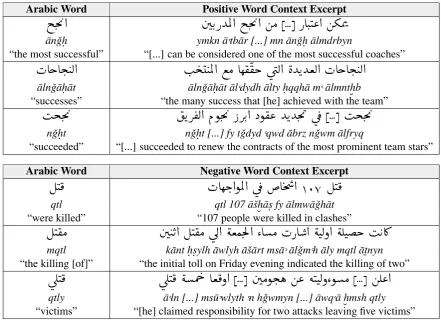
Two sets of sentiment-bearing words that are derived from the positive-sentiment root
h h.
à
(nun-jim-ha´, having to do with “success”) and the negative-sentiment rootÈ
H
(qaf-ta´-lam, hav-ing to do with “killhav-ing”), are shown in Table 2 (with their respective transliterations and transla-tions). Various derivations are shown in match-ing positive and negative contexts, where the root word is the same, and the meaning of the sentence, likewise, retains the same sentiment orientation.Because the task of sentiment analysis is not enclosed at the word-level, and because the sur-rounding words in a phrase may change the mean-ing of the phrase significantly as in the case of polarity incrementing or decrementing words (or even entirely, as in the case of negation words) a root-matching scheme on its own is not sufficient for consistently accurate sentiment classification. One common handling of such problems as nega-tions in English is to consider all words between the negation and the next clause-level punctuation mark as negative (Pang et al., 2002; Sanjiv and Chen, 2001). In an Arabic context, a more flexible free word-ordering makes such a method difficult to consistently match, so the task would require a more elaborate handling scheme. Still, the initial root-matching task can be used to enhance results as a building block for an automatic Arabic senti-ment analysis system.
3 Related Work
While there has been much work on sentiment analysis in English, few examples of work on the
Arabic Word Positive Word Context Excerpt
im.
'@
áK.PYÖÏ@ im.
'@ áÓ [...] PAJ
.
J«@ áºÖß
¯anˇgh. ymkn ¯a,tb¯ar [...] mn ¯anˇgh. ¯almdrbyn
“the most successful” “[...] can be considered one of the most successful coaches”
HAgAj.
JË@
I
.
j
JÖÏ@ ©Ó Aê
®
®k ú
æË@ èYKYªË@ HAgAj. JË@
¯alnˇg¯ah. ¯at ¯alnˇg¯ah. ¯at ¯al,dydh ¯alty h. qqh¯a m,¯almnth ˘b
“successes” “the many success that [he] achieved with the team”
Ijm.
'
KQ
®Ë@ Ðñm.
' PQK
. @ Xñ
®« YKYm.
' ú
¯ [...]
Ijm.
'
nˇgh. t nˇgh. t [...] fy tˇgdyd,qwd ¯abrz nˇgwm ¯alfryq
“succeeded” “[...] succeeded to renew the contracts of the most prominent team stars”
Arabic Word Negative Word Context Excerpt
ÉJ
¯
HAêk.@ñÖÏ@ ú
¯ A
m
@ 107 ÉJ¯
qtl qtl 107 ¯aˇsh
˘ ¯as. fy ¯almw¯aˇgh¯at
“were killed” “107 people were killed in clashes”
ÉJ
®Ó
á JK@ ÉJ®Ó ú
Í@
éªÒm.Ì'@ ZAÓ HPA @
éJËð@
éÊJk I
KA¿
mqtl k¯ant h. s.ylh ¯awlyh ¯aˇs¯art ms¯a-¯alˇgm,h ¯aly mqtl ¯at ¯nyn
“the killing [of]” “the initial toll on Friday evening indicated the killing of two”
ú
Î
J¯
ú
ÎJ¯ éÔ g Aª¯ð@ [...] áÓñj.ë á« éJJËðZñÓ [...] áÊ«@
qtly ¯a,ln [...] ms¯u-wlyth,n hˇgwmyn [...] ¯awq,¯a h
˘msh qtly
[image:3.595.76.518.410.730.2]“victims” “[he] claimed responsibility for two attacks leaving five victims”
task for morphologically complex language such as Arabic are available, and possibly even more rare are data sets and corpora suitable for work on Arabic sentiment classification tasks.
Pang et al. (2002) tackled the classic problem of positive and negative two-class sentiment classifi-cation of English movie reviews from the Internet Movie Database (IMDB) corpus, highlighting the effectiveness of machine-learning techniques for sentiment classification, and paving the way for further research to enhance the efficiency of such automatic classification systems. With respect to the varied levels of granularity used (term, phrase, sentence, and document) in the classification task, individual and process-oriented approaches have been addressed, where information acquired from one level of analysis can be passed on to the next level, as observed by Turney and Littman (2003) and Dave et al. (2003). At the sentence-level, the work of Kim and Hovy (2004) addresses the topic of detecting sentiment towards a specific topic.
For feature selection and optimization, Yu et Hatzivassiloglou (2003) use N-gram based fea-tures and a polarity lexicon at the sentence level to determine subjectivity of sentences on the Wall Street Journal (WSJ) corpus, while Bruce and Wiebe (1999) use the same corpus, but employ ad-ditional lexical, part-of-speech (POS), and struc-tural features. As a more profound paradigm shift, recent research has shifted from keyword and lexical-based approaches to concept-based sentiment analysis approaches, where semantic networks and entity ontologies are employed to achieve a more semantically-oriented “under-standing” of text (Cambria et al., 2013; Grassi et al., 2011; Olsher, 2012).
With respect to the task of Arabic subjectiv-ity and sentiment analysis in specific, the work of Abdul-Mageed et al. (2011) addresses the task in Modern Standard Arabic (MSA), where a manually-annotated corpus of MSA is presented from Part 1 v 3.0 of the Penn Arabic Tree-bank (PATB) (Maamouri et al., 2004), in addi-tion to a wide-scale polarity lexicon tailored to the newswire domain under analysis. By us-ing various stemmus-ing and lemmatization settus-ings with a rich feature-set under an SVM classifier, it is shown that taking language-specific morpho-logical features and traits into consideration for complex languages such as Arabic results in sig-nificant improvements in performance, achieving
test results of 71.54% F (16.44% higher than the baseline) for subjectivity detection, and 95.52% F (37.14% higher than the baseline) for the sen-timent analysis task using a newswire domain-specific lexicon, as compared to 57.84% F in de-velopment without the lexicon.
In the domain of positive and negative movie reviews, Rushdi-Saleh et al. (2011) present the Opinion Corpus for Arabic (OCA) movie review corpus, compiled from various Arabic web pages. Classification was performed using both Naive-Bayes and SVM classifiers, with combinations of N-grams, stemming, and stop-word removal pre-processing, and achieved a best result of 90% accuracy under SVM, as compared to a similar classification task in English with the Pang et al. (2002) IMDB corpus, which obtained 85.35% ac-curacy with various N-gram models.
Abbassi et al. (2008) explore the task of fea-ture selection for the opinion classification task, using an Entropy Weighted Genetic Algorithm (EWGA), which incorporates both syntactic and stylistic features and the information gain heuris-tic to classify text on the document level. An accu-racy of 93.6% is reported on a compiled Middle-Eastern web forum dataset. Other problems of sentiment analysis in informal and dialectical Ara-bic are also addressed by Albraheem and Al-Khalifa (2012) and Shoukry and Rafea (2012), for a more specific approach to the classification prob-lem, tailored to a regional, social-media setting.
As compared to the discussed work on the sen-timent analysis task in Arabic, the proposed root-based technique employes the commonalities be-tween words of the same root to map sets of words to the same base meaning. Rather than taking a domain-specific approach to the problem, the pro-posed technique is tested on two corpora from very different domains: the PATB newswire corpus an-notated by Abdul-mageed et al. (2011), and the OCA movie review corpus by Rushdi-Saled et al. (2011), with focus on language characteristics to enhance classification results.
4 Proposed Algorithm
4.1 Datasets
The proposed sentiment classification method was conducted on two different datasets, to test the root-based approach on a generic level, uncon-strained by the domain of the data itself.
4.1.1 Penn Arabic Treebank (PATB Part 1 v 4.1) Newswire Corpus
The first corpus used pertains to the tokenized newswire-domain text from the latest version of the PATB, Part 1 v 4.1 (Maamouri et al., 2010). The corpus consists of 734 newswire stories from the Agence France Presse (AFP) with various tags attached to each token, including part-of-speech information, morphology, English gloss, treebank annotation, and vocalization.
For the purposes of the sentiment analysis task, the applied section of the dataset comes from the compiled corpus of Abdul-Mageed et al. (2011), where the first 2855 sentences (comprising 54.5% of the Part 1 v 3.0 dataset1, in 400 documents) were each manually annotated into one of four labels (Abdul-Mageed and Diab, 2011): objec-tive (OBJ), subjecobjec-tive posiobjec-tive (S-POS), subjec-tive negasubjec-tive NEG), and subjecsubjec-tive neutral (S-NEUT), depending on whether the information be-ing conveyed in the sentence was to objectively inform, or offer a subjective sense (Wiebe et al., 1999). The number of sentences with each of the four respective tags are shown in Table 3.
Tag Class Number of Sentences
OBJ 1281
S-POS 491
S-NEG 689
[image:5.595.95.265.495.565.2]S-NEUT 394
Table 3: Distribution of Sentiment Classes in the Manually-Tagged Portion of the PATB Corpus
(Abdul-Mageed et al., 2011).
4.1.2 Opinion Corpus for Arabic (OCA) Movie Review Corpus
For another perspective for testing the proposed root-based method, the distinctly subjective OCA corpus (Rushdi-Saleh et al., 2011) was also ex-perimented with. The corpus is comprised of
1
The differences between the two versions of the PATB Part 1 lie in improvements to the organization of the data, and updates to certain aspects of the annotation (Maamouri et al., 2010).
500 movie reviews (250 positive and 250 nega-tive) which were collected from 15 Arabic web pages, after which a series of spelling correction, tokenization, basic stop-word and special charac-ter removal, and stemming processes were per-formed. In addition, normalization of the rating schemes used for each site was conducted to ap-propriately partition the reviews into positive and negative categories, and prepare the text for the classification task (Rushdi-Saleh et al., 2011).
4.2 Rooting Libraries
Three different rooting libraries were applied to derive the roots of each of the input words in the classification examples, each applying a slightly different approach to the complex Arabic rooting problem.
4.2.1 Khoja Arabic Stemmer
The Khoja Arabic Stemmer (Khoja and Garside, 1999) is a fast Arabic stemmer that works by re-moving the longest prefix and suffix present in the input word and then matching the rest of the word with known verb and noun patterns using a root li-brary. The stemmer attempts to take into account the unavoidable irregularities in the language in order to extract the correct root from words that do not follow the general rules. The Khoja stem-mer has been used in various Arabic natural lan-guage processing tasks, and has been noted to pro-duce good improvements to various natural lan-guage tasks, despite many tagging errors (Larkey and Connell, 2001).
4.2.2 Information Science Research Institute (ISRI) Arabic Stemmer
The Information Science Research Institute’s (ISRI) stemmer (Taghva et al., 2005) uses a simi-lar approach to word rooting as the Khoja stem-mer, but does not employ a root dictionary for lookup. Additionally, if a word cannot be rooted, the ISRI stemmer normalizes the word and returns a normalized form (for example, removing certain determinants and end patterns) instead of leaving the word unchanged. The ISRI stemmer has been shown to give good improvements to language tasks such as document clustering, as opposed to a non-stemmed approach (Bsoul and Mohd, 2011).
4.2.3 Tashaphyne Light Arabic Stemmer
preparation for the “search and index” tasks re-quired for stemming, including removing diacrit-ics and elongation from input words. Next, seg-mentation and stemming of the input is performed using a default Arabic affix lookup list, allowing for various levels of stemming and rooting (Tasha-phyne, 2010).
4.3 Experimental Setup
Two different sets of experiments were conducted to test the effect of the root-based method for the sentiment analysis task, varying somewhat for the different corpora under analysis.
For the PATB corpus, only the subjective data was taken into consideration for the two-class pos-itive and negative sentiment classification problem (the 1180 sentences in total: 491 S-POS and 689 S-NEG sentences). The task was conducted at the sentence-level, with 5-fold cross-validation splits across the dataset (Abdul-Mageed et al., 2011).
For the OCA corpus, with already-defined opin-ions in the form of movie reviews, the entire dataset was used for classification. The task was conducted at the document-level (with each docu-ment composed of sets of sentences, ranging from an average of 13 sentences in the positive review sets, and 20 sentences in the negative reviews), with 10-fold cross-validation splits (Rushdi-Saleh et al., 2011).
Each of the corpora was tested using the basic words as features to the classifier, then by itera-tively adding roots using each of the three root-ing libraries. After experimentation with param-eters, the classification task was performed using a linear kernel (Abdul-Mageed et al., 2011) un-der the SVMlightclassifier (Joachims, 2008). Pre-cision and recall values are reported for the aver-age of the K-fold runs (5 folds for the first corpus, and 10 folds for the second), along with F-measure (F1) and accuracy results for each respective ex-periment.
4.4 Pre-processing
As pre-processing to prepare the text for the clas-sification and analysis tasks, the already undi-acritized corpus sentences were tokenized from the set of documents into word sets, and test-ing with stop-word removal (the removal of com-monly used words) was done to filter out words that could be unnecessary for the task of opinion classification.
4.5 Feature Sets
For each document, the basic unigrams (individ-ual words) composing the document were used as initial input features to the SVM, after which the three rooting libraries (Khoja, ISRI, and Tasha-phyne) were then iteratively used to derive the roots of each of the input word features. Finally, the resultant roots were then added as additional features (along with the unigrams) to each of the examples. Binary presence vectors were used to indicate the existence of a feature (Abdul-Mageed et al., 2011). For the purposes of exploring the ef-fect of adding the root-based features, only inde-pendent unigrams and unigrams with roots were experimented with for the basic evaluation task.
5 Results and Evaluation
The results of the sentiment analysis tasks on the two datasets are illustrated in Table 4 for the PATB corpus, and Table 5 for the OCA corpus, detail-ing the task statistics. The basic results usdetail-ing a standard unigram feature (the encountered word itself) are depicted initially, along with abaseline
result (in F-measure and accuracy, as available for the two datasets, respectively) without the use of root features, as presented by previous work with the datasets (Abdul-Mageed et al., 2011; Rushdi-Saleh et al., 2011).
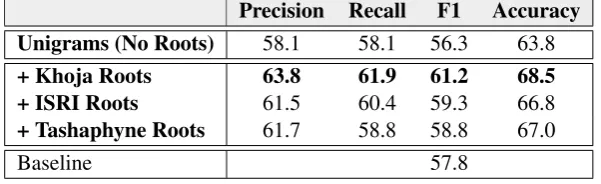
With respect to the sentiment analysis task on the PATB newswire-domain corpus shown in Ta-ble 4, all three of the individual rooting libraries resulted in improvements to the initial unigram results. The largest observable improvement to all measures reported came from the Khoja stem-mer, with a 4.9% increase in F-measure, and a 4.7% increase in accuracy as compared to the un-igram result. Also, a 3.4% increase in F-measure is observed from the sentiment baseline of 57.8% (previously achieved on the dataset using various morphological features, without a domain-specific lexicon (Abdul-Mageed et al., 2011)).
For the OCA movie-domain corpus shown in Table 5, slight improvements can be seen by adding root features to the unigram classifier in-put, particularly with the Tashaphyne rooting li-brary. An increase of 3.2% accuracy after the addi-tion of root features is observed from the baseline accuracy of 90.0% (Rushdi-Saleh et al., 2011).
im-Precision Recall F1 Accuracy Unigrams (No Roots) 58.1 58.1 56.3 63.8
+ Khoja Roots 63.8 61.9 61.2 68.5 + ISRI Roots 61.5 60.4 59.3 66.8
+ Tashaphyne Roots 61.7 58.8 58.8 67.0
[image:7.595.148.449.72.164.2]Baseline 57.8
Table 4: PATB Sentiment Classification Results for the Proposed Method under Three Rooting Libraries. (Baseline: Abdul-Mageed et al. (2011))
Precision Recall F1 Accuracy Unigrams (No Roots) 90.0 95.2 92.8 92.6
+ Khoja Roots 90.7 94.4 92.3 92.2
+ ISRI Roots 90.5 95.6 92.8 92.6
+ Tashaphyne Roots 91.1 96.0 93.4 93.2
[image:7.595.147.451.222.315.2]Baseline 90.0
Table 5: OCA Sentiment Classification Results for the Proposed Method under Three Rooting Libraries. (Baseline: Rushdi-Saled et al. (2011))
portance: the nature of the words in the dataset under analysis, and the efficiency of the stemming systems themselves. The divergence in the most effective rooting library on each of the corpora can be attributed to various factors, including the style of writing used in the datasets, the formality of the text, and the existence of irregular words and words that cannot be rooted, depending on the ac-curacy and robustness of the employed stemming library.
The PATB news domain corpus, for example, is expected to have less opinion-bearing content than the OCA movie review corpus, due to the less sub-jective nature of the domain. The overall accuracy and F-measure results for the OCA movie corpus are thus significantly higher than those observed in the PATB corpus. Another difference between the corpora lies in the formality of the language em-ployed: while the PATB corpus uses a strict Mod-ern Standard Arabic (MSA), the use of slang and dialect-specific language is frequent in the OCA corpus. This type of varied language presents a layer of difficulty for sentiment classification in general, as well as for the rooting systems applied for language mapping.
Furthermore, with respect to the stemming tools themselves, the overall inaccuracy of current stem-mers is another important consideration. The best-performing stemming libraries, Khoja and
Tasha-phyne, for each of the two domains, are those that employ some form of root-lookup dictionary in order to verify the correctness of the affixes and resultant roots generated. Another consideration is the limitation imposed by employing only uni-grams enriched with the root features, while fea-tures beyond word level could be used to further predict sentiment patterns changes over a more complex language structure.
6 Conclusion
The composition scheme and complex morphol-ogy of Arabic make the task of root-extraction to normalize words to their basic functional units a very relevant one for various natural language processing tasks. With respect to the sentiment analysis tasks presented in this paper, some no-table improvements to the classification perfor-mance when using various rooting libraries as in-put features can be observed, warranting further research on enhancements to existent rooting tech-niques and handling of the intricacies of the Ara-bic language structure to predict more sentence forms and correctly classify their polarity.
interconnections between words with similar po-larity orientation to be created. Such valid in-terconnections between words also warrants the exploration of semantic expansion of words and their synonyms (Magdy et al., 2013), expanding the word map and serving to better connect and understand sentiment-bearing ideas and expressed opinions.
By applying various rooting schemes at differ-ent granularities in two separate domains, it is also shown that word roots can serve to enhance the sentiment analysis task results on a more generic level, instead of using a domain-specific approach that may not always be applicable. Thus, using root derivation techniques such as that presented for Arabic sentiment analysis in particular are ap-plicable and valid to help enhance the performance of natural language processing tasks on morpho-logically rich and complex languages.
References
A. Abbasi, H. Chen, and A. Salem. 2008. Sentiment analysis in multiple languages: feature selection for opinion classification in web forums. ACM Trans. Inf. Syst., 26(3):12:1–12:34, June.
M. Abdul-Mageed and M. Diab. 2011. Subjectivity and sentiment annotation of modern standard ara-bic newswire. In Proceedings of the 5th
Linguis-tic Annotation Workshop, LAW V ’11, pages 110–
118, Stroudsburg, PA, USA. Association for Com-putational Linguistics.
M. Abdul-Mageed, M. Diab, and M. Korayem. 2011. Subjectivity and sentiment analysis of modern stan-dard arabic. In Proceedings of the 49th Annual Meeting of the Association for Computational Lin-guistics: Human Language Technologies: short
pa-pers - Volume 2, HLT ’11, pages 587–591,
Strouds-burg, PA, USA. Association for Computational Lin-guistics.
L. Albraheem and H. Al-Khalifa. 2012. Exploring the problems of sentiment analysis in informal arabic. InProceedings of the 14th International Conference on Information Integration and Web-based
Applica-tions; Services, IIWAS ’12, pages 415–418, New
York, NY, USA. ACM.
R. Bruce and J. Wiebe. 1999. Recognizing subjectiv-ity: a case study in manual tagging. Nat. Lang. Eng., 5(2):187–205, June.
Q. Bsoul and M. Mohd. 2011. Effect of isri stemming on similarity measure for arabic document cluster-ing. In Information Retrieval Technology, volume 7097 ofLecture Notes in Computer Science, pages 584–593. Springer Berlin Heidelberg.
E. Cambria, B. Schuller, Y. Xia, and C. Havasi. 2013. New avenues in opinion mining and sentiment anal-ysis.Intelligent Systems, IEEE, 28(2):15–21.
K. Dave, S. Lawrence, and D. Pennock. 2003. Mining the peanut gallery: opinion extraction and seman-tic classification of product reviews. InProceedings of the 12th international conference on World Wide Web, WWW ’03, pages 519–528, New York, NY, USA. ACM.
M. Grassi, E. Cambria, A. Hussain, and F. Piazza. 2011. Sentic web: A new paradigm for managing social media affective information. Cognitive Com-putation, 3(3):480–489.
N. Habash. 2008. Introduction to Arabic Natural Lan-guage Processing. Synthesis lectures on human lan-guage technologies. Morgan & Claypool Publishers.
T. Joachims. 2008. Svmlight: Support vector machine, http://svmlight.joachims.org/.
S. Khoja and R. Garside. 1999. Stemming arabic text (tech. rep.). Computer Department, Lancaster Uni-versity, Lancaster.
S. Kim and E. Hovy. 2004. Determining the senti-ment of opinions. InProceedings of the 20th
inter-national conference on Computational Linguistics,
COLING ’04, Stroudsburg, PA, USA. Association for Computational Linguistics.
L. Larkey and M. Connell. 2001. Arabic information retrieval at umass in trec-10. University of Mas-sachusetts.
B. Liu. 2012.Sentiment Analysis and Opinion Mining. Morgan & Claypool Publishers.
M. Maamouri, A. Bies, and W. Mekki. 2004. The penn arabic treebank: building a large-scale anno-tated arabic corpus. pages 102–109.
M. Maamouri, A. Bies, S. Kulick, F. Gaddeche, W. Mekki, S. Krouna, B. Bouziri, and W. Za-ghouani. 2010. Arabic treebank: Part 1 v 4.1.
A. Magdy, M. Kholief, and Y. El-Sonbaty. 2013. Qasim: Arabic language question answer selection in machines. Conference and Labs of the Evalua-tion Forum.
D. Olsher. 2012. Full spectrum opinion mining: inte-grating domain, syntactic and lexical knowledge. In
Data Mining Workshops (ICDMW), 2012 IEEE 12th International Conference on, pages 693–700.
B. Pang, L. Lee, and S. Vaithyanathan. 2002. Thumbs up?: sentiment classification using machine learn-ing techniques. InProceedings of the ACL-02 con-ference on empirical methods in natural language
processing - Volume 10, EMNLP ’02, pages 79–86,
M. Rushdi-Saleh, M. Martin-Valdivia, L. Urena-Lopez, and J. Perea-Ortega. 2011. Oca: Opinion corpus for arabic. J. Am. Soc. Inf. Sci. Technol., 62(10):2045– 2054, October.
K. Ryding. 2006. A Reference Grammar of Modern
Standard Arabic. Reference Grammars. Cambridge
University Press, New York.
D. Sanjiv and M. Chen. 2001. Yahoo! for
ama-zon: extraction market sentiment from stock mes-sage boards. InProceedings of the 8th Asia Pacific
Finance Association Annual Conference.
A. Shoukry and A. Rafea. 2012. Sentence-level arabic sentiment analysis. InCollaboration Technologies and Systems (CTS), 2012 International Conference on, pages 546–550.
StudyQuran. 2004. Project root list online. 2004. http://www.studyquran.co.uk/prlonline.htm.
K. Taghva, R. Elkhoury, and J. Coombs. 2005. Ara-bic stemming without a root dictionary. In Proceed-ings of the International Conference on Information Technology: Coding and Computing (ITCC’05)
-Volume I - -Volume 01, ITCC ’05, pages 152–157,
Washington, DC, USA. IEEE Computer Society.
Tashaphyne. 2010. Arabic light stemmer, 0.2. 2010. http://tashaphyne.sourceforge.net/.
P. Turney and M. Littman. 2003. Measuring praise and criticism: Inference of semantic orientation from as-sociation. ACM Trans. Inf. Syst., 21(4):315–346, October.
J. Wiebe, R. Bruce, and T. O’Hara. 1999. Develop-ment and use of a gold-standard data set for subjec-tivity classifications. InProceedings of the 37th an-nual meeting of the Association for Computational Linguistics on Computational Linguistics, ACL ’99, pages 246–253, Stroudsburg, PA, USA. Association for Computational Linguistics.