Understanding and Improving Morphological Learning
in the Neural Machine Translation Decoder
Fahim Dalvi Nadir Durrani Hassan Sajjad Yonatan Belinkov∗ Stephan Vogel
Qatar Computing Research Institute – HBKU, Doha, Qatar
{faimaduddin, ndurrani, hsajjad, svogel}@qf.org.qa
∗MIT Computer Science and Artificial Intelligence Laboratory, Cambridge, MA 02139, USA
Abstract
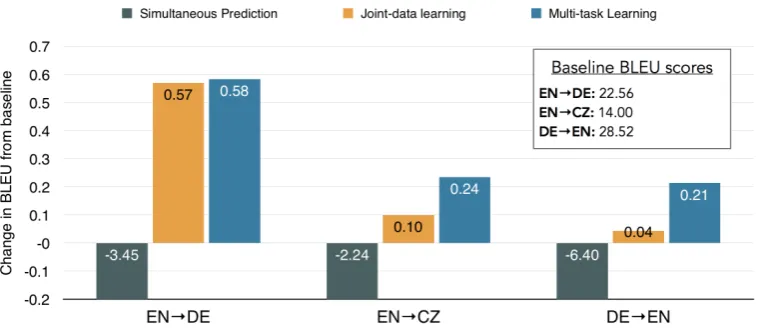
End-to-end training makes the neural ma-chine translation (NMT) architecture sim-pler, yet elegant compared to traditional statistical machine translation (SMT). However, little is known about linguis-tic patterns of morphology, syntax and semantics learned during the training of NMT systems, and more importantly, which parts of the architecture are re-sponsible for learning each of these phe-nomena. In this paper we i) analyze how much morphology an NMT decoder learns, and ii) investigate whether inject-ing target morphology into the decoder helps it produce better translations. To this end we present three methods: i) joint generation, ii) joint-data learning, and iii) multi-task learning. Our results show that explicit morphological information helps the decoder learn target language mor-phology and improves the translation qual-ity by 0.2–0.6 BLEU points.
1 Introduction
Neural machine translation (NMT) offers an el-egant end-to-end architecture, improving transla-tion quality compared to traditransla-tional phrase-based machine translation. These improvements are at-tributed to more fluent output (Toral and S´anchez-Cartagena, 2017) and better handling of mor-phology and long-range dependencies (Bentivogli et al.,2016). However, systematic studies are re-quired to understand what kinds of linguistic phe-nomena (morphology, syntax, semantics, etc.) are learned by these models and more importantly, which of the components is responsible for each phenomenon.
A few attempts have been made to understand
what NMT models learn about morphology ( Be-linkov et al., 2017a), syntax (Shi et al., 2016) and semantics (Belinkov et al.,2017b). Shi et al. (2016) used activations at various layers from the NMT encoder to predict syntactic properties on the source-side, whileBelinkov et al.(2017a) and Belinkov et al.(2017b) used a similar approach to investigate the quality of word representations on the task of morphological and semantic tagging.
Belinkov et al. (2017a) found that word rep-resentations learned from the encoder are rich in morphological information, while representations learned from the decoder are significantly poorer. However, the paper does not present a convincing explanation for this finding. Our first contribution in this work is to provide a more comprehensive analysis of morphological learning on the decoder side. We hypothesize that other components of the NMT architecture – specifically the encoder and the attention mechanism, learn enough informa-tion about the target language morphology for the decoder to perform reasonably well, without in-corporating high levels of morphological knowl-edge into the decoder. To probe this hypothesis, we investigate the following questions:
• What is the effect of attention on the perfor-mance of the decoder?
• How much does the encoder help the decoder in predicting the correct morphological vari-ant of the word it generates?
To answer these questions, we train NMT mod-els for different language pairs, involving mor-phologically rich languages such as German and Czech. We then use the trained models to ex-tract features from the decoder for words in the language of interest. Finally we train a classifier using the extracted features to predict the morpho-logical tag of the words. The accuracy of this
ternal classifier gives us a quantitative measure of how well the NMT model learned features that are relevant to morphology. Our results indicate that both the encoder and the attention mechanism aid the decoder in generating correct morphological forms, and thus limit the need of the decoder to learn target morphology.
Motivated by these findings, we hypothesize that it may be possible to force the decoder to learn more about morphology by injecting the morpho-logical information during training which can in turn improve the overall translation quality. In order to test this hypothesis, we experiment with three possible solutions:
1. Joint Generation: An NMT model is trained on the concatenation of words and morpho-logical tags on the target side.
2. Joint-data learning: An NMT model is trained where each source sequence is used twice with an artificial token to either predict target words or morphological tags.
3. Multi-task learning: A multi-task NMT sys-tem with two objective functions is trained to jointly learn translation and morphological tagging.
Our experiments show that word representations learned after explicitly injecting target morphol-ogy improve morphological tagging accuracy of the decoder by 3% and also improves the trans-lation quality by up to 0.6 BLEU points.
The remainder of this paper is organized as fol-lows. Section2describes our experimental setup. Section3shows an analysis of the decoder. Sec-tion4describes the three proposed methods to in-tegrate morphology into the decoder. Section 5 presents the results. Section 6 gives an account of related work and Section7concludes the paper.
2 Experimental Design Parallel Data
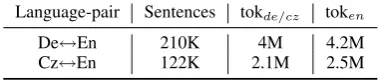
We used the German-English and Czech-English datasets from the WIT3 TED corpus (Cettolo, 2016) made available for IWSLT 2016. We used the official training sets to analyze and evaluate the proposed methods for integrating morphology . The corpus also provides four test sets, test-11 through test-14. We used test-11 for tuning, and the other test sets for evaluation. The statistics for the sets are provided in Table1.
Language-pair Sentences tokde/cz token
De↔En 210K 4M 4.2M
[image:2.595.321.511.65.105.2]Cz↔En 122K 2.1M 2.5M
Table 1: Statistics for the data used for training, tuning and testing
Morphological Annotations
In order to train and evaluate the external classifier on the extracted features, we required data anno-tated with morphological tags. We used the fol-lowing tools recommended on the Moses website1 to annotate the data: LoPar (Schmid, 2000) for German, Tree-tagger (Schmid, 1994) for Czech and MXPOST (Ratnaparkhi, 1998) for English. The number of tags produced by these taggers is 214 for German and 368 for Czech.
Data preprocessing
We used the standard MT pre-processing pipeline of tokenizing and truecasing the data using Moses (Koehn et al., 2007) scripts. We did not apply byte-pair encoding (BPE) (Sennrich et al.,2016b), which has recently become a common part of the NMT pipeline, because both our analysis and the annotation tools are word level.2 However, ex-perimenting with BPE and other representations such as character-based models (Kim et al.,2015) would be interesting.3
NMT Systems
We used the seq2seq-attn implementation (Kim, 2016) with the following default settings: word embeddings and LSTM states with 500 di-mensions, SGD with an initial learning rate of1.0
and decay rate of 0.5 (after the 9th epoch), and dropout rate of 0.3. We use two uni-directional hidden layers for both the encoder and the decoder. 1These have been used frequently to annotate data in the previous evaluation campaigns (Birch et al., 2014;Durrani et al.,2014a).
2The difficulty with using these is that it is not straight-forward to derive word representations out of a decoder that processes BPE-ed text, because the original words are split into subwords. We considered aggregating the representa-tions of BPE subword units, but the choice of aggregation strategy may have an undesired impact on the analysis. For this reason we decided to leave exploration of BPE for future work.
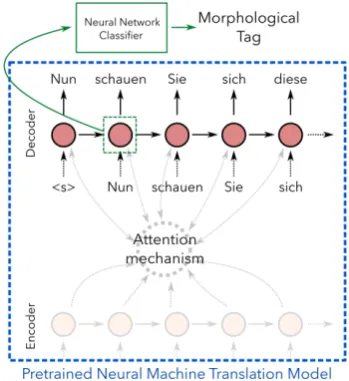
Figure 1: Features for the word Nun(DECt1) are
extracted from the decoder of a pre-trained NMT system and provided to the classifier for training
The NMT system is trained for 13 epochs, and the model with the best validation loss is used for ex-tracting features for the external classifier. We use a vocabulary size of 50000 on both the source and target side.
Classifier Settings
For the classification task, we used a feed-forward network with one hidden layer, dropout (ρ= 0.5), a ReLU non-linearity, and an output layer map-ping to the tag set (followed by a Softmax). The size of the hidden layer is set to be identical to the size of the NMT decoder’s hidden state (500 di-mensions). The classifier has no explicit access to context other than the hidden representation gener-ated by the NMT system, which allows us to focus on the quality of the representation. We use Adam (Kingma and Ba,2014) with default parameters to minimize the cross-entropy objective.
3 Decoder Analysis 3.1 Methodology
We follow a process similar to Shi et al. (2016) andBelinkov et al. (2017a) to analyze the NMT systems but with a focus on the decoder compo-nent of the architecture. Formally, given a source sentence s = {s1, s2, ..., sN} and a target
sen-tencet={t1, t2, ..., tM}, we first use the encoder
(Equation 1) to compute a set of hidden states h = {h1, h2, ..., hN}. We then use an attention
mechanism (Bahdanau et al., 2014) to compute a
weighted average of these hidden states from the previous decoder state (di−1), known as the con-text vectorci(Equation2). The context vector is a
real valued vector ofkdimensions, which is set to be the same as the hidden states in our case. The attention model computes a weight whi for each hidden state of the encoder, thus giving soft align-ment for each target word. The context vector is then used by the decoder (Equation 3) to generate the next word in the target sequence:
ENC:s={s1, ..., sN} 7→h={h1, ..., hN} (1)
ATTNi:h, di−1, ti−17→ci∈Rk(1≤i≤M) (2)
DEC:{c1, ..., cM} 7→t={t1, t2, ..., tM} (3) After training the NMT system, we freeze the pa-rameters of the network and use the encoder or the decoder as a feature extractor to generate vectors representing words in the sentence. LetENCsi de-note the representation of a source word si. We
use ENCsi to train the external classifier that for predicting the morphological tag forsiand
evalu-ate the quality of the representation based on our ability to train a good classifier. For word repre-sentations on the target side, we feed our word of interest ti as the previously predicted word, and
extract the representation DECti from the higher layers (See Figure1for illustration).
Note that in the decoder, the target word rep-resentations DECti are not learned for predicting the wordti, but the next word (ti+1). Hence, it is arguable thatDECti actually captures morpholog-ical information about ti+1 rather than ti, which
can also explain the poorer decoder accuracies. To test this argument, we also trained our systems as-suming that DECti encodes morphological infor-mation about the next word ti+1. In this case, the decoder performance dropped by almost 15%.
DECti probably encodes morphological informa-tion about both the current word (ti) and the next
word (ti+1). However, we leave this exploration for future work, and work with the assumption that
DECti encodes information about wordti. 3.2 Analysis
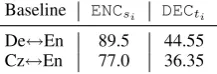
Baseline ENCsi DECti
[image:4.595.128.237.66.103.2]De↔En 89.5 44.55 Cz↔En 77.0 36.35
Table 2: Comparison of morphological accuracy for the encoder and decoder representations
En→De/En→Cz models to extract decoder rep-resentations. We then feed these representations to our classifier to predict morphological tags for German and Czech words. Table 2 shows that German and Czech representations learned on the encoder-side (using the De→En/Cz→En models) give much better accuracy compared to the ones learned on the decoder-side (using the En→De/En→Cz models).
Given this difference in performance between the two components in our NMT system, we ana-lyze the decoder further in various settings: com-paring the performance i) with and without the attention mechanism, and ii) augmenting the de-coder representation with the representation of the most attended source word. The baseline NMT models were trained with an attention mechanism. In an attempt to probe what effect the attention mechanism has on the decoder’s performance in the context of learning target language morphol-ogy, we trained NMT models without attention. Next we tried to take our baseline model (with at-tention) and augment its decoder representations with the encoder hidden state corresponding to the maximum attention (hereby denoted asENCti). Our hypothesis is that since the decoder focuses on this hidden state to output the next target word, it may also encode some useful information about target morphology. Lastly, we also train a classi-fier onENCti alone in order to compare the ability of the encoder and decoder in learningtarget lan-guage morphology.
Table3summarizes the results of these experi-ments. Comparing systems with (DECti) and with-out attention (w/o-ATTN), we see that the ac-curacy on the morphological tagging task goes up when no attention is used. This can be ex-plained by the fact that in the case of no attention, the decoder only receives a single context vector from the encoder and it has to learn more infor-mation about each target word to make accurate predictions. It is difficult for the encoder to trans-fer information about each target word using the same context vector cleanly, causing the decoder
DECti w/o-ATTN DECti+ENCti ENCti
En→De 44.55 50.26 60.34 43.43
En→Cz 36.35 42.09 48.64 36.36
Table 3: Morphological Tagging accuracy of the Decoder with and without attention, and effect of considering the most attended source word (ENCti)
to learn more, resulting in better decoder perfor-mance in regards to the morphological information learned.
The second part of the table presents results in-volving encoder representations to aid morpholog-ical analysis of target words. There is a signif-icant boost in the classifier’s performance when the decoder representation for a target word ti
is concatenated with the encoder representation of the most attended source word (DECti+ENCti). This hints towards several hypotheses: i) because the source and target words are translations, they share some morphological properties (e.g. nouns get translated to nouns, etc.), ii) the encoder also learns and stores information about the target lan-guage, so that the attention mechanism can make use of this information while deciding which word to focus on next. To ensure that the encoder and decoder indeed learn different information, we also tried to classify the morphological tag of a given wordti based on the encoder representation
of the most attended source word alone (ENCti). We see a drop in accuracy, showing that both en-coder and deen-coder learned different things about the same target word and are complementary rep-resentations. We can also see that the accuracy of the combined representation (DECti+ENCti) still lags behind the encoder’s performance in predict-ing source morphology (Table2). This indicates that there is still room for improvement in the NMT model’s ability to learn target side morphol-ogy.
In this section, we showed that the encoder and decoder learn different amounts of morphology due to the varying nature of their tasks within NMT architecture. The decoder depends on the encoder and attention mechanism to generate the correct morphological variant of a target word.
4 Morphology-aware Decoder
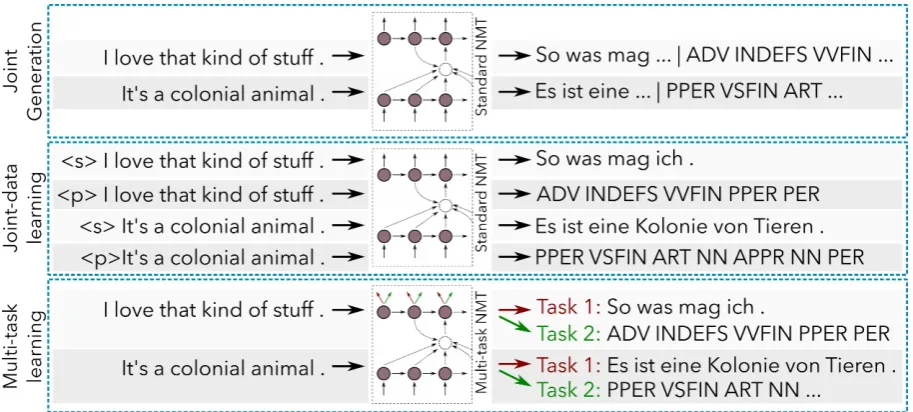
Figure 2: Various approaches to inject morphological knowledge into the decoder
encoder (Table2) and the overall system does not learn as much about target morphology as source morphology, we investigated three ways to di-rectly inject target morphology into the decoder, namely: i) Joint Generation, ii) Joint-data Learn-ing, iii) Multi-task Learning. Figure2 illustrates the approaches.
4.1 Joint Generation
As our first approach, we considered a solution that uses the standard NMT architecture, but is trained on a modified dataset. To incorporate morphological information, we modify the target sentence by appending the morphological tag se-quence to it. The NMT system trained on this data learns to produce both words and morpho-logical tags simultaneously. Formally, given a source sentences= {s1, ..., sN}, target sentence
t = {t1, ..., tM}and its morphological sequence
m ={m1, ..., mM}, we train an NMT system on
(s0, t0)pairs, where s0 = sandt0 = t+m. Al-though this model is quite weak and the (word and morphological) bases are quite far away, we posit that the attention mechanism might be able to at-tend to the same source word twice. Given this, the decoder gets a similar representation from which it has to predict a word in the first instance, and a tag in the second - thus helping in common learning for the two tasks.
4.2 Joint-data Learning
Given the drawbacks of the first approach, we considered another data augmentation technique
inspired by multilingual NMT systems (Johnson et al., 2016). Instead of having multiple source and target languages, we used one source language and two target language variations. The training data consists of sequences of source→target words and source→target morphological tags. We added an artificial token in the beginning of each source sentence indicating whether we want to generate target words or morphological tags. Using an ar-tificial token in the source sentence has been ex-plored and shown to work well to control the style of the target language (Sennrich et al.,2016a). The objective function is the same as the one in usual sequence-to-sequence models, and is hence shared to minimize both morphological and translation error given the mixed data.
4.3 Multi-task Learning
Figure 3: Improvements from adding morphology. A y-value of zero represents the baseline
ers have their own separate loss function. While training, we combine the losses from both output layers to jointly train the system. This is different from the Joint-data learning technique, where we predict entire sequences of words or tags without any dependence on each other.
Formally, given a set of N tasks, sequence-to-sequence multi-task learning involves an objec-tive function minimizing the overall loss, which is a weighted combination of the N individual task losses. In our scenario, the training corpus consisted of a multi-target corpus: source→target words and source→target morphological tags, i.e N = 2. Hence, given a set of training exam-ples D = {hs(n), t(n), m(n)i}N
n=1, wheresis the source sentence,tis the target sentence andmis the target morphological tag sequence, the new ob-jective function to maximize is as follows:
L=(1−λ)XN
n=1
logP(t(n)|s(n);θ)
+λ
N
X
n=1
logP(m(n)|s(n);θ)
Whereλis a hyper-parameter used to shift focus towards translation or the morphological tagging.6 5 Results and Discussion
Our results show that the multi-task learning proach performed the best among the three ap-proaches, while the Joint Generation method has the poorest performance. Figure3summarizes the results for different language pairs. The joint gen-eration method degrades overall translation per-formance, as expected, given its weakness from
6We tuned the weight parameter on held-out data.
a modeling perspective. It is possible that even though the attention mechanism is able to focus on the source sequence in two passes, the parts of the network that predict words and tags are not tightly coupled enough to learn from each other.
The BLEU scores improved when using the other two methods. We achieved an improvement of up to 0.6 BLEU points and 3% (in tagging accu-racy). The best improvements were obtained in the En→De direction, while we observed lesser gains in the De→En. This is perhaps because English is morphologically poorer, and the baseline system was able to learn the required amount of morpho-logical information from the text itself. Improve-ments were also obtained for the En→Cz direc-tion, although not as much as in German. This could be due to data sparsity: Czech is much richer in morphology,7 and the available TED En↔Cz data was40%less than the En↔De data.
Joint-data vs. Multi-task Learning
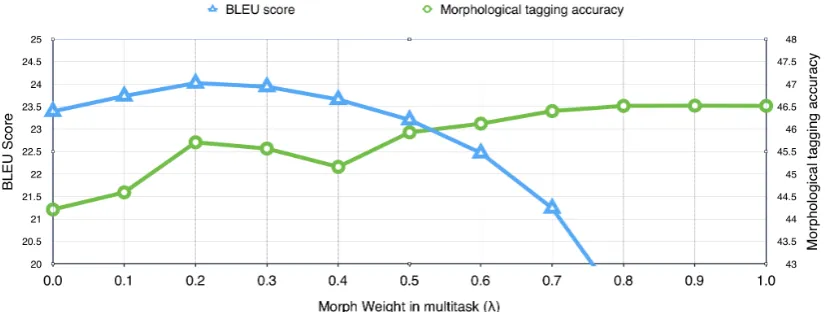
Figure 4: Multi-task learning: Translation vs. Morphological Tagging weight for En→De model
be handy if the morphological information quality is not very high. On the flip side, this additional explicit weight adjustment can also be viewed as a potential constraint that is not present in the joint-data learning approach.
Multi-task Weight Hyper-Parameter
As discussed, the multi-task learning approach has an additional weight hyper-parameter λ that ad-justs the balance between word and tag prediction. Figure 4 shows the result of varying λ from no morphological information (λ = 0) to only mor-phological information (λ = 1) on test-11 set. The left y-axis presents the BLEU score and the right y-axis presents the morphological accuracy. The best morphological accuracy is achieved at λ = 1 which does not correspond to best trans-lation quality since at that point the model is only minimizing the tag objective function. Similarly at λ= 0, the model falls back to the baseline model with a single objective function minimizing trans-lation error. For all language pairs, we consistently achieved the best BLEU score atλ= 0.2. The pa-rameter was tuned on a separate held out develop-ment set (test-11), and the results shown in Figure 3are on blind test sets (test-12,13). Averages are reported in the figure.
6 Related Work
The related work to this paper can be broken into two groups:
Analysis Several approaches have been devised to analyze MT models and the linguistic properties that are learned during training. A common ap-proach has been to use activations from a trained model to train an external classifier to predict some
this information to generate the actual target word. Dong et al.(2015) presented multi-task learning to translate a language into multiple target languages, andLuong et al.(2015) did experiments involving several levels of source and target language infor-mation. There have been previous efforts to in-tegrate morphology into MT systems by learning factored models (Koehn and Hoang,2007;Durrani et al.,2014b) over POS and morphological tags.
7 Conclusion
In this paper we analyzed and investigated ways to improve morphological learning in the NMT de-coder. We carried a series of experiments to un-derstand why the decoder learns considerably less morphology than the encoder in the NMT archi-tecture. We found that the decoder needs assis-tance from the encoder and the attention mecha-nism to generate correct target morphology. Ad-ditionally we explored three ways to explicitly inject morphology in the decoder: joint genera-tion, joint-data learning, and multi-task learning. We found multi-task learning to outperform the other two methods. The simpler joint-data learn-ing method also gave decent improvements. The code for the experiments and the modified frame-work is available at https://github.com/
fdalvi/seq2seq-attn-multitask.
References
Yossi Adi, Einat Kermany, Yonatan Belinkov, Ofer Lavi, and Yoav Goldberg. 2016. Fine-grained Anal-ysis of Sentence Embeddings Using Auxiliary Pre-diction Tasks.arXiv preprint arXiv:1608.04207.
Roee Aharoni and Yoav Goldberg. 2017. Towards String-To-Tree Neural Machine Translation. In Pro-ceedings of the 55th Annual Meeting of the Associa-tion for ComputaAssocia-tional Linguistics (Volume 2: Short Papers), pages 132–140. Association for Computa-tional Linguistics.
Dzmitry Bahdanau, Kyunghyun Cho, and Yoshua Ben-gio. 2014. Neural Machine Translation by Jointly Learning to Align and Translate. arXiv preprint arXiv:1409.0473.
Yonatan Belinkov, Nadir Durrani, Fahim Dalvi, Hassan Sajjad, and James Glass. 2017a. What do Neural Machine Translation Models Learn about Morphol-ogy? InProceedings of the 55th Annual Meeting of the Association for Computational Linguistics (Vol-ume 1: Long Papers), pages 861–872. Association for Computational Linguistics.
Yonatan Belinkov and James Glass. 2016. Large-Scale Machine Translation between Arabic and Hebrew: Available Corpora and Initial Results. In Proceed-ings of the Workshop on Semitic Machine Trans-lation, pages 7–12, Austin, Texas. Association for Computational Linguistics.
Yonatan Belinkov, Lluis Marquez, Hassan Sajjad, Nadir Durrani, Fahim Dalvi, and James Glass. 2017b. Evaluating layers of representation in neural machine translation on parts-of-speech and semantic tagging task. InProceedings of the 8th International Joint Conference on Natural Language Processing (Volume 1: Long Papers), Taipei, Taiwan. Associa-tion for ComputaAssocia-tional Linguistics.
Luisa Bentivogli, Arianna Bisazza, Mauro Cettolo, and Marcello Federico. 2016. Neural versus Phrase-Based Machine Translation Quality: a Case Study. In Proceedings of the 2016 Conference on Empiri-cal Methods in Natural Language Processing, pages 257–267, Austin, Texas. Association for Computa-tional Linguistics.
Alexandra Birch, Matthias Huck, Nadir Durrani, Niko-lay Bogoychev, and Philipp Koehn. 2014. Ed-inburgh SLT and MT system description for the IWSLT 2014 evaluation. InProceedings of the 11th International Workshop on Spoken Language Trans-lation, IWSLT ’14, Lake Tahoe, CA, USA.
Mauro Cettolo. 2016. An Arabic-Hebrew parallel cor-pus of TED talks. In Proceedings of the AMTA Workshop on Semitic Machine Translation (SeMaT), Austin, US-TX.
Ronan Collobert and Jason Weston. 2008. A unified architecture for natural language processing: Deep neural networks with multitask learning. In Pro-ceedings of the 25th International Conference on Machine Learning, ICML ’08, pages 160–167, New York, NY, USA. ACM.
Marta R. Costa-juss`a and Jos´e A. R. Fonollosa. 2016.
Character-based Neural Machine Translation. In
Proceedings of the 54th Annual Meeting of the As-sociation for Computational Linguistics (Volume 2: Short Papers), pages 357–361, Berlin, Germany. As-sociation for Computational Linguistics.
Daxiang Dong, Hua Wu, Wei He, Dianhai Yu, and Haifeng Wang. 2015. Multi-Task Learning for Mul-tiple Language Translation. InACL (1).
Nadir Durrani, Barry Haddow, Philipp Koehn, and Kenneth Heafield. 2014a. Edinburgh’s phrase-based machine translation systems for WMT-14. In Pro-ceedings of the ACL 2014 Ninth Workshop on Sta-tistical Machine Translation, pages 97–104, Balti-more, MD, USA.
Technical Papers, pages 421–432, Dublin, Ireland. Dublin City University and Association for Compu-tational Linguistics.
Nadir Durrani, Hassan Sajjad, Alexander Fraser, and Helmut Schmid. 2010. Hindi-to-Urdu Machine Translation through Transliteration. In Proceed-ings of the 48th Annual Meeting of the Association for Computational Linguistics, pages 465–474, Up-psala, Sweden. Association for Computational Lin-guistics.
Akiko Eriguchi, Yoshimasa Tsuruoka, and Kyunghyun Cho. 2017. Learning to parse and translate improves neural machine translation. InProceedings of the 55th Annual Meeting of the Association for Compu-tational Linguistics (Volume 2: Short Papers), pages 72–78. Association for Computational Linguistics. Mercedes Garc´ıa-Mart´ınez, Lo¨ıc Barrault, and Fethi
Bougares. 2016. Factored neural machine transla-tion.CoRR, abs/1609.04621.
Melvin Johnson, Mike Schuster, Quoc V. Le, Maxim Krikun, Yonghui Wu, Zhifeng Chen, Nikhil Tho-rat, Fernanda B. Vi´egas, Martin Wattenberg, Greg Corrado, Macduff Hughes, and Jeffrey Dean. 2016.
Google’s multilingual neural machine translation system: Enabling zero-shot translation. CoRR, abs/1611.04558.
Yoon Kim. 2016. Seq2seq-attn. https:// github.com/harvardnlp/seq2seq-attn. Yoon Kim, Yacine Jernite, David Sontag, and Alexan-der M Rush. 2015. Character-aware Neural Lan-guage Models. arXiv preprint arXiv:1508.06615. Diederik Kingma and Jimmy Ba. 2014. Adam: A
Method for Stochastic Optimization. arXiv preprint arXiv:1412.6980.
Philipp Koehn and Hieu Hoang. 2007.Factored Trans-lation Models. In Proceedings of the 2007 Joint Conference on Empirical Methods in Natural guage Processing and Computational Natural Lan-guage Learning (EMNLP-CoNLL), pages 868–876, Prague, Czech Republic. Association for Computa-tional Linguistics.
Philipp Koehn, Hieu Hoang, Alexandra Birch, Chris Callison-Burch, Marcello Federico, Nicola Bertoldi, Brooke Cowan, Wade Shen, Christine Moran, Richard Zens, Chris Dyer, Ondrej Bojar, Alexandra Constantin, and Evan Herbst. 2007. Moses: Open source toolkit for statistical machine translation. In
Proceedings of the Association for Computational Linguistics (ACL’07), Prague, Czech Republic. Arne K¨ohn. 2015. What’s in an Embedding?
Analyz-ing Word EmbeddAnalyz-ings through MultilAnalyz-ingual Evalu-ation. In Proceedings of the 2015 Conference on Empirical Methods in Natural Language Process-ing, pages 2067–2073, Lisbon, Portugal. Associa-tion for ComputaAssocia-tional Linguistics.
Minh-Thang Luong, Quoc V. Le, Ilya Sutskever, Oriol Vinyals, and Lukasz Kaiser. 2015. Multi-task sequence to sequence learning. CoRR, abs/1511.06114.
Minh-Thang Luong, Preslav Nakov, and Min-Yen Kan. 2010. A Hybrid Morpheme-Word Representation for Machine Translation of Morphologically Rich Languages. InProceedings of the 2010 Conference on Empirical Methods in Natural Language Pro-cessing, pages 148–157. Association for Computa-tional Linguistics.
Maria Nadejde, Siva Reddy, Rico Sennrich, Tomasz Dwojak, Marcin Junczys-Dowmunt, Philipp Koehn, and Alexandra Birch. 2017. Syntax-aware neu-ral machine translation using CCG. CoRR, abs/1702.01147.
Peng Qian, Xipeng Qiu, and Xuanjing Huang. 2016a.
Analyzing Linguistic Knowledge in Sequential Model of Sentence. InProceedings of the 2016 Con-ference on Empirical Methods in Natural Language Processing, pages 826–835, Austin, Texas. Associa-tion for ComputaAssocia-tional Linguistics.
Peng Qian, Xipeng Qiu, and Xuanjing Huang. 2016b.
Investigating Language Universal and Specific Prop-erties in Word Embeddings. InProceedings of the 54th Annual Meeting of the Association for Compu-tational Linguistics (Volume 1: Long Papers), pages 1478–1488, Berlin, Germany. Association for Com-putational Linguistics.
Adwait Ratnaparkhi. 1998. Maximum Entropy Models for Natural Language Ambiguity Resolution. Ph.D. thesis, University of Pennsylvania, Philadelphia, PA. Hassan Sajjad, Kareem Darwish, and Yonatan Be-linkov. 2013. Translating Dialectal Arabic to En-glish. InProceedings of the 51st Conference of the Association for Computational Linguistics (ACL). Helmut Schmid. 1994. Part-of-Speech Tagging with
Neural Networks. InProceedings of the 15th Inter-national Conference on Computational Linguistics (Coling 1994), pages 172–176, Kyoto, Japan. Col-ing 1994 OrganizCol-ing Committee.
Helmut Schmid. 2000. LoPar: Design and Imple-mentation. Bericht des Sonderforschungsbereiches “Sprachtheoretische Grundlagen fr die Computerlin-guistik” 149, Institute for Computational Linguis-tics, University of Stuttgart.
Rico Sennrich and Barry Haddow. 2016. Linguistic input features improve neural machine translation. InProceedings of the First Conference on Machine Translation, pages 83–91, Berlin, Germany. Associ-ation for ComputAssoci-ational Linguistics.
Human Language Technologies, San Diego, Califor-nia.
Rico Sennrich, Barry Haddow, and Alexandra Birch. 2016b. Neural Machine Translation of Rare Words with Subword Units. InProceedings of the 54th An-nual Meeting of the Association for Computational Linguistics (Volume 1: Long Papers), pages 1715– 1725, Berlin, Germany. Association for Computa-tional Linguistics.
Xing Shi, Inkit Padhi, and Kevin Knight. 2016. Does String-Based Neural MT Learn Source Syntax? In
Proceedings of the 2016 Conference on Empirical Methods in Natural Language Processing, pages 1526–1534, Austin, Texas. Association for Compu-tational Linguistics.