A Case Study on Cloud Based Hybrid Adaptive Mobile
Streaming: Performance Evaluation
T. Mahesh kumar
1Student member of IEEE Department of
[email protected],[email protected]
Abstract: Nowadays Cloud multimedia services Provide
very useful in the present trend. In the present world Mobile phones and Hand held devices are very popular. The limited bandwidth available for mobile streaming is a disadvantage so for this reaso
efficient Cloud Service On the server side, whenever the mobile devices request a video file, first the base layer of the video file will be accessed and Than after the enhancement layers will be accessed while str
(Hybrid adaptive Mobile Streaming) method is proposed which is a new scalable video codec method. Now finally this method gives a better solution for mobile devices without freezing the video file and simultaneously Providing better video Quality compared to the existing systems.
Keywords—Hybrid Adaptive Mobile Streaming, Cloud Service, Adaptive Streaming, Video Freeze.
1. INTRODUCTION
1.1 Cloud Computing:
Cloud computing is the emerging technology with growing internet services. Nowadays Cloud
can be utilized by using smart phones and smart books. Cloud computing is the delivery of computing as a service rather than a product. Cloud computing used for sharing resources to achieve coherence and economies of scale, similar to a over a
The cloud also focuses on maxi effectiveness of the shared resources. Cloud
are usually not only shared by multiple users but are useful for dynamically realloScated per demand. This is used for allocating resources to users
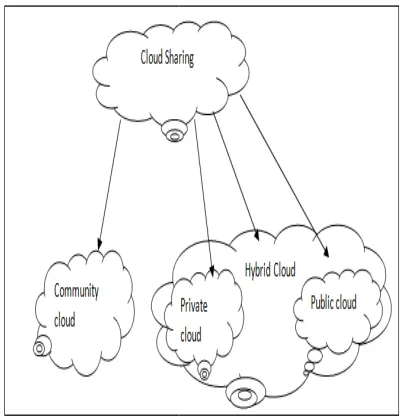
mainly three types of clouds those are: Private Clou Public Cloud, Hybrid Cloud [4]. Private cloud is cloud infrastructure operated solely for a single organization and it was managed internally by a third party, and it will be hosted either
externally. And various services provided by cloud are IAAS, PASS, SAAS.
A Case Study on Cloud Based Hybrid Adaptive Mobile
Streaming: Performance Evaluation
1
, Dr. k. Santhisree
2, M. Bharat
3, V. Pruthvi Chaithanya Varshu
member of IEEE, M. tech1 , Professor of CSE2, M. Tech3, M. Department of Computer science and engineering.1, 2,3,4
Jawaharlal Nehru Technological University. Hyderabad, India.
,[email protected],[email protected],[email protected]
Nowadays Cloud multimedia services Provide tremendous data processing methods, and these services are very useful in the present trend. In the present world Mobile phones and Hand held devices are very popular. The limited bandwidth available for mobile streaming is a disadvantage so for this reason a new method is proposed with help of efficient Cloud Service On the server side, whenever the mobile devices request a video file, first the base layer of the video file will be accessed and Than after the enhancement layers will be accessed while str
(Hybrid adaptive Mobile Streaming) method is proposed which is a new scalable video codec method. Now finally this method gives a better solution for mobile devices without freezing the video file and simultaneously Providing better
ideo Quality compared to the existing systems.
Hybrid Adaptive Mobile Streaming, Cloud Service, Adaptive Streaming, Video Freeze.
Cloud computing is the emerging technology with growing internet services. Nowadays Cloud services can be utilized by using smart phones and smart books. Cloud computing is the delivery of computing Cloud computing is resources to achieve coherence and economies of scale, similar to a over a network [1]. The cloud also focuses on maximizing the effectiveness of the shared resources. Cloud services are usually not only shared by multiple users but are cated per demand. This allocating resources to users. There are mainly three types of clouds those are: Private Cloud, ]. Private cloud is olely for a single managed internally by a
third-hosted either internally or externally. And various services provided by cloud
Fig. 1. Cloud Computing Types
1.2 Streaming Media:
Streaming media is multimedia that is constantly received by and presented to an end
delivered by a provider
delivering media in this manner; the term refers to the delivery method of the medium
medium itself [5]. Types of streaming media are Live Streaming, Video Streaming Live Streaming refers to content delivered live,
media, an encoder is used
72
A Case Study on Cloud Based Hybrid Adaptive Mobile
Streaming: Performance Evaluation
, V. Pruthvi Chaithanya Varshu
4, M. Tech4
tremendous data processing methods, and these services are very useful in the present trend. In the present world Mobile phones and Hand held devices are very popular. The limited n a new method is proposed with help of efficient Cloud Service On the server side, whenever the mobile devices request a video file, first the base layer of the video file will be accessed and Than after the enhancement layers will be accessed while streaming. Now here HAMS (Hybrid adaptive Mobile Streaming) method is proposed which is a new scalable video codec method. Now finally this method gives a better solution for mobile devices without freezing the video file and simultaneously Providing better
Hybrid Adaptive Mobile Streaming, Cloud Service, Adaptive Streaming, Video Freeze.
Fig. 1. Cloud Computing Types
International Journal of Research in Advent
media publisher and content delivery network used to distribute and deliver the content.
In streaming video and audio, the traveling information is a stream of data
decoder is a stand-alone player or a plugin that works as part of the Web browser. Server and
stream and decoder work together to let people watch live or prerecorded broadcasts. Most streaming videos don't fill the whole screen on a computer. It was in a smaller frame or window.
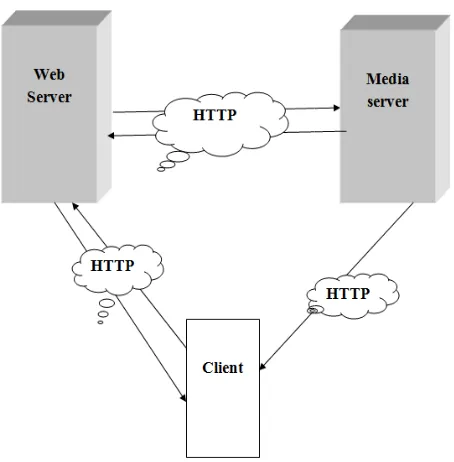
Fig 2. Streaming Meia server
1.3 Scalable Video Coding:
The H.264/AVC (Advanced Video Coding) has been used for the encoding process in the DASH(Dynamic adaptive Streaming over HTTP) solution. This encoding scheme usually introduces significant amount of content redundancy across different quality levels, requiring a large size of storage [2
this redundancy, the SVC based adaptiv
has been proposed [3]. In the SVC encoding scheme, each video Clip is encoded into one base layer and several enhancement layers. The base layer is mandatory for playback of the video chunk whereas the enhancement layers are optional. the lowest quality layer, is always requested first. Therefore, the SVC based adaptive streaming is able to keep the buffer occupancy level very stable.
1.4 Progressive Download and Adaptive Streaming:
On the basis of HTTP Video technologies are categorized in to two one is progressive download and
International Journal of Research in Advent Technology, Vol.2, Issue.8, August 2014
E-ISSN: 2321-9637
content delivery network are to distribute and deliver the content.
In streaming video and audio, the traveling information is a stream of data of server. The a plugin that works as part of the Web browser. Server and information stream and decoder work together to let people watch e or prerecorded broadcasts. Most streaming videos screen on a computer. It was play
Fig 2. Streaming Meia server
The H.264/AVC (Advanced Video Coding) has been encoding process in the DASH(Dynamic adaptive Streaming over HTTP) solution. This encoding scheme usually introduces significant amount of content redundancy across different quality ring a large size of storage [2]. To remove the SVC based adaptive streaming ]. In the SVC encoding scheme, each video Clip is encoded into one base layer and several enhancement layers. The base layer is mandatory for playback of the video chunk whereas re optional. the lowest quality layer, is always requested first. Therefore, the SVC based adaptive streaming is able to keep the
Progressive Download and Adaptive Streaming:
On the basis of HTTP Video technologies are categorized in to two one is progressive download and
another one is Adaptive Streaming by using HTTP online content Providers provides the video services.
Users will play the downloaded video without download the full video this technique is Progressive download it already available in many websites. The disadvantage is that users should preset the video quality. If the user request for a video if the available in the web server is having high bandwidth then th user get the problem. The mismatch between the user selection video and available video in the web server so this disadvantage is overcome by the DASH (Dynamic Adaptive Streaming over HTTP).
2.PROPOSED WORK
Case Study: Performance Evaluation
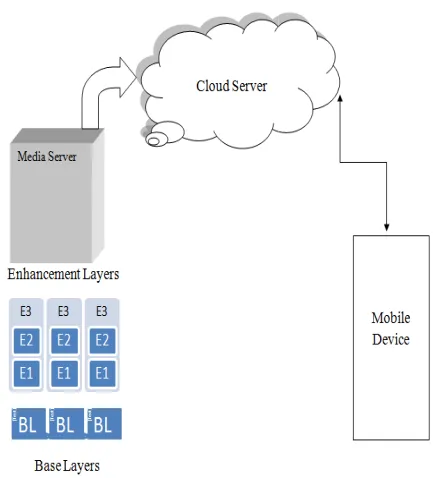
In this work we are presenting the effective video streaming through two processes one is Progressive Download Mode and second is Hybrid Mode through Cloud based Streaming. HAMS Starts with the stores on the server for streaming operation.
Fig 3. Mobile Streaming In Hybrid Mode
This base file is progressively downloaded and stored on the secondary storage device. The download can be done independently. There is no need to send request message for all video clips. Here in this hybrid mode the users
request for the enhancement Layers simultaneously. In the above figure we observe that the mobile
Technology, Vol.2, Issue.8, August 2014
73 another one is Adaptive Streaming by using HTTP online content Providers provides the video services.
Users will play the downloaded video without the full video this technique is Progressive download it already available in many websites. The disadvantage is that users should preset the video quality. If the user request for a video if the available in the web server is having high bandwidth then the user get the problem. The mismatch between the user selection video and available video in the web server so this disadvantage is overcome by the DASH (Dynamic Adaptive Streaming over HTTP).
PROPOSED WORK
Case Study: Performance Evaluation
In this work we are presenting the effective video streaming through two processes one is Progressive Download Mode and second is Hybrid Mode through Cloud based Streaming. HAMS Starts with the stores on the server for streaming operation.
device gets the base layer video clips in the clip there is processing of downloading enhancement layers and it adds to the streaming buffer so there is no freezing can be done in this process. So this concept clearly tells about it prevents video freeze and provide better video quality, rather then the existing non hybrid Technologies.
The proposed system has the following modules:
• Hybrid adaptive Mobile Streaming through
Service.
• Operation of Hybrid adaptive Mobile Streaming.
• Video Quality Performance.
• Average Quality of Video.
Fig 4. Cloud Based Mobile Streaming in Hybrid Mode
(1). Hybrid adaptive Mobile Streaming through Cloud Service:
The experiment through Cloud service is as shown in following figure.4 four mobile devices requesting for the service through the cloud. Here all the mobile clip there is processing of downloading enhancement layers and it adds to the streaming buffer so there is ne in this process. So this concept clearly tells about it prevents video freeze and provide better video quality, rather then the existing non hybrid Technologies.
The proposed system has the following modules:
Hybrid adaptive Mobile Streaming through Cloud
Operation of Hybrid adaptive Mobile Streaming.
Fig 4. Cloud Based Mobile Streaming in Hybrid Mode
Hybrid adaptive Mobile Streaming through Cloud
The experiment through Cloud service is as shown in following figure.4 four mobile devices requesting for the service through the cloud. Here all the mobile devices are requesting for the same video service
available in media server. In this schema the vid content was accessed by the Joint Scalable Video Mode, it is an open source based SVC encoder.
And there are four quality Layers are generated in seconds and the total number video clips are 128 and the total play back time is 256
(2) Operation of Hybrid Adaptive
To examine the operation of HAMS the difference between the requested bitrate by the Client with target bitrate is performed as follows. HAMS starts with the Progressive download mode and stays until video clip 40 in this area the availabl
not enough to activate the HAMS mode. SVC DASH experiences video freezing at video clips 10 to 30 here the reason is that the SVC is not able to download more than the available Buffer size. HAMs downloads the base layered Video clips as many as possible in the progressive download mode. After a certain period the HAMS switches to Hybrid mode. At this point HAMS performs only adaptive streaming for the remaining enhancement layers here we found out there is no video freezing. It shows that it provides a better video quality after the peak value as 40.
(3). Video Quality Performance:
TABLE. 1: Total number of Freezes
The video Performance for the following Four Clients As shown in the Table. Here the performance
74 available in media server. In this schema the video content was accessed by the Joint Scalable Video Mode, it is an open source based SVC encoder.
And there are four quality Layers are generated in seconds and the total number video clips are 128 and the total play back time is 256 seconds.
Operation of Hybrid Adaptive Mobile Streaming
To examine the operation of HAMS the difference between the requested bitrate by the Client with target bitrate is performed as follows. HAMS starts with the Progressive download mode and stays until video clip 40 in this area the available bandwidth is not enough to activate the HAMS mode. SVC-DASH experiences video freezing at video clips 10 to 30 here the reason is that the SVC is not able to download more than the available Buffer size. HAMs downloads the base layered Video clips as ny as possible in the progressive download mode. After a certain period the HAMS switches to Hybrid mode. At this point HAMS performs only adaptive streaming for the remaining enhancement layers here we found out there is no video freezing. It shows that t provides a better video quality after the peak value
Video Quality Performance:
: Total number of Freezes
International Journal of Research in Advent
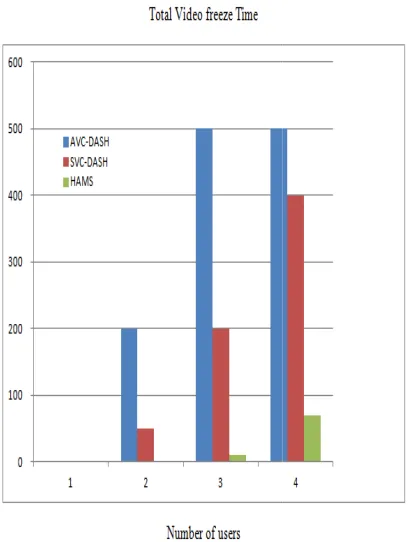
metric is video Freeze, which is related to the user experience with streaming. From the table we can conclude that AVC and SVC shows poor Performance in terms of the number of video freezes according to the increasing the number of clients.
Here the total number of video freezes was about and the number of users was 4. From this experiment we observe that SVC is better than the AVC
SVC can play the video as long as the base layer is downloaded. HAMS achieves zero video freezes up to three users in this efficiently download the base layers through progressive download mode. Here there are 4 number of clients also the freezes was 2 only.
Fig.5 Total number of video freezes with time
Fig.5 shows the total number of video freezes according to time. Depending upon the network condition the duration of the video freeze is different. If the video freeze time will increase it will take long time to download the next video clip. It is observed that the total video freeze time for AVC is 48 seconds and for svc is also 48 seconds respectively. Entirely HAMS downloads the base layers efficiently to avoid the video freeze. Whereas HAMS has short freeze time when compared SVC it is about 3 seconds.
(4). Average Quality of Video.
International Journal of Research in Advent Technology, Vol.2, Issue.8, August 2014
E-ISSN: 2321-9637
metric is video Freeze, which is related to the user experience with streaming. From the table we can conclude that AVC and SVC shows poor Performance in terms of the number of video freezes according to the increasing the number of clients.
al number of video freezes was about 48 4. From this experiment we observe that SVC is better than the AVC-DASH. SVC can play the video as long as the base layer is downloaded. HAMS achieves zero video freezes up to in this efficiently download the base layers through progressive download mode. Here there are 4 number of clients also the freezes was 2 only.
Fig.5 Total number of video freezes with time
Fig.5 shows the total number of video freezes time. Depending upon the network condition the duration of the video freeze is different. If the video freeze time will increase it will take long time to download the next video clip. It is observed that the total video freeze time for AVC is 48 seconds and for svc is also 48 seconds respectively. Entirely HAMS downloads the base layers efficiently to avoid the video freeze. Whereas HAMS has short freeze time when compared SVC it is about 3 seconds.
Fig.6 Average video qu
In this graph we measure the average requested bitrate according to the HAMS as shown in the following figure. HAMS performs better average video quality rather than the existing adaptive streaming quality. Adding with more number of clients also it observed that HAMS is similar to that of SVC and better than the AVC
HAMS perform the better video quality effectively avoiding video freeze.
3. CONCLUSION
Finally this paper Proposes New Cloud based Hybrid Adaptive Mobile Streaming for efficient Video streaming in mobile devices according to SVC based video streaming first the base layer is requested by the clients and after enhancement layers are optional. Whereas HAMS performs progressive Download for the base layer and after performs adaptive streaming for the enhanced layers. Entirely through video quality experiment it is conformed that HAMS performs Better video quality rather than the existing unhybrid technologies without freezing video.
REFERENCES
[1] "The NIST Definit
National Institute of Standards and Technology. Retrieved 24 July 2011.
Technology, Vol.2, Issue.8, August 2014
75 Fig.6 Average video quality
In this graph we measure the average requested bitrate according to the HAMS as shown in the following figure. HAMS performs better average video quality rather than the existing adaptive streaming quality. Adding with more number of clients also it is observed that HAMS is similar to that of SVC-DASH and better than the AVC-DASH. Ultimately the the better video quality effectively
Finally this paper Proposes New Cloud based Hybrid Streaming for efficient Video streaming in mobile devices according to SVC based video streaming first the base layer is requested by the clients and after enhancement layers are optional. Whereas HAMS performs progressive Download for fter performs adaptive streaming for the enhanced layers. Entirely through video quality experiment it is conformed that HAMS performs Better video quality rather than the existing unhybrid technologies without freezing video.
76
[2] R. Huysegems, B. De Vleeschauwer, T. Wu, and
W. Van Leekwijck, “SVC-based HTTP adaptive
streaming,” Bell Labs Technical Journal,
vol.16(4), pp.(25-41), Mar. 2012.
[3] Y. Sánchez de la Fuente, T. Schierl, C. Hellge, T. Wiegand, D. Hong, D. De Vleeschauwer, W. Van Leekwijck, and Y. Le Louédec, “iDASH: Improved dynamic adaptive streaming over HTTP using scalable video coding,” in Proc. ACM Multimedia Systems Conference, San Jose, pp.(257-264), 2011,USA.
[4] “Cloud and Computing Technology”
http://cloudandcompute.com/private
cloud/privatecloudmor”Security”.Secure/CloudA ndCompute.com..http://www.informationweek.co m/private-clouds-take-shape.
[5] http://computer.howstuffworks.com/internet/basi