An Evaluation Exercise for Word Alignment
Rada Mihalcea
Department of Computer Science
University of North Texas
Denton, TX 76203
[email protected]
Ted Pedersen
Department of Computer Science
University of Minnesota
Duluth, MN 55812
[email protected]
Abstract
This paper presents the task definition, re-sources, participating systems, and compara-tive results for the shared task on word align-ment, which was organized as part of the HLT/NAACL 2003 Workshop on Building and Using Parallel Texts. The shared task in-cluded Romanian-English and English-French sub-tasks, and drew the participation of seven teams from around the world.
1
Defining a Word Alignment Shared Task
The task of word alignment consists of finding correspon-dences between words and phrases in parallel texts. As-suming a sentence aligned bilingual corpus in languages L1 and L2, the task of a word alignment system is to indi-cate which word token in the corpus of language L1 cor-responds to which word token in the corpus of language L2.
As part of the HLT/NAACL 2003 workshop on ”Build-ing and Us”Build-ing Parallel Texts: Data Driven Machine Translation and Beyond”, we organized a shared task on word alignment, where participating teams were provided with training and test data, consisting of sentence aligned parallel texts, and were asked to provide automatically derived word alignments for all the words in the test set. Data for two language pairs were provided: (1) English-French, representing languages with rich resources (20 million word parallel texts), and (2) Romanian-English, representing languages with scarce resources (1 million word parallel texts). Similar with the Machine Transla-tion evaluaTransla-tion exercise organized by NIST1, two sub-tasks were defined, with teams being encouraged to par-ticipate in both subtasks.
1
http://www.nist.gov/speech/tests/mt/
1. Limited resources, where systems are allowed to use
only the resources provided.
2. Unlimited resources, where systems are allowed to use any resources in addition to those provided. Such resources had to be explicitly mentioned in the system description.
Test data were released one week prior to the deadline for result submissions. Participating teams were asked to produce word alignments, following a common format as specified below, and submit their output by a certain deadline. Results were returned to each team within three days of submission.
1.1 Word Alignment Output Format
The word alignment result files had to include one line for each word-to-word alignment. Additionally, lines in the result files had to follow the format specified in Fig.1. While the and confidence fields overlap in their
meaning, the intent of having both fields available is to enable participating teams to draw their own line on what they consider to be a Sure or Probable alignment. Both these fields were optional, with some standard values as-signed by default.
1.1.1 A Running Word Alignment Example
Consider the following two aligned sentences: [English]s snum=18They had gone ./s
[French]s snum=18Ils etaient alles ./s
A correct word alignment for this sentence is 18 1 1
18 2 2 18 3 3 18 4 4
sentence no position L1 position L2 [ËÈ] [confidence]
where:
Æsentence no represents the id of the sentence within the
test file. Sentences in the test data already have an id as-signed. (see the examples below)
Æposition L1 represents the position of the token that is
aligned from the text in language L1; the first token in each sentence is token 1. (not 0)
Æposition L2 represents the position of the token that is
aligned from the text in language L2; again, the first token is token 1.
ÆËÈ can be either S or P, representing a Sure or Probable
alignment. All alignments that are tagged as S are also con-sidered to be part of the P alignments set (that is, all align-ments that are considered ”Sure” alignalign-ments are also part of the ”Probable” alignments set). If theËÈfield is missing, a
value of S will be assumed by default.
Æconfidence is a real number, in the range (0-1] (1 meaning
highly confident, 0 meaning not confident); this field is op-tional, and by default confidence number of 1 was assumed.
Figure 1: Word Alignment file format
aligned (English token 4 aligned with French token 4), and counts towards the final evaluation figures.
Alternatively, systems could also provide an
marker and/or a confidence score, as shown in the fol-lowing example:
18 1 1 1 18 2 2 P 0.7 18 3 3 S 18 4 4 S 1
with missing fields considered by default to be S,
and missing confidence scores considered by default 1.
1.2 Annotation Guide for Word Alignments
The annotation guide and illustrative word alignment ex-amples were mostly drawn from the Blinker Annotation Project. Please refer to (Melamed, 1999, pp. 169–182) for additional details.
1. All items separated by a white space are considered to be a word (or token), and therefore have to be aligned. (punctuation included)
2. Omissions in translation use the NULL token, i.e. token with id 0. For instance, in the examples below:
[English]:s snum=18And he said , appoint me
thy wages , and I will give it ./s
[French]:s snum=18fixe moi ton salaire , et je
te le donnerai ./s
and he said from the English sentence has no
cor-responding translation in French, and therefore all these words are aligned with the token id 0.
... 18 1 0 18 2 0 18 3 0 18 4 0 ...
3. Phrasal correspondences produce multiple word-to-word alignments. For instance, in the examples be-low:
English:s snum=18cultiver la terre/s
French:s snum=18to be a husbandman/s
since the words do not correspond one to one, and yet the two phrases mean the same thing in the given context, the phrases should be linked as wholes, by linking each word in one to each word in another. For the example above, this translates into 12 word-to-word alignments:
18 1 1 18 1 2
18 1 3 18 1 4
18 2 1 18 2 2
18 2 3 18 2 4
18 3 1 18 3 2
18 3 3 18 3 4
2
Resources
The shared task included two different language pairs: the alignment of words in English-French parallel texts, and in Romanian-English parallel texts. For each lan-guage pair, training data were provided to participants. Systems relying only on these resources were considered part of the Limited Resources subtask. Systems making use of any additional resources (e.g. bilingual dictionar-ies, additional parallel corpora, and others) were classi-fied under the Unlimited Resources category.
2.1 Training Data
Two sets of training data were made available.
1. A set of Romanian-English parallel texts, consist-ing of about 1 million Romanian words, and about the same number of English words. These data con-sisted of:
Parallel texts collected from the Web using a
alignment was also performed. These data col-lection process resulted in a corpus of about 850,000 Romanian words, and about 900,000 English words.
Orwell’s 1984, aligned within the
MULTEXT-EAST project (Erjavec et al., 1997), with about 130,000 Romanian words, and a similar num-ber of English words.
The Romanian Constitution, for about 13,000
Romanian words and 13,000 English words.
2. A set of English-French parallel texts, consisting of about 20 million English words, and about the same number of French words. This is a subset of the Canadian Hansards, processed and sentence aligned by Ulrich Germann at ISI (Germann, 2001).
All data were pre-tokenized. For English and French, we used a version of the tokenizers provided within the EGYPT Toolkit2. For Romanian, we used our own tok-enizer. Identical tokenization procedures were used for training, trial, and test data.
2.2 Trial Data
Two sets of trial data were made available at the same time training data became available. Trial sets consisted of sentence aligned texts, provided together with man-ually determined word alignments. The main purpose of these data was to enable participants to better under-stand the format required for the word alignment result files. Trial sets consisted of 37 English-French, and 17 Romanian-English aligned sentences.
2.3 Test Data
A total of 447 English-French aligned sentences (Och and Ney, 2000), and 248 Romanian-English aligned sen-tences were released one week prior to the deadline. Par-ticipants were required to run their word alignment sys-tems on these two sets, and submit word alignments. Teams were allowed to submit an unlimited number of results sets for each language pair.
2.3.1 Gold Standard Word Aligned Data
The gold standard for the two language pair alignments were produced using slightly different alignment proce-dures, which allowed us to study different schemes for producing gold standards for word aligned data.
For English-French, annotators where instructed to as-sign a Sure or Probable tag to each word alignment they produced. The intersection of the Sure alignments pro-duced by the two annotators led to the final Sure aligned set, while the reunion of the Probable alignments led to the final Probable aligned set. The Sure alignment set is
2
http://www.clsp.jhu.edu/ws99/projects/mt/toolkit/
guaranteed to be a subset of the Probable alignment set. The annotators did not produce any NULL alignments. Instead, we assigned NULL alignments as a default back-up mechanism, which forced each word to belong to at least one alignment. The English-French aligned data were produced by Franz Och and Hermann Ney (Och and Ney, 2000).
For Romanian-English, annotators were instructed to assign an alignment to all words, with specific instruc-tions as to when to assign a NULL alignment. Annota-tors were not asked to assign a Sure or Probable label. Instead, we had an arbitration phase, where a third anno-tator judged the cases where the first two annoanno-tators dis-agreed. Since an inter-annotator agreement was reached for all word alignments, the final resulting alignments were considered to be Sure alignments.
3
Evaluation Measures
Evaluations were performed with respect to four differ-ent measures. Three of them – precision, recall, and F-measure – represent traditional F-measures in Information Retrieval, and were also frequently used in previous word alignment literature. The fourth measure was originally introduced by (Och and Ney, 2000), and proposes the no-tion of quality of word alignment.
Given an alignment, and a gold standard alignment
, each such alignment set eventually consisting of two
sets Ë,
È, and
Ë,
È corresponding to Sure and
Probable alignments, the following measures are defined (whereis the alignment type, and can be set to either S
or P). Ì Ì Ì Ì (1) Ì Ì Ì Ì (2) Ì Ì Ì Ì Ì (3) È Ë È È È Ë (4)
Each word alignment submission was evaluated in terms of the above measures. Moreover, we conducted two sets of evaluations for each submission:
NULL-Align, where each word was enforced to
long to at least one alignment; if a word did not be-long to any alignment, a NULL Probable alignment was assigned by default. This set of evaluations per-tains to full coverage word alignments.
NO-NULL-Align, where all NULL alignments were
Team System name Description
Language Technologies Institute, CMU BiBr (Zhao and Vogel, 2003)
MITRE Corporation Fourday (Henderson, 2003)
RALI - Universit´e the Montr´eal Ralign (Simard and Langlais, 2003)
Romanian Academy Institute of Artificial Intelligence RACAI (Tufis¸ et al., 2003)
University of Alberta ProAlign (Lin and Cherry, 2003)
University of Minnesota, Duluth UMD (Thomson McInnes and Pedersen, 2003)
[image:4.612.76.540.71.171.2]Xerox Research Centre Europe XRCE (Dejean et al., 2003)
Table 1: Teams participating in the word alignment shared task
We conducted therefore 14 evaluations for each submission file: AER, Sure/Probable Precision, Sure/Probable Recall, and Sure/Probable F-measure, with a different figure determined for NULL-Align and NO-NULL-Align alignments.
4
Participating Systems
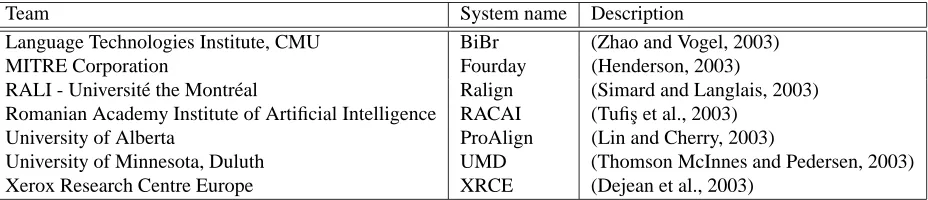
Seven teams from around the world participated in the word alignment shared task. Table 1 lists the names of the participating systems, the corresponding institutions, and references to papers in this volume that provide de-tailed descriptions of the systems and additional analysis of their results.
All seven teams participated in the Romanian-English subtask, and five teams participated in the English-French subtask.3 There were no restrictions placed on the
num-ber of submissions each team could make. This resulted in a total of 27 submissions from the seven teams, where 14 sets of results were submitted for the English-French subtask, and 13 for the Romanian-English subtask. Of the 27 total submissions, there were 17 in the Limited
re-sources subtask, and 10 in the Unlimited rere-sources
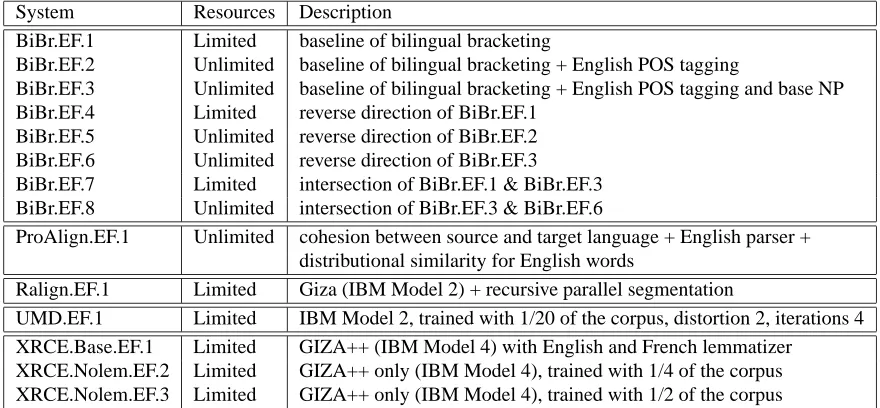
sub-task. Tables 2 and 3 show all of the submissions for each team in the two subtasks, and provide a brief description of their approaches.
While each participating system was unique, there were a few unifying themes.
Four teams had approaches that relied (to varying de-grees) on an IBM model of statistical machine translation (Brown et al., 1993). UMD was a straightforward imple-mentation of IBM Model 2, BiBr employed a boosting procedure in deriving an IBM Model 1 lexicon, Ralign used IBM Model 2 as a foundation for their recursive splitting procedure, and XRCE used IBM Model 4 as a base for alignment with lemmatized text and bilingual lexicons.
Two teams made use of syntactic structure in the text to be aligned. ProAlign satisfies constraints derived from a dependency tree parse of the English sentence being
3
The two teams that did not participate in English-French were Fourday and RACAI.
aligned. BiBr also employs syntactic constraints that must be satisfied. However, these come from parallel text that has been shallowly parsed via a method known as bilingual bracketing.
Three teams approached the shared task with baseline or prototype systems. Fourday combines several intuitive baselines via a nearest neighbor classifier, RACAI car-ries out a greedy alignment based on an automatically extracted dictionary of translations, and UMD’s imple-mentation of IBM Model 2 provides an experimental plat-form for their future work incorporating prior knowledge about cognates. All three of these systems were devel-oped within a short period of time before and during the shared task.
5
Results and Discussion
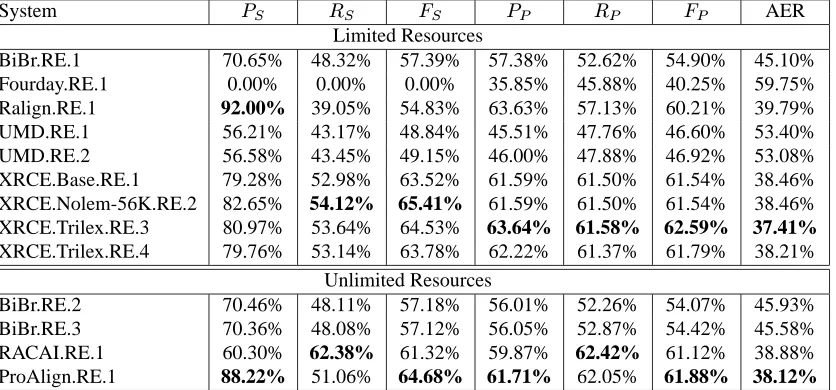
Tables 4 and 5 list the results obtained by participating systems in the Romanian-English task. Similarly, results obtained during the English-French task are listed in Ta-bles 6 and 7.
For Romanian-English, limited resources, XRCE sys-tems (XRCE.Nolem-56k.RE.2 and XRCE.Trilex.RE.3) seem to lead to the best results. These are systems that are based on GIZA++, with or without additional sources (lemmatizers and lexicons). For unlimited re-sources, ProAlign.RE.1 has the best performance.
For English-French, Ralign.EF.1 has the best perfor-mance for limited resources, while ProAlign.EF.1 has again the largest number of top ranked figures for unlim-ited resources.
This difference in performance between the two data sets is not a surprise. As expected, word alignment, like many other NLP tasks (Banko and Brill, 2001), highly benefits from large amounts of training data. Increased performance is therefore expected when larger training data sets are available.
The only evaluation set where Romanian-English data leads to better performance is the Probable alignments set. We believe however that these figures are not di-rectly comparable, since the English-French Probable alignments were obtained as a reunion of the align-ments assigned by two different annotators, while for the Romanian-English Probable set two annotators had to reach an agreement (that is, an intersection of their in-dividual alignment assignments).
Interestingly, in an overall evaluation, the limited re-sources systems seem to lead to better results than those with unlimited resources. Out of 28 different evaluation figures, 20 top ranked figures are provided by systems with limited resources. This suggests that perhaps using a large number of additional resources does not seem to improve a lot over the case when only parallel texts are employed.
Ranked results for all systems are plotted in Figures 2 and 3. In the graphs, systems are ordered based on their AER scores. System names are preceded by a marker to indicate the system type: L stands for Limited Resources, and U stands for Unlimited Resources.
6
Conclusion
A shared task on word alignment was organized as part of the HLT/NAACL 2003 Workshop on Building and Using Parallel Texts. In this paper, we presented the task definition, and resources involved, and shortly de-scribed the participating systems. The shared task in-cluded Romanian-English and English-French sub-tasks, and drew the participation of seven teams from around the world. Comparative evaluations of results led to interest-ing insights regardinterest-ing the impact on performance of (1) various alignment algorithms, (2) large or small amounts of training data, and (3) type of resources available. Data and evaluation software used in this exercise are available online at http://www.cs.unt.edu/˜rada/wpt.
Acknowledgments
There are many people who contributed greatly to mak-ing this word alignment evaluation task possible. We are grateful to all the participants in the shared task, for their hard work and involvement in this evaluation exercise. Without them, all these comparative analyses of word alignment techniques would not be possible.
We are very thankful to Franz Och from ISI and Her-mann Ney from RWTH Aachen for kindly making their
English-French word aligned data available to the work-shop participants; the Hansards made available by Ul-rich Germann from ISI constituted invaluable data for the English-French shared task. We would also like to thank the student volunteers from the Department of En-glish, Babes-Bolyai University, Cluj-Napoca, Romania who helped creating the Romanian-English word aligned data.
We are also grateful to all the Program Committee members of the current workshop, for their comments and suggestions, which helped us improve the definition of this shared task. In particular, we would like to thank Dan Melamed for suggesting the two different subtasks (limited and unlimited resources), and Michael Carl and Phil Resnik for initiating interesting discussions regard-ing phrase-based evaluations.
References
M. Banko and E. Brill. 2001. Scaling to very very large corpora for natural language disambiguation. In
Pro-ceedings of the 39th Annual Meeting of the Association for Computational Lingusitics (ACL-2001), Toulouse,
France, July.
P. Brown, S. Della Pietra, V. Della Pietra, and R. Mercer. 1993. The mathematics of statistical machine trans-lation: Parameter estimation. Computational
Linguis-tics, 19(2):263–311.
Herve Dejean, Eric Gaussier, Cyril Goutte, and Kenji Yamada. 2003. Reducing parameter space for word alignment. In HLT-NAACL 2003 Workshop: Building
and Using Parallel Texts: Data Driven Machine Trans-lation and Beyond, pages 23–26, Edmonton, Alberta,
Canada, May 31. Association for Computational Lin-guistics.
T. Erjavec, N. Ide, and D. Tufis¸. 1997. Encoding and parallel alignment of linguistic corpora in six central and Eastern European languages. In Proceedings of
the Joint ACH/ALL Conference, Queen’s University,
Kingston, Ontario, June.
U. Germann. 2001. Aligned hansards of the 36th parliament of canada. http://www.isi.edu/natural-language/download/hansard/.
John C. Henderson. 2003. Word alignment baselines. In
HLT-NAACL 2003 Workshop: Building and Using Par-allel Texts: Data Driven Machine Translation and Be-yond, pages 27–30, Edmonton, Alberta, Canada, May
31. Association for Computational Linguistics.
Dekang Lin and Colin Cherry. 2003. Proalign: Shared task system description. In HLT-NAACL 2003
Machine Translation and Beyond, pages 11–14,
Ed-monton, Alberta, Canada, May 31. Association for Computational Linguistics.
D.I. Melamed. 1999. Empirical Methods for Exploiting
Parallel Texts. MIT Press.
F. Och and H. Ney. 2000. A comparison of alignment models for statistical machine translation. In
Proceed-ings of the 18th International Conference on Computa-tional Linguistics (COLING-ACL 2000), Saarbrucken,
Germany, August.
Michel Simard and Philippe Langlais. 2003. Statisti-cal translation alignment with compositionality con-straints. In HLT-NAACL 2003 Workshop: Building
and Using Parallel Texts: Data Driven Machine Trans-lation and Beyond, pages 19–22, Edmonton, Alberta,
Canada, May 31. Association for Computational Lin-guistics.
Bridget Thomson McInnes and Ted Pedersen. 2003. The duluth word alignment system. In HLT-NAACL 2003
Workshop: Building and Using Parallel Texts: Data Driven Machine Translation and Beyond, pages 40–
43, Edmonton, Alberta, Canada, May 31. Association for Computational Linguistics.
Dan Tufis¸, Ana-Maria Barbu, and Radu Ion. 2003. Treq-al: A word alignment system with limited language resources. In HLT-NAACL 2003 Workshop: Building
and Using Parallel Texts: Data Driven Machine Trans-lation and Beyond, pages 36–39, Edmonton, Alberta,
Canada, May 31. Association for Computational Lin-guistics.
D Tufis¸. 2002. A cheap and fast way to build useful translation lexicons. In Proceedings of the 19th
In-ternational Conference on Computational Linguistics,
pages 1030–1036, Taipei, August.
Bing Zhao and Stephan Vogel. 2003. Word alignment based on bilingual bracketing. In HLT-NAACL 2003
Workshop: Building and Using Parallel Texts: Data Driven Machine Translation and Beyond, pages 15–
System Resources Description
BiBr.EF.1 Limited baseline of bilingual bracketing
BiBr.EF.2 Unlimited baseline of bilingual bracketing + English POS tagging
BiBr.EF.3 Unlimited baseline of bilingual bracketing + English POS tagging and base NP BiBr.EF.4 Limited reverse direction of BiBr.EF.1
BiBr.EF.5 Unlimited reverse direction of BiBr.EF.2 BiBr.EF.6 Unlimited reverse direction of BiBr.EF.3 BiBr.EF.7 Limited intersection of BiBr.EF.1 & BiBr.EF.3 BiBr.EF.8 Unlimited intersection of BiBr.EF.3 & BiBr.EF.6
ProAlign.EF.1 Unlimited cohesion between source and target language + English parser + distributional similarity for English words
Ralign.EF.1 Limited Giza (IBM Model 2) + recursive parallel segmentation
UMD.EF.1 Limited IBM Model 2, trained with 1/20 of the corpus, distortion 2, iterations 4 XRCE.Base.EF.1 Limited GIZA++ (IBM Model 4) with English and French lemmatizer
[image:7.612.86.526.119.323.2]XRCE.Nolem.EF.2 Limited GIZA++ only (IBM Model 4), trained with 1/4 of the corpus XRCE.Nolem.EF.3 Limited GIZA++ only (IBM Model 4), trained with 1/2 of the corpus
Table 2: Short description for English-French systems
System Resources Description
BiBr.RE.1 Limited baseline of bilingual bracketing
BiBr.RE.2 Unlimited baseline of bilingual bracketing + English POS tagging
BiBr.RE.3 Unlimited baseline of bilingual bracketing + English POS tagging and base NP Fourday.RE.1 Limited nearest neighbor combination of baseline measures
ProAlign.RE.1 Unlimited cohesion between source and target language + English parser + distributional similarity for English words
RACAI.RE.1 Unlimited translation equivalence dictionary (Tufis¸, 2002) + POS tagging
Ralign.RE.1 Limited Giza (IBM Model 2) + recursive parallel segmentation
UMD.RE.1 Limited IBM Model 2, trained with all the corpus, distortion 4, iterations 4 UMD.RE.2 Limited IBM Model 2, trained with all the corpus, distortion 2, iterations 4
XRCE.Base.RE.1 Limited GIZA++ (IBM Model 4), with English lemmatizer XRCE.Nolem.RE.2 Limited GIZA++ only (IBM Model 4)
XRCE.Trilex.RE.3 Limited GIZA++ only (IBM Model 4), with English lemmatizer and trinity lexicon XRCE.Trilex.RE.4 Limited GIZA++ only (IBM Model 4), with English lemmatizer and trinity lexicon
[image:7.612.81.530.451.649.2]System Ë
Ë Ë
È
È È AER
Limited Resources
BiBr.RE.1 70.65% 55.75% 62.32% 59.60% 57.65% 58.61% 41.39%
Fourday.RE.1 0.00% 0.00% 0.00% 52.83% 42.86% 47.33% 52.67%
Ralign.RE.1 92.00% 45.06% 60.49% 63.63% 65.92% 64.76% 35.24%
UMD.RE.1 57.67% 49.70% 53.39% 57.67% 49.70% 53.39% 46.61%
UMD.RE.2 58.29% 49.99% 53.82% 58.29% 49.99% 53.82% 46.18%
XRCE.Base.RE.1 79.28% 61.14% 69.03% 79.28% 61.14% 69.03% 30.97%
XRCE.Nolem-56K.RE.2 82.65% 62.44% 71.14% 82.65% 62.44% 71.14% 28.86%
XRCE.Trilex.RE.3 80.97% 61.89% 70.16% 80.97% 61.89% 70.16% 29.84%
XRCE.Trilex.RE.4 79.76% 61.31% 69.33% 79.76% 61.31% 69.33% 30.67%
Unlimited Resources
BiBr.RE.2 70.46% 55.51% 62.10% 58.40% 57.59% 57.99% 41.39%
BiBr.RE.3 70.36% 55.47% 62.04% 58.17% 58.12% 58.14% 41.86%
RACAI.RE.1 81.29% 60.26% 69.21% 81.29% 60.26% 69.21% 30.79%
[image:8.612.94.520.120.319.2]ProAlign.RE.1 88.22% 58.91% 70.64% 88.22% 58.91% 70.64% 29.36%
Table 4: Results for Romanian-English, NO-NULL-Align
System
Ë
Ë Ë
È
È È AER
Limited Resources
BiBr.RE.1 70.65% 48.32% 57.39% 57.38% 52.62% 54.90% 45.10%
Fourday.RE.1 0.00% 0.00% 0.00% 35.85% 45.88% 40.25% 59.75%
Ralign.RE.1 92.00% 39.05% 54.83% 63.63% 57.13% 60.21% 39.79%
UMD.RE.1 56.21% 43.17% 48.84% 45.51% 47.76% 46.60% 53.40%
UMD.RE.2 56.58% 43.45% 49.15% 46.00% 47.88% 46.92% 53.08%
XRCE.Base.RE.1 79.28% 52.98% 63.52% 61.59% 61.50% 61.54% 38.46%
XRCE.Nolem-56K.RE.2 82.65% 54.12% 65.41% 61.59% 61.50% 61.54% 38.46%
XRCE.Trilex.RE.3 80.97% 53.64% 64.53% 63.64% 61.58% 62.59% 37.41%
XRCE.Trilex.RE.4 79.76% 53.14% 63.78% 62.22% 61.37% 61.79% 38.21%
Unlimited Resources
BiBr.RE.2 70.46% 48.11% 57.18% 56.01% 52.26% 54.07% 45.93%
BiBr.RE.3 70.36% 48.08% 57.12% 56.05% 52.87% 54.42% 45.58%
RACAI.RE.1 60.30% 62.38% 61.32% 59.87% 62.42% 61.12% 38.88%
ProAlign.RE.1 88.22% 51.06% 64.68% 61.71% 62.05% 61.88% 38.12%
[image:8.612.102.520.450.645.2]System Ë
Ë Ë
È
È È AER
Limited Resources
BiBr.EF.1 49.85% 79.45% 61.26% 67.23% 29.24% 40.76% 28.23%
BiBr.EF.4 51.46% 82.42% 63.36% 66.65% 32.68% 43.86% 28.01%
BiBr.EF.7 63.03% 74.59% 68.32% 66.11% 30.06% 41.33% 29.38%
Ralign.EF.1 72.54% 80.61% 76.36% 77.56% 38.19% 51.18% 18.50%
UMD.EF.1 37.98% 64.66% 47.85% 59.69% 23.53% 33.75% 38.47%
XRCE.Base.EF.1 50.89% 84.67% 63.57% 83.22% 32.05% 46.28% 16.23%
XRCE.Nolem.EF.2 55.54% 93.46% 69.68% 89.65% 34.92% 50.27% 8.93%
XRCE.Nolem.EF.3 55.43% 93.81% 69.68% 90.09% 35.30% 50.72% 8.53%
Unlimited Resources
BiBr.EF.2 50.05% 79.89% 61.54% 66.92% 29.14% 40.60% 28.24%
BiBr.EF.3 50.21% 80.26% 61.80% 63.79% 30.52% 41.29% 30.38%
BiBr.EF.5 51.27% 82.17% 63.15% 67.22% 32.56% 43.87% 27.71%
BiBr.EF.6 51.91% 83.26% 63.95% 62.21% 34.58% 44.45% 31.32%
BiBr.EF.8 66.34% 74.86% 70.34% 61.62% 31.37% 41.57% 32.48%
[image:9.612.107.507.113.325.2]ProAlign.EF.1 71.94% 91.48% 80.54% 96.49% 28.41% 43.89% 5.71%
Table 6: Results for English-French, NO-NULL-Align
System
Ë
Ë Ë
È
È È AER
Limited Resources
BiBr.EF.1 49.85% 79.45% 61.26% 60.32% 29.12% 39.28% 33.37%
BiBr.EF.4 51.46% 82.42% 63.36% 61.64% 32.41% 42.48% 31.91%
BiBr.EF.7 63.03% 74.59% 68.32% 51.35% 30.45% 38.23% 40.97%
Ralign.EF.1 72.54% 80.61% 76.36% 77.56% 36.79% 49.91% 18.50%
UMD.EF.1 37.19% 64.66% 47.22% 41.93% 24.08% 30.59% 51.71%
XRCE.Base.EF.1 50.89% 84.67% 63.57% 64.96% 32.73% 43.53% 28.99%
XRCE.Nolem.EF.2 55.54% 93.46% 69.68% 70.98% 35.61% 47.43% 22.10%
XRCE.Nolem.EF.3 55.43% 93.81% 69.68% 72.01% 36.00% 48.00% 21.27%
Unlimited Resources
BiBr.EF.2 50.05% 79.89% 61.54% 59.89% 28.96% 39.04% 33.48%
BiBr.EF.3 50.21% 80.26% 61.80% 57.85% 30.28% 39.75% 35.03%
BiBr.EF.5 51.27% 82.17% 63.15% 62.05% 32.23% 42.43% 31.69%
BiBr.EF.6 51.91% 83.26% 63.95% 58.41% 34.20% 43.14% 34.47%
BiBr.EF.8 66.34% 74.86% 70.34% 48.50% 31.76% 38.38% 43.37%
ProAlign.EF.1 71.94% 91.48% 80.54% 56.02% 30.05% 39.62% 33.71%
[image:9.612.108.506.443.650.2]Figure 2: Ranked results for Romanian-English data