Using an incremental robust parser to automatically generate
semantic UNL graphs
Nuria Gala GETA-CLIPS-IMAG 385 av. de la Biblioth`eque, BP 53 F-38041 Grenoble cedex 9, France
Abstract
The UNL project (Universal Networking Lan-guage) proposes a standard for encoding the meaning of natural language utterances as se-mantic hypergraphs, intended to be used as pivot in multilingual information and commu-nication systems. Several deconverters permit to automatically translate UNL utterances into natural languages. However, a rough enconver-tion from natural language texts to UNL expres-sions is usually done interactively with editors specially designed for the UNL project or by hand (which is very time-consuming and diffi-cult to extrapolate to huge amounts of data). In this paper, we address the issue of using an existing incremental robust parser as main re-source to enconverting French utterances into UNL expressions.
1 Introduction
UNL is a project of multilingual personal networking communication initiated by the Uni-versity of United Nations based in Tokyo. The representation of an utterance in the UNL inter-lingua is a hypergraph where nodes bear uni-versal words (interlingual acceptions) with se-mantic attributes and arcs denote sese-mantic re-lations. Any natural language utterance can be enconverted (encoded) into a UNL expression that can then be used as a pivot in a variety of possible applications (multilingual information retrieval, automatic translation, etc.).
Enconverting into UNL is thus to be unders-tood as the process by which a UNL expression is generated from the analysis of a natural lan-guage utterance. This process can be carried out by different strategies, ranging from fully automatic to fully human enconverting.
Within the UNL project, a number of soft-ware tools exist for different languages, mainly dictionnaries and deconverters (for French (Serasset and Boitet, 2000), for Tamil (Dhan-abalan and Geeta, 2003), etc.). However, there
are a few tools for enconversion (for German (Hong and Streiter, 1999), for Spanish1, etc.). As they are not full automatic enconverters, these systems have not yet proved to be suitable for dealing with huge amounts of heterogeneous data.
For French, there is currently a version un-der development of an enconverter that uses the Ariane-G5 platform (Boitet et al., 1982), an en-vironment for multilingual machine translation, for the analysis of the natural language input. However, this approach has several drawbacks. First, the size of the linguistic input that it can process is limited to 200-250 words. Second, the output produced contains all the possible com-plete linguistic analysis for a sentence (multi-ple syntactic and logico-semantic trees). This implies an interactive disambiguation step to choose the appropriate linguistic analysis for the enconverter. Such an interactive disambigua-tion step is not a drawback in itself (it is in-deed very useful in the context of automatic translation). The problem rather comes from an efficient disambiguation of huge amounts of analysis in a reasonable time. Finally, the sys-tem is not yet multi-platform (the program cur-rently runs only on Macintosh) and the connec-ting procedures with Ariane-G5 are not very ef-ficient at this time (efforts are currently being done to address this issue).
To cope with all these difficulties and to de-velop a French enconverter that can generate UNL expressions for large collections of raw cor-pora, we propose to use the ouputs produced by an existing incremental parser which has al-ready proved robust and efficient for parsing huge amounts of data.
This article is organized as follows: after introducing the UNL language and giving some details on how it represents knowledge in a language-neutral way, we present XIP, an
cremental parser, that we will use as the central tool for the enconversion. Then, we describe the mechanism for transforming XIP’s outputs into UNL expressions and finally we discuss a pre-liminary evaluation of the enconverter and our perspectives.
2 The Universal Networking Language (UNL)
2.1 The language
UNL is an artificial language that describes semantic networks. Sentence information is represented by hypergraphs having universal words (UWs) as nodes and relations as arcs. A hypergraph can also be represented as a set of directed binary relations, between UWs in the sentence. Linguistic information is encoded by means of the UWs, the relations that exist bet-ween them and the attributes that are associ-ated with them.
2.2 Universal Words
Universal Words represent simple or compound concepts. They denote interlingual acceptions (word senses) for a given lemma.
An entry in the dictionnary of Universal Words contains, as illustrated in Figure 1, a head word (the French lemma ”membre” in this example) followed by a list of morpho-syntactic constraints. The last part of the entry contains the UW itself: a character string (an English-language lemma) between double quotes, which usually contains a list of semantic constraints in brackets.
[membre] { CAT(CATN),GNR(MAS,FEM),N(NC) } "associate(icl>member)";
[membre]{CAT(CATN),GNR(MAS),N(NC)} "member(icl>human)";
[membre]{CAT(CATN),GNR(MAS)} "member(icl>part)";
[membre]{CAT(CATN),GNR(MAS),N(NC)} "member";
Figure 1: Semantic ambiguity in Universal Words.
When present, the list of semantic constraints describes conceptual restrictions. For example, the first three entries in Figure 1 define three different acceptions while the last one provides only the lemma and is thus more general.
2.3 Relations
Binary relations are the building blocks for UNL expressions. They link together two UWs in a linguistic utterance and have labels that de-pend on the roles the UWs play in the sentence. A UNL relation is represented by a headword (the label of the semantic relation) followed by a bracketed expression containing the UWs. The UWs are separated by a comma and decorated with different kinds of linguistic information.
Figure 2 shows the UNL enconversion for the following French sentence:
“Lors de la 29e session de la Conf´erence g´en´erale de l’Unesco, les 186 Etats membres ont ratifi´e `a l’unanimit´e ce projet.”2
agt(ratify(agt>thing,obj>thing).@entry.@past, state(icl>nation).@def.@pl)
mod(state(icl>nation).@def.@pl, member(mod<thing))
qua(state(icl>nation).@def.@pl,186)
man(ratify(agt>thing,obj>thing).@entry.@past, unanimously(icl>how))
obj(ratify(agt>thing,obj>thing).@entry.@past, project(icl>plan(icl>thing)))
mod(project(icl>plan(icl>thing)),this)
tim(ratify(agt>thing,obj>thing).@entry.@past, session(icl>meeting).@def)
mod(session(icl>meeting).@def,29.@ordinal) mod(session(icl>meeting).@def,
conference(icl>meeting).@def) mod(conference(icl>meeting).@def, general(mod<thing))
mod(conference(icl>meeting).@def,UNESCO.@def)
Figure 2: UNL expressions.
The UNL expressions in Figure 2 encode re-lations such as agt (agent), qua (quantifier),
mod (modifier), tim (instant time), man (man-ner) andobj(object).
As can be seen on the figure, the information given by a UNL relation may be very semanti-cally precise : for example, the notion of “time” is composed of six labels, corresponding to an instant time (tim), an initial time (tmf), a final time (tmt), a period (dur), a sequence (seq) or a simultaneous action (coo).
The couple of UWs present in a relation have different kinds of attributes : morphological in-formation (def, pl, etc.), information about tense (past), etc.
2.4 Representation of UNL graphs
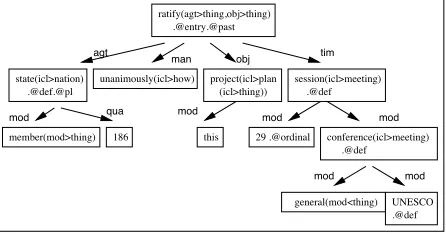
The list of UNL relations for a linguistic ut-terance is represented by a UNL hypergraph (a graph where a node is simple or recursively con-tains a hypergraph). The arcs bear semantic re-lation labels and the nodes are UWs with their attributes as showed in Figure 3.
29 .@ordinal 186
member(mod>thing)
.@entry.@past ratify(agt>thing,obj>thing)
UNESCO .@def conference(icl>meeting)
.@def state(icl>nation)
.@def.@pl
unanimously(icl>how) project(icl>plan (icl>thing)) .@def
session(icl>meeting)
this
general(mod<thing)
mod
mod
mod mod
obj
man tim
agt
[image:3.595.66.289.212.329.2]mod qua mod
Figure 3: UNL Hypergraph.
UNL hypergraphs must contain one special node, called the entry of the graph (usually the finite verb). This information is encoded with the label entry in the list of UNL relations re-presenting the corresponding hypergraph.
3 An incremental robust parser
3.1 Overview of the parser
XIP (Ait-Mokhtar et al., 2002; Hagege and Roux, 2002) is a rule-based platform for buil-ding robust incremental parsers. It is deve-lopped at the Xerox Research Centre Europe (XRCE) and shares the same computation-nal paradigm as the PNLPL approach (Jensen, 1992) and the FDGP approach (Tapanainen and Jarvinen, 1997).
At present, various grammars for XIP have been built for English and French. The different phases of linguistic processing are organized in-crementally : syntactic analysis is done by first chunking (Abney, 1991) a morphosyntactic an-notated input text and then extracting func-tionnal dependencies (links between the words). The aim of the system is to produce a list of syntactic dependencies which may be later used in applications such as information retrieval, se-mantic disambiguation, coreference resolution, etc.
3.2 Incremental approach
A XIP parser, like the French parser (that we will call XIPF hereafter), is composed of diffe-rent modules that transform and process incre-mentally the linguistic information given as in-put. XIPF contains three main modules: one for morphological disambiguation (disambigua-tion of POS tags depending on contextual in-formation), another one for chunking (marking structural groups) and a last one for dependency calculus (identifying links between words).
Each module may have a number of gram-mars which are applied one after the other depending on the linguistic complexity of the phenomena present. For example, for French, the identification of verbal phrases comes after the identification of nominal phrases. The dif-ferent rules in the grammars also apply incre-mentally. They are organized in levels so that they apply sequentially to enrich stepwise the linguistic analysis. This strategy favors linguis-tic precision over recall.
3.3 Data representation
Within the XIP formalism, information is re-presented by means of syntactic trees with ter-minal nodes or sequences of constituant nodes (such as nominal phrases (NPs), finite verbal phrases (FVs), etc.). The maximal node for each tree (sentence) is a virtual node calledGROUPE. All nodes, lexical (membre) or not (NP), have a list of features associated with them and describing precise features : typogra-phical (capital letter [maj:+]), lexical (proper noun [proper:+]), morphological (number
[plu:+]), syntactic (subcategorization with the preposition “a” [sfa:+]) or semantic (time
[tim:+]).
Since the complete linguistic information of a node is always present, even if it is not dis-played in the output, it is simple to manipulate at any time during the analysis. Therefore, the possibility of taking into account different kinds of features at any step of the analysis is a con-siderable advantage when building a semantic application (the enconversion into UNL expres-sions).
Indeed, semantic information can be enriched by adding new particular features when neces-sary (a featuretitlehas been added to be ap-plied in titles).
3.4 XIPF output
processing done by the different modules. Fi-gure 4 shows the XIPF analysis for the French sentence given as example in section 2.3.
SUBJ NOUN(ratifi´e,Etats) VARG NOUN DIR(ratifi´e,projet) VMOD LEFT NOUN INDIR(ratifi´e,Lors de,session)
VMOD POSIT1 ADV(ratifi´e,`a, l’unanimit´e) NMOD POSIT1 RIGHT ADJ(Conf´erence,g´en´erale) NMOD POSIT1 LEFT ADJ NOUN(session,29e) NMOD POSIT1 NOUN(session,de,Conf´erence) NMOD POSIT1 NOUN(Conf´erence,de,Unesco) NN(Etats,membres)
DETERM DEF NOUN DET(la,session) DETERM DEF NOUN DET(la,Conf´erence) DETERM DEF NOUN DET(l’,Unesco) DETERM DEF NOUN DET(les,Etats) DETERM DEM NOUN DET(ce,projet) DETERM NUM NOUN(186,Etats) AUXIL(ratifi´e,ont)
0>GROUPE{SC{PP{Lors de NP{la AP{29e} session}} PP{de NP{la Conf´erence}}
AP{g´en´erale} PP{de NP{l’ Unesco}} , NP{les 186 Etats} NP{membres} FV{ont ratifi´e}} `a l’unanimit´e NP{ce projet} .}
Figure 4: XIPF output.
For this sentence, the parser extracts re-lations such as subject (SUBJ), verbal subca-tegorization (VARG), verbal and nominal mo-dification (VMOD, NMOD and NN), determination (DETERM) and verbal auxiliary (AUXIL). The head of the dependency appears as the first ele-ment except in the case of a determination re-lation.
Relations usually have a list of morpho-syntactic features associated with them : the POS tag of the word linked to the head (NOUNin aSUBJ relation,ADJin aNMOD, etc.), morpholo-gical precisions (NUM,DEM) or syntactic features (the position of the adjective, POSIT1, RIGHT, etc.).
The process of dependency extraction is de-terministic: the most plausible relation accor-ding to the system is extracted. The only excep-tion is that of preposiexcep-tionnal attachment (VMOD
and NMOD): the linguistic information that the parser has is not enough to handle structural ambiguities. In this case, all possible relations appear in the result.
3.5 Parser evaluation
Parsers built with the XIP engine (XIPF) are able to process about 2.000 words/s using 10 Mo of memory footprint (only grammars, without lexicons)3 .
As for linguistic performance, an evalu-ation of XIPF subject and object (VARG) dependencies, conducted on French newspa-pers (Ait-Mokhtar et al., 2001), showed the following precision (P) and recall (R) rates:
SUBJECT, P = 93,45 %, R = 89,36 %; OBJECT, P = 90,62 %, R = 86,56 %.
Another evaluation carried out with XIPF+ (Gala, 2003), a second French parser contai-ning more specialized grammars to handle com-plex phenomena such as punctuation, lists, ti-tles etc., using varied raw corpora from different types and domains4 gives P = 94 % for subject even in sentences being or containing lists, enu-merations etc. and P = 93 % and R = 89,6 % for key words in titles (CLE relation).
4 A French UNL enconverter
4.1 Overview
The principal motivation to create a French en-converter is to easily obtain huge amounts of UNL enconverted corpora which can be subse-quently used in other applications (for example, multilingual information retrieval). To achieve this objective, one of the main requirements was also the reusability of existing robust linguistic resources.
The choice of a XIP parser was motivated by several reasons. First, its robustness permits to deal with huge amounts of text (a result is al-ways produced whatever the complexity of the input). Second, its modular architecture facili-tates the articulation of different ressources (it is easy to enrich the parser with new lexicons and grammars and to desactivate a particular module when necessary). Finally, the flexibi-lity of the formalism permits to enrich the rules and the features with no harm. We have pre-fered XIPF+ over the standard XIPF because of its broader linguistic coverage.
The French UNL enconverter is thus a proces-sor that automatically transforms annotations
3Obtained with a Pentum III 1 GHz.
provided by the XIPF+ parser into UNL ex-pressions.
4.2 Remarks on terminology
To avoid ambiguity, we use the term “depen-dency” to indicate XIPF+ syntactic links of the form D(x,y) or D(x,y,z), as shown in Figure 4, and the term “feature” to indicate linguis-tic information provided by the parser. XIPF+ provides twelve types of dependencies and more than two hundred and fifty features, of the types described in section 3.3 (typographical, mor-phological, etc.).
As for UNL, we use the term “rela-tion” to denote a semantic link of the form
label(UW1.attributes,UW2.attributes), as shown in Figure 2, while an “attribute” corre-sponds to a UNL annotation. Such an annota-tion appears to the right of a UW and adds par-ticular linguistic information. The UNL forma-lism provides about fourty relations and eighty attributes of different types.
4.3 Generation of UNL expressions
The first step of the enconvertion consists in identifying the information provided by XIPF+ that will be translated into UNL relations. There are three kinds of mapping rules perfor-ming this task, depending on the input and the result of the transformation: a dependency gi-ving an attribute, a dependency gigi-ving a rela-tion, a feature giving a relation.
4.3.1 Dependency to attribute.
The first kind of mapping rules transforms a XIPF+ dependency into a UNL attribute. An example is that of the relation CLE(the head of a title). Within UNL it becomes @titleand it is included as an attribute of the UNL relation containing the head word of the title.
The following example describes a title, its analysis with XIPF+ and its UNL encoversion:
Le Forum Universel des Cultures5
4.3.2 Dependency to relation.
The second kind of mapping rules transforms a XIPF+ dependency into a UNL relation. In some cases, this transformation is not straight-forward since a number of lexical and semantic features are to be taken into account (and they are not always provided by the parser). This
5The Universal Forum of Cultures
CLE(Forum)
NMOD POSIT1 RIGHT ADJ(Forum,Universel) NMOD POSIT1 NOUN INDIR(Forum,des,Cultures) DETERM CLOSED DEF NOUN DET(Le,Forum)
<title> 0>GROUPE{NP{Le Forum} AP{Universel} PP{des NP{Cultures}} </title>
mod(forum.@def.@entry.@title, universal(mod<thing))
mod(forum.@def.@entry.@title,
culture(icl>abstract thing).@def.@pl)
Figure 5: Example of dependency to attribute transformation.
is the case of dependencies with the verb to be and generally with all verbs denoting a state.
While in the UNL formalism the verb to be
is considered a copula and does not appear in the semantic representation, the parser produces the syntactic dependencies in which the verb participates and marks the fact of being a copula by means of features ([copula]
as lexical feature and SPRED -predicative- as syntactic feature) as illustrated on the example below :
Le Forum est Universel.6
SUBJ(^etre,Forum)
VARG ADJ SPRED(^etre,Universel)
aoj(Universal,Forum)
Figure 6: Example of dependencies involving the verbto beand their corresponding UNL re-lation.
In this case, an aoj relation shows the link between the noun in the subject and the adjec-tive. The parser’s feature permitting the iden-tification of a copula is thus crucial in order to map precisely a SUBJ and a VARG into an agt
and aobjor into a single aoj.
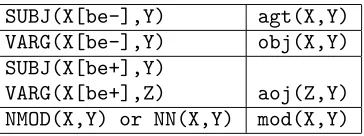
Table 1 gives a summary of the principal transformations performed by this second kind of mapping rules (as it is shown, in the case of modification, two types of XIPF+ relations produce a UNLmod):
SUBJ(X[be-],Y) agt(X,Y) VARG(X[be-],Y) obj(X,Y) SUBJ(X[be+],Y)
VARG(X[be+],Z) aoj(Z,Y) NMOD(X,Y) or NN(X,Y) mod(X,Y)
Table 1: XIPF+ dependencies producing UNL relations.
4.3.3 Feature to relation.
The last type of mapping rules identifies parti-cular information encoded as features within the parser’s output and transforms them into UNL relations with the appropriate words. This is the case for the notions of quantification and time.
Regarding quantification, this feature, en-coded within the dependency DETERM, is trans-formed to produce aquaUNL relation between a determiner and a noun.
As for the relations involving the notion of time, the feature time encoded by XIPF+ is too general. Therefore, it is not possible to produce the semantically precise UNL relations expressing variations of the concept of time (duration, final time, sequence, etc.). In this case, we have chosen to create an intermediate UNL relation named timein order to keep this semantic information.
NMOD(X,Y,Z)
[image:6.595.67.249.45.113.2]DETERM(W[quant+],Z) qua(Z,W) NMOD(X,Y,Z[time+]) time(X,Z)
Table 2: XIPF+ features producing UNL rela-tions.
4.4 Accessing the UW base
After identifying the UNL relations, the encon-verter retrieves the UWs corresponding to each French word in a relation. UWs are contained into a UW database of 37.901 French lemmas.
The major difficulty here concerns ambiguity, that is, accessing the right acception, since the database usually contains a list of UWs for a given lemma. The ambiguity can be semantic, when a French lemma corresponds to a single English lemma with different acceptions (cf
Figure 1) or lexical, when a French lemma corresponds to several English lemmas. Here is an example of lexical ambiguity with the
pronounil (”he” or ”it” in English) :
[il]{CAT(CATR)}"he(icl>human)"; [il]{CAT(CATR)}"it(icl>nonhuman)";
Figure 7: Lexical ambiguity in Universal Words.
To this date, as the lexico-semantic infor-mation provided by the parser is not enough to choose the appropriate UW, the enconverter takes the most general acception (that is, the word sense without a constraint list –the last entry in the list showed in Figure 1). When all acceptions of an entry have such list of cons-traints, the enconverter chooses the first one.
4.5 Enrichment with lexical information
The final step of the enconversion enriches the rough UNL expressions produced (UNL labels with simplified UWs) with more complete mor-phological information. A set of rules is thus specialized in translating different linguistic fea-tures from the parser into UNL descriptors com-pleting the words in a relation.
Some of this morphological information can also be extracted from the UW base (gender). However, we have preferred to extract a maxi-mum of information from the parser because it produces a contextual analysis of the words ap-pearing in a linguistic utterance.
The features which enrich the UNL output concern definiteness (@def or @indef), num-ber (@sg or @pl) and tense (@past, @present,
@fut). A few labels (@ordinal, @complete...) are absent on the XIPF+ output and therefore not automatically enconverted in the UNL out-put. Finally, the attribute@entryis systemati-cally added to UWs head of their sentence (the verb): agt,varg,aoj, etc.
5 Evaluation
A complete evaluation of a UNL enconverter should take into account the following possible kinds of errors:
• graphs with wrong linguistic information (semantic relations, attributes, etc.),
• missing information (incomplete graph due to missing relations, incomplete decora-tions, etc.),
[image:6.595.68.249.446.487.2]Since in this article we want to emphasize the use of an incremental robust parser for creating an enconverter, we evaluated errors concerning semantic relations7, thus the first and the se-cond points which correspond, respectively, to classic evaluation metrics of precision and recall rates.
The enconverter was tested against the first 50 manually enconverted UNL graphs (1.059 words) from a corpus of legal text. The a-verage length of the sentences was about 21 words (21,18). The semantic relations evalu-ated in this preliminary experiment (322 UNL expressions) were agt (44), obj (57) and mod
(221).
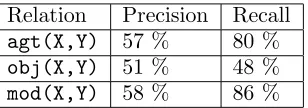
Table 3 gives the results obtained for the evaluation of this first version of the encon-verter :
Relation Precision Recall
agt(X,Y) 57 % 80 %
obj(X,Y) 51 % 48 %
[image:7.595.66.220.298.352.2]mod(X,Y) 58 % 86 %
Table 3: Results of the evaluation of the first version of the enconverter.
For agents, most errors come from syntac-tic subjects correctly identified by the parser but presenting semantic features that should had been taken into account to createaoj rela-tions. To give an example, in the sentence “La culture acquiert des formes diff´erentes (...)”8, the parser extracts correctly the dependency
subj(acquire,culture)although it is seman-tically encoded as aoj(acquire,culture) in UNL because the verb “acquire” is considered in this utterance as a verb of state.
In the case of objects, errors on precision concern wrong scope of coordination as well as objects being a whole sentence. As for recall, there are several constructions which may be considered obj from a semantic point of view but that the parser identifies as modifiers due to their surface construction with a preposition. For example, “source de creativit´e”9 is analyzed by the parser as
mod(source,de,cr´eativit´e) although UNL encodes obj(source,creativity). Likewise,
7The presence or absence of the different attributes was not evaluated.
8Culture acquires different forms (...). 9Source of creativity.
“vers l’acc´es de la diversit´e culturelle”10 is en-coded in UNL asobj(towards,access), a kind of relation that the parser does not extract.
A final remark concerns modifiers. As said before, the parser is not deterministic in mark-ing modifiers: all possible combinations be-tween a head word and its dependents are ex-tracted. That is the main reason why precision is low and recall is high.
The average of all these figures gives a global evaluation of the enconverter corresponding to P = 56 % and R = 69 %.
6 Discussion
At this stage of the project, there are a number of conclusions we can draw from the preceding evaluation.
The first one is that the results are rather en-couraging in terms of a first rough enconvertion from syntactic XIPF+ information to UNL ex-pressions (agt,obj and mod). However, we are aware that certain cases present considerable difficulties. For example, in addition to the ex-amples presented in the evaluation for verbs of state, subjects with a semantic feature of “pa-tient” are to be enconverted as objand not as
subj (unfortunately the semantic information needed for this transformation is not yet avail-able within the parser). Thus in “La r´eunion continuera jusqu’`a ce soir.”11 the parser ex-tracts asubj(continuer,r´eunion)that might be enconverted as obj(continue,meeting) in UNL. All these kinds of complex transforma-tions including particular semantic features are at this point an important bottleneck for the enconverter.
The second conclusion coming from the eva-luation (even if not quantitatively analyzed) is that the choice of the UW remains a critical point, as the enconverter has not the possibi-lity of choosing the correct acception giving a configuration. One possibility to consider might be to introduce interactivity with a human to choose the correct UW. The second possibility is related to the improval of the parser: we can consider adding more linguistic information, in the form of semantic classes or semantic fea-tures, in order to be able to disambiguate. Ha-ving enriched the parser with these semantic features, another possibility to improve the en-converter might be to consider statistical infor-mation about collocations.
10Towards accessing cultural diversity.
Finally, we are conscious that there would still remain several aspects which would demand to be improved within the parser itself : prepo-sitionnal attachment disambiguation, scope of coordination, complex coreference, etc. Parti-cular strategies may be adapted to handle such difficulties individually (using statistical infor-mation, interactive disambiguation, etc.).
7 Conclusion
In this paper we have presented a mechanism for automatically producing UNL expressions using the ouput of a robust parser. After des-cribing the UNL formalism and presenting an incremental parser able to accurately process huge amounts of data, we have shown how one can transform the linguistic information pro-vided by the parser into UNL expressions. We have also presented a first evaluation in an at-tempt to try to assess the performance of the enconverter.
Our results show that there are still several crucial problems that we need to solve. Ho-wever, taking into account that this is prelimi-nary work, the results already obtained are en-couraging and confirm the possibility of using the reliable linguistic information automatically obtained from an incremental robust parser to create a UNL semantic enconverter for huge amounts of data.
Acknowledgements
The author wants to express her gratitude to E. Blanc and A. Max, as well as to the three anonymous reviewers, for their suggestions and comments on a first draft of the paper.
References
S. Abney. 1991. Parsing by chunks. In
Principle-Based Parsing, edited by R. Berwick, S. Abney and C. Tenny, 257–278. Kluwer Academic Publishers. Boston.
S. A¨ıt-Mokhtar, J. P. Chanod, and C. Roux. 2001. A multi-input dependency parser. In
Proceedings of International Workshop on Parsing Technologies, IWPT-2001, 201-204. Beijing, China.
S. A¨ıt-Mokhtar, J. P. Chanod, and C. Roux. 2002. Robustness beyond shallowness : In-cremental Deep Parsing. Special Issue of the Natural Language Engineering Journal on Robust Methods in Analysis of Natural Lan-guage Data, vol. 8(3), 121–144, Cambridge University Press.
C. Boitet, P. Guillaume, and M. Qu´ ezel-Ambrunaz. 1982. ARIANE-78, an integrated environment for automated translation and human revision. InProceedings of Conference on Computational Linguistics, COLING-82, 19–27, Prague.
T. Dhanabalan, and T. V. Geetha. 2003. UNL Deconverter for Tamil. In International Con-ference on the Convergence of Knowledge, Culture, Language and Information Tech-nologies. Alexandria, Egypt.
N. Gala. Un mod`ele d’analyseur syntaxique robuste fond´e sur la modularit´e et la lexi-calisation de ses grammaires. Th`ese de doc-torat, Universit´e de Paris-Sud, UFR scien-tifique d’Orsay, France.
C. Hag`ege, and C. Roux. 2002. A Robust and Flexible Platform for Dependency Ex-traction. InProceedings of 3rd Conference on Language Ressources and Evaluation, LREC-2002, 520–523, Las Palmas de Gran Canaria, Spain.
M. Hong, and O. Streiter. 1999. Overcom-ing the language barriers in the Web : the UNL-Approach. In Multilingual Corpora : encoding, structuring, analysis. 11th Annual Meeting of the German Society for Compu-tational Linguistics and Language Technolo-gies.. Frankfurt, Germany.
K. Jensen. 1992. PEG: the PLNLP English Grammar. In Natural Language Processing : the PLNLP approach, edited by K. Jensen, G. Heidorn and S. Richardson. Kluwer Academic Publishers. Boston.
G. Serasset, and C. Boitet. 2000. On UNL as the future “html of the linguistic content” and the reuse of existing NLP components in UNL-related applications with the example of a UNL-French deconverter. InProceedings of Conference on Computational Linguistics, COLING-2000. Saarbruecken.