Adaptive Development Data Selection for Log-linear Model
in Statistical Machine Translation
Mu Li
Microsoft Research Asia [email protected]
Yinggong Zhao∗ Nanjing University [email protected]
Dongdong Zhang
Microsoft Research Asia [email protected]
Ming Zhou
Microsoft Research Asia [email protected]
Abstract
This paper addresses the problem of dy-namic model parameter selection for log-linear model based statistical machine translation (SMT) systems. In this work, we propose a principled method for this task by transforming it to a test data de-pendent development set selection prob-lem. We present two algorithms for au-tomatic development set construction, and evaluated our method on several NIST data sets for the Chinese-English trans-lation task. Experimental results show that our method can effectively adapt log-linear model parameters to different test data, and consistently achieves good translation performance compared with conventional methods that use a fixed model parameter setting across different data sets.
1 Introduction
In recent years, log-linear model (Och and Ney, 2002) has been a mainstream method to formu-late statistical models for machine translation. Us-ing this formulation, various kinds of relevant properties and data statistics used in the transla-tion process, either on the monolingual-side or on the bilingual-side, are encoded and used as real-valued feature functions, thus it provides an ef-fective mathematical framework to accommodate a large variety of SMT formalisms with different computational linguistic motivations.
∗
This work was done while the author was visiting Mi-crosoft Research Asia.
Formally, in a log-linear SMT model, given a source sentencef, we are to find a translatione∗ with largest posterior probability among all possi-ble translations:
e∗= argmax
e Pr(e|f)
and the posterior probability distributionPr(e|f) is directly approximated by a log-linear formula-tion:
Pr(e|f) =pλ(e|f)
= exp(
PM
m=1λmhm(e, f))
P
e0exp(PMm=1λmhm(e0, f))
(1)
in which hm’s are feature functions and λ =
(λ1, . . . , λM) are model parameters (feature
weights).
For a successful practical log-linear SMT model, it is usually a combined result of the sev-eral efforts:
• Construction of well-motivated SMT models
• Accurate estimation of feature functions
• Appropriate scaling of log-linear model fea-tures (feature weight tuning).
which often does not hold for real-world data. The goal of this paper is to investigate novel meth-ods for test data dependent model parameter se-lection. We begin with discussing the principle of parameter learning for log-linear SMT models, and explain the rationale of task transformation from parameter selection to development data se-lection. We describe two algorithms for automatic development set construction, and evaluated our method on several NIST MT evaluation data sets. Experimental results show that our method can ef-fectively adapt log-linear model parameters to dif-ferent test data and achieves consistent good trans-lation performance compared with conventional methods that use a group of fixed model param-eters across different data sets.
2 Model Learning for SMT with Log-linear Models
Model learning refers to the task to estimate a group of suitable log-linear model parameters λ= (λ1, . . . , λM)for use in Equation 1, which is
often formulated as an optimization problem that finds the parameters maximizing certaingoodness
of the translations generated by the learnt model on a development corpusD. The goodness can be measured with either the translations’ likelihood or specific machine translation evaluation metrics such as TER or BLEU.
More specifically, let e∗ be the most probable translation ofDwith respect to model parameters λ, andE(e∗,λ, D)be a score function indicating the goodness of translation e∗, then a parameter estimation algorithm will try to find theλwhich satisfies:
λ∗= argmax
λ
E(e∗,λ, D) (2)
Note when the goodness scoring functionE(·) is specified, the parameter learning criterion in Equation 2 indicates that the derivation of model parametersλ∗only depends on development data D, and does not require any knowledge of test data T. The underlying rationale for this rule is that if the test dataT observes the same distribu-tion asD,λ∗will be optimal for both of them.
On the other side, however, when there are mis-matches between development and test data, the
translation performance on test data will be sub-optimal, which is very common for real-world data. Due to the difference between data sets, gen-erally there is no suchλ∗that is optimal for multi-ple data sets at the same time. Table 1 shows some empirical evidences when two data sets are mutu-ally used as development and test data. In this set-ting, we used a hierarchical phrase based decoder and 2 years’ evaluation data of NIST Chinese-to-English machine translation task (for the year 2008 only the newswire subset was used because we want to limit both data sets within the same do-main to show that data mismatch also exists even if there is no domain difference), and report re-sults using BLEU scores. Model parameters were tuned using the MERT algorithm (Och, 2003) op-timized for BLEU metric.
Dev data MT05 MT08-nw
MT05 0.402 0.306
MT08-nw 0.372 0.343
Table 1: Translation performance of cross devel-opment/test on two NIST evaluation data sets.
In our work, we present a solution to this prob-lem by using test data dependent model parame-ters for test data translation. As discussed above, since model parameters are solely determined by development dataD, selection of log-linear model parameters is basically equivalent to selecting a set of development dataD.
However, automatic development data selection in current SMT research remains a relatively open issue. Manual selection based on human experi-ence and observation is still a common practice.
development sets with the same settings as in Ta-ble 1. As expected, MT06-nw is far more suitaTa-ble than MT03 as the development data for MT08-nw; yet for test set MT05, the situation is just the opposite.
Dev data MT05 MT08-nw
MT03 0.397 0.306
MT06-nw 0.381 0.337
Table 2: Translation performance on different test sets of using different development sets.
In this work, this heuristic is further exploited for automatic development data selection when there is no prior knowledge of the test data avail-able. In the following discussion, we assume the availability of a set of candidate source sentences together with translation references that are qual-ified for the log-linear model parameter learning task. LetDF be the full candidate set, given a test
set T, the task of selecting a set of development data which can optimize the translation quality on T can be transformed to searching for a suitable subset ofDF which is most similar toT:
D∗= argmax
D⊆DF
Sim(D, T)
To achieve this goal, we need to address the fol-lowing key issues:
• How to define and computeSim(D, T), the similarity between different data sets;
• How to extract development data sets from a full candidate set for unseen test data.
3.1 Dataset Similarity
Computing document similarity is a classical task in many research areas such as information re-trieval and document classification. However, typ-ical methods for computing document similarity may not be suitable for our purpose. The reasons are two-fold:
1. The sizes of both development and test data are small in usual circumstances, and using similarity measures such as cosine or dice coefficient based on term vectors will suffer from severe data sparseness problems. As a
result, the obtained similarity measure will not be statistically reliable.
2. More importantly, what we care about here is not the surface string similarity. Instead, we need a method to measure how similar two data sets are from the view of a log-linear SMT model.
Next we start with discussing the similarity between sentences. Given a source sentence f, we denote its possible translation space with
H(f). In a log-linear SMT model, every trans-lation e ∈ H(f) is essentially a feature vector h(e) = (h1, . . . , hM). Accordingly, the
similar-ity between two sentencesf1andf2should be
de-fined on the feature space of the model in use. Let V(f) = {h(e) : e∈ H(f)}be the set of feature vectors for all translations inH(f), we have
Sim(f1, f2) = Sim
V(f1),V(f2)
(3)
Because it is not practical to compute Equation 3 directly by enumerating all translations inH(f1)
andH(f2) due to the huge search space in SMT
tasks, we need to resort to some approximations. A viable solution to this is that if we can use a single feature vectorh˜(f)to representV(f), then Equation 3 can be simply computed using existing vector similarity measures.
One reasonable method to derive˜h(f)is to use a feature vector based on theaverage principle – each dimension of the vector is set to the expec-tation of its corresponding feature value over all translations:
˜
h(f) = X
e∈H(f)
P(e|f)h(e) (4)
An alternative and much simpler way to com-puteh˜(f)is to employ themaxprinciple in which we just use the feature vector of the best transla-tion inH(f):
˜
h(f) =h(e∗) (5) wheree∗ = argmaxeP(e|f).
Since the true distribution is unknown, a pre-learnt modelMhas to be used to assign
approxi-mate probabilities to translations, which indicates that the obtained similarity depends on a specific model. As a convention, we useSimM(f1, f2)to
denote the similarity betweenf1 andf2 based on M, and callMthe reference model of the com-puted similarity. To avoid unexpected bias caused by a single reference model, multiple reference models can be simultaneously used, and the simi-larity is defined to be the maximum of all model-dependent similarity values:
Sim(f1, f2) = max
M SimM(f1, f2) (6)
where M belongs to {M1, . . . ,Mn}, which is
the set of reference models under consideration. To generalize this method to data set level, we compute the vector h˜(S) for a data set S = (f1, . . . , f|S|)as follows:
˜ h(S) =
|S|
X
i=1
˜
h(fi) (7)
3.2 Development Sets Pre-construction
In the following, we sketch a method for automat-ically building a set of development data based on the full candidate set DF before seeing any test
data.
Theoretically, a subset of DF containing
ran-domly sampled sentences fromDF will not meet
our requirement well because it is very probable that it will observe a distribution similar to DF.
What we expect is that the pre-built development sets can approximate as many as possible typi-cal data distributions that can be estimated from subsets ofDF. Our solution is based on the
as-sumption thatDF can be depicted by some
mix-ture models, hence we can use classical cluster-ing methods such ask-means to partitionDF into
subsets with different distributions.
LetSF be the set of extracted development data
from DF. The construction ofSDF proceeds as following:
1. Train a log-linear model MF using DF as
development data;
2. Compute a feature vectorh˜(d)1for each
sen-tenced∈DF usingMFas reference model;
3. Cluster sentences in DF using h˜(d)/|d| as
feature vectors;
4. Add obtained sentence clusters to SDF as candidate development sets.
In the third step, since the feature vectorh˜(d) is defined at sentence level, it is averaged by the number of words indso that it is irrelevant to the length of a sentence. Considering the outputs of unsupervised data clustering methods are usually sensitive to initial conditions, we include inSDF sentence clusters based on different initialization configurations to remove related random effects. An initialization configuration for sentence clus-tering in our work includes starting point for each cluster and total number of clusters. In fact, the inclusion of more sentence clusters increases the diversity of the resultedSDF as well.
At decoding time, when a test set T is pre-sented, we compute the similarity betweenT and each development setD ∈ SDF, and choose the one with largest similarity score as the develop-ment set forT:
D∗= argmax
D∈SDF
Sim(T, D) (8)
When a single reference model is used to com-puteSim(T, D), MF is a natural choice. In the
multi-model setting as shown in Equation 6, mod-els learnt from the development sets inSDF can serve this purpose.
Note in this method model learning is not re-quired for every new test set because the model parameters for each development set inSDF can also be pre-learnt and ready to be used for decod-ing.
3.3 Dynamic Development Set Construction
In the previous method, test data T is only in-volved in the process of choosing a development set from a list of candidates but not in process of development set construction. Next we present a
method for building a development set on demand based on test dataT.
Let DF = (d1, . . . , dn) be the data set
con-taining all candidate sentences for development data selection. The method is iterative process in which development data and learnt model are al-ternatively updated. Detailed steps are illustrated as follows:
1. Leti= 0,D0 =DF;
2. Train a modelMibased onDi;
3. For each dk ∈ DF, compute the similarity
scoreSimMi(T, dk)betweenTanddkbased
on modelMi;
4. Select topncandidate sentences with highest similarity scores fromDF to formDi+1;
5. Repeat step 2 to step 4 until the similarity be-tweenTand latest selected development data converges (the increase in similarity measure is less than a specified threshold compared to last round) or the specified iteration limit is reached.
In step 4,Di+1is greedily extracted fromDF,
and there is no guarantee that SimMi(T, Di+1)
will increase or decrease after a new sentence is added to Di+1. Thereby the number of selected
sentences nneeds to be empirically determined. Ifnis too small, neither the selected data nor the learnt model parameters will be statistically reli-able; while ifnis too large, we may have to in-clude some sentences that are not suitable for test data in the development data, and miss the oppor-tunity to extract the most desirable development set.
One drawback of this method is the relatively high computational cost because it requires multi-ple parameter training passes when any test set is presented to the system for translation.
4 Experiments
4.1 Data
Experiments were conducted on the data sets used for NIST Chinese-English machine transla-tion evaluatransla-tion tasks. MT03 and MT06 data sets,
which contain 919 and 1,664 sentences respec-tively, were used for development data in vari-ous settings. MT04, MT05 and MT08 data sets were used for test purpose. In some settings, we also used a test set MT0x, which containing 1,000 sentences randomly sampled from the above 3 data sets. All the translation performance results were measured in terms of case-insensitive BLEU scores.
For all experiments, all parallel corpora avail-able to the constrained track of NIST 2008 Chinese-English MT evaluation task were used for translation model training, which consist of around 5.1M bilingual sentence pairs. GIZA++ was used for word alignment in both directions, which was further refined with the intersec-diag-grow heuristics.
We used a 5-gram language model which was trained from the Xinhua portion of English Giga-word corpus version 3.0 from LDC and the En-glish part of parallel corpora.
4.2 Machine Translation System
We used an in-house implementation of the hierar-chical phrase-based decoder as described in Chi-ang (2005). In addtion to the standard features used in Chiang (2005), we also used a lexicon fea-ture indicating how many word paris in the trans-lation found in a conventional Chinese-English lexicon. Phrasal rules were extracted from all the parallel data, but hierarchical rules were only ex-tracted from the FBIS part of the parallel data which contains around 128,000 sentence pairs. For all the development data, feature weights of the decoder were tuned using the MERT algorithm (Och, 2003).
4.3 Results of Development Data Pre-construction
In the following we first present some overall re-sults using the method of development data pre-construction, then dive into more detailed settings of the experiments.
Tuning set MT04 MT05 MT08 MT0x MT03 0.399 / 0.392 0.395 / 0.390 0.241 / 0.258 0.319 / 0.322 MT06 0.381 / 0.388 0.382 / 0.391 0.275 / 0.283 0.343 / 0.342 MT03+MT06 0.391 / 0.401 0.392 / 0.397 0.265 / 0.281 0.336 / 0.345
Oracle cluster 0.401 0.398 0.293 0.345
Self-training 0.406 0.402 0.298 0.351
Table 3: Translation performance using different methods and data sets for parameter tuning.
third row of the table, MT03+MT06 means com-bining the data sets of MT03 and MT06 together to form a larger tuning set. The first number in each cell denotes the BLEU score using the tuning set as standard development setD, and the second for using the tuning set as a candidate setDF.
For all experiment settings in the table, we used cosine value between feature vectors to mea-sure similarity between data sets, and feature vec-tors were computed according to Equation 5 and Equation 7 using a reference model which is trained on the corresponding candidate setDF as
development set.2 We adopted thek-means
algo-rithm for data clustering with the number of clus-ters iterating from 2 to 5. In each iteration, we ran 4 passes of clustering using different initial values. Therefore, in total there are 56 sentence clusters generated in eachSDF.
3
From the table it can be seen that given the same set of sentences (MT03, MT06 and MT03+MT06), when they are used as the can-didate set DF for the development set
pre-construction method, the translation performance is generally better than when they are just used as development sets as a whole. Using MT03 data set as DF is an exception: there is slight
perfor-mance drop on test sets MT04 and MT05, but it also helps reduce the performancesee-saw prob-lem on different test sets as shown in Table 1. Meanwhile, in the other two settings of DF, we
observed significant BLEU score increase on all test sets but MT0x (on which the performance al-most kept unchanged). In addition, the fact that using MT03+MT06 as DF achieves best (or
al-2For example, in all the experiments in the row of MT03 asDF, we use the same reference model trained with MT03 as development set.
3Sometimes some clusters are empty or contain too few sentences, so the actual number may be smaller.
most best) performance on all test sets implies that it should be a better choice to include as diverse data as possible inDF.
We also appended two oracle BLEU numbers for each test set in Table 3 for reference. One is denoted with oracle cluster, which is the high-est possible BLEU that can be achieved on the test set when the development set must be cho-sen from the cho-sentence clusters in SM T03+M T06.
The other is labeled asself-training, which is the BLEU score that can be obtained when the test data itself is used as development data. This num-ber can serve as actual performance upper bound on the test set.
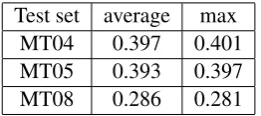
Next we investigated the impact of using dif-ferent ways to compute feature vectors presented in Section 3.1. We re-ran some previous exper-iments on test sets MT04, MT05 and MT08 us-ing MT03+MT06 asDF. Most settings were kept
unchanged except that the feature vector of each sentence was computed according to Equation 4. A 20-best translation list was used to approximate
H(f). The results are shown in Table 4.
Test set average max
MT04 0.397 0.401
MT05 0.393 0.397
MT08 0.286 0.281
Table 4: Translation performance when using av-eraged feature values for similarity computation.
is much simpler, it is a good decision to use it in practice. So did we conduct all following experi-ments based on Equation 5.
We are also interested in the correlation be-tween two measures: the similarity bebe-tween de-velopment and test data and the actual translation performance on test data.
First we would like to echo the motivating ex-periment presented in Section 3. Table 5 shows the similarity between the data sets used in the ex-periment withMMT03+MT06as reference model.
Obviously the results in Table 2 and Table 5 fit each other very well.
Dev data MT05 MT08-nw
MT03 0.99988 0.99012
MT06-nw 0.99004 0.99728
Table 5: Similarity between NIST data sets.
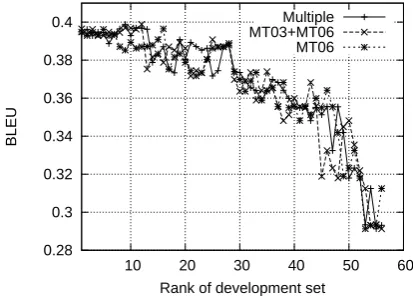
Figure 1 shows the results of a set of more com-prehensive experiments on MT05 data set con-cerning the similarity between development and test sets.
Rank of development set Multiple MT03+MT06 MT06
Figure 1: Correlation between similarity and BLEU on MT05 data set
In the figure, every data line shows how BLEU score changes when different pre-built develop-ment set inSM T03+M T06is used for model
learn-ing. The data points in each line are sorted by the rank of similarity between the development set in use and the MT05 data set. We also compared re-sults based on 3 reference model settings. In the first one (multiple), the similarity was computed
using Equation 6, and the reference model set con-tains all models learnt from the development sets inSM T03+M T06. The other two settings use
refer-ence models learnt from MT06 and MT03+MT06 data sets respectively.
We can observe from the figure that the corre-lation between BLEU scores and data set similar-ity can only be identified on macro scales for all the three similarity settings. Although using data similarity may not be able to select the perfect de-velopment data set fromSDF, by picking a devel-opment set with highest similarity score, we can usually (almost always) get good enough BLEU scores in our experiments.
4.4 Results of Development Data Dynamic Generation
We ran two sets of experiments for the method of development data dynamic construction.
The first one was designed to investigate how the size of extracted development data affects the translation performance. Using MT05 and MT08 as test sets and MT03+MT06 asDF, we ran
ex-periments for the algorithm presented in Section 3.3 with n = 200 to n = 1,000. In this ex-periment we did not observe significant enough changes in BLEU scores – the difference between the highest and lowest numbers is generally less than 0.005.
The second one aimed at examining how BLEU numbers changes when the extracted development data were iteratively updated. Figure 2 shows one set of results on test sets MT05 and MT08 using MT03+MT06 data set asDF andnset to 400.
MT05 BLEU MT08 BLEU
Iteration MT05 MT08
Figure 2: BLEU score as function of iteration in dynamic development data extraction.
it-erations, which is consistent with trend of BLEU scores on test sets. However, in all our experimen-tal settings, we did not observe any results signif-icantly better than using the development set pre-construction method.
5 Discussions
Some of the previous work related to building adaptive SMT systems were discussed in the do-main adaptation context, in which one fundamen-tal idea is to estimate a more suitable domain-specific translation model or language model. When the target domain is already known, adding a small amount of domain data (both monolingual and bilingual) to the existing training corpora has been shown to be very effective in practice. But model adaptation is required in more scenarios other than explicitly defined domains. As shown by the results in Table 2, even for the data from the same domain, distribution mismatch can also be a problem.
There are also considerable efforts made to deal with the unknown distribution of text to be trans-lated, and the research topics were still focused on translation and language model adaptation. Typ-ical methods used in this direction include dy-namic data selection (L¨u et al., 2007; Zhao et al., 2004; Hildebrand et al., 1995) and data weighting (Foster and Kuhn, 2007; Matsoukas et al., 2009). All the mentioned methods use information re-trieval techniques to identify relevant training data from the entire training corpora.
Our work presented here also makes no as-sumption about the distribution of test data, but it differs from the previous methods significantly from a log-linear model’s perspective. Adjust-ing translation and language models based on test data can be viewed as adaptation of feature val-ues, while our method is essentiallyadaptation of feature weights. This difference makes these two kinds of methods complementary to each other — it is possible to make further improvement by us-ing both of them in one task.
To our knowledge, there is no dedicated discus-sion on principled methods to perform develop-ment data selection in previous research. In L¨u et al. (2007), log-linear model parameters can also be adjusted at decoding time. But in their
approach, the adjustment was based on heuristic rules and re-weighted training data distribution. In addition, compared with training data selection, the computational cost of development data selec-tion is much smaller.
From machine learning perspective, both pro-posed methods can be viewed as certain form of transductive learning applied to the SMT task (Ueffing et al., 2007). But our methods do not rely on surface similarities between training and training/development sentences, and develop-ment/test sentences are not used to re-train SMT sub-models.
6 Conclusions and Future Work
In this paper, we addressed the data mismatch is-sue between training and decoding time of log-linear SMT models, and presented principled methods for dynamically inferring test data de-pendent model parameters with development set selection. We describe two algorithms for this task, development set pre-construction and dy-namic construction, and evaluated our method on the NIST data sets for the Chinese-English translation task. Experimental results show that our methods are capable of consistently achiev-ing good translation performance on multiple test sets with different data distributions without manual tweaking of log-linear model parameters. Though theoretically using the dynamic construc-tion method could bring better results, the pre-construction method performs comparably well in our experimental settings. Considering the fact that the pre-consruction method is computation-ally cheaper, it should be a better choice in prac-tice.
References
David Chiang. 2005. A hierarchical phrase-based model for statistical machine translation. InProc. of the 43th Annual Meeting of the Association for Computational Linguistic (ACL). Ann Arbor, Michigan.
George Foster and Roland Kuhn. 2007. Mixture-Model Adaptation for SMT. InProc. of the Second ACL Workshop on Statistical Machine Translation.. Prague, Czech Republic.
Michel Galley, Mark Hopkins, Kevin Knight and Daniel Marcu. 2004. What’s in a translation rule? InProc. of the Human Language Technology Conf. (HLT-NAACL). Boston, Massachusetts.
Almut Hildebrand, Matthias Eck, Stephan Vogel, and Alex Waibel. 1995. Adaptation of the Transla-tion Model for Statistical Machine translaTransla-tion Based on Information Retrieval. InProc. of EAMT. Bu-dapest, Hungary.
Philipp Koehn, Franz Och and Daniel Marcu. 2003. Statistical Phrase-Based Translation. InProc. of the Human Language Technology Conf. (HLT-NAACL). Edmonton, Canada.
Yang Liu, Qun Liu, and Shouxun Lin. 2007. Tree-to-string alignment template for statistical machine translation. In Proc. of the 45th Annual Meet-ing of the Association for Computational LMeet-inguistic (ACL). Prague, Czech Republic.
Yajuan L¨u, Jin Huang and Qun Liu. 2007. Improv-ing Statistical Machine Translation Performance by Training Data Selection and Optimization. InProc. of the Conference on Empirical Methods in Natural Language Processing. Prague, Czech Republic. Spyros Matsoukas, Antti-Veikko I. Rosti and Bing
Zhang. 2009. Discriminative Corpus Weight Es-timation for Machine Translation. InProc. of the Conference on Empirical Methods in Natural Lan-guage Processing. Singapore.
Franz Och and Hermann Ney. 2002. Discriminative Training and Maximum Entropy Models for Statis-tical Machine Translation. InProc. of the 40th An-nual Meeting of the Association for Computational Linguistic (ACL). Philadelphia, PA.
Franz Och. 2003. Minimum Error Rate Training in Statistical Machine Translation. InProc. of the 41th Annual Meeting of the Association for Computa-tional Linguistic (ACL). Sapporo, Japan.
Nicola Ueffing, Gholamreza Haffari and Anoop Sarkar. 2007. Transductive learning for statistical machine translation. In Proc. of the Annual Meet-ing of the Association for Computational LMeet-inguis- Linguis-tics. Prague, Czech Republic.