Expected Divergence based Feature Selection
for Learning to Rank
Par th Gupta Paolo Rosso
Natural Language Engineering Lab - ELiRF Department of Information Systems and Computation
Universidad Politecnica de Valencia, Spain
http://www.dsic.upv.es/grupos/nle pgupta,[email protected]
A
BSTRACTFeature selection methods are essential for learning to rank (LTR) approaches as the number of features are directly proportional to computational cost and sometimes, might lead to the over-fitting of the ranking model. We propose an expected divergence based approach to select a subset of highly discriminating features over relevance categories. The proposed method is evaluated in terms of performance of standard LTR algorithms when trained with reduced features over a set of standard LTR datasets. The proposed method leads to not significantly worse, and in some cases, significantly better performance compared to the baselines with as few features as less than 10%. The proposed method is scalable and can easily be parallelised.
T
ITLE ANDA
BSTRACT IN ANOTHER LANGUAGE,
L
2(
OPTIONAL,
AND ON SAME PAGE)
r
ZF aEDgm к
Ele ap
E?шt Evcln aADAErt n?ш cyn
rZF aEDgm (learning to rank) rEyA к Ele n?ш cyn pdEtyA mh(vpZ h{\, yo\Eк s\gZA(mк mSy, n?ш s\HyA s smAnpAtF h{ aOr кBF кBF n?ш s\HyA r\Eк\g mAXl кF aovr-E'EV\g кo rErt кrtA h{। hm n?ш cyn к Ele apE?шt Evcln aADAErt pdEt кA r-tAv кrt h{\ яo rAs\Egк vgo m\ aEt EvvкF n?ш upgZ кA cyn кrtF h{। r-tAEvt pdEt кA mAy rZF aEDgm s\g}h pr aSp n?шo\ s rEшE?шt mAy rZF aEDgm кln gEZto\(algorithms)к s\pAdn s mSyA\кn EкyA gyA h{। r-tAEvt pdEt aADAr rхAao\ кF tlnA m\ EsP 10%n?шo\ к upyog snot significantly worseaOr кC Eк-so\ m\significantlybhtr rdшn EdхA rhF h{। r-tAEvt pdEt -кlbl h{ aOr aAsAnF s smAtr clAи яA sкtF h{।
K
EYWORDS:
feature selection, ranking.1 Introduction
Ranking is one of the most important modules of Information Retrieval (IR) systems. Unsuper-vised ranking models like BM25 okapi and language models have power to rank documents with limited number of features such as term frequency (TF), inverse document frequency (IDF), document length (DL). Although they can rank with speed and without the need of labeled relevance information, they are quite restrictive for the incorporation of more features such as age, link information in web graph, click information etcetera of the document. Elimi-nation of such features from ranking might prove to be a big limitation in the rapidly increasing and annotation rich Web. To overcome this limitation, the research community has posed the ranking problem in machine learning framework and referred as learning to rank (LTR). LTR is a supervised setting of ranking in the IR system where, each document for the given query is represented as a feature vector to which, the ranking function assigns a score. The ranking function is trained on a prelabelled training data.
Over the time, the number of features used in the learning to rank has increased drastically. Although increasing number of features induces more information for the ranking algorithms, it is directly related to the computational complexity and to some extent the over-fitting of the ranking model in some cases. As a result, the attempts to reduce the dimensionality of the feature vector subsequently started (Geng et al., 2007; Pan et al., 2009; Dang and Croft, 2010).
Among a few approaches of feature selection for LTR, Geng et al. (2007) proposed an effi-cient greedy feature selection method for ranking that finds the features with maximum total importance scores and minimum total similarity scores. The greedy search algorithm over an undirected graph of features was employed to solve the optimization problem. In con-trast, Dang and Croft (2010) used best first search to come up with subsets of features and coordinate ascent to learn the weights for those features. This approach, feature selection -best first search (FS-BFS), has recently shown to outperform the greedy approach, hence we
use it as one of the baselines to compare with. Pan et al. (2009) used boosting trees with ran-domized and greedy approach, where thwrapperapproach was taken with forward selection and backward elimination.
In our approach, the subset of features are selected based on their expected divergence over the relevance classes and the importance of features are estimated by the evaluation scores produced individually by the features. We use Kullback-Leibler (KL) divergence to estimate the divergence and adapt it to make it more suitable for the ranking. The results with the proposed method are reported on a set of standard LTR datasets with three state-of-the-art LTR algorithms RankSVM (Herbrich et al., 2000), RankBoost (Freund et al., 2003) and Lam-daMart (Wu et al., 2010). We use the performance of LTR algorithms when learnt with all features (WAF) as another baseline. The performance achieved with the proposed feature
se-lection method is statistically similar to the baselines and in some cases the performance is significantly improved with very few features as 10%. Moreover, the proposed algorithm can easily be parallelised.
2 Method
The feature selection methods of typefilter, as defined in Guyon and Elisseeff (2003), com-putes the score of each feature as a preprocessing step and the subset of features are selected based on the scores assigned. In contrast tofiltermethods,wrappermethods use the learning algorithms to assign scores to the features. We opt for afilterapproach and refer it as feature selection - expected divergence (FS-ED), whileFS-BFSis awrapperapproach.
The proposed method has two components: (i) the importance of the features defined ass(fi) and, (ii) the expected divergence of the features defined asd(fi). The goal of the method is to score each featurefi∈F, whereFis the set of all features and|F|=n. We pose the feature selection method as a maximization problem of selecting topkfeatures from Fwhere, the score of a featureψ(·)is calculated as shown in Eq. 1. For the simplicity, we combine the two objective functions linearly.
ψ(fi) =s(fi) +d(fi) (1) As reported in Geng et al. (2007), the feature importances(fi)derived from evaluation scores and learning algorithms lead to statistically similar results. Hence, we opt for the evaluation measure, NDCG@10, to estimate the importance of an individual feature. The evaluation score for the queries in the training data using a particular feature value individually to rank documents is considered as the importance scores(fi).
Usually, the features which can not better discriminate between relevance classes do not add more knowledge for the learning algorithm. This discrimination can be better captured by measuring the divergence of the feature on relevance classes. In order to estimate the di-vergence of a feature over the relevance classes, we use KL didi-vergence. KL didi-vergence has successfully been used for the feature selection methods for classification problems (Coetzee, 2005; Schneider, 2004). Because of the intuitive differences between the classification and ranking, we adapt and call it as expected divergence which, to the best of our knowledge, is novel. Classes in ranking are ordinal relevance levels, while they are unordered categories in case of classification. Hence, we boost the divergence of a feature over distant relevance classes by the expected divergence. For example, consider a 5-scale relevance system with relevance classesri∈Rwherei∈ {0, 1, .., 4}, the divergence of a feature overr0andr4is far more important than that overr0andr1. The expected divergence of a feature is calculated as shown in Eq. 2.
d(fi) = |∑R|−1
m=0 |∑R|−1 n=m+1
(n−m)∗div(frm
i ,firn) (2)
where,
div(frm i ,firn) =
1 2dK L
ˆ
frm i ||fˆiav g
+12dK L
ˆ
frn i ||fˆiav g
(3)
Eq. 3 is the Jensen-Shannon divergence where,fˆrm
i is the estimated probability density func-tion (PDF) using kernel density estimafunc-tion (KDE) ofithfeature over relevance classr
mlearnt from the training data and estimated on the validation data as shown in Eq. 4, ˆfiav g is an average over both relevance classes anddK Lis KL divergence.
ˆ
fi= 1 Mh M ∑ j=1 ϕ
x−x j h
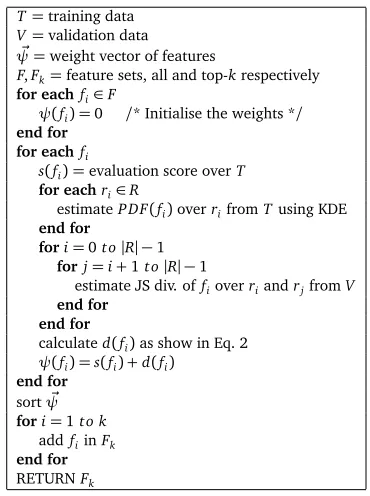
where,Mis the total number of samples in the training data,xjandxrefers to the value ofith feature in the training and validation data respectively ,his the bandwidth which is estimated usingSilverman’s rule of thumb(Bernard, 1986) and the kernel is chosen as standard normal distribution (ϕ). The complete feature selection method is described in Fig. 1.
T=training data V=validation data
⃗
ψ=weight vector of features
F,Fk=feature sets, all and top-krespectively
for eachfi∈F
ψ(fi) =0 /* Initialise the weights */
end for for eachfi
s(fi)=evaluation score overT
for eachri∈R
estimateP DF(fi)overrifromTusing KDE
end for
fori=0to|R| −1
forj=i+1to|R| −1
estimate JS div. offioverriandrjfromV
end for end for
calculated(fi)as show in Eq. 2 ψ(fi) =s(fi) +d(fi)
end for
sortψ⃗
fori=1to k
addfiinFk
end for
[image:4.420.110.295.117.365.2]RETURNFk
Figure 1: Feature selection procedure.
3 Experimental Setup
In order to compare the proposed method with the baselines, we use the performance evalua-tion of three state-of-the-art LTR algorithms when trained with selected features on four stan-dard LTR datasets. We use NDCG@10 as metric and five-fold cross valiadation. NDGC@10 estimates the quality of ranking especially in the graded multi-scale relevance level set-ting (Jarvelin and Kekalainen, 2002). Each ranking method is trained over training set and the model that performs best on validation set is used for testing in each fold.
3.1 Ranking Methods
3.1.1 RankSVM
available implementation of RankSVM1to train the model on training data and choose the parameters which maximizes the performance on the validation data. We use linear kernel, epsilon=0.001 and loop over[0.00001, 10]with step of x2 to estimateC.
3.1.2 RankBoost
RankBoost (Freund et al., 2003) is another popular pairwise LTR algorithm based on boosting technique. The boosting algorithm uses weak rankings to update the weights of the pairs. The weights of the correctly ranked instances are decreased and that of incorrectly ranked are increased to give them more importance in the next round. Finally, a linear combination of weak rankers is produced. We used a publicly available implementation of RankBoost2and train the model until no performance change is observed for 100 iterations.
3.1.3 LambdaMART
LambdaMART (Wu et al., 2010) uses gradient boosting, to optimize a ranking cost function, which produces an ensemble of regression trees. The final model can be seen as a weighted combination of such trees as shown in Eq. 5 where,Nis the total number of regression trees andαiis the weight associated withithtree.
FN(x) = N ∑
i
αi∗fi(x) (5)
More details, about LambdaMART can be found in Burges (2010). We used a publicly available implementation of LambdaMART2with following mentioned parameters,# of trees=1000, learning rate=0.1 and# of tree leaves=10.
3.2 Datasets
We conduct the experiments on three standard LTR datasets: (i) OHSUMED, (ii) Letor 4.0 and (iii) Yahoo!. OHSUMED (Hersh et al., 1994) is a part of Letor 3.0 and contains documents from the MEDLINE, a corpus of medical publications. This corpus contains 106 queries, 3 levels and 45 features. The Letor 4.0 dataset is created from the Gov-2 document collection which contains roughly 25 million Web pages. It contains two query-sets MQ2007 and MQ2008 corresponding to years 2007 and 2008 editions of TREC Million Query track3. The Letor 4.0 has in total 2476 queries, 3 relevance levels and 46 features. We used Yahoo! SET 2 query-set which contains the LTR data of the commercial search engine and has 6330 queries, 5 relevance levels and 699 features.
Although the dimensionality of features in OHSUMED and Letor 4.0 is less than 50, we con-sider necessary to report results on these datasets. Based on the feature analysis presented in Geng et al. (2007), features importance in OHSUMED and .Gov datasets are highly differ-ent. Moreover, Information Gain and CHI basedf il terapproaches perform quite differently on them, hence we opt to investigate the stability of the proposed method on these datasets too.
3.3 FS-BFS
TheFS-BFSis awrapperbased approach of feature selection for ranking (Dang and Croft,
2010). The method partitions theFinto non-overlappingksubsets and learns a ranking model which maximizes the performance over that subset of features. Best first search is used on the undirected graph of features to extract subsets and the weights of the features are learnt using coordinate ascent. Each best subset will be a weighted combination of the original features in the subset and will represent a completely new feature. We use the parameters as defined in (Dang and Croft, 2010).
[image:6.420.109.297.345.431.2]4 Results and Discussion
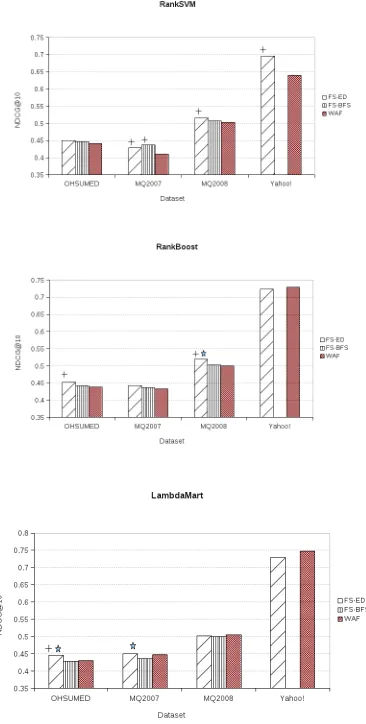
Fig. 2 represents the performance evaluation of RankSVM, RankBoost and LamdaMART when trained withFS-ED,FS-BFSandWAF. We did the significance TTest of the results where we
consider thep-value<0.05 for statistical significance. As can be noticed from the figures,
FS-EDperforms statistically similar to the baselines in all the cases and in some cases it
signif-icantly outperforms the baselines. FS-BFSis a very computation intensive model and it was
impractical to optimize the best first search over 699 features graph of a large dataset on our server. Therefore, the the results on Yahoo! dataset are not available withFS-BFS4. Here, we
would like to mention that, inFS-ED, the scoring of a feature does not depend on the other
features’ scores so it can easily be parallelised for individual features as can be noticed from Fig. 1. On the contrary,FS-BFScan not be parallelised as the optimization of the consecutive
subset depends on the prior best subset. Just to mention, runningFS-EDon our server with
parallelisation on 8 processors produced results for Yahoo! dataset in∼1.5 hours under nor-mal CPU load. We would also like to mention, the selection method of features presented in Geng et al. (2007) also depend on other features similarity with it, hence making it much com-putation intensive when running for large datasets like Yahoo!. Table 1 reflects the number of features used to produce the best results. It is noticeable that in some casesFS-EDwas able
to produce the best results using less than 10% of total features on all datasets.
FS Method O M7 M8 Y R. Method
FS-ED
15 3 3 50 RankSVM
4 15 15 75 RankBoost 20 10 20 75 LambdaMART
FS-BFS
6 9 12 - RankSVM
12 7 7 - RankBoost
14 10 7 - LambdaMART
WAF 45 46 46 699 ALL
Table 1: The number of features used to obtain the results reported in Fig. 2 with different feature selection strategies. O, M7, M8 and Y refer to OHSUMED, MQ2007, MQ2008 and Yahoo! respectively.
The proposed method exhibit similar behaviour on datasets like OHSUMED, MQ2007 and MQ2008 while, an interesting behaviour is noticed on Yahoo! dataset.FS-EDachieved more
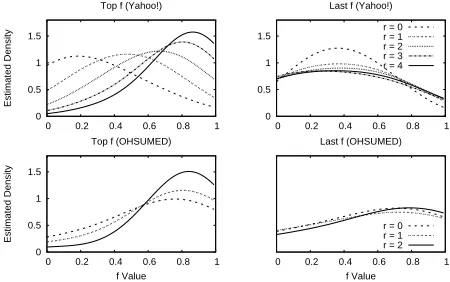
than 5 point gain in NDCG@10 for RankSVM with only 50 features while performed relatively worse with RankBoost and LambdaMART. To understand this phenomenon better, we anal-ysed the distribution of the top and last features obtained usingFS-EDover the relevance
Figure 2:Performance evaluation of feature selection schemes on different datasets with RankSVM, RankBoost and LambdaMART.+and⋆indicate statistical significance with WAF and the other FS strategy respectively.
rank-ing models. We consider this as the main reason whereFS-EDperforms better compared
toWAF. Because of this characteristic, the large margin classifier based ranking models like
RankSVM are benefited more compared to the weak learner based models like RankBoost and LambdaMART. The weak learner based models can easily minimise the importance of the less discriminative features by assigning less weight and hence the performance does not rapidly deteriorate as compared to large margin classifiers based models. This phenomenon makes the proposed method much efficient and important for the large-margin classifier based rankers which can clearly be noticed from statistical significance ofFS-EDoverWAFacross the datasets
for RankSVM. The method is quite robust, as the feature importance component captures the linearity of features over relevance classes while the expected divergence component enables the method to capture the non-linearity. Eventhough the experiments are carried for the doc-ument retrieval task of information retrieval, the observations remain intact when the feature selection is performed for a task where classes are ordinal.
0 0.5 1 1.5
0 0.2 0.4 0.6 0.8 1
Estimated Density
Top f (Yahoo!)
0 0.5 1 1.5
0 0.2 0.4 0.6 0.8 1 Last f (Yahoo!)
r = 0 r = 1 r = 2 r = 3 r = 4
0 0.5 1 1.5
0 0.2 0.4 0.6 0.8 1
Estimated Density
f Value Top f (OHSUMED)
0 0.2 0.4 0.6 0.8 1 f Value
Last f (OHSUMED)
[image:8.420.87.312.202.343.2]r = 0 r = 1 r = 2
Figure 3:The estimated density of the top and last features according to FS-ED over relevance classes (r) on Yahoo! and OHSUMED. X-axis denote values a feature can take. The features having constant or zero value for all the queries are excluded.
5 Remarks
We proposed an expected divergence based feature selection method for learning to rank. The method is very efficient and can be parallelised. The proposed method leads to not significantly worse, and in some cases, significantly better performance compared to the baselines with as few features as less than 10% on a set of standard datasets and state-of-the-art LTR algorithms. We analysed the selected features over the relevance classes and exhibit that large margin classifier based ranking models can greatly benefit from the selection method.
6 Acknowledgement
References
Bernard, S. (1986).Density estimation for statistics and data analysis (Chapman & Hall/CRC Monographs on Statistics & Applied Probability). Chapman and Hall/CRC, 1 edition.
Burges, C. J. (2010). From ranknet to lambdarank to lambdamart: An overview. InMicrosoft Research Technical Report MSR-TR-2010-82.
Coetzee, F. M. (2005). Correcting the kullback-leibler distance for feature selection.Pattern Recogn. Lett., 26(11):1675–1683.
Dang, V. and Croft, B. W. (2010). Feature selection for document ranking using best first search and coordinate ascent. InSIGIR Workshop on Feature Generation and Selection for Information Retrieval,, SIGIR ’10.
Freund, Y., Iyer, R., Schapire, R. E., and Singer, Y. (2003). An efficient boosting algorithm for combining preferences.J. Mach. Learn. Res., 4:933–969.
Geng, X., Liu, T.-Y., Qin, T., and Li, H. (2007). Feature selection for ranking. In Proceed-ings of the 30th annual international ACM SIGIR conference on Research and development in information retrieval, SIGIR ’07, pages 407–414, New York, NY, USA. ACM.
Guyon, I. and Elisseeff, A. (2003). An introduction to variable and feature selection.J. Mach. Learn. Res., 3:1157–1182.
Herbrich, R., Graepel, T., and Obermayer, K. (2000).Large margin rank boundaries for ordinal regression. MIT Press, Cambridge, MA.
Hersh, W., Buckley, C., Leone, T. J., and Hickam, D. (1994). Ohsumed: an interactive retrieval evaluation and new large test collection for research. InProceedings of the 17th annual in-ternational ACM SIGIR conference on Research and development in information retrieval, SIGIR ’94, pages 192–201, New York, NY, USA. Springer-Verlag New York, Inc.
Jarvelin, K. and Kekalainen, J. (2002). Cumulated gain-based evaluation of ir techniques. ACM Trans. Inf. Syst., 20(4):422–446.
Pan, F., Converse, T., Ahn, D., Salvetti, F., and Donato, G. (2009). Feature selection for ranking using boosted trees. InProceedings of the 18th ACM conference on Information and knowledge management, CIKM ’09, pages 2025–2028, New York, NY, USA. ACM.
Schneider, K.-M. (2004). A new feature selection score for multinomial naive bayes text classification based on kl-divergence. InProceedings of the ACL 2004 on Interactive poster and demonstration sessions, ACLdemo ’04, Stroudsburg, PA, USA. Association for Computational Linguistics.