Fast and Robust POS tagger for Arabic Tweets
Using Agreement-based Bootstrapping
Fahad Albogamy, Allan Ramsay
School of Computer Science The University of ManchesterManchester, M13 9PL, UK
{fahad.albogamy, allan.ramsay}@manchester.ac.uk
Abstract
Part-of-Speech (POS) tagging is a key step in many NLP algorithms. However, tweets are difficult to POS tag because they are short, are not always written maintaining formal grammar and proper spelling, and abbreviations are often used to overcome their restricted lengths. Arabic tweets also show a further range of linguistic phenomena such as usage of different dialects, romanised Arabic and borrowing foreign words. In this paper, we present an evaluation and a detailed error analysis of state-of-the-art POS taggers for Arabic when applied to Arabic tweets. On the basis of this analysis, we combine normalisation and external knowledge to handle the domain noisiness and exploit bootstrapping to construct extra training data in order to improve POS tagging for Arabic tweets. Our results show significant improvements over the performance of a number of well-known taggers for Arabic.
Keywords:Arabic tweets, POS tagging, Bootstrapping
1.
Introduction
The last few years have seen an enormous growth in the use of social networking platforms such as Twitter in the Arab World. A study prepared and published by Semiocast in 2012 has revealed that Arabic was the fastest growing language on Twitter in 2011. People post about their lives, share opinions on a variety of topics and discuss current is-sues. There are millions of tweets daily, yielding a corpus which is noisy and informal, but which is sometimes infor-mative. As a result, Twitter has become one of the most important social information mutual platforms. The nature of the text content of microblogs differs from traditional blogs. In Twitter, for example, a tweet is short and contains a maximum of 140 characters. Tweets also are not always written maintaining formal grammar and proper spelling. Slang and abbreviations are often used to overcome their restricted lengths (Java et al., 2007).
POS tagging is an essential processing step in a wide range of high level text processing applications such as informa-tion extracinforma-tion, machine translainforma-tion and sentiment analysis (Barbosa and Feng, 2010). However, people working on Arabic tweets have tended to concentrate on low level lexi-cal relations which were used for shallow parsing and sen-timent analysis such as (Mourad and Darwish, 2013; El-Fishawy et al., 2014). They do not use the standard lin-guistic pipeline tools such as POS tagging which might en-able a richer linguistic analysis (Gimpel et al., 2011). The properties listed above of the microblogging domain make POS tagging on Twitter very different from its counterpart in more formal texts. It is an open question how well the features and techniques of NLP used on more well-formed data (e.g. in the newswire domain) will transfer to Twitter in order to understand and exploit tweets. Therefore, we experimentally evaluate the performance of state-of-the-art POS taggers for Modern Standard Arabic (MSA) on Arabic tweets. POS tagging accuracy drops from about 97% on MSA to 49-65% on Arabic tweets. We also analyse their
limitations and errors they made. Finally, we propose an approach to boost their performance.
Our contributions in this paper are as follows:
1. Evaluating how robust state-of-the-art POS taggers for MSA are on Arabic tweets (Section 4.2.) and identify-ing problem areas in taggidentify-ing Arabic tweets and what caused the majority of errors (Section 4.3.).
2. Boosting the taggers’ performance on Arabic tweets by using pre- and post-processing techniques to ad-dress Arabic tweets’ noisiness (Section 5.1.).
3. Investigating ’agreement-based bootstrapping’ on un-labelled Arabic tweets, to create a sufficient amount of tweets training data (Section 5.2.).
2.
Related Work
POS tagging is a well-studied problem in computational linguistics and NLP over the past decades. This can be in-ferred from the high accuracy of state-of-the-art POS tag-ging not only for English, but also most other languages such as Arabic, which reaches 97% for Arabic and English being at 97.32% (Gadde et al., 2011). However, the per-formance of standard POS taggers for English is severely degraded on Tweets due to their noisiness and sparseness (Ritter et al., 2011). Therefore, POS taggers for English tweets have been developed such as ARK, T-Pos and GATE TwitIE which reaches 92.8%, 88.4% and 89.37% accuracy respectively (Derczynski et al., 2013).
people post on Twitter. They also have been built specif-ically for dialectal Arabic and subjectivity and sentiment analysis.
Our work is, to best of our knowledge, the first step towards developing a POS tagger for Arabic tweets which can ben-efit a wide range of downstream NLP applications such as information extraction and machine translation. We evalu-ate the existing stevalu-ate-of-the-art POS tagging tools on Arabic tweets, with an intention of developing a POS tagger for Arabic tweets by utilising the existing standard POS tag-gers for MSA instead of building a separate tagger. We use pre- and post-processing modules to improve their accu-racy. Then, we use agreement-based bootstrapping on unla-belled data to create a sufficient amount of launla-belled training tweets that we can train our proposed tagger on it.
3.
Data Collection
There is a growing interest within the NLP community to build Arabic social media corpora by harvesting the web such as (Refaee and Rieser, 2014; Abdul-Mageed et al., 2012). However, none of these resources are publicly avail-able yet. They also do not contain all phenomena of tweets as they appear in their original forms in Twitter and they have been built to be used mainly in sentiment analysis. Hence, we built our own corpus which preserves all phe-nomena of Arabic tweets. We used Twitter Stream API to crawl Twitter by setting a query to retrieve tweets from the Arabian Peninsula by using latitude and longitude coordi-nates of these regions since Arabic dialects in these regions share similar characteristics and they are the closest Ara-bic dialects to MSA. We did not restrict tweets language to ”Arabic” in the query since users may use other character sets such as English to write their Arabic tweets (Romanisa-tion) or they may mix Arabic script with another language in the same tweets. Next, we excluded all tweets which were written completely in English. Then, we sampled 390 tweets (5454 words) from the collected set to be used in our experiments (similar studies for English tweets also use a few hundred tweets e.g. (Gimpel et al., 2011)).
4.
Evaluating Existing POS Taggers
We start by evaluating three state-of-the-art publicly avail-able POS taggers for Arabic, namely AMIRA (Diab, 2009), MADA (Habash et al., 2009) and Stanford (Toutanova et al., 2003).
4.1.
Gold Standard
A set of correctly annotated tweets (gold standard) is re-quired in order to be able to appraise the outputs of POS taggers. Once we have this, we can compare the outputs of the POS taggers with this gold standard. Since there is no publicly available annotated corpus for Arabic tweets, we have created POS tags for Twitter phenomena (i.e. REP, MEN, HASH, LINK, USERN and RET for replies, men-tions, hashtags, links, usernames and retweets respectively) and we manually annotated our dataset. To speed up man-ual annotation, we tagged tweets by using the taggers, and then we corrected the output of the taggers to construct a gold standard.
4.2.
POS Tagging Performance Comparison
We compare three taggers on 390 tweets (5454 words) from our corpus. The performance of these taggers is com-puted by comparing the output of each tagger against the manually corrected gold standard. We use standard pcision, recall and F-score as evaluation measures. The re-sults for AMIRA, MADA and Stanford, which were trained on newswire text, present poor success rates, for example, the precision for AMIRA, MADA and Stanford on Arabic tweets are 60.2%, 65.8% and 49.0% respectively (see Ta-ble 1). These figures are far below the performance of the same taggers on newswire genres, where accuracy is around 96% for AMIRA and Stanford whereas MADA achieves over 97% accuracy1. This huge drop in the accuracy of
these taggers on Arabic tweets warrants some analysis of the problem and of mistagged cases.
Tagger Newswire Arabic Tweets
AMIRA 96.0% 60.2%
MADA 97.0% 65.8%
Stanford 96.5% 49.0%
Table 1: POS tagging accuracy for three off-the-shelf tag-gers
4.3.
Error Analysis
We noticed that most of the mistagged tokens are unknown words. In this case, the taggers rely on contextual clues such as the word’s morphology and its sentential context to assign them the most appropriate POS tags (Foster et al., 2011). We identified the unknown words that were mistagged and classified them into three groups: Arabic words, Twitter-specific and non-Arabic tokens. Table 2 shows baseline taggers’ performance on each category.
Arabic words These are words which are written in
Arabic, but which were assigned incorrect POS tags by the taggers. This category represents 73.5%, 68.1% and 73.2% of the total of mistagged items by AMIRA, MADA and Stanford respectively. We observed that words in
Tokens AMIRA MADA Stanford
Arabic words 67.1% 73.8% 54.0% Twitter-specific 0.0% 0.0% 0.0% Non-Arabic 19.9% 9.1% 14.0%
Overall 60.2% 65.8% 49.0%
Table 2: POS tagging accuracy on Arabic Tweets for base-line taggers categorised by tokens
this category have different characteristics and most of them are twitter phenomena. So, we classify them into subcategories as follows:
MSA words These are proper words which are used in
well-formed text and part of MSA vocabulary, but which were assigned incorrect POS tags by the taggers. We ob-served that the accuracy of MSA words which are not noisy dropped from 96% for AMIRA, 97% for MADA and 96.5%
1These taggers’ performance on newswire are provided in the
for Stanford on newswire domain to 71.8%, 79.3% and 62% respectively on Arabic tweets. There are three pos-sible reasons for that:1) the context of MSA words be-ing noisy, 2) text structure has been changed, for exam-ple, many function words are omitted in tweets and 3) the domain change between the Arabic Treebank corpus (PATB) on which they were trained and tested and the Ara-bic tweets. For example, the word ”A J«” (disobey) was taggedNNby AMIRA,nounby MADA andNNPby Stan-ford but, in fact, it is a verb. A larger training data and making the context less noisy may reduce this error.
Concatenation In this classification, two or more words
were connected to each other to form one token. So, the taggers struggled to label them. Users may connect words deliberately to overcome tweets restricted length or acci-dentally. In this experiment, the taggers mistagged all con-nected words in the subset. For example, the word ” à@Y»AK”
was labelledNNby AMIRA, labellednounby MADA and taggedNNPby Stanford. But, in fact, it is two words ”Y»AK”
and ” à@” connected together which are a verb and a
conjunc-tion respectively.
Repeated lettersWords in this classification have one or
more letters repeated. Users repeat letters deliberately to express subjectivity and sentiment. For example, the word ” áJJJJJJJ ®¯@@@@@@@@@@@@@ð” (standing) was labelledNNSby AMIRA and Stanford andnounby MADA, but it is an adjective.
Named entities All of these words should be labelled
proper noun by the taggers because they refer to person, place or organization, but they mistagged them since these words were not part of their training data. For example, the proper noun ”ÕÎÓ” was taggedNNby AMIRA and Stanford
and labellednounby MADA.
Spelling mistakesIt is not easy to know the intent of the
user, but some words seem likely to have been accidentally misspelled. Most words belonging to this category were mistagged by the taggers. For example, the word ”èQ»” was
misspelled and it should be written as ”HQ »” (abounded).
AMIRA and Stanford tagged it NN and MADA labelled itnounbut, in fact, it is a verb.
SlangThe words in this category are regarded as informal
and are typically restricted to a particular context or group of people. They are often mistagged by the taggers. For example, the slang word ”¬ñ ” is the counterpart of MSA
word ”Q ¢@” which meanslook!.
Characters deletionArabic users delete letters from words
deliberately to overcome tweets restricted length or because they do not have enough time to write complete words. For example, the word ”ú
¯” (at) was shortened to only one letter
”¬”. This word was tagged PUNC by AMIRA, conj by
MADA andCCby Stanford but, in fact, it is a preposition.
Transliteration Arabic users borrow some words and
multiwords abbreviations from English. They use their Arabic transliteration in Arabic tweets. For example, LOL in English (Laugh Out Loud) is written in Arabic as ”ÈñË” and ”mix” in English is written in Arabic as ”ºÓ” .
AMIRA and Stanford tagged the translated form of mix as
NNwhereas MADA labelled them all asnounbut, in fact, it is a verb.
Twitter-specific They are elements that are unique to
Twitter such as reply, mention, retweet, hashtag and url. They represent 19.6%, 22.8% and 20.2% of the total of mistagged items by AMIRA, MADA and Stanford respectively. In fact, taggers mistagged all Twitter-specific elements in the experiment and they tokenised them in different ways. AMIRA uses punctuation as an indicator for a new token so replies, mentions, retweets and hashtags in tweets are broken into the indicator part (@ for replies, mentions and retweets and # for hashtags) and the remain-der of them. Moreover, if the remainder part contains punctuation marks, AMIRA will split it further into parts. AMIRA also breaks urls into parts since they contain punctuation marks. In contrast, MADA and Stanford do not break all Twitter-specific elements into parts since they use the space as an indicator for a new token. MADA has one exception to this rule. If a hashtag started with an Arabic letter, then MADA breaks it into parts when punctuation is found. We notice that MADA always labels unsplitted Twitter-specific elements as nounsnoun.
Non-Arabic tokens This group contains the
remain-ing twitter phenomena which are appear in Arabic tweets, but which are not written by using the Arabic alpha-bet. They represent 6.9%, 9.1% and 9% of the total of mistagged items by AMIRA, MADA and Stanford respectively.We classify them into subcategories based on their shared characteristics as follows:
Romanisation Arabic users sometimes use Latin letters
and Arabic numerals to write Arabic tweets because the actual Arabic alphabet is unavailable for technical reasons, difficult to use or they speak Arabic but they cannot write Arabic script. For example, the word 3ala which is the Romanised form of the Arabic word ”úΫ” was tagged NN
by AMIRA, labellednounby MADA andCDby Stanford but, in fact, it is a preposition.
Emoticons They are constructed by using traditional
alphabetics or punctuation, usually a face expression. They are used by users to express their feelings or emotions in tweets. AMIRA and MADA break emoticons into parts during tokenisation processes and they deal with each part as punctuation so all emoticons lost their meaning. For example, the emoticon (= was broken into two parts: ”(” (labelled PUNC) and ”=” (labelled PUNC). In contrast, Stanford does not break them into parts but it mistagged all of them.
Untagged emoji Emoji means symbols provided in
software as small pictures in line with the text which are used by users to express their feelings or emotions in tweets. AMIRA and MADA omitted these symbols in the tokenisation stage and they did not tag them. For example, the heart symbol ♥ was omitted when tweets were tokenised by the taggers. In contrast, Stanford does not omit them but it mistagged all of them.
Foreign wordsSome Arabic tweets contain foreign words
especially from English. These words may refer to events, locations, English hashtags or retweet of English tweets with comments written in Arabic. ”I’m at Arab Bank
úG.QªË@ ½ JJ.Ë@” this tweet is an example of this category. AMIRA
whereas MADA labelled them all asnoun.
5.
Improving POS Tagging Performance
Our experiments show that the taggers present poor suc-cess rates since they were trained on newswire text and de-signed to deal with MSA text. They fail to deal with Twitter phenomena. As a result, their outcomes are not useful to be used in linguistics downstream processing applications such as information extraction and machine translation in microblogging domain. Therefore, there is a need for a POS tagger which should take into consideration the char-acteristics of Arabic tweets and yield acceptable results. Our goal is not to build a new POS tagger for Arabic tweets. The goal is to make existing POS taggers for MSA robust towards noise. There are two ways to do so, one is to retrain POS taggers on Arabic tweets and alter their implementa-tion if needed, the other is to overcome noise through pre-and post-processing to the tagging. Our approach is based on both approaches. We combine normalisation and exter-nal knowledge to boost the taggers’ performance. Then, we retrain Stanford tagger on Arabic tweets since its speed is ideal for tweets domain and it is only the retrainable tagger. However, we do not have suitable labelled training data to do so. Therefore, we use bootstrapping on unlabelled data to create a sufficient amount of labelled training tweets.5.1.
Pre- and Post-processing
As seen in error analysis, unknown words (out-of-vocabulary tokens or OOV) represent a large proportion of mistagged tokens. We argue that normalisation and exter-nal knowledge will reduce this proportion which will im-prove the performance of the proposed tagger. Normalisa-tion is the process of providing in-vocabulary (IV) versions of OOV words (Han and Baldwin, 2011). We create a map-ping from OOV tokens to their IV equivalents by using suit-able dictionaries and the original token is replaced with its equivalent IV token. External sources of knowledge such as regular expression rules, gazetteer lists and an output of English tagger are also used. The combination of normali-sation and external knowledge is applied to text as pre- and post-processing steps.
Handling ConcatenationUsers may connect words
delib-erately to overcome tweets restricted length or accidentally. This forms tokens which all taggers struggle to tag them correctly. One approach to deal with these cases is to use a MSA dictionary. We constructed a MSA dictionary from 250k Arabic words which were extracted from news web-site2. We handle concatenation for a word in the corpus W
as follows:
1. If the length of W is <= 5, then it is left as it is, since the average length of Arabic words is five let-ters (Mustafa, 2012).
2. Else, if W exists in the MSA dictionary, then it is left as it is, since it is a valid MSA word.
3. Else, if a part P of W exists in the MSA dictionary, then W is split into two parts P and the remainder and the same steps are applied to the remainder.
2
http://sourceforge.net/projects/ar-text-mining/files/Arabic-Corpora/
We apply the above algorithm on ” à@Y»AK”. The length of this
token is six characters, it is larger than the average length of Arabic words, so we check if it exists in the MSA dictio-nary, but it does not exist in the dictionary. Then we check if any part of it exists in the dictionary, we find ”Y»AK” in the
dictionary so we split the token into two parts ”Y»AK” and the
remaining characters and then we apply the algorithm on the second part. Because the length of the second part ” à@”
is two characters, it is left as it is and the algorithm stops.
Handling Elongated Words We handle these cases by
us-ing the same MSA dictionary mentioned above. Given a word in the corpus W, we do the following steps:
1. If a word W exists in the MSA dictionary, then it is left as it is, even it contains repeated letters.
2. Else, a compressed form of it is constructed by remov-ing any repetition in letters.
As shown in Table 3, the first two tokens do not exist in the dictionary. So, they are replaced by their compressed forms. The third token has repeated letters, but it exists in the dictionary so it is left as it is.
Token MSA Surface form Translation
áJJJJJJJ ®¯@@@@@@@@@@@@@ð No á ®¯@ð Standing
Õæ @A®Ë@@ No Õæ A®Ë@ Algasim
é<Ë@ Yes é<Ë@ Allah
Table 3: Elongated words and their surface forms
Handling Characters DeletionWe have noticed that users
tend to shorten closed-class lexical items more than other speech classes to overcome tweets restricted length since it is easy for recipients of tweets to recognise them. Table 4 shows some examples of these classes. We handle these cases by detecting and replacing them by their IV equiva-lents.
Short form(OOV) Surface form(IV) Class ¨ úΫ Preposition
¬ ú
¯ Preposition Ð AÓ Neg. particle ø AK Voc. particle
Table 4: Characters deletion and surface forms
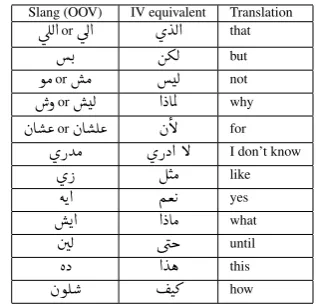
Handling SlangWe handle these cases by mapping slangs
Slang (OOV) IV equivalent Translation ú
ÎË@orúÍ@ øYË@ that
. áºË but
ñÓorÓ Ë not
ðorË @XAÖÏ why
àA «or àA Ê« àB for
øPYÓ øPX@ B I don’t know
ø P ÉJÓ like
éK@ Ѫ K yes
@ @XAÓ what
áË ú æk until
èX @Yë this
àñÊ J» how
Table 5: Slang words and their IV equivalents
difficult to detect all slangs in tweets domain. Therefore, we select the most frequent twenty slang words from 17k types in our corpus (10 million tokens) and map them to their IV equivalents as shown in Table 5.
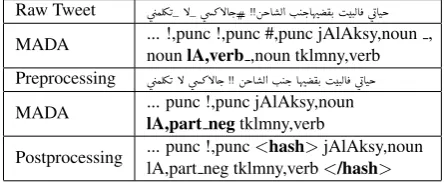
Handling Twitter-specific ItemsWe use regular
expres-sion rules to detect and tag Twitter-specific elements such as mentions, hashtags, urls and etc. by doing some pre-processing and then tagging and finally doing post-processing. Due to the space limit, we present the way we deal with hashtags: all the remaining Twitter elements are tagged in similar ways. First, we detected hashtags by us-ing regular expression rules. Then, we removed the hashtag signs and underscores from raw tweets. Next, we tagged them by using AMIRA, MADA and Satnford. Finally, we inserted hashtag signs in their original place in tweets to indicate the beginning and the end of hashtags content as shown in Table 6.
Raw Tweet ú
æÒʾK_B_úæ» BAg.# !! ákA Ë@ I. Jk.AîD ®K. IJ.ËA ¯ ú GAJk
MADA ... !,punc !,punc #,punc jAlAksy,noun , nounlA,verb,noun tklmny,verb Preprocessing ú
æÒʾK B úæ» BAg. !! ákA Ë@ I. Jk. AîD ®K. IJ.ËA ¯ ú GAJk
MADA ... punc !,punc jAlAksy,noun
lA,part negtklmny,verb
Postprocessing ... punc !,punc<hash>jAlAksy,noun lA,part neg tklmny,verb</hash>
Table 6: Pre- and post-processing (tag hashtag’s words)
In fact, the taggers not just mistagged Twitter elements, but they also mistagged some MSA words in the same tweets because the text is noisy and the taggers rely on contextual clues. By using the above approach, we are not just able to tag Twitter elements correctly but we also make the context less noisy so the taggers are more likely to tag MSA words correctly as ”IA” word in Table 6.
Handling Named Entities These can be recognised
by using gazetteer lists. We use ANERGazet3 which a collection of three Gazetteers, (i) Locations: it contains names of continents, countries, cities, etc.; (ii) People: it has names of people recollected manually from different Arabic websites; and finally (iii) Organizations: it contains names of organizations like companies, football teams, etc..
Handling English WordsOur focus is on Arabic tweets,
but some of them contain English words. These words may refer to events, locations, English hashtags or retweet of English tweets with comments written in Arabic and they are part of the syntactic structure of Arabic tweets. So, they need to be tagged correctly. In this case, we use Stanford for English (Toutanova et al., 2003) to tag English words as a post-processing step.
Results for Pre- and Post-processing
In our experiments, the taggers were adapted to handle Twitter phenomena. The experiments were run using three off-the-shelf taggers trained on PATB and our augmented approach to address Arabic tweets noisiness as described in Section 5.. Table 7 shows the performance difference
3
http://users.dsic.upv.es/grupos/nle/?file=kop4.php
on each of three categories of mistagged tokens and the overall performance compared with their baseline performance in Table 2. By combining normalisation and external knowledge, we are able to reduce unknown tokens in each category which boosts the taggers’ performance. The overall performance of the three taggers increases by absolute twelve percent accuracy for AMIRA and by absolute thirteen percent for MADA and Stanford. This improvement in accuracy will reduce the propagation of POS tagging errors to downstream applications on Arabic tweets such as information extraction.
Tokens AMIRA MADA Stanford
Arabic words 70.4% 77.9% 62.1% Twitter-specific 100% 100% 100% Non-Arabic 68.3% 66.1% 66.1%
Overall 72.6% 79.0% 65.2%
Table 7: Impact of applying pre- and post-processing on POS tagging accuracy
We can infer from the above results that the augmented version of MADA is the most appropriate tagger for tagging Arabic tweets since it outperforms its counterparts of AMIRA and Stanford in accuracy. However, the accuracy is not only the factor that should be considered when tagging Arabic tweets. The tagging speed is another crucial factor to take into account since there are millions of tweets that need to be tagged. So, the most suitable tagger may be the one that performs well in terms of both speed and accuracy. So, we measure the taggers’ speed below.
Tagging speeds We measure speed performance of
AMIRA v2.1, MADA v3.2 and Stanford v3.5.1 POS tag-gers on 250k tweet tokens. It is measured in words pro-cessed per second. The speed evaluation is conducted for Stand-alone (raw input) modes on a Dell XPS lap-top computer with Intet(R) Core(TM)2 Duo CPU T8100 @2.10GHz and 4GB memory.
Tagger Accuracy Speed(words/sec.)
AMIRA 72.6% 289
MADA 79.0% 48
Stanford 65.2% 8966
Table 8: Accuracy and speed comparison for the taggers
5.2.
Agreement-based Bootstrapping
Bootstrapping is used to create a labelled training data from large amounts of unlabelled data (Cucerzan and Yarowsky, 2002; Zavrel and Daelemans, 2000). There are different ways to select the labelled data from the taggers’ outputs. We follow (Clark et al., 2003) in using agreement-based training method. We use the augmented versions of AMIRA, MADA and Stanford taggers to tag a large amount of Arabic tweets and add the tokens which they agreed upon to the pool of training data. Then, we retrain Stanford tagger on the selected labelled data.
Tag Gloss
CC coordinating conjunction CD cardinal number DT demonstrative pronoun
IN subordinating conjunction or preposition JJ adjective
NN common noun NNP proper noun PRP personal pronoun PUNC punctuation RB adverb RP particle UH interjection
VB verb
WP relative pronoun WRB wh-adverb
Table 9: Collapsed tagset
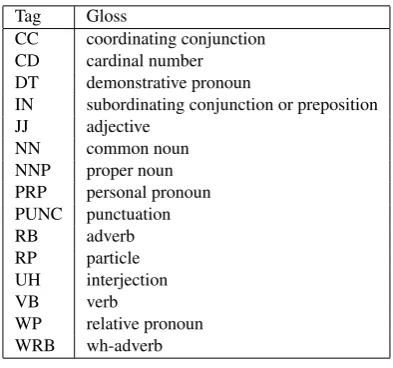
Tagset Unification The taggers use different tagsets.
AMIRA uses RTS tagset which consists of 25 tags whereas Stanford uses Bies’s tagset which is similar to RTS tagset with extra tags to represent the determiner ”Al”. So, we reduce Stanford tagset to AMIRA tagset by omitting deter-miner tags. On the other hand, MADA has 34 different tags which make different types of distictions with RTS\Bies tagsets. For example, RTS tagset uses one tag (RP) to cover a range of particles which are subdivided to nine subclasses by MADA (part det, part focus, part fut, part interrog, part neg, part restrict,
part verb, part voc ,part); and it uses several
tags to distinguish between verbs tenses (VBD, VBG,
VBN, VBP) where MADA just uses one tag (verb).
Therefore, mapping between these tagsets is a prerequisite for using agreement-based method on the taggers’ outputs. We construct a unified tagset consisting of the main POS tags as shown in Table 9 to do the mapping.
Agreement-based Bootstrapping Results We used
the augmented versions of AMIRA, MADA and Stanford taggers to tag 25K Arabic tweets which contain 203682 tokens. In these experiments, we focused on Arabic words so we omitted all non-Arabic tokens from the tagged data. This reduced the number of tokens used in agreement-based bootstrapping experiment to 166573 Arabic words. Then, we mapped the taggers’ outputs to our unified tagset. Next, we admitted all Arabic words that all taggers were agreed upon to the pool of training data. Taggers reached agreement on 60.4% of Arabic words which formed 100691 agreed bootstrapped tokens
as a training data. Finally, we trained Stanford tagger on the bootstrapped training data. Training on bootstrapped data improves the performance of Stanford from 58.5% to 66.5% on Arabic words and from 49.0% to 69.1% on overall tokens (Table 10). We tried adding 50K further Arabic words to the training pool by repeating the same experiment on different Arabic tweets, but they did not give a performance increase which suggests no potential benefit from more bootstrapping data.
We have noticed that 75% from our dataset in Section 4.2. is MSA words, so we argue that adding some amounts of labelled newswire tokens to the pool of bootstrapped data above and retrain Stanford on it will boost its accuracy. Ta-ble 10 shows the performance of Stanford improves from 66.5% to 72.1% on Arabic words and from 69.1% to 74% on overall tokens when PATB was added to the training pool. By using the above approaches, we are able to in-crease the accuracy of Stanford tagger while preserving its speed. It outperforms AMIRA in terms of speed and accu-racy. It also outperforms MADA in terms of speed and it is not a long way behind MADA’s accuracy. So, it is the most suitable taggers for tagging Arabic tweets.
Training data Overall Arabic words size
PATB 65.2% 62.1% 145K
Bootstrapped 69.1% 66.5% 100K
PATB+Bootstrapped 74.0% 72.1% 245K
Table 10: Stanford performance on Arabic Tweets using different training data
6.
Conclusion
We have examined the consequences of applying MSA-trained POS tagging to Arabic tweets. Off-the-shelf tag-gers present poor success rates on Arabic tweets due to the domain noisiness. Furthermore, existing approaches suffer from insufficient labelled training data. We introduced ap-proaches for avoiding the noisiness of domain by combin-ing normalisation and external knowledge and for generat-ing traingenerat-ing data by applygenerat-ing agreement-based bootstrap-ping on heterogeneous taggers’ outputs. These combined to improve POS tagging for Arabic tweets. Our techniques yield a very fast and robust POS for Arabic tweets. By using a pool of bootstrapped data combined with PATB to train the augmented version of Stanford tagger, we are able to improve its accuracy from 49% to 74% on Arabic tweets while preserving its speed.
7.
Acknowledgments
The authors would like to thank the anonymous reviewers for their encouraging feedback and insights. Fahad would also like to thank King Saud University for their financial support. Allan Ramsay’s contribution to this work was partially supported by Qatar National Research Foundation (grant NPRP-7-1334-6 -039).
8.
Bibliographical References
Workshop in Computational Approaches to Subjectivity and Sentiment Analysis, pages 19–28. Association for Computational Linguistics.
Al-Sabbagh, R. and Girju, R. (2012). A supervised POS tagger for written Arabic social networking corpora. In
Proceedings of KONVENS, pages 39–52.
Albogamy, F. and Ramsay, A. (2015a). Towards POS tag-ging for Arabic tweets. InProceedings of ACL Workshop on Noisy User-generated Text.
Albogamy, F. and Ramsay, A. (2015b). POS tagging for Arabic tweets. In Proceedings of Recent Advances in Natural Language Processing, pages 1–8.
Barbosa, L. and Feng, J. (2010). Robust sentiment detec-tion on Twitter from biased and noisy data. In Proceed-ings of the 23rd International Conference on Computa-tional Linguistics: Posters, pages 36–44. Association for Computational Linguistics.
Brill, E. (1995). Transformation-based error-driven learn-ing and natural language processlearn-ing: A case study in part-of-speech tagging. Computational linguistics, 21(4):543–565.
Clark, S., Curran, J. R., and Osborne, M. (2003). Boot-strapping POS taggers using unlabelled data. In Pro-ceedings of the Seventh Conference on Natural Language Learning at HLT-NAACL 2003-Volume 4, pages 49–55. Association for Computational Linguistics.
Cucerzan, S. and Yarowsky, D. (2002). Bootstrapping a multilingual part-of-speech tagger in one person-day. In
Proceedings of the 6th Conference on Natural Language Learning-Volume 20, pages 1–7. Association for Com-putational Linguistics.
Derczynski, L., Ritter, A., Clark, S., and Bontcheva, K. (2013). Twitter part-of-speech tagging for all: Overcom-ing sparse and noisy data. InRANLP, pages 198–206. Diab, M. (2009). Second generation AMIRA tools for
Arabic processing: Fast and robust tokenization, POS tagging, and base phrase chunking. In2nd International Conference on Arabic Language Resources and Tools. El-Fishawy, N., Hamouda, A., Attiya, G. M., and Atef, M.
(2014). Arabic summarization in Twitter social network.
Ain Shams Engineering Journal, 5(2):411–420.
Elsahar, H. and El-Beltagy, S. R. (2014). A fully auto-mated approach for Arabic slang lexicon extraction from microblogs. In Proceedings of the 15th International Conference on Computational Linguistics and Intelligent Text Processing - Volume 8403, CICLing 2014.
Foster, J., C¸ etinoglu, ¨O., Wagner, J., Le Roux, J., Hogan, S., Nivre, J., Hogan, D., and Van Genabith, J. (2011). # hardtoparse: POS tagging and parsing the twitterverse. InAAAI 2011 Workshop on Analyzing Microtext, pages 20–25.
Gadde, P., Subramaniam, L., and Faruquie, T. A. (2011). Adapting a WSJ trained part-of-speech tagger to noisy text: preliminary results. In Proceedings of the 2011 Joint Workshop on Multilingual OCR and Analytics for Noisy Unstructured Text Data, page 5. ACM.
Gimpel, K., Schneider, N., O’Connor, B., Das, D., Mills, D., Eisenstein, J., Heilman, M., Yogatama, D., Flanigan, J., and Smith, N. A. (2011). Part-of-speech tagging for
Twitter: Annotation, features, and experiments. In Pro-ceedings of the 49th Annual Meeting of the Association for Computational Linguistics: Human Language Tech-nologies: short papers-Volume 2, pages 42–47. Associa-tion for ComputaAssocia-tional Linguistics.
Habash, N., Rambow, O., and Roth, R. (2009). Mada+ tokan: A toolkit for Arabic tokenization, diacritization, morphological disambiguation, POS tagging, stemming and lemmatization.
Han, B. and Baldwin, T. (2011). Lexical normalisation of short text messages: Makn sens a# twitter. In Pro-ceedings of the 49th Annual Meeting of the Associa-tion for ComputaAssocia-tional Linguistics: Human Language Technologies-Volume 1, pages 368–378. Association for Computational Linguistics.
Java, A., Song, X., Finin, T., and Tseng, B. (2007). Why we Twitter: understanding microblogging usage and communities. In Proceedings of the 9th WebKDD and 1st SNA-KDD 2007 workshop on Web mining and social network analysis, pages 56–65. ACM.
Mourad, A. and Darwish, K. (2013). Subjectivity and sentiment analysis of modern standard Arabic and Ara-bic microblogs. In Proceedings of the 4th Workshop on Computational Approaches to Subjectivity, Sentiment and Social Media Analysis, pages 55–64.
Mustafa, S. H. (2012). Word stemming for Arabic in-formation retrieval: The case for simple light stem-ming. Abhath Al-Yarmouk: Science & Engineering Se-ries, 21(1):2012.
Refaee, E. and Rieser, V. (2014). An Arabic Twitter cor-pus for subjectivity and sentiment analysis. In Proceed-ings of the Ninth International Conference on Language Resources and Evaluation (LREC14), Reykjavik, Ice-land, may. European Language Resources Association (ELRA).
Ritter, A., Clark, S., Etzioni, O., et al. (2011). Named entity recognition in tweets: an experimental study. In
Proceedings of the Conference on Empirical Methods in Natural Language Processing, pages 1524–1534. Asso-ciation for Computational Linguistics.
Toutanova, K., Klein, D., Manning, C. D., and Singer, Y. (2003). Feature-rich part-of-speech tagging with a cyclic dependency network. InProceedings of the 2003 Con-ference of the North American Chapter of the Associa-tion for ComputaAssocia-tional Linguistics on Human Language Technology-Volume 1, pages 173–180. Association for Computational Linguistics.