Resources for Building Applications with Dependency Minimal Recursion
Semantics
Ann Copestake
∗, Guy Emerson
∗, Michael Wayne Goodman
†,
Matic Horvat
∗, Alexander Kuhnle
∗, Ewa Muszy ´nska
∗∗University of Cambridge, Cambridge, UK
{aac10, gete2, mh693, aok25, emm68}@cam.ac.uk †University of Washington Seattle, WA, USA
Abstract
We describe resources aimed at increasing the usability of the semantic representations utilized within the DELPH-IN (Deep Linguistic Processing with HPSG) consortium. We concentrate in particular on the Dependency Minimal Recursion Semantics (DMRS) formalism, a graph-based representation designed for compositional semantic representation with deep grammars. Our main focus is on English, and specifically English Resource Semantics (ERS) as used in the English Resource Grammar. We first give an introduction to ERS and DMRS and a brief overview of some existing resources and then describe in detail a new repository which has been developed to simplify the use of ERS/DMRS. We explain a number of operations on DMRS graphs which our repository supports, with sketches of the algorithms, and illustrate how these operations can be exploited in application building. We believe that this work will aid researchers to exploit the rich and effective but complex DELPH-IN resources.
Keywords:English Resource Semantics, Operations on Semantics, Tools for Semantics
1.
Introduction
DELPH-IN (http://www.delph-in.net) is an ternational collaboration between researchers with an in-terest in ‘deep’, linguistically-motivated, language process-ing. Several broad-coverage computational grammars have been produced, together with experimental grammars for languages in all the main language families. These gram-mars share a framework for compositional meaning repre-sentation known as Minimal Recursion Semantics (MRS; Copestake et al. (2005)), which has several variants, col-lectively referred to as *MRS. Currently, the most used and widest coverage DELPH-IN grammar is the English Re-source Grammar (ERG; Flickinger (2000)).
*MRS from the ERG (henceforth English Resource Seman-tics: ERS) and other DELPH-IN grammars has been suc-cessfully used in a number of applications. These include machine translation (e.g., Bond et al. (2011)), informa-tion extracinforma-tion and quesinforma-tion answering (e.g., Copestake et al. (2006), Frank et al. (2005), MacKinlay et al. (2009), MacKinlay et al. (2012)), extraction of ontological rela-tionships (e.g., Herbelot and Copestake (2006)), question generation (e.g., Yao and Zhang (2010), Yao et al. (2012)), entailment recognition (e.g., Lien and Kouylekov (2014)), detection of scope of negation (e.g., Packard et al. (2014)) and natural language interfaces (e.g., Packard (2014)). In several cases (including Packard et al. (2014), Lien and Kouylekov (2014), Packard (2014), Yao and Zhang (2010), MacKinlay et al. (2009)) an ERS-based system has outper-formed other approaches in a competitive task. While an ERG-based system is not suitable for applications which require rapid analysis of very large quantities of text, pars-ing accuracy is competitive with other approaches and is generally good on new domains without any need for sub-stantial training or adaptation (MacKinlay et al. (2010), Dridan and Oepen (2013)). ERS is especially suitable in applications which require high precision in semantic tasks
and where some lack of recall due to parse failure rates is tolerable. Furthermore, the ERG is bidirectional and ERSs can also be used for realization.
However, the adoption of ERS (and *MRS with other gram-mars) has been limited outside the DELPH-IN community, despite the fact that the resources are all Open Source. Anecdotally, a major problem is the complexity of the anal-yses. The DELPH-IN community have taken various steps towards addressing this. There is a standardized seman-tic interface to the grammars (the SEM-I: Flickinger et al. (2005)). Flickinger et al. (2014) described an approach to documenting the fundamentals of ERS, allowing users to look up the detailed analysis of particular grammatical constructions. The Elementary Dependency representation (Oepen and Lønning, 2006) is simpler than *MRS and cap-tures many aspects of ERS while being relatively similar to familiar syntactic dependency formalisms. It can be used for comparative parser evaluation as well as other applica-tions (Ivanova et al. (2012), Dridan and Oepen (2011)). In this paper, we concentrate on resources for processing Dependency MRS (DMRS; Copestake (2009)). This is a version of MRS which can be represented as a dependency graph, with no need for variables. Unlike Elementary De-pendencies, DMRS has a proper representation of scope and is fully inter-convertible with other forms of *MRS. It thus makes use of the full power of the ERG for semantic description. DMRS has been used in a number of applica-tions (e.g., Reiplinger et al. (2012), Sch¨afer et al. (2011), Herbelot (2013), Horvat et al. (2015), Emerson and Copes-take (2015)) and our aim is to increase its use.
important property of semantic representations. We believe that the DMRS is interestingly different from these other representations and that the coverage and depth of ERS have significant potential advantages in applications, if re-searchers can overcome the difficulties arising from its de-tail and complexity.
Our purpose here is thus to improve the utility of DMRS to encourage increased uptake of DELPH-IN resources. In this paper, we start by outlining DMRS and some existing resources and then move on to describe a repository which supports developers by providing standard operations on DMRS and giving illustrative examples of their potential use in applications.
2.
An Outline of DMRS
Rather than give a formal introduction to DMRS, we will outline its properties by means of the example shown in Fig 1. This shows a scoped structure in predicate calcu-lus using generalized quantifiers, the corresponding MRS, the Robust MRS (RMRS; Copestake (2007b)), and finally the DMRS. Both MRS and RMRS can be regarded as a flat list of elementary predications, unlike a conventional logi-cal representation which uses nesting to convey scope. The labels (l1, l2 etc) shown in the MRS and RMRS structures together with the qeq constraints represent (underspecified) scope restrictions (e.g., the restrictor ofevery). The ERG actually uses argument labels internally (RSTR,ARG1 etc), but to make the comparison with the scoped representation clearer, the MRS in Figure 1 is shown in a format which omits them. RMRS always makes the argument labels ex-plicit: arguments may be dropped or underspecified without the RMRS structure being ill-formed, but the cost is that an additional anchor element (a1, a2 etc) is required to relate arguments to the predications.
The DMRS is essentially a simplification of the complex graph which results if identities between labels and vari-ables in the RMRS are replaced by links, with the canoni-cal DMRS form being produced by exploiting general con-ditions of ERS. These mean, for instance, that the RMRS ARG0 is not needed.
One complication discussed by Copestake (2009) is that oc-casionally undirected bare /EQ links are necessary to com-pletely model the MRS. This situation arises when two ele-mentary predications have equal labels in the MRS/RMRS but there is no argument relation between them: e.g., in some (fairly unusual) types of relative clause. We are cur-rently seeking to revise the definition of DMRS to avoid such undirected links, but since they do not substantially affect the main objectives of this paper, we will not discuss that further here.
Although a more detailed description of DMRS and its se-mantics is out of the scope of this paper, it will be useful in what follows to note that there are several different notions of DMRS well-formedness:
• Realizability: A DMRS meets the realizability con-straint with respect to a grammar if it corresponds to a natural language string according to that grammar (for the current ERG, this is mediated by the MRS). Of course, not all semantically-meaningful DMRSs meet this condition.
• MRS well-formedness: A DMRS meets this condi-tion if it can be converted into a well-formed MRS as defined by Copestake et al. (2005). Informally, a well-formed MRS is one that can be specialized into one or more scope-resolved structures. For a grammar where all semantic composition operations and lexi-cal entries are correctly specified, all MRS structures produced by/accepted by the grammar for an utterance will meet this well-formedness condition,1 and hence the set of DMRSs which are well-formed under this condition are a subset of those which meet the realiz-ability constraint. This condition is also a requirement for conversion into predicate calculus.
• Basic well-formedness: simply requires that the DMRS is a graph with well-formed labels on nodes and edges. If the bare EQ links described above are excluded, the graph must be acyclic, but not necessar-ily connected.
3.
DMRS Resources
Links to resources for DMRS, including those highlighted below, can be found on http://moin.delph-in. net/RmrsDmrs. DELPH-IN is committed to the devel-opment of Open Source resources, and all software listed below (including the ERG, ACE, pyDelphin, and pydmrs) uses the MIT license. The HPSG annotations in the Wiki-Woods corpus are covered by the LGPL v3 license.
3.1.
The English Resource Grammar and
DELPH-IN Tools
*MRSs are produced from English text with the ERG us-ing suitable preprocessus-ing tools and a compatible parser. Details are beyond the scope of this paper, but seehttp: //moin.delph-in.net/. DELPH-IN realizers al-low text to be produced from *MRS input. For most of our work, we now use Woodley Packard’s Answer Constraint Engine (ACE: http://sweaglesw.org/ linguistics/ace/) for parsing and realization.
3.2.
pyDelphin
The pyDelphin library (https://github.com/ delph-in/pydelphin) is an Open Source Python package implementing a variety of DELPH-IN formal representations, with a particular emphasis on MRS and DMRS support. As most of the parsers/realizers which handle DELPH-IN grammars (including ACE) currently assume MRS output/input rather than DMRS, pyDelphin’s MRS*)DMRS conversion functionality is useful for researchers wishing to work with DMRS representations. A Python wrapper for ACE is also provided, which can simplify applications or workflows that rely on ACE.
3.3.
WikiWoods DMRS
WikiWoods (Flickinger et al., 2010) is a dump of Wikipedia parsed with the ERG. It is very useful for applications where a large number of semantic contexts are required, for
1
Sentence: Every big angry dog barks loudly.
Scoped form (single scope for this example):
every q(x4, big a 1(e8,x4)∧ angry a 1(e9, x4)∧ dog n 1(x4), bark v 1(e2,x4)∧ loud a 1(e10,e2))
MRS (hiding argument labels):
l1: every q(x4,h5,h6), h5 qeq l2,
l2: big a 1(e8,x4), l2: angry a 1(e9,x4), l2: dog n 1(x4), l4: bark v 1(e2,x4), l4: loud a 1(e10,e2)
RMRS: l1:a1: every q,BV(a1,x4),RSTR(a1,h5),BODY(a1,h6), h5 qeq l2,
l2:a2: big a 1(e8),ARG1(a2,x4), l2:a3: angry a 1(e9),ARG1(a3,x4), l2:a4: dog n 1(x4), l4:a5: bark v 1(e2),ARG1(a5,x4), l4:a6: loud a 1(e10),ARG1(a6,e2)
DMRS: every q big a 1 angry a at dog n 1 bark v 1* loud a 1
-ARG1/EQ ARG1/NEQ ARG1/EQ
-ARG1/EQ
[image:3.595.198.510.235.291.2]-RSTR/H
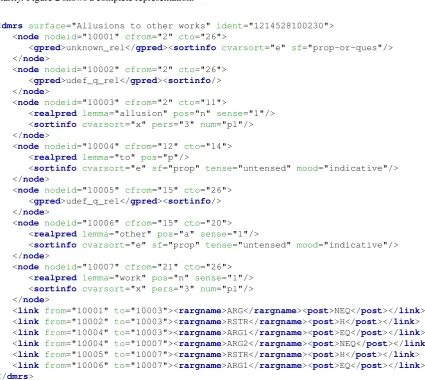
Figure 1: Semantic representations for ‘Every big angry dog barks loudly.’ Note that the directionality of the modifier links in the DMRS follows from the predicate calculus representation but is the opposite of conventional syntactic dependencies. Tense and number information is associated with variables in MRS and RMRS and nodes in DMRS, but is omitted here for clarity. Figure 2 shows a complete representation.
<dmrs surface="Allusions to other works" ident="1214528100230">
<node nodeid="10001" cfrom="2" cto="26">
<gpred>unknown_rel</gpred><sortinfo cvarsort="e" sf="prop-or-ques"/>
</node>
<node nodeid="10002" cfrom="2" cto="26">
<gpred>udef_q_rel</gpred><sortinfo/> </node>
<node nodeid="10003" cfrom="2" cto="11">
<realpred lemma="allusion" pos="n" sense="1"/> <sortinfo cvarsort="x" pers="3" num="pl"/>
</node>
<node nodeid="10004" cfrom="12" cto="14">
<realpred lemma="to" pos="p"/>
<sortinfo cvarsort="e" sf="prop" tense="untensed" mood="indicative"/>
</node>
<node nodeid="10005" cfrom="15" cto="26"> <gpred>udef_q_rel</gpred><sortinfo/>
</node>
<node nodeid="10006" cfrom="15" cto="20">
<realpred lemma="other" pos="a" sense="1"/>
<sortinfo cvarsort="e" sf="prop" tense="untensed" mood="indicative"/>
</node>
<node nodeid="10007" cfrom="21" cto="26">
<realpred lemma="work" pos="n" sense="1"/> <sortinfo cvarsort="x" pers="3" num="pl"/> </node>
<link from="10001" to="10003"><rargname>ARG</rargname><post>NEQ</post></link> <link from="10002" to="10003"><rargname>RSTR</rargname><post>H</post></link>
<link from="10004" to="10003"><rargname>ARG1</rargname><post>EQ</post></link> <link from="10004" to="10007"><rargname>ARG2</rargname><post>NEQ</post></link>
<link from="10005" to="10007"><rargname>RSTR</rargname><post>H</post></link> <link from="10006" to="10007"><rargname>ARG1</rargname><post>EQ</post></link> </dmrs>
[image:3.595.56.482.351.731.2]instance building distributional models from parsed data. The DMRS version of WikiWoods has been used by a number of researchers (e.g., Herbelot (2013), Emerson and Copestake (2015)) since it is much easier to extract seman-tic relationships from it than to deal with variable interac-tions in MRS/RMRS. An example WikiWoods DMRS is shown in Fig 2.
3.4.
DMRS Application Libraries: pydmrs
The bulk of this paper concerns pydmrs: a new Python package supporting operations such as DMRS subgraph matching, standard types of DMRS simplification, mapping and chunking as discussed in more detail in§4. A user may choose either to import the routines provided in this pack-age into their own Python code, or to run specific modules as batch scripts to process large amounts of data. Detailed examples of various uses are given in the pydmrs reposi-tory. We are also including some sample applications, out-lined in§5, in order to help developers to investigate these resources further themselves.4.
Operations on DMRS
By considering the DMRS as a semantic graph, we define a number of operations which can be utilized in applications. Our aim here is to motivate the abstract operation types and outline how they can be exploited. Note that all these types of operation are applicable both where machine learning is used and for hand-written rules or patterns.
4.1.
Matching
Matching is the basic *MRS operation used in information extraction and question answering. Copestake (2007a) dis-cusses how the *MRS matching operation can be regarded as a form of robust inference. In the robust approach to real-ization described by Horvat et al. (2015), subgraph match-ing is required to find which rules can be applied to the in-put DMRS graph. Matching can be used with wildcards to implement ontology extraction, as outlined in§5. One ad-vantage of matching using DMRS, as opposed to the earlier *MRS approaches, is that DMRS structures may be packed, allowing efficient matching operations to be performed on a forest of alternative structures.
The basic operation of DMRS matching amounts to sub-graph matching, with conditions on node and arc labels that they are compatible rather than identical. It can thus be stated more simply than MRS/RMRS matching and is more straightforward to implement, since there is no need to maintain a list of variable equalities. *MRS matching is worst-case exponential, but, as discussed below, efficient algorithms exist for practical uses.
The pydmrs library includes three algorithms for DMRS matching: exact subgraph matching, surface-aligned matching and general scored matching.
Theexact (sub)graph matchingchecks whether a DMRS graph contains a specified subgraph. If any element of the subgraph is missing in the larger graph, no match is de-tected. The efficiency of this matching method is based on the assumption that a DMRS graph corresponding to a sen-tence or a sensen-tence fragment mainly consists of uniquely-labelled nodes, which hence match unambiguously. A
naive matching algorithm performing an exhaustive search over all possible node match combinations, with worst-case exponential runtime, is therefore sufficient in practice. The algorithm identifies the unambiguous node matches and then adds all matches that can be inferred for repeated la-bels by considering their immediately neighbouring nodes. Node labels which are repeated in a sentence will generally correspond to common words like quantifiers or preposi-tions, which will be connected to open class words which are unlikely to be repeated. If all of the neighbouring nodes already match uniquely and there is only one node in the other graph containing the corresponding neighbourhood, we can conclude a match of the node in question. Subse-quently, we continue to perform an exhaustive search over all the possible combinations if there are still unmatched nodes left.
The other two matching approaches find the best possible match, even a non-exact one, and assess its quality with an F-score, computed based on the number of matched nodes and links, similarly to a metric by Cai and Knight (2013). Nodes and links are treated as equally important.
The surface-aligned matching uses the fact that parser output contains information on which part of the original string corresponds to a given predicate. By ordering the DMRS nodes by the position of their predicates in a sen-tence, we can limit the search space of the matching algo-rithm. There are two ways to use this form of matching. The matched subgraph returned as the result of the query can include only nodes from the query, or it can include all the nodes corresponding to the aligned region of the sur-face. For example, if we query forbig dog in the DMRS graph from Figure 1, the first variant of the algorithm grants the match a perfect score. In the second variant the match is penalized because the surface region of interest and the matched subgraph includeangry.
The above approach cannot be used when the alignment in-formation is missing. Moreover, if two different sentences have the same DMRS representation but different word or-der, the algorithm will not match them perfectly. To ac-count for these and other scenarios, we provide an alterna-tive in the form of a less efficientgeneral matching algo-rithm. The algorithm traverses the DMRS graph following its link structure exploring any matching regions and com-bining the disconnected matches from individual regions in a way which maximizes the score. The resulting subgraph contains only the nodes and links from the query.
4.2.
Simplification
proper q named/David compound proper q named/von compound proper q named/Platen
ARG2/NEQ
-ARG1/EQ
ARG2/NEQ
-RSTR/H
-ARG1/EQ
-RSTR/H RSTR/H
-Figure 3: Original DMRS/ERS structure for the nameDavid von Platen.
proper q named/David von Platen
-RSTR/H
Figure 4: Simplified DMRS/ERS structure forDavid von Platen
subgraph may be replaced with a smaller subgraph. We dis-tinguish between reversible, semi-reversible and lossy sim-plifications: after lossy simplification the DMRS is not re-quired to meet any well-formedness criteria other than that of basic well-formedness.
4.2.1. Simplification of Complex ERS Structures There are cases where the generality and compositionality of ERS produces structures which are inconveniently com-plex for many applications. For instance, numbers are rep-resented compositionally: the DMRS for twenty five has three nodes — two nodes for numbers ‘20’ and ‘5’ and a ‘plus’ node connecting the two. Although this represen-tation follows from MRS compositionality principles and is required for full generality (e.g.,three or four thousand
with the interpretation 3000 or 4000), the representation of numbers written using words can often usefully be simpli-fied to be equivalent to the representation using digits. For instance, the simplified DMRS fortwenty fiveis equivalent to the DMRS for25.
We provide a number of operations to simplify complex structures of this type. Consider the case of proper names such as David von Platen. The ERS for this structure is given in Fig. 3, with the simplified structure in Fig. 4. As shown, in the simplified structure, the name is treated as a single element, as though it were a simple proper name (see below for discussion ofPROPER Q). As with numbers, there are cases where this simplification process fails (e.g.,
David and Albrecht von Platen), which justifies the ERS approach as a more general account, but for most texts, such examples are rare.
Complex structure simplification may optionally be fol-lowed by grammar predicate filtering (discussed below), in which case thePROPER Qcan also be removed.
In general, complex structure simplification is semi-reversible. A *MRS can be constructed from the simpli-fied DMRS which is equivalent to an ERS structure, but the precise input structure may not be recoverable. For in-stance, names with more than two elements have multiple bracketing possibilities in ERS: name simplification can be reversed to a canonical structure equivalent to one of these, but cannot recover the original analysis. Complex structure simplifications nevertheless meet the realizability and MRS well-formedness conditions (§2).
4.2.2. Grammar Predicate Filtering
In addition to lexically-derived predicates, ERS uses a considerable number of grammar predicates, such as
PROPER QandCOMPOUND. Grammar predicates capture the semantic contribution of various grammatical construc-tions. For instance,COMPOUNDis used to represent com-pound nouns (e.g., kitchen knife) as well as the complex names discussed above.
Although grammar predicate nodes are an important facet of ERS, they are not needed for some applications. For ex-ample, althoughPROPER Qis necessary in order to produce a well-formed structure according to the MRS criteria, it can usually be omitted without losing information. Another example isELLIPSIS, which allows a representation of the semantics of elliptical constructions, but in practice very often occurs in misparses. Such nodes increase the size and complexity of the DMRS graph, and also make it more dif-ficult to align the DMRS with the original text: developers working with DMRS may therefore remove them. For ex-ample, in graph to string realization (Horvat et al., 2015), unneeded grammar predicate nodes are removed from the DMRS graph to lessen the data sparsity problem with trans-lation grammar, as well as to speed up the otherwise re-source and time intensive decoding.
Our current aim is to make removal of predicate nodes less ad hoc. Grammar predicate filtering works by matching in-dividual nodes against a filter list and, when a match occurs, removing the node and adjacent edges from the DMRS graph. Specifying which grammar predicates to filter is ac-complished using a configuration file. We provide a default configuration used by Horvat et al. (2015) in pydmrs. Removing some types of grammar predicate nodes may re-sult in a disconnected graph. Since this is generally un-desirable, we implemented optional functionality that only removes a grammar predicate node if the graph will remain connected. Computing whether a graph is disconnected can be done with breadth-first search: starting from any node, we iteratively visit adjacent nodes; if any nodes are left un-visited at the end, the graph is disconnected.
[image:5.595.57.541.65.118.2]Search:[2]:node? <-3- [1]:_give_v_1 e? -2-> _hand_n_1 x? <-- _a_q Replace:[1]:_help_v_1 e? -2-> [2]:node?
Example sentence:“I can give you a hand with your work.”→“I can help you with your work.”
Search:[2]:node? <-1- [1]:_give_v_1 e? -3-> [3]:node?
Replace:[3]:node? <-1- [1]:_get_v_1 e? <=1= _from_p e -2-> [2]:node?
Example sentence:“Kim gave a book to Sandy.”→“Sandy got a book from Kim.”
Search:[1]:_like_v_1 e? -2h-> [2]:_?_v e[pui--] Replace:[1]:_enjoy_v_1 e? -2h-> [2]:_?_v e[pui-+]
Example sentence:“I like to play tennis.”→“I enjoy playing tennis.”
Figure 5: Example for paraphrases of the idiom“give a hand”to“help”,“give”to“get”(involving argument re-ordering) and“like to”to“enjoy” (involving a gerund; note the -/+ in the square bracket event variable specification indicating progressive form) using DMRS mapping (question marks denote underspecification). The subgraph patterns are written in our DMRS graph description language.
Kim promised to go), for many tree-based algorithms, it suf-fices to have a graph that is both acyclic and rooted, because it is then possible to pass from the root to the leaves, or vice versa. To facilitate using such algorithms, we provide func-tionality for converting DMRS structures to rooted acyclic graphs, by changing the directionality of certain links, such as modifiers. As a side effect, this results in a structure that is closer to syntactic dependencies.
4.4.
Mapping
DMRS mapping is a two-step process, referring to the iden-tification of a DMRS subgraph, followed by its replacement by another (i.e., a form of graph rewriting) to obtain a mod-ified DMRS graph that can be used in realization.
First, the subgraphSto be replaced has to be identified in the DMRS graphG. This is done via a form of exact sub-graph matching, where nodes inSare associated with cor-responding nodes inGandalllinks in this subgraph ofG match the ones inS(see§4.1). However, matching nodes exactly would be very inflexible and would require writing all possible concrete instantiations of a mapping pattern. We therefore introduce underspecification for the attributes of a node, like predicates and variable features. For exam-ple, this allows us to specify that a node must be nominal or verbal but to underspecify the tense of a verb.
The subgraphSfound inGthen is replaced by another sub-graphS0. To do this, the mapping rule has to specify how the relevantanchornodes ofSinGare associated with re-spective nodes inS0. The anchor nodes ofS0can again be underspecified, meaning that they overwrite only specific attributes of the corresponding node ofSand leave the rest unchanged. For example, this allows us to keep the tense of a verb but change the lemma.
DMRS mapping has a variety of applications. Sets of sub-graphs that are considered to be semantically equivalent (in a specific context) correspond to possible paraphrases, and mapping between them corresponds to the process of paraphrasing (see§5.2). By distinguishing one of the para-phrases as the target to which others are mapped, one can
“normalise”sentences to a subset of possible expressions. Initial experiments with DMRS mapping for paraphrase us-ing automatically acquired rules are described by MacKin-lay (2012, ch7). On the other hand, when the source and
target languages of the subgraphs are different, mapping becomes a method of machine translation, analogous to the use of MRS transfer rules in MT (compare e.g., Bond et al. (2011) or Oepen et al. (2004)). We are experimenting with ways of generalizing the current mapping procedure pre-sented above. One application of interest is question gen-eration (see Yao and Zhang (2010) and Yao et al. (2012)), which reduces to a more structural variant of DMRS map-ping than straightforward node-to-node replacement.
4.5.
Chunking
Chunking refers to the splitting of a DMRS graph into sub-graphs which can be processed independently. The results of processing can be recombined with minimal loss of in-formation. For instance, if a DMRS corresponds to two complex propositions joined by a conjunction, it can be split into two subgraphs corresponding to the coordinated propositions. Each of these subgraphs can then be treated separately by a realization system at a lower cost than the full graph. The subgraph results can then be recombined, yielding the same outcome as performing the operation on the original graph. Apart from conjunctions, chunking can also be applied to subordinated clauses, phrasal comple-ments and to other grammar structures, depending on the demands of the application.
5.
Sample Applications
These are included in the pydmrs repository to give some guidance to developers about possible uses of ERS.
5.1.
A Simple Robot Interface
commands which should be interpreted in the same way are mapped to identical graphs. For example, we might want to treat“Turn left at a yellow line”and“On a yellow line, turn to the left”in the same way. The simplified graphs can then be converted to a domain-specific representation, such as low-level instructions for the robot.
5.2.
Paraphrase
One application of DMRS mapping is paraphrasing. In terms of DMRS, paraphrases correspond to sets of sub-graphs that are considered to be semantically equivalent (in a specific context). Mapping one subgraph to another within a DMRS corresponds to replacing one expression with another in a sentence. We are currently developing a DMRS graph description language as part of the pydmrs li-brary which will allow for a convenient way of specifying such subgraphs. The pydmrs library contains some exem-plary paraphrase rules, based on our DMRS mapping func-tionality with underspecified nodes and written in a prelim-inary version of the aforementioned description language. In figure 5, we present a few examples of paraphrase rules together with an input sentence and corresponding realiza-tion after applying the paraphrase rule.
5.3.
Ontological Relationship Extraction
DMRS matching can be used to query subgraph patterns in corpora of parsed text. Searching for DMRS subgraphs is a more robust query method than one based on e.g., regular expressions, since DMRS graphs comprise semantic depen-dencies and abstract certain purely syntactic phenomena (like active/passive). The effectiveness of a *MRS strategy for extraction of ontological relationships was previously demonstrated by Herbelot and Copestake (2006) using the RMRS representation on Wikipedia. This allowed exam-ples such as the following to be processed:
The Cottontop Tamarin (Saguinus oedipus), also known as the Pinchu Tamarin, is a small New World monkey weighing less than 1lb (0.5 kg): cottontop tamarin is-a new world monkey
Our current use of DMRS in combination with the Wikipedia dump of WikiWoods (see §3.3) considerably simplifies the work required to achieve such results. The following example illustrates the extraction of the relation-ship“X eat Y”from a few sentences:
A mouse ate the whole cheese.→(mouse, cheese)
Lions eat around 15 zebras per year.→(lion, zebra)
Their children eat so many sweets.→(child, sweet)
Potatoes are mostly eaten by humans.→(human, potato)
Such relationships can be easily expressed in terms of DMRS subgraphs using our DMRS description language.
6.
Conclusion
We have outlined a diverse range of applications of ERS, and discussed the need to make it easier to use. We have de-scribed why DMRS is preferable to MRS/RMRS for some applications, illustrated some standard types of operation on DMRS and discussed some uses which we are currently
making of the representation. We have outlined the DMRS-related resources which we have developed to support de-velopers. The pydmrs repository is currently under active development and we intend to expand it further to support other operations and illustrative applications.
7.
Acknowledgements
This research was supported in part by the Singapore MOE Tier 2 grantThat’s what you meant: a Rich Representation for Manipulation of Meaning (MOE ARC41/13) and by PhD studentships funded by Qualcomm, the Schiff Founda-tion, Churchill College and by the EPSRC (Doctoral Train-ing Grant). We are grateful to the anonymous reviewers for their comments.
8.
Bibliographical References
Allen, J. F., Swift, M., and de Beaumont, W. (2008). Deep Semantic Analysis of Text. In Johan Bos et al., editors,
Semantics in Text Processing. STEP 2008 Conference Proceedings, volume 1 of Research in Computational Semantics, pages 343–354. College Publications. Banarescu, L., Bonial, C., Cai, S., Georgescu, M., Griffitt,
K., Hermjakob, U., Knight, K., Koehn, P., Palmer, M., and Schneider, N. (2013). Abstract Meaning Represen-tation for sembanking. In Proceedings of the 7th Lin-guistic Annotation Workshop and Interoperability with Discourse, page 178 – 186, Sofia, Bulgaria.
Bender, E. M., Flickinger, D., Oepen, S., Packard, W., and Copestake, A. (2015). Layers of interpretation: On grammar and compositionality. In Proceedings of the 11th International Conference on Computational Se-mantics, pages 239–249, London, UK.
Bond, F., Oepen, S., Nichols, E., Flickinger, D., Velldal, E., and Haugereid, P. (2011). Deep open-source machine translation.Machine Translation, 25:87–105.
Cai, S. and Knight, K. (2013). Smatch: an evaluation met-ric for semantic feature structures. InProceedings of the 51st Annual Meeting of the Association for Computa-tional Linguistics, ACL 2013, 4-9 August 2013, Sofia, Bulgaria, Volume 2: Short Papers, pages 748–752. Copestake, A., Flickinger, D., Pollard, C., and Sag, I. A.
(2005). Minimal Recursion Semantics. An introduction.
Research on Language and Computation, 3(4):281–332. Copestake, A., Corbett, P., Murray-Rust, P., Rupp, C., Siddharthan, A., Teufel, S., and Waldron, B. (2006). An architecture for language processing for scientific texts. Proceedings of the UK eScience All Hands Meet-ing 2006.
Copestake, A. (2007a). Applying robust semantics. In
Proceedings of the 10th Conference of the Pacific Asso-cation for Computational Linguistics (PACLING), pages 1–12.
Copestake, A. (2007b). Semantic composition with (ro-bust) minimal recursion semantics. InACL 2007 Work-shop on Deep Linguistic Processing, pages 73–80, Prague, Czech Republic.
the European Chapter of the Association for Computa-tional Linguistics, pages 1–9, Athens, Greece.
Dridan, R. and Oepen, S. (2011). Parser evaluation using elementary dependency matching. InProceedings of the 12th International Conference on Parsing Technologies, pages 225–230, Dublin, Ireland.
Dridan, R. and Oepen, S. (2013). Document parsing. To-wards realistic syntactic analysis. InProceedings of the 13th International Conference on Parsing Technologies, Nara, Japan.
Emerson, G. and Copestake, A. (2015). Leveraging a semantically annotated corpus to disambiguate prepo-sitional phrase attachment. InProceedings of the 11th International Conference on Computational Semantics, pages 1–11, London, UK.
Flickinger, D., Lønning, J. T., Dyvik, H., Oepen, S., and Bond, F. (2005). SEM-I rational MT — enriching deep grammars with a semantic interface for scalable machine translation. InProc. MT Summit X, Phuket, Thailand. Flickinger, D., Oepen, S., and Ytrest ˜A¸l, G. (2010).
Wikiwoods: Syntacto-semantic annotation for english wikipedia. In Proceedings of the Seventh conference on International Language Resources and Evaluation (LREC’10), Valletta, Malta.
Flickinger, D., Bender, E. M., and Oepen, S. (2014). To-wards an encyclopedia of compositional semantics. Doc-umenting the interface of the English Resource Gram-mar. InProceedings of the 9th International Conference on Language Resources and Evaluation, pages 875–881, Reykjavik, Iceland.
Flickinger, D. (2000). On building a more efficient gram-mar by exploiting types.Natural Language Engineering, 6(1):15–28.
Frank, A., Krieger, H., Xu, F., Uszkoreit, H., Crysmann, B., Jorg, B., and Schafer, U. (2005). Querying struc-tured knowledge sources. AAAI-05 Workshop on Ques-tion Answering in Restricted Domains, pages 10–19. Herbelot, A. and Copestake, A. (2006). Acquiring
Onto-logical Relationships from Wikipedia Using RMRS. In
Proceedings of the ISWC 2006 Workshop on Web Con-tent.
Herbelot, A. (2013). What is in a text, what isn’t, and what this has to do with lexical semantics. In Proceedings of the 10th International Conference on Computational Semantics (IWCS 2013), pages 321–327, Potsdam, Ger-many.
Horvat, M., Copestake, A., and Byrne, B. (2015). Hier-archical statistical semantic realization for Minimal Re-cursion Semantics. InProceedings of the 11th Interna-tional Conference on ComputaInterna-tional Semantics, pages 107–117, London, UK.
Ivanova, A., Oepen, S., Øvrelid, L., and Flickinger, D. (2012). Who did what to whom? A contrastive study of syntacto-semantic dependencies. InProceedings of the Sixth Linguistic Annotation Workshop, pages 2–11, Jeju, Republic of Korea.
Lien, E. and Kouylekov, M. (2014). Entailment recogni-tion using Minimal Recursion Semantics. In
Proceed-ings of the 8th International Workshop on Semantic Eval-uation (SemEval 2014, pages 699–703.
MacKinlay, A., Martinez, D., and Baldwin, T. (2009). Biomedical Event Annotation with CRFs and Precision Grammars. In Proceedings of the BioNLP 2009 Work-shop Companion Volume for Shared Task, pages 77–85. MacKinlay, A., Dridan, R., Flickinger, D., and Baldwin,
T. (2010). Cross-domain effects on parse selection for precision grammars. Research on Language and Com-putation, 8(4):299–340.
MacKinlay, A., Martinez, D., and Baldwin, T. (2012). De-tecting modification of biomedical events using a deep parsing approach. BMC medical informatics and deci-sion making, 12(Suppl 1):S4.
MacKinlay, A. (2012). Pushing the boundaries of deep parsing. Ph.D. thesis, Department of Computing and In-formation Systems, The University of Melbourne. Oepen, S. and Lønning, J. T. (2006). Discriminant-based
MRS banking. InProc. LREC-2006, Genoa, Italy. Oepen, S., Dyvik, H., Lønning, J. T., Velldal, E.,
Beer-mann, D., Carroll, J., Flickinger, D., Hellan, L., Johan-nessen, J. B., Meurer, P., Nordg˚ard, T., and Ros´en, V. (2004). Som ˚a kapp-ete med trollet? Towards MRS-based Norwegian-English machine translation. In Pro-ceedings of the 10th International Conference on Theo-retical and Methodological Issues in Machine Transla-tion, Baltimore, MD.
Packard, W., Bender, E. M., Read, J., Oepen, S., and Dridan, R. (2014). Simple negation scope resolution through deep parsing: A semantic solution to a seman-tic problem. InProceedings of the 52nd Meeting of the Association for Computational Linguistics, pages 69–78, Baltimore, MD, USA.
Packard, W. (2014). UW-MRS: Leveraging a deep gram-mar for robotic spatial commands. InProceedings of the 8th International Workshop on Semantic Evaluation (Se-mEval 2014), pages 812–816, Dublin, Ireland.
Reiplinger, M., Sch¨afer, U., and Wolska, M. (2012). Extracting glossary sentences from scholarly articles: A comparative evaluation of pattern bootstrapping and deep analysis. In Proceedings of the ACL-2012 Spe-cial Workshop on Rediscovering 50 Years of Discoveries, pages 55–65, Jeju Island, Korea.
Sch¨afer, U., Kiefer, B., Spurk, C., Steffen, J., and Wang, R. (2011). The ACL Anthology Searchbench. In Pro-ceedings of the ACL-HLT 2011 System Demonstrations, pages 7–13, Portland, Oregon, June. Association for Computational Linguistics.
Socher, R., Manning, C. D., and Ng, A. Y. (2010). Learn-ing continuous phrase representations and syntactic pars-ing with recursive neural networks. In Proceedings of the NIPS-2010 Deep Learning and Unsupervised Fea-ture Learning Workshop, pages 1–9.
Yao, X. and Zhang, Y. (2010). Question generation with Minimal Recursion Semantics. InQG2010: The Third Workshop on Question Generation.