Distributed Representations for Building Profiles of Users and Items from
Text Reviews
Wenliang Chen†, Zhenjie Zhang‡, Zhenghua Li†, Min Zhang† †School of Computer Science and Technology, Soochow University, China ‡Advanced Digital Sciences Center, Illinois at Singapore Pte. Ltd., Singapore
{wlchen, zhli13, minzhang}@suda.edu.cn [email protected]
Abstract
In this paper, we propose an approach to learn distributed representations of users and items from text comments for recommendation systems. Traditional recommendation algorithms, e.g. collaborative filtering and matrix completion, are not designed to exploit the key information hidden in the text comments, while existing opinion mining methods do not provide direct sup-port to recommendation systems with useful features on users and items. Our approach attempts to construct vectors to represent profiles of users and items under a unified framework to max-imize word appearance likelihood. Then, the vector representations are used for a recommen-dation task in which we predict scores on unobserved user-item pairs without given texts. The recommendation-aware distributed representation approach is fully supported by effective and ef-ficient learning algorithms over massive text archive. Our empirical evaluations on real datasets show that our system outperforms the state-of-the-art baseline systems.
1 Introduction
With the prosperity of Internet-based e-commerce in the last decade, millions of item (e.g., prod-uct/serivce) comments are now available online and even more are flooding in an explosive manner. Yelp (www.yelp.com), as the largest restaurant comment web site, for example, attracts more than 140 million users to contribute new text comments every month, covering almost all restaurants in USA. It is widely believed that text comments contain much richer information on users as well as items than dull scores, with far more precise descriptions on personal preferences and item features. To fully unleash the potential value underneath the text comments, huge research efforts are now devoted to the design and development of new technologies to capture and understand the semantics in the comments, particularly those associated with users and items. The text analytical outcomes are expected to support decision making and provide new business opportunities in e-commerce.
Recommendation is recognized as one of the most important components in e-commerce systems, driving the growth of profits. Traditional recommendation systems rely on scores over user-item pairs under a bipartite graph model, such that accurate score prediction over unobserved user-item pair helps the system to identify potential interested buyers. A huge bulk of prediction and recommendation strate-gies are proposed in this domain, e.g. collaborative filtering and matrix completion (Sarwar et al., 2001; Koren et al., 2009). Because of the limited information included in each individual score, such recom-mendation strategies commonly suffer from the cold-start problem (Zhou et al., 2011), which returns poor recommendations to newcoming users. While text mining on comment archive may provide im-portant information to the recommendation engine, even for fresh users, the integration of such infor-mation adds new complexity and challenges to the system, since the text mining results are not directly useful to the recommendation algorithms. In particular, most of the opinion mining techniques avail-able in the literature (Liu and Zhang, 2012; Melville et al., 2002) do not distinguish attributes on user preference from attributes of items. The recommendation engines are thus unable to understand the underlying reasons behind the good and poor opinions from the users on the items. While there are This work is licensed under a Creative Commons Attribution 4.0 International License. License details: http://creativecommons.org/licenses/by/4.0/
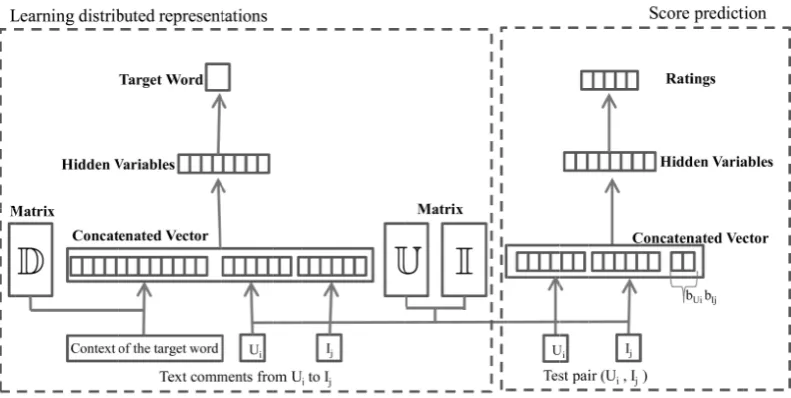
Figure 1: Our framework for learning distributed representations for recommendation
attempts on tightly connecting recommendation and text mining, e.g. (McAuley and Leskovec, 2013; Almahairi et al., 2015), these studies make strong assumptions on the generative mechanism behind the text comments and scores, which may not correctly reflect the interaction between user preferences and item attributes appropriately.
To better exploit the value of text comments for recommendation engine, we propose a simple yet effective approach inspired by the successful distributed representation models on text semantics extrac-tion (Le and Mikolov, 2014; Mikolov et al., 2013). In our approach, we learn distributed representaextrac-tions from text comments to represent users and items. Our approach has a number of unique advantages, which make it a promising alternative to existing feature extraction methods used in comment-based recommendation systems. Firstly, the distributed representations on users and items are aligned, en-abling the employment of a huge cluster of classification approaches on prediction and recommendation. Secondly, distributed representations do not rely on any assumption on the generative procedures over the user-generated contents. This feature generally avoids the potential bias on the analytical outcomes, caused by inappropriate setting on the priors, and finally saving computation overheads. Thirdly, the dis-tributed representations work well on both long and short texts. It is thus likely to enhance the usefulness of the mining outcomes, by training over text data from multiple sources, e.g. food blogs and restaurant comments.
In our approach, we adapt the vectorization techniques used in the training of distributed representa-tions over words and documents, to address the problem of factor decomposition between user prefer-ences and item attributes. User vectors and item vectors are introduced as independent representations to the target users and items correspondingly and are learned by a neural network. In the model, the user vector is shared across the comments written by the same user and the item vector is shared across the comments written on the same item. Then, the vector representations are included in the training of the task of score prediction in which we predict rates on unobserved user-item pairs without given texts. The experimental results on real datasets show that our approach generates a significant margin of performance advantage over existing methods in the task of score prediction.
2 Preliminaries
2.1 Score Prediction
Assume that we have a fixed group of n usersU = {U1, U2, . . . , Un} and a fixed group of m items I ={I1, I2, . . . , Im}. Here, an itemIj can be either a product or a service, provided to all the users in Uwithout any restriction. Each commentCk in databaseC= {C1, C2, . . . , Cl}composes a sequence
ofLkwords{w1, w2, . . . , wLk}, with every word drawn from a known dictionaryD. Each commentCk is also uniquely associated with a userUi ∈ U, an itemIj ∈ I and a scoreSk. It indicates that user Ui purchases itemIj with scoreSk and detailed text comments inCk. The recommendation system is
expected to return a group of items to each userUi, such that the userUiis more likely to buy these items
with high scores and good comments. Therefore, the problem of recommendation is usually transformed into the score prediction problem, as formally defined below.
Problem 1 Score Prediction Given(U,I,C), the problem of score prediction is to estimate the score over unseen user-item pair (Ui,Ij) without text comments, whereUi∈UandIj ∈I.
Obviously, the score prediction is quite different from text-based sentiment classification which has text information in the testing stage. The recommendation system is more efficient, if the score prediction returns more accurate estimations.
2.2 Distributed Representations
Here, we briefly review the approaches of learning distributed representations of words and documents(Mikolov et al., 2013; Le and Mikolov, 2014). Word distributed representation denotes semantical meanings of the words extracted from large-scale text archive in a unified way (Mikolov et al., 2013). Each word is represented by a vector of fixed length L, such that 1) semanti-cally similar words are close to each other in the new vector space; and 2) the semantics of words are compositional by vector operations. To simplify the notation, we usewto denote a word in the dictio-nary, as well as its corresponding vector representation. Given a sequence of words, i.e. w1, . . . , wT,
the distributed representations of the words are calculated by maximizing the likelihood of observing the words in the sequence, based on the neighbor words in the sequence. Mathematically, with the specified neighborhood widthd, this objective is formalized as
1
T T ∑
i=1
log Pr (wi|wi−d, . . . , wi−1, wi+1, . . . , wi+d).
For words at the beginning and end of the sequence, special null words are inserted as the padding words. To generate the vector representations of the words, the algorithm runs an optimization over the vectors as well as a group of weights, with a weight vectorvwiof length(2d−1)Lassociated with every word wi. Given the representations of the words in form of vectors, the vector representations of the
words in the neighborhood ofwiare concatenated, resulting in a long vectorxiof length(2d−1)L. The
probability of observingwiin the context ofxiis estimated by the following equation:
Pr (wi|xi) =softmax(W ·xi+b). (1)
whereW is the weight matrix connecting the input and the output andbis a bias vector. To efficiently op-timize the weights and word representations, a number of optimization tricks, including hierarchical soft-max and negative sampling are suggested in (Mikolov et al., 2013), in order to train the representations in reasonable time. The detail of learning procedure can be found in the paper of (Mikolov et al., 2013). Paragraph (or document) vector is an extension of word distributed representation, by introducing a global vector indicating the topics of the whole paragraph (Le and Mikolov, 2014). When generating the representation of the neighborhood xi, the paragraph vector, another vector of fixed length across
3 Our Approach
Our approach for learning distributed representations is inspired by the models for learning the vectors of words and documents in (Le and Mikolov, 2014; Mikolov et al., 2013). In our solution, as presented in Figure 1, there are three types of distributed representations built and utilized in the learning phase, in-cluding word representation, user representation and item representation. Each representation is a vector of fixed length in its respective domain, sayW,U andI respectively. Intuitively, the word representa-tion denotes the conceptual meanings of the words in a latent space. Similarly, the user representarepresenta-tion denotes the personal preferences over the items, and item representation denotes the important attributes of the items. The dimensions of the user representations, for example, are expected to indicate personal preference and behavior patterns, such as 1) whether the user prefers cheap items; or 2) whether the user prefers better service to good foods during dining in restaurants. We hereby emphasize that such preferences and profiles are automatically extracted from the data, without any supervision or manual labeling involved.
When the context is clear, we useUi(resp.Ij) to denote both the user identity (resp. item identity) as
well as its corresponding representation vector. Similarly, we misusewto denote a word in dictionary
D and its word representation vector. There are two parts in our approach: 1) Learning distributed representations of words, users, and items; 2) Score prediction for pairs of users and items without text comments.
3.1 The Learning Model
During the learning phase, the contexts are fixed-length and sampled from a sliding window over the text comments. The matrixD, with stacked word vectors, is shared across all the text comments. However, the user vector is shared across the comments written by the same user and the item vector is shared across the comments written on the same item.
By looking up the matrices, we obtain the vectors of users, items, and words. After concatenating all relevant vectors in order, including user vector, item vector and neighborhood word vectors, a bi-layer neural network model is built on top of the concatenated vector to predict the words as shown in the left part of Figure 1.
Suppose that the target word iswand the input (the concatenated vector) isXw. A intermediate layer
is applied on the input vectorXw to generate a fixed length vector withLh binary variablesVh. Each
variablevi ∈Vhis independently activated, based on the weight assignment on the edges between input
vector and intermediate layer, following the logistic function:
Pr(vi= 1) = 1
1 + exp(−(∑xj∈Xwxj ·wij )).
where wij is the weight connecting from the jth dimension of the input to the ith dimension of Vh.
From the intermediate layer, our model predicts the word occurrence with anotherprediction layer. On this layer, the system employs exactly the same softmax function used in the existing word vector and paragraph vector models. The prediction function is,
Pr (w|Vh) =softmax(Wwh·Vh+bh).
whereWh
wis the weight vector connectingVhtowandbhis the bias vector.
3.2 Training the Parameters
During training, the parameters we should learn include the weights in the above equations and the vector representations of users, items and words. We use stochastic gradient descent to learn the parameters. Then thebackpropagationalgorithm is employed to push the gradients to the concatenated vector level, and thus used to update the weights on the edges as well as the user/item/word vectors by exactly the same mechanism. At every step of the learning phase, we sample a fixed-length context from a random comment.
To train the weights from hidden variables to the target words, we apply negative sam-pling. The negative sampling method is a simplified variation of Noise Contrastive Estimation (Gutmann and Hyvarinen, 2012; Mhih and Teh, 2012). To compute the probabilities efficiently, we use the negative sampling method proposed by (Mikolov et al., 2013), which approximates the probabil-ity by the correct example and K negative samples for each instance. The formulation to compute log(Pr(wi|Vh))is,
logσ(zwi) +
K ∑
k=1
Ewk∼P(w)[logσ(−zwk)] (2)
whereσ(zw) = 1/(1 +exp(−zw)),zw=Wwh·Vh+bh,wiis the target word,Vhis the vector of hidden
variables, andP(w)is the noise distribution on the data. We setK as 5 in our experiments as used in (Mikolov et al., 2013). We perform the iterative update after predicting the target word,
θ←θ−α(∂
∑
log(Pr(wi|Vh))
∂θ ) (3)
whereαis the learning rate andθis the set of parameters to learn that includes the weights of the model. The initial value ofαis 0.025. During training, the learning rate is halved if the log-likelihood does not improve significantly after one update. Then, the training stops if it does not improve again.
The computation efficiency on the training procedure is excellent, because most of the computation time is spent on the training between hidden variables and target words. The training between concate-nated vectors and hidden variables is much more efficient, since the number of variables involved is highly constrained, depending on the specified size of the word neighborhood and the size of the hidden variable layer.
After the learning phase, we obtain the distributed representations of users and items shown as vectors. They are used in the score prediction task.
3.3 Predicting Scores
As is described in Problem 1, the problem of score prediction is to estimate the score of a user before he/she actually purchases the item. Thus, we do not have the text comment for the given pair when testing. We build a regression/classification model on top of the user/item representations. Specifically, a prediction model is a parameterized functionF(Ui, Ij)with inputs of user/item vectors and outputs of
score estimation. While any regression model can be employed as the parameterized functionF(·), we use the network shown in the right part of Figure 1. First, we learn a non-linear transformation which can project the input user/item representations into a space where it becomes linearly separable. The space is a intermediate layer referred to as a hidden layer. Then, a logistic regression classifier takes the transformed vectors for predicting the scores.
As indicated in Figure 1, the input layer contain the user and item representations and the average scores (bUi andbIj) of user and item, and the output layer has possible ratings.
Given the inputx,h(x) = s(W1x+b1)represents the hidden layer, whereW1 is the weight matrix connecting the input vector to the hidden layer andb1 is a bias vector for the transformation. Here, we usetanh(a) = (ea−e−a)/(ea+e−a)for functionssince it is fast when training the parameters.
Specifically, the prediction is then obtained by applying:
Yelp Dianping Amazon
review# 1.6M 1.2M 1.2M
item# 60,785 43,141 246,200
[image:6.595.181.420.60.161.2]users# 366,715 350,936 641,380 review# per item 25.81 27.98 4.73 review# per user 4.27 3.44 1.81 word# per review 128.93 91.78 167.39
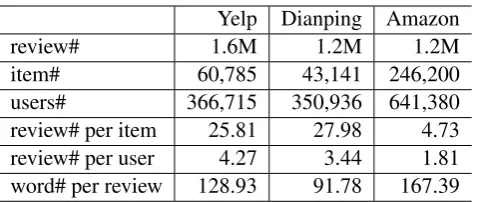
Table 1: Statistics of data set
whereW2is the weight matrix connecting the hidden layer to the output layer andb2is a bias vector for the classifier. We use stochastic gradient descent to learn all parameters of the model, includingW1,b1,
W2andb2. Finally, the prediction of the modelypredis the class whose probability is maximal:
ypred= argmaxiP(Y =yi|x) (5)
4 Experiments
4.1 Dataset
We evaluate the systems on datasets from a variety of public sources. The first one is from Yelp Dataset Challenge1, which contains about 1.6M reviews. The second one is fromDianping(www.dianping.com), which consists of user reviews on the restaurants located in China. We also include about 1.2M reviews from Amazon previously used for opinion analysis in (Jindal and Liu, 2008). In the datasets, each review contains a user ID, restaurant/product ID, numeric rating (from 1 to 5), and detailed comment text. We filter out the reviews that do not have comment texts. The detailed statistics of the data sets are summa-rized in Table 1. The reviews are written in two different languages, Yelp and Amazon using English, and Dianping using Chinese. The experiments with different languages and domains demonstrate the genericity of our approach.
For each dataset, we randomly split the whole set into two parts: 80% as training data and 20% as test data. We also randomly select 10% of training data as development data to tune the parameters of the systems.
4.2 Score Prediction
We report the mean absolute error (MAE) of the score predictor, i.e.,MAE = 1
N ∑
u,i∈T |ˆrui−rui|,
whereTis the test set,N is the total number of predicted ratings,rˆuiandruiare the predicted rating and
the user assigned rating scores for useruand itemi, respectively.
We compare with four systems: 1) CF: This is a user-based Collaborative Filtering (CF) system in which we follow the description of (Sarwar et al., 2001). 2) FM: This is a latent factor model imple-mented in libfm2(Rendle, 2012). 3) CTR: This is a collaborative topic regression model adapted from (Wang and Blei, 2011)3, which is proposed to recommend scientific articles in citation networks. 4) HFT: This is the Hidden Factors as Topics (HFT) model proposed by (McAuley and Leskovec, 2013), which is a state-of-the-art system using text reviews4. The first two systems use rating information only and the other two systems utilize text reviews. The settings of all the systems are tuned on the devel-opment sets. According to the results on the develdevel-opment sets, we set user/item vectors size as 100 and number of hidden units as 50 in our system.
Table 2 shows the experimental results of score prediction, where DRT is our system. FM is better than the traditional Collaborative Filtering (CF) system. This shows that the factor model is very powerful. HFT and CTR achieve similar scores to FM on two datasets and perform better than FM on the Amazon
1http://www.yelp.com/dataset challenge/ 2http://libfm.org/
data. Our system provides the best performance on all the datasets and is significantly better than other systems (p <10−5).
[image:7.595.205.396.101.185.2]System Yelp Dianping Amazon CF 1.0004 0.6906 0.9924 FM 0.9276 0.6609 0.8936 CTR 0.9243 0.6619 0.8693 HFT 0.9221 0.6615 0.8658 DRT 0.9064 0.6316 0.8165
Table 2: Results of score prediction (MAE)
0 0.2 0.4 0.6 0.8 1 1.2 1.4
2 3 4 5 6 7 8
MAE
Number of comments per user CF
FM
CTR HFT
DRT
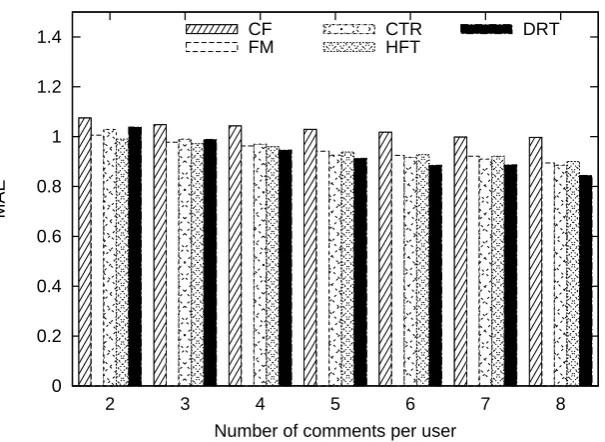
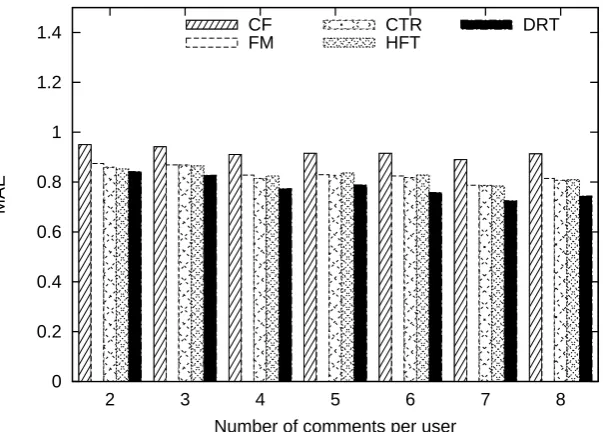
Figure 2: MAE vs number of training reviews per user (Yelp)
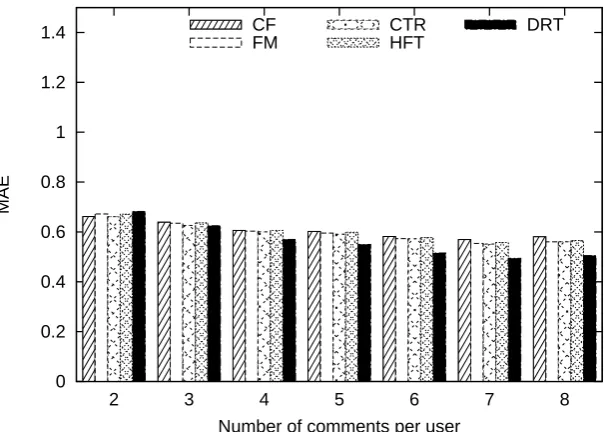
The number of training reviews is important for recommendation systems. We thus investigate the effect of training reviews per user. Figure 2- 4 show the MAE scores with varying number of training reviews per user. The trend of the results shows that all the systems are getting better scores, with increasing number of comments. When the number of training reviews grows larger, the performance gap between DRT and CF also grows. This fact indicates that our approach can make use of text comments to improve performance. The results also show that with 2 or 3 training reviews, DRT performs best on 3 among 6 cases, while with 4 or more training reviews, DRT can beat other approaches. In future work, we will try to improve the bad cases.
[image:7.595.145.448.227.448.2]0 0.2 0.4 0.6 0.8 1 1.2 1.4
2 3 4 5 6 7 8
MAE
Number of comments per user CF
FM
CTR HFT
[image:8.595.143.447.70.286.2]DRT
Figure 3: MAE vs number of training reviews per user (Dianping)
5 Related Work
In this paper, we utilize user comments to enhance recommendation systems. Text mining techniques are now widely used on comment data on the Internet to support a large variety of applications in e-commerce. Liu et al. (2005) discuss the possibility of comparing comments available online to identify important opinions of the users on the items. Zhai et al. (2011) present an approach to select important sentences in the product comments. Zhang et al. (2015) design a customized solution to restaurant comment summarization on dishes. Topic modeling techniques based on Dirichlet allocation are recently popular in text analytics (Blei et al., 2003), which is particularly effective on long documents to find meaningful topics (Blei et al., 2004). However, we hereby emphasize that all these techniques are not directly helpful to improve recommendation systems.
A huge bulk of recommendation algorithms are proposed in the literature. Collaborative filtering is known as the most popular approach (Su and Khoshgoftaar, 2009; Sarwar et al., 2001) and matrix fac-torization has recently emerged as an effective strategy to improve the effectiveness of collaborative filtering (Koren et al., 2009; Rendle, 2012). Latent Factorization Model decomposes the matrix of user-item features and identifies the features connected to users and user-items respectively. Some other invariants, such as max-margin matrix factorization (Rennie and Srebro, 2005) and probabilistic matrix factoriza-tion (Salakhutdinov and Mnih, 2008), are proposed to improve the robustness of the factorizafactoriza-tion out-puts. Singh and Gordon (2008) further encode genres of movies and roles of actors in movies as binary relations into a collective matrix factorization model. All these approaches require the generation of matrix with aligned features, and only can use very limited information besides scores.
0 0.2 0.4 0.6 0.8 1 1.2 1.4
2 3 4 5 6 7 8
MAE
Number of comments per user CF
FM
CTR HFT
[image:9.595.145.447.70.286.2]DRT
Figure 4: MAE vs number of training reviews per user (Amazon)
identify the feature words directly extracted from comments.
Recently some researchers try to learn latent aspects from comments (Wu and Ester, 2015). Wang et al. (2011) builds a regression model over the topic results from LDA. Their approach does not try to identify user profiles, and thus only applicable to score prediction on the text comments. Wang and Blei (2011) combine the merits of traditional collaborative filtering and topic modeling which provides a latent structure to recommend scientific articles in citation networks. Tang et al. (2015) learn repre-sentations of users and item for sentiment classification. Although similar concepts of user and item representations are used in (Tang et al., 2015), there are two major differences. Firstly, the problem we try to solve is completely different: they work on review sentiment classification, while our work focuses on score prediction without text. Secondly, the models are different: their approach includes user/product representation in CNN to enhance score prediction accuracy over text review, while out proposal attempts to maximize the likelihood of individual words. McAuley and Leskovec (2013) use a topic model to ex-tract user and item profiles based on text comments. Although related, such approaches differ from ours in that they represent latent topics by keywords which are limited in representations. The approach of McAuley and Leskovec (2013) is the most relevant work to ours, but there are a number of limitations in their work. Firstly, they assume there is a one-to-one correspondence between the entries in the user profile and item profile. Secondly, their optimization relies on the assumption of LDA, such that the words are drawn independently from an unknown distribution. Our approach does not have any strong assumption on the generation mechanism.
6 Conclusion
In this paper, we have presented a simple yet effective approach to learn distributed representations of users and items from large amounts of text reviews. In our approach, the user vectors and item vectors are learned by a neural network. The user representation denotes the personal preferences over the items, while the item representation denotes the important attributes of the items. Finally, the distributed representations are used in recommendation systems. When tested on the datasets from different domains and languages, our systems achieve better performance than the state-of-the-art baseline systems.
Acknowledgments
0 0.2 0.4 0.6 0.8 1 1.2 1.4
40 80 120 160 200 240
MAE
[image:10.595.143.443.71.288.2]Comment Length (BIN) Yelp Amazon Dianping
Figure 5: MAE vs average comment length (BIN) per user
is supported by the research grant for the Human Centered Cyber-physical Systems Programme at the Advanced Digital Sciences Center from Singapores A*STAR. We would also thank the anonymous re-viewers for their detailed comments, which have helped us to improve the quality of this work.
References
Amjad Almahairi, Kyle Kastner, Kyunghyun Cho, and Aaron Courville. 2015. Learning distributed represen-tations from reviews for collaborative filtering. InProceedings of the 9th ACM Conference on Recommender Systems, pages 147–154. ACM.
David M Blei, Andrew Y Ng, and Michael I Jordan. 2003. Latent dirichlet allocation. the Journal of machine Learning research, 3:993–1022.
David M Blei, T Griffiths, M Jordan, and J Tenenbaum. 2004. Hierarchical topic models and the nested chinese restaurant process. NIPS, 16:106–114.
Michael Gutmann and Anpo Hyvarinen. 2012. Noise-contrastive estimation of unnormalized statistical models, with applications to natural image statistica. The Journal of Machine Learning Research, 13:307–361.
Xiangnan He, Tao Chen, Min-Yen Kan, and Xiao Chen. 2015. Trirank: Review-aware explainable recommenda-tion by modeling aspects. InCIKM.
Nitin Jindal and Bing Liu. 2008. Opinion spam and analysis. InProceedings of the 2008 International Conference on Web Search and Data Mining, pages 219–230. ACM.
Yehuda Koren, Robert Bell, and Chris Volinsky. 2009. Matrix factorization techniques for recommender systems. Computer, (8):30–37.
Quoc V. Le and Tomas Mikolov. 2014. Distributed representations of sentences and documents. InICML, pages 1188–1196.
Bing Liu and Lei Zhang. 2012. A survey of opinion mining and sentiment analysis. InMining text data, pages 415–463. Springer.
Bing Liu, Minqing Hu, and Junsheng Cheng. 2005. Opinion observer: analyzing and comparing opinions on the web. InProc of WWW, pages 342–351. ACM.
Julian J. McAuley and Jure Leskovec. 2013. Hidden factors and hidden topics: understanding rating dimensions with review text. InRecSys, pages 165–172.
Prem Melville, Raymond J. Mooney, and Ramadass Nagarajan. 2002. Content-boosted collaborative filtering for improved recommendations. InAAAI, pages 187–192.
Andriy Mhih and Hyee Whye Teh. 2012. A fast and simple algorithm for training neural probabilistic language models. InProceedings of ICML.
Tomas Mikolov, Ilya Sutskever, Kai Chen, Gregory S. Corrado, and Jeffrey Dean. 2013. Distributed representa-tions of words and phrases and their compositionality. InNIPS, pages 3111–3119.
Claudiu Cristian Musat, Yizhong Liang, and Boi Faltings. 2013. Recommendation using textual opinions. In IJCAI.
Steffen Rendle. 2012. Factorization machines with libFM. ACM Trans. Intell. Syst. Technol., 3(3):57:1–57:22, May.
Jason D. M. Rennie and Nathan Srebro. 2005. Fast maximum margin matrix factorization for collaborative prediction. InICML, pages 713–719.
Ruslan Salakhutdinov and Andriy Mnih. 2008. Bayesian probabilistic matrix factorization using markov chain monte carlo. InICML, pages 880–887.
Badrul M. Sarwar, George Karypis, Joseph A. Konstan, and John Riedl. 2001. Item-based collaborative filtering recommendation algorithms. InWWW Conference, pages 285–295.
Ajit P Singh and Geoffrey J Gordon. 2008. Relational learning via collective matrix factorization. InKDD, pages 650–658. ACM.
Xiaoyuan Su and Taghi M Khoshgoftaar. 2009. A survey of collaborative filtering techniques. Advances in artificial intelligence, 2009:4.
Duyu Tang, Bing Qin, and Ting Liu. 2015. Learning semantic representations of users and products for document level sentiment classification. In Proceedings of the 53rd Annual Meeting of the Association for Computa-tional Linguistics and the 7th InternaComputa-tional Joint Conference on Natural Language Processing (Volume 1: Long Papers), pages 1014–1023, Beijing, China, July. Association for Computational Linguistics.
Chong Wang and David M Blei. 2011. Collaborative topic modeling for recommending scientific articles. In KDD, pages 448–456. ACM.
Hongning Wang, Yue Lu, and ChengXiang Zhai. 2011. Latent aspect rating analysis without aspect keyword supervision. InKDD, pages 618–626.
Yao Wu and Martin Ester. 2015. Flame: A probabilistic model combining aspect based opinion mining and collaborative filtering. InProceedings of the Eighth ACM International Conference on Web Search and Data Mining, pages 199–208. ACM.
Zhongwu Zhai, Bing Liu, Lei Zhang, Hua Xu, and Peifa Jia. 2011. Identifying evaluative sentences in online discussions. InAAAI.
Yongfeng Zhang, Guokun Lai, Min Zhang, Yi Zhang, Yiqun Liu, and Shaoping Ma. 2014. Explicit factor models for explainable recommendation based on phrase-level sentiment analysis. InSIGIR, pages 83–92.
Rong Zhang, Zhenjie Zhang, Xiaofeng He, and Aoying Zhou. 2015. Dish comment summarization based on bilateral topic analysis. InICDE, pages 483–494.