Some Experiments on Indicators of
Parsing Complexity for Lexicalized Grammars
Anoop Sarkar, Fei Xia and Aravind Joshi
Dept. of Computer and Information Science
University of Pennsylvania
200 South 33rd Street,
Philadelphia, PA 19104-6389, USA
anoop,fxia,joshi @linc.cis.upenn.edu
Abstract
In this paper, we identify syntactic lexical ambi-guity and sentence complexity as factors that con-tribute to parsing complexity in fully lexicalized grammar formalisms such as Lexicalized Tree Ad-joining Grammars. We also report on experiments that explore the effects of these factors on parsing complexity. We discuss how these constraints can be exploited in improving efficiency of parsers for such grammar formalisms.
1 Introduction
The time taken by a parser to produce derivations for input sentences is typically associated with the length of those sentences. The longer the sentence, the more time the parser is expected to take. How-ever, complex algorithms like parsers are typically affected by several factors. A common experience is that parsing algorithms differ in the number of edges inserted into the chart while parsing. In this paper, we explore some of these constraints from the perspective of lexicalized grammars and explore how these constraints might be exploited to improve parser efficiency.
We concentrate on the problem of parsing using
fullylexicalized grammars by looking at parsers for Lexicalized Tree Adjoining Grammar (LTAG). By a fully lexicalized grammar we mean a grammar in which there are one or more syntactic structures associated with each lexical item. In the case of LTAG each structure is a tree (or, in general, a di-rected acyclic graph). For each structure there is an explicit structural slot for each of the arguments of the lexical item. The various advantages of defin-ing a lexicalized grammar formalism in this way are discussed in (Joshi and Schabes, 1991).
An example LTAG is shown in Figure 1. To
parse the sentenceMs. Haag plays Eliantithe parser
has to combine the trees selected by each word in the sentence by using the operations of substitution and adjunction (the two composition operations in LTAG) producing a valid derivation for the sen-tence.
Notice that as a consequence of this kind of
lexi-calized grammatical description there might be sev-eral different factors that affect parsing complex-ity. Each word can select many different trees; for
example, the word plays in Figure 1 might select
several trees for each syntactic context in which it
can occur. The verb playscan be used in a
rela-tive clause, a wh-extraction clause, among others. While grammatical notions of argument structure and syntax can be processed in abstract terms just as in other kinds of formalisms, the crucial differ-ence in LTAG is that all of this information is
com-piled into a finite set of treesbefore parsing. Each
of these separate lexicalized trees is now considered by the parser. This compilation is repeated for other
argument structures, e.g. the verb playscould also
select trees which are intransitive thus increasing the set of lexicalized trees it can select. The set of trees selected by different lexical items is what we term
in this paper aslexical syntactic ambiguity.
The importance of this compilation into a set of lexicalized trees is that each predicate-argument structure across each syntactic context has its own
lexicalized tree. Most grammar formalisms use
feature structures to capture the same grammatical and predicate-argument information. In LTAG, this larger set of lexicalized trees directly corresponds to the fact that recursive feature structures are not needed for linguistic description. Feature struc-tures are typically atomic with a few instances of re-entrant features.
NNP n NP
u
NNP
m NPn
NP u
sNP NNP@=4 1[Haag] m NNP@ NP*=2 1[Ms.]
NNP n NP
u NParg
VBZ
n NParg
VP n S
u
[image:2.595.174.425.58.218.2]sNP NNP@=4 1[Elianti] sS NPs VBZ@ NPs=20 1[plays]
Figure 1: Example lexicalized elementary trees. They are shown in the usual notation: anchor
substitution node footnode na null-adjunction constraint. These trees can be combined using
sub-stitution and adjunction to parse the sentenceMs. Haag plays Elianti.
Furthermore, as the sentence length increases, the number of lexicalized trees increase proportionally increasing the attachment ambiguity. Each sentence is composed of several clauses. In a lexicalized grammar, each clause can be seen as headed by a single predicate tree with its arguments and asso-ciated adjuncts. We shall see that empirically the number of clauses grow with increasing sentence length only up to a certain point. For sentences greater than a certain length the number of clauses do not keep increasing.
Based on these intuitions we identify the follow-ing factors that affect parsfollow-ing complexity for lexi-calized grammars:
Syntactic Lexical Ambiguity The number of trees selected by the words in the sentence being parsed. We show that this is a better indica-tor of parsing time than sentence length. This is also a predictor of the number of edges that will be proposed by a parser, allowing us to
better handle difficult casesbeforeparsing.
Sentence Complexity The clausal complexity in the sentences to be parsed. We observe that the number of clauses in a sentence stops grow-ing in proportion to the sentence length after a point. We show that before this point parsing complexity is related to attachment of adjuncts rather than attachment of arguments.
2
LTAG
Treebank Grammar
The grammar we used for our experiments was a LTAG Treebank Grammar which was automatically extracted from Sections 02–21 of the Wall Street Journal Penn Treebank II corpus (Marcus et al.,
1993). The extraction tool (Xia, 1999) converted the
derivedtrees of the Treebank intoderivationtrees in LTAG which represent the attachments of
lexical-ized elementary trees. There are tree templates
in the grammar with tree nodes. Each word
in the corpus selects some set of tree templates. The
total number of lexicalized trees is . The
total number of word types in the lexicon is .
The average number of trees per word type is .
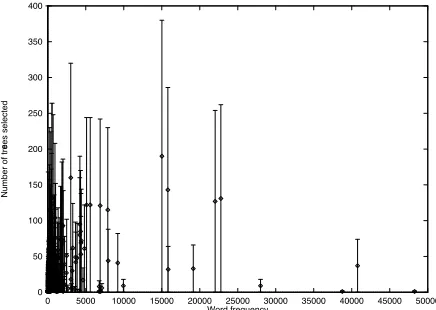
However, this average is misleading since it does not consider the frequency with which words that select a large number of trees occur in the corpus. In Figure 2 we see that many frequently seen words can select a large number of trees.
0 50 100 150 200 250 300 350 400
0 5000 10000 15000 20000 25000 30000 35000 40000 45000 50000
Number of trees selected
Word frequency
Figure 2: Number of trees selected plotted against words with a particular frequency. (x-axis: words of frequency ; y-axis: number of trees selected, error bars indicate least and most ambiguous word of a particular frequency )
[image:2.595.318.536.494.649.2]Treebank grammar which has been automatically extracted is that any parsing results using such a grammar might not be indicative of parsing us-ing a hand-crafted lus-inguistically sophisticated gram-mar. To address this point (Xia and Palmer, 2000), compares this Treebank grammar with the XTAG grammar (XTAG-Group, 1998), a large-scale hand-crafted LTAG grammar for English. The experiment shows that 82.1% of template tokens in the Tree-bank grammar matches with a corresponding tem-plate in the XTAG grammar; 14.0% are covered by the XTAG grammar but the templates in two gram-mars look different because the Treebank and the XTAG grammar have adopted different analyses for the corresponding constructions; 1.1% of template tokens in the Treebank grammar are not linguisti-cally sound due to annotation errors in the original Treebank; and the remaining 2.8% are not currently covered by the XTAG grammar. Thus, a total of 96.1% of the structures in the Treebank grammar match up with structures in the XTAG grammar.
3 Syntactic Lexical Ambiguity
In a fully lexicalized grammar such as LTAG the combinations of trees (by substitution and
adjunc-tion) can be thought of asattachments. It is this
per-spective that allows us to define the parsing problem in two steps (Joshi and Schabes, 1991):
1. Assigning a set of lexicalized structures to each word in the input sentence.
2. Finding the correct attachments between these structures to get all parses for the sentence.
In this section we will try to find which of these factors determines parsing complexity when finding all parses in an LTAG parser.
To test the performance of LTAG parsing on a realistic corpus using a large grammar (described
above) we parsed sentences from the Wall
Street Journal using the lexicalized grammar
de-scribed in Section 2.1 All of these sentences were
of length words or less. These sentences were
taken from the same sections (02-21) of the Tree-bank from which the original grammar was ex-tracted. This was done to avoid the complication of using default rules for unknown words.
In all of the experiments reported here, the parser produces all parses for each sentence. It produces a shared derivation forest for each sentence which stores, in compact form, all derivations for each sen-tence.
1
Some of these results appear in (Sarkar, 2000). In this sec-tion we present some addisec-tional data on the previous results and also the results of some new experiments that do not appear in the earlier work.
We found that the observed complexity of pars-ing for LTAG is dominated by factors other than
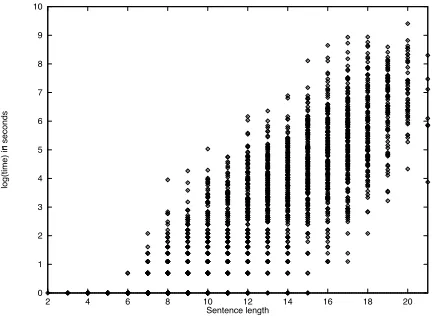
sentence length.2 Figure 3 shows the time taken
in seconds by the parser plotted against sentence length. We see a great deal of variation in timing for the same sentence length, especially for longer sentences.
We wanted to find the relevant variable other than sentence length which would be the right predictor of parsing time complexity. There can be a large variation in syntactic lexical ambiguity which might be a relevant factor in parsing time complexity. To draw this out, in Figure 4 we plotted the number of trees selected by a sentence against the time taken to parse that sentence. By examining this graph we can visually infer that the number of trees selected is a better predictor of increase in parsing complexity than sentence length. We can also compare numer-ically the two hypotheses by computing the
coeffi-cient of determination ( ) for the two graphs. We
get a value of for Figure 3 and a value of
for Figure 4. Thus, we infer that it is the syn-tactic lexical ambiguity of the words in the sentence which is the major contributor to parsing time com-plexity.
0 1 2 3 4 5 6 7 8 9 10
2 4 6 8 10 12 14 16 18 20
log(time) in seconds
Sentence length
Figure 3: Parse times plotted against sentence
length. Coefficient of determination: .
(x-axis: Sentence length; y-axis: log(time in sec-onds))
Since we can easily determine the number of trees selected by a sentence before we start parsing, we can use this number to predict the number of edges that will be proposed by a parser when pars-ing this sentence, allowpars-ing us to better handle
diffi-cult casesbeforeparsing.
2
[image:3.595.318.534.380.541.2]0 1 2 3 4 5 6 7 8 9 10
0 200 400 600 800 1000
log(Time taken) in seconds
[image:4.595.74.292.49.208.2]Total num of trees selected by a sentence
Figure 4: The impact of syntactic lexical ambigu-ity on parsing times. Log of the time taken to parse a sentence plotted against the total number of trees selected by the sentence. Coefficient of
determina-tion: . (x-axis: Total number of trees
se-lected by a sentence; y-axis: log(time) in seconds).
We test the above hypothesis further by parsing the same set of sentences as above but this time us-ing an oracle which tells us the correct elementary lexicalized structure for each word in the sentence. This eliminates lexical syntactic ambiguity but does not eliminate attachment ambiguity for the parser. The graph comparing the parsing times is shown in Figure 5. As the comparison shows, the elimina-tion of lexical ambiguity leads to a drastic increase in parsing efficiency. The total time taken to parse
all sentences went from 548K seconds to 31.2
[image:4.595.318.533.206.370.2]seconds.
Figure 5 shows us that a model which disam-biguates syntactic lexical ambiguity can potentially be extremely useful in terms of parsing efficiency. Thus disambiguation of tree assignment or Su-perTagging (Srinivas, 1997) of a sentence before parsing it might be a way of improving parsing ef-ficiency. This gives us a way to reduce the pars-ing complexity for precisely the sentences which were problematic: the ones which selected too many trees. To test whether parsing times are reduced af-ter SuperTagging we conducted an experiment in
which the output of an -best SuperTagger was
taken as input to the parser. In our experiment we
set to be .3 The time taken to parse the same set
of sentences was again dramatically reduced (the to-tal time taken was 21K seconds). However, the dis-advantage of this method was that the coverage of
3(Chen et al., 1999) shows that to get greater than 97%
ac-curacy using SuperTagging the value of must be quite high ( ). They use a different set of SuperTags and so we used their result simply to get an approximate estimate of the value of .
the parser was reduced: 926 sentences (out of the 2250) did not get any parse. This was because some crucial tree was missing in the -best output. The results are graphed in Figure 6. The total number of derivations for all sentences went down to 1.01e+10 (the original total number was 1.4e+18) indicating (not surprisingly) that some attachment ambiguities persist although the number of trees are reduced. We are experimenting with techniques where the output of the -best SuperTagger is combined with other pieces of evidence to improve the coverage of the parser while retaining the speedup.
-5 -4.5 -4 -3.5 -3 -2.5 -2 -1.5 -1 -0.5 0
0 5 10 15 20
log(Time taken in secs)
Sentence length
Figure 5: Parse times when the parser gets the cor-rect tree for each word in the sentence (eliminating any syntactic lexical ambiguity). The parsing times
for all the sentences for all lengths never goes
above second. (x-axis: Sentence length; y-axis:
log(time) in seconds)
-6 -4 -2 0 2 4 6 8
0 5 10 15 20 25
log(Time in secs)
Sentence length
Figure 6: Time taken by the parser after -best
Su-perTagging ( ). (x-axis: Sentence length;
y-axis: log(time) in seconds)
4 Sentence Complexity
[image:4.595.317.535.480.640.2]each other. In the context of lexicalized tree-adjoining grammar (and in other lexical frame-works, perhaps with some modifications) the com-plexity of syntactic and semantic processing is re-lated to the number of predicate-argument structures being computed for a given sentence.
In this section, we explore the possibility of char-acterizing sentence complexity in terms of the num-ber of clauses which is used as an approximation to the number of predicate-argument structures to be found in a sentence.
The number of clauses of a given sentence in the Penn Treebank is counted using the bracketing tags. The count is computed to be the number of S/SINV/SQ/RRC nodes which have a VP child or a child with -PRD function tag. In principle number of clauses can grow continuously as the sentence length increases. However it is interesting to note that 99.1% of sentences in the Penn Treebank con-tain 6 or fewer clauses.
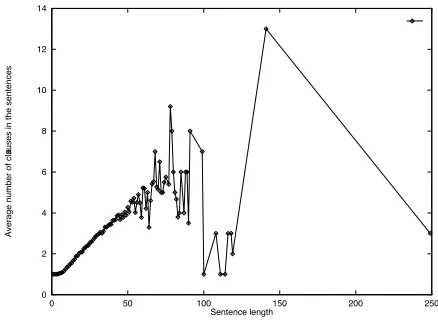
Figure 7 shows the average number of clauses plotted against sentence length. For sentences with no more than 50 words, which accounts for 98.2% of the corpus, we see a linear increase in the av-erage number of clauses with respect to sentence length. But from that point on, increasing the sen-tence length does not lead to a proportional increase in the number of clauses. Thus, empirically, the number of clauses is bounded by a constant. For some very long sentences, the number of clauses actually decreases because these sentences include long but flat coordinated phrases.
Figure 8 shows the standard deviation of the clause number plotted against sentence length. There is an increase in deviation for sentences longer than 50 words. This is due to two reasons: first, quite often, long sentences either have many embedded clauses or are flat with long coordinated phrases; second, the data become sparse as the
sen-tence length grows, resulting in high deviation.4
In Figure 9 and Figure 10 we show how parsing time varies as a function of the number of clauses present in the sentence being parsed. The figures are analogous to the earlier graphs relating parsing time with other factors (see Figure 3 and Figure 4). Surprisingly, in both graphs we see that when the number of clauses is small (in this case less than ), an increase in the number of clauses has no ef-fect on the parsing complexity. Even when the
num-ber of clauses is we find the same pattern of time
complexity that we have seen in the earlier graphs when we ignored clause complexity. Thus, when the number of clauses is small parsing complexity
4For some sentence lengths (e.g., length ), there is
only one sentence with that length in the whole corpus, result-ing in zero deviation.
0 2 4 6 8 10 12 14
0 50 100 150 200 250
Average number of clauses in the sentences
[image:5.595.316.535.49.209.2]Sentence length
Figure 7: Average number of clause plotted against sentence length
0 0.5 1 1.5 2 2.5 3 3.5 4
0 50 100 150 200 250
Standard deviation of clause number
[image:5.595.317.535.264.424.2]Sentence length
Figure 8: Standard deviation of clause number plot-ted against sentence length
is related to attachment of adjuncts rather than argu-ments. It would be interesting to continue increas-ing the number of clauses and the sentence length
and then compare the differences in parsing times.5
We have seen that beyond a certain sentence length, the number of clauses do not increase pro-portionally. We conjecture that a parser can ex-ploit this observed constraint on clause complexity in sentences to improve its efficiency. In a way sim-ilar to methods that account for low attachment of adjuncts while parsing, we can introduce constraints on how many clauses a particular node can domi-nate in a parse. By making the parser sensitive to this measure, we can prune out unlikely derivations previously considered to be plausible by the parser. There is also an independent reason for pursuing this measure of clausal complexity. It can be ex-tended to a notion of syntactic and semantic com-plexity as they relate to both the representational
5We plan to conduct this experiment and present the results
1 1.5 2 2.5
3 3.5 4 4.5
5 5
10 15
20 0
1 2 3 4 5 6 7 8 9 10
Num of clauses
[image:6.595.81.280.72.196.2]Sentence length log(Time taken in secs)
Figure 9: Variation in times for parsing plotted against length of each sentence while identifying the number of clauses.
1 1.5 2 2.5
3 3.5 4 4.5
5
500 1000 0
1 2 3 4 5 6 7 8 9 10
Num of clauses
Num of trees selected log(Time taken in secs)
Figure 10: Variation in times for parsing plotted against the number of trees selected by each sen-tence while identifying the number of clauses.
and processing aspects (Joshi, 2000). The empirical study of clausal complexity described in this section might shed some light on the general issue of syn-tactic and semantic complexity.
5 Conclusion
In this paper, we identified syntactic lexical ambi-guity and sentence complexity as factors that con-tribute to parsing complexity in fully lexicalized grammars.
We showed that lexical syntactic ambiguity has a strong effect on parsing time and that a model which disambiguates syntactic lexical ambiguity can po-tentially be extremely useful in terms of parsing ef-ficiency. By assigning each word in the sentence with the correct elementary tree showed that parsing times were reduced by several orders of magnitude
(the total time taken to parse sentences went
from 548K seconds to 31.2 seconds).
We conducted an experiment in which the out-put of an -best SuperTagger was taken as inout-put to the parser. The time taken to parse the same set of sentences was again dramatically reduced (the total time taken was 21K seconds). The disadvantage of this approach was that 926 out of the original 2250 sentences did not get any parse.
We showed that even as sentence length increases the number of clauses is empirically bounded by a constant. The number of clauses in 99.1% of sen-tences in the Penn Treebank was bounded by 6. We discussed how this finding affects parsing efficiency and showed that for when the number of clauses is smaller than , parsing efficiency is dominated by adjunct attachments rather than argument attach-ments.
References
John Chen, Srinivas Bangalore, and K. Vijay-Shanker. 1999. New models for improving supertag disam-biguation. In Proceedings of the 9th Conference of the European Chapter of the Association for Compu-tational Linguistics, Bergen, Norway.
A. Joshi and Y. Schabes. 1991. Tree adjoining grammars and lexicalized grammars. In M. Nivat and A. Podel-ski, editors, Tree automata and languages. North-Holland.
Aravind K. Joshi. 2000. Some aspects of syntactic and semantic complexity and underspecification. Talk given atSyntactic and Semantic Complexity in Natural Language Processing Systems, Workshop at ANLP-NAACL 2000, Seattle, May.
M. Marcus, B. Santorini, and M. Marcinkiewiecz. 1993. Building a large annotated corpus of english. Compu-tational Linguistics, 19(2):313–330.
Stephan Oepen and John Carroll. 2000. Ambiguity packing in constraint-based parsing – practical results. InProceedings of the 1st Meeting of the North Amer-ican ACL, NAACL-2000, Seattle, Washington, Apr 29 – May 4.
Anoop Sarkar. 2000. Practical experiments in parsing using tree adjoining grammars. InProceedings of the Fifth Workshop on Tree Adjoining Grammars, Paris, France, May 25–27.
The XTAG-Group. 1998. A Lexicalized Tree Adjoining Grammar for English. Technical Report IRCS 98-18, University of Pennsylvania.
B. Srinivas. 1997. Performance Evaluation of Supertag-ging for Partial Parsing. InProceedings of Fifth In-ternational Workshop on Parsing Technology, Boston, USA, September.
Fei Xia and Martha Palmer. 2000. Evaluating the Cover-age of LTAGs on Annotated Corpora. InProceedings of LREC satellite workshop Using Evaluation within HLT Programs: Results and Trends.
[image:6.595.80.284.296.423.2]