Temiar Reduplication in One-Level Prosodic Morphology
Markus Walther
University of Marburg
FB09/IGS, Wilhelm-R¨opke-Str. 6A, D-35032 Marburg, Germany
[email protected]
Abstract
Temiar reduplication is a difficult piece of prosodic morphology. This paper presents the first com-putational analysis of Temiar reduplication, us-ing the novel finite-state approach of One-Level Prosodic Morphology originally developed by Walther (1999b, 2000). After reviewing both the data and the basic tenets of One-level Prosodic Mor-phology, the analysis is laid out in some detail, using the notation of the FSA Utilities finite-state toolkit (van Noord 1997). One important discovery is that in this approach one can easily define a regu-lar expression operator which ambiguously scans a string in the left- or rightward direction for a cer-tain prosodic property. This yields an elegant ac-count of base-length-dependent triggering of redu-plication as found in Temiar.
1 Introduction
Temiar is an Austroasiatic language of the Mon-Khmer group spoken by a variety of tribal people in West Malaysia (Benjamin, 1976). Its intricate mor-phological system has received some attention in the theoretical literature. The main focus has been on the aspectual morphology of verbs, where an inter-esting pattern of partial reduplication emerges that is sensitive to the size of the verbal root. For exam-ple, in the active continuative, ‘to eat’ redu-plicates both the initial /g/ and the final /l/ of its monosyllabic base . In contrast, bisyllabic ‘to shoot’ comes out as , where only the final /h/ is copied, this time as an infix.
Temiar reduplication thus appears to be a suitably rich testing ground for a novel approach to redu-plication developed by (Walther, 1999b; Walther, 2000) within a finite-state framework. Even though that approach, One-Level Prosodic Morphology, was presented from the outset as being generally applicable, it has been proven time and time again that only concrete empirical application of a
par-ticular approach to computational morphology and phonology will fully reveal its inherent virtues and weaknesses. As an example, (Beesley, 1998) re-ports that it was actual experimentation with gram-mars of word-formation in Arabic and Hungarian which fully revealed the negative effects of mod-elling long-distance circumfixional dependencies in purely finite-state terms, subsequently leading to some suggestions for improvement.
It is perhaps worth emphasizing that (Walther, 1999b)’s solution for reduplication in a finite-state context is preferrable for cross-linguistic validation precisely because it is the first that solves the prob-lem in thegeneral case. Because reduplication of-ten involves copying of a strictly bounded amount of material, the bounded casecouldin principle be modelled as a finite-state process by enumerating all possible forms of the copy and then making sure each was matched to the proper stem. To solve this simplified problem, no new techniques are needed in theory. In practice however, the brute-force enu-meration approach apparently has not been pursued further, apart from isolated examples (see Antworth (1990), p.157f for a fixed-size case in Tagalog). This is probably because such an approach is awkward to specify in actual grammars and because it will inevitably lead to an explosion of the state space (Sproat (1992), p.161). Finally and in contrast to (Walther, 1999b), it would clearly break down for
productive total reduplication, which is isomorphic to the context-sensitive language .
with respect to linguistic adequacy would represent significant progress on its own.
In the rest of the paper I will attempt to provide just such an analysis, beginning in 2 with a presen-tation of the relevant data. Next, section 3 reviews the core of One-Level Prosodic Morphology, which will be used as formal background. Using that back-ground, the analysis is then fully developed in 4. The paper concludes with some discussion in 5.
2 Temiar reduplication
All data on Temiar reduplication in this section come from (Benjamin, 1976), the main source on the subject.1 According to Benjamin, the charac-teristic aspectual paradigms of “monosyllabic and schewa-form verbs” (B:168) are as follows (B:169):
(1) ‘to call’ ‘to lie down/sleep/marry’
‘monosyllabic’ ‘schewa-form’ a
c t i v e
perfective
k simulfactive
k w g continuative
c a u s a t.
perfective simulfactive
w g continuative
We have inferred syllabifications in (1) from the statement that “only two types of syllables occur:
open syllablesof canonical form CV, andclosed syl-lablesof canonical form CVC” (B:141). Note that Benjamin abstracts from vowel length here. Word-level stress, which is “falling regularly on the final syllable” (B:139), is likewise inferred in (1). Ob-serve that only monosyllabic roots like redu-plicate their initial consonant in the non-perfective aspectual forms of the active, while longer roots like do not. This contrasts with obligatory redupli-cation of the root-final consonant in the continua-tive.
An important further generalization is that all extra segmental material beyond the bare root is inserted immediately before the stressed syllable, leading to prefixation for monosyllabic roots, but in-fixation in polysyllabic ones (Gafos, 1998b). From this point of view we can also see a correlation be-tween the fact that causative forms of monosyllabic roots – which must be at least bisyllabic – begin
1We will abbreviate further references to this work with
“(B: page number )” in the text. Moreover, to highlight
reduplicated parts in the data they will often be printed in bold.
with a fixed /t/2 and the restriction that words must “always begin and end with a consonant” (B:141). In triconsonantal roots like that restriction is taken care of by the first root consonant itself, so no fixed segment needs to appear.
According to Benjamin, prefinal syllables – which are unstressed – can show alternation of their vocalic quality: “In prefinal closed syllables the in-ner vowels /e o/ are replaced by the outer vowels /i u/ respectively” (B:144). This descriptive general-ization accounts for the remaining contrasts in (1),
witness e.g. versus .
It is interesting to see that Temiar even exhibits phonological modifications between base and redu-plicant, affecting consonants in the continuative:
(2) y m ‘to cry’ (B:143)
p n ‘to long for’ (B:146)
‘to hunt successfully’ (B:146)
Benjamin explains that medial coda consonants from the class of oral voiceless stops turn into their voiced nasal equivalents in Northern Temiar (and to plain voiced stops in the Southern dialect; B:143).
It is of some importance to clarify a number of further aspects of the data and their interpreta-tion. First, theorists have frequently employed the stronger term ‘minor syllables’ for Benjamin’s pre-final syllables, reflecting their alleged special status by means of an impoverished representation (e.g. empty syllable nuclei in (Gafos, 1998b)) and/or fur-ther formal mechanisms (e.g. a ban on full vowels in prefinal position *PREFINAL-V (Gafos, 1998a)). We do not follow this move here, because empiri-cally it is neither true that penultimate vowels are categorically restricted to schwa-like vowels (
‘to go downriver’, ‘to float’, etc.) nor are there any solid statistics of a presumed tendency to vowel reduction in unstressed syllables, nor can the variable quality of prefinal vowels be consis-tently derived from flanking consonants. Hence, such penultimative vowels are to be lexically speci-fied as alternating.
Second, Benjamin’s subclass restriction of (1) to “monosyllabic and schewa-form verbs” correctly excludes polysyllabic roots like the already men-tioned and , where prefinal open syl-lables with vowels outside of / / occur. These roots undergo “very few morphological changes” (B:170), basically proclitization.
2
Or /b/, if the root starts in /c,t/: / / ‘to eat’ gives
Third, paradigms for a given root are hardly ever complete, with various irregularities and non-productive patterns also occuring (B:169f). Again, a good deal of lexicalization would seem necessary to correctly describe Temiar verbs in a realistic gram-mar fragment.
Given this descriptive summary, our goals for the upcoming analysis are, first, to treat the full
paradigm of (1). As a second goal, we would like to reflect the emergent formal desiderata in a trans-parent way, in particular referring to the need to account for repetition, truncation, infixation and
phonological modification. Thirdly, we will attempt a compositional analysis of the morphological ex-ponency of aspect.
3 One-Level Prosodic Morphology
In order to provide the necessary background for the Temiar analysis in 4, this section briefly re-views the finite-state approach to prosodic morphol-ogy developed in (Walther, 1999b),
That work itself was presented as an extension to (Bird and Ellison, 1994)’s One-Level Phonol-ogy framework, where phonological representa-tions, morphemes and more abstract generalizations are all finite-state automata that express surface-true constraints on word forms, and constraint combina-tion is by automata interseccombina-tion.
In a nutshell, the extension comprises three main components. We (i) represent phonological strings differently for purposes of modelling prosodic mor-phology, (ii) implement reduplicative coyping by automata intersection, and (iii) introduce a resource-conscious variant of automata.
For (i), operators are provided that construct en-riched automata from a simple string automaton, in particular giving it a kind of doubly-linked structure so that the symbol repetition inherent in redupli-cation translates into following backwards-pointing technical transitions. The individual enrichments in-volve only local computation per state or transition, so that on-the-fly implementation is easy if desired. In other words, one does not necessarily have to en-rich the entire lexicon in advance.
Enriched representations In a bit more de-tail, the enrichments of (i) are as follows. The three aspects of reduplication or symbol repeti-tion, truncation or symbol skipping and infixation
or transitive, non-immediate precedence of sym-bols are reflected in three regular expression
op-erators, .
Each takes the underlying automaton of a regular language as its only argument. Formally, they can be defined as follows:
(3) Let be the minimal
-free3 finite-state automaton for , with a finite set of states, finite alphabet , transition
function , start state
and set of final states .
a. Assume .
,
where ,
and
b. Assume .
,
where ,
and
c. ,
where
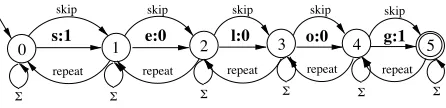
An example enrichment of Temiar is shown in figure 1. One can imagine how and
transitions allow, figuratively speaking, forward and backward movement within a string, while self loops will absorb infixal morphemes that are inter-sected with fig. 1. Finally, so-calledsynchronization bits :1, :0 were introduced in (Walther, 1999b) to define the extent of a reduplicative base constituent in a segment-independent way. Bit value:1marks the edges and:0the interior segments of a base, as shown in fig. 1 for a hypothetical whole-root redu-plication pattern. In actual practive, synchronization
0 s:1 1 2 3 4
skip skip skip skip
l:0 o:0
e:0
repeat repeat repeat repeat
Σ Σ
Σ Σ
Σ
repeat skip
Σ
[image:3.595.317.540.547.601.2]g:1 5
Figure 1:add repeats(add skips(add self loops(selog)))
bits are sets of symbols, just like the rest of the al-phabet. Sets as transition labels improve over tra-ditional automata in terms of automata compact-ness, were already proposed for phonology in (Bird
3Minimality prevents non-(co)-accessible transitions from
getting enriched, while lack of transitions keeps positional
and Ellison, 1992) and do not increase mathematical expressivity beyond regular languages.4 Hence, the segmental part of fig. 1 may be defined in a modular fashion through the intersection of strings of sym-bol sets that mention only certain dimensions (here: phonemes and synchronisation bits), being under-specified for the unmentioned dimensions. We will again follow (Walther, 1999b) in conceiving of sets as types arranged in a type hierarchy that is struc-tured by set inclusion, and also in allowing arbitrary boolean combinations of types.
Copying as intersection Given enriched repre-sentations as in fig. 1, various patterns of redupli-cation are now easy to define. We can denote a syn-chronised abstract string by the regular expression
where is the type subsuming all phonological segments. Then hypothetical total reduplication – unattested in Temiar, but wellknown from Indone-sian and many other languages – is described by
A variant slightly more akin to Temiar – and actu-ally attested in the neighbouring language Semai – that s the interior of the base in a prefixed redu-plicant is just as easy:
Ignoring self loops for the moment, all we need now to apply a reduplication pattern to an enriched base representation is simply tointersectthe former with the latter: automata intersection has sufficient formal power to implement reduplicative copying! Here is an example, using the abbreviation
for perspicuous display:
As pointed out in (Walther, 2000), generaliz-ing to a set of bases involves nothing more than enriching each base separately, then forming the union of the resulting automata. The opposite or-der would produce unwanted cross-string repetition, since does not distribute over union. However, an unpublished experiment shows that on-demand implementation of a slightly modified
4Of course, the identity requirement for matching
transi-tions in traditional automata intersection must be replaced by a non-empty intersection requirement for set-based matching.
can help to preserve the memory ef-ficiency of building a minimized base lexicon as the union of individual base strings first. Due to lack of space, the details will be reported elsewhere.
Resource consciousness As much as we need the formal means provided by self loops for infixations like Temiar , the resulting automata over-generate massively. What’s missing according to (Walther, 1999b) is a distinction between explic-itly contributed, independent information (e.g. the infix itself) and contextual, dependent informa-tion that is tolerated but must be provided by other constraints (e.g. the self loop thathosts the infix). Therefore, a parallel distinction between two kinds of symbols – producers and consumers – was introduced. In that scenario a symbol represents an information resource that needs to be produced at least once, then can be consumed arbitrarily often. To utilize the distinction, an additional P/C bit ac-companies symbols, with P/C = 1 for producers. All symbols introduced by the three enrichment oper-ators are consumers. Furthermore, automata inter-section is made aware of these resource-conscious notions by splitting it into two variants: In open interpretation mode, P/C bits of matching symbols are combined by logical OR, so that a result transi-tion will be marked as a producer whenever at least one argument transition is a producer. In closed in-terpretation mode, combination is by logical AND instead, allowing only producer-producer matches. Grammatical evaluation can then be characterized as follows:
Lexicon Constraint Constraint
Here and elsewhere, producers are in bold print. Note the final intersection with the universal pro-ducer language, which eliminates unused consumer transitions, the main source of overgeneration.
4 The analysis
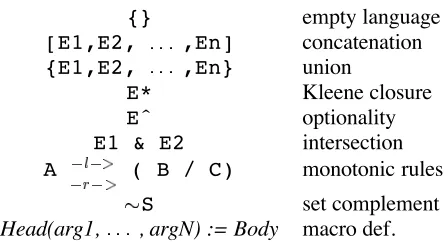
We have assembled enough background now to pro-ceed to the actual analysis of the Temiar data in (1). The analysis is implemented using FSA Utilities, a finite-state toolbox written in Prolog which encour-ages rapid prototyping (van Noord, 1997). Figure 2 shows a relevant fragment of its syntax (extensions and modifications in italics).
{} empty language
[E1,E2, ,En] concatenation
{E1,E2, ,En} union
E* Kleene closure
Eˆ optionality
E1 & E2 intersection
A ( B / C) monotonic rules
S set complement
[image:5.595.78.302.69.190.2]Head(arg1, , argN) := Body macro def.
Figure 2: Regular expression operators
their names instead. A case in point isproducer(T), consumer(T): since the names are self-explanatory,
it suffices to note that the only argument T
con-tains type formulae that denote the symbol sets, as explained before. Allowable type-combining opera-tors are conjunction&, disjunction;and negation .
The same goes for monotonic rules, which – unlike rewrite rules – can only specialize their focussed segmental positionAtoB. They exist in two variants,
whereA -r-> B/Cnotates the case where contextC
is right-adjacent to the focus ( ), and vice versa forA -l-> B/C.
Syllabification To define the reduplicant in prosodic terms later on, we need syllabification
in the first place. Here a simplified finite-state ver-sion of a proposal by (Walther, 1999a) is employed. Its key idea is to allow incremental assignment of syllable roles to segmental positions via a featural decomposition of the three traditional roles, using two binary-valued featuresonsandcod:
(4)
Onset ons cod
Nucleus ons cod
Coda ons cod
CodaOnset ons cod
As a side-effect, one gets the fourth role CO, a monosegmental prosodic representation of true geminates. The subcomponent sbs, for
sonority-based syllabification, itself rests on the computation of sonority differences
be-tween adjacent segmental positions (not shown), where sonority may either go up or down.
To-gether with some self-explanatory constraints
obligatory wordinternal onsets and no geminates,
prosodic surface wellformedness is then wellde-fined. Only if doubly synced edge then stressed
may seem slightly odd, since it has a purely technical character: it rules out certain illformed alternatives in wordforms. Note, however, that the
necesssity of such technical constraints, which are certainly implicit in informal analyses as well, can only be reliably detected in computerized analyses such as the present one, which allow for mechanical enumeration of a grammar’s denotation.
sbs := [ { [consumer(down&˜ons), consumer(segment&˜’Nuc’)], [consumer(up&˜’Nuc’),
consumer(segment&˜cod) } *, no_final_onset ˆ].
no_initial_coda := consumer(segment&˜cod). no_final_onset := consumer(segment&˜ons).
syllabification := sonority_differences& sbs&[no_initial_coda, sbs].
% -- further constraints ---obligatory_wordinternal_onsets :=
( segment -r-> ons / ’Nuc’ ). % _ ’N’
no_geminates := consumer(˜’CO’)*.
prosodic_constraints := obligatory_word-internal_onsets & no_geminates &
if_doubly_synced_edge_then_stressed.
if_doubly_synced_edge_then_stressed := [( {consumer(˜’:1’),
[consumer(’:1’),consumer(˜’:1’)], [consumer(’:1’),consumer(’:1’),
consumer(stressed)] } *), consumer(’:1’) ˆ].
Stress Given the assignment of syllable roles to segmental positions, we are now ready to define Temiar word stress. A possibly empty sequence
ofprefinal syllables, each of which is constrained
to be of shape and unstressed, is
fol-lowed by a final stressed syllable. The macro ends before last syllmakes sure that the dividing
line between the penultimate and ultimate syllable is drawn correctly.
stress := [prefinal_syllables & ends_before_last_syll, syllable].
prefinal_syllables :=
([consumer(’Ons’), consumer(’Nuc’), (consumer(’Cod’) ˆ) ]*) &
consumer(unstressed)*.
ends_before_last_syll:=([consumer(segment)*, consumer(segment&˜ons)]ˆ).
syllable := [consumer(ons)+,consumer(’Nuc’), consumer(cod)*] &
Stems We proceed towards the definition of astem
by noting that – as described in 2 – both the extent of abase’s phonological materialandits stress
pat-tern are necessary prior knowledge for adding as-pectual morphemes in the appropriate way. Hence, we impose the respective constraints onto the iso-lated base string instem0, before wrapping the
re-sult in the usual enrichments. However, the addi-tion of self loops for infixaaddi-tion this time is a pri-ori restricted to the position immediately before a stressed onset, in accordance with the descriptive generalization stated in 2. Experiments have shown that using the unrestricted of (3.c) would cause much unnecessary hassle ina posteri-orirestriction of the possible infix locations to the actually attested ones. It thus appears that Temiar provides a first case for further parametrization of at least one of the original operators from (Walther, 1999b):
base := [consumer(’:1’),consumer(’:0’)*, consumer(’:1’)].
stem0(StemMaterial) :=
add_self_loop_before(stressed&’Ons’, add_repeats(add_skips(StemMaterial &
base & syllabification &
prosodic_constraints & stress))).
stem(Segments) :=
stem0(stringToSegments(Segments)).
Definitions for the actual stem entries of selog, koow, yaapare shown below, using the ASCII-IPA
mapping @ , E , O . In
eval-uating the first entry, the schwa actually trans-lates into a producer-type disjunction ( ; ) with the help of stringToSegments. It thus makes sense
to constrain this free alternation further, which is the purpose of has prefinal syllable. While
the monosyllable koow needs no extra treatment, yaap is an example of a stem ending in an alternating labial, whose definition however is
straightforward (medial, finalrefer to a positional
classification of the word that is defined later):
selog := stem("s@lOg") & has_prefinal_syllable.
koow := stem("kOOw").
yaap := stem0([stringToSegments("yaa"), alternating_labial]).
alternating_labial := {producer(p&final), producer(m&medial&cod)}.
If we now define has prefinal syllable itself, we
have completed the components that make up
stem. While the definition really targets the prefinal
vowel, its preceding onset and the stretch of arbi-trary material after it must also be mentioned. To tolerate interspersed technical symbols, theignore
operator is used (Kaplan and Kay, 1994).
The purpose of prefinal V is to control the
al-ternation between ‘outer’ and ‘inner’ vowel, here parametrized for only. It does so by referenc-ing the next syllable role: if it is consistent with
ons, that vowel resides in an open syllable, hence
theclose midvariant ( ) will be selected. Two
else-where cases deal with closed syllables and the pos-sible presence of a technical symbol:
has_prefinal_syllable := ignore([consumer(’Ons’),
prefinal_V((’E’;’@’), ’:0’&unstressed), consumer(anything) *], technical_symbols).
technical_symbols :=
(consumer((skip;repeat)) *).
prefinal_V(Quality, Common) :=
{ [producer(Quality&close_mid&Common), consumer(ons)],
[producer(Quality&˜close_mid&Common), consumer(cod)],
[consumer((skip;repeat))] } ).
Aspectual affixes It is time to concentrate on the most interesting part, and that is how to define the affixes. Again the general picture will be to see them as constraints on word forms which are imposed by intersection. We begin with thesimulfactive. The
claim here is that its characteristic pattern is the real-ization of the initial base segment (:1), followed by
the infixed melodic element /a/, and then the entire string that begins with the stressed onset. Phrasing the pattern this way already suffices to capture the difference in reduplication behaviour between and : if we have inserted the after the ini-tial consonant in the first base, the stressed onset is
to the left of /a/’s position, whereas in the second base that onset is found to the right. Thus, repeti-tion of segments is necessary to avoid ungrammat-icality due to constraint violation in the first case ( ), but not in the second ( ).
ambiguous movement eitherto the left (repeat) or
to the right (skip) before imposing the restriction X. This operator is applied to infixal /a/ because
it is precisely the infix which needs to ‘seek’ its prosodically defined unique insertion point, i.e. self loop. Finally, to ensure that the other aspectual mor-phemes can play their part later on, the entire pat-tern is wrapped inalignto tolerate further material
before (align right) and after it (align left):
simulfactive :=
align([consumer(’:1’),
seek([producer(a&’:0’&unstressed), consumer(stressed&’Ons’)])]).
seek(X) :=
[{producer(skip)*,producer(repeat)*},X].
align_left(X):=[X,consumer(anything)*]. align_right(X):=[consumer(anything)*,X]. align(X) := align_right(align_left(X)).
Moving on to thecontinuative, we can see that the
relevant formal generalization is a bit more com-plex. Again we start off with the initial base segment (:1), but then seek a place to infix the constant / /,
before weskip tothe next synchronised base
posi-tion (:1), which inevitably will be the final one. The
pattern is completed by again seeking the stressed onset, from which realization of the string proceeds uninterrupted due to the licensing of extra material that the align wrapper provides. This produces a
similar contrast with respect to (non-)reduplication of the first base position, but makes both the rep-etition of the last base segment and the truncation of its interior material obligatory in both base types
( oo vs. lo ):
continuative :=
align([consumer(’:1’),
seek([producer(’E’&’:0’&unstressed)]), skip_to(consumer(’:1’)),
seek(consumer(stressed&’Ons’))]).
skip_to(X) := [producer(skip)+, X].
What is left now is the proper definition of the
causative. Here we observe from (1) that the
causative morphology always starts word-initial, hence the use ofalign left. We have a default
con-sonant /t/ whose realization we must somehow force in the monosyllabic roots. Next comes a vowel, whose quality – or – is again regulated by the
familiarhas prefinal syllable. Finally, the
charac-teristic fixed element /r/ is specified. Upon second thought, the /t/ is guaranteed to appear in mono-syllable roots, because prefinal mono-syllables always re-quire an onset. The default absence of the /t/ – when not needed on prosodic grounds – is again encoded by the producer/consumer distinction, which con-trasts the two disjuncts of the parametrized macro
default:
causative :=
align_left([default(t&unstressed,’:1’), producer(vowel),
producer(r&’:1’&unstressed)])& has_prefinal_syllable.
default(Optional, Common) := { producer(Common&Optional),
consumer(Common) }.
Entire words We can put the pieces together now by first defining the word constraint as the
junction of syllabification and related prosodic con-straints plus a classification of the word’s segmental positions into initial,medial,final ones. Again,
this is modulo interspersed or sym-bols. This actually means that base syllabification and word syllabification must match up, but fortu-nately this is indeed a property of our Temiar data.
Second,wordformconjoins the previous constraint
with its parameterX – which will contain the
con-junction of stem and aspect morphemes –, before eliminating leftover consumer symbols with the help ofclosed interpretation:
word := ignore(syllabification & prosodic_constraints & positional_classification, technical_symbols).
positional_classification :=
[consumer(initial),consumer(medial)*, consumer(final)].
wordform(X):=closed_interpretation(X&word).
These definitions have removed the last barrier to evaluating expressions like wordform(selog & simulfactive & causative) or even suitable
0
1
2
3
4
5
6
7
8
9
10
11
12
13
14
15
16
17
18
19
20 21
22 23
24 25
26 27
[s−Ons−up−:1
[ ‘k−Ons−up−:1
[ ‘y−Ons−up−:1
@−Nuc−down−:0
repeat
repeat
r−Ons−up−:1
a−Nuc−down−:0
E−Nuc−down−:0
a−Nuc−down−:0
‘k−Ons−up−:1
skip
‘l−Ons−up−:0
‘O−Nuc−down−:0
skip
‘O−Nuc−down−:0
‘O−Cod−down−:0
skip
] ‘g−Cod−down−:1
] ‘w−Cod−down−:1
‘m−Cod−down−:1 repeat
repeatrepeat repeat
[image:8.595.70.548.74.218.2]‘y−Ons−up−:1 ‘a−Nuc−down−:0 ‘a−Cod−down−:0 ] ‘p−Cod−down−:1
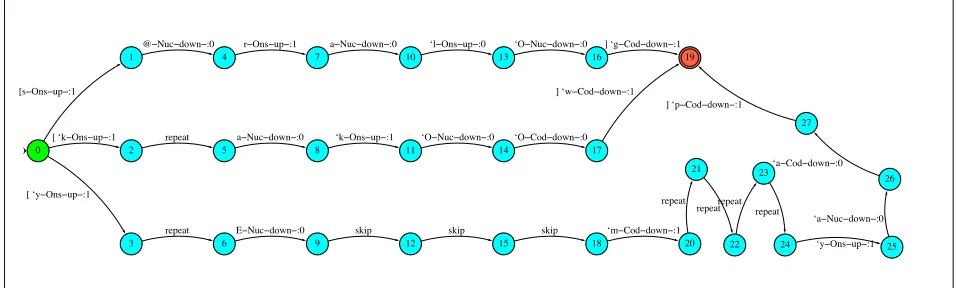
Figure 3: Temiar reduplications , ,
to use here to filter harmless spurious ambiguities from the original version of fig. 3. The kind of am-biguity involved in our Temiar grammar is one of al-ternative distribution of technical symbols in strings of the same segmental-content yield. Suffice to say that a simple parametrization of Bounded Local Op-timization, which could only look at length-1 transi-tion paths emerging from any given state, was able to prune the unwanted alternatives by considering technical transitions costlier in weight than segmen-tal transitions.
5 Conclusion
The present paper has provided further support for (Walther, 1999b)’s finite-state conception of One-Level Prosodic Morphology by formulating – for the first time – a fully formalized and computa-tional analysis of a complicated piece of reduplica-tive morphology found in the Mon-Khmer language of Temiar. Compared to the initial proposal, all three core components of enriched representations, namely technical transitions for repeating or skip-ping segmental symbols and the ability to perform infixation by using self loops, were again found necessary in the course of this analysis. However,
in Temiar the last enrichment – –
needed to be parametrized for a prosodic condition to narrow down the insertion site to a unique posi-tion per base.
The prosodic condition of ‘stressed onset’ proved crucial to define that position, and accounted for the variation between infixing aspectual morphology in longer bases and descriptively prefixing morphol-ogy in monosyllabic ones. Temiar thus underscores the utility of computing with real prosodic informa-tion in finite-state morphology, a frequently miss-ing desideratum accordmiss-ing to (Sproat, 1992, p.170). Also, the symmetry of having both forward and
backward-pointing technical transitions in enriched automata representations was exploited in a novel regular expression operator called seek(X), which
encapsulated an interesting kind of ambiguous di-rectional movement (or: movement underspecified for direction) towards a position satisfying property
X. This operator could rather directly be motivated
from the data. In particular, it facilitated an insight-ful account of the base-length-dependent triggering of reduplication in the active simulfactive aspect.
Finally, in contrast to even the most recent anal-yses in the theoretical linguistic literature, the full paradigm including the causative forms was cap-tured in this fairly complete analysis, together with phonological modifications that sometimes occur between base and reduplicant, as exemplified by . Apart from an optional filtering step for some technical spurious ambiguities that could make use of local optimization, neither global op-timization nor violable or soft constraints of the type argued for in Optimality Theory (Prince and Smolensky, 1993) were found necessary.
References
Evan Antworth. 1990. PC-KIMMO: A Two-Level
Pro-cessor for Morphological Analysis. SIL, Dallas. Kenneth R. Beesley. 1998. Constraining separated
morphotactic dependencies in finite-state grammars. In Proceedings of FSMNLP’98, Bilkent University, Turkey, pages 118–127.
Geoffrey Benjamin. 1976. An outline of Temiar gram-mar. In Philip Jenner, Lawrence Thompson, and Stan-ley Starosta, editors,Austroastiatic studies, volume II, pages 129–187. University Press of Hawaii, Honululu. Steven Bird and T. Mark Ellison. 1992. One-Level Phonology: Autosegmental representations and rules
as finite-state automata. Technical report,
Cen-tre for Cognitive Science, University of Edinburgh. EUCCS/RP-51.
Steven Bird and T. Mark Ellison. 1994. One-Level
Phonology.Computational Linguistics, 20(1):55–90.
Ellen Broselow and John McCarthy. 1983. A theory of
infixing reduplication. The Linguistic Review, 3:25–
98.
Adamantios Gafos. 1995. On the Proper
Charac-terization of ‘Nonconcatenative’ Languages. Ms., Department of Cognitive Science, The Johns
Hopkins University, Baltimore. (ROA-106 at
http://ruccs.rutgers.edu/roa.html).
Diamandis Gafos. 1996. The articulatory basis of
lo-cality in phonology. Ph.D. thesis, The Johns Hop-kins University, Baltimore, Md. [Published by Gar-land:New York].
Diamandis Gafos. 1998a. A-templatic reduplication.
Linguistic Inquiry, 29(3):515–527.
Diamandis Gafos. 1998b. Eliminating long distance
consonantal spreading. Natural Language and
Lin-guistic Theory, 16(2):223–278.
Ron Kaplan and Martin Kay. 1994. Regular models of
phonological rule systems. Computational
Linguis-tics, 20(3):331–78.
John McCarthy. 1982. Prosodic templates, morphemic templates, and morphemic tiers. In Harry van der
Hulst and Norval Smith, editors, The structure of
phonological representations, part I, pages 191–224. Foris, Dordrecht.
Alan Prince and Paul Smolensky. 1993. Optimality theory. constraint interaction in generative grammar. Technical Report RuCCS TR-2, Rutgers University Center for Cognitive Science.
Patricia Shaw. 1993. The prosodic constituency of
mi-nor syllables. In Proceedings of the Eleventh West
Coast Conference on Formal Linguistics, pages 117– 132, Stanford, CA. CSLI Publications. [Distributed by Cambridge University Press].
Kelly Sloan. 1988. Bare-consonant reduplication. In
Proceedings of the Seventh West Coast Conference on Formal Linguistics, pages 319–330, Stanford, CA.
CSLI Publications. [Distributed by Cambridge Uni-versity Press].
Richard Sproat. 1992. Morphology and Computation.
MIT Press, Cambridge, Mass.
Gertjan van Noord. 1997. FSA Utilities: A
tool-box to manipulate finite-state automata. In
Darrell Raymond, Derrick Wood, and Sheng
Yu, editors, Automata Implementation, volume
1260 of Lecture Notes in Computer Science,
pages 87–108. Springer Verlag. (Software under
http://grid.let.rug.nl/ vannoord/Fsa/).
Markus Walther. 1999a. Deklarative prosodische
Mor-phologie: constraint-basierte Analysen und Comput-ermodelle zum Finnischen und Tigrinya. Niemeyer, T¨ubingen.
Markus Walther. 1999b. One-Level Prosodic Morphol-ogy. Marburger Arbeiten zur Linguistik 1, University of Marburg. 64 pp.
(http://xxx.lanl.gov/abs/cs.CL/9911011).
Markus Walther. 2000. Finite-state
Reduplica-tion in One-Level Prosodic Morphology. In
Proceedings of NAACL-2000, pages 296–302,
Seattle/WA. North American Association for
Computational Linguistics, Morgan Kaufman.