From Elementary Discourse U n i t s to C o m p l e x Ones
H o l g e r S c h a u e r
C o m p u t a t i o n a l Linguistics Division Freiburg University
D-79085 Freiburg, G e r m a n y s c]~auer@coling, uni-freiburg, de
A b s t r a c t
Coherence relations have usually been taken to link clauses and larger units. After arguing that some phrases can be seen as discourse units, a computational account for such phrases is presented that inte- grates surface-based criteria with in- ferential ones. This approach can be generalized to treat intra-sentential cue-phrases. Since cue-phrases are not always present, referential rela- tions between nominal expressions are additionally used to derive a text's discourse structure.
:1 I n t r o d u c t i o n
It is widely acknowledged that texts are not just collections of sentences, b u t have a struc- ture of their own. There has been substan- tial work in order to account for the different phenomena of discourse structure by apply- ing theories of coherence relations, e.g. (Mann and Thompson, 1988; Asher, 1993) among others. Coherence relations represent rich se- mantic linkage (like Cause t or Evaluation) between text segments of varying size.
However, what the minimmn size of text segments to relate should be, is still left open to debate. As common approaches argue that coherence relations relate events or situ- ations (e.g. (Hobbs et al., 1993; Asher, 1993)) and that such events are usually introduced 1Coherence relations in this paper are basically tulc~n from taken Rhetorical Structure Theory (Mann and Thompson, 1988) will appear emphasized and Capitalized.
through the means of verbs, it has become standard practice to consider clauses to be the appropriate size for elementary discourse units. It has, however, also been observed (Vander Linden and Martin, 1995; Grote et al., 1997) that sometimes phrases may serve as very condensed forms to express elaborate contents. Recently, (Schauer and Hahn, 2000) provided a more detailed analysis when prepo- sitional phrases (PPs) may serve as elemen- tary discourse units.
Cursorily viewed, the claims of another re- cent study stand in contrast to the idea of intra-clansal discou~e units: (Schauer, 2000) examined the interplay of coreferential ex- pressions and discourse structure and con- cluded that referential relations are a good indicator of the discourse structural configu- rations in case the units examiued are entire sentences. This poses the question whether not entire sentences are the appropriate grain size for elementary discourse units.
I will argue that these results - i.e. the dif- ferent levels of granularity for discourse units - are not incompatible with each other. The approach used in (Schauer and Hahn, 2000) to derive the coherence relation governing a prepositional phrase neatly carries over to the computation of coherence relations signaled by sentence-internal cue-phrases. This then allows an integration with the algorithm us- ing referential relations that was proposed in (Schauer, 2000).
2 A d j u n c t s a s D i s c o u r s e U n i t s
(Mann and Thompson, 1988), for example, state that "Unit size is arbitrary, but the di- vision of the text should be based on some theory-neutral classification. That is, for in- teresting results, the units should have inde- pendent functional integrity. In our analy- ses, units are basically clauses [...]" [p.248]. It has been noted previously that sometimes phrases already seem to have enough "func- tional integrity" to give some "interesting re- sults", however, until recently there has been no detailed proposal what kind of phrases should be considered.
Consider the following (German) example: 2 (1) a. Mit dem P6LXZ-A versucht Elite-
group neue Kunden zu gewinnen. [With the P6LXZ-A - - Elitegroup tries to attract new customers.] b. Mit einem PCI-Slot bietet das Mother-
board wenig Platz fiir Erweiterungen. [With one P C I slot (only) - - the moth- erboard provides only little space for extensions.]
A straightforward coherence analysis with relations from R S T (Mann and Thompson, 1988) takes (l-b) as a single unit and links it to (l-a), probably via an Evaluation re- lation. Paraphrasing sentence (l-b) reveals, however, a plausible decomposition into two interdependent discourse units:
(2) a. The motherboard has one P C I slot, b. so it provides only little space for ex-
tensions.
Clause (2-a) gives an Explanation for the subordinate clause (2-b). This might be at- tributed to the impact of the cue word "so" in (2-b). More generally, it has been claimed that whenever an implicit coherence relation can be made explicit by a paraphrase incor- porating a specific cue word, then this coher- ence relation can always be assumed to hold. 3 So, from a methodological point of view it 2In the following, I will summarize the arguments from (Schauer and Hahn, 2000) that focus on prepo- sitional phrases.
S"As a test for the presence of an implicit connec- tion it can be required that the connection could have been explicit... "(Martin, 1992, p.184)
cannot be justified to analyze Sentence (2) as being composed of two elementary units, while the prepositional phrase "with one P C I slot" should be an indistinguishable part of the whole Sentence (l-b).
Obviously, not all kind of phrases may serve as elementary units. As a first criterion to de- termine whether a phrase is a discourse unit, we propose to consider only those phrases that are not syntactically mandatory com- plements of their governing syntactic head. Complements are assumed to be specified in terms of subcategorization frames, valency hsts, etc. Adjuncts are phrases which do not match such a complement specification of their governing syntactic head.
In Example (l-b), while it is both possi- ble to omit the optional prepositional phrase "with one P C I slot" and to decompose the sentence such that the prepositional phrase turns into a proper clause, this is only hardly possible for any other phrase in this example, say the subject "the motherboard".
The second major criterion operates at the semantic level. Semantic specifications of lex- emes, independent of the specific semantic theory one subscribes to, are confined to "typ- ical" properties, e.g., events are character- ized by agents, patients, instruments, loca- tions, time frames, etc. The interpretation of phrases referring to these attributes can be taken care of by straightforward semantic interpretation mechanisms. As long as the interpretation makes reference only to such "typical" properties it is not necessary to con- sider such phrases as discourse units. But when an analyst thinks that the interpreta- tion involves (additional) non-typical, unpre- dictable information, coherence relations may capture their value-adding meaning. 4 E.g., the prepositional phrase of (l-a) only refers to a such typical property, namely the instru- ment of an action. This typicality considera- tion does not carry over to an "explanation" of events, which is the interpretation of "with
one P C I slot" from Sentence (l-b).
Ultimately, however, there is also a third criterion that needs to be considered: namely, that a coherence relation can be found by which the phrase may be related to the re- mainder of the clause it occurs in (Marcu et al., 1999). We propose that this search for an applicable coherence relation may be per- formed by trying to paraphrase the phrase and its matrix clause in such a way that it results in two clauses that are related by a cue-phrase.
(Schauer and H~.hn, 2000) evaluated the applicability of the criteria by' hmnan anno- tators using two corpora. We found that 11.0% of the prepositional phrases in a Ger- man text corpus can be seen as discourse units and 8.0% in an English control set. These P P s are responsible for 14.8% and 12.1%, re- spectively, of the relations fomad in the texts. The discourse units triggered by prepositional phrases always occur in satellite (i.e. subordi- nate) position, which is not surprising, given their status of optional information.
3 F r o m P r e p o s i t i o n a l P h r a s e s t o C o h e r e n c e R e l a t i o n s
For an automated coherence analysis, we will b a s i c a l l y take the preposition as a trigger for computing a coherence relation. To make this discussion more concrete, it is embed- ded in the framework of SYNDIKATE, a text analysis system under development in our lab
(Hahn and Romacker, 1999). 3.1 S e m a n t i c I n t e r p r e t a t i o n
Crucial for the discussion here is that the syn- tactic analysis provided by the system allows to distinguish b e t w e e n a d j u n c t s and manda- tory complements: for Sentence (l-b), a de- pendency relation ppadj between the prepo- sitional phrase and its governing syntactic head is derived, that results from the valency specification for the main verb "bietet" (pro- vide). For computing a semantic interpre- tation s , the corresponding conceptual corm- lares of the content words are then checked SWe assume the framework of description logics (Woods and Sclmaolze, 1992).
for role compatibility.
In Example (l-b), the major interpretation constraints derive fzom the main verb "bi- etet" (provide) which is represented by the concept PROVIDE. It has three major concep- tual roles, PROVIDE-PATIENT, P R O V I D E - C O - PATIENT, a n d I N S T R U M E N T . T h e PROVIDE- PATIENT a n d P R O V I D E - C O - P A T I E N T roles can be filled by s o m e instance of M O T H E R B O A R D a n d SPACE, respectively.
Focusing on the analysis of the PP, each preposition specifies allowed semantic rela- tions (Romacker et al., 1999). In the case of "mit" (with) they allow an interpretation in terms of the conceptual INSTRUMENT
role,
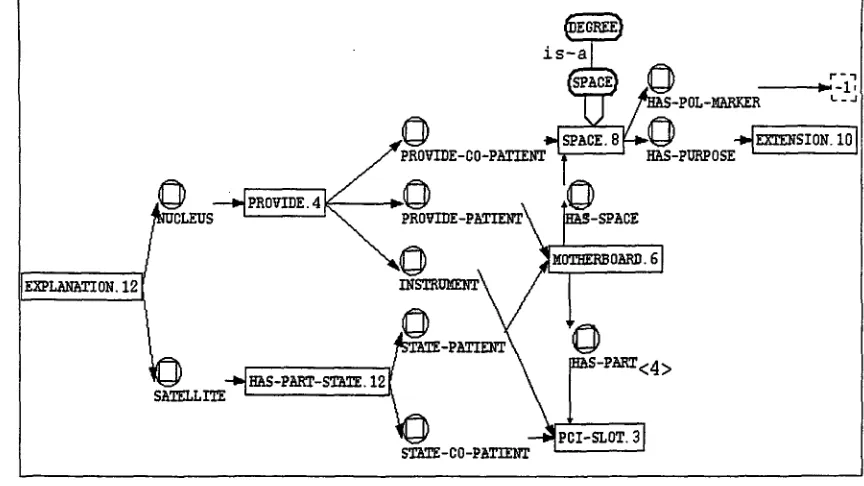
so the corresponding role of PROVIDE is frilled with PCI-SLOT. This causes additional con- ceptual interpretation processes: a production rule checks whether the filler of the INSTRU- MENT role may be a PART-OF the concep- tual correlate of the syntactic subject, link- ing SPACE and MOTHERBOARD. Along the line, a HAS-PART-STATE is established that corresponds to the situation that "the moth- erboard has one P C I slot". 63 . 2 D i s c o u r s e I n t e r p r e t a t i o n
As discussed above, a preposition does not always signal a coherence relation. Also, a preposition may give rise to different coher- ence relations depending on context, so one can not simply paste a label of "the" coher- ence relation into the representation. Instead, t h e computation of coherence relations is per- formed by testing relation-specific constraints on the configuration of the text-knowledge base resulting from semantic interpretation. Following standard practice, coherence rela- tions are assumed to connect situations. So, we try to derive the relation between the conceptual correlate PROVIDE of the main verb and the inferred state HAS-PART-STATE, which stems from the conceptual interpreta- tion of the prepositional phrase.
6In case that the sentence ~he mo~he.rboard has
one PCI slot" would have been parsed, the PART-OF
EXPLANATION. 12
- ~ HAS-PERT-STA~. 12
SATELLITE '
HAS-i~UKP OSE
~ Fs-P~r<4>
~_co _P~TiENT-~
PCI"
SLOT"
3
i
r ' ' l
Figure 1: Discourse Interpretation for Example (l-b)
The preposition "mit" (with) may signal an Explanation. The basis for computing this re- lation consists in recognizing that the matrix clause gives some kind of evaluation: namely, that the "motherboard provides only little space.". The degree expression SPACE, with its associated negative POL--MARKER, (Staab and Hahn, 1997) is the trigger for recognizing the evaluative status of the matrix clause. We can now start looking for the signalled Expla- nation for this negative judgment.
Explanation can be found quite easily: usu- ally, a MOTHERBOARD h a s u p t o f o u r P C I - SLOTS (see the default value that is denoted at the PART-OF relation in Figure 1). But actu- ally the situation HAS-PART-STATE is a state in which only one is present, which is obvi- ously "little". The computations that derive the Explanation-relation are all performed by means of production rules.
As a preposition might give rise to differ- ent coherence relations, the constraints of all those relations have to be checked. None of the constraints that are checked for other co- herence relations signaled by 'knit" (e.g. Con-
dition) are satisfiable in this example. Sim- ilarly, for Example (l-a) no coherence rela- tion would be derived, because the constraints would not be appicable. So, the compu- tational approach is complementary to the semantic criterion of typicallity discussed in Section 2.
4 I n t e r c l a u s a l C o h e r e n c e
[image:4.596.87.519.52.295.2]The presented approach can'ies over neatly to such cue-phrases with multiple relations: indeed, the process described in Section 3 can be seen as a formal reconstruction of the paraphrase. T h e conceptual representations that is derived for Sentence (2) is basically the same as for (l-b): in both cases a HAS- PART-STATE a n d a PART-OF relation are com- puted that connects the MOTHERBOARD and its PCI-SLOT. Finally, the computation of the coherence relation for Sentence (2) differs only with respect to the trigger: in Sentence (2), the cue-phrase "so" triggers the computa- tion instead of the preposition ~mit" in (l-b). The presented approach is thus able to han- dle coherence relations t h a t operate on the intra-sentential level. Still, this is only a first step to account for the discourse structure of entire texts: cue-phrases are by no means always present. And even if there is a cue- phrase in a new unit to attach, it is still often not clear from the cue alone to which unit the new one should connect:
(3) a. Apple presented a n e w member of the MessagePad organ/zer thmily.
b. A new display and a n e w version of the operating system are introduced. c. However, the old MessagePad 120 is
still available.
The cue "however" alone does not give enough information to decide whether Sen- tence (3-c) should connect to (3-b) or to (3-a): further information is needed, like that there is a referential relation between the old Mes- sagePad 120 and the MessagePad family. As a step towards connecting larger units, a re- cent study (Schauer, 2000) examined the in- teraction of discourse structure and referen- tim relations among nominM expressions.
4 . 1 S t r u c t u r a l D e p e n d e n c i e s
W h a t seems intuitively clear, is that a theory of discourse structure should reflect the struc- ture of the text under consideration. Rhetor- ical Structure Theory, however, concentrates on the effects intended by the author of a text. RST focuses on a '~pre-ree~|izational" struc- ture and is not primarily concerned with text
phenomena. The results are analyses t h a t do not account for the structural constraints in a text, here referential constraints: the depen- dency of an anaphoric expression on its an- tecedent - t h a t it is resolvable and hence in- terpretable - can hardly be captured in RST. While this is of course not an issue for RST as a theory, it is a prerequisite for any sys- tem that wants to account automatically for a text's discourse structure. As an example consider the following fragment:
(4) a. The Vaio F190 comes with convincing equipment.
b. It features a D V D - R O M and a 6 GB harddisk.
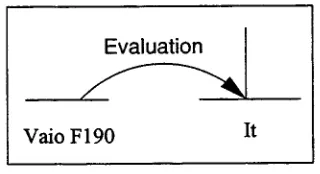
In classical RST, example (4-a) could be said to stand in an Evaluation relation to (4-b). The definition of Evaluation requires t h a t the satellite evaluates the nucleus, see Figure 2. r However, this would not capture a structural dependency: the pronominal anaphora "it" ca.nnot be interpreted correctly without the antecedent, so (4-b) depends on (4-a).
Vaio F 190 It
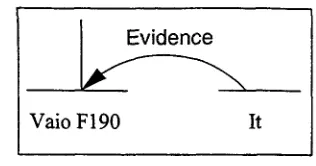
Figure 2: Structure of Evaluation In RST, one could reflect this referential dependency by analyzing (4-b) as giving Evi- dence for (4-a) (see Figure 3), as an Evidence relation may be applied when the hypothesis is the nucleus. Such an analysis would ne- glect the "convincing" in (4-a) which is quite an explicit evaluation.
In order to account for the structural dependency and the appropriate semantic linkage, we propose to use a new kind of Evaluation-N(ucleus) relation. More gener- ally, this loosens the relation between nucleus- satellite assignment and semantic content of coherence relations.
[image:5.596.357.517.357.444.2]Vaio F190 It
Figure 3: Structure of Evidence 4 . 2 S t r u c t u r a l C o n f i g u r a t i o n s
Analyzing texts using the outlined notion of structural dependencies as a basic guide- line, we determined the structural configu- rations involving coreference relations. Ba- sically, when two units contain coreferentiai expressions, they are usually connected by a coherence relation which subordinates the anaphoric unit. In the simplest case, the re- lation is one of Elaboration. However, further linguistic cues or inferences might give rise to semantically "richer" relations.
When more than one coreference relation is involved, issues become more complex. For instance, consider the following example:
(5) a. T h e Panasonic L C 9 0 S is a 19"-display. b. A l t h o u g h its screen size o f 482 ram corresponds to a conventional 21"- monitor,
c. considerably less space is required. d. T h e device can be attached to a video-
card via a USB-comaector.
Obviously, the nominal anaphor '2he device" in (5-d) requires an antecedent. One possi- bility would be the pronominal "it" in (5-b), leading to a resolution to "the LC90S". How- ever, this is not reflected in the discourse structure that seems most appropriate, of. Figure 4. The topic of (5-b) and (5-c) (the size) is not further elaborated on in (5-d), so one might say there is a mini-segment bound- ary between these two sentences. Hence, it would also be not correct to analyze (5-d) as an Elaboration of (5a-c), because (5-d) elab- orates only (5-a). So, unless further connec- tions (stemming from cue-phrases, inferences or whatever) license a topic continuation, a new unit containing anaphora will connect to the upmost unit bearing their antecedents.
Elaboration
~----~aboration ~ ,
5a ~ ¢ f _ ~ s s i o n 5d
5b 5c
Figure 4: R S T analyses for Example (5) 5 F r o m R e f e r e n c e s t o C o h e r e n c e The configurations just described naturally lead to a combined account of deriving a text's discourse structure and resolving its re- ferring expressions, repeated from (Schauer, 2000) in Figure 5. Basically, the algorithm uses the successful resolution of anaphoric ex- pressions as a guideline for determining the target unit to which a new unit should be connected which in turn restricts the set of units which should be searched for resolving further referring expressions.
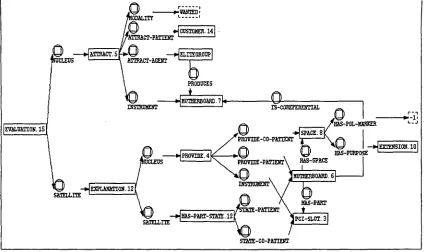
The algorithm assumes the availability of several capabilities for anaphora resolution. First, for a given unit candidate s a set of noun phrases needs to be identified that may be anaphoric expressions. Second, some resolu- tion process is necessary that checks whether an anaphoric expression can be resolved in a given list of possible antecedents. This pro- cess makes heavy use of underlying (domain) knowledge (Hahn et al., 1996): in Exam- ple (1), "the P 6 L X Z - A " is an instance of a MOTHERBOARD. Since ~the m o t h e r b o a r d " in (l-a) is a definite noun phrase and syntactic as well as conceptual information match with the plausible antecedent "the P 6 L X Z - A ' , a referential link can be established, see the IS- COREFERENTIAL relation in Figure 6.
[image:6.596.115.273.43.126.2] [image:6.596.315.520.43.186.2]t r e e : = t r e e ( c e n t e r s _ f o r w a r d ( f i r s t ( c l a u s e s ) ) , N I L ) c l a u s e s : = r e s t ( c l a u s e s )
f o r a l l c l a u s e : = c l a u s e s do
a n a _ n o d e s : = a r r a y o f l i s t s o f n o d e s .
f o r a l l a n a _ c a n d ::= a n a p h o r i c _ e x p r e s s i o n s ( c l a u s e ) do n o d e : = l o w e s t _ r i g h t _ n o d e ( t r e e )
w h i l e n o d e do
i f m a t c h ( a n a _ c a n d , a n t e _ l i s t ( n o d e ) ) t h e n
a n a _ n o d e s [ a n a _ c a n d ] : = a p p e n d ( a n a _ n o d e s [ a n a _ c a n d ], n o d e : = p r e d e c e s s o r ( n o d e )
d o n e d o n e
t a r g e t _ n o d e : = f i n d _ h i g h e s t _ n o d e _ m a t c h i n g _ a l l ( a n a _ n o d e s ) / , f o u n d a t l e a s t one a n t e c e d e n t node , /
i f t a r g e t _ n o d e t:hen
/ , c o n n e c t new u n i t t o o l d node , /
c o n n e c t ( t a r g e t _ n o d e , t r e e ( c e n t e r s _ f o r w a r d ( c l a u s e ) , N I L ) ) d o n e
Figure 5: Algorithm integrating Coreferences and Discourse Structure
n o d e )
tecedent candidates and reflects the discourse structure in terms of coherence relations that has been derived so far. 9
The algorithm now loops through all clauses of a text, building up both the tree and the antecedent lists incrementally. When- ever a new clause has to be considered, its left context consisting of the right frontier of the tree is checked for plausible antecedents.
When all accessible antecedent nodes are determined, the
highest
node that provides antecedents for all resolvable anaphoric ex- pressions in the new unit is taken as the tar- get node, in accordance with the discussion in Section 4.2.If a new unit contains no referential expres- sion then the algorithm makes no prediction. If the target node has been found, the new unit is connected to it, i.e. the new unit is es- tablished as a satellite to the target unit. This means t h a t the new unit opens a new right- most branch a n d hence becomes the lowest- right node of the tree. So, the new right fron- tier consists of the newly attached unit, the
9The computed representation of the discourse structure is shown in Figure 6, while the storage of accessible referential objects is managed elsewhere in the system as it interacts with the syntactic parser.
modified node and its predecessors.
The evaluation in (Schaner, 2000) showed that the predictions made by the algorithm depend crucially on the size of the elementary units considered. When clauses are consid- ered to be the elementary unit size, the pre- dictions are correct in up to 81% of the cases in which the algorithm makes a prediction - - under the pre-condition t h a t intra-sentential units axe handled first. Linking units by ref- erentiai makes surely no sense when the units considered axe phrases: of course, syntactic constraints always mandate t h a t intra-clausal units are related with each other first.
~ s ~ z zs-cozczzmrrz~ ~ I -
• ~
,__~/~-POL-~n
- ~I
S'~Z..~-CO-P~IZI¢2
Figure 6: Representation of the Complex Discourse Unit for Example (1)
expensive inference-only methods. A com- plete approach will also try to account for inter-sentential cue-phrases and also further intercounections, based on the computed rep- resentation, see Figure 6 ) 0
6 R e l a t e d W o r k
Rhetorical Structure Theory (Mann and Thompson, 1988) was basically used as the theory on which the presented arguments were grounded. Unfortunately, its definitions are intended to be applied by human anno- tators and have long resisted approaches to automation because of their vagueness. Pre- vious approaches to (automatically) deriv- ing a text's discourse structure either tried to rely on purely surface-based criteria (cue- phrases, (Marcu, 1998)) or concentrated on inferences about representations of discourse units (Asher, 1993; Hobbs et al., 1993). How- ever, neither of these approaches tries to ac- count for phrases as discourse units. Two re-
1°The Evaluation relation in Figure 6 is due to the
evaluative nature of Sentence (l-b), see the discussion
in Section 3.
cent studies mention the role of PPs as carri- ers of coherence relations (Vander Linden and Martin, 1995; Grote et al., 1997), but only for the purpose of text generation.
[image:8.596.97.523.47.299.2]Cue-phrases are not necessarily alone re- sponsible for the discourse structure of texts. Hence, referential relations bel~ween nominal expressions were suggested as means for find- ing attachment points of n e w traits that need to be incorporated. (Corston, Oliver, 1998) enlarges the cue-phrase approach of (Marcu, 1998) in a vein sJmi]ar to the one presented in Section 5. However, h o w several corefer- ence relations interact with the resulting dis- course structure, is not spelled out. Also, in his approach, it remains uncle~ h o w the cor- rect target node to attach to is identified.
Segmented Discourse Representation The- ory (SDRT), as described in (Asher, 1993), provides a framework of discourse structure which interacts with referential accessibility constraints. Asher does not rely on coref- erences for establishing target units; instead the derivation of a coherence relation (and thereby of the target unit to connect a new unit to) relies on rather abstract connections between "events". While recognizing corefer- ence relations certainly also requires domain knowledge and inference capabilities, recog- nizing connections between events seems an even more impossible task. The presented ap- proach is hence more light-weight in nature.
(Webber et al., 1999) apply operations on trees for incorporating cue-phrases in a grammar-driven approach to discourse struc- ture. The presented algorithm could be in- tegrated with their approach, to account for the cases of units t h a t are not connected by referential relations but via cue-phrases.
7 C o n c l u s i o n
Starting from the question what are the el- ementary units to consider for a text's dis- course structure, I presented an account for prepositional phrases with adjunct-status as discourse units. Prepositions can be seen as a kind of cue-phrase; however, a preposition does not necessarily signal a coherence re- lation and even if it does is often ambigu- ous with regard to the coherence relation sig- naled. Therefore accounting for prepositional phrases as disco~se units requires additional inferences operating on the semantic repre-
sentation of both P P and its matrix clause. The approach neatly carries over to the phenomena of ambiguous cue-phrases. How- ever, this is still not sufficient to account for deriving the discourse structure of texts in general: cue-phrases are by no means always present and even if there is a cue-phrase, de- tecting the correct attachment point of a new unit is usually not straight-forward.
As (one step towards) a solution, ref- erential relations between nominal expres- sions were suggested. The presented algo- rithm integrates the resolution of anaphora - - which also depends heavily on inferences and domain-knowledge - - with choosing the target unit to which a new unit should con- nect to: namely, the highest node provid- ing antecedents to all anaphoric expressions in the new unit. In order for this algorithm to operate successful, it is however necessary t h a t this process is started only after all phe- nomena of intra-sentential coherence relations have been accounted for, which might be done using the combined approach outlined above. Returning to the question posed at the be- ginning of the paper - what is t h e appropri- ate size of elementary discourse units - the answer is twofold: first of all, coherence re- lations can be found to hold between phrases and the clause containing them, so one should indeed start looking for discourse units at the phrase level. However, Syntax requires t h a t the components of sentences group together, and returning to what (Mann and Thompson, 1988) said, sentences have a kind of functional integrity - one t h a t operates on a level t h a t is different from those of phrases. Once this level is reached, larger chunks can be formed, e.g. by referential means.
A c k n o w l e d g m e n t s
T h e a u t h o r is a member of the Graduate P r o g r a m on Human and Machine Intelligence at Freiburg University, Germany, funded by DFG. I would like to thank the staff at the Computational Linguistics Lab, Freiburg, and also the reviewers for their comments.
R e f e r e n c e s
Nicholas Asher. 1993. Reference to Abstract Ob- jects in Discourse. Dordrecht: Kluwer.
Simon H. Corston-OliveL 1998. Identifying the linguistic correlates of rhetorical relations. In Proceedings of the COLING-A CL '98 Workshop 'Discourse Relations and Discourse Markers', pages 8-14. Montreal, Canada, August.
Dan Cristea, Nancy Ide, and Laurent Romary. 1998. Veins theory: A model of global dis- course cohesion and coherence. In Proceedings of the 35th Annual Meeting of the Association for Computational Linguistics, pages 281-285, Montreal, Canada, August.
Dan Cristea, Daniel Marcu, Nancy Ide, and Valentin Tablan. 1999. Discourse structure and co-reference: An empirical study. In The ACL99 Workshop on Standards and Tools for Discourse Tagging, pages 48-57, June.
Brigitte Grote, Nils Lenke, and Manfred Stede. 1997. Ma(r)king concessions in English and German. Discourse Processes, 24(1):87-118.
Udo Hahn and Martin Romacker. 1999. SYN- DIKATE - generating text knowledge bases from natural language texts. In Proceedings
of the 1999 IEEE International Conference on Systems, Man, and Cybernetics, volume 5, pages 918-923. Tokyo, Japan, October.
Udo I-I~hn~ Katja Markert, and Michael Strube. 1996. A conceptual reasoning approach to tex- tual ellipsis. In Proceedings of the 12th Euro- pean Conference on Artifical Intelligence, pages 572-576. Budapest, Hungary, August.
Jerry R. Hobbs, Mark E. Stickel, Douglas E. Ap- pelt, and Paul Martin. 1993. Interpretation as abduction. Artificial Intelligence, 63:69-142.
Alistair Knott and Ted Sanders. 1998. The classi- fication of coherence relations and their linguis- tic markers: an exploration of two languages.
Journal of Pragrnatics, 30(2):135--175.
William C. Mann and Sandra A. Thompson. 1988. Rhetorical Structure Theory: toward a functional theory of text organization. Text, 8(3):243-281.
Daniel Marcu, Estibaliz Amorrortu, and Mag- dalena Romera. 1999. Experiments in con- structing a corpus of discourse trees. In Pro- ceedings of the ACL 'g9 Workshop 'Standards and Tools for Discourse Tagging', pages 48---57, University of Maryland, USA, June.
Daniel Marcu. 1998. A surface-based approach to identifying discourse markers and elementary textual units in unrestricted texts. In Proceed- ings of the COLING-ACL'98 Workshop 'Dis- course Relations and Discourse Markers; pages 1-7. Montreal, Canada, August.
J.R. Martin. 1 9 9 2 . English Text. System and Structure. John Benjamins, Philadel- phia/Amsterdam.
Martin Romacker, Katja Markert, and Udo Hahn. 1999. Lean semantic interpretation. In Pro- ceedings of the 16th International Joint Confer- ence on Artificial Intelligence, volume 2, pages 868-875. Stockholm, Sweden, August.
Holger Schauer and Udo Hahn. 2000. Phrases as carriers of coherence relations. In Proceedings of the 22rid Annual Meeting of the Cognitive Science Society, pages 429--434, Philadelphia, USA, October.
Holger Schaner. 2000. Using coreferences for co- herence relations. In Proceedings of the 38th Annual Meeting of the Association for Com- putational Linguistics, Student Research Work- shop, Hong Kong, China, October.
Steffen Staab and Udo Hahn. 1997. Comparatives in context. In Proceedings of A A A I 9 7 - the lgth National Conference on Artificial Intelli- gence, pages 616-621. Providence, USA, July.
Keith Vander Linden and James tI. Martin. 1995. Expressing rhetorical relations in instructional texts: A case study of the purpose relation.
Computational Linguistics, 21(1).
Wietske Vonk, Lettic, u G.M.M. Hustinx, and Wire H.G. Simous. 1992. The use of referential expressions in structuring discourse. Language and Cognitive Processes, 3/4(7):301-333.
Bonnie Webber, Alistalr Knott, Matthew Stone, and Aravind Joshi. 1999. Discourse relations: A structural and presuppositional account us- ing lexicalised TAG. In Proceedings of the 37th Meeting of the Association for Computational Linguistics, University of Maryland, June.