T o w a r d s T r a n s l a t i n g S p o k e n L a n g u a g e P r a g m a t i c s in an
A n a l o g i c a l F r a m e w o r k
Keiko Horiguchi
Department of Language Engineering, U M I S T
& D-21 Laboratory, Sony Corporation
6-7-35 Kitashinagawa
Shinagawa-ku, Tokyo 141
Japan
keikoQpdp, c r l . sony. co. jp
Abstract
This paper argues that stylistically and pragmatically high-quality spoken lan- guage translation requires the transfer of pragmatic information at an abstract level of "utterance strategies". A n e w cate- gorization of spoken language p h e n o m e n a into essentially non-meaningful "speech errors", and purposeful "natural speech properties" is introduced, and the m a n n e r in which natural speech properties convey pragmatic information is described. Fi- nally, an extension of the analogical speech translation approach is proposed that ac- counts for such higher-level pragmatic in- formation.
1
Introduction
Traditional grammar, at its origin highly prescrip- tive, was aimed at written sentences, and completely ignored all characteristics of spoken language. This distinction was codified in Chomsky's competence- performance distinction (Chomsky, 1965). Chom- sky singled out the abstract notion of grammati- cal competence, the rules or constraints character- ize grammatical sentences, as the proper subject for the study of language. All other characteristics of language were relegated to the category of language performance, essentially meaningless by-products of the system that happens to implement language pro- duction in humans. Traditional approaches to com- putational linguistics have also focused on the rules of grammar.
1.1 S p o k e n L a n g u a g e
Spoken language, however, has m a n y characteris- tics that are different from written language. W h e n an utterance is produced on-line, the speaker does not have a lot of time to think and plan the en- tire utterance. For this reason, spoken utterances
tend to be relatively short, have less complex struc- ture, and contain more fixed or semi-fixed expres- sions than written sentences. At the same time, the on-line nature of spoken language also gives rise to so-called "disfluencies'. Furthermore, written com- munication usually aims at an accurate transfer of information, in an interactive m o d e of verbal com- munication, each utterance often carries larger por- tion of pragmatic information such as a variety of illocutionary and perlocutionary forces.
1.2
Pragmatic Information
Accurate handling of pragmatic information in speech translation is gaining importance as speech
recognition technology improves. As can be observed in communications between a native speaker and an intermediate/advanced second- language learner, pragmatic inappropriateness in otherwise perfectly grammatical utterances causes more communicational d a m a g e than purely syntac- tic mistakes, since the listener tends to interpret it as intentional or malicious, instead of viewing it as a result of the speaker's linguistic incompetence.
2 Previous
Approaches: Recognizing
Speech Act Types
For the reasons outlined above, it is important to handle pragmatic information in spoken language translation. The most studied area in pragmatics has been the illocutionary force of utterances. This type of information has been shown to be useful for reducing ambiguities and improving the accuracy of speech recognition and translation in many systems (Woszczyna and Waibel, 1994), (Nagata, 1992), ( q u et al., 1996).
2.1 R u l e - b a s e d A p p r o a c h e s
a few pragmatic principles, such as felicity condi- tions for each speech act type. Spoken language expressions, however, tend to deviate from conven- tional grammars, and a system consisting of layers of rule-based modules is often too brittle to han- dle naturally-occurring spoken input. Furthermore, there are a number of fully- or semi-lexicalized mor- pheme sequences that carry specific illocutionary forces but that are not totally predictable from its forms. These sequences have an institutionalized function in the particular community, and are best accounted holistically rather than analytically (Paw- Icy and Syder, 1983).
2.2 Pattern M a t c h i n g
M a n y spoken language systems have thus been us- ing robust pattern-matching techniques to overcome these problems. They use detailed, task-specific templates and semantic grammars, which can recog- nize various fixed phrases to mark speech act types while skipping over disflucncies in the input. This method has been shown to be successful in m a n y di- aloguc systems (Jackson ct al., 1991), (Ward, 1991).
3
O t h e r P r a g m a t i c I n f o r m a t i o n
When people engage in face-to-face dialogues, the fo- cus is usually on establishing and maintaining a good relationship among the interlocutors, rather than mere transfer of information. Each spoken utterance thus usually carries a large portion of what (Trau- golf, 1982) calls the
expressive
component, which expresses the speaker's a t t i t u d e toward the proposi- tion, toward the interlocutor, and toward the speech situation.3.1 I g n o r i n g E x p r e s s i v e I n f o r m a t i o n
When spoken language understanding is performed in a goal-oriented dialogue system, it is usually ac- ceptable to strip off any "extraneous" information in order to m a p the speaker's intention onto an unam- biguous system command. This is not possible, how- ever, in a spoken language translation system t h a t acts as a h u m a n - h u m a n verbal communication aid, where the expressive information encoded in utter- ances plays a far bigger role. For example, if we con- sider a conversation between two persons who meet for the first time at a party and extract only proposi- tionally meaningful chunks and translate them, the result will resemble an interrogation rather than a pleasant conversation.
3.2 T r a n s l a t i n g P r a g m a t i c I n f o r m a t i o n
In our work, we take the view t h a t i m p o r t a n t prag- matic information is actually encoded in many of the characteristics of spoken language that have been viewed as defective or ill-formed. We believe that many of such characteristics carry specific commu- nicative functions that must be preserved in order
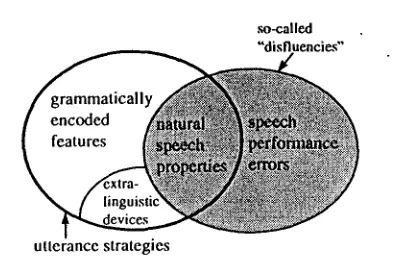
so-called "disfluencies"
(
utterance strategies
Figure 1: Communication vs. Performance
to obtain translations with high stylistic and prag- matic accuracy. W e propose that the spoken lan- guage phenomena that have been labeled as "disflu- encies" or "ill-formedness" be divided into two cat- egories: those that serve a communicative function, and those that are non-communicative by-products of the speech production process.
4
C o m m u n i c a t i o n a n d P e r f o r m a n c e
W e refer to the spoken language phenomena that are non-communicative by-products of the speech production process as "speech performance errors", and to the phenomena that serve a communicative function as "natural speech properties".
4.1 S p e e c h P e r f o r m a n c e E r r o r s
Speech performance errors are obvious errors not in- tended by the speaker and (for our purposes) not bearing any information. This includes errors in pronunciation, word selection, and structure selec- tion. When speech performance errors are corrected by the speaker within the utterance, they result in
slip-of-the-tongue repairs.
4.2 N a t u r a l S p e e c h P r o p e r t i e s
In contrast to speech performance errors, natu- ral speech properties are produced intentionally by the speaker, and usually carry specific pragmatic, communicative functions. For example, inverted word order and repetitions usually emphasize cer- tain parts of the utterance. Incomplete sentences are often used to soften so-called "face threatening acts" (Brown and Levinson, 1987), speech acts that might have negative effects on the listener, such as rejections or requests.
4.3 S p e e c h R e p a i r s
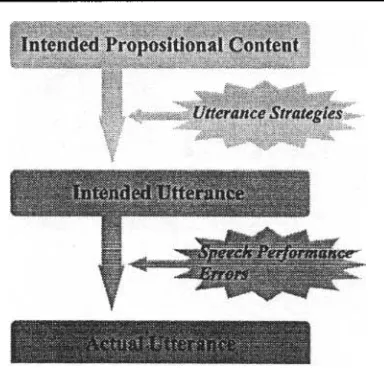
[image:2.612.320.526.56.188.2]Figure 2: Two-level Distortion Model of Spoken Language
fill communicative functions. We call such repairs
elaborating repairs,
in contrast toslip-of-the-tongue
repairs
which result from correcting speech perfor- mance errors. Elaborating repairs like the example below may signal the listener a b o u t the status of the speaker's internal processing, or reduce the face- threatening effect of the utterance.I gave it to you on Monday, yeah, probably on Monday the 27th.
Unlike a slip-of-the-tongue repair, where the speaker would have deleted the original phrase had there be time and means, in an elaborating repair, deleting the phrase
(on Monday
in the example above) would result in a different effect on the di- alogue.4.4 U t t e r a n c e S t r a t e g i e s
We refer to all the devices t h a t serves pragmatic or communicative functions as "utterance strategies". T h e y concern the speaker's intention of "how to say" an utterance, as opposed to "what to say" (proposi- tional content) of the utterance. For this reason, their semantics are non-truth-conditional. Utter- ance strategies range from grammatically-encoded information to extra-linguistic devices such as facial expressions and body language, to natural speech properties (Figure 1).
4.5 D i s t o r t i o n M o d e l
Based on this discussion, we arrive at the two-level model of spoken language p h e n o m e n a shown in Fig- ure 2. The speaker's intention of "what to say" (in- tended propositional content) is combined with the speaker's intention of "how to say it" (pragmatic ut- terance strategies) to form the "intended utterance",
which contains natural speech properties. When the speaker actually produces the utterance, speech per- formance errors might occur, resulting in the "ac- tual utterance" t h a t is to be interpreted by the lis- tener. We believe t h a t spoken language translation systems need to be able to translate what is con- veyed through natural speech properties in order to fully convey the speaker's intentions in verbal com- munication.
5
C o m m u n i c a t i n g Pragmatic
Information
This section discusses the different types of prag- m a t i c information t h a t play a role in spoken dia- logues.
5.1 D i s c o u r s e S t r u c t u r e
One type of pragmatic information relates to sig- naling discourse structure. This concerns how the propositional content of the current utterance is re- lated to what the conversational participants already know, and to the structure of the discourse. It in- dicates the
theme
and thetheme
of the utterance, and places new or contrasting information intofo-
cus.
It may signal a new topic, or the return of an old topic, the speaker's a t t e m p t to hold the conversa- tional floor. This type of pragmatic information has been noted to be very i m p o r t a n t for automatically synthesizing utterance with appropriate intonation (Prevost, 1996), and for generating sentences with appropriate word order in free word order languages such as Turkish (Hoffman, 1996).Natural speech properties that carry the informa- tion related to discourse include word order vari- ations (inversions, right or left-dislocations), and filled pauses and hedges used as a floor-holding de- vice to signal the listener not to take her turn. Some interjections and hedges can be used to help the lis- tener prepare herself for the subsequent information, or aid the listener's processing and comprehension of the current utterance.
5.2 I n t e r p e r s o n a l I n t e n t i o n : P o l i t e n e s s
[image:3.612.111.303.55.239.2]familiar second person pronouns in French and Ger- m a n are examples of lexically encoded discernment markers.
The volitional aspect of politeness is usually ex-" pressed through projection of "face". There are two distinct aspects of face, "positive face" and "negative face" in the theory of (Brown and Levinson, 1987), which are rephrased as involvement and indepen- dence, respectively, in (Scollon and Scollon, 1995). Positive face or involvement concerns one's desire to be liked by others, to be involved with others, and to be part of the same group. Negative face or inde- pendence, on the other hand, concerns one's desire to maintain privacy and independence, and to avoid the imposition or dominance of others.
5.3 P o s i t i v e F a c e
Strategies to project positive face, which are called "positive politeness strategies" (Brown and Levin- son, 1987) or "solidarity politeness" (Scollon and Scollon, 1995), can be carried out by the use of in- tensifiers accompanying positively affecting speech acts such as thanking and complimenting. The use of the first-person plural pronoun we in English is also an example of solidarity politeness. Most of the other linguistic items used in solidarity politeness strategies, however, do not bear propositional con- tent. For example, the speaker m a y try to appeal to mutual beliefs or affective c o m m o n ground by using the English interjection you know and the Japanese sentence-final particle ne (Cook, 1988). The speaker m a y also try to invite the addressee's involvement by using hearer-oriented question tags such as right, all right, okay, would you or will you, or by using devices to attract the addressee's attention such as
look, listen, hey and informal or affectionate address terms.
Telegraphic utterances that omit obvious informa- tion can be interpreted as a strategy to emphasize common knowledge among the interlocutors. In- volvement strategies "assert the speaker's right to advance his or her own position on the grounds that the listener will be equally interested in that position and in advancing his or her own position (Scollon and Scollon, 1995):85". The speaker may achieve this by displaying an assertive, "non-challengeable attitude" (Kawanishi, 1994) with the Japanese janai
form, or by aligning herself and the listener on the same side by using distant demonstrative ano (that)
(Cook, 1993).
5.4 N e g a t i v e F a c e
Strategies to project negative face, which are called "negative politeness" or "deference politeness", are mainly carried out by the use of "toning down" devices accompanying negatively affecting speech acts such as criticizing, giving advice, requesting, or refusing an offer or request. Expressions of the speaker's hesitation or tentativeness, such as hedges
(well, I don't know, I think, I am wondering i f . . . ) ,
use of the interrogative form, or the past tense I was wondering i f . . . or the subjunctive m o o d it would be better are examples of such devices to soften the force of the utterance, and to make it easier for the addressee to refuse. Sometimes even questions to ask permissions to ask a question are used to give the addressees ways to answer negatively without directly refusing the request, as shown in the follow- ing example given (Yule, 1996), pp.64-65:
I know you're busy, but might I ask you i f - e m - i f you happen to have an extra pen that I could, you k n o w - e h - m a y b e borrow? There are also content "downtoners" such as lit- tle, a bit, just, . . . and so on, and the use of collo- quial expressions (such as to give a hand instead of to help), which trivialize the action mentioned in the utterance. The speaker may also try to create dis- tance between the addressee by avoiding reference to both the speaker and the addressee, as in an agent- less passive sentence I would like a reservation to be made.
5.5 Expressing A t t i t u d e
Another type of utterance strategy expresses the speaker's attitude towards the propositional content in the utterance. This information can be conveyed through various forms of evidential markers and de- vices to express the speaker's certainty/uncertainty, or the speaker's perspective.
6 Handling Pragmatic Information
in Speech Translation
In the context of spoken language translation, the crucial characteristic of pragmatic utterance strate- gies is that the surface forms in which they are real- ized are often different across languages.
6.1 Example: English vs. J a p a n e s e Politeness
For example, softening the effect of an imperative force by questioning the addressee's ability to per- form the action (Can you do X for me ?) or assert- ing the speaker's desire ( I would like you to do X for me) can be found across many languages. How- ever, strategies to further reduce the imposing effect of these request forms are usually not directly trans- ferable across languages. In English, a more polite way of phrasing the request Can you do X for me ?
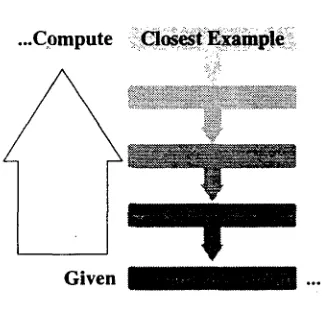
• ..Compute :i C i ~ i ! E x a m p ! ~ i !i
[image:5.612.113.274.60.221.2]Given ~ ...
Figure 3: Computing an Interpretation
6.2 Abstract P r a g m a t i c Transfer
To what extent word order can be altered, and how easily known information can be elided, are also largely dependent on the syntax of each language. One strategy that is realized as fronting m a y be marked as intonation in another language. It is not sufficient, therefore, to recognize the surface form of each pragmatic strategy and directly transfer it to the same surface form in another language. Spoken language systems are thus required to transfer prag- matic utterance strategies at a more abstract level and to be able to recognize and generate appropriate surface forms in each language, in order to achieve high-quallty translation. In our approach, we treat pragmatic strategies as additional information that are superimposed upon basic propositional content, try to recognize and extract them, and transfer them to the appropriate target language expressions.
7 A n A n a l o g i c a l F r a m e w o r k for
T r a n s l a t i n g P r a g m a t i c s
This section gives a brief overview of our approach to translating spoken language.
7.1 T h e Role of Lexicallzation
Our approach to translating spoken utterances res- onates well with the insights of (Pawley and Syder,
1983) about native speakers' competence and knowl- edge. According to Pawley and Syder, a native speaker has a number of fully- or semi-lexicalized morpheme sequences in her long-term memory, in addition to a set of productive syntactic rules. When people engage in a conversation, there are a num- ber of cognitively intensive tasks that they have to perform other than encording and decoding inter- nal structure of each utterance, such as planning a
larger unit of discourse, planning and interpreting perlocutionary effects, and paying attention to the surroundings. The use of pre-established expressions helps both the speaker and the addressee, since such expressions can be easily and quickly retrieved from their long-term memory, and little encoding and de- coding work is required. As Pawley and Syder note, these memorized sequences have varying degrees of lexicalization. While some are completely fixed ex- pressions, most others are "stems" that can be in- flected, expanded or transformed to some extent.
7.2 Analogical Translation
This model of a native speaker's linguistic compe- tence fits very well with the analogical framework of translation (Nagao, 1984), (Jones, 1996). In the analogical framework, the translation system is equipped with a large database of pre-translated ex- ample pairs, in which the best example that matches the input expression is selected and used for gen- erating an appropriate target language expression. For translating spoken language, an analogical sys- tem should have various sentence stems and patterns along with their corresponding translation in its ex- ample database. In this framework, the task of an the spoken language translation system can be seen as follows: given the speech recognizer output, the system must recover the closest example available in the example database (Figure 3).
7.3 A M o d e l of S p e e c h P r o d u c t i o n
There are a number of factors that need to be consid- ered in trying to select the most appropriate example in the database for the given input. Based on four distinct factors that we have identified, we propose a model of spoken language production that we call the "cascaded noisy channel model" (Figure 4). In this model, the speaker first selects an example E that is closest to the core of the message that she intends to express. Then, the speaker modifies pat- terns by replacing subconstituents, by expanding it with modifiers, and by transforming it into different syntactic constructions (for example, transforming it from the declarative m o o d 4to the interrogative mood, or from the active voice to the passive voice). This process yields the "intended propositional con- tent"~ Next, depending on the speech situation and discourse context, the speaker applies certain prag- matic utterance strategies. This results in the "in- tended utterance", which is characterized by natural speech properties such as ellipsis, inverted word or- der, or interjections.
Closest :Exampie i::. ::: ':
Figure 4: Cascaded Noisy Channel Model of Spoken Language
Thus, the speech recognizer output, which repre- sents the input to the translation engine, has tra- versed four distinct channels or distortion processes, each of which is associated with different causes and effects on the message. Previous research has shown that speech recognizer errors can bc modeled, and corrected, in such a framework (Ringger and Allen, 1996). In our work, we extend this model to cover a sequence of separate sources of distortions.
7.4 A H y b r i d Analogical M e t h o d for S p e e c h Translation
W e have incorporated into the analogical transla- tion method a shallow syntactic analysis module that identifies clause and phrase boundaries and that converts some variations into lexical and syntactic features. Both input and example expressions are matched after shallow syntactic analysis. Analogi- cal matching and transfer is applied recursively to the input syntactic tree. B y applying the recursivc analogical transfer process from larger linguistic con- stitucnts to subconstituents, the system can handle various degree of lexicalization in the input language in an efficient manner.
In our work, the distortion processes are modeled using a number of distortion operators that operate on the shallow syntactic tree of the utterance. Given a number of independence assumptions, the most probable example can be computed efficiently with a dynamic programming algorithm. (See (Horiguchi and Franz, 1997) for more details.)
8 A n
Example
This section shows an example of the manner in which an expression containing a pragmatic "polite-
ness" component is translated from Japanese to En- glish.
8.1 J a p a n e s e Input
In the following example, speaker A is explaining an incident in which she was asked a difficult favor, and speaker B is responding, expressing her understand- ing of A's difficult position.
(1)A: sorede tyotto kangaesasete so a-little think-CAUSE-PASS
''so I said 'let me think for a while'''
(2)B:
hosii-tte itta no ,ant-QUOTE say-PAST PART
nanka muzukasii-yo-ne souiu no HEDGE be-difficult-PART-PART such thing
kotowaru no-tte reject thing-TOP
T h e propositional content of speaker B's response is "To reject something like that is difficult," but the utterance also contains a n u m b e r of natural speech properties that add certain pragmatic elements of meaning.
8.2 P r a g m a t i c O p e r a t o r s
T h e "intended propositional content" of the above utterancc's can be paraphrased as follows:
(3) Souiu no-wo kotowaru no-ga muzukashii. such thing-0BJ reject thing-SBJ be-difficult
Our flexible matching process is ~ble to m a p an inverted construction like example input (2) onto its normalized form (3). Then, the following pragmatic operators are found to have been applied to the "in- tended propositional content":
a inserting nanka
pragmatic strategy: soften the current assertion pragmatic effect: deference politeness '
• inserting-yo
pragmatic strategy: express the attitude that the speaker's assertion is non-challcngcable pragmatic effect: solidarity politeness
• inserting-he
pragmatic strategy: indicate affective c o m m o n ground
pragmatic effect: solidarity politeness
• deleting object marker -wo
pragmatic strategy: emphasize shared knowl- edge
pragmatic effect: solidarity politeness
• subject-predicate inversion
pragmatic strategy: point to previously estab- lished or implied referent
[image:6.612.57.269.51.223.2]The last operator, subject-predicate inversion, is usually employed to describe how the subsequent information connects to the previous discourse by preposing the constituent that is implicitly or explic- itly related to something in the previous discourse. In the example above, it is used to point to the sit- uation that A has been talking about as something already established or agreed upon to be difficult, and thus can be interpreted as a solidarity polite- ness operator which reinforces the common ground between the interlocutors.
8.3 Translating the
Utterance
This subsection discusses w h y it is necessary to ana- lyze which pragmatic operators were applied to the input, and to generate the corresponding pragmatic operators in the output, in order to obtain stylisti- cally and pragmatically high-quality translations.
8.4 P u r e A n a l o g i c a l T r a n s l a t i o n
If we employ a pure example-based translation method, most of the pragmatic information cannot be reflected, since it is not feasible for the exam- ple database to contain all possible pragmatically marked permutations of the examples. Therefore, in the best case, the following literal translation of sentence (3) might be obtained:
(4) To reject something like that is difficult.
Since sentence (4) is pragmatically neutral, the pragmatic information from the original sentence has been lost.
8.5
Direct Mapp|ng
A direct one-to~one mapping of each pragmatic strategy operator to the target language is not pos- sible, since m a n y of these operators are not directly translatable to other languages. For example, while m a n y languages have hedges similar to nanka, and m a n y languages include means to invert subject and predicate, only few languages include dcletable case- markers such as zoo or sentential particles such as yo
and ne. Thus, if we attempt a direct mapping of the pragmatic operators, we might obtain a translation similar to the following:
(5) Sort of difficult, to reject something like that is
This translation is quite awkward, and does not fully reflect the pragmatic meaning of the original
sentence.
8.6
Translating
Pragmatic Strategies
B y analyzing each operator for its pragmatic ef- fect, we can obtain a translation that preserves the speaker's pragmatic intentions:Well, it's sort of difficult, isn't it, to reject something like that.
In this translation, the deference politeness strategy is transferred to the hedge words well and sort of, the solidarity politeness strategies are transferred to the tag question isn't it, and the subject-predicate inversion is transferred into the extraposition con- struction.
8.7 C o n c l u s i o n s a n d F u r t h e r W o r k
Our work is motivated by the goal of pragmatically high-quality translation of spoken utterances of the type that may be found in human-to-human spo- ken dialogues. In order to accurately render the full range of meaning conveyed by such utterances, it is not sufficient to limit attention to syntactic and semantic aspects of spoken expressions.
Based on a number of independent motivations, we have adopted a hybrid analogical approach to the problem of translating spoken language. Briefly, our approach is motivated by the shortcomings that we perceive in other approaches, such as syntactic or semantic-grammar based, interlingua-based, purely analogical, or purely statistical methods. For more detailed arguments, please refer to (Horiguchi and Franz, 1997).
In this paper, we have described our view of spo- ken language pragmatics, and we have described how pragmatic information can be translated within the hybrid analogical approach. In future work, we will perform corpus analysis for additional pragmatic op- erators, and extend the prototype implementation of our analogical speech translation system to cover these phenomena.
R e f e r e n c e s
Bateman, John. 1988. Aspects of clause: Politeness in Japanese: An extended inquiry semantics treat- ment. In Proceedings of the ~6th Annual Meeting of the Association for Computational Linguistics. Bates, Madeleine, Robert J. Bobrow, and Ralph M. Weischedel. 1993. Critical challenges for natu- ral language processing. In Madeleine Bates and Ralph M. Weischedel, editors, Challenges in Nat- ural Language Processing. Cambridge University Press, Cambridge, pages 3-36.
Bobrow, R., Robert Ingria, and David Stallard. 1990. Syntactic and semantic knowledge in the
D E L P H I unification grammar. In Proceedings of
the Speech and Natural Language Workshop, pages 230-236, June.
Brown, Penelope and Stephen Levinson. 1987. Politeness: Some universals in language usage. Cambridge University Press, Cambridge, U.K. Chomsky, Noam. 1965. Syntactic Structures. The
Cook, Haruko Minegishi. 1988. Sentential particle in Japanese conversations: A study of indezical- ity. Ph.D. thesis, University of Southern Califor- nia.
Cook, Haruko Minegishi. 1993. Functions of the filler ano in Japanese. In Soonja Choi, editor, Japanese/Korean Linguistics Volume 3, pages 19- 38. CSLI, Stanford University, CA.
Epstein, M., K. Papieni, S. Roukos, T. Ward, and S. Della Pietra. 1996. Statistical natural lan- guage understanding using hidden clumpings. In ICASSP-96, pages 176-179, Atlanta, GA. Hoffman, Beryl. 1996. Translating into free word
order languages. In Coling-96, Copenhagen, Den-
m a r k .
Horiguchi, Keiko and Alexander Franz. 1997. A formal basis for spoken language translation by analogy. In Spoken Language Workshop at A CL/EA CL-97, Madrid, Spain.
Ide, Sachiko. 1989. Formal forms and discernment: Two neglected aspects of universals of linguistic politeness. Multilingua, 8(2/3):223-248.
Jackson, Eric, Douglas Appelt, John Bear, Robert Moore, and Ann Podlozny. 1991. A template matcher for robust NL interpretation. In Proceed- ings of the Speech and Natural Language Work- shop, pages 190-194, February.
Jones, Daniel. 1996. Analogical Natural Language Processing. UCL Press, London.
Kawanishi, Yumiko. 1994. An ananlysis of non- challengeable modals: Korean -canha(yo) and Japanese -janai. In Noriko Akatsuka, editor, Japanese/Korean Linguistics, Volume 4, pages 95-112. CSLI, Stanford.
Maruyama, Naoko. 1996. Hanashikotoba no shoso (bt). In wQN'[gA, pages 41-58, March.
Mayfield, L., M. Gavalda, W. Ward, and A. Waibel. 1995. Concept-based speech translation. In ICASSP-g5, pages 97-100, Detroit, MI.
Nagao, Makoto. 1984. A framework of a Machine Translation between Japanese and English by analogy principle. In A. Elithorn and R. Banerji, editors, Artificial and Human Intelligence, pages
173-180. North-Holland.
Nagata, Masaaki. 1992. Using pragmatics to rule out recognition errors in cooperative task-oriented dialogues. In Proceedings of International Confer- ence on Spoken Language Processing (ICSLP-g2), pages 647-650.
Nakatani, Christine and Julia Hirschberg. 1993. A speech-first model for repair detection and correc- tion. In Proceedings of the 31st Annual Meeting of the Association for Computational Linguistics, pages 46-3, Columbus, Ohio.
O'Shaughnessy, Douglas. 1994. Correcting complex
false starts in spontaneous speech. In
Proceedings
of International Conference on Acoustics, Speech, and Signal Processing, volume I, pages 349-352, April.Pawley, Andrew and Frances Hodgetts Syder. 1983. Two puzzles for linguistic theory: Nativelike selec- tion and nativelike fluency. In Jack C. Richards and Richard W. Schmidt, editors, Language and
Communication, pages 191-227. Longman. Prevost, Scott. 1996. An information structural ap-
proach to spoken language generation. In Proceed- ings of the 34th Annual Meeting of the Association for Computational Linguistics, pages 46-53, Santa Cruz, CA.
Qu, Yon, Barbara Di Eugenio, Alon Lavie, Lori Levin, and Carolyn P. Rose. 1996. Minimizing cumulative error in discourse context. In Proceed- ings of the ECAI, Budapest.
Ringger, Eric K. and James F. Alien. 1996. A fertil- ity channel model for post-correction of continu- ous speech recognition. In Proceedings of Interna- tional Conference on Spoken Language Processing (ICSLP-g6), pages 897-900, Philadelphia, PA. Scollon; Ron and Suzanne Wong Scollon. 1995.
Intercultural Communication: A Discourse Ap- proach. Blackwell, Oxford UK/Cambridge USA. Traugott, E. C. 1982. From propositional to tex-
tual and expressive meanings: Some semantic- pragmatic aspects of grammaticalization. In W. P. and Y. Malkiel, editors, Perspectives on historical linguistics. John Benjamin, Amster- dam/Philadelphia, pages 245-71.
Ward, Wayne. 1991. Understanding spontaneous speech: The PHOENIX system. In Proceedings of International Conference on Acoustics, Speech, and Signal Processing, pages 365-367, May. Woszczyna, Monies and Alex Waibel. 1994. Infer-
ring linguistic structure in spoken language. In Proceedings of International Conference on Spo- ken Language Processing (ICSLP-94), pages 847- 850, Yokohama, Japan.
Yamashita, Yoichi, Keiichi Tajima, Yasuo Nomura, and Riichiro Mizoguchi. 1994. Dialog context dependencies of utterances generated from con- cept representation. In Proceedings of Interna- tional Conference on Spoken Language Processing