Finnish Native Language Identification
Shervin Malmasi
Centre for Language Technology Macquarie University Sydney, NSW, Australia [email protected]
Mark Dras
Centre for Language Technology Macquarie University Sydney, NSW, Australia [email protected]
Abstract
We outline the first application of Native Language Identification (NLI) to Finnish learner data. NLI is the task of predicting an author’s first language using writings in an acquired language. Using data from a new learner corpus of Finnish — a lan-guage typology quite different from others previously investigated, with its morpho-logical richness potentially causing diffi-culties — we show that a combination of three feature types is useful for this task. Our system achieves an accuracy of 70% against a baseline of 20% for predicting an author’s L1. Using the same features we can also distinguish non-native writings with an accuracy of 97%. This method-ology can be useful for studying language transfer effects, developing teaching mate-rials tailored to students’ native language and also forensic linguistics.
1 Introduction
It has been noted in the linguistics literature since the 1950s that speakers of particular languages have characteristic production patterns when writ-ing in a second language. This language transfer phenomenon has been investigated independently in a number of fields from different perspectives, including qualitative research in Second Language Acquisition (SLA) and more recently though pre-dictive computational models in NLP (Jarvis and Crossley, 2012).
Such analyses have traditionally been con-ducted manually by researchers, and the issues that arise when they are attempted on large cor-pora are well known (Ellis, 2008). Recently, re-searchers have noted that NLP has the tools to use large amounts of data to automate this analysis, using complex feature types. This has motivated studies in Native Language Identification (NLI), a
subtype of text classification where the goal is to determine the native language (L1) of an author using texts they have written in a second language or L2 (Tetreault et al., 2013).
Most work in SLA, NLI and NLP for that mat-ter has dealt with English. This is largely due to the fact that since World War II, the world has witnessed the ascendancy of English as itslingua franca. While English is the native language of over 400 million people in the U.S., U.K. and the Commonwealth, there are also over a billion peo-ple who speak English as their second or foreign language (Guo and Beckett, 2007). This has cre-ated a global environment where learning multiple languages is not exceptional and this has fueled the growing research into language acquisition.
However, while English is one of the most prevalent languages in the world there are still a sizeable number of jobs and activities in parts of the world where the acquisition of a language other than English is a necessity.
One such example is Finland, where due to the predicted labour shortage, the government has adopted policies encouraging economic and work-related migration (Ministry of Labour, 2006), with an emphasis on the role of the education system. Aiding new immigrants to learn the Finnish lan-guage has been a key pillar of this policy par-ticularly as learning the language of the host na-tion has been found to be an important factor for social integration and assimilation (Nieminen, 2009). This, in turn, has motivated research in studying the acquisition of Finnish to identify the most challenging aspects of the process.1
Finnish differs from English in many respects including verb tenses and forms (Karlsson, 2008). It is a highly inflectional agglutinative language with a flexible word order.2
1
For example, the recent study by Siitonen (2014)
2More information about these differences can be found
Given these differences, the main objective of the present study is to determine if NLI techniques previously applied to L2 English can be effective for detecting L1 transfer effects in L2 Finnish.
2 Background
NLI is a fairly recent, but rapidly growing area of research. While some early research was con-ducted in the early 2000s, most work has only ap-peared in the last few years. This surge of inter-est, coupled with the inaugural shared task in 2013 have resulted in NLI becoming a well-established NLP task. The NLI Shared Task in 2013 was at-tended by 29 teams from the NLP and SLA areas. An overview of the shared task results and a re-view of prior NLI work can be found in Tetreault et al. (2013).
While there exists a large body of literature pro-duced in the last decade, almost all of this work has focused exclusively on L2 English. The most recent work in this field has successfully presented the first applications of NLI to a large non-English datasets (Malmasi and Dras, 2014b; Malmasi and Dras, 2014a), evidencing the usefulness of syntac-tic features in distinguishing L2 Chinese and L2 Arabic texts.
Finnish poses a particular challenge. In terms of morphological complexity, it is among the world’s most extreme: its number of cases, for example, places it in the highest category in the compara-tive World Atlas of Language Structures (Iggesen, 2013). Comrie (1989) proposed two scales for characterising morphology, the index of synthe-sis (based on the number of categories expressed per morpheme) and the index of fusion (based on the number of categories expressed per mor-pheme). While an isolating language like Viet-namese would have an index of synthesis score close to 1, the lowest possible score, Finnish scores particularly high on this metric (Pirkola, 2001). Because of this morphological richness, and because it is typically associated with freeness of word order, Finnish potentially poses a prob-lem for the quite strongly lexical features currently used in NLI.
3 Data
Although the majority of currently available learner corpora are based on English L2 (Granger,
finnish.htm
Native Language Documents
Russian 40
Japanese 34
Lithuanian 28
Czech 27
German 21
Hungarian 21
Polish 12
Komi 11
English 10
[image:2.595.346.488.58.215.2]Total 204
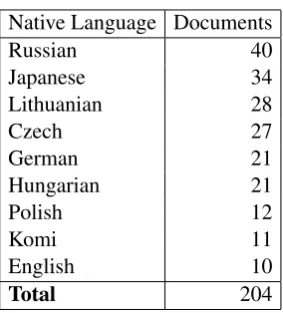
Table 1: The L1 classes included in this experi-ment and the number of texts within each class.
2012), data collection from learners of other lan-guages such as Finnish has also attracted attention in recent years.
The present study is based on texts from the Corpus of Advanced Learner Finnish (LAS2) which is comprised of L2 Finnish writings (Ivaska, 2014). The texts are being collected as part of an ongoing project at the University of Turku3 since 2007 with the goal of collection suitable data than allows for quantitative and qualitative analysis of Finnish interlanguage.
The current version of the corpus contains ap-proximately 630k tokens of text in 640 texts collected from writers of 15 different L1 back-grounds. The included native language back-grounds are: Czech, English, Erzya, Estonian, German, Hungarian, Icelandic, Japanese, Komi, Lithuanian, Polish, Russian, Slovak, Swedish and Udmurt. The corpus texts are available in an XML format and have been annotated in terms of parts of speech, word lemmas, morphological forms and syntactic functions.
While there are 15 different L1s represented in the corpus, the majority of these have less than 10 texts and cannot reliably be used for NLI. Instead we use a subset of the corpus consisting of the top seven native languages by number of texts. The languages and document counts in each class are shown in Table 1.
4 Experimental Methodology
In this study we employ a supervised multi-class classification approach. The learner texts from
3http://www.utu.fi/fi/yksikot/
the corpus are organized into classes according on the author’s L1 and these documents are used for training and testing in our experiments.
4.1 Classifier
We use a linear Support Vector Machine to per-form multi-class classification in our experiments. In particular, we use the LIBLINEAR4 package (Fan et al., 2008) which has been shown to be efficient for text classification problems such as this. More specifically, it has been demonstrated to be the most effective classifier for this task in the 2013 NLI Shared Task (Tetreault et al., 2013).
4.2 Evaluation Methodology
Consistent with most previous NLI studies and the NLI 2013 shared task, we report results as clas-sification accuracy under k-fold cross-validation, withk= 10. In recent years this has become ade factostandard for reporting NLI results.
5 Experiments
We experiment using three different feature types described in this section. Previous NLI research on English data has utilized a range of features types varying from surface features to more so-phisticated syntactic ones (Malmasi et al., 2013). However, in most such studies the use of such deeper features is predicated on the availability of NLP tools and models for extracting those fea-tures. This, unfortunately, is not the case for Finnish and it was decided to make use of a sim-pler feature set in this preliminary study.
As our data is not balanced for topic, we do not consider the use of purely lexical features such as word n-grams in this study. Topic bias can oc-cur as a result of the subject matters or topics of the texts to be classified not not evenly distributed across the classes. For example, if in our train-ing data all the texts written by English L1 speak-ers are on topic A, while all the French L1 au-thors write about topic B, then we have implic-itly trained our classifier on the topics as well. In this case the classifier learns to distinguish our tar-get variable through another confounding variable. Others researchers like Brooke and Hirst (2012), however, argue that lexical features cannot be sim-ply ignored. Given the small size of our data and
4
http://www.csie.ntu.edu.tw/˜cjlin/ liblinear/
the inability to reach definitive conclusions regard-ing this, we do not attempt to explore this issue here.
5.1 Finnish Function Words
The distributions of grammatical function words such as determiners and auxiliary verbs have proven to be useful in NLI. This is considered to be a useful syntactic feature as these words indi-cate the relations between content words and are topic independent. The frequency distributions of 700 Finnish function words5were extracted from the learner texts and used as features in this model.
5.2 Part-of-Speech tagn-grams
In this model POSn-grams of size 1–3 were ex-tracted. Thesen-grams capture small and very lo-cal syntactic patterns of language production and were used as classification features. Previous work and our experiments showed that sequences of size 4 or greater achieve lower accuracy, possibly due to data sparsity, so we do not include them.
5.3 Charactern-grams
This is a sub-lexical feature that uses the con-stituent characters that make up the whole text. From a linguistic point of view, the substrings cap-tured by this feature, depending on the order, can implicitly capture various sub-lexical features in-cluding letters, phonemes, syllables, morphemes and suffixes. We do not considern-grams of order 4 or higher as they may be capturing whole words.
5.4 Identifying Non-Native Writing
Our final experiment involves using the above-described features to classify Finnish texts as ei-ther Native or non-Native. To achieve this we use 100 control texts included in the LAS2 corpus that written by native Finnish speakers to repre-sent the Native class. This is contrasted against the non-Native class which includes 100 texts sam-pled from each language6listed in Table 1.
6 Results
The results of the first three experiments are shown in Table 2. The majority baseline is calculated by using the largest class, in this case Russian,7as the
5
These were sourced from pre-existing word lists from http://members.unine.ch/jacques.savoy/clef/index.html
6English only has 10 texts, so we include 2 extra Japanese
texts to create a set of 100 documents.
Feature Accuracy (%)
Majority Baseline 19.6
Character unigrams 34.8
Character bigrams 42.6
Character trigrams 53.9
Function Words 54.6
[image:4.595.316.516.60.212.2]Part-of-Speech unigrams 36.3 Part-of-Speech bigrams 55.2 Part-of-Speech trigrams 54.8 All features combined 69.5
Table 2: Finnish Native Language Identification accuracy for the three experiments in this study.
default classification label chosen for all texts. No other baselines are available here since this is the first NLI work using this data and L2 language.
The charactern-gram models all perform well-above the baseline, with higher accuracies as n increases. Similarly, the distribution of function words is highly discriminative, yielding 54.6% ac-curacy. The purely syntactic POSn-gram models are also very useful for this task, with the best ac-curacy of 54.8% for POS trigrams.
Combining all of the models into a single feature vector provides the highest accuracy of 69.5%, around 15% better than the best single fea-ture type. This demonstrates that the information captured by the various models is complementary and that the feature types are not redundant.
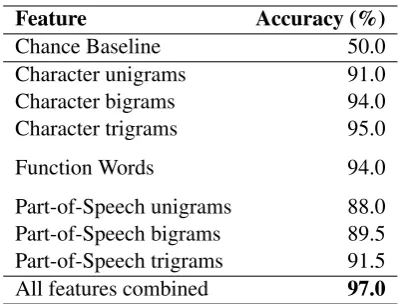
The results of our final experiment for distin-guishing non-Native writing are listed in Table 3. They demonstrate that these feature types are highly useful for discriminating between Native and non-Native writings, achieving 97% accuracy by using all feature types. Character trigrams are the best single feature in this experiment.
7 Discussion
The most significant finding here is that the NLI methodology can be successfully applied to Finnish data with results that are largely compara-ble to state-of-the-art English NLI systems.
The main contributions of this work include the identification of a new dataset for NLI and em-ploying it to demonstrate the cross-linguistic na-ture of NLI. This is one of the very first applica-tions of NLI to a language other than English and an important step in the growing field of NLI, par-ticularly with the current drive to investigate other
Feature Accuracy (%)
Chance Baseline 50.0
Character unigrams 91.0
Character bigrams 94.0
Character trigrams 95.0
Function Words 94.0
Part-of-Speech unigrams 88.0 Part-of-Speech bigrams 89.5 Part-of-Speech trigrams 91.5 All features combined 97.0
Table 3: Accuracy for classifying texts as Native or non-Native (Experiment 4).
languages.
NLI technology has practical applications in various fields. One potential application is in the field of forensic linguistics (Coulthard and Johnson, 2007), a juncture where the legal sys-tem and linguistic stylistics intersect (Gibbons and Prakasam, 2004). Here NLI can be used as a tool for Authorship Profiling (Grant, 2007) to provide evidence about a writer’s linguistic background. There are a number of situations where a text, like an anonymous letter, is the key piece of evidence in an investigation. Clues about the native lan-guage of a writer can help investigators in identify-ing the source.8 Accordingly, we can see that NLI can be a useful forensic tool for law enforcement agencies. In fact, recent NLI research such as that related to the work presented by (Perkins, 2014) has already attracted interest and funding from in-telligence agencies (Perkins, 2014, p. 17).
In addition to applications in forensic linguis-tics, NLI can aid the development of research tools for SLA researchers investigating language transfer and cross-linguistic effects. Similar data-driven methods have been recently applied to gen-erate potential language transfer hypotheses from the writings of English learners (Swanson and Charniak, 2014; Malmasi and Dras, 2014d). By using an error annotated corpus, which was not the case in this study, the annotations could be used in conjunction with similar linguistic features to study the syntactic contexts in which different er-ror types occur (Malmasi and Dras, 2014c). Re-sults from such approaches could be used to cre-ate teaching mcre-aterial that is customized for the
8e.g. for analysing extremist related activity on the web
[image:4.595.81.284.61.212.2]learner’s L1. This has been previously shown to yield learning improvements (Laufer and Girsai, 2008).
There are a number of avenues for future work. A key limitation of this study, although beyond our control, is the limited amount of data used. We hope to evaluate our system on larger data as it be-comes available. The application of more linguis-tically sophisticated features also merits further in-vestigation, but this is limited by the availability of Finnish NLP tools and resources. Another possi-ble improvement is the use of classifier ensempossi-bles to improve classification accuracy. This has previ-ously been applied to English NLI with good re-sults (Tetreault et al., 2012).
We would also like to point to the failure to dis-tinguish between the L2 and any other acquired languages as a more general criticism of the NLI literature to date. The current body of NLI liter-ature fails to distinguish whether the learner lan-guage is in fact the writer’s second lanlan-guage, or whether it is possibly a third language (L3).
It has been noted in the SLA literature that when acquiring an L3, there may be instances of both L1- and L2-based transfer effects on L3 produc-tion (Ringbom, 2001). Studies of such second lan-guage transfer effects during third lanlan-guage acqui-sition have been a recent focus on cross-linguistic influence research (Murphy, 2005).
One potential reason for this shortcoming in NLI is that none of commonly used corpora dis-tinguish between the L2 and L3; they only include the author’s L1 and the language which they are learning. This language is generally assumed to be an L2, but this may not be case. At its core, this issue relates to corpus linguistics and the method-ology used to create learner corpora. The thor-ough study of these effects is contingent upon the availability of more detailed language profiles of authors in learner corpora. The manifestation of these interlanguage transfer effects (the influence of one non-native language on another) are depen-dent on the status, recency and proficiency of the learner’s acquired languages (Cenoz and Jessner, 2001). Accordingly, these variables need to be ac-counted for by the corpus creation methodology.
But it should also be noted that based on cur-rently available evidence, identifying the specific source of cross-linguistic influence in speakers of an L3 or additional languages (L4, L5, etc.) is not an easy task. Recent studies point to the
method-ological problems in studying productions of mul-tilinguals (De Angelis, 2005; Williams and Ham-marberg, 1998; Dewaele, 1998).
From an NLP standpoint, if the author’s ac-quired languages or their number is known, it may be possible to attempt to trace different transfer ef-fects to their source using advanced segmentation techniques. We believe that this is an interesting task in itself and a potentially promising area of future research.
References
Ahmed Abbasi and Hsinchun Chen. 2005. Applying authorship analysis to extremist-group Web forum messages. IEEE Intelligent Systems, 20(5):67–75.
Julian Brooke and Graeme Hirst. 2012. Robust, Lex-icalized Native Language Identification. In Pro-ceedings of COLING 2012, pages 391–408, Mum-bai, India, December. The COLING 2012 Organiz-ing Committee.
Jasone Cenoz and Ulrike Jessner. 2001. Cross-linguistic influence in third language acquisition: Psycholinguistic perspectives, volume 31. Multilin-gual Matters.
Bernard Comrie. 1989. Language Universals and Linguistic Typology. University of Chicago Press, Chicago, IL, US, 2nd edition.
Malcolm Coulthard and Alison Johnson. 2007. An in-troduction to Forensic Linguistics: Language in evi-dence. Routledge.
Gessica De Angelis. 2005. Multilingualism and non-native lexical transfer: An identification problem. International Journal of Multilingualism, 2(1):1–25.
Jean-Marc Dewaele. 1998. Lexical inventions: French interlanguage as L2 versus L3. Applied Linguistics, 19(4):471–490.
Rod Ellis. 2008. The Study of Second Language Ac-quisition, 2nd edition. Oxford University Press, Ox-ford, UK.
Rong-En Fan, Kai-Wei Chang, Cho-Jui Hsieh, Xiang-Rui Wang, and Chih-Jen Lin. 2008. LIBLINEAR: A library for large linear classification. Journal of Machine Learning Research, 9:1871–1874.
John Gibbons and Venn Prakasam. 2004.Language in the Law. Orient Blackswan.
Sylviane Granger. 2012. Learner corpora. The Ency-clopedia of Applied Linguistics.
Yan Guo and Gulbahar H Beckett. 2007. The hege-mony of english as a global language: Reclaiming local knowledge and culture in china. Convergence, 40:117–132.
Oliver A. Iggesen, 2013. Number of Cases. Max Planck Institute for Evolutionary Anthropology, Leipzig.
Ilmari Ivaska. 2014. The corpus of advanced learner Finnish (LAS2): database and toolkit to study aca-demic learner Finnish. Apples, 8.
Scott Jarvis and Scott Crossley, editors. 2012. Ap-proaching Language Transfer Through Text Classi-fication: Explorations in the Detection-based Ap-proach, volume 64. Multilingual Matters Limited, Bristol, UK.
Fred Karlsson. 2008. Finnish: An essential grammar. Routledge.
Batia Laufer and Nany Girsai. 2008. Form-focused instruction in second language vocabulary learning: A case for contrastive analysis and translation. Ap-plied Linguistics, 29(4):694–716.
Shervin Malmasi and Mark Dras. 2014a. Arabic Na-tive Language Identification. InProceedings of the Arabic Natural Language Processing Workshop (co-located with EMNLP 2014), pages 180–186, Doha, Qatar, October. Association for Computational Lin-guistics.
Shervin Malmasi and Mark Dras. 2014b. Chinese Native Language Identification. Proceedings of the 14th Conference of the European Chapter of the As-sociation for Computational Linguistics, April.
Shervin Malmasi and Mark Dras. 2014c. From Vi-sualisation to Hypothesis Construction for Second Language Acquisition. InGraph-Based Methods for Natural Language Processing, pages 56–64, Doha, Qatar, October. Association for Computational Lin-guistics.
Shervin Malmasi and Mark Dras. 2014d. Language Transfer Hypotheses with Linear SVM Weights. Proceedings of the 2014 Conference on Empir-ical Methods in Natural Language Processing (EMNLP), pages 1385–1390.
Shervin Malmasi, Sze-Meng Jojo Wong, and Mark Dras. 2013. NLI Shared Task 2013: MQ Submis-sion. InProceedings of the Eighth Workshop on In-novative Use of NLP for Building Educational Ap-plications, pages 124–133, Atlanta, Georgia, June. Association for Computational Linguistics.
Ministry of Labour. 2006. Hallituksen maahanmuut-topoliittinen ohjelma.Tyhallinnon julkaisu 371.
Shirin Murphy. 2005. Second language transfer dur-ing third language acquisition. Teachers College, Columbia University Working Papers in TESOL & Applied Linguistics, 3(1).
Tanja Nieminen. 2009. Becoming a new Finn through language: non-native English-speaking immigrants’ views on integrating into Finnish society.
Ria Perkins. 2014. Linguistic identifiers of L1 Persian speakers writing in English: NLID for authorship analysis. Ph.D. thesis, Aston University.
Ari Pirkola. 2001. Morphological typology of languages for IR. Journal of Documentation, 57(3):330–348.
Hakan Ringbom. 2001. Lexical transfer in L3 produc-tion. (Cenoz and Jessner, 2001), pages 59–68.
Kirsti Siitonen. 2014. Learners’ dilemma: an ex-ample of complexity in academic Finnish. The fre-quency and use of the E infinitive passive in L2 and L1 Finnish. AFinLA-e: Soveltavan kielitieteen tutkimuksia, (6):134–148.
Ben Swanson and Eugene Charniak. 2014. Data Driven Language Transfer Hypotheses. EACL 2014, page 169.
Joel Tetreault, Daniel Blanchard, Aoife Cahill, Beata Beigman-Klebanov, and Martin Chodorow. 2012. Native Tongues, Lost and Found: Resources and Empirical Evaluations in Native Language Identifi-cation. InProc. Internat. Conf. on Computat. Lin-guistics (COLING).
Joel Tetreault, Daniel Blanchard, and Aoife Cahill. 2013. A report on the first native language identi-fication shared task. InProceedings of the Eighth Workshop on Innovative Use of NLP for Build-ing Educational Applications, pages 48–57, Atlanta, Georgia, June. Association for Computational Lin-guistics.