Extending a Formal and Computational Model of Rhetorical Structure
Theory with Intentional Structures `a la Grosz and Sidner
Daniel Marcu
Information Sciences Institute and Department of Computer Science
University of Southern California
4676 Admiralty Way, Suite 1001
Marina del Rey, CA 90292-6601
Abstract
In the last decade, members of the computational linguis-tics community have adopted a perspective on discourse based primarily on either Rhetorical Structure Theory or Grosz and Sidner’s Theory. However, only recently, re-searchers have started to investigate the relationship be-tween the two perspectives. In this paper, we use Moser and Moore’s (1996) work as a departure point for extend-ing Marcu’s formalization of RST (1996). The result is a first-order axiomatization of the mathematical proper-ties of text structures and of the relationship between the structure of text and intentions. The axiomatization en-ables one to use intentions for reducing the ambiguity of discourse and the structure of discourse for deriving in-tentional inferences.
1
Motivation
In the last decade, members of the computational linguis-tics community have adopted a perspective on discourse based primarily on either Rhetorical Structure Theory (RST) (Mann and Thompson, 1988) or Grosz and Sid-ner’s Theory (GST) (Grosz and Sidner, 1986).
In GST, the linguistic constituents are called discourse
segments (DS) and the linguistic discourse structure is
explicitly stipulated to be a tree of recursively embedded discourse segments. Each discourse segment is charac-terized by a primary intention, which is called discourse
segment purpose (DSP). GST identifies only two kinds
of intention-based relations that hold between the DSPs of two discourse segments: dominance and satisfaction
precedence. When a discourse segment purpose DSP1
that characterizes discourse segment DS1 provides part
of the satisfaction of a discourse segment purpose DSP2
that characterizes discourse segment DS2, with DS1
be-ing embedded in DS2, it is said that there exists a
domi-nance relation between DSP2and DSP1, i.e., DSP2
dom-inates DSP1. If the satisfaction of DSP1is a condition of
the satisfaction of DSP2, it is said that DSP1
satisfaction-precedes DSP2.
RST has a richer ontology of relations than GST: in-tentional and semantic rhetorical relations are considered to hold between non-overlapping textual spans. Most of these relations are asymmetric, i.e., they distinguish between their associated nuclei, which express what is
most essential to the writer’s purpose, and their satellites, which support the nuclei. In RST, the linguistic discourse structure is modeled recursively as a tree of related seg-ments. Hence, unlike GST, where relations are consid-ered to hold between the DSPs associated with
embed-ded segments, relations in RST hold between adjacent, non-overlapping segments.
Because RST has traditionally been applied to build discourse trees of finer granularity than GST, we will use it here as the starting point of our discussion. As-sume, for example, that we are given the following text (in which the elementary textual units are labelled for reference).
(1) [No matter how much one wants to stay a non-smoker,A1
] [the truth is that the pressure to smoke in junior high is greater than it will be any other time of one’s life.B
1
] [We know that 3,000 teens start smoking each day,C
1
] [al-though it is a fact that 90% of them once [al-thought that smoking was something that they’d never do.D
1
]
Assume for the moment that we do not analyze this text as a whole, but rather, we determine what rhetorical rela-tions could hold between every pair of elementary units. When we apply, for example, the definitions proposed by Mann and Thompson (1988), we obtain the set given below.1
(2)
8 > > > <
> > > :
rhet rel
(JUSTIFICATION;
A1
;
B1 )rhet rel
(JUSTIFICATION;
D1
;
B1 )rhet rel
(EVIDENCE;
C1
;
B 1)rhet rel
(CONCESSION;
D1
;
C 1)rhet rel
(RESTATEMENT;
D1
;
A1 )These relations hold because the understanding of both
A1(teens want to stay non-smokers) andD1(90% of the
teens think that smoking is something that they would never do) will increase the reader’s readiness to accept the writer’s right to presentB1(the pressure on teens to
start smoking is greater than it will be any other time of their lives); the understanding ofC1(3000 teens start
smoking each day) will increase the reader’s belief of
B1; the recognition ofD1as something compatible with
1Throughout this paper, we use the convention that rhetori-cal relations are represented as sorted, first-order predicates hav-ing the form
rhet rel
(name;satellite;nucleus
).Multinu-clear relations are represented as predicates having the form
rhet rel
(name;nucleus
JUSTIFICATION
A1 B1 C1 D1 A1-B1 C1-D1
a)
CONCESSION EVIDENCE
A1
B1 C1 D1 B1-C1
B1-D1 JUSTIFICATION
JUSTIFICATION
EVIDENCE
e)
A1
B1 C1 D1 B1-C1 A1-C1
JUSTIFICATION
JUSTIFICATION
EVIDENCE
d)
A1
B1
C1 D1 C1-D1 B1-D1 JUSTIFICATION
c)
CONCESSION EVIDENCE
A1 B1 C1
D1 A1-B1
A1-C1
JUSTIFICATION
EVIDENCE
b)
JUSTIFICATION
Figure 1: The set of all RS-trees that can be built for text (1).
the situation presented in C1 will increase the reader’s
negative regard for the situation presented inC1; and the
situation presented inD1is a restatement of the situation
presented inA1.
Marcu (1996) has shown that on the basis of only the rhetorical judgments in (2) and without considering in-tentions, there are five valid RS-trees that one can build for text (1) (see figure 1). What happens though when we consider intentions as well? Moore and Pollack (1992) have already shown that different high-level intentions yield different RS-trees. But how do we formalize the relationship between intentions and rhetorical structures? For example, how can we use the discourse trees in fig-ure 1 in order to determine the primary intention asso-ciated with each analysis? And how can we determine what would be the corresponding dominance relations in a GST account of the same text?
Consider also a slightly different problem: assume that besides rhetorical judgments, such as those shown in (2), one can also make intentional judgments. For example, assume that one is interested in an interpretation in which one knows that the DSP of segment[A
1
;
D1], which
con-tains all units fromA1toD1, dominates the DSP of
seg-ment[C 1
;
D1]. Then what is the primary intention of the
text in that case? And how many discourse trees are both valid and consistent with that intentional judgment? Nei-ther RST nor GST can answer these questions on their
own. However, a unified theory can. In this paper, we
provide such a theory.
2
The limits of Moser and Moore’s
approach
In a recent proposal, Moser and Moore (1996) argued that the primary intentions in a GST representation can be derived from the nuclei of the corresponding RST rep-resentation. Although their proposal is consistent with the cases in which each textual span is characterized by an explicit nucleus that encodes the primary intention of that span (as in the case of text (1)), it seems that an ad-equate account of the correspondence between GST and RST is somewhat more complicated. For example, in the case of text (3) below, whose RST analysis is shown in figure 2, we cannot apply Moser and Moore’s approach because we can associate the primary intention of dis-course segment[A
2
;
B2]neither to unitA
2nor to unitB2.
(3) [John wanted to play squash with Janet,A
2
] [but he
CONTRAST NONVOLITIONAL
A2 B2
C2 CAUSE
Figure 2: A rhetorical analysis of text (3).
also wanted to have dinner with Suzanne.B2
] [He went crazy.C
2
]
In Grosz and Sidner’s terms, we can say that the primary intention of segment [A
2
;
B2]is (Intend writer (Believe
reader “John wanted to do two things that were incom-patible”)). But in order to recognize this relation, we need to recognize that the two desires given in unitsA2
andB2are incompatible, which is captured by theCON
-TRASTrelation that holds between the two units. In other words, the intention associated with segment[A
2
;
B2 ]is afunction both of its nuclei,A2andB2, and of the
rhetori-cal relation ofCONTRASTthat holds between them. In this paper, we generalize this observation by making use of the compositionality criterion proposed in (Marcu, 1996), which stipulates that if a rhetorical relation holds between two textual spans, a similar re-lation also holds between two salient constructs of those spans.2 Similarly, we will assume that the primary
inten-tion of a discourse segment is not given by the nucleus of the corresponding relation but rather that it depends on the corresponding relation and the salient constructs associated with that segment.
3
Melding text structures and intentions
3.1 Formulation of the problem
Formally, the problem that we want to solve is the following. Given a sequence of textual units
U
=u
1;u
2;::: ;u
N, a setRR
of rhetorical relations that holdamong these units, and a set of intentional judgments
RI
that pertain to the same units, find all legal discourse structures (trees) ofU
, and determine the dominance, satisfaction-precedence relations, and primary intentions of each span of these trees.Following (Marcu, 1996), we use the predicates
position
(u
i;j
)and
rhet rel
(name;s;n
) with thelowing semantics: the predicate
position
(u
i;j
)is true
for a textual unit
u
i in sequenceU
if and only ifu
i is thej
-th element in the sequence; the predicaterhet rel
(name;u
i;u
j)is true for textual units
u
i andu
jwith respect to rhetorical relationname
, if and onlyif the definition provided by RST for rhetorical relation
name
applies to textual unitsu
i, in most cases a satellite,and
u
j, a nucleus. In order to enable discourseprob-lems to be characterized by rhetorical judgments that hold between large textual spans as well, we use pred-icate
rhet rel ext
(name;s
s
;s
e;n
s;n
e). This predicate
is true for textual spans[
s
s;s
e]and[
n
s;n
e]with respect
to rhetorical relation
name
if and only if the definition of rhetorical relationname
applies for the textual span that ranges over unitss
s–s
e, in most cases a satellite, andtex-tual spans that ranges over units
n
s–n
e, a nucleus.3
From a rhetorical perspective, text (1) is described at the minimal unit level by the relations given in (2) and (4) below.
(4)
position
(A1
;
1)
;position
(B1
;
2);
position
(C1
;
3)
;position
(D1
;
4)The intentional judgments
RI
are given by the follow-ing functions and predicates:The predicate
dom
(l
1
;h
1;l
2;h
2)is true whenever
the DSP of discourse segment/span [
l
1;h
1]
domi-nates the DSP of discourse segment[
l
2;h
2]. A
dom-inance relation is well-formed if segment [
l
2;h
2]
is a proper subsegment of segment [
l
1;h
1]. i.e.,
l
1l
2
h
2
h
1 ^(
l
1 6=
l
2 _
h
1 6=
h
2 ).
The predicate
satprec
(l
1
;h
1;l
2;h
2)is true
when-ever an intentional satisfaction-precedence relation holds between the DSPs of segments [
l
1
;h
1 ] and [l
2
;h
2]. A satisfaction-precedence relation is
well-formed if the segments do not overlap.
The oracle function
f
I(
r;x
1
;::: ;x
n)takes as
ar-guments a rhetorical relation
r
and a set of textual units, and returns the primary intention that pertains to that relation and those units. For example, in the case of segment [A2
;
B2] in text (3), the
ora-cle function
f
I(CONTRAST
;
A 2;
B2)is assumed to
return a first-order object whose meaning can be glossed as “inform the reader that John wanted to do two things that were incompatible”. And the oracle function
f
I(EVIDENCE
;
B 1)associated with
segment [A 1
;
D1] in text (1) is assumed to return
a first-order object whose meaning can be glossed as “increase the reader’s belief that the pressure to smoke in junior high is greater than it will be any other time of one’s life”.
Without restricting the generality of the problem, dis-course structures are assumed to be binary trees. In our formalization, each node of a discourse structure is char-acterized by four features: the status (nucleus or satel-lite), the type (the rhetorical relations that hold between
3The
s
ande
subscripts correspond to starting and ending positions.the text spans that that node spans over), the promotion
set (the set of units that constitute the most “salient”
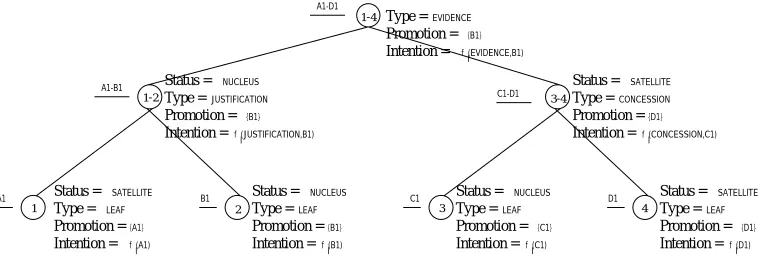
(im-portant) part of the text that is spanned by that node), and the primary intention. By convention, for each leaf node, the type isLEAF, the promotion set is the textual unit to which it corresponds, and the primary intention is that of informing the content of that unit. For exam-ple, a representation of the tree in figure 1.a that makes explicit the features of all spans that play an active role in the final representation is given in figure 3. In general, the salient units are computed using the compositionality criterion proposed in (Marcu, 1996), i.e, they are given by the union of the salient units of the immediate sub-ordinated nuclei. Similarly, the primary intentions are a function of the rhetorical relation (type) and salient units of each span.
The status, type, promotion set, and primary intention that are associated with each node in a discourse tree pro-vide sufficient information for a full description of an in-stance of a tree structure. Given the linear nature of text and the fact that we cannot predict in advance where the boundaries between various segments will be drawn, we should provide a methodology that permits one to enu-merate all possible ways in which a tree could be built on the top of a linear sequence of elementary discourse units. The solution we use relies on the same intuition that constitutes the foundation of chart parsing: just as a chart parser is capable of considering all possible ways in which different words in a sentence could be clustered into higher-order grammatical units, so our formalization is capable of considering all the possible ways in which different segments could be joined into discourse trees.
Let
span
i;j, or simply[
i;j
], denote a text spanthat includes all the elementary discourse units be-tween position
i
andj
. Then, if we consider a sequence of discourse unitsu
1;u
2;::: ;u
n, thereare
n
ways in which spans of length one could be built,span
1;1;span
2;2;::: ;span
n;n;n
, 1
ways in which spans of length two could be built,
span
1;2;span
2;3;::: ;span
n,1;n;n
, 2 ways
in which spans of length three could be built,
span
1;3;span
2;4;::: ;span
n,2;n;:::
; and oneway in which a span of length
n
could be built,span
1;n.Since it is impossible to determine a priori the spans that will be used to make up a discourse tree, we will associate with each span that could possibly become part of a tree a status, a type, promotion, and primary intention relation and let discourse and intentional constraints determine the valid discourse trees. In other words, we want to determine from the set of
n
+(n
,1)+(n
,2)+:::
+1=n
(n
+1)=
2potentialspans that pertain to a sequence of
n
discourse units, the subset that adheres to some constraints of rhetorical and intentional well-formedness. For example, for text 1, there are 4+3+2+ 1 = 10 potential spans, i.e.,span
1;1;span
2;2;span
3;3;span
4;4;span
1;2;span
2;3;
1-4
1-2
1 2 3 4
3-4
A1 B1 C1 D1
A1-B1
C1-D1 A1-D1
Status = Type = Promotion =
Status = Type = Promotion = Status =
Type = Promotion =
Type = Promotion =
Status = Type = Promotion =
Status = Type = Promotion =
Status = Type = Promotion =
SATELLITE
LEAF
{A1}
NUCLEUS
LEAF
{B1}
NUCLEUS
LEAF
{C1}
SATELLITE
LEAF
{D1} NUCLEUS
JUSTIFICATION
{B1}
SATELLITE
CONCESSION
{D1} EVIDENCE
{B1}
Intention = Intention =
Intention =
Intention =
Intention =
Intention =
Intention =
f (A1) I
f (JUSTIFICATION,B1) I
f (EVIDENCE,B1) I
f (CONCESSION,C1) I
f (D1) I f (C1)
I f (B1)
I
Figure 3: A representation of tree 1.a that includes the status, type, promotion, and primary intention features that characterize every node that does not have aNONEstatus. The numbers associated with each node denote the limits of the text span that that node characterizes.
only seven of them play an active role in the representation given in figure 1.a, i.e.,
span
1;1;span
2;2;span
3;3;span
4;4;span
1;2;span
3;4;
and
span
1;4.To formalize the constraints that pertain both to RST and GST, we thus assume that each potential span[
l;h
]is characterized by the following predicates:
S
(l;h;status
)provides the status of span[l;h
], i.e.,the text span that contains units
l
toh
;status
can take one of the values NUCLEUS, SATELLITE, orNONE according to the role played by that span in the final discourse tree. For example, for the tree depicted in figure 3, some of the relations that hold are:
S
(1;
2;
NUCLEUS);S
(3;
4;
SATELLITE);
S
(1;
3;
NONE).
T
(l;h;relation name
) provides the name of therhetorical relation that holds between the text spans that are immediate subordinates of span
[
l;h
] in the discourse tree. If the text span isnot used in the construction of the final tree, the type assigned is NONE. For example, for the tree in figure 3, some of the relations that hold are:
T
(1;
1;
LEAF);T
(1;
2;
JUSTIFICATION);
T
(3;
4;
CONCESSION);T
(1;
3;
NONE).
P
(l;h;unit name
) provides one of the set ofunits that are salient for span [
l;h
]. Thecol-lection of units for which the predicate is true provides the promotion set of a span, i.e., all units that are salient for that span. If span [
l;h
]is not used in the final tree, by convention, the set of salient units is NONE. For example, for the tree in figure 3, some of the relations that hold are:
P
(1;
1;
A1
)
;P
(1;
2;
B 1)
;P
(1;
3;
NONE);
P
(3;
4;
D 1).
I
(l;h;intention
) provides the primary intentionof discourse span [
l;h
]. The termintention
isrepresented using the oracle function
f
I. Forex-ample, for the tree in figure 3, some of the
rela-tions that hold are:
I
(3;
4;f
I(CONCESSION,C 1
))
;
I
(1;
4;f
I(EVIDENCE,B 1
))
;I
(1;
3;
NONE).3.2 An integrated formalization of RST and GST
Using the ideas that we have discussed in the previous section, we present now a first-order formalization of dis-course structures that makes use both of RST- and GST-like constraints. In this formalization, we assume a uni-verse that consists of the set of natural numbers from1
toN, whereNrepresents the number of textual units in the text that is considered; the set of names that were defined by Mann and Thompson for each rhetorical rela-tion; the set of unit names that are associated with each textual unit; and four extra constants:NUCLEUS,SATEL
-LITE,NONE, andLEAF. The formalization is assumed to provide unique name axioms for all these constants.
The only function symbols that operate over the as-sumed domain are the traditional+and,functions that
are associated with the set of natural numbers and the or-acle function
f
I. The formalization uses the traditionalpredicate symbols that pertain to the set of natural num-bers(
<;
;>;
;
=;
6=)and eight other predicatesym-bols:
S;T;P
andI
to account for the status, type, salient units, and primary intention that are associated with ev-ery text span;rhet rel
to account for the rhetorical rela-tions that hold between different textual units;position
to account for the index of the textual units in the text that one considers;dom
to account for dominance rela-tions; andsatprec
to account for satisfaction-precedence relations.Throughout the paper, we apply the convention that all unbound variables are universally quantified and that variables are represented in lower-case italics and con-stants in SMALL CAPITALS. We also make use of the two extra relations,
relevant unit
andrelevant rel
. For every text span span [l;h
],relevant unit
(l;h;u
)describes the set of textual units that are relevant for that text span, i.e., the units whose positions in the initial sequence are numbers in the interval [
l;h
]. Itpro-motion set associated with a tree that subsumes all units in the interval [
l;h
]. For every text span [l;h
],relevant rel
(l;h;name
)describes the set of rhetoricalrelations that are relevant to that text span, i.e., the set of rhetorical relations that span over text units in the inter-val[
l;h
]and the set of extended rhetorical relations thatspan over text spans that cover the whole interval[
l;h
](see (Marcu, 1996) for the formal definitions of these re-lations.)
For example, for text (1), which is described formally in (2) and (4), the following is the set of all
relevant rel
andrelevant unit
relations that hold with respect to text segment [1;
3]: frelevant rel
(1;
3;
JUSTIFICATION);
relevant rel
(1;
3;
EVIDENCE); relevant unit
(1;
3;
A 1)
;
relevant unit
(1;
3;
B 1)
; relevant unit
(1;
3;
C 1)g.
The constraints that pertain to the discourse trees that we formalize can be partitioned into constraints related to the domain of objects over which each predicate ranges, constraints related to the structure of the tree, and con-straints that relate the structural component with the in-tentional component. The axioms that pertain to the do-mains over which predicates
S;P;
andT
range and the constraints related to the structure of the tree are the same as those given by Marcu (1996). For the sake of com-pleteness, in this paper we only enumerate them infor-mally. In contrast, the axioms that pertain to intentions and the relation between structure and intentions are dis-cussed in detail.Constraints that concern the objects over which the predicates that describe every segment[
l;h
]of a textstructure range (Marcu, 1996, pp. 1072–1073).
For every span[
l;h
], the set of objects over whichpredicate
S
ranges is the setfNUCLEUS,SATELLITE,NONEg.
The status of any discourse segment is unique.
For every segment [
l;h
], the set of objects overwhich predicate
T
ranges is the set of rhetorical re-lations that are relevant to that span.At most one rhetorical relation can connect two
ad-jacent discourse spans
The primary intention of a discourse segment is
ei-therNONEor is a function of the salient units that per-tain to that segment and of the rhetorical relation that holds between the immediate subordinated segments. Since we want to stay within the boundaries of first-order logic, we express this (see formula (5) below) by means of a disjunction of at mostNsubformulas, which corre-spond to the cases in which the span has1,2,
:::
, orNsalient units.4
4Formula (5) reflects no preference concerning the order in which rhetorical relations and intentions should be computed (Asher and Las-carides, 1998). It only asserts a constraint on the two.
(5)
[(1
h
N)^(1l
h
)]!f
I
(l;h;intention
lh )!
intention
lh=NONE_
(9
r;x
)[T
(l;h;r
)^r
6=NONE^P
(l;h;x
)^(8y
)(P
(l;h;y
)!x
=y
)^intention
lh=
f
I(r;x
)]_ (9r;x
1
;x
2)[
T
(l;h;r
)^r
6=NONE^P
(l;h;x
1)^P
(l;h;x
2)^x
1 6=
x
2^(8
y
)(P
(l;h;y
)!(y
=x
1
_
y
=x
2))^
intention
lh=
f
I(r;x
1;x
2)]_
.. .
(9
r;x
1
;x
2;::: ;x
N)[
T
(l;h;r
)^r
6=NONE^x
1 6=x
2 ^
x
1 6=
x
3
^
:::
^x
16=
x
N^x
2 6=x
3
^
:::
^x
26=
x
N^. ..
x
N,1 6=x
N^P
(l;h;x
1)^P
(l;h;x
2)^:::
^P
(l;h;x
N)^(8
y
)(P
(l;h;y
)!(y
=x
1
_
:::
_y
=x
N))^intention
lh=
f
I(r;x
1
;x
2;::: ;x
N )]gThe primary intention of any discourse segment is
unique.
(6) [(1
h
N)^(1l < h
)]![(
I
(l;h;i
1)^
I
(l;h;i
2))!
i
1=
i
2]
For every segment [
l;h
], the set of objects overwhich predicate
P
ranges is the set of units that make up that segment .Constraints that concern the structure of the dis-course trees
The status, type, and promotion set that are
associ-ated with a discourse segment reflect the composition-ality criterion. That is, whenever a rhetorical relation holds between two spans, either a similar relation holds between the most salient units of those spans or an ex-tended rhetorical relation holds between those spans.
Discourse segments do not overlap.
A discourse segment with statusNONEdoes not
par-ticipate in the tree at all.
There exists a discourse segment, the root, that
spans over the entire text.
(7) :
S
(1;
N;
NONE)^:P
(1;
N;
NONE)^ :T
(1;
N;
NONE)^:I
(1;
N;
NONE)The dominance relations described by Grosz and
Sidner hold between the DSP of a discourse seg-ment and the DSP of its most immediate subordinated satellite. This constraint is consistent with Moser and Moore’s (1996) discussion of RST and GST. In fact, this is not surprising if we examine the definitions of dom-inance relation given by Grosz and Sidner and satellite given by Mann and Thompson: a discourse segment purpose
DSP
2 dominates a discourse segment purposeDSP
1 ifDSP
1 contributes to the satisfaction of theDSP
2. But this is exactly the role that satellites play inThe relationship between Grosz and Sidner’s domi-nance relations and Mann and Thompson’s distinction between nuclei and satellites is formalized by axioms (8) and (9).
Axiom (8) specifies that if segment[
l
2;h
2]is the
imme-diate satellite of segment[
l
1;h
1], then there exists a
dom-inance relation between the DSP of segment[
l
1;h
1]and
the DSP of segment[
l
2;h
2]. Hence, axiom (8) explicates
the relationship between the structure of discourse and intentional dominance. In contrast, axiom (9) explicates the relationship between intentional dominance and dis-course structure. That is, if we know that the intention associated with span[
l
1
;h
1]dominates the intention
as-sociated with span[
l
2;h
2], then both these spans play an
active role in the representation and, moreover, the seg-ment[
l
2
;h
2]plays aSATELLITErole.
The satisfaction-precedence relations described by
Grosz and Sidner are paratactic relations that hold between arbitrarily large textual spans. Neverthe-less, as we have seen in the examples discussed in this paper, the fact that a paratactic relation holds between spans does not imply that there exists a satisfaction-precedence relation at the intentional level between those spans. Therefore, for satisfaction-precedence relations, we will have only one axiom, that shown in (10), below.
(10)
This specifies that the spans that are arguments of a satisfaction-precedence relation have aNUCLEUSstatus in the final representation.
4
A computational view of the
axiomatization
Given the formulation discussed above, finding the dis-course trees and the primary intentions for a text such as that given in (1) amounts to finding a model for a first-order theory that consists of formulas (2), (4), and the axioms enumerated in section 3.
There are a number of ways in which one can pro-ceed with an implementation: for example, a straight-forward choice is one that applies constraint-satisfaction techniques, an approach that extends that discussed in (Marcu, 1996). Given a sequence
U
ofNtextual units, one can take advantage of the structure of the domain andassociate with each of theN(N+1)
=
2possible text spansa status and a type variable whose domains consist in the set of objects over which the corresponding predicates
S
andT;
range. For each of theN(N+1)=
2possibletext spans[
l;h
], one can also associateh
,l
+1promo-tion variables. These are boolean variables that specify whether units
l
,l
+1,::: ;h
belong to the promotion setof span[
l;h
]. For each of theN(N+1)=
2possible textspans[
l;h
], one can also associateh
,l
+2intentionalvariables: one of these variables has as domain the set of rhetorical relations that are relevant for the span[
l;h
].The rest of the
h
,l
+1variables are boolean and specifywhether unit
l
,l
+1,:::
, orh
are arguments of the oraclefunction
f
I that intentionally characterizes that span.Hence, each text of N units yields a constraint-satisfaction problem with N(N+1)(2N+13)
=
6vari-The constraints associated with these variables are a one-to-one mapping of the axioms in section 3. Finding the set of RS-trees and the intentions that are associated with a given discourse reduces then to finding all the solutions for a traditional constraint-satisfaction problem.
5
Applications
Reasoning from text structures to intentions. Con-sider again the example text (1), which was used throughout this paper. As we discussed in section 1, if we assume that an analyst (or a program) determines that the rhetorical relations given in (2) hold between the el-ementary units of the text, there are five valid trees that correspond to text (1) (see figure 1). If we consider now the axioms that describe the relationship between text structures and intentions, we can infer, for example, that, for the tree 1.a, the DSP of span[A
1
;
D1]dominates the
DSP of span[C 1
;
D1] and that the primary intention of
the whole text depends on unitB1 and on the
rhetori-cal relation ofEVIDENCE. In such a case, the axiomati-zation provides the means for drawing intentional infer-ences on the basis of the discourse structure. Also, al-though there are five discourse structures that are consis-tent with the rhetorical judgments in (1), they yield only three intentional interpretations, i.e., there are only three primary intentions that one can associate to the whole text. One intention is that discussed above, which is as-sociated with analysis 1.a. Another intention depends on unitB1 and the JUSTIFICATION relation that holds
be-tween unitsA1andB1; this intention is associated with
the analyses shown in figure 1.c and 1.e. And another in-tention depends on unitB1and theJUSTIFICATION
rela-tion that holds between unitsD1andB1; this intention is
Using intentions for managing rhetorical ambiguities. Assume now that besides providing judgments concern-ing the rhetorical relations that hold between various units, an analyst (or a program) provides judgments of intentions as well. If, for example, besides the relations given in (2) a program determines that the DSP of span
[A 1
;
D1] dominates the DSP of unitD
1, the theory that
corresponds to these judgments and the axioms given in section 3 yields only two valid text structures, those presented in figure 1.b and 1.d. In this case, the axiom-atization provides the means of using intentional judg-ments for reducing the ambiguity that characterizes the discourse parsing process.
Investigating the relationship between semantic and intentional relations. In their seminal paper, Moore and Pollack (1992) showed that a text may be charac-terized by intentional and rhetorical analyses that are not isomorphic. For example, for the text shown in (11) be-low, which is taken from (Moore and Pollack, 1992), one may argue from an informational perspective thatA3 is
aCONDITIONforB3. However, from an intentional
per-spective, one may argue that B3 can be used to MOTI
-VATE A3. Similar judgments can be made with respect
to unitsB3andC3. Hence, the set of relations that
com-pletely characterizes text (11) is that shown in (12) be-low.
(11) [Come home by 5:00.A3
] [Then we can go to the hard-ware store before it closes.B3
] [That way we can finish the bookshelves tonight.C
3
]
(12)
8 > > <
> > :
rhet rel
(CONDITION;
A3
;
B 3)rhet rel
(MOTIVATION;
B3
;
A3 )rhet rel
(CONDITION;
B3
;
C3 )rhet rel
(MOTIVATION;
C3
;
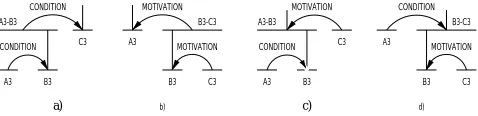
B 3)When given this discourse problem, our imple-mentation produces the four discourse trees shown in figure 4, each of them having a different primary intention (
f
I(CONDITION,C 3
)
;f
I(MOTIVATION,A 3
)
;
f
I(MOTIVATION,B 3
)
;
andf
I
(CONDITION,B 3
)).
Hence, our approach enables one to derive automatically and enumerate all possible rhetorical interpretations of a text and to study the relationship between structure and intentions. Our approach does not provide yet the mechanisms for choosing between different interpreta-tions, but it provides the foundations for such a study. In contrast, Moore and Pollack’s informal approach could neither derive nor enumerate all possible interpretations: in fact, their discussion refers only to the two trees shown in figure 4.a and .b.
Unlike Moore and Pollack’s approach, where it is sug-gested that a discourse representation should reflect si-multaneously both its informational and intentional inter-pretations, the approach presented here is capable of only enumerating these interpretations. The formal model we proposed is not rich enough to accommodate concurrent, non-isomorphic interpretations.
CONDITION B3 A3-B3
C3
A3
MOTIVATION A3
B3 C3 B3-C3
c)
MOTIVATION CONDITION
d) MOTIVATION
MOTIVATION A3
B3 C3 B3-C3
b) CONDITION
B3 A3-B3
C3
A3 CONDITION
a)
Figure 4: The set of all RS-trees that can be built for text (11).
6
Conclusion
Crucial to the development of syntactic theories was the ability to provide mechanisms capable of deriving all valid syntactic interpretations of a given sentence. Se-mantic or corpus-specific information was then used to manage the usually large number of interpretations.
The work described in this paper sets theoretical foun-dations that enable a similar approach to the study of dis-course. The way a syntactic theory enables all valid syn-tactic trees of a sentence be derived, the same way the axiomatization presented here enables all valid discourse trees of a text be derived. But the same way a syntac-tic theory may produce trees that are incorrect from a semantic perspective for example, the same way the ax-iomatization described here may produce trees that are incorrect when, for example, focus and cohesion are fac-tored in.
A number of researchers have already shown how
in-dividual rhetorical and intentional judgments can be
de-rived automatically from linguistic constructs such as tense and aspect, certain patterns of pronominalization and anaphoric usages, it-clefts, and discourse markers or cue phrases. But once these judgments are made, we still need to determine all discourse interpretations that are not only consistent with these judgments but also valid. This paper provides mechanisms for deriving and enu-merating all valid structure of a discourse and enables a quantitative study of the relation between text structures and intentions.
References
Nicholas Asher and Alex Lascarides. 1998. Questions in dia-logue. Linguistics and Philosophy, 21(3):237–309. Barbara J. Grosz and Candace L. Sidner. 1986. Attention,
in-tentions, and the structure of discourse. Computational
Lin-guistics, 12(3):175–204.
Karen E. Lochbaum. 1998. A collaborative planning model of intentional structure. Computational Linguistics, 24(4):525–572.
William C. Mann and Sandra A. Thompson. 1988. Rhetorical structure theory: Toward a functional theory of text organi-zation. Text, 8(3):243–281.
Daniel Marcu. 1996. Building up rhetorical structure trees. In
Proceedings of AAAI–96, pages 1069–1074.
Johanna D. Moore and Martha E. Pollack. 1992. A problem for RST: The need for multi-level discourse analysis.
Com-putational Linguistics, 18(4):537–544.
Megan Moser and Johanna D. Moore. 1996. Toward a synthe-sis of two accounts of discourse structure. Computational