Interpreting Vague Utterances in Context
David DeVault and Matthew StoneDepartment of Computer Science Rutgers University
Piscataway NJ 08854-8019
[email protected], [email protected]
Abstract
We use the interpretation of vague scalar predi-cates like small as an illustration of how system-atic semantic models of dialogue context en-able the derivation of useful, fine-grained utter-ance interpretations from radically underspeci-fied semantic forms. Because dialogue context suffices to determine salient alternative scales and relevant distinctions along these scales, we can infer implicit standards of comparison for vague scalar predicates through completely general pragmatics, yet closely constrain the in-tended meaning to within a natural range.
1 Introduction
Modeling context and its effects on interpretation may once have seemed to call for an open-ended in-vestigation of people’s knowledge of the common-sense world (Hobbs et al., 1993). But research on the semantics of practical dialogue (Allen et al., 2001) now approaches dimensions of context sys-tematically, through increasingly lightweight, ftored models. The evolving state of real-world ac-tivity proceeds predictably according to background plans and principles of coordination (Rich et al., 2001). The status of the dialogue itself is defined by circumscribed obligations to ground prior ut-terances, follow up open issues, and advance real-world negotiation (Larsson and Traum, 2000). Fi-nally, the evolving state of the linguistic context is a direct outgrowth of the linguistic forms inter-locutors use and the linguistic relationships among successive utterances (Ginzburg and Cooper, 2001; Asher and Lascarides, 2003). These compatible models combine directly to characterize an aggre-gate information state that provides a general back-ground for interpretation (Bunt, 2000).
We argue in this paper that such integrated mod-els enable systems to calculate useful, fine-grained utterance interpretations from radically underspec-ified semantic forms. We focus in particular on vague scalar predicates like small or long. These predicates typify qualitative linguistic expression of quantitative information, and are thus both
chal-lenging and commonplace. Building on a mul-tidimensional treatment of dialogue context, we develop and implement a theoretically-motivated model of vagueness which is unique in treating vague predicates as genuinely vague and genuinely context-sensitive, yet amenable to general processes of contextual and interpretive inference.
1.1 Semantic insights
We pursue our argument in the context of an imple-mented drawing application, FIGLET, which allows
users to give English instructions to draw a carica-ture of an expressive face. Figure 1 shows a repre-sentative interaction withFIGLET; the user gives the successive instructions in (1):
(1) a. Make two small circles. b. Draw a long line underneath.
Like Di Eugenio and Webber (1996), we empha-size that understanding such instructions requires contextual inference combining linguistic, task and domain knowledge. For example, consider the re-sponse to (1a) of placing circles so as to form the eyes of a new face. To recognize the possibility of drawing eyes exploits knowledge of the ongoing drawing task. To put the eyes where they belong in the upper part of the new face exploits domain knowledge. The response to (1b) adds the linguis-tic context as another ingredient. To identify where the line goes, the user uses the objects mentioned recently in the interaction as the understood spatial landmark for underneath. Figure 1 highlights the importance of using multidimensional representa-tions of dialogue context in understanding instruc-tions for quantitative domains.
knowl-Initial blank figure state. After the user utters (1a): Make two small circles.
[image:2.595.114.183.68.134.2]After the user utters (1b): Draw a long line underneath.
Figure 1: Motivating interaction: Vague instructions to draw a face.
edge already being applied in utterance interpre-tation. The user’s motivation in using long is to differentiate an intended interpretation, here an in-tended action, from alternative possibilities in con-text. Background knowledge already sets out the relevant ways to draw a line; drawing a long line means singling out some of them by the length of that new line. This model recalls dynamic theo-ries of vague scalar predicates, such as the seman-tics of Kyburg and Morreau (2000), Barker (2002), or Kennedy (2003), but it is exactly implemented in FIGLET. The implementation capitalizes on the
richness of current models of context to recover content for the you know of vagueness.
1.2 Overview
In Section 2, we motivate approaches to the seman-tics of vague scalar predicates that associate them with a presupposed standard of comparison. We il-lustrate how context can be understood to supply possible standards, and how pragmatic reasoning from utterances allows interlocutors to infer them. In Section 3, we establish a bridge to the general treatment of practical dialogue, by showing how multiple dimensions of context generally contribute to recognizing possible interpretations for under-specified utterances. Section 4 builds on Sections 2 and 3 to show howFIGLETexploits a rich model of utterance context to respond cooperatively to vague utterances like (1a) and (1b), while Section 5 de-tailsFIGLET’s actual implementation. We conclude in Section 6 by suggesting further challenges that vagueness still poses for computational semantics.
2 Vague standards in context
We adopt a view of vague predicates motivated by linguistic theory, particularly Kennedy’s approach (1999; 2003). We assume that gradable adjectives are associated with measurement functions mapping individuals to degrees on a scale. InFIGLET’s draw-ing domain, the relevant measurements pertain to spatial properties. For long, for example, the mea-surement maps individuals to their spatial lengths; for small, it maps individuals to degrees on an in-verted scale of size.
Positive gradable adjectives compare measured degrees against a standard on the scale which is de-rived from context. For example, long says that an object’s length exceeds the threshold set by the cur-rent standard for length. Other forms, such as com-parative adjectives or adjectives with explicit mea-sure phrases, compare degrees differently.
Importantly, grammar says nothing about how standards for positive gradable adjectives are de-rived. In other words, contra Cresswell (1977) and others, the interpretation of adjectives is not com-puted relative to a grammatically-specified “com-parison class” of related objects. And, contra Oates et al. (2000) and Roy and Pentland (2002), the in-terpretation of adjectives need not require statistical knowledge about how objects with different mea-surements on a scale tend to be described. Instead, standards are derived directly from an evolving con-text by the general principles that govern pragmatic resolution of context dependence.
Kennedy synthesizes a range of evidence for this claim. Here we go further, and provide a formal, implemented model. We can sketch the evidence and our model by considering two key examples.
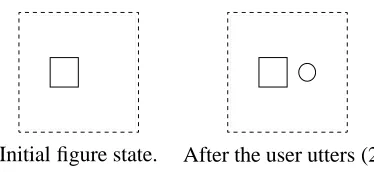
First, we illustrate that vagueness depends di-rectly on specific contextually-relevant distinctions. Consider the session with FIGLET shown in Fig-ure 2. The user has elected to draw two objects side-by-side. The initial context just contains a square. The user utters (2).
(2) Make a small circle.
To interpret (2) it doesn’t seem to help to appeal to general knowledge about how big circles tend to be. (It’s quite convoluted to even frame the idea in a sensible way.) Graff (2000) observes that standards often implicitly appeal to what we expect about par-ticular individuals, not just what we know about similar individuals. In context, here, the user just seems to be asking for a circle vaguely smaller than the square. This is the interpretationFIGLETbuilds;
to comply,FIGLETdraws the circle an arbitrary but
dis-Initial figure state. After the user utters (2). Initial figure state. After the user utters (3).
[image:3.595.338.532.66.151.2]Figure 2: Taking standards from context in (2): Make a small circle.
Figure 3: Disambiguating contextual standards in (3): Make the small square a circle.
tinctions in the context. Interlocutors exploit these distinctions in using vague adjectives.
Figure 3 illustrates that understanding vagueness is part of a general problem of understanding utter-ances. Figure 3 shows FIGLET’s action in a more complex context, containing two squares of differ-ent sizes. We consider the user’s instruction (3):
(3) Make the small square a circle.
FIGLET’s action changes the smaller of the two squares. The standard behind this interpretation is implicitly set to differentiate the contextually-salient objects from one another; the natural reso-lution of (3) does not require that either square be definitely small (Kyburg and Morreau, 2000). In Figure 3, for example, there are different potential standards that would admit either both squares or neither square as small. However, we can rule out these candidate standards in interpreting (3). The user’s communicative intention must explain how a unique square from the context can be identified from (3) using a presupposed small standard. If that standard is too big, both squares will fit. If that stan-dard is too small, neither square will fit. Only when that standard falls between the sizes of the squares does (3) identify a unique square.
The examples in Figures 2 and 3 show two ways new standards can be established. Once established, however, standards become part of the evolving context (Barker, 2002). Old standards serve as de-faults in interpreting subsequent utterances. Only if no better interpretation is found will FIGLET go back and reconsider its standard. This too is general pragmatic reasoning (Stone and Thomason, 2003).
3 Dimensions of context in interpretation To cash out our account of contextual reasoning with vagueness, we need to characterize the con-text for practical dialogue. Our account presupposes a context comprising domain and situation knowl-edge, task context and linguistic context. In this sec-tion, we survey each of these dimensions of context, and show how they converge in the resolution of un-derspecification across a wide range utterances.
Domain and situation knowledge describes the commonsense structure of the real-world objects and actions under discussion. Practical dialogue re-stricts this otherwise open-ended specification to the circumscribed facts that are directly relevant to an ongoing collaboration. For example, in our drawing domain, individuals are categorized by a few types: types of shape such as circles and squares; and types of depiction such as eyes and heads. These types come with corresponding constraints on individuals. For example, the shape of a mouth may be a line, an ellipse, or a rectangle, while the shape of a head can only be an ellipse. These constraints contribute to interpretation. For instance, a head can never be de-scribed as a line, for example, since heads cannot have this shape.
Task context tracks collaborators’ evolving com-mitment to shared goals and plans during joint ac-tivity. In FIGLET’s drawing domain, available ac-tions allow users to build figure parts by introducing shapes and revising them. Our experience is that users’ domain plans organize these actions hierar-chically into strategic patterns. For example, users tend to complete the structures they begin drawing before drawing elsewhere; and once they are satis-fied with what they have, they proceed in natural sequence to a new part nearby. Task context plays a powerful role in finding natural utterance inter-pretations. By recording a plan representation and keeping track of progress in carrying it out,FIGLET
has access to a set of candidate next actions at each point in an interaction. Matching the user’s utter-ance against this candidate set restricts the interpre-tation of instructions based on the drawing already created and the user’s focus of attention within it. For example, if the user has just drawn the right eye onto an empty face, they are likely to turn to the left eye next. This context suggests making a winking left eye in response to draw a line, an interpretation that might not otherwise be salient.
Initial figure state. After the user utters (4): Draw a line underneath.
Figure 4: Context in instructions.
that can serve as the referents of pronouns and other reduced expressions. To see this, note that, as far as domain knowledge and task context go, the in-struction make it bigger could apply to any object currently being created. If the figure is hierarchi-cal, there will be many possibilities. Yet we typi-cally understand it to refer specifitypi-cally to an object mentioned saliently in the previous utterance. The linguistic context helps disambiguate it.
Figure 4 illustrates how the three different dimen-sions of context work together. It illustrates an inter-action withFIGLETwhere the user has just issued an
instruction to create two eyes, resulting in the figure state shown at the left in Figure 4. The user’s next instruction is (4):
(4) Draw a line underneath.
We focus on how the context constrains the position and orientation of the line.
Linguistic context indicates that underneath should be understood as underneath the eyes. This provides one constraint on the placement of the line. Task context makes drawing the mouth a plausible candidate next action. Domain knowledge shows that the mouth can be a line, but only if further constraints on position, orientation and length are met. In understanding the instruction, FIGLET ap-plies all these contextual constraints simultaneously. The set of consistent solutions—drawing a horizon-tal line at a range of plausible mouth positions be-low the eyes—constitutes the utterance interpreta-tion. FIGLETacts to create the result in Figure 4 by choosing a representative action from this set.
4 Interpreting vague utterances in context In our approach, the linguistic context stores agreed standards for vague predicates. Candidate standards are determined using information available from do-main knowledge and the current task context. In
FIGLET’s drawing domain, possibilities include the actual measurements of objects that have already been drawn. They also include the default domain measurements for new objects that task context says could be added. Setting standards by a
measure-ment is our shorthand for adopting an implicit range of compatible standards; these standards remain vague, especially since many options are normally available (Graff, 2000).
We treat the use of new candidate standards in in-terpretation as a case of presupposition dation (Bos, 2003). In presupposition accommo-dation, the interpretation of an utterance must be constructed using a context that differs from the ac-tual context. When speakers use an utterance which requires accommodation, they typically expect that interlocutors will update the dialogue context to in-clude the additional presumptions the utterance re-quires. We assume that all accommodation is sub-ject to two Gricean constraints. First, we assume whenever possible that an utterance should have a uniquely identifiable intended interpretation in the context in which it is to be interpreted. Second, we assume that when interpretations in alternative con-texts are available, the speaker is committed to the strongest one—compare Dalrymple et al. (1998). Inferring standards for vague predicates is a special case of this general Gricean reasoning.
The principles articulated thus far in Sections 2–4 allow us to offer a precise explanation of FIGLET’s
behavior as depicted in Figure 1. The user starts drawing a face with an empty figure. In this domain and task context, make two circles fits a number of possible actions. For example, it fits the action of drawing a round head and its gaping mouth. How-ever, in (1a), what the user actually says is make two small circles. The interpretation for (1a) must accommodate a standard for small and select from the continuum of size possibilities two new circles that meet this standard.
The standards in this context are associated with the size distinctions among potential new objects. The different qualitative behavior of these standards in interpretation can be illustrated by the standards set from possible new circular objects that are con-sistent with the face-drawing task. We can set the standard from the default size of an eye, from the default size of a mouth (larger), or from the default size of a head (larger still).1 Because each stan-dard allows all smaller objects to be created next, these standards lead to 1, 3, and 6 interpretations, respectively. So we recover the standard from the eye, which results in a unique interpretation.2
1Since the default sizes of new objects reflect the relative
dimensions of any other objects already in the figure,FIGLET’s default sizes are not generally equivalent to static comparison classes.
2Note that there are many potential sources of standards for
In tandem with its response, FIGLET tracks the
changes to the context. The task context is updated to note that the user has drawn the eyes and must continue with the process of creating and revising the features of the face. The linguistic context is updated to include the new small standard, and to place the eyes in focus.
This updated context provides the background for (1b), the user’s next instruction draw a long line underneath. In this context, as we saw with Figure 4, context makes it clear that any response to draw a line underneath must draw the mouth. Thus, unlike in (1a), all the interpretations here have the same qualitative form. Nevertheless, FIGLET’s Gricean reasoning can still adjust the standard for length to differentiate interpretations quantitatively, and thereby motivate the user’s use of the word long in the instruction. FIGLET bases its possible stan-dards for length on both actual and potential ob-jects. It can set the standard from an actual eye or from the two eyes together; and it can set the stan-dard from the default mouth or head. The mouth, of course, must fit inside the head; the largest standard is ruled out. All the other standards lead to unique interpretations. Since the length of the two eyes to-gether is the strictest of the remaining standards, it is adopted. This interpretation leads FIGLET to the response illustrated at the right in Figure 1.
5 Implementation
We have implemented FIGLET in Prolog using
CLP(R) real constraints (Jaffar and Lassez, 1987) for metric and spatial reasoning. This section presents a necessarily brief overview of this imple-mentation; we highlight howFIGLET is able to ex-actly implement the semantic representations and pragmatic reasoning presented in Sections 2–4. We offer a detailed description of our system and dis-cuss some of the challenges of building it in DeVault and Stone (2003).
5.1 Semantic representation
InFIGLET, we record the semantics of user instruc-tions using constraints, or logical conjuncinstruc-tions of open atomic formulas, to represent the contextual requirements that utterances impose; we view these constraints as presuppositions that speakers make in using the utterance. We assume matches take the form of instances that supply particular domain rep-resentations as suitable values for variables. Stone (2003) motivates this framework in detail.
methods for specifying domain knowledge will help provide the meaningful task distinctions that serve as candidate stan-dards for vague predicates on our approach, but pursuing this hypothesis is beyond the scope of this paper.
In (5a-d), we show the presuppositions FIGLET
assigns to an utterance of Make two small circles, arranged to show the contributions of each individ-ual word. In (5e), we show the contribution made by the utterance to an evolving dialogue; the effect is to propose that an action be carried out.
(5) a. simple(A)∧target(A,X)∧fits plan(A)∧ holds(result(A,now),visible(X))∧
holds(now,invisible(X))∧ b. number(X,2)∧
c. standard(small,S)∧
holds(result(A,now),small(X,S))∧ d. number(X,multiple)∧
holds(result(A,now),shape(X,circle)) e. propose(A)
We formulate these constraints in an expressive ontology. We have terms and variables for ac-tions, such as A; for situaac-tions, such as now and result(A,now); for objects, such as X ; for stan-dards for gradable vague predicates (scale-threshold pairs), such as S; and for quantitative points and in-tervals of varying dimensionality, as necessary.
5.2 Pragmatic reasoning
Constraint networks such as (5a-e) provide a uni-form venue for describing the various contextual dependencies required to arrive at natural utterance interpretations. Thus, the contextual representation and reasoning outlined in Sections 3 and 4 is real-ized by a uniform mechanism inFIGLET: specifica-tions of how to reason from context to find soluspecifica-tions to these constraints.
For example, Section 3 described domain knowl-edge that links particular object types like eyes and heads with type-specific constraints. In our imple-mentation, we specify real and finite constraints that individuals of each type must satisfy. In order for an individual e of type t to serve as part of a solution to a constraint network like (5a-e), e must addition-ally meet the constraints associated with type t. In this way, FIGLET requires utterance interpretations to respect domain knowledge.
char-acterize causal relationships in the domain; thus target(A,X)means that action A directly affects X , and the constraints of (5a-d) together mean that car-rying out action A in the current situation causes two small circles to become visible. These constraints are proved inFIGLETby what is in effect a planner
that can find complex actions that achieve specified effects via a repertoire of basic domain actions.
Task context is brought to bear on interpretation through the fits plan(A)constraint of (5a). FIGLET
uses a standard hierarchical, partially ordered plan representation to record the structure of a user’s task. We specify the solutions to fits plan(A) to be just those actions A that are possible next steps given the user’s current state in achieving the task. Since these task-appropriate actions can factor addi-tional constraints into interpretation, enforcing the fits plan(A) constraint can help FIGLET identify a natural interpretation.
As discussed in Section 4, FIGLET records a list of current standards for vague scalar adjec-tives in the linguistic context. The constraint standard(small,S) of (5c) connects the overall ut-terance interpretation to the available standards for small in the linguistic context.FIGLETinterprets ut-terances carrying semantic constraints of the form standard(vague-predicate,S) in one or two stages. In the first stage, the constraint is solved just in case S is the prevailing standard for vague-predicate in the linguistic context. If there is no prevailing standard for an evoked vague property, or if this stage does not yield a unique utterance interpreta-tion, thenFIGLETmoves to a second stage in which
the constraint is solved for any standard that cap-tures a relevant distinction for vague-predicate in the context. If there is a strongest standard that re-sults in a unique interpretation, it is adopted and in-tegrated into the new linguistic context.
5.3 Parsing and Interpretation
Language understanding inFIGLETis mediated by a bottom-up chart parser written in Prolog. As usual, chart edges indicate the presence of recognized par-tial constituents within the input sequence. In ad-dition, edges now carry constraint networks that specify the contextual reasoning required for under-standing. In addition to finite instances (Schuler, 2001), these networks include real constraints that formalize metric and spatial relationships. Interpre-tation of these networks is carried out incremen-tally, during parsing; each edge thus records a set of associated candidate interpretations. Since do-main reasoning can be somewhat time-intensive in our current implementation, we adopt a strategy
of delaying the solution of certain constraints until enough lexical material has accrued that the asso-ciated problem-solving is judged tractable (DeVault and Stone, 2003).
6 Assessment and Conclusion
In our approach, we specify a genuinely vague se-mantics: vague words evoke a domain-specific scale that can differentiate alternative domain individuals. To find a unique interpretation for a vague utter-ance, we leverage ordinary inference about the do-main, task, and linguistic context to recover implicit thresholds on this scale.
We believe that further methodological advances will be required to evaluate treatments of vagueness in indefinite reference, such as that considered here. For example, obviously the very idea of a “gold standard” for resolution of vagueness is problem-atic. We believe that the best argument for a theory of vagueness in a language interface would show that naive users of the interface are, on the whole, likely to accept its vague interpretations and un-likely to renegotiate them through clarification. But the experiment would have to rule out confounding factors such as poorly-modeled lexical representa-tion and context tracking as sources for system in-terpretations that users reject.
We intend to take up the methodological chal-lenges necessary to construct such an argument in future work. In the meantime, while our current im-plementation ofFIGLET exhibits the promising be-havior discussed in this paper and illustrated in Fig-ures 1–4, some minor engineering unrelated to lan-guage understanding remains before a fruitful eval-uation can take place. As alluded to above, the tight integration of contextual reasoning and interpreta-tion thatFIGLETcarries out can be expensive if not pursued efficiently. While our initial implementa-tion achieves a level of performance that we accept as researchers (interpretation times of between one and a few tens of seconds), evaluation requires us to improveFIGLET’s performance to levels that exper-imental participants will accept as volunteers. Our analysis ofFIGLET indicates that this performance can in fact be achieved with better-regimented do-main problem-solving.
(Gorniak and Roy, In Press). The computational ap-peal is that all the expensive infrastructure required to pursue the account is independently necessary. Once this infrastructure is in place the account is readily implemented with small penalty of perfor-mance and development time. It is particularly at-tractive that the approach requires minimal lexical knowledge and training data. This means adding new vague words to an interface is a snap.
Overall, our new model offers three contribu-tions. Most importantly, of course, we have devel-oped a computational model of vagueness in terms of underspecified quantitative constraints. But we have also presented a new demonstration of the im-portance and the feasibility of using multidimen-sional representations of dialogue context in under-standing descriptions of quantitative domains. And we have introduced an architecture for resolving un-derspecification through uniform pragmatic mech-anisms based on context-dependent collaboration. Together, these developments allow us to circum-scribe possible resolutions for underspecified utter-ances, to zero in on those that the speaker and hearer could adopt consistently and collaboratively, and so to constrain the speaker’s intended meaning to within a natural range.
Acknowledgments
We thank Kees van Deemter and our anonymous re-viewers for valuable comments. This work was sup-ported by NSF grant HLC 0308121.
References
J. Allen, D. Byron, M. Dzikovska, G. Ferguson, L. Galescu, and A. Stent. 2001. Towards conver-sational human-computer interaction. AI Maga-zine, 22(4):27–37.
N. Asher and A. Lascarides. 2003. Logics of Con-versation. Cambridge.
C. Barker. 2002. The dynamics of vagueness. Lin-guistics and Philosophy, 25(1):1–36.
J. Bos. 2003. Implementing the binding and accommodation theory for anaphora resolution and presupposition. Computational Linguistics, 29(2):179–210.
H. Bunt. 2000. Dialogue pragmatics and context specification. In H. Bunt and W. Black, editors, Abduction, Belief and Context in Dialogue, pages 81–150. Benjamin.
M. Cresswell. 1977. The semantics of degree. In B. H. Partee, editor, Montague Grammar, pages 261–292. Academic.
M. Dalrymple, M. Kanazawa, Y. Kim, S. Mchombo, and S. Peters. 1998. Reciprocal expressions and
the concept of reciprocity. Linguistics and Phi-losophy, 21(2):159–210.
D. DeVault and M. Stone. 2003. Domain inference in incremental interpretation. In Proc. ICoS. B. Di Eugenio and B. Webber. 1996. Pragmatic
overloading in natural language instructions. Int. Journal of Expert Systems, 9(2):53–84.
J. Ginzburg and R. Cooper. 2001. Resolving ellip-sis in clarification. In Proc. ACL.
P. Gorniak and D. Roy. In Press. Grounded seman-tic composition for visual scenes. Journal of Ar-tificial Intelligence Research.
D. Graff. 2000. Shifting sands: An interest-relative theory of vagueness. Philosophical Top-ics, 28(1):45–81.
J. Hobbs, M. Stickel, D. Appelt, and P. Martin. 1993. Interpretation as abduction. Artificial In-telligence, 63:69–142.
J. Jaffar and J.-L. Lassez. 1987. Constraint logic programming. In Proc. POPL, pages 111–119. C. Kennedy. 1999. Projecting the adjective: The
syntax and semantics of gradability and compar-ison. Garland.
C. Kennedy. 2003. Towards a grammar of vague-ness. Manuscript, Northwestern.
A. Kyburg and M. Morreau. 2000. Fitting words: Vague words in context. Linguistics and Philos-ophy, 23(6):577–597.
S. Larsson and D. Traum. 2000. Information state and dialogue management in the TRINDI dia-logue move engine toolkit. Natural Language Engineering, 6:323–340.
T. Oates, M. D. Schmill, and P. R. Cohen. 2000. Toward natural language interfaces for robotic agents. In Proc. Agents, pages 227–228.
C. Rich, C. L. Sidner, and N. Lesh. 2001. COL-LAGEN: applying collaborative discourse the-ory to human-computer interaction. AI Maga-zine, 22(4):15–26.
D. Roy and A. Pentland. 2002. Learning words from sights and sounds: A computational model. Cognitive Science, 26(1):113–146.
W. Schuler. 2001. Computational properties of environment-based disambiguation. In Proc. ACL, pages 466–473.
M. Stone and R. H. Thomason. 2003. Coordinat-ing understandCoordinat-ing and generation in an abductive approach to interpretation. In Proc. DiaBruck, pages 131–138.