Using the Rational Valued Characters Table for
Cyclic Groups
=
⨁
=
in
Transformation
Bassim Kareem Mihsin
General Directorate of Education, Karbala. Karbala, Iraq
ABSTRACT: In this paper, we introduce a new method to transform image by using the rational character table for
point group , = ⨁ =
by considering character table as square matrix of size × and designing an algorithm
for it, which includes the transformation matrix of the image to the sets of matrices square of size × .
KEYWORDS:point group, character table, cipher and anti – cipher.
I. INTRODUCTION
Image processing refers to the various operations; Purpose of transformation is to convert the data into a form where compression is easier. This transformation will transform the pixels which are correlated into a representation where they are decorrelated . The new values are usually smaller on average than the original values. The net effect is to reduce the redundancy of representation. For lossy compression, the transform coefficients can now be quantized according to their statistical properties, producing a much compressed representation of the original image data , in this paper we presented a new method to cipher and anti-cipher see[5],[6]and[9].
II. MATERIAL AND METHODS
POINT GROUP(1.1):[7]
Particularly we will consider the following point groups which molecules can belong to the group Cn. A molecule
belongs to the group Cn if it has a n-fold axis. C2 group as it has the elements E and C2. The group = ⨁
= 1 A
molecule belongs to the group = ⨁
= 1
if in addition to the identity E and a Cn axis, it has n vertical mirror planes
CHARACTER TABLE OF FINITE ABELIAN GROUP(1.2):[3]
≡( ) =
Table (1.1)
Where =
≡( ) =
Table (1.2)
Theorem(1.3) : [4]
Let : → ( , ) : → ( , )are two matrix representations of the groups ,
be two characters of respectively ,then the character of ⨂ is ⋅ .
Theorem(1.4) : [8]
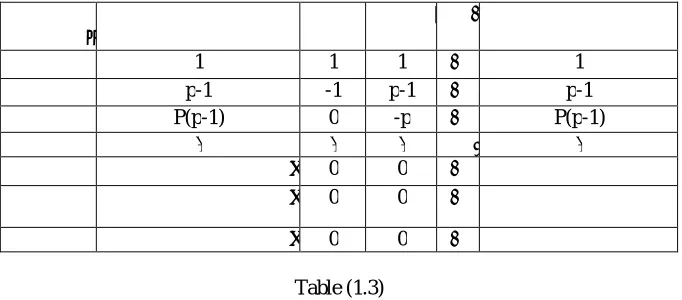
The rational valued Character table of the cyclic group of the rank
+ 1where p is a prime number which is denoted by (≡∗ ) is given as follows :
Table (1.3)
Where its rank s+1 represents the number of all distinct Γ-classes.
Example(1.5):
To find the rational valued Character table of the cyclic group by using theorem (1.4) . ⋯
| | 1 1 1 ⋯ 1
| ( )| n n n ⋯ n
1 1 1 ⋯ 1
1 ⋯
1 ⋯
⋮ ⋮ ⋮ ⋮ ⋱ ⋮
1 ⋯
1
| | 1 1
| ( )| 2 2
1 1
1 -1
Γ −
[ [ ⋯
1 1 1 ⋯ 1
p-1 -1 p-1 ⋯ p-1
P(p-1) 0 -p ⋯ P(p-1)
⋮ ⋮ ⋮ ⋱ ⋮
0 0 ⋯
0 0 ⋯
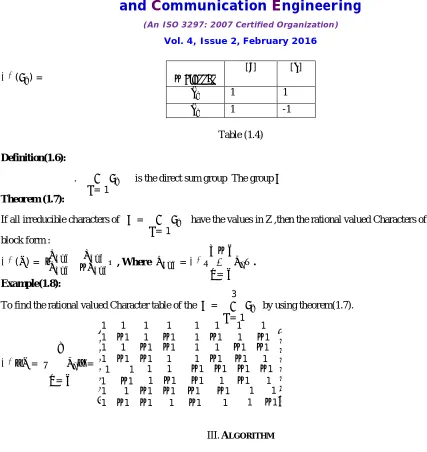
≡∗( ) =
Table (1.4)
Definition(1.6):
. ⨁
= 1
is the direct sum group The group
Theorem (1.7):
If all irreducible characters of = ⨁ = 1
have the values in Z ,then the rational valued Characters of G has the
block form :
≡∗( ) =
− , Where = ≡∗
− ⊕ =
. Example(1.8):
To find the rational valued Character table of the = 3 ⨁ = 1
by using theorem(1.7).
≡∗ = = = ⎣ ⎢ ⎢ ⎢ ⎢ ⎢ ⎢ ⎡11
1 1 1 −1 1 −1 1 1 −1 −1 1 −1 −1 1 1 1 1 1 1 −1 1 −1
1 1 1 −1 −1 −1 −1 1
1 1 1 1
1 −1 1 −1
1 1 1 −1 −1 −1 −1 1 −1 −1 −1 1 −1 −1 −1 1 −1 −1 1 1 −1 1 1 −1⎦
⎥ ⎥ ⎥ ⎥ ⎥ ⎥ ⎤
III.ALGORITHM
In this section will divide the matrix into the blocks matrix of the same order mxm.
Definition(2.1) : [6],[5]
Let an matrix f be represented as an × matrix of integer numbers = ⋯
⋮ ⋱ ⋮
⋯
, where are blocks matrix of
order ixi .
General transform = , If P and are non-singular (non-zero determinants), inverse matrices exist and
=
Rule (2.2):
Let =
= 1 1
1 −1 = ≡
∗ , when of size 2x2
=
1 1
1 −1
1 1
1 −1
1 1
1 −1
−1 −1 −1 1
=≡∗( = ⨁
=
) , when of size 4x4
Transformation matrix when be of size × : Γ
−
[ ] [ ]
1 1
So we get the final matrix encoded And for the purpose of obtaining the original matrix and without the use of inverse matrix, so the answer will be in the following main theorems
IV.RESULT AND DISCUSSION
In this section we present important theorems on open cipher , where its cipher an n loop
Theorem (3.1):
If = − where P is matrix of size × , Where = ≡∗ ⊕−1 = 1
.
Then = −
Example(3.2):
To find by theorem (3.1)
If = 1 1
1 −1 then =
1 1
1 −1 . and
If =
1 1
1 −1
1 1
1 −1
1 1
1 −1
−1 −1 −1 1
then =
1 1
1 −1
1 1
1 −1
1 1
1 −1
−1 −1 −1 1
.
Theorem (3.3):
Let , ,⋯, , are matrices n-time of size × and n even then × × … × × = , where identity matrix .
Proof:
× × … × × = − ×⋯× − , where = ≡∗ ⊕−1
= 1
.
= × ×⋯×
=
Example(3.4):
Let and are matrices of size 4 × 4 , then × = 4 , where identity matrix of size 4 × 4.
Proof: by theorem (3.3)
Example (3.5):
Let , , … , are matrices n-time of size 4 × 4 and n even to find × × … × × by theorem (3.3).
×
= 4 where identity matrix .
Theorem(3.6) :
Let P be matrix of size × , and is transformation matrix , for level n then:
Keys when n is even number:
Keys when n is odd number :
Proof:
If n is even level:
Let be be transformation for n-time , then we need n-time inverse matric for . i.e:
= [ .
= {1 .1
= { 1 ( .
= { 1
= { 1
= { (
= { 1 (
If n is odd level:
Let be be transformation for n-time , then we need n-time inverse matric for . i.e:
= [ .
= {1 .1
= { 1 ( .
= { 1
= { (
= { 1 (
Example(3.7) :
Let P be matrix of size8 × 8, and is transformation matrix, for level n then:
Keys when n is even number:
Keys when n is odd number :
Proof: by theorem (3.6)
If n is even level: Let be be transformation for n-time, then we need n-time inverse matric for . i.e:
= [ .
= {1
8 .
1
8 …
= {1
8 ( . …
= {1
8 8
= {1
8 8
= {1
8 ( )
If n is odd level:
Let be be transformation for n-time, then we need n-time inverse matric for . i.e:
= [ .
= {1
8 .
1
8 …
= {1
8 ( . …
= {1
8 8
= {8
8 ( (
= {1
8 (
V. APPLICATION
Now we can applied the transformation
=
⋯ ⋮ ⋱
⋯
Then the block matrix of matrix f be
=
12 34 68 19
20 33 200
78 65 44
25 87 268
100 90 11
.
Now the transformation be : = , where = =
1 1
1 −1
1 1
1 −1
1 1
1 −1
−1 −1 −1 1
Where n=4 and degree of partition 4x4 then:
VI.CONCLUSION
Transferring messages secretly between participants has interested people for long time, and it's been really important and needed in our modern world, especially with the advent of electronic messaging and the internet. This paper is a suggestion of a transformation that transform the pixels which are correlated into a representation where they are decor related. The new values are usually smaller on an average than the original values. The net effect is to reduce the redundancy of representation. For lossy compression, the transform coefficients can now be quantized according to their statistical properties, producing a much compressed representation of the original the image data. This idea of this transformation can be applied in encrypting and decrypting important data, and that would be my future modification of this paper.
REFERENCES
1. Amlya k and madhumangalpal(2004) “ two new operators on fuzzy matrices” Appl. Math. & Computing Vol. 15, No. 1 - 2, pp. 91 – 107 2. Balu, M.S(2001)., "Application of Fuzzy Theory to Indian Politics", Masters Dissertation, Guide: Dr. W. B. VasanthaKandasamy, Department
of Mathematics, Indian Instituteof Technology, April .
3. C.Curits and I.Reiner(1981) ," Methods of Representation Theory with Application to Finite Groups and Order " , John wily& sons, New York.
4. C.W. Curits& I. Renier.(2006) " Representation Theory of Finite Groups and Associative Algebra " ,AMS Chelsea publishing ,1962 , printed by the AMS.
5. G. Csurka, C. Zeller, Z. Zhang, and O. Faugeras.(1997)" Characterizing the uncertainty of the fundamental matrix. Computer Vision and Image Understanding", 68(1):18–36, October.
6. G.H. Golub and C.F. van Loan.(1996) "Matrix Computations". The John Hopkins University Press, Baltimore, Maryland, 3 edition, 7. M. Hamermesh. (1962 )“Group Theory and its appliction to physical problems”, University of Southampton,. Available .
8. M.S. Kirdar .(1982) " The Factor Group of The Z-Valued Class Function Modulo The Group of The Generalized Characters " , Ph.D . thesis , University of Birmingham.
9. Quang-Tuan Luong and Olivier Faugeras. (1995) "The fundamental matrix: theory, algorithms, and stability analysis. The International Journal of Computer Vision", 17(1):43–76, January.
BIOGRAPHY
Bassim Kareem Mihsin, received B.Sc. in mathematics from al-Qadisiya university, M.Sc. in mathematics from