University of Windsor University of Windsor
Scholarship at UWindsor
Scholarship at UWindsor
Electronic Theses and Dissertations Theses, Dissertations, and Major Papers
1-1-2019
An SOA-Based Framework of Computational Offloading for Mobile
An SOA-Based Framework of Computational Offloading for Mobile
Cloud Computing
Cloud Computing
Rajasi D. Upadhyay University of Windsor
Follow this and additional works at: https://scholar.uwindsor.ca/etd
Recommended Citation Recommended Citation
Upadhyay, Rajasi D., "An SOA-Based Framework of Computational Offloading for Mobile Cloud Computing" (2019). Electronic Theses and Dissertations. 8185.
https://scholar.uwindsor.ca/etd/8185
This online database contains the full-text of PhD dissertations and Masters’ theses of University of Windsor students from 1954 forward. These documents are made available for personal study and research purposes only, in accordance with the Canadian Copyright Act and the Creative Commons license—CC BY-NC-ND (Attribution, Non-Commercial, No Derivative Works). Under this license, works must always be attributed to the copyright holder (original author), cannot be used for any commercial purposes, and may not be altered. Any other use would require the permission of the copyright holder. Students may inquire about withdrawing their dissertation and/or thesis from this database. For additional inquiries, please contact the repository administrator via email
An SOA-Based Framework of Computational Offloading for Mobile
Cloud Computing
By
Rajasi Upadhyay
A Thesis
Submitted to the Faculty of Graduate Studies
Through Computer Science
In Partial Fulfilment of the Requirements for
The Degree of Master of Science at the
University of Windsor
Windsor, Ontario, Canada
2019
An SOA-Based Framework of Computational Offloading for Mobile Cloud
Computing
by
Rajasi Upadhyay
APPROVED BY:
_______________________________________
M. Monfared
Department of Mathematics and Statistics
______________________________________________
J. Lu
School of Computer Science
______________________________________________
X. Yuan, Advisor
School of Computer Science
iii
DECLARATION OF ORIGINALITY
I hereby confirm that I am the sole creator of this theory, and no piece of this
proposition has been distributed or submitted for production.
I approve to the best of my insight, my proposition does not encroach upon
anybody's copyright nor damage any restrictive rights and their thoughts, methods,
citations, or some other material crafted by other individuals incorporated into my
postulation, circulation or something else, and are entirely recognized as per the
standard referencing hone. Moreover, I have included copyrighted material that
outperforms the limits of reasonable managing inside the significance of the Canada
Copyright Act. I affirm to acquire a composed consent from the copyright owner(s)
to incorporate such material(s) in my postulation and have included duplicates of
such copyright clearances to my reference section.
I pronounce that this is a genuine copy of my thesis, including any last updates,
as affirmed by my thesis advisory group and the Graduate Studies office, and this
theory has not been submitted for a higher degree to some other University or
iv
ABSTRACT
Mobile Computing is a technology that allows transmission of audio, video, and
other types of data via a computer or any other wireless-enabled device without
having to be connected to a fixed physical link. Despite increasing usage of mobile
computing, exploiting its full potential is difficult due to its inherent problems such
as resource scarcity, connection instability, and limited computational power. In
particular, the advent of connecting mobile devices to the internet offers the
possibility of offloading computation and data intensive tasks from mobile devices
to remote cloud servers for efficient execution. This proposed thesis develops an
algorithm that uses an objective function to adaptively decide strategies for
computational offloading according to changing context information. By following
the style of Service-Oriented Architecture (SOA), the proposed framework brings
cloud computing to mobile devices for mobile applications to benefit from remote
execution of tasks in the cloud. This research discusses the algorithm and
framework, along with the results of the experiments with a newly developed system
for self-driving vehicles and points out the anticipated advantages of Adaptive
v
DEDICATION
Dedicated to God, my grandparents, my beloved mummy and papa without whose
support, I would not have made it this far, my loving sister, my supportive
vi
ACKNOWLEDGEMENTS
First and foremost, I would like to express profound thankfulness to my supervisor,
Dr. Xiaobu Yuan, who has supported me throughout my thesis with his knowledge
and expertise in this exciting field of research. His ideas and suggestions have helped
me become more creative, without which I would not have been able to complete
this research.
I want to offer my sincere gratitude to the advisory group members, Dr. Jianguo Lu
and Dr. Mehdi Monfared, for their significant remarks and recommendations for my
research.
I want to thank all my friends, especially Saurav Agrawal, Rachit Tomar, and
Chandini Nair, who have supported and helped me throughout my studies here in
Canada. I also thank my parents and family for their blessings and financial support,
vii
TABLE OF CONTENTS
DECLARATION OF ORIGINALITY ... iii
ABSTRACT ... iv
DEDICATION ... v
ACKNOWLEDGEMENTS ... vi
LIST OF TABLES ... ix
LIST OF ABBREVIATIONS/SYMBOLS ... x
LIST OF FIGURES ... xii
CHAPTER 1 INTRODUCTION ... 1
1.1 Mobile Computing ... 1
1.2 Mobile Cloud Ecosystem ... 2
1.2.1 Applications ... 3
1.2.2 Network... 3
1.2.3 Execution Platform ... 3
1.3 Mobile Cloud Computing ... 4
1.3.1 Mobile Cloud Computing: Service-Oriented Architecture ... 4
1.3.2 Mobile Cloud Computing: Computational Offloading ... 5
1.4 Challenges in Computational Offloading for Mobile Cloud Computing ... 6
1.5 Problem statement ... 7
1.6 Motivation ... 7
1.7 Thesis contribution ... 8
1.8 Structure of the thesis ... 8
CHAPTER 2 LITERATURE REVIEW ... 9
2.1 Techniques for Computational Offloading ... 9
2.1.1 Code Migration ... 9
2.1.2 Offloading by Replication ... 9
2.1.3 Placement and Scheduling ... 10
2.1.4 Cuckoo Design ... 10
2.2 Background Study ... 11
2.3 Related works... 19
CHAPTER 3 PROPOSED METHODOLOGY ... 23
3.1 General System Structure ... 23
viii
3.2.1 Service-Oriented Architecture ... 24
3.2.2 Computational Offloading for Mobile Cloud Computing Architecture ... 25
3.3 Overall Flowchart ... 30
CHAPTER 4 IMPLEMENTATION AND EXPERIMENTS ... 33
4.1 Software information ... 33
4.2 Datasets used in the implementation ... 33
4.3 A New System for Self-Driving Vehicles ... 34
4.3.1 Code Partitioning ... 36
4.3.2 Implementation of the SOA System ... 36
4.4 Implementation of Context Monitor ... 40
4.5 Implementation of Decision Making Engine ... 42
4.6 Implementation of Communication Manager and Offloading Planner ... 49
4.7 Comparison and Discussion ... 50
CHAPTER 5 CONCLUSION AND FUTURE WORK ... 52
5.1 Conclusion ... 52
5.2 Future work ... 53
REFERENCES ... 54
ix
LIST OF TABLES
Table 2.1: Review of research work based on offloading ………22
x
LIST OF ABBREVIATIONS/SYMBOLS
QoS Quality of Service
MCC Mobile Cloud Computing
SOA Service-Oriented Architecture
SLA Service Level Agreement
ILP Integer Linear Programming
LP Linear Programming
COSMOS Computation Offloading as a Service for Mobile devices
CPU Central Processing Unit
UI User Interface
OBU On-board Unit
MACS Mobile Augmentation Cloud Services
EEQoSA Energy-Efficient and Quality-of-Service Architecture
HSS Home Subscriber Server
IPMS Internet Protocol Multimedia Subsystem
SRI Subscription-Related Information
LU Location Update
PRR Periodic Re-Registration
RRCC Re-Registration for Change Capabilities
MRA Media Resource Agent
MRFC Media Resource Function Controller
WP Weight value of Performance
xi
WE Weight value of Economic Cost
3D 3-Dimensional
2D 2-Dimensional
VGI Volunteered Graphic Information
API Application Programming Interface
HTTP HyperText Transfer Protocol
XML Extensible Markup Language
RCNN Region Convolutional Neural Network
SSID Service Set Identifier
AWS Amazon Web Services
URL Uniform Resource Locator
CAD Canadian Dollar
EC2 Elastic Cloud Compute
AMI Amazon Machine Image
RDP Remote Desktop Protocol
xii
LIST OF FIGURES
Figure 1.1: Mobile Computing ………..….…..1
Figure 1.2 Applications of Mobile Computing……….2
Figure 1.3: Mobile Cloud Ecosystem ………..…...……...3
Figure 1.4: Mobile Cloud Computing ……….………..4
Figure 1.5: Computational Offloading ………..………5
Figure 2.1: CloneCloud Execution model ………..……….10
Figure 2.2: Offloading using Cuckoo Framework ………..11
Figure 2.3: Taxonomy of computation augmentation techniques ………….……..16
Figure 2.4: Taxonomy of Mobile Storage Augmentation ……….…………..17
Figure 3.1: General System Structure for Offloading …………..………24
Figure 3.2: Proposed System Structure for Offloading ………25
Figure 3.3: Context Monitor ………27
Figure 3.4: Decision Making Engine ………..29
Figure 3.5: Communication Manager and Offloading Planner ………30
Figure 3.6: Overall Flowchart of the Offloading System .………...….31
Figure 4.1: Constructed 3D Virtual World ……….……….34
Figure 4.2: Constructed 3D Objects ………...……….34
Figure 4.3: Overall system ………..…35
Figure 4.4: Service Interaction among self-driving car modules………38
Figure 4.5: Project’s Web Config file snapshot ……….…..39
Figure 4.6: Input image to fast algorithm……….……39
Figure 4.7: Output of fast algorithm ………....40
Figure 4.8: Context Monitor Output UI ………..41
Figure 4.9: Context Monitor Output in file ……….42
Figure 4.10: Pop up for user’s consent..……….…………..42
Figure 4.11: Decision Making Engine Scenario 1………..……..…………...43
Figure 4.12: Decision Making Engine Scenario 2………....…45
xiii
Figure 4.14: Code for cost calculation ………47
Figure 4.15: Decision Making Engine Scenario 4…...48
Figure 4.16: Decision Making Engine Scenario 5.………...49
Figure 4.17: AWS EC2 Windows Server Creation …………..………50
1
CHAPTER 1
INTRODUCTION
The use and deployment of smartphone platforms and apps have increased phenomenally, around
the globe. We use mobile devices for various tasks like communicating in different ways, sending
emails, online banking, browsing internet, watching videos, using social media and navigating
using online maps. Different applications are available for performing these tasks. Due to the
increasing growth of mobile applications and demands of users, the Quality of Service (QoS) is
obstructed by restrictions at the mobile end such as resource limitations, finite energy, limited
available connectivity and shared wireless medium. Since the resources of the mobile devices are
not enough for performing computation-intensive and resource-intensive tasks like image
recognition and natural language processing, the concept of Mobile Cloud Computing is used.
Mobile Cloud Computing (MCC) addresses these resource constraints by incorporating cloud
computing into the mobile environment. This is done by using Computational Offloading, which
involves enabling resource-intensive applications to be executed on remote cloud servers.
1.1Mobile Computing
Mobile Computing is a technology that enables data, voice, and video to be transmitted using a
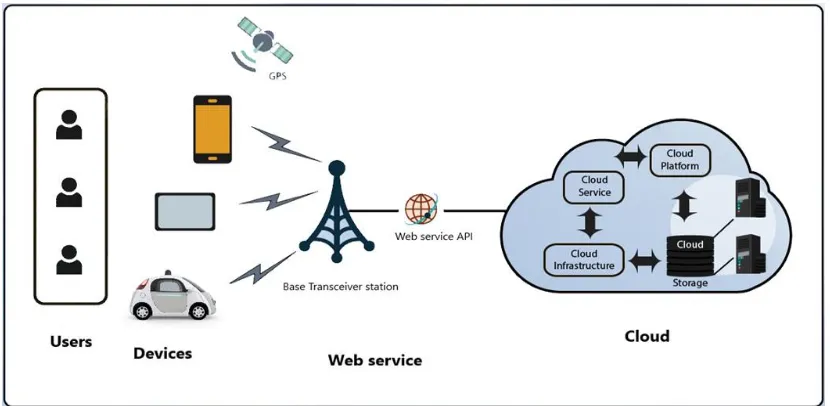
device like a laptop without connecting to a fixed physical connection [1].
2
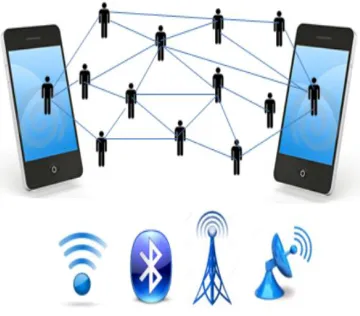
There are three basic concepts of mobile computing - portable hardware, mobile software, and
mobile communication. Portable hardware includes mobile phones, and other gadgets available in
the market that can support mobile computing on devices. Some examples of such portable
hardware are smart phones, tablet PCs, laptops, etc. Mobile software includes various applications
like web browsers, maps, and games. Mobile communication includes communication channels
like Wi-Fi, Bluetooth, and cellular networks. There are numerous applications of Mobile
Computing as shown in Figure 1.2, when used with wireless networks. However, there are various
constraints on mobile computing like resource limitations, mobile connectivity, finite energy, and
security.
Figure 1.2 Applications of Mobile Computing [49]
1.2Mobile Cloud Ecosystem
We explain mobile cloud ecosystem and its different components, in this section. We also discuss
the Quality of Experience (QoE) of a user to study the impact of mobile cloud ecosystem. In this
ecosystem, the mobile system and the cloud system are connected by network. Hence, the
ecosystem consists of three distinct components [2]:
1. Mobile System
3
3. Cloud System
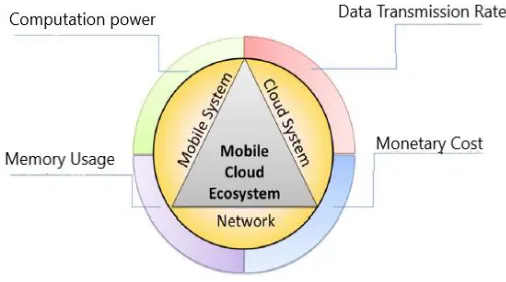
The QoE of a user is affected by the three above-mentioned components of the mobile cloud
ecosystem as shown in Figure 1.3. The QoE, in turn, has four components – memory usage, energy
consumption, monetary cost, and data transmission rate. The environmental parameters in mobile
cloud ecosystem are categorized into following three components based on the source of variation
– applications, network, and execution platform.
1.2.1 Applications
Some mobile applications are computation and resource-intensive e.g., Object Recognition, Map
Reconstruction, Image Search, etc. while other applications like Text Editor, Web Browser, etc.
are not. These applications impose varying requirements on the mobile system. Handling these
variations for a mobile system is a major challenge.
Figure 1.3: Mobile Cloud Ecosystem
1.2.2 Network
There are several types of wireless networks (cellular network, Wi-Fi, Bluetooth) available today.
However, wireless networks are not reliable and stable since the location of mobile devices keeps
changing from time to time. Also, the signal strength is different when mobile devices are moving.
Mobile systems are required to adapt to these changes and continue to function seamlessly.
1.2.3 Execution Platform
The executing platform refers to the mobile devices and the remote cloud servers. Organization
4
system should be adaptive to these changes since it is not feasible to develop a separate system for
each configuration.
1.3Mobile Cloud Computing
It is hard to exploit the complete potential of mobile computing despite its growing use. This is
due to its intrinsic issues such as resource scarcity, frequent disconnections, and mobility. These
issues can be addressed using Mobile Cloud Computing by executing mobile applications on
external resources i.e. the cloud. By extending the storage and computing capabilities of mobile
devices, cloud resources are utilized, and hence, mobile cloud computing is used to expand the
mobile cloud ecosystem [3].
Figure 1.4: Mobile Cloud Computing
1.3.1 Mobile Cloud Computing: Service-Oriented Architecture
Service-Oriented Architecture (SOA) is an architecture used for developing distributed and
interoperable applications [4]. A distributed application has application components that run in
various nodes of the computer. In other words, an application (desktop or internet) that runs at one
place in one system and utilizes some features or business logic from another system somewhere
in the world. An interoperable application means one application developed in one language; for
example, Python, can communicate with another application developed using another language
such as C#. The service-oriented approach can provide a reduction in network cost.
5
contain only information related to the task and not all of its code. Hence, SOA can be used to
provide cloud computing services to mobile applications, where task functionalities are provided
as services [5].
1.3.2 Mobile Cloud Computing: Computational Offloading
As mentioned earlier, the user expects the mobile system to run a variety of applications. However,
a mobile system is constrained by different parameters at any point in time, such as memory
limitation, the limited computation power of existing mobile processors, etc. Computation
offloading aims to enable memory or computation-intensive applications on mobile systems by
distributed execution of mobile applications. This is achieved by running a portion of the
application from the mobile device to remote computation resources such as a cloud server. To
enable distributed execution of a mobile application, the offloading framework must determine
how to partition any application for scheduling on a mobile device and the cloud servers [2].
Even though Computational Offloading originated around the 1970s, its potential was widely
explored only after wireless communication and Internet speed were improved sufficiently and
were able to support it [53]. The offloading capacity depends primarily on technology such as
cellular and WiFi networks, because these networks determine the feasibility of computational
offloading. In today’s age, it has been seen in various scenarios where the Wi-Fi is able to deliver
high bandwidth connections. Moreover, 5G network is receiving a lot of attention, as it can support
increased network capacity and low latency and it paves the way for MCC to solve the problem of
computing offloading.
6
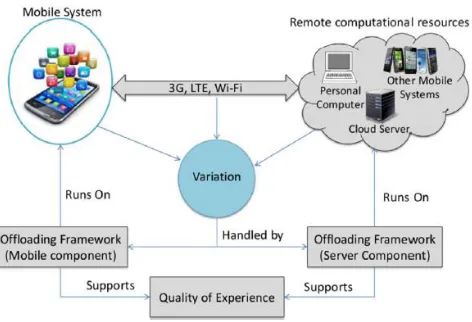
Hence, by using these wireless networks, offloading of the applications is performed to the cloud
resources. Figure 1.5 represents the general architecture for computational offloading. Variations
mentioned earlier in Section 1.2 such as applications, network, and execution platform should be
handled while offloading. Also, the Quality of Experience of the user should be supported.
1.4Challenges in Computational Offloading for Mobile Cloud Computing
Following challenges are taken into consideration based on the requirements of mobile devices
[12]:
1. Network Connectivity and Fault Tolerance
As the mobile devices are constantly moving, freedom of movement and communication
autonomy during the use of mobile cloud services are key criteria for the satisfaction of users.
However, while on the move, there are some constraints that prevent seamless connectivity and
uninterrupted access to cloud services. Data exchange rates and network bandwidth differ as
mobile users travel. In addition, when sending or receiving data, users lose their connection in
some locations; thus, appropriate fault-tolerant strategies should be provided for offloading
approaches to resend the lost components and to reduce the response time.
2. Automatic Mechanism
There is still a need to automate the existing computing offloading frameworks. The automation
makes the offloading process to be carried out seamlessly while taking the surrounding
environment into consideration. It is not an easy task to perform this type of automation as it
requires a protocol to define and discover services in accordance with the current context and its
constraints.
3. Diverse Platform
The diversity and heterogeneity of mobile device architectures and operating systems are some of
the issues in the current computing offloading frameworks. Consistent access to cloud services is
required where mobile devices can access cloud computing services irrespective of the operating
system installed or the hardware used. A standardized offloading system for various mobile
7
4. Offloading Cost
The usage of cloud resources imposes financial costs on end-users who are required to pay in
compliance with the Service Level Agreement (SLA) decided with the cloud provider supporting
them. Content offloading and data transfer operations between cloud providers typically incur
additional costs for end-users. Economic factors should, therefore, be taken into account when
making offloading decisions.
1.5Problem statement
Since the context of a mobile device is varying from time to time, the computational offloading
strategy should adjust itself dynamically in order to achieve the best energy-efficiency, get the best
performance consumption and reduce the monetary cost according to the change of these context
information. Besides, because of the inherent intricacy of the context on which mobile devices are
executing, the computational offloading strategy should adapt itself automatically, rather than
adjust itself manually. As to be discussed in the literature survey (Chapter 2), various methods are
used in offloading. However, some of them are manual, some are not flexible, and some are just
surveys which do not provide specific formulas that can be used for offloading. For solving these
problems caused by changes in the context of mobile devices, an SOA based offloading framework
is proposed using Mobile Cloud Computing (MCC). This framework adapts itself and make a
proper decision of the offloading strategy according to the changes in the context information.
There is a service selection mechanism which selects the required service from several services.
1.6Motivation
The introduction of the connectivity of the mobile device to the Internet offers the possibility of
offloading computation-intensive and resource-intensive tasks from the mobile device to remote
cloud servers for efficient execution. However, as mentioned in Section 1.4, there are several
challenges in Computational Offloading for Mobile Cloud Computing, such as Network
Connectivity and Fault Tolerance, Automatic Mechanism, Diverse Platform, and Offloading Cost.
Due to these limitations, none of the existing approaches are able to solve all the issues, hence, not
allowing the users to the exploit full potential of the devices. Hence, this thesis covers the problems
mentioned above by creating an SOA-based system of Computational Offloading for Mobile
8
creates benefits by remote execution of various application tasks that are provided as services. This
system is advantageous to the end-users in terms of cost reduction, faster, and better performance.
1.7Thesis contribution
Major contributions of this research work can be summarized as follows:
1. Created an Objective Function for deciding the executing location of a service:
OF = P(s1,s2,…,sn)*WP + M(s1,s2,…,sn)*WM + E(s1,s2,…,sn)*WE,
where s represents the services, P represents Performance(computation), M represents
Memory, E represents Economic Cost, WP represents the weight value of Performance,
WM represents the weight value of Memory and WE represents the weight value of
Economic Cost.
2. Created an offloading framework. Depending on the adaptive objective function and the
changing context information, this offloading framework generates a most appropriate
offloading strategy at a certain time.
3. Converted different self-driving modules to an SOA based system for better maintenance
and easier expansion.
4. Performed number of experiments on the SOA based system to verify that the adaptive
offloading framework, the adaptive objective function, and an adaptive service selection
mechanism achieve the best power consumption efficiency, get the satisfying performance
and reduce the monetary cost according to the changing context on which mobile device
such as mobiles, cars, etc. are executing.
1.8Structure of the thesis
Chapter 2 extensively discusses the background study and related works about Computational
Offloading in Mobile Cloud Computing. Chapter 3 explains the proposed system thoroughly with
the overall working of the Offloading System. In Chapter 4, we explore the details about the
implementation, different scenarios that were considered during the implementation of the
proposed idea, and the experimental results. Finally, in Chapter 5 we conclude the thesis and
9
CHAPTER 2
LITERATURE REVIEW
This chapter explains the different methods which can be used to implement computational
offloading. The chapter further discusses the various works done so far using the computational
offloading technique.
2.1Techniques for Computational Offloading
2.1.1 Code Migration
Code Migration is a computational offloading method where the source code is offloaded to remote
machines at run time. There are several works which have adopted this method. MAUI [6] is one
among them. In MAUI, the specific annotated parts of the code are offloaded to a middlebox. For
making the decision of identifying the partitions that are needed to be offloaded, MAUI uses the
concept of Integer Linear Programming (ILP). Linear Programming is a mathematical model used
for solving decision problems having many decision variables that are limited by a set of
constraints. ILP is a subbranch of Linear Programming (LP) where the decision variables are
constrained to hold integer values. Another work which uses Code Migration is ThinkAir [7], in
which, the author has allotted virtual machines for executing the application code partitions at run
time. However, it causes high management overhead if the virtual machines are commissioned at
runtime. In COSMOS: computation offloading as a service for mobile devices [8], task allocation
is managed and offloaded to cloud instance on virtual machines. This method, however, is
customized for Android x86 processor only.
2.1.2 Offloading by Replication
Offloading by Replication is the method in which the characteristics of the mobile device are
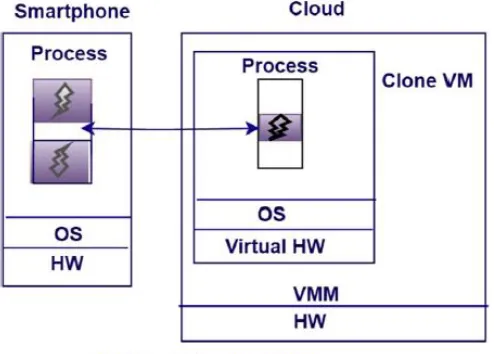
cloned to the remote machines. CloneCloud [9] proposed this method for optimizing the
computation of the mobile device. It mainly focuses on improving the performance and battery
life. For partitioning of applications, they used thread-level granularity in this framework. Static
10
models are combined to find the offloadable components. In this work, the offloading decision is
taken at run time, and cloning is performed by migrating the threads from mobile devices to the
cloud. However, it is an inefficient process to clone the already existing components. Another
work that replicates the code execution on remote server or cloud and mobile device is Tango [10].
It replicates and then selects the one which has the minimum response time. Although replicating
the same is an impractical process.
Figure 2.1: CloneCloud Execution model
2.1.3 Placement and Scheduling
Another technique for offloading is Placement and Scheduling. In this technique, Mahmoodi et al.
[11] has designed an analytical framework towards scheduling for offloading, but the practicality
is in question based on the assumptions about the network conditions. Considering those unfeasible
assumptions, we can say that it is better to address the problem from a system point of view and
build mechanisms that are practically viable.
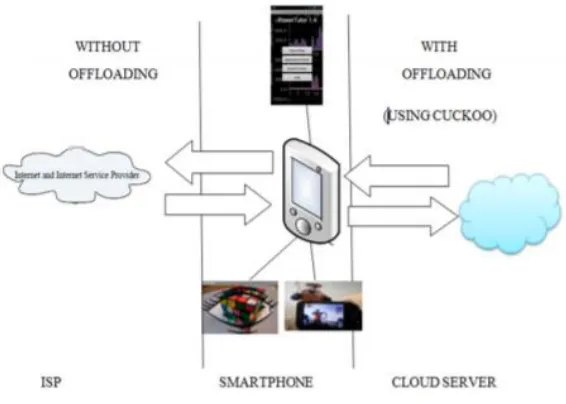
2.1.4 Cuckoo Design
The cuckoo design was proposed for offloading from smartphones that run on the android platform
to the cloud [12]. In this method, the author has used Java stub model for offloading, which
integrates the Eclipse development tool with the open-source Android framework. This model
supports both local and on-cloud execution of the code and works on an already existing
non-11
intensive components of the application. In this design, static code partitioning is done in which a
part of the code that is needed to be offloaded to the remote server is pre-set by the mobile devices.
However, it can be said that this method is a failure in today’s heterogeneous network environment.
Therefore, to handle this heterogeneity, dynamic code partitioning was introduced.
Figure 2.2: Offloading using Cuckoo Framework
2.2Background Study
Many previous works have focused on Computational Offloading for Mobile Cloud Computing.
Some of the papers use a function/formula to decide the location where the tasks need to be
executed. For example, Kovachev et al. [20] provide a middleware MACS (Mobile Augmentation
Cloud Services) that enables adaptive extension of Android application execution from a mobile
device into cloud. Middleware is responsible for heavy lifting of application partitioning, resource
monitoring, and computation offloading. The mobile applications are elastic, which can run as
standard mobile applications and can also reach transparently remote computing resources. In a
MACS application, there is an application core, which cannot be offloaded, and there are multiple
services (Si) that encapsulate separate application functionality which can be offloaded (SRi). The
following metadata is profiled for each service:
Memory cost – memory consumption of the service,
12
Transfer size – amount of data to be transferred,
Send size – amount of data to be sent,
Receive size – amount of data to be received,
Code size – size of compiled code.
For offloading, this approach considers k offloadable modules. For those modules, transfer size is
tr1, tr2, … trk. Send size is send1, send2, … sendkand receive size is rec1, rec2, … reck. The cost
function is depicted as follows:
min
0,1 𝑥 (𝑐𝑡𝑟𝑎𝑛𝑠𝑓𝑒𝑟∗ 𝑤𝑡𝑟 + 𝑐𝑚𝑒𝑚𝑜𝑟𝑦∗ 𝑤𝑚𝑒𝑚+ 𝑐𝑐𝑝𝑢∗ 𝑤𝑐𝑝𝑢)
The cost function is used to make the decision of executing the module locally or remotely. This
framework, however, does not consider minimizing the execution cost and the network
uncertainty.
Considering the limitations of the MACS, Deng et al. [17] proposes the offloading framework in
which services in workflows are invoked, and a decision is made on whether to offload the services
or not. In this paper, an offloading system is proposed to address the issue of unstable network
connectivity of mobile devices. This approach focusses on optimizing the energy consumption and
execution time of mobile services. The offloading system is based on genetic algorithm. In the
class of evolutionary algorithms, genetic algorithms are based on the concept of "survival of the
fittest" [21]. By recombining a population's finest alternatives and mutating them now and then,
one can solve extremely challenging issues for which writing programs would otherwise be
hopelessly difficult. It uses a mobility enabled and fault-tolerance offloading system for making
computation offloading decisions. The main goal of the offloading planner is to propose an optimal
offloading strategy that will minimize energy consumption and execution time for the executing
mobile applications (workflows). Function F(m) is used in the offloading strategy to make
decisions. F(m) for each mobile device m is defined as:
13
Here, 𝑤𝑚 is the weight coefficient, 𝐿𝑚 is the overall execution time and 𝐸𝑚 is overall energy
consumed when a workflow is executing.
The author has covered the drawbacks of MACS and has also proposed an algorithm for optimized
fault tolerance offloading. However, the algorithm presumes the user’s moving path, but there are
other possibilities.
As there are several assumptions made in the previous work, Ashok et al. [5] has proposed an
architecture where the vehicular applications are remotely executed on the cloud, and the tasks are
provided as services. Authors of this paper has also considered the network instability, which was
a shortcoming of MACS framework. In this paper, firstly, the challenges are identified for cloud
computing in vehicles. Challenges are a heterogeneous environment of the wireless network;
different software and hardware architecture of the vehicle’s on-board unit (OBU) and cloud;
seamless offloading of tasks. In this approach, the service-oriented approach is used to provide
cloud computing services to the applications. Computation and data-intensive tasks are identified,
and then an offloading framework is used in which the tasks marked as offloadable are executed
as services and provided in the cloud. The online placement framework is used to make decisions
of offloading the tasks to cloud, based on a set of variables and a set of costs. Variables are network
speed, availability of the server, offloadable modules, and other optimization parameters. Costs
include execution time of modules, storage space, CPU Usage, and energy expensed. For
offloading, the framework follows two steps: Profiling and Conditioning. In profiling step, the
information such as input (output) data sizes to (from) each module, depicted as din (dout), network
uplink (Wup) and downlink (Wdown) speeds, the execution time of the module on the vehicle (e)
and the cloud (e*) and the storage size of the module application code, depicted as s is obtained.
In Conditioning step, those parameters are used to obtain Module Execution Time ratio, E, which
is as follows:
E =
𝑒∗ +𝑊𝑢𝑝𝑑𝑖𝑛+𝑊𝑜𝑢𝑡𝑑𝑜𝑢𝑡 𝑒
Based on the value of E, the decision for marking a module as offloadable is made. However, the
modules to be offloaded are statically marked by the developer. Hence, the offloading is not
14
This paper by Chen et al. [13] proposed a framework for context-aware Computation Offloading
in Mobile Cloud Computing, which tries to provide a solution for the previous paper. As the
previous paper by Ashok et al. [5] did not perform offloading based on the context information,
this paper supports applications with the context-aware computation offloading capability. It is
based on the working of mobile applications. In this approach, to enable an application to be
offloaded, a design pattern is proposed. Then, for selecting the cloud resource, an estimation model
is shown. After that, a framework is presented, which is implemented at the client-side and
server-side to support the previously mentioned design pattern and estimation model. In this framework,
during the development of an application, the methods are classified into different categories. The
first category is Anchored applications, which interact with input or output devices and external
services, or which implement applications UI (User Interface). The second category is Movable
applications, which can run either on different execution platforms like mobile device or cloud
server. The parameters considered for evaluation are battery power consumption and execution
time of the applications. The disadvantage of this method is that service-oriented architecture is
not used. Hence, distributed and interoperable applications will not be supported.
To take advantage of SOA’s benefits, Hani et al. [18] introduced a secure energy-efficient and
quality-of-service architecture (EEQoSA) for mobile cloud handover. This is a service-oriented
architecture, and consists of four layers:
1. Application layer
This layer consists of the home subscriber server (HSS) that interconnects with the cloud
computing servers as an enterprise server. To maintain data communication, HSS links to
Internet protocol multimedia subsystem (IPMS) layer. It includes subscription-related
information (SRI) server, role manager server, and location update (LU) server. Before
transferring the cloud data to a legitimate mobile cloud user, encryption is performed for
secure data communication
2. IPMS layer
This layer provides utility services, like web browsing, email, video-on-demand,
15
obtain updated location information from the mobile cloud user. IPMS uses a call session
control function to bind a public user identity to the IP address of a mobile cloud user.
3. Communication layer
It routes the data and synchronizes the media and IPMS layers. The LU server starts the
registration process, comprising of two levels - periodic registration (PRR) and
re-registration for change capabilities (RRCC). These levels required the messaging process
to complete the re-registration. Therefore, at the end of the handover process, the energy
for registration should be calculated to determine the remaining power of the mobile
device.
4. Media with connectivity layer
It consists of a media resource agent (MRA) and a media resource function controller
(MRFC). MRA controls existing media resource function information and transmits the
suitable information to the authentication server. MRFC combines the streams of media
and manages the shared resources. It allows only authentic users to complete the
re-registration process after starting the handover and reduces the occurrence of extended
delays during the handover.
This architecture ensures the security of the data handover and guarantees Quality of Service;
however, it only considers energy efficiency for the performance.
Since all these previous works, which use different objective functions and algorithms for decision
making has many limitations, we have designed a framework that considers all the parameters and
can perform in a robust manner. Following are the survey papers that we reviewed for our research
to obtain the information about various techniques used for offloading, the issues faced, and the
solutions.
In the paper by Bhattacharya et al. [2], a survey of state-of-the-art adaptive algorithms which are
used for Computational Offloading is presented. The entities are described using a mobile-cloud
ecosystem. Those are then used to define different sources of variation in the system. Due to the
mobility of the mobile device, parameters change during the run time. Hence, the mobile-cloud
ecosystem is used to define the parameters and the effect of those changing parameters. Different
16
solutions. For various offloading environments, there is a Quality of Experience metrics, including
energy saved, monetary cost, etc. Finally, the effect of those parameters on the user’s Quality of
Experience is provided.
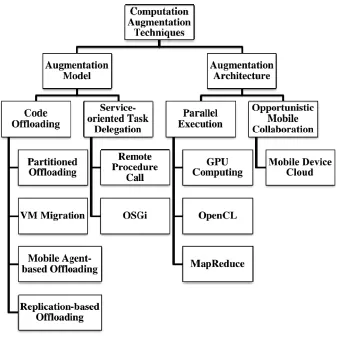
Another paper by Zhou et al. [15] provides a survey and future directions of the augmentation
techniques that can be used for Mobile Cloud Computing. Augmentation techniques are computing
models and solutions for outsourcing mobile device computing and storage to more strong
computing resources that can improve the computing capacity and energy efficiency of a mobile
device. Hence, these techniques are used to increase, enhance, and optimize the computing
capabilities of mobile devices. It offers an extensive taxonomy and survey of current mobile cloud
augmentation methods and frameworks for computing and storage. Taxonomy of computation
augmentation techniques is provided, as shown in Figure 2.3.
17
This taxonomy addressed the methods and approaches used in mobile cloud augmentation to
merge hybrid cloud resources into a shared mobile device resource pool that will provide reliable
and energy-efficient computing outsourcing through a mobile cloud-as-a-service.
Next is the taxonomy of storage augmentation, which is shown in Figure 2.4 in which data-oriented
architecture for storing data on clouds and the mobile device cloud is discussed. It also studies
various vital issues, like data protection and data interoperability.
Figure 2.4: Taxonomy of Mobile Storage Augmentation
The survey also analyzed different significant technical gaps for further study.
The paper by Boukerche et al. [14] focusses on Sustainable Offloading in Mobile Cloud
Computing. This survey provides a comparison of state-of-the-art works related to energy-aware
offloading in the scope of MCC based offloading. They have gathered the existing studies and
have classified those according to the perspective of the mobile device and the Cloud Performance.
These aspects are observed in terms of the energy-aware offloading processing and the trade-off
between energy reservation and execution efficiency. It includes information on algorithmic
design and the implementation of various techniques. Critical analysis of the offloading techniques
shows that the following three functionalities can be used for categorizing open issues:
18
Task Partitioning functionality is based on compatibility and usability. Since the hardware
of mobile device and cloud are different, it is difficult to process the mobile applications
on cloud. Additionally, as the performance of task offloading is not officially defined, it is
estimated by the developers, and the task partitioning is done by supportive Application
programming interfaces (APIs). For using the traditional applications to execute on Mobile
Cloud Computing flow, a remarkable amount of work is required.
2. Profiling
Profiling functionality gathers the profile information of the device like CPU Usage,
battery value, network information, etc. which keeps changing continuously. In most cases
the profile information is not accurate as the average of the specific interval is taken.
3. Decision Making
For any offloading system, decision making is the most critical and challenging part. The
operation of decision making is dependent on the profiling step mentioned earlier. For the
actual execution, the decision-making process uses the profiling information and provides
result based on that.
This paper then explains how these open issues are handled in various offloading techniques.
Following that is the comparison between Grid Computing and Cloud Computing. Additionally,
the network aspects are investigated, as it is an essential factor that affects the performance. Hence,
all this information is gathered, and various solutions from existing studies are provided in terms
of energy-aware offloading.
Parsa et al. [19] proposes an approach to wrap the existing programs into web service layers, such
that the component can be accessed through web services. In this approach, first, the code is
analyzed, and then it is wrapped into a web service. The analysis phase determines a way of using
the functions of the analyzed program into a web environment. It is done in four steps: Evaluation,
Conversion, Reengineering, and Web Service Generation. A new code is obtained after the
completion of these steps, which contains the valuable functions of the program. In the next step,
the important functions are wrapped into web services by using Service Bus Class. The Service
19
is to migrate obtained functions to the external environment. These two steps are performed to
create a tool which can be installed in a programming environment to wrap a program into service.
2.3Related works
The table below gives the information about the work done so far by researchers in the area closely
related to this research work; also, mentioned are year and contributions.
Research Paper Contributions Limitations
Framework for
context-aware
computation
offloading in
mobile cloud
computing by
Chen X., Chen S.,
Zeng X., Zheng
X., Zhang Y., and
Rong C. (2017).
- Proposes a design pattern for
Computational Offloading
- Presents estimation model to calculate
reduced execution time and network
delay then selects cloud resource for
offloading
- Implements a framework to support
the design pattern and estimation model
- The framework does not include
resource-intensive applications.
It only considers
computation-intensive applications.
- Only execution time and power
consumption are the considered
parameters. Monetary Cost,
Memory Consumption, and
Economic Cost are not
considered.
- Service-oriented Architecture is
not used in this approach; hence,
the benefits of SOA, as discussed
in Section 1.3.1, are not
applicable.
A survey of
adaptation
techniques in
computation
offloading by
- Adaptive algorithms used for
computation offloading are surveyed
- Parameters that influence the mobile
systems and offloading system are
identified
- This is a survey paper that just
provides the information about
different algorithms that are
already developed.
- It does not provide a new idea
20
Bhattacharya A.
and De P. (2017).
- Solutions are classified for adaptive
offloading based on the parameters that
the system can adapt to
Energy-efficient
service-oriented
architecture for
mobile cloud
handover by Hani
Q. B. and Dichter
J. P. (2017).
- Introduces a secure energy-efficient
and quality-of-service architecture
(EEQoSA) for the handover process in
the mobile cloud computing
environment
- It handles parameters like
energy-efficiency, security and QoS
- Security parameter is
considered in this paper,
however, the experiments are not
performed, so solutions for
possible malicious attacks are not
provided.
- Parameters like Memory and
Cost are not considered which
shows that resource limitations of
mobile devices are not taken into
account.
Augmentation
techniques for
mobile cloud
computing: A
taxonomy,
survey, and future
directions by
Zhou B., and
Buyya R. (2018).
- This paper studies the augmentation
techniques to increase, enhance, and
optimize computing capabilities of
mobile devices
- It aims at execution of
computation-intensive and resource-intensive
mobile applications
- It mainly provides a guide on what
available augmentation techniques can
be adopted in mobile cloud computing
systems
- It only gives the information on
existing taxonomies in the field
and augmentation techniques that
are already available for mobile
cloud computing systems.
- It does not provide any new
21 Computation
offloading for
service workflow
in mobile cloud
computing by
Deng S., Huang
L., Taheri J., and
Zomaya A. Y.
(2014).
- This paper proposes a mobility
enabled and fault-tolerance offloading
system for making computation
offloading strategies
- The proposed offloading algorithm is
based on genetic algorithm
- This paper is considered mainly due
to its fault-tolerance technique, in the
case of lost connectivity
- In this paper, user’s moving
path is presumed. But since there
are other possibilities, it will not
perform accurately in all
scenarios.
- The signal strength is also
assumed to be persistent in some
part of the path.
Enabling
vehicular
applications using
cloud services
through adaptive
computation
offloading by
Ashok A.,
Steenkiste P., and
Bai, F. (2015).
- This paper proposes a service-based
architecture and designs a framework
for computation offloading of vehicular
applications.
- It prototypes an end to end offloading
system which uses the proposed service
driven framework.
- Experiments are performed on real
world vehicular settings.
- In this paper, the modules to be
offloaded are statically marked
by the developer. Hence, the
offloading is not dependent upon
the context information.
Sustainable
Offloading in
Mobile Cloud
Computing:
Algorithmic
Design and
Implementation
by Boukerche A.,
Guan S., and
- In this survey, a comparison of
state-of-the-art works related to
energy-aware offloading in the scope of MCC
based offloading is provided
- The existing studies are gathered and
classified according to the perspective
of the mobile device and the Cloud
Performance aspects in terms of the
energy-aware offloading processing
and the tradeoff between energy
- This is a survey paper that just
provides the information about
existing energy-aware offloading
algorithms.
- It does not include other
important parameters like
computation power, memory and
22
Grande R. E. D.
(2019).
reservation, and execution efficiency is
observed.
23
CHAPTER 3
PROPOSED METHODOLOGY
This chapter firstly discusses about the general structure of an offloading system and further dives
into the detailed explanation of the structure used in our Computational Offloading System. The
General Structure of Offloading System consists of different modules like Client Proxy, Profiler
and Solver. These modules are responsible for executing the method on the server side.
Alternatively, our Computational Offloading System is based on Service-oriented Architecture,
hence the methods are converted into services and then the offloading is performed. Our
Offloading System consists of modules like Context Monitor, Decision Making Engine,
Communication Manager and Offloading Planner.
In the upcoming section, the structure of general offloading system is discussed followed by the
overall flowchart of the offloading system.
3.1 General System Structure
In this method, initially two requirements are taken into consideration:
1. The compiled code is on both, the mobile side and the server side
2. The client proxy, profiler and solver are installed on mobile and server side [22].
The profiler collects information about the network characteristics from the beginning and
monitors that information after that. Every time a method is called, the profiler measures its energy
saving potential and profiles the device and the network to get the status information. The solver
then works on the results provided by the profiler and determines where the method will be
24
Figure 3.1: General System Structure for Offloading
Figure 3.1 shows the general system structure for Offloading in which code migration is
performed.
3.2 Proposed Computational Offloading System
Since the proposed Computation Offloading System is based on Service-Oriented Architecture,
we will first discuss the working and importance of SOA.
3.2.1 Service-Oriented Architecture
In the proposed system, the components are converted to services and the interaction of services
is performed using Service-Oriented Architecture. SOA is a software design style in which
services are provided by application components to the other components via a network
communication protocol [23]. By using SOA, the components can be described more clearly,
which makes it possible to structure the services. Hence, in a system, some components are service
providers, who provides the required service, and some are the service consumers, who requests
and receives the service. SOA architecture has a middleware, which is the intermediator between
25
and the consumer. SOA is particularly useful in the proposed system because of its loosely coupled
nature i.e. the service interface is independent of the implementation. Different developers can
build different applications by creating one or more services without knowing underlying
implementations of the services. For example, a service can be implemented in python or .Net, and
the application consuming the service can be on a different platform or language. It also helps
systems to adapt while keeping service consumers separate from changes that occur while service
implementation [24]. Finally, by utilizing existing software infrastructure to build new services,
SOA provides better flexibility in building applications and processes in an agile manner.
3.2.2 Computational Offloading for Mobile Cloud Computing Architecture
Our proposed system includes the mobile device that consists of the applications and the cloud
server that provides the functionalities of the applications as services. The communication between
the service provider and service consumer is performed by the middleware. The middleware is the
main part of our Offloading System. Figure 3.2 shows the proposed Offloading System structure.
26
In this system, the middleware consists of four different modules:
1. Context Monitor
2. Decision Making Engine
3. Communication Manager
4. Offloading Planner
The next sections provide detailed information about the modules of the middleware for the
Offloading System:
1. Context Monitor
The context monitor is responsible for collecting the context information and providing these
values to the decision-making engine when service is executing. This context information includes:
a. The profile of mobile device: the computation power, the average CPU usage, the available
memory size;
b. Mobility model at runtime: location of the car;
c. Network Condition: the availability of cell network(4G,3G) and its signal strength, the
availability of Wireless network (WiFi) and signal strength
For any mobile device that the service is executing on, Context Monitor gathers this information
(mentioned above) and it also updates the information from time to time. This information is then
provided to the Decision Making Engine. In Figure 3.3, we have displayed the flowchart for the
27
Figure 3.3: Context Monitor
2. Decision Making Engine
The Decision Making Engine first analyzes the context information, like the available network
connections, computation power, the state of the vehicle, available memory size, upload speed and
download speed. It then leverages the result of analysis of the context information for
decision-making. For making the decision about the executing location of the service. Objective Function
is used. The Objective Function is defined as follows:
OF = P(s1,s2,…,sn)*WP + M(s1,s2,…,sn)*WM + E(s1,s2,…,sn)*WE,
where s represents the services, P represents Performance(computation), M represents Memory, E
represents Economic Cost, WP represents the weight value of Performance, WM represents the
28
The objective function is calculated as the weighted sum of Performance, Memory, and Economic
Cost. The weight values are set according to the context of the mobile device. For example, if the
device’s memory is less than the threshold value then we increase the weight value in the objective
function. So, the weight values are set according to the preference of any parameter at that time.
The weight values are adjusted in this way to handle different units of the parameters. The sum of
the weight values will always be 1.
So, for each service p.local and p.cloud is calculated, where p = p.local = W/C, where W is the
workload of the service and C is the CPU capacity,
p.cloud = TR +RT +TO,
where RT is the response time of a cloud service;
TR is the time of uploading input data = input data size /data transferring rate;
TO is the time of downloading output data = output data size /data transferring rate;
Following that, is the calculation if Memory and Economic Cost.
Economic Cost for a service si is defined as:
E(si) = E.Cloud(si) * IsOffloading,
where IsOffloading is value which either 0 or 1. 0 represents that si is executed by a local service
while 1 represents that it is executed by a cloud service.
E.Cloud(si) = DI + DO,
where DI is input data size of a service invocation;
DO is output data size of a service invocation.
Decision Making Engine then makes the decision of changing (if required) the weight values of
computation power, memory and monetary cost in Objective Function according to varying
context information. For example, if the memory on the local system is below the threshold point,
the weight value of memory (WM), which indicates the priority of that parameter, will be increased.
29
is better, the Decision Making Engine makes the decision that the service should run locally,
otherwise, it makes the decision to offload the service on the cloud. Hence, the decision is taken
based on the Objective Function value. Figure 3.4 shows the flowchart of Decision Making Engine.
Figure 3.4: Decision Making Engine
3. Communication Manager
Communication manager is responsible for transferring the information between local and cloud.
It encapsulates the tedious details of serializing data and deserializing data from one format to
another. It also synchronizes the offloading plan between the mobile device and cloud.
4. Offloading planner
Offloading planner is in charge of offloading the service to the cloud. Offloading planner also
30
noted that, as the decision of where the service runs is dependent on the context information at a
certain time, an offloading plan for a certain workflow model will also vary from time to time due
to the change of context information. So, the offloading planner executes the plan based on the
decision and the context information. Figure 3.5 displays the flow of Communication Manager
and Offloading Planner
Figure 3.5: Communication Manager and Offloading Planner
3.3 Overall Flowchart
Figure 3.5 shows the overall flowchart of our Offloading System. As shown in the figure, first, the
user’s data plan expiration is checked. If it is expired, then the user’s preference will be asked on
whether user wants to allow additional charges on their account or not. If the data plan is not
31
Figure 3.6: Overall Flowchart of the Offloading System
Then the Context Monitor collects all the required information like network connections,
32
speed, download speed, etc. From the Context Monitor, the information of whether the network
connection is available or not, is obtained. If it is not available, then the service will be executed
locally but if it is available then the information is passed to the Decision Making Engine. The
Decision Making Engine analyzes the information and obtains the values of different parameters
like performance, memory and economic cost, as discussed in the previous section. Then, in the
Objective Function, it adjusts the weight value of any parameter if required. Following that is the
calculation of the Objective Function. Based on the result of the Objective Function, the decision
of executing location (local or cloud) is obtained. If the decision is local, then the service is
executed locally otherwise the information is passed to Communication Manager and Offloading
Planner. Communication Manager synchronizes the offloading plan between the mobile device
and cloud. Offloading Planner manages the offload plan and executes the service on cloud. Then
the cost is calculated in case the data plan was expired and the user needs to be charged additionally
33
CHAPTER 4
IMPLEMENTATION AND EXPERIMENTS
The proposed approach is implemented on Windows OS using C# programming language and
.NET Framework. For the experiments, the approach is used on autonomous car modules. The list
of software and tools used is given in Table 4.1.
4.1 Software information
The implementation of proposed methodology was performed on Dell Laptop with Intel(R)
Wireless-AC 9560.
ITEM DETAILS
Operating System Windows
Languages C#
IDE Visual Studio 2017
Application Framework ASP.NET
Cloud Server Amazon Web Services
Table 4.1: List of tools used for implementation and experiments
4.2 Datasets used in the implementation
For different autonomous car modules, various datasets are used for experimentation. ShapeNet
dataset [25] is used, which is a repository with the keypoint information for the different rendered
views of 3D car models. DensePose [26] model which has its own manually collected ground truth
dataset called the COCO-DensePose dataset is adopted and integrated into our system for 3D pose
estimation of pedestrians on the road. For object verification and object elimination, the 3D virtual
world has been produced using OpenStreetMap data (VGI/crowdsourced) and the façade texture
34
environment comprises stationary (e.g. Buildings), and variable (e.g. Trees) objects. Figure 4.1
and 4.2 below displays an example of a constructed 3D virtual world.
Figure 4.1: Constructed 3D Virtual World
Figure 4.2: Constructed 3D Objects
4.3 A New System for Self-Driving Vehicles
As mentioned in the beginning of Chapter 4, experiments for our offloading system are performed
on autonomous car modules. There are basically six different modules for this system which are
interconnected with each other, as shown in Figure 4.3. Those six modules are:
1. Construction on virtual 3D environment
35
3. 3D feature and keypoint extraction
4. Removal of static and variable objects
5. Dynamic object recognition
6. Dynamic object detection
Figure 4.3: Overall system
Following is the description of the overall system in reference to Figure 4.3: the overall system
first deals with the construction of a virtual 3D environment with the use of OpenStreetMap data
(VGI/crowdsourced) and the façade texture from Google street view images. The virtual 3D city
model consists of static objects, such as buildings, and some of the variable objects, such as trees.
Apart from this, there is a separate repository which contains 3D models of dynamic objects, such
as cars. The module marked in the blue-colored box in Figure 4.3 shows the real-time video (image
36
features and 3D features are stored in a repository; this work is performed in the module colored
in pink. The module marked in yellow is the static and variable object elimination module. In this
module, the keypoint features of the input image (blue module) and keypoint features of the virtual
environment (pink module) are matched. Matching the keypoint features of the virtual
environment and real-time image confirms the location of the car in the real-world; this solves the
problem of geo-localization of the self-driving car. With the matching, location of the static objects
is also confirmed, and they are eliminated from the object identification process; which provides
more time for the identification and prediction of dynamic objects such as human beings or animals
on the road, as those are the ones which have impact on the navigation of the self-driving system.
The module marked in cyan deals with the object recognition and pose estimation of dynamic
objects present in the real-time input image, such as cars. Additionally, this module tracks the
recognized objects from multiple frames of the video and calculates the speed of the dynamic
object. The recognized object with the pose information along with the object speed and location
is used to update dynamic objects into the 3D virtual environment. The module marked in grey
color updates the dynamic objects’ information into the virtual environment.
4.3.1 Code Partitioning
Offloading is the process of transferring a computation or resource intensive tasks from a mobile
device to a remote server or cloud resources, as discussed earlier. As this approach uses a
Service-Oriented Architecture, the modules that are discussed in the previous section are wrapped as
services and those services are offloaded to the cloud. Before offloading a service, the process of
code partition is required on the modules. Firstly, the code is partitioned by simply marking some
parts of the code as non-offloadable. Those parts are the ones that interact with any input or output
device or it can be the part that implements application’s UI (user interface). Then, source code
analysis is performed for individual modules. During the source code analysis, if there are some
sub modules that are common among different modules, then those are identified, and only single
service is created for them. That service can then be shared between those modules. The final
offloading is done based on the Decision Making Engine, as discussed in Chapter 3.
4.3.2 Implementation of the SOA System
After performing initial code partitioning, the modules like 3D feature and keypoint extraction,
![Figure 1.2 Applications of Mobile Computing [49]](https://thumb-us.123doks.com/thumbv2/123dok_us/1499506.1183591/16.612.177.425.305.525/figure-applications-of-mobile-computing.webp)