Radio Frequency Identification (RFID
)
Shashikala S1, Shobha R2, Dr. K. S. Jagadeesh Gowda3, Rajesh V4
U.G Student, Department of Computer Science and Engineering, Sri Krishna Institute of Technology,
Bengaluru, India1.
U.G Student, Department of Computer Science and Engineering, Sri Krishna Institute of Technology,
Bengaluru, India2
Head of the Department, Department of Computer Engineering, Sri Krishna Institute of Technology, Bengaluru,
Karnataka, India3
Assistant Professor, Department of Computer Science and Engineering, Sri Krishna Institute of Technology,
Bengaluru, Karnataka, India4
ABSTRACT: Radio frequency identification (RFID) uses Radio Waves to track objects using tags attached to them.
The tags contain information about theobject they are tagged to which is revealed using an RFID reader. Active tags have a local power source (battery) and can operate over hundreds of meters from the RFID reader. Passive tags do not have a local power source, hence they are poweredusing radio waves from an RFID reader. Unlike a barcode, the tag could be out of the reader’s line of sight,hence it may be attached as well as embedded within the tracked object. RFID is one of Automatic Identification and Data Capture (AIDC) methods. RFID tags are used in numerous industries, for example, an automobile with an RIFD tag tagged to it can be tracked in real time throughout the assembly line; It can be used to track pharmaceuticals ina warehouse; and implanting RFID tags in livestock and pets assist in their tracking and classification.
KEYWORDS: RFID; RFID Tags; Security; Location and Tracking;
I. INTRODUCTION
II RELATEDWORK
RFID is a wireless communication technology. Radio waves are used by RFID to automatically identify, track, and authenticate items or people. It is not a new technology. It was first used in world warII to identify friendly aircrafts.[ 1] Radio frequency identification (international journal of computer trends and technology IJCTT 2016 by IJCTT journal). RFID is used to identify people, objects and for monitoring environmental parameters. This paper is about the working, architecture and real world application of RFID. The advantages are, reduced labour levels, enhanced visibility, and improved inventory management.
There are many types of tags and readers available in the market for different types of application which has been described in this Paper. [2] Radio Frequency Identification (RFID) Trends by ChristopyJechlitschek. This paper provides a survey on RFID. RFID tags were developed to replace barcodes in supply chains. Their advantage over barcodes is that it can be read wirelessly and need not be within the line of sight. This paper also presents current research that focusses on locating and tracking objects that move. The RFID tags are widespread and there is a large interest in lowering the costs for miniaturising them. [3] A Survey on RFID Tags by M Ayoub Khan, Manoj Sharma, may 2009. This paper is about a comprehensive survey of various RFID tag technologies and their classification. [4] RFID technology, its applications and classification of security/privacy attacks and solutions. This paper talks about different types of RFID attacks, their significant features, and feasible counter measures. This paper talks about the weakness of RFID communication so that its vulnerabilities can be better understood and appropriate counter measures could be developed to stop these attacks. [5] Transmission control scheme for fast RFID object identification by Floerkemeier, shows techniques to improve RFID reading performance by selection of Frame Sizes.[ 6] Anti-collision performance of Gen2 air protocol in ran- dom error communication link. In: SAINTW 2006 (2006) by Kawakita, Y., Mitsugi, J shows impact on reading performance from errors. [7] Analytic modelling methodology for analysis of energy consumption for ISO 18000-7 RFID networks. In: IJRFITA 2007 (2007) by Hawrylak, P.J., Cain, J.T., Mickle, M.H talks on power modelling for RFID systems[ 8] Study of UHF RFID signal propagation through complex media. In: IEEE Antennas and Propagation Society International Symposium (2005) by Fletcher, R., Marti, U., Redemske shows effects pf different materials on RFID performance. [9] Performance benchmarks for passive UHF RFID tags. In: MMB 2006 (2006) by Ramakrishnan, K., Deavours, D. is about performance benchmarks, speed and reliability experiments for static RFID tags. 10] An empirical study of UHF RFID performance. In: MobiCom 2008 (2008) by Buettner, M., Wetherallperformed deeper analysis by utilizing specialized equipment to obtain physical layer RFID metrics such as error rates 11] Assessing and optimizing the range of UHF RFID to enable real-world pervasive computing applications. In: LaMarca, A., Langheinrich, M., Truong, K.N. (eds.) Pervasive 2007. LNCS, vol. 4480, pp. 280–297. Springer, Heidelberg (2007) talks about Specific experimental studies on RFID and ubiquitous computing applications.
III. SYSTEMDESIGN
RFID Tags
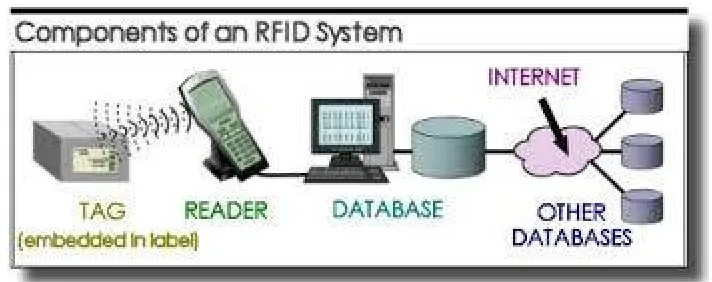
RFID Tags are the building block of RFID technology. Tag component emits radio signals and is a combination of microchip and antenna. Each RFID tag contains a unique identification number which is stored in the microchip of tag. This microchip is built with the integrated circuit, sensors, I/O ports and embedded logic on a silicon chip. Tags antenna is used to transmission of radio waves. Sometimes RFID tags is also known as transponder. RFID tags are available in different shapes and sizes according to the environment and application, they will be used in.
RFID Readers
RFID Readers act like the heart of the RFID technology. Reader is the main component that is responsible for operating and controlling the RFID system with a particular frequency. Reader consists of a decoder and a transceiver. The transceiver is used to receive and transmit radio signals, the decoder is used to decode received radio (analog) signals to digital form. The reader range depends upon what frequency is used, basically reader range is some inch to 200+ feet. After decoding the radio waves into bit stream, it gives the information to the host computer or a device controller.
Host controller
Host controller uses the information provided by the reader to asses or forward it for further processing depending on the type of application. Host, also called system software, are combination of four components, Edge interface: Establishing communication and data retrieval from reader is the responsibility of the Edge interface. Middleware: Filtering, counting of tags, control and manage the reader is the responsibility of the middleware. Enterprise back end interface: Enterprise back-end.
Working principle of RFID Technology
Radio waves are transmitted by RFID Tags, which is received by a reader and converted to meaningful data to identify or locate the tagged object within the working area of the entire system.
There are three types of tags,
1. Active tags 2. Passive tags 3. Semi-passive tags
Active tags have their own power supply to power on-board Integrated Circuit and to transmit data to the reader. They are more expensive compared to passive tags. Their working range is 10 to 100 meters.
Passive tags have no internal battery power. The microchip of passive tag will be in sleep mode, until the tag is in the reader range. Reader sends electromagnetic waves which is used by the tag to power the on-board Integrated Circuit and transmit data. Passive tags are less expensive compared to active tags. Their working range is just a meter.
Semi-passive tags lay between active and passive tags with respect to both price and capabilities. It is called both as semi-passive or semi-active tag. Semi-passive tags use a battery to power the signal, but only respond when they are in range of the reader. They provide an energy efficient RFID system as they don’t drain the on-board power supply, like the active tags do, but retain the advantage of its Working Range over Passive tags.
Some Terminology of RFID Technology
Different frequency ranges: RFID tags use different types of frequency bands according to the type of environment its working in and type of application using it. Because radio waves behave differently at different frequencies, it is imperative to choose the right frequency band for the specific application. Frequency is the measurement of radio waves. Basically, four types of frequency bands are used as below,
4. MF: Microwave Frequency.
Low Frequency band ranges between 125KHz - 134.2KHz. This frequency band is mainly used by Passive tags. The working range spans usually from minimum 10 cm to maximum 100 cm. The allowed field strength transmission power is 72dBμA/m. It is usually used in animal identification, food traceability, tree implants, item tracking applications. It also performs better in liquids and underwater applications, but requires long antennas and is expensive compared to High Frequency bands.
High Frequency band is 13.56MHz. Bath Passive and semi passive tags use this frequency band. The working range spans usually from minimum 10 cm to maximum 1.5 m. The allowed field strength transmission power is 60dBμA/m. It is used mainly in temperature measuring, animal identification and cold chain tracking applications. It uses shorter antennas compared to that of Low Frequency bands.
Ultra-High Frequency band ranges between 860MHz – 930MHz. This frequency band is mainly used by active tags. Its working range spans usually from minimum 3m to maximum 10m. The allowed field strength transmission is 10-100mW. It is usually used in farm machinery, intermodal transformation and crop monitoring. It has a greater range compared to LF and HF. It can work in environments consisting of metal and liquids, but has limited battery power.
Microwave Frequency band is 2.45GHz. Its working range spans from 10 meters to over 100 meters in distance. It can transfer data\up to 100 Kbits per second. It cannot penetrate water or metals. Application areas are in highway toll collection and in vehicle fleet identification.
IV. EXPERIMENTALRESULTS
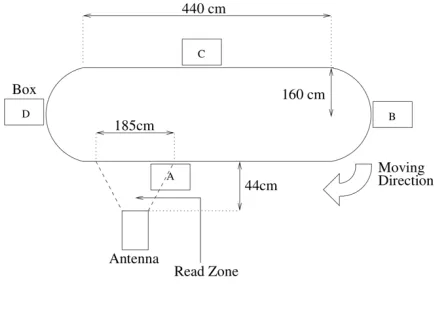
The experimental setup to gauge RFID performance is as shown below,
Fig 2 Experimental Setup
Fig 3 Results for 1 tag and 10 tags for 5 rounds
Fig 4 Detailed Results
The metric for RFID performance is the number of reads performed per second as shown below
Reads per second =
Total number of reads
Total reading time
V. CONCLUSION
REFERENCES
[1] NamaboodiriV,DeSilva M, Deegala K, Ramamoorthy S, “An Extensive study Alloha-Based RFID anti-collision protocols”, Computer Communications 35(2012), Page(s):1955-1966.
[2] Ahuja S, PottiP , “An introducation to RFID Technology” communication and networks, 2010,2, Page(s): 183-186. [3] Roberts C.M, “Radio Frequency Identification”, Computer & Security 25, 2006, Page(s): 18-26.
[4] Gladysz B, “Typology of RFID System” Page(s): 948-957. [5] Landt J, “The History of RFID” IEEE 2005, Page(s):11. [5] Floerkemeier, C.: Transmission control scheme for fast RFID object identification. In: PercomW 2006 (2006)
[6] Kawakita, Y., Mitsugi, J.: Anti-collision performance of Gen2 air protocol in ran- dom error communication link. In: SAINTW 2006 (2006) [7] Hawrylak, P.J., Cain, J.T., Mickle, M.H.: Analytic modelling methodology for analysis of energy consumption for ISO 18000-7 RFID
networks. In: IJRFITA 2007 (2007)
[8] Fletcher, R., Marti, U., Redemske, R.: Study of UHF RFID signal propagation through complex media. In: IEEE Antennas and Propagation Society International Symposium (2005)
[9] Ramakrishnan, K., Deavours, D.: Performance benchmarks for passive UHF RFID tags. In: MMB 2006 (2006) [10] Buettner, M., Wetherall, D.: An empirical study of UHF RFID performance. In: MobiCom 2008 (2008)
[11] Hodges, S., Thorne, A., Mallinson, H., Floerkemeier, C.: Assessing and optimizing the range of UHF RFID to enable real-world pervasive computing applications. In: LaMarca, A., Langheinrich, M., Truong, K.N. (eds.) Pervasive 2007. LNCS, vol. 4480, pp. 280–297. Springer, Heidelberg (2007)
[12] Campos L.B, Cugnasca C.E, “Applications Of RFID and WSN Technologies to Internet of Things”.
[13] Puiz-Garica L, Lunadei L, “The Role of RFID in Agriculture: Applications, Limitations and Challenges” Computers and Electronics in Agriculture, 2011, Page(s):42- 50.
[14] L. Ruiz-Garcia and L. Lunadei, "The role of RFID in agriculture: Applications, limitations and challenges," Computers and Electronics in Agriculture, vol. 79,p p. 42- 50,1 01/2011.
[15] A. Z. Abbasi, N. Islam, and Z. A. Shaikh, "A review of wireless sensors and networks' applications in agriculture," Computer Standards & Interfaces, vol. 36,p p. 263-270,2 014.
[16] A. Srinivasan, Handbook of precision agriculture: principles and applications: Food Products Press BinghamtonAeNY NY,2 006.
[17] D. Yan-e, "Design of Intelligent Agriculture Management information system based on loT," in Intelligent Computation Technology and Automation (lCICTA), 2011 International Conference on, 2011, pp. 1045-1049.
[18] WambaS.F,AnandA,Carter L, “A Literate review of RFID enabled Healthcare Applications And Issues”, International Journal of Information management, 2013, Page(s):875-891.
[19] kony M, Walter M, SchlebuschT,Leonhardt S, “An RFID Communication System For Medical Applications” International conference on Body Sensor Network 2010.
[20] Weinstein R, “RFID: A technical Overview & Its Application To The Enterprise” IEEE May/June 2005, Page(s):27-33. [21] Abdelhalim E.A, El-Khayat G.A, “ A Survey on Analytical Approches used in RFID Based Applications”, IEEE 2013.
[22] Mudigonda M, Ramani A, Subramanian V, “Applications of RFID in Public transport System to Aid the Visually Challenged” IEEE Indicon 2005 Conference.11-13 dec 2005, Page(s): 543-544.
[23] Cheng X, Lu J, Cheng W, “A Survey on RFID Applications in Vehicle Networks” International Conference On Identification, Infromation and Knowledge in the Internet of Things, IEEE 2015, Page(s): 146-151.
[24] Malakar B, Roy B.K, “Survey of RFID Applications in Railway Industry”.