ABSTRACT
HUGHES, ANDREW JOHN. Impact of Online Self-regulated Professional Development on Technology and Engineering Educators Metacognitive Awareness. (Under the direction of Dr. Cameron Denson and Dr. Aaron Clark).
The study was designed to investigate the impact of professional development on
technology and engineering teacher’s metacognitive awareness. The study pursued answers
to one primary and three secondary research questions involving three groups of technology
and engineering teacher’s metacognitive awareness based on their participation in
professional development. The study had a sample size of 18 (N = 18). There were six
participants in three groups. Group one consisted of teachers that actively participated in
Transforming Teaching through Implementing Inquiry (T2I2) professional development
system. Group two consisted of teachers that did not actively participate in T2I2 professional
development system. Group three consisted of teachers that completed National Board for
Professional Teaching Standards professional development.
To measure the metacognitive awareness of each group a mixed method design was
implemented. The quantitative measure used in this study was Schraw and Dennison’s
(1994) metacognitive awareness inventory. The Kruskal-Wallis one way analysis of variance
by ranks was used analyze the quantitative data. The qualitative measure used was a
metacognitive awareness semi-structured open-ended interview. The interviews were
analyzed by two coders using a coding rubric. The results and complementarity of both
measures were used to identify each group’s metacognitive awareness. A comparative
analysis was used to describe the essence of each group’s metacognitive awareness during
© Copyright 2015 by Andrew John Hughes
Impact of Online Self-regulated Professional Development on Technology and Engineering Educators Metacognitive Awareness
by
Andrew John Hughes
A dissertation submitted to the Graduate Faculty of North Carolina State University
in partial fulfillment of the requirements for the degree of
Doctor of Education
Technology Education
Raleigh, North Carolina
2015
APPROVED BY:
_______________________________ _______________________________
Dr. Cameron Denson Dr. Aaron Clark
Committee Chair Committee Vice Chair
_______________________________ _______________________________
DEDICATION
This dissertation is dedicated to Brett Leon Davis. Brett taught me many things;
kindness, compassion, and the continuous formulation of goals in the face of adversity. I
joked about completing my doctorate at 18 years old. When Brett was unable to complete his
goals due to a diagnosis of cancer, he continued to remain positive, formulate, and work
towards goals. As I am able minded and bodied, to joke about a goal without the intention to
complete it would be dishonorable to Brett’s life. Brett, you are my inspiration to be a better
BIOGRAPHY
Andrew John Hughes was born in DuBois, Pennsylvania on April 25, 1984 and raised
in Punxsutawney, Pennsylvania. He is one of two children of Owen Keith and Jean Hughes.
O. Keith taught technology and engineering education for 35 years before retiring and Jean
taught special education for 33 years before retiring. Andrew received an Associate of
Engineering Technology degree in Mechanical Engineering from Pennsylvania State
University, Bachelor of Science degree in Technology Education from California University
of Pennsylvania, Master of Science in Technology from Illinois State University, and Doctor
of Education degree in Technology Education with a minor concentration in Adult and
Higher Education from North Carolina State University. After completing his master’s
program Andrew taught technology and engineering education for three and half years in
Pennsylvania. During Andrew’s time at North Carolina State University, he served as a
research assistant for the Transforming Teaching through Implementing Inquiry grant and
teaching assistant for an engineering graphics course within the technology education
department. Outside of Andrew’s academic activities he is an avid motorcyclist and weight
lifter. Andrew is married to his loving, caring, and intelligent wife Leslie A. Hughes. Leslie
ACKNOWLEDGEMENTS
I would like to thank all of my committee members for their contributions towards
my dissertation. Dr. Cameron Denson, my chair, for all of his guidance and stress diffusion
through the entire dissertation process. Dr. Aaron Clark, my vice-chair, for providing timely
assistance on numerous occasions through the doctoral program. Thank you to Dr. Matthew
Lammi for pushing me to achieve more. Thank you to Dr. James Bartlett for having genuine
concern for me during minor course selection, for being flexible, and for facilitating
completion of my minor in Adult and Higher Education. I would also like to thank Dr. Chris
Merrill of Illinois State University for providing the best advice for someone pursuing a
doctoral degree, a strong support system.
I would like to thank my support system; one pack, one goal. First, I would like to
express my appreciation for my wife, recognizing the sacrifices she made as well as the
mental and moral support she provided enabling me to accomplish my goals. Leslie is the
reason I was successful and I am blessed to call her my partner. Next, I am grateful for my
grandfather, John H. Hughes for providing me opportunities to learn lifelong relevant skills;
how to use my mind and hands to accomplish anything. I am deeply appreciative of my
parents, Keith and Jean Hughes, who tirelessly supported and encouraged every aspect of my
education and dissertation. They have supported me through life, instilling the values and
beliefs that kept me positive, especially during this pursuit. Finally, I am grateful for my
sister Marcella and the rest of my family and friends, who offered opportunities for laughter,
serious discussion, and the confidence that my goal was accomplishable; they helped me
TABLE OF CONTENTS
LIST OF TABLES ... ix
CHAPTER ONE: INTRODUCTION ...1
Significance of the Study ...5
Background and Content ...7
National Boards for Professional Teaching Standards (NBPTS) ...7
Alignment of T2I2 with National Board Certification ...9
T2I2, NBPTS, and Metacognition ...12
Purpose of the Study ...13
Problem Statement ...14
Research Questions ...14
Methodology ...15
Data Analysis ...17
Limitations ...18
Definitions ...19
Chapter Summary ...21
CHAPTER TWO: LITERATURE REVIEW ...23
Metacognitive Awareness and Metacognition ...24
Definitions of Metacognition ...24
Metacognitive Awareness ...28
Knowledge of Cognition ...28
Regulation of Cognition ...29
Importance of Metacognitive Awareness ...32
Metacognitive Measurement ...35
Mixed Methods ...41
Technology and Engineering Professional Development ...45
Online Professional Development ...46
Effective Professional Development ...48
Macro-level ...49
Micro-level Content ...51
Higher-order Thinking ...51
Pedagogical Content Knowledge ...52
Content Knowledge ...53
Self-regulation and Reflection ...53
Metacognition ...55
Evaluation of Professional Development ...56
Difficulties and Limitations of Effective Professional Development ...57
Chapter Summary ...60
CHAPTER THREE: METHODOLOGY ...62
Research Questions ...63
Study Design and Rational ...64
Quantitative Rational ...67
Qualitative Rational ...69
Domain and Participants ...71
Data Collection Procedures ...74
Informed Consent ...75
Overview of Data Collection Process ...76
Metacognitive Awareness Inventory ...77
Metacognitive Awareness Interview ...79
Data Analysis Procedures ...81
Qualitative Analysis ...83
Chapter Summary ...88
CHAPTER FOUR: FINDINGS ...89
Demographic Data ...89
Control Variables ...92
T2I2 Amount Completed ...93
Data Analysis ...95
Quantitative Analysis ...95
Qualitative Analysis ...104
Chapter Summary ...113
CHAPTER FIVE: CONCLUSIONS AND IMPLICATIONS ...115
Analysis of Research Questions ...116
Research Question One ...116
Secondary Research Question One ...118
Secondary Research Question Two ...119
Secondary Research Question Three ...121
Group One ...122
Group Two ...124
Group Three ...127
Implications ...130
Future Research ...136
Conclusions ...140
REFERENCES ...143
APPENDICES ...163
Appendix A ...164
Metacognitive Awareness Components and Subcomponents ...168
Questions by Subcomponents ...169
Copyright Permission ...170
Appendix B ...171
Metacognitive Awareness Interview ...172
Metacognitive Awareness Interview Coding Rubric ...174
Appendix C ...177
Institutional Review Board Request for Exemption ...178
Appendix D ...180
Informed Consent ...181
Appendix E ...182
LIST OF TABLES
Table 1 T2I2 alignment with NBPTS ...10
Table 2 Components and Subcomponents of Metacognitive Awareness ...27
Table 3 Description of Metacognitive Awareness Subcomponents ...31
Table 4 Components of Effective Professional Development ...44
Table 5 Research Timeline ...74
Table 6 Demographics ...91
Table 7 Kruskal-Wallis Test for Control Variables ...94
Table 8 Kruskal-Wallis test for Metacognitive Awareness all Three Groups ...97
Table 9 Kruskal-Wallis test for Metacognitive Awareness Groups One and Two ...99
Table 10 Kruskal-Wallis test for Metacognitive Awareness Groups Two and Three ...101
CHAPTER ONE: INTRODUCTION
Cognition, the ability to process knowledge and understand through thought, has been
a focus of educational research over the past several decades (Anderson, 1995; Piaget, 1971
& 1973; and Vygotski, 1962 & 1978). Metacognition, the capacity to recognize and regulate
one’s own thinking in real time, was identified by the National Research Council as one of
three components fundamental to the teaching and learning process (Bransford, Brown, &
Cocking, 1999 as cited by Young, 2010). Examples of metacognitive functions include
declarative, procedural, and conditional knowledge as well as planning, monitoring,
organizing, debugging and evaluation (Brown, 1978 & 1987; Flavell, 1976 & 1979; Jacobs &
Paris, 1987; and Schraw & Dennison, 1994). These metacognitive functions are
subcomponents of metacognitive awareness (Schraw & Dennison, 1994).
Ample research has shown that metacognitive awareness is crucial to student learning
(Artzt & Armour-Thomas, 1992; Garner & Alexander, 1989; Perfect & Schwartz, 2002;
Pressley & Ghatala, 1990; Robson, 2006; and Swanson, 1990). Literature also suggests that
teachers play an important role in helping students develop metacognitive awareness by
promoting self-regulated learning, engaging students in complex problem solving, and
modeling metacognitive behaviors (Baker & Brown, 1980; Paris & Winograd, 1990; Pucheu,
2008; and Schraw, 1998). Thus, there is an emerging focus on teacher’s development of
metacognition (Prytula, 2012 and Pucheu, 2008). Literature indicates that learning how to
learn and regulating learning are imperative for success in the technological age (Davis,
varying complexity of education entails teachers having the ability to adapt, monitor, and
regulate their cognition; also known as self-regulation (Pintrich, 2004; Pucheu, 2008; and
Zimmerman, 2002). Self-regulation, a person’s regulation of their cognition, has been
determined as an important aspect in developing metacognitive awareness (Pintrich, 2004;
Pucheu, 2008; Young, 2010; and Zimmerman, 2002).
Implementation of self-regulated learning strategies are often identified as important
for teachers and students (Kramarski & Michalsky, 2009; Pintrich, 2004; Pucheu, 2008; and
Zimmerman, 2002). “The ability to self-regulate learning is essential for teachers’
professional growth during their entire career as well as for their ability to promote these
processes among students” (Kramarski & Michalsky, 2009, p. 161). Self-regulation is
important for a teacher’s ability to plan, monitor, reflect, react, and adapt in the constantly
evolving educational environment (Bransford et al., 1999; Corno, 1987; Pintrich, 2004; and
Zimmerman, 2002).Furthermore, research has shown that there is a direct link between
teacher’s metacognitive awareness and the effectiveness of their planning, managing,
monitoring, and adjusting (Corno, 1987; Palincsar & Brown, 1984; Paris & Winogard, 1990;
Pucheu, 2008; and Swanson, 1990). Teachers with higher levels of metacognitive awareness
will have improved learning capability and more effective teacher practices (Ertmer &
Newby, 1996; Palinscar & Brown, 1984; Pressley & Ghatala, 1990; Prytula, 2012; Pucheu,
2008; and Swanson, 1990). The literature suggests that when teachers are metacognitively
aware, they are able to transfer awareness to their students (Bransford et al., 1999;
Darling-Hammond, 1999; and Pucheu, 2008).
students develop their metacognitive awareness, has recently prompted interest in
professional development focused on metacognitive awareness (Prytula, 2012 and Pucheu,
2008). Literature implies that some professional development programs unintentionally
promote metacognitive awareness in teachers (Ernst, Clark, DeLuca, & Bottomley, 2013;
Guskey, 2003; Smylie, Allensworth, Greenberg, Harris, & Luppescu, 2001; Wenglinsky,
2002; WestEd, 2000). Literature further indicates that teacher professional development
aimed at improving metacognitive awareness would positively impact teachers’ and students’
higher-order thinking, problem-solving, assessment, regulated learning, and
self-awareness (Corno, 1987; Guskey, 2003; Leinhardt, 1990; Mundry, 2007; Palincsar, 1986;
Paris & Winograd, 1990; Prytula, 2012; Pucheu, 2008; and Wenglinsky, 2000). For teachers
currently in the classroom, professional development is often one of the only choices offered
for promoting growth in pedagogical practices. Literature has implied that the professional
development of teachers will lead to higher student achievement (Bransford et al., 1999;
Darling-Hammond, 1999; Guskey, 2003; Pucheu, 2008; and Wenglinsky, 2002). The focus
on the development of metacognitively aware teachers has prompted research in the area
(Lin, Schwartz, & Hatano, 2005; Prytula, 2012; Pucheu, 2008; Topcu & Ubuz, 2008; and
Wilson & Bai, 2010). The research relates to the evaluation of teachers metacognitive
awareness and the impact on implementing successful learning strategies (Lin et al., 2005;
Pucheu, 2008; and Wilson & Bai, 2010). Research also investigates the impact of
professional development programs on teacher’s metacognitive awareness (Prytula, 2012 and
Topcu & Ubuz, 2008).
effectiveness, schools often use nonspecific, poorly planned, short term, and single day
professional development workshops that lack any form of support with implementation
(Guskey, 2003; Murphy, 2000; NCES, 2001; Paez, 2003; and Sykes, 1999). These short-term
professional development workshops offered by schools almost never have a strategic plan,
long-term focus, connection with teacher learning, and especially lack focus on
metacognition (Boyle, Lamprianou, & Boyle, 2004; Desimone, Porter, Garet, Yoon, &
Birman, 2002; Guskey & Yoon, 2009; Pucheu, 2008; and Smylie et al., 2001). Furthermore,
schools are often unable to provide effective forms of professional development, “not
because they do not want to, but because they do not know how…” (NCTAF, 1996, p. 5). As
a result schools usually offer a one-time professional development session that does not
provide an adequate learning opportunity for teachers (Murphy, 2000 and Paez, 2003).
Compounding the problem of professional development lacking a focus on
metacognitive awareness is the literature indicating that lower levels of metacognitive
awareness is the reason teachers are unable to implement classroom practices expressed
during professional development programs (Bransford et al., 1999; Graber, 1998; and
Palincsar & Brown, 1984). Teacher’s ability to transfer learning may be addressed by
designing professional development with a focus on self-regulation and metacognitive
awareness (Bransford et al., 1999; Guskey, 2003; Loucks-Horsley, Hewson, Love, & Stiles,
1998; Mundry, 2007; Pucheu, 2008; Wenglinsky, 2000 & 2002). Many schools do not offer
professional development specifically focused on improving metacognitive awareness
(Guskey, 2003; NCTAF, 1996; and Pucheu, 2008). Furthermore, many schools do not offer
literature (Guskey, 2003; NCTAF, 1996; and Pucheu, 2008).
In order for professional development to instill change in teachers, the professional
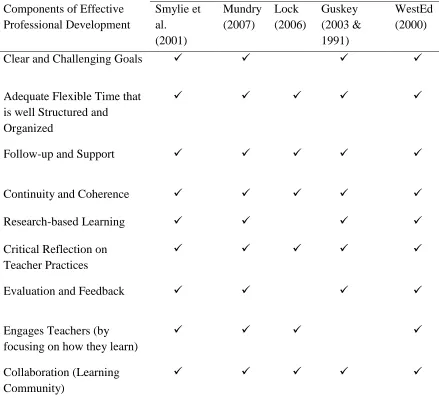
development should have clear and challenging goals, adequate; flexible; structured time,
follow-up, support, continuity, critical self-reflection, evaluation, feedback, collaboration,
and a long-term goal of improved student achievement (Guskey, 1991 & 2003; Lock, 2006;
Mundry, 2007; Smylie et al., 2001; and WestEd, 2000). Effective professional development
programs require the teacher to understand students’ learning needs (Guskey, 2003 and
Sykes, 1999). To ensure effective professional development, numerous characteristics must
be considered in addition to metacognitive awareness (Bybee & Loucks-Horsley, 2000;
Desimone et al., 2002; Guskey, 1991 & 2003; Learning First Alliance, 2000; Mundry, 2007;
Prytula, 2012; Pucheu, 2008; Smylie et al., 2001; Wenglinsky, 2000; WestEd, 2000; and
Zohar, 1999). Designers of professional development should consider the macro- and micro-
level design characteristics without forgetting the primary goal of teacher professional
development. The primary goal of professional development is to improve student
achievement by improving teacher practice (Guskey, 2003 and Sykes, 1999). If the need is for
students to develop metacognitive abilities, teachers will be expected to teach and model
these metacognitive abilities (Pucheu, 2008; Schraw, 2000). This implies that professional
development for teachers will need to focus on teacher’s metacognitive awareness.
Significance of the Study
Ensuring that educators receive effective professional development is essential to
improving the practice of teaching and ultimately student learning. Effective teaching and
Palincsar & Brown, 1984; Paris & Winograd, 1990; and Pucheu, 2008). In addition to the
need for more research focused on teachers’ metacognitive awareness and professional
development that emphasizes metacognitive awareness, there is a need to better understand
how and why teachers develop metacognitive awareness (Prytula, 2012). If improving
students’ metacognitive awareness continues to be an important part of educational reform,
then teacher professional development that focuses on metacognitive awareness will be an
important emphasis in education (Bransford et al. 1999). Furthermore, as information
concerning teacher metacognitive awareness continues to develop, gaps in the existing
literature may become more apparent. This study could provide additional and useful
information on improving professional development and could help guide teachers’
development of metacognitive awareness.
The practical significance of this study is that it will contribute to both teacher and
student development of metacognition (Darling-Hammond, 1999; Pucheu, 2008; and Schraw,
2000). In particular, it will help to identify the role of professional development in teachers’
development of metacognitive awareness and thus will guide the design and implementation
of future professional development programs for teachers. The theoretical significance of this
study is that the results contribute to the literature on the connection between professional
development and teachers’ metacognitive awareness. The results of this study could
contribute to the literature concerned with professional development and teachers’
metacognitive awareness. This study could also contribute to the literature concerned with
the role professional development plays in promoting teachers’ and ultimately students’
Background and Context
This study was conducted in the context of a program called Transforming Teaching
through Implementing Inquiry (T2I2), a research and development project funded for four
years by the National Science Foundation (NSF) (Award #1156629) (Ernst et al., 2013). The
project started in the fall 2011 with the development of a highly interactive
cyberinfrastructure system for delivering research-based professional development. The
professional development was designed for secondary technology and engineering teachers
in grades sixth through twelfth (Ernst et al., 2013). There are several goals that the designers
of T2I2 attempted to accomplish.
The primary goal for the T2I2 professional development was to increase the
participating teachers’ ability to manage, monitor, adjust, and contribute in the learning
environment (Ernst et al., 2013). Another goal was to increase teachers’ understanding of
engineering design concepts and the ability to effectively teach these concepts (Ernst et al.,
2013). The next goal was to increase the teachers understanding of and ability to address
student learning needs (Ernst et al., 2013). The final goal was to increase the teachers’
instructional abilities with use of self-assessment (Ernst et al., 2013). All of the goals of T2I2
professional development system had an unintentional direct alignment with teachers’
metacognitive abilities. T2I2 also had an alignment with the National Boards for Professional
Teaching Standards (NBPTS) professional development.
National Board for Professional Teaching Standards (NBPST)
In 1987, the NBPST was started with a focus on teacher quality
recommendations presented by A Nation Prepared: Teachers for the 21st Century report. The
report suggested the use of standards to determine the quality of teachers and their
instruction. In 1989, “What Teachers Should Know and Be Able to Do” was published by the
NBPTS. In the document, the NBPTS identified their Five Core Propositions for Teaching.
The five core propositions signified the knowledge, skills, dispositions and beliefs that
characterized an exemplary teacher.
The Five Core Propositions for Teaching are: (1) Teachers are committed to students
and their learning; (2) Teachers know the subjects they teach and how to teach those subjects
to students; (3) Teachers are responsible for managing and monitoring student learning; (4)
Teachers think systematically about their practice and learn from experience, and (5)
Teachers are members of learning communities. After developing the propositions and the
standards for the various teaching certification areas, the NBPTS worked on developing a
process that would allow all teachers to be fairly and reliably evaluated
(http://www.nbpts.org/).
The certification process that NBPTS developed is considered the most rigorous and
coveted process in education (http://www.nbpts.org/). The certification process incorporates
performance-based tasks and assessments using multiple-measures. Additionally, the
teachers’ submitted documentation is peer-reviewed by individuals in the profession. In
1993, the NBPTS started accepting teacher applicants from teachers who were interested in
pursuing the certification (Lustick & Sykes, 2006). The unique National Board Certification
(NBC) process is considered the benchmark for measuring teachers. The NBC process is still
The NBPTS requires participants to have a bachelor’s degree, completed three years
of teaching, and a valid state teaching license. NBPTS certification process entails a teacher
developing a portfolio demonstrating their teacher practices and completing six 30 minute
content knowledge assessments. The submitted teacher portfolio is assessed by national
board evaluators. The portfolio includes two 20 minute videos of the teacher’s practice,
samples of student work, six 11 page written teacher commentaries, and other artifacts
deemed significant by the teacher. The portfolio enables the teacher to document
accomplishment that contributed to the learning environment. Written commentaries
provides evaluators with a detailed analysis of goals, the purpose of instruction, the teacher’s
effectiveness, teacher reflections, and rationales of professional judgments.
Alignment of T2I2 with National Board Certification
The T2I2 project sought to promote technology and engineering teachers’ attainment
of NBC by aligning with NBPTS in three key ways. First, T2I2 aligns with NBPTS in the
overall goals. The goals for T2I2 are grounded in the mission and vision of NBPTS.
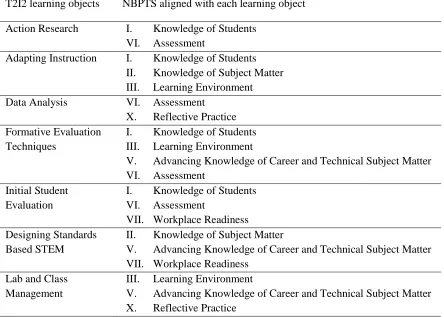
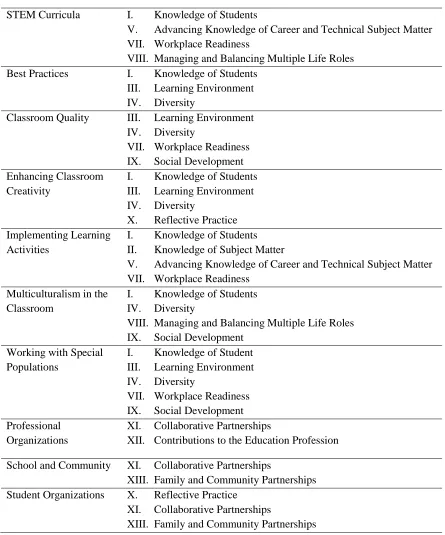
Secondly, the 17 learning objects of T2I2 were aligned with the thirteen Career and
Technical Education (CTE) standards within NBPTS (Ernst et al., 2013). Table 1 illustrates
the alignment between T2I2’s 17 learning objects and the 13 CTE standards. Lastly, T2I2
aligns with NBPTS in the use of teacher artifacts. In order to become NBC, teachers must
submit two videos commentaries, samples of student work, six written teacher commentaries
as well as other teacher artifacts. In order to complete the T2I2 professional development
teachers were asked submit shorter versions of six NBPTS teacher artifacts (T2I2: 2 page
commentaries and 20 minute video commentaries). The six T2I2 teacher artifacts are titled
(1) assessment of student learning, (2) demonstration lesson: video capture, (3)
demonstration lesson: written commentary, (4) documented accomplishments, (5) fostering
teamwork: written commentary, and (6) fostering teamwork: video capture. Furthermore,
feedback on the six artifacts is provided to the T2I2 teachers by a national board evaluator
using the same artifact rubrics as the NBPTS.
Table 1
T2I2 alignment with NBPTS
T2I2 learning objects NBPTS aligned with each learning object Action Research I. Knowledge of Students
VI. Assessment
Adapting Instruction I. Knowledge of Students II. Knowledge of Subject Matter III. Learning Environment Data Analysis VI. Assessment
X. Reflective Practice Formative Evaluation
Techniques
I. Knowledge of Students III. Learning Environment
V. Advancing Knowledge of Career and Technical Subject Matter VI. Assessment
Initial Student Evaluation
I. Knowledge of Students VI. Assessment
VII. Workplace Readiness Designing Standards
Based STEM
II. Knowledge of Subject Matter
V. Advancing Knowledge of Career and Technical Subject Matter VII. Workplace Readiness
Lab and Class Management
III. Learning Environment
Table 1 Continued
STEM Curricula I. Knowledge of Students
V. Advancing Knowledge of Career and Technical Subject Matter VII. Workplace Readiness
VIII. Managing and Balancing Multiple Life Roles Best Practices I. Knowledge of Students
III. Learning Environment IV. Diversity
Classroom Quality III. Learning Environment IV. Diversity
VII. Workplace Readiness IX. Social Development Enhancing Classroom
Creativity
I. Knowledge of Students III. Learning Environment IV. Diversity
X. Reflective Practice Implementing Learning
Activities
I. Knowledge of Students II. Knowledge of Subject Matter
V. Advancing Knowledge of Career and Technical Subject Matter VII. Workplace Readiness
Multiculturalism in the Classroom
I. Knowledge of Students IV. Diversity
VIII. Managing and Balancing Multiple Life Roles IX. Social Development
Working with Special Populations
I. Knowledge of Student III. Learning Environment IV. Diversity
VII. Workplace Readiness IX. Social Development Professional
Organizations
XI. Collaborative Partnerships
XII. Contributions to the Education Profession School and Community XI. Collaborative Partnerships
XIII. Family and Community Partnerships Student Organizations X. Reflective Practice
XI. Collaborative Partnerships
T2I2, NBPTS, and Metacognition
The T2I2 professional development system was designed using many of the
suggested characteristic for effective professional development from the literature including:
challenging goals, flexible time, continuity, coherence, critical reflection, teacher evaluation,
teacher feedback, enhancing teacher content and pedagogical knowledge, and direct focus on
student improvement (Ernst et al., 2013; Guskey, 1991 & 2003; Mundry, 2007; Smylie et al.,
2001 and WestEd, 2000). Even though T2I2 professional development was designed with a
consideration of many effective characteristics from the literature, a connection to
metacognition was not an explicit consideration. Although, due to T2I2’s connection with the
NBPTS and its use of certain effectiveness characteristics, the T2I2 professional
development had a notable connection to metacognitive practices. The teachers that actively
participated in the T2I2 professional development system were having metacognitive
experiences (Flavell, 1979). This study investigated if these unintentional metacognitive
experiences were enough to promote the development of metacognitive awareness. This
study aimed to explore the level and essence of teacher’s metacognitive awareness based on
their participation in either T2I2 or NBPTS professional development.
T2I2 professional development’s alignment with the NBPTS, as indicated by the use
of shorter teacher artifacts, the same artifact rubrics, and NBPTS evaluator as well as the 17
learning objects and 13 CTE standards (see Table 1). T2I2 participants are asked to submit
four 2 page written commentaries, two 5 minute video commentaries, and complete 5
question quizzes at the end of each of the 17 learning objects. T2I2 and NBPTS use the same
metacognitive awareness subcomponents (see Appendix E). Metacognitive awareness is also
part of the T2I2 professional development through the self-regulated learning, critical
reflection on practice, and inclusion of the requirement for the teachers to generate shorter
versions of six NBPTS teacher artifacts (CREDE, 2002 and Ernst et al., 2013).
Purpose of the Study
The purpose of this study was to explore technology and engineering teachers’ level
of metacognitive awareness at the time of the study, according to their participation in one of
two professional development programs, T2I2 and NBPTS. As a convergent
complementarity mixed-methods study, the research design had quantitative, qualitative, and
convergent components to understand the complex phenomenon of metacognitive awareness
(Creswell, 2007 & 2014 and Creswell & Plano, 2007). In the quantitative component,
participants’ self-reported their level on Schraw and Dennison’s (1994) metacognitive
awareness inventory (MAI) (see Appendix A). The completed MAIs were collected and
analyzed in order to measure participants’ current levels of metacognitive awareness. The
data was used to compare groups of participants on their metacognitive awareness.
Additionally, the groups were compared based on the two components and eight
subcomponents of metacognitive awareness (Schraw and Dennison, 1994). In the qualitative
component, the researcher conducted semi-structured open-ended interviews to investigate
the phenomenon of participant’s metacognition (see Appendix B). The convergence and
divergence of the quantitative and qualitative findings were synthesized in order to increase
the understanding of the participant’s level of metacognitive awareness as well as provide a
teacher practices.
Problem Statement
Teachers need metacognitive awareness (metacognition), a skill that is central to
teaching and learning, in order to teach this skill to students and foster student learning
(Kramarski & Michalsky, 2009; Pucheu, 2008; Schraw, 1998; and Young, 2010). Yet teacher
professional development (opportunities to learn skills that will improve their teaching
practice) is often unsuccessful at fostering effective teacher practices due to teachers’ lack of
metacognitive awareness (Bransford et al., 1999; Pucheu, 2008; and Schraw, 1998).
Professional development without a focus on metacognitive awareness will not enable
teachers with the required metacognitive awareness to transfer professional development
training into effective teacher practices (Bransford et al., 1999; Pucheu, 2008; and Schraw,
1998). The T2I2 professional development program described above is a promising
professional development opportunity for 6-12th grade technology and engineering teachers,
but could use a more explicit focus on developing teacher’s metacognitive awareness.
Research Questions
This study was guided by the main research question, “What effects did Transforming
Teaching through Implementing Inquiry online professional development system have on
technology and engineering teachers’ metacognitive awareness?” The three sub-questions
were as follows:
a. How do technology and engineering teachers that actively participated in
development system compare to NBC technology and engineering teachers in terms
of metacognitive awareness?
b. How do technology and engineering teachers that did not actively participate in
Transforming Teaching through Implementing Inquiry online professional
development system compare to NBC technology and engineering teachers in terms
of metacognitive awareness?
c. What is the essence of technology and engineering teacher’s metacognitive awareness
while performing established teacher practices?
These questions enabled the researcher to investigate the connection between professional
development and metacognitive awareness of teachers.
Methodology
This section provides a description of the convergent complementarity mixed
methods research design that was utilized by this study. As a convergent study, both
quantitative and qualitative data were collected at the same time, analyzed separately, and
then the results of both methods were analyzed together (Creswell, 2007 & 2014). The study
design is also considered a complementarity design (Creswell & Plano, 2007). In a
complementarity design, quantitative and qualitative data complement each other as they
measure a single complex phenomenon in different ways (Creswell & Plano, 2007). The
study was conducted over a sixteen-week period in the fall 2014 semester. There were a total
of 18 participants that completed both the quantitative and qualitative phases, 3 additional
their participation in either T2I2 or NBPTS professional development. The participants were
placed into three groups: (1) participants that actively participated in T2I2, (2) participants
that did not actively participate in T2I2, and (3) participants that are NBC in CTE. Group
three participants were include in this study for two reasons. The first reason was the
connection between T2I2 and NBPTS professional development as well as their connection
with metacognition. The second reason was NBPTS reputation as a quality benchmark for
teachers. Research as indicated that the NBPTS process recognizes teacher excellence by
certifying accomplished, exemplary teachers (Bond, Smith, Baker, & Hattie, 2000).
The use of mixed method designs are important for investigating metacognition due
to the challenges in measuring metacognition (Akturk & Sahin, 2011 and Schraw, 2009).
Schraw (2009) points out that no single method will allow for a complete understanding of
metacognitive awareness and its multiple components. The purpose of a complementarity
mixed method design is to use the gathered data to strengthen the analysis providing a more
complete understanding of a single complex phenomenon, in this case metacognitive
awareness (Greene, Caracelli, & Graham, 1989). Bryman (2006) details gaining a complete
understanding of a researched entity by using mixed method designs. Metacognitive and
research design literature was used to determine and refine the design of this study. The use
of mixed methods designs when investigating multifaceted complex entities, like
metacognition, is suggested in the metacognitive and research design literature (Akturk &
Sahin, 2011; Creswell, 2014; Schraw, 2009; and Veenman, Van Hout-Wolters, & Afflerbach,
2006). Literature also indicates mixed method designs offer an improved depth and breadth
(Bryman, 2006; Creswell, 2007; and Denzin & Lincoln, 1994).
Prytula (2012) and Pucheu (2008) were previous studies that helped further define
and guide the design of this study. Prytula (2012) used interviews and other forms of
qualitative data to describe the essence of participation in a professional learning community
and how it affected teacher’s metacognitive awareness. Pucheu (2008) used Schraw and
Dennison’s metacognitive awareness inventory, a scoring rubric inventory, observations, and
interviews to analyze participant’s ability to implement scoring rubrics. Due to the focus on
metacognitive awareness impacted by participation in professional development in this study,
it was helpful to analyze the use of interviews and the metacognitive awareness inventory in
Prytula’s (2012) and Pucheu’s (2008) studies. For this study, the quantitative data was
collected using Schraw and Dennison’s (1994) MAI (see Appendix A). The MAI is a 52 item
self-reported instrument. The qualitative data was collected using a nine question
metacognitive awareness interview (see Appendix B).
Data Analysis
As with a convergent study, the analysis of the quantitative and qualitative data was
performed separately and then later combined for an additional analysis. The Kruskal-Wallis
one-way analysis of variance by ranks was used to analyze the quantitative data from the
MAI. The Kruskal-Wallis test was selected based on the ability to compare two or more
independent groups, small sample size in the study, non-normally distributed data, and the
ranking of data to decrease impact of outliers (Sheskin, 2004). The quantitative analysis was
done using Statistical Package for the Social Sciences (SPSS). The Kruskal-Wallis test was
eight subcomponents of metacognitive awareness (see Table 3). The analysis of the
qualitative data was performed by two independent and trained coders. The participants’
responses were ranked by the coders using a coding rubric (see Appendix B). The coder’s
ranks were then compared using Cohen’s kappa to determine the level of agreement
(Sheskin, 2004). Cohen’s kappa was selected based on ability of the statistic to offer a chance
correlated agreement between two independent raters (Sheskin, 2004). After both the
quantitative and qualitative data were analyzed, the results were further analyzed using
comparative analysis to develop a more complete understanding of each group’s
metacognitive awareness. The analyses of the quantitative, qualitative, and combined data
was used to describe the essence of each group’s metacognition during common teacher
practices (Creswell, 2007). Additionally, the analyses were used to provide answers to the
research questions.
Limitations
The study has several limitations. It will not study or evaluate any of the following:
the overall effectiveness of the T2I2 professional development system; the transfer of
metacognitive awareness from the teacher to the students; or the teachers’ metacognitive
awareness prior to their participation in T2I2 professional development. Thus, it will not
measure the teachers’ before and after levels of metacognitive awareness or their changes in
metacognitive awareness over time. In addition, it will not investigate factors that may hinder
effective professional development (Darling-Hammond & McLaughlin, 1995 and Smylie et
al., 2001). The study controls for several variables but is not able to control for other
Definitions
Metacognition. Metacognition: thinking about thinking or the monitoring and
regulation of thinking (Flavell, 1979); "metacognition refers, among other things, to the
active monitoring and consequent regulation and orchestration of these processes in relation
to the cognitive objects or data on which they bear, usually in service of some concrete goal
or objective" (Flavell, 1976, p. 232).
Cognition. Cognition: conscious mental activities: the activities of thinking,
understanding, learning, and remembering (Merriam-Webster's online dictionary, n.d.)
Metacognitive Awareness Inventory (MAI)-- Metacognitive Awareness Inventory
(MAI): a self-reported 52 question instrument for measuring levels of metacognitive
awareness, consisting of two factors with five levels of awareness across eight components of
metacognition (Schraw & Dennison, 1994)
Metacognitive Awareness. Perception of one’s own knowledge of cognition and
regulation of cognition (Brown, 1978; Flavell, 1979; Schraw & Dennison, 1994)
Regulation of Cognition. One of the two major components in metacognitive
awareness, includes five subcomponents that enable the control portion of metacognition
(Schraw & Dennison, 1994)
Knowledge of Cognition. One of the two components in metacognitive awareness,
includes three subcomponents that enable the reflective practice portion of metacognition
Planning. Planning, goal setting, and allocating resources (Schraw & Dennison,
1994)
Monitoring. On-line assessment of one’s learning or strategy use (Schraw &
Dennison, 1994)
Organizing. Implementing strategies and heuristics that help one manage information
(Pucheu, 2008)
Information Management. Organizing, elaborating, summarizing, and selectively
focusing on important information (Pucheu, 2008 & Schraw & Dennison, 1994)
Evaluating. Post-hoc analysis of performance and strategy effectiveness (Schraw &
Dennison, 1994)
Debugging. Strategies used to correct performance errors or assumptions about the
task or strategy use (Schraw & Dennison, 1994)
Declarative Knowledge. Knowledge about learning and one’s cognitive skills and
abilities (Schraw & Dennison, 1994)
Procedural Knowledge. Knowledge about how to use strategies (Schraw &
Dennison, 1994)
Conditional Knowledge. Knowledge about when and why to use strategies (Schraw &
Dennison, 1994)
teachers that have a state certification in technology education and are currently employed to
teach content using technology, engineering, and design curriculum
Professional Development. Professional Development: refers to the improvement or
growth of skills and knowledge, usually with direct towards improving student achievement
(Guskey, 2003; Loucks-Horsley et al., 1998)
T2I2. Transforming Teaching through Implementing Inquiry (T2I2): a research and
development grant funded by the National Science Foundation with a goal of producing a
highly interactive cyberinfrastructure for delivering research-based professional development
to teachers (NSF Award #1156629)
National Board Certification. National Board Certification: teacher recognition from
the NBPTS, National Board for Professional Teaching Standards (NBPTS): an organization
started in 1987 with the goal of evaluating and advancing the quality of teaching and learning
through the development of professional teaching standards. Considered in the teaching
profession as one of the highest accomplishments for teachers (http://www.nbpts.org/).
Chapter Summary
This chapter discusses the need for research related to teachers’ metacognitive
awareness. The primary goal of the study was to understand the role that T2I2 professional
development has in impacting technology and engineering teachers’ metacognitive
awareness. The secondary goal of the study was to measure the differences in technology and
NBPTS professional development. The final goal was to describe each group’s
metacognition while performing common teacher practices. Literature indicated the
importance of professional development focused on metacognition (Bransford et al., 1999;
Prytula, 2012; and Pucheu, 2008). Although, few studies have been completed regarding
metacognition as a characteristic of professional development (Prytula, 2012 and Pucheu,
2008). This study was conducted in the fall semester of 2014. The MAI and metacognitive
awareness interview were used to investigate participants’ metacognitive awareness. Due to
the complexity of metacognition, literature suggests the use of mixed method designs when
investigating metacognition (Akturk & Sahin, 2011; Creswell, 2014; Veenman et al., 2006).
The participants were selected and grouped based on their participation in professional
development. The use of the MAI was due to its identification as the only available,
psychometric reliable measure (α = .90, Schraw and Dennison, 1994) of metacognitive
awareness (Baker & Cerro, 2000 and Pucheu, 2008). The metacognitive awareness interview
was used to provide a more complete perspective of the participants’ metacognitive
awareness (Bryman, 2006; Creswell, 2007; and Denzin & Lincoln, 1994). This chapter has
provided introductory evidence of the reason and method for investigating professional
development’s role in impacting teacher’s metacognitive awareness. Later chapters will
CHAPTER TWO: LITERATURE REVIEW
The purpose of this study was to investigate how participation in professional
development impacted technology and engineering teacher’s metacognitive awareness. The
role and importance of metacognitive awareness as a characteristic of professional
development was presented in the review of literature. Metacognitive awareness has two
primary components, knowledge of cognition and regulation of cognition. The importance of
teacher’s metacognitive awareness and consequent student awareness was detailed by
reviewing relevant literature, previous research, and findings from the research. Previous
research was reviewed to identify elements of measuring metacognition. The literature
expressed the difficulty in measuring metacognition due to its complexity. The use of
multiple methods was suggested by the literature for the purpose of developing a more
comprehensive understanding of metacognition. The literature also indicated that multiple
methods could be used to counteract possible weaknesses in any one measure. Next, the
literature on professional development was reviewed. The review consisted of literature from
the general educational domain as well as the relevant literature within the domains of STEM
education and online professional development. Professional development’s primary goal of
improving student achievement was discussed. Literature was reviewed to detail
characteristics of effective professional development. The characteristics were divided into
macro- and micro- level based on when they should be considered in the design of
professional development. Literature on the importance and process of evaluating
professional development was reviewed. Finally, the limitations and challenges of delivering
Metacognitive Awareness and Metacognition
Metacognitive awareness, the deliberate ability to explain one’s knowledge and
regulation of cognition, is woven into the history of human experience. Several centuries ago,
Plato discussed thinking about thinking and being aware of one’s thinking (Spearman, 1923
as cited by Georghiades, 2004). Similarly, Sandi Ureña (2008) mentioned that Aristotle
discussed the mind having powers that could not be seen or heard (as cited by Akturk &
Sahin, 2011). Aristotle’s ideology on the mind’s powers further established the foundation
for metacognition. Piaget’s (1950, 1971, & 1973) work on cognitive development
psychology revealed that the stages of cognitive development were distinguishable,
observable, and with the proper method measurable. Expanding on the work of Jean Piaget,
John Flavell (1976) was the first scholar to conceptualize metacognition. Flavell (1976) used
the term metamemory to describe a person’s knowledge of their own memory. Flavell (1976)
also defined metacognition as “one’s knowledge concerning one’s own cognitive processes
and products or anything related to them, e.g., the learning-relevant properties of information
or data. For example, I am engaging in metacognition if I notice that I am having more
trouble learning A than B; if it strikes me that I should double check C before accepting it as
fact” (p. 232).
Definitions of Metacognition
Flavell’s (1976) definition of metacognition is frequently used in metacognitive
literature. A more concise definition of metacognition is thinking about thinking and is also
(Brown, 1987; Dunlosky & Hertzog, 2000; Flavell, 1979; Georghiades, 2004; Jacobs &
Paris, 1987; Livingston, 1997; Schraw, 1994; and Wellman, 1985 as cited by Akturk &
Sahin, 2011 p. 3732). The numerous and varying definitions of metacognition indicates the lack of consensus (Young, 2010). The areas of metacognitive research as well as the identified components of metacognition are often used as an operational definition for metacognition (Young, 2010). The two main areas of metacognitive research are regulation of cognition and knowledge of cognition (Brown, 1978 & 1987 and Flavell, 1976 & 1979). Additionally, there are a variety of terms from the literature, related to metacognition, that use metacognition to
describe them.
Today, the term metacognition has become a catch-all and is used to express several
related concepts including: thinking process, information management, beliefs about
thinking, executive abilities, judgments of learning, self-management, self-regulation,
metamentation, self-reflection, meta-learning, and metacomponents (Bogdan, 2000; Leader,
2008; O’Neil & Spielberger, 1979; and Veenman et al., 2006). The variety of definitions and
terms for metacognition may be part of the reason that metacognition is considered ambiguous
(Akturk & Sahin, 2011). Additionally, metacognition has several identified components and
subcomponents including: awareness, metacognitive knowledge, metacognitive experiences,
person knowledge, task knowledge, strategy knowledge, monitoring, regulation, and
orchestration of cognitive processes (Flavell, 1976 & 1979). Brown (1978 & 1987) indicated
that metacognition includes the components and subcomponents of knowledge of cognition,
regulation of cognition, awareness, planning, checking, and monitoring. Jacobs and Paris
self-management, procedural knowledge, conditional knowledge, and declarative knowledge.
Here it is beneficial to distinguish between metacognition and cognition: According
to Schraw (2001), metacognition is the comprehension of how to complete a task and
cognition is essential for completing the task. According to Senemoğlu (2005),
metacognition is the awareness of one’s own knowledge and regulation of learning; cognition
is required for awareness and understanding of a problem. Furthermore, metacognition is
necessary for an individual to observe, develop, and evaluate their knowledge and adapt it for
different circumstances, whereas cognition is required to formulate information (Gourgey,
1998). Ultimately, a person requires metacognition in order to have cognitive effectiveness.
The commonly presented constructs in the literature on metacognition’s definitions,
components, and subcomponents is a person’s awareness of their knowledge and regulation
of cognition (Baker & Brown, 1980; Jacobs & Paris, 1987; Pucheu, 2008; Schraw &
Dennison, 1994; and Young, 2010). Flavell (1979) incidentally discussed a person’s
metacognitive awareness of their knowledge, understanding, affective state, and difficulty
with tasks. Swanson (1990) defined metacognition as a person’s awareness of monitoring
and regulating their own learning. Wilson (1998) explained metacognition as a person’s
knowledge, awareness, organization, and evaluation of their thinking processes and
strategies. Scarr & Zanden (1984) defined it as a person’s awareness, comprehension, and
regulation of their mental state, skills, memory, and behavior. Similarly, Royer, Cisero, and
Carlo (1993) defined metacognition as a person’s awareness of their cognitive processes.
Metacognitive awareness is the term used to describe an individual’s ability to detail their
components and subcomponents of metacognitive awareness presented in the literature.
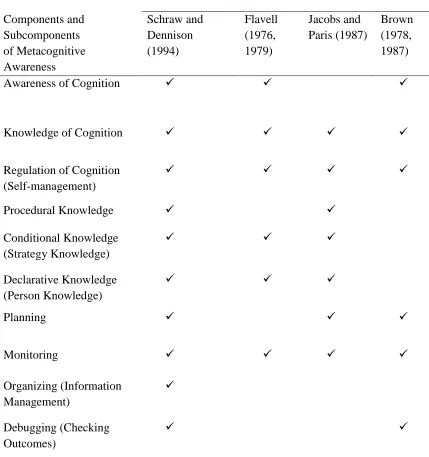
Table 2
Components and Subcomponents of Metacognitive Awareness
Literature on Metacognition
Components and Subcomponents of Metacognitive Awareness Schraw and Dennison (1994) Flavell (1976, 1979) Jacobs and Paris (1987) Brown (1978, 1987)
Awareness of Cognition
Knowledge of Cognition
Regulation of Cognition (Self-management)
Procedural Knowledge
Conditional Knowledge (Strategy Knowledge) Declarative Knowledge (Person Knowledge)
Planning
Monitoring
Table 2 Continued
Evaluating (Self-appraisal)
Metacognitive Awareness
According to the literature, metacognitive awareness is the combination of two main
components: knowledge of cognition and regulation of cognition (Baker & Brown 1980,
Flavell, 1979; Jacobs & Paris, 1987; and Schraw & Dennison, 1994). Jacobs and Paris (1987)
determined that the component knowledge of cognition requires a metacognitive
self-awareness of three areas: declarative, procedural, and conditional knowledge. The second
component, regulation of cognition, is a person’s control and monitoring of their cognitive
processes especially surrounding learning and processing information (Brown, 1987). There
have been numerous regulatory skills identified (Brown, 1987; Hunter-Blanks, Ghatala,
Pressley & Levin, 1988; Marine & Escribe, 1994; Pintrich & DeGroot, 1990; Schraw and
Dennison, 1994; Schraw, Dunkle, Bendixen & Roedel, 1995; and Steinberg, Bohning, &
Chowning, 1991). For this study the five regulatory subcomponents of particular interest are:
planning, organizing, monitoring, debugging, and evaluating (Schraw, 1998 and Schraw & Dennison, 1994). Table 3 shows the subcomponents of metacognitive awareness and description of each subcomponent.
Knowledge of Cognition
“Any kind of self-appraisal of cognition can be classified as either declarative,
knowledge refers to the knowledge a person has about their cognitive skills and abilities (Jacobs
& Paris, 1987 and Schraw & Dennison, 1994). A person with declarative knowledge knows
what impacts their learning, the learning of others, and what they do and do not know (Jacobs &
Paris, 1987 and Schraw & Dennison, 1994). The term procedural knowledge refers to a
person’s knowledge about how to use strategies and techniques to accomplish cognitive tasks
(Jacobs & Paris, 1987 and Schraw & Dennison, 1994). The term conditional knowledge refers
to the knowledge a person has regarding when and why to use strategies for accomplishing
cognitive tasks (Jacobs & Paris, 1987 and Schraw & Dennison, 1994). A person with
conditional knowledge knows when and why to present an idea. A person with conditional
knowledge knows the appropriate time to use strategies and has cognitive reasoning for why to
use specific strategies.
Regulation of Cognition.
Regulation of cognition was described early in metacognitive literature by Flavell (1976
& 1979) and Brown (1978). During a learning opportunity, like a professional development
program, people regulate their thinking through planning, monitoring, organizing, debugging,
and evaluating (Brown, 1978; Flavell, 1979; and Schraw & Dennison, 1994). Brown (1987)
defined regulation of cognition as “the activities used to regulate and oversee learning” (p. 68).
Brown (1987) separated the activities involved in regulating cognition into three actions: (1)
planning behaviors, (2) monitoring behaviors, and (3) checking outcomes. Jacobs and Paris
(1987) also indicated the importance of planning, monitoring, and evaluation. Schraw and
Dennison (1994) determined from their review of literature that the five regulatory
(organizing), monitoring, debugging, and evaluating.
The term planning is used to describe a person’s ability to select appropriate planning
strategies, set goals, and allocate resources (Pucheu, 2008; Schraw, 1998; and Schraw &
Dennison, 1994). A person with an awareness of their planning would be able to describe in
detail their planning, goal setting, and allocation of resources related to accomplishing a
cognitive task. The organizing and information management subcomponents are connected
(Pucheu, 2008 and Schraw & Dennison, 1994). Organizing is the cognitive use of strategies and
techniques to manage information (Pucheu, 2008). Information management is the active
process of organizing, elaborating, summarizing, and selectively focusing on important
information for the purpose of mental restructuring due to cognitive dissonance (Pucheu, 2008
and Schraw & Dennison, 1994). During monitoring a person assesses their cognition and
strategy effectiveness (Brown, 1987 and Schraw & Dennison, 1994). When teachers are
monitoring, they add the assessment of students’ learning and cognitive functioning to their
monitoring. During the process of debugging a person uses strategies to identify and correct
errors and assumptions about tasks and implemented strategies (Schraw and Dennison, 1994).
The subcomponent of evaluating is the post-hoc analysis of performance and strategy
Table 3
Description of Metacognitive Awareness Subcomponents
Subcomponents of
Metacognitive Awareness
Description of Subcomponent
Procedural Knowledge knowledge about how to use strategies and techniques to
accomplish cognitive tasks (Jacobs & Paris, 1987 and
Schraw & Dennison, 1994)
Conditional Knowledge knowledge about when and why to use strategies for
accomplishing cognitive tasks (Jacobs & Paris, 1987 and
Schraw & Dennison, 1994)
Declarative Knowledge knowledge a person has about their cognitive skills and
abilities (Jacobs & Paris, 1987 and Schraw & Dennison,
1994)
Planning ability to select appropriate planning strategies, set goals, and
allocate resources (Pucheu, 2008; Schraw, 1998; and Schraw
& Dennison, 1994)
Monitoring cognitive assessment of self, others, and strategy
effectiveness (Brown, 1987; Pucheu, 2008; and Schraw &
Dennison, 1994)
Organizing use of strategies and techniques to manage information
(Pucheu, 2008)
Information Management process of organizing, elaborating, summarizing, and
selectively focusing on important information (Pucheu, 2008
Table 3 Continued
Debugging use of strategies to identify and correct errors and
assumptions about tasks and implemented strategies (Schraw
and Dennison, 1994)
Evaluating post-hoc analysis of performance and strategy effectiveness
(Schraw & Dennison, 1994)
Importance of Metacognitive Awareness
The power of the mind to think about and regulate one’s own cognition is the key not
only to learning, but also to teaching others. “Metacognition fills a unique niche in the
self-regulatory phylum, by providing domain-general knowledge and self-regulatory skills that enable
individuals to control cognition in multiple domains” (Schraw, 1998, p. 118). Georghiades
(2004) further detailed the importance of metacognition in his review of three decades of
metacognitive literature:
Relating metacognition to developing one’s self-knowledge and ability to ‘learn how to
learn’ resulted in metacognition being awarded a high status as a feature of learning. The
ground for developing such an interest proved particularly fertile, especially in view of a
constantly changing technological world when not only it is impossible for individuals to
acquire all existing knowledge, but it is also difficult to envisage what knowledge will be
essential for the future. (p. 366)
Having an awareness of what one knows and does not know when approaching future
Georghiades, 2004; and Lin, Schwartz, & Hatano, 2005) The National Research Council
identified metacognition as one of three components central to learning and teaching
(Bransford et al., 1999 as cited by Young, 2010). Teacher’s metacognitive awareness is
essential for effective planning, monitoring, organizing, adapting, and evaluating of their
classroom practices (Bransford et al., 1999; Kramarski & Michalsky, 2009; and Pucheu,
2008).
Teacher’s metacognitive awareness is also an essential part of their mental and
environmental adaption to ill-defined problems, tasks, and broad variability that they encounter
daily (Lin et al., 2005 and Pucheu, 2008). “Noted differences in adult strategy use and
performance are directly linked to differences in metacognitive awareness rather than
significant differences in intellectual abilities” (Corno, 1987; Palincsar & Brown, 1984;
Schraw & Dennison, 1994; and Swanson, 1990 as cited by Pucheu, 2008, p. 7). Teachers
with a greater metacognitive awareness are able to promote students’ metacognitive
awareness, self-regulation, higher-order thinking, enhanced learning, and problem-solving
abilities (Bransford et al., 1999; Pintrich & DeGroot, 1990; Paris & Winograd, 1990; Pucheu,
2008; and Wenglinsky, 2000 & 2002). More often, researchers are measuring and evaluating
students’ metacognition (Reingold, Rimor, & Kalay, 2008; Tanner, 2012; and Young, 2010).
Researching students’ metacognition has indicated the importance of metacognition for
student learning (Brown, 1978, 1987; Reingold, Rimor, & Kalay, 2008; Tanner, 2012; and
Young, 2010).
Brown (1978) defined metacognition in terms of students’ awareness and organization
(1980) defined metacognition as a theoretical structure with two components. The first
component was a learner having accountability for their learning (Baker & Brown, 1980).
The second component was the learner being aware of and managing their learning (Baker &
Brown, 1980). Flavell (1979) studied children to determine if they had awareness of what
controlled their memory and thinking. Flavell (1979) determined there was sufficient
evidence to support his belief that children had the ability to reflect on their cognitive
processes. Flavell (1987) indicated a concern for the separation of children’s cognitive
experiences and thorough understanding of these experiences. The literature debates whether
young children are even capable of understanding their cognitive experiences (Brown, 1987
and Brown & DeLoache, 1978). Georghiades (2004) indicated, using Flavell’s (1985 &
1987) reasoning, that it was not a question of children’s metacognitive ability but rather a
question of how they were taught to be metacognitive. “A ‘metacognitive’ approach to
instruction can help students learn to take control of their own learning by defining learning
goals and monitoring their progress in achieving them” (Bransford et al., 1999, p. 18).
More recently, research has shifted towards teacher’s development of metacognition
as a means to improve students’ metacognition (Lin et al., 2005; Prytula, 2012; Pucheu,
2008; and Wilson & Bai, 2010). Teacher’s metacognitive awareness will determine their
ability to help students develop their metacognitive awareness (Kramarski & Michalsky,
2009). Teachers lacking metacognitive awareness will have difficulty modeling
metacognitive behaviors for students during their development of metacognitive awareness
(Schraw, 1998). Teacher professional development has received recent attention as an
teachers do not have the metacognitive awareness required to implement effective classroom
practices received from professional development training (Bransford et al., 1999; Pucheu,
2008; and Schraw, 1998).
In order for teachers to effectively implement material from professional development
in their classrooms they require knowledge and regulation of cognition (Bransford et al.,
1999; Lin et al., 2005; Pucheu, 2008; and Schraw, 1998). The teacher must have the
knowledge necessary to understand the type of environment that will improve student
learning, the appropriate strategy based on the situation, the level of difficulty for a given
task, students’ level of understanding, and the ability to use their knowledge to benefit them
(Bransford et al., 1999 and Lin et al., 2005). The ability to select and apply effective learning
strategies is determined by teachers’ knowledge of cognition (Leinhardt, 1990; Palincsar,
1986; Pucheu, 2008; Wilson & Bai, 2010; and Schraw, 2009). Additionally, teachers are
often required to plan for the implementation of new material, organize learning, monitor
themselves, debug what did not work, and evaluate the effectiveness of their classroom
(Bransford et al., 1999; Lin et al., 2005; Prytula, 2012; and Pucheu, 2008). The varying
complexity of the learning environment entails teachers having the ability to adapt their
cognitive regulation to manage the environment (Lin et al., 2005) A teacher that focuses on
their regulation of cognition will develop a classroom tenacity promoting life-long learning
(Jonassen, Peck & Wilson, 1999; Stiggins, 2002; Wiggins, 1993; 1998).
Metacognitive Measurement
Given the great importance of metacognition and metacognitive awareness,
Metacognition has been identified as ambiguous by many scholars (Akturk & Sahin, 2011).
Metacognition’s ambiguity implies the inherent difficulty with its measurement. Early
studies concluded that metacognition was not an easily visible action, suggesting
problematic measurement (Akturk & Sahin, 2011). Later studies argued that metacognition
was not purely an internal process and could be more easily detected (Akturk & Sahin,
2011). Akturk and Sahin (2011) identified that the current metacognitive research is within one of three domains: (1) cognitive psychology (Hart, 1965 and Peters2007), (2) cognitive
development psychology (Piaget, 1950 and Steinbach 2008), or (3) social development psychology (Tsai 2001 and Vygotsky, 1962). Hart (1965) was the first to measure metacognition’s existence (as cited by Peters, 2007). Hart (1965) first asked participants
broad questions about general information. Hart (1965) then followed up by asking about
participant’s thoughts regarding solutions to various problems. Hart (1965) believed that the
participants’ thoughts about the solutions indicated correct answers to the general questions.
Hart’s (1965) research was followed by Underwood (1966). In Underwood’s (1966) studies,
participants were asked to indicate their perceived difficulty with various problems on a test.
Underwood (1966) believed that the indicated level of difficulty expressed by the participant
would reflect their level of difficulty in learning the concept covered by the question,
implying the participant’s inadvertent awareness. Arbuckle and Cuddy (1969) studied
participants’ judgments about their own learning. Their study determined that participant’s
judgments were highly accurate regarding their own understanding of material (Arbucle &
Cuddy, 1969).