Human Feature Detection in Abandoned
Object by Using Android Application with
Modern Security Alert System
Ananya Chandran1, Dr N Sudha2
M.E Scholar, Dept. of CSE, CMS College of Engineering and Technology, Coimbatore, Tamil Nadu, India1
Professor and Principal, Dept. of CSE, CMS College of Engineering and Technology, Coimbatore, Tamil Nadu, India 2
ABSTRACT: In recent years, visual surveillance has gained importance in security, law enforcement and military applications. Due to the wide use of video surveillance systems, the amount of data that has to be monitored and interpreted has increased enormously. Nowadays, the pure mass of information that has to be handled by the operators of such systems has overgrown their capabilities. It is therefore crucial to support human operators with (semi-)automatic surveillance systems which notify their supervisors in case of an incident potentially relevant to security. In this paper, we present a tracking/surveillance system that supports a human operator by automatically detecting abandoned objects and drawing the operator’s attention to such events. It consists of two major parts: A Bayesian multi-people tracker that explains as much of the scene as possible and a blob-based object detection system that identifies abandoned objects using the unexplained image parts. If a potentially abandoned object is detected, the operator is notified and the system provides the appropriate key frames for interpreting the incident.
KEYWORDS: Tracking/Surveillance System, Bayesian Multi-People Tracker, Blob-Based Object Detection System..
I. INTRODUCTION
Recent years have shown a growing demand for visual surveillance systems. Governments as well as companies have started to equip their property with video cameras and other sensor systems in order to increase the safety for their citizens or customers. Large buildings and even whole cities have been covered with cameras which supply an enormous amount of data. It is thus no longer sufficient to monitor this data by human operators but the collected data has to be analyzed and interpreted automatically.
Although completely autonomous surveillance systems are still far from being operational, intermediate steps are within grasp. In this paper, we present a tracking/surveillance system that aims at this task: It is capable of tracking multiple people under the influence of clutter, distractors and occlusion.
The goal of detection algorithms is the notification of a human operator about potentially critical events such as unobserved objects placed in museums. The operator will then decide how to proceed based on the information provided by the system.
In this paper, we present a tracking/surveillance system that aims at this task: It is capable of tracking multiple people under the influence of clutter, distractors and occlusion. Furthermore, the surveillance subsystem detects objects which could not be “explained” by the people tracker and monitors them in order to alert a human operator in case of a potential incident.Objects that have been abandoned are kept under close surveillance until they have been removed from the scene. However, removing a previously abandoned object may also cause a security alert in order to verify that the person that takes the object away is the same which had brought it into the scene.
II. RELATEDWORK
Chuan-Yu Cho, Wei-Hao Tung and Jia-Shung Wang, “a crowd-filter for detection of abandoned objects in crowded area” ,2008 - Terrorist attacks have become a critical threat of public safety; especially, explosive attacks with abandoned packages are repeatedly concentrated on public places such as MRT stations. Hence, establishing a surveillance system with high -tech appliances to against terrorism is a critical issue nowadays. Unlike most of the existing object detection schemes which mainly deal with monotonic surveillance scenarios, abandoned object detection in crowded area becomes much important on against anonymous explosive attacks.
Weilong Huangy, Lizuo Jinyz, Yi Luoy, Yawei Liy, Tong Cui, “a novel algorithm for abandoned object detection” ,2016 - Abandoned object detection is a crucial problem in many computer vision tasksIn this paper, we propose a novel detection algorithm based on change detection and blob separation. Our proposed approach suits more practical scenarios in which objects located near each other. Experiments are conducted on several well-known benchmarks to validate the efficacy of the algorithm proposed in this paper.
He Ma, Tiantian Zhao, Jinghan Li, Wei Qian , “abandoned object detection based on tachygraphy videos” 2016. - In this paper, a novel abandoned object detection based on tachograph is proposed. Firstly, we use the Harris- SIFT features and particle filter to achieve object tracking. After that, the VIBE algorithmic applied to detect the abandoned object with background modeling frame by frame, using both background subtraction method and frame difference method.
Ketaki Shet-Talathi ,S.V Khobragade “A real time abandoned object detection hardware approach” 2017 - Most of the bomb blast was done wih the help of abandoned object, so effective and efficient detection and Real time localization of abandoned object is very important to prevent attacks. This paper presents an effective hardware implementation approach or Abandoned Object Detection in video surveillance. We had combined long term and short term background model for foreground extraction. Change detection is done with the help of fuzzy clustering using log ratio and mean ratio operators. In proposed system SVM classifier is used to classify detected static object and its location is traced by GPS.
YingLi Tian, Rogerio Schmidt Feris, Haowei Liu, Ming-Ting Sun,” Robust detection of abandoned and removed objects in complex surveillance videos” - 2011 - Tracking-based approaches for abandoned object detection often become unreliable in complex surveillance videos due to occlusions, lighting changes, and other factors.
We present a new framework to robustly and efficiently detect abandoned and removed objects based on background subtraction (BGS) and foreground analysis with complement of tracking to reduce false positives. In our system, the background is modeled by three Gaussian mixtures. Then, the same Gaussian mixture models used for BGS are employed to detect static foreground regions without extra computation cost Based on the type of the static regions and user-defined parameters a matching method is proposed to detect abandoned and removed objects.
III.METHODOLOGIES
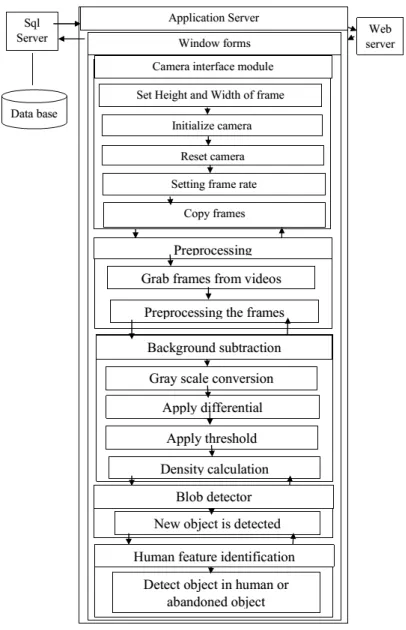
The object detection and surveillance module, built on top of the people tracker, identifies image regions which possibly contain abandoned objects. An abandoned object is defined as sufficiently large foreground region that is static (no movements) for a certain period. In addition, a color mixture model is built for possible a candidate which is also part of the evaluation. Candidate regions are observed for a certain time before an alert is issued and the operator is informed about a potential incident.
Fig 1: System Architecture
3.1 Camera Interfacing Module
The Microsoft Windows graphics device interface (GDI) enables applications to use graphics and formatted text on both the video display and the printer. Windows-based applications do not access the graphics hardware directly. Instead, GDI interacts with device drivers on behalf of applications. Here we are using GDI programming to interface camera to the application Functionalities in this module are
● set height and width of frame
● initializes camera
● reset camera
● setting frame rate
3.2 Preprocessing
Grab frames from videos and preprocessing the frames by avoiding the noise. It is implemented for the real time situation and capturing of live streaming videos.
3.3 Background Subtraction
Background subtraction, also known as Foreground Detection, is a technique in the fields of image processing and computer vision wherein an image's foreground is extracted for further processing (object recognition etc.).
● gray scale conversion
● apply differential
● apply threshold
● density calculation
3.4 Blob Detector
It detecting regions in a digital image that differ in properties, such as brightness or color, compared to surrounding regions. Here the new objects where detected using blob detector.
3.5 Human Feature Identification
Human feature detection is carried along with abandoned object detection to specify whether the detected object is human or an abandoned object. The histogram of oriented gradients (HOG) is a feature descriptor used detect the human.
IV.EXPERIMENTALRESULTS
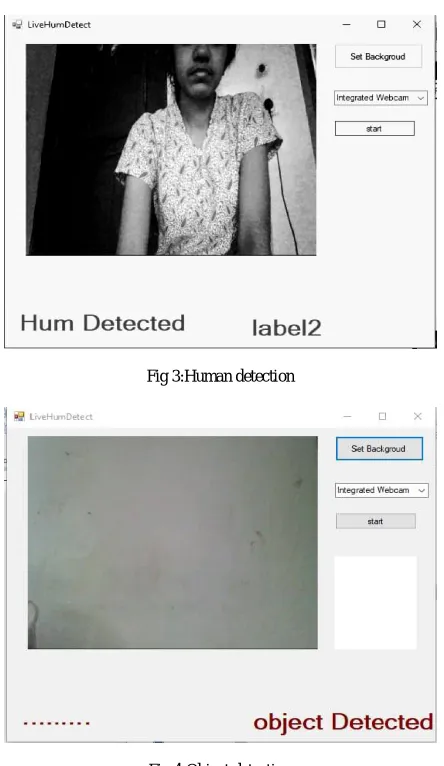
Fig 3:Human detection
Fig 4:Object detection
V. CONCLUSION
In this paper we presented a combined tracking and surveillance system which is able to detect abandoned objects. An abandoned object is defined as sufficiently large foreground region that is static (no movements) for a certain period. In addition, a color mixture model is built for possible candidates which is also part of the evaluation. Candidate regions are observed for a certain time before an alert is issued and the operator is informed about a potential incident. Together with this notification, the system provides key frames which show the scene at the time the event actually occurred.
REFERENCES
1. Sangho Park, Aggarwal, J.K., “Segmentation and tracking of interacting human body parts under occlusion and shadowing,” Motion
and Video Computing, 2002. Proceedings. 5-6 Dec. 2002. pp.105-11.
2. Bhandarkar, S.M.; Xingzhi Luo, “Fast and Robust Background Updating for Real-time Traffic Surveillance and Monitoring,” Computer Vision and Pattern Recognition, 2005, vol. 3, June 2005,pp. 55.K. Supreeth, K. S. Sundar, and D. Balamurugan, “Performance Evaluation & Simulation of Solar Power System,” vol. 2, no. 7, 2014.
3. Zivkovic, Z ., ”Improved Adaptive Gaussian Mixture Modelfor Background,” Pattern Recognition, 2004. ICPR., Vol. 2, 23-26 Aug. 2004,
pp. 28–31.
4. Bailo, G., Bariani, M.; Ijas, P., Raggio, M.,”Background Estimation with Gaussian Distribution for Image Estimation with Gaussian Distribution for Image Segmentation, a Fast Approach,” Measurement Systems for Homeland Security, Contraband Detection and Personal Safety Workshop, IMS 2005, 29-30 Mar. 2005 pp.2–5
5. Qi Zang and Reinhard Klette, “Evaluation of an Adaptive Composite Gaussian Model in Video Surveillance,” CITR at Tamaki
Campus, vol.2756, Aug 2002, pp.165–172.36
6. R. H. Evangelio, T. Senst, and T. Sikora, “Detection of static objects for the task of video surveillance.” Proc. IEEE WACV, pp. 534-540, Jan.
2011.
7. C. Lin, H. Zhao, Y. Ma and H. Liu, “Abandoned object detection and analysis based on online learning.” Proc. IEEE Conference on Dec.