Dept. of EEE, College of Engineering, Trikaripur (CAPE, Government of Kerala), Cheemeni, Kasaragod, Kerala-671313, India
Voice Recognition Based Intelligent
Wheelchair
Megha Muralidharan, P.T.Jabir1, Vinod Pottakulath2
Graduated, MES College of Engineering Kuttippuram, Malappuram, Kerala, India1
Associated Professor, Department of EEE, College of Engineering, Trikaripur, Kerala, India 2
ABSTRACT: This paper focuses on the development of an intelligent wheelchair for application to physically disabled persons. Freedom of mobility is a dream for every person with physical disability especially in the case of quadriplegics, those people who are paralyzed below neck and in case of multiple sclerosis patients. Though many types of mobility equipment are available for the disabled for their independent mobility, no efficient devices have yet been invented for the independent mobility of quadriplegic and multiple sclerosis patients. The quadriplegic and multiple sclerosis patients cannot drive a joystick operated wheelchair which is the only type of powered wheelchair which is commercially available. Quadriplegia and multiple sclerosis is cureless. This paper describes the sincere devotion to design a powered wheelchair with particular features that helps the above patients to move independently. Safety is our first priority, so we use ultrasonic sensors in order to detect the depth. This powered wheelchair is controlled by the joystick as well as speech of the user. This wheelchair can be easily driven to desired direction with minimum effort. The user requires minimum training to use this mobility equipment. Technically the wheelchair is integrated with an ultrasonic sensor for depth detection, a joystick, voice recognition circuit to recognize the voice, a microcontroller which can be programmed supporting these hardware components. Powered wheelchairs with the standard joystick interface are unable to control by many people. A voice controlled wheelchair can provide easy access for physically disabled person who cannot control their movements especially the hands.
KEYWORDS: Depth detection, Ultrasonic sensor, Voice recognition, Wheel chair, ATMEGA 32 micro controller.
I. INTRODUCTION
The wide spread prevalence of lost limbs is of major concern in present day due to wars, accident, age and health problems. An intelligent wheelchair is developed to help these types of patients by using speech recognition system to control the movement of wheelchair in different directions by using voice commands and also the simple movement of the patient's fingers with joystick control. Automatic depth detection is done using an ultrasonic system which helps the patient to apply a temporary brake in case any obstacle suddenly comes in the way of the wheelchair. The intelligent wheelchair is designed in such a way that it can be controlled easily with minimum effort from the patient and also provides protection from obstacle collision if any voice mistake happens. The main advantage is the low cost design which allows more number of patients to use this type of wheelchair.
There are patients who have lost control of both arms and legs, as a result of higher level spinal cord injury or brain and nervous system disorder. These kinds of patients can't use the standard wheelchair which depends on the arms muscular force to move the wheelchair. At the same time, they can't use the electrically powered wheelchair which is controlled by joystick. So these types of patients still need the help of another person to move their wheelchair from one place to another. Many researchers have proposed different methods to control the wheelchair. One of the possible solutions for them is to use their voice to control the wheelchair. Voice recognition technology depends on converting a particular spoken word to an electrical signal which is further digitized in order to be processed by a computer or microcontroller.
II. SCOPEOFTHEPROJECT
Dept. of EEE, College of Engineering, Trikaripur (CAPE, Government of Kerala), Cheemeni, Kasaragod, Kerala-671313, India
There are patients who have lost control of both arms and legs, as a result of higher level spinal cord injury or brain and nervous system disorder. These kinds of patients can't use the standard wheelchair which depends on the arms muscular force to move the wheelchair. At the same time, they can't use the electrically powered wheelchair which is controlled by joystick. So these types of patients still need the help of another person to move their wheelchair from one place to another. Many researchers have proposed different methods to control the wheelchair. One of the possible solutions for them is to use their voice to control the wheelchair. Voice recognition technology depends on converting a particular spoken word to an electrical signal which is further digitized in order to be processed by a computer or microcontroller. The presented work is innovative in the sense. It uses voice recognition control system with different language to control the movement of the wheelchair which is not available commercially. The use of depth detection using sensors in system will stop the wheelchair if it finds any depth. This will provides more safety to the users. The cost effectiveness of the system makes it affordable for the patients to use.
III. METHODOLOGY
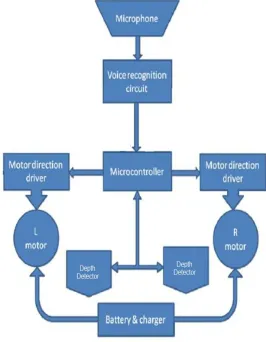
The block diagram shown in Fig. 1 includes all the wheelchair elements, starting with the microphone which is used to pick up the voice command (sound wave) from the user and convert it to an electrical signal. The next unit is the voice recognition circuit which receives the output of the microphone, digitizes it and stores the result signal as template which indicates the users command. The core of this unit is the Voice recognition IC.
The next block is the microcontroller circuit which receives the control signal from the voice recognition circuit and also
Dept. of EEE, College of Engineering, Trikaripur (CAPE, Government of Kerala), Cheemeni, Kasaragod, Kerala-671313, India
from the obstacle detection circuit, which includes two ultrasonic sensors. The microcontroller output is connected to the motor driver circuit which includes the relays used to control the DC motor’s direction of rotation giving the wheelchair movement in four directions. The charger is used to charge the 12 volt battery, which is the main source of power for the wheelchair.
The program flowchart is as shown in Fig. 2. After initializing the unit, the unit checks for inputs from ultrasonic sensors, followed by joystick and finally from voice module.. If there is no new input then the previous state is continued.
Figure 2. Flow Chart
The hardwares used are described below according to their priorities. A.Depth Detection Unit
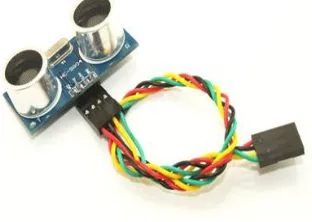
The obstacle detection is done by four HR SC04 ultrasonic sensors. Here only depth is taken as obstacle. The HR SC04 sensor detects objects by emitting a short ultrasonic wave (40 kHz) and receiving the reflected echo.
Dept. of EEE, College of Engineering, Trikaripur (CAPE, Government of Kerala), Cheemeni, Kasaragod, Kerala-671313, India
Ultrasonic transmitter emits an ultrasonic wave in one direction, and starts timing when it launched. Ultrasonic spread in the air, and would return immediately when it encounters obstacles on the way. At last, the ultrasonic receiver would stop timing when it receives the reflected wave. As Ultrasonic spread velocity is 340m / s in the air, based on the timer record t, we can calculate the distance (s) between the obstacle and transmitter, namely: s = 340t / 2, which is so- called time difference distance measurement principle.
B.Joystick
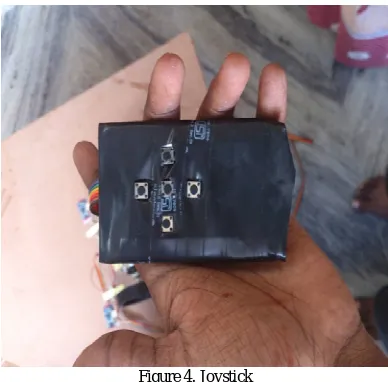
The joystick control is also incorporated in the wheelchair. Microswitches are used for direction control. Five controls are given- FRONT, BACK, RIGHT, LEFT, & STOP.
Figure 4. Joystick C.Voice Recognition Unit
This module can store up to 15 pieces of voice instruction. Those 15 pieces are divided into 3groups, with 5 in each group. First the module is trained with voice instructions group by group. After that, one group is imported before it could recognize the 5 voice instructions within that group. If we need to implement instructions in other groups, we should import the group first. This module is speaker dependent.
Figure 5. Voice Recognition Unit
Dept. of EEE, College of Engineering, Trikaripur (CAPE, Government of Kerala), Cheemeni, Kasaragod, Kerala-671313, India
until you finish all the 5 voice instructions recording of one group. Also, once you start recording, the previous voice instructions in that group will be erased. In training state, this module doesn’t reply to any other serial commands.
Record indication: D1 (RED) flashes 3 times within the 600ms, then off for 400ms, and then flashes quickly for 4 times within 600ms. Now the recording indication is over.
Begin to speak: D1 (RED) is off for 400ms, and then is on. Voice during the time while D1 (RED) is on will be recorded by this module.
Recording a voice instruction successfully for the first time: D1 (RED) off, D2 (ORANGE) on for 300ms.
Recording a voice instruction successfully for the first time: D1 (RED) off, D2 (ORANGE) on for 700ms.
Recording failure: D2 (ORANGE) flashes 4 times within the 600ms. In cases that voice instructions detected twice don’t match, or the sound is too large, or there is no sound, recording will fail. You need to start over the recording process for that instruction.
In identification stage, D2 (ORANGE) is off, and D1 (RED) is on for 100ms every other 1500ms, slow flashing. In this stage, this module is processing received voice signal, and if matching, it will send the result immediately via serial port.
D.Microcontroller Unit
The microcontroller unit is the core of the intelligent wheelchair. It interfaces the voice recognition unit, joystick, depth detection system and the motor driver circuit. The main function of this unit is to receive the data from the VR kit through (B0-B2, C0, C1), from joystick through (B3-B7), from Ultrasonic sensor through (A0-A7) and determine the right commands to be given to the driver circuit. ATMEGA 32 microcontroller with 32 I/O lines covers all the requisites for this wheelchair.
E.Motor Driver Circuit
This circuit is responsible for the DC motor rotation .The circuit consists of L293D motor driver IC. The circuit is responsible for converting the microcontroller’s output signal of 5 volt to the motor operating voltage of 12 volt. The available motor motions are:
Forward: Both the motors in forward direction.
Reverse: Both the motors in reverse direction.
Left: Left motor in backward direction/Right motor in forward direction.
Right: Right motor in backward direction /Left motor in forward direction.
Stop: Both motors stop rotation. F.DC Motor
The wheelchair moves by two DC motors. The operating voltage and current are 12 Volts and 1 A respectively. The motors run at a speed of 60 rpm.
IV. WORKDESCRIPTION
The three different modes are interfaced to ATMEGA 32 microcontroller. Switches are shown instead of modules for simplicity. The main components in the circuit diagram are:
Ultrasonic sensors
Joystick Control
Voice Recognition system.
V. RESULTS
The ‘Voice Recognition based intelligent wheelchair system’ prototype is successfully developed. Priority based overriding of control is also fully operational and working.
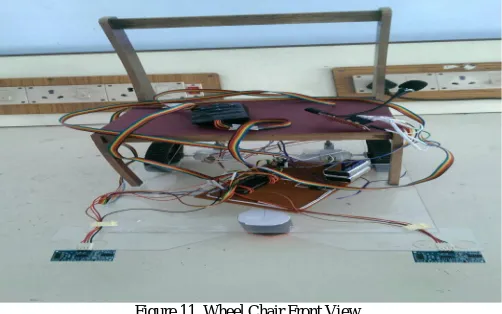
The photograph of the prototype developed is shown in Fig.11. This model is built on an acrylic board. The motors used in the prototype are of 12V rating and 60 rpm speed. The VR module along with the microphone is attached to the user’s head for easy communication with the system.
Dept. of EEE, College of Engineering, Trikaripur (CAPE, Government of Kerala), Cheemeni, Kasaragod, Kerala-671313, India
A.Challenges Faced
Problems regarding IR sensors.
Inconsistency in voice recognition.
Program complexities.
Independent calibration of Ultra sonic sensors.
B.Future Works
The wheelchair could be incorporated with an intelligent navigation system which will automatically navigate the user to the nearest hospital or pre-defined location in case of any emergency.
The project can be modified to an all-terrain wheel chair.
A robotic arm could be included which enable automated wheelchair users to pick up any objects out of their reach with ease.
An emergency back-up battery could be provided which would sense the amount of power in the original battery and turn on the back-up battery when the original battery shuts down.
Automation can be gesture identification, electro-occulogram, etc.
VI. CONCLUSION
We have developed an intelligent wheel chair with voice control system, joystick control and depth detection system. It successfully moves according to the command either by voice or joystick along detecting the depth of the moving surface.
Figure 11. Wheel Chair Front View
REFERENCES
[1] G.Kalasamy, A.MohammedImthiyaz, A.Manikandan,S.Senthilrani, “Micro-Controller Based Intelligent Wheelchair Design,”IJREAT International Journal of Research in Engineering & Advanced Technology, Volume 2, Issue 2, Apr-May, 2014.
[2] Kuruparan.J, Jayanthan T, RatheeskanthV and Denixavier S, “Semiautonomous Low Cost Wheelchair for Elderly and Disabled People,” IEEE 2006 International Conference on Information and automation, ICIA 2006.
[3] Murai A, Mizuguchi M, Nishimori M, Saitoh T, Osaki T and Konishi R, “Voice Activated Wheelchair with Collision Avoidance Using Sensor Information,” International Joint Conference (ICROS-SICE) 2009.
[4] Manuel Mazo, Francisco J. Rodriguez, Josi L. L, Zaro, Juan C. Garcia, Enrique Santiso, Pedro Revenga and J. Jesi Garcia, “Wheelchair for Physically Disabled People with Voice, Ultrasonic and infrared Sensor Control,” Autonomous Robots, 2, 203-224 (1995).
[5] Prof.R.S.Nipanikar, VinayGaikwad, ChetanChoudhari, Ram Gosavi and Vishal Harne, “Automatic wheelchair for physically disabled persons,” International Journal of Advanced Research in Electronics and Communication Engineering (IJARECE), Vol. 2, Issue 4, Apr. 2013.
[6] Akira Murai, MasaharuMizuguchi, Takeshi Saitoh, Member, IEEE, TomoyukiOsakiandRyosukeKonishi (2009) ,“ Elevator Available Voice Activated Wheelchair,” The 18th IEEE International Symposium on Robot and Human Interactive Communication Toyama, Japan, Sept. 27-Oct. 2, 2009.
[7] HC-SR04 User Guide,www.elecfreaks.com