Linear MMSE Time Domain Equalisation
Technique for 2 × 2 MIMO System
Without Pilot In LTE
R.Sharanya1, Prof.S.Chidambaram2
PG Scholar, Department of ECE, Adhiyamaan College of Engineering, Hosur, Tamilnadu, India1
Professor, Department of ECE, Adhiyamaan College of Engineering, Hosur, Tamilnadu, India2
ABSTRACT: Interference cancellation system (ICS) for 3GPP/LTE system is the broadband cancellation
system, which receives forward signal through the donor antenna. We proposed new algorithm of received signal with pilot and non-pilot de-sign. Although repeater design needs our project, so in this paper we discuss about interference cancellation algorithm for 2x2 MIMO systems without pilot in LTE. First explain the general principle structure of 3GPP/LTE, next determine our new design and algorithm. Finally, we simulated our mathematic extraction of proposed new algorithm on MAT-LAB.
KEYWORDS:MMSE:Lookup-table;Threshold;Cost Function;Viterbi Algorithm
I.INTRODUCTION
Interference cancellation system (ICS) for the donor and service antenna amplifies the received signals and sends them to base station and mobile to get stronger signal. During this process, it cancels the interference signal between the donor and receiving antenna. There are us-ing types of cancellation algorithms, some existing adap-tive cancellation algorithms work in the frequency do-main, using the reference tones carried in the OFDM signal. Other algorithms use the time domain methods like the LMS. In general these algorithms are classified by interference cancellation algorithm with and without pilot signals. We described interference cancellation al-gorithm without pilot signals in this paper. It is feasible to implement ICS in OFDMA systems such as LTE. Al-though IC techniques can be applied to both downlink and uplink of LTE, due to complexity considerations, IC is considered mainly as a technique for the UL and im-plemented in the base station receiver. ICS techniques can be used to cancel both intra-cell and inter-cell inter-ference.
II.PROPOSED CHANNEL ESTIMATION METHOD AND EQUALIZATION
2.1.Non Pilot Channel Estimation:
The MMSE estimator minimizes the MSE of the channelestimates, but the complexity is high compared to the ML or LS estimators. The LS and MMSE method were compared in and for OFDM systems and the MMSE was found to outperform the ML in low SNRs. The calcula-tion of the MMSE estimate requires a large matrix inver-sion.
In general, there are three categories of equalization techniques. Our technique is the time–frequency domain equalization with channel shortening. A time-domain equalizer is inserted to reduce the MIMO channels to the ones with the channel length shorter than or equal to the CP length, and then, a one-tap frequency-domain equal-izer is applied to each subcarrier. When the MIMO channels are shortened by the time-domain equalequal-izer, residual ICI and ISI are introduced. They cannot be eliminated by the subsequent frequency-domain equalizer and, thus, limit the performance.This has resulted in new receiver concepts using dif-ferent equalization techniques. These techniques are briefly explained below
Time-domain equalizer (TEQ)
The time domain equalization (TEQ) is a shortFIR filter at the receiver input that is designed to shorten the duration of the channel impulse response (L). Thus it allows a reduction in the guard interval length. Using a filter with up to 20 coefficients, the effective channel impulse response of a typical AWGN channel can easily be reduced by a factor of 10. Different cost functions such as minimum mean squared error, maximum short-ening signal-to-noise ratio (SNR), and minimum in-ter-symbol interference (ISI), and maximum bit rate have been proposed to design the time domain equalizer (TEQ).
2.3.Iterative Algorithm
In OFDM, channel estimation can be performed with a blind or a non-blind technique. The blind channel esti mation method does not require the use of training se-quences or pilot symbols and enables a more efficient use of the available bandwidth. The channel estimates are obtained using the statistical properties of the received data which is collected over a certain time period.
ML equalizer, and can be used to compute the coeffi-cients of suboptimal but lower-complexity equalizers such as the minimum mean-squared error (MMSE) linear equa-lizer (LE). Even though the MMSE-LE can be estimated directly, having the channel estimates allows us to choose which equalizer is more appropriate for the channel..
III.MATHEMATIC EXTRACTION FOR NON PILOT CHANNEL ESTIMATION
We assume a single UE receiving desired signal from the serving BS as well as inter-cell interference signals from neighboring BSs. The BSs from different cells are as-sumed to be synchronized in time and frequency. The UE has NR receive antennas which are used for performing inter-cell interference suppression. Each BS has one an-tenna to transmit one stream of information.We define s as the vector that stands for the d pilot symbols, which are multiplexed with s to form a block of N=Nd+Np transmitted symbols s. For simplicity, we consider unit-energy QPSK with the symbol alphabet αk, k=1,…,4, which are used for desired signal as well as all other interference signals. In this work, the receiver is assumed to have perfect CSI between the serving BS and the UE. If SIC is applied, the UE also requires knowl-edge about the interference link, e.g., the channel be-tween the UE and the interfering BS and the modulation scheme of the interference signals..
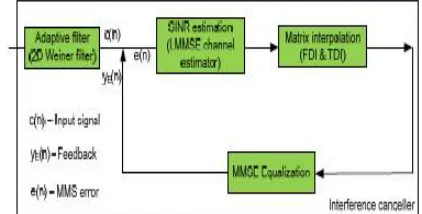
Fig 2: Proposed system model of ICS Repeater without Pilot signal for 3GPP/LTE.
Fig 3 : Multi-path propagation in a terrestrial mobile radio environment
Fading and Multipath propagation are the two main characteristics of wireless channels, fading is basically the result of multipath propagation. As the name depicts, multipath means that there will be multiple copies of a transmitted signal which will be received at the receiver, which is because in the wireless environment our transmitted signal can be affected by several factors, like ionospheric reflection, refraction, reflection from different objects like buildings or mountains. Investigating the effect of frequency offsets in LTE uplink is the main objective of this thesis to but we need to understand the causes of fading.
3.1.MMSE Estimator
This effectively equalizes the frequency-selective chan-nel. First, consider the infinite length filter case: The output of the equalizer is
Is where the equalized channel IR is
and the MMSE cost function is:
Principle of orthogonality is
We can calculate the MMSE equalizer by either mini-mizing J over w:
Then Jmin is,
Due to the principle of orthogonality,
3.2.MMSE Calculation :
where the WMF output/equalizer input is
and the convolution of the equalizer and the equivalent channel IRs is
Obviously, the variance of noise is
The ISI terms are
Then, the probability of error for this sequence is
Average probability is found by averaging over all DJ
PM{DJ}is dominated by the sequence yielding high-est DJ which occurs when x[n]= ±(M-1) and the signs of
x[n]’s match the corresponding {qn}.
IV.RESULT OF PROPOSED SIGNAL PROCESSING TECHNIQUE WITHOUT PILOT SIGNAL FOR ICS
In result section, the simulations of the algorithms de-veloped two cases. Our proposed design implemented both cases, which are pilot and non-pilot receiver simu-lated on MATLAB.
This figure shows non-pilot design for 2-2 Tx-Rx MIMO system. This figure included TDI and FDI based matrix interpolation that requires modulation
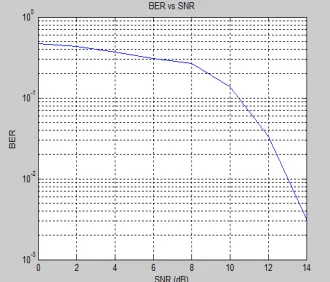
Fig 4: The symbol error rate comparison of the pro-posed non-pilot technique with that of a 2Tx−2Rx at
Fig 5: The symbol error rate comparison of the pro-posed non-pilot and pilot technique with any modulation order at the receiver
QPSK, 16QAM, 64QAM. The first iterative step ended to check maximum threshold is larger than Jmin value. If true no more iterative step, otherwise next iterative step continue. Proposed methods based two cases of ICS receiver structure. So we define only one general algorithm, which is used to any system with ICS block. If system determined input signal with pilot, then signal go to matched filtering block, otherwise select to adaptive filter.
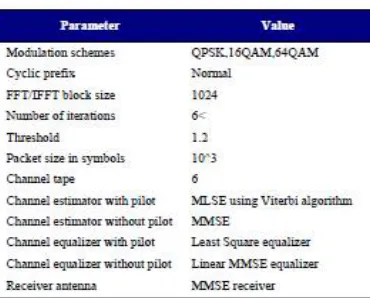
Table 1: Simulation parameters.
V.CONCLUSIONS AND FUTURE WORKS
estimation system on channel ICS method
REFERENCES
[1] S. Mahboob, Interference Cancellation System, Simon Frazer University, 2009.
[2] J. Ketonen, Equalization and Channel Estimation Algo-rithms and Implementations for Cellular MIMO-OFDM downlink; University of Oulu Graduate School; Juvenes Print, Tampere 2012.
[3] A. Mehmood and W. A. Cheema, Channel Estimation for LTE Downlink, Blekinge Institute of Technology, 2009.
[4] J. C. Henao, Y. J. Chen, K. Fang, M. Grieger, P. Helbing and R. Legouable, Advanced Receiver Signal Processing Techniques: Evaluation and Characterization.
[5] B. M. Donlan, Ultra-wideband Narrowband Interference Cancellation and Channel Modeling for Communications.