ISSN(Online): 2320-9801
ISSN (Print) : 2320-9798
I
nternational
J
ournal of
I
nnovative
R
esearch in
C
omputer
and
C
ommunication
E
ngineering
(An ISO 3297: 2007 Certified Organization)
Vol. 3, Issue 9, September 2015
Power Efficient Transciever Designs in
Mimocognitive Radio Network Using LMS
Algorithm
Numa Joy1, Anu Abraham Mathew2
M. Tech Student, Dept. of ECE, Amal Jyothi College of Engineering, Mahatma Gandhi University, Kottayam, Kerala,
India1
Assistant Professor, Dept. of ECE, Amal Jyothi College of Engineering, Mahatma Gandhi University, Kottayam,
Kerala, India 2
ABSTRACT: Cognitive radio technology has come out as the promising solution to reduce the imbalance between spectrum shortage and spectrum under-utilisation. It increases the spectrum utilisation by reusing the vacant spectrum of the primary systems. The interference should be properly controlled and managed in order to ensure successful operation of the primary network and to improve the performance of cognitive radio networks. This interference problem is solved by employing multiple antennas. Transceiver beamforming is performed to avoid the unwanted radiation. Iterative algorithms are used to minimize the total transmit power of secondary systems, while maintaining the interference to the primary users below a certain threshold value and satisfying QoS (Quality of Service) constraint for each secondary system. This is performed by MMSE(Minimum Mean Square Error) beamformer in cognitive radio
network. This paper investigates the transmit power minimization with MMSE and an adaptive beamformer.
KEYWORDS: Cognitive radio networks; Transceiver beamforming; MMSE; Adaptive beamformer
I. INTRODUCTION
Within the current spectrum scenario, spectrum resources are allocated to particular users. Radio spectrum is becoming scarce as more and more devices are moving to wireless functioning. Studies indicate that most of the spectrum is vacant in the domain of time, frequency and space. The imbalance between spectrum scarcity and spectrum under-utilization has led to drastic change allowing the spectrum to be shared and reused in a dynamic manner. This is known as Dynamic Spectrum Access (DSA). Cognitive radio is the technology enabling DSA.
It is an intelligent wireless communication system that is aware of its environment and can adapt to the changes in the environment by changing its parameters. It works according to the cognitive cycle. This cycle includes detecting the RF stimuli and finding the spectrum holes. It includes functions like power control and spectrum management after sensing the spectrum holes to reduce the interference. Cognitive radio network contain two types of users. One is primary user who is the licensed user and others are the secondary users who are the unlicensed users. The spectrum resources allocated to licensed users can be used by unlicensed users by this technology. The unlicensed users also called cognitive user’s senses the spectrum continuously to detect the spectrum holes. Spectrum holes are the frequency bands that are unused by the licensed users in either frequency or time domain. These spectrum holes are utilized by the secondary users to transmit their data.
ISSN(Online): 2320-9801
ISSN (Print) : 2320-9798
I
nternational
J
ournal of
I
nnovative
R
esearch in
C
omputer
and
C
ommunication
E
ngineering
(An ISO 3297: 2007 Certified Organization)
Vol. 3, Issue 9, September 2015
reduce the power. To reduce the effect of co-channel interference at secondary transmitter, a transmit beamformer is designed that maximize the Signal to Leakage Noise Ratio (SLNR). The stability between signal and the interference is obtained by maximising this SLNR ratio. At the receiver side, Signal to Interference Noise Ratio (SINR) is maximized by using MMSEbeamformer. This MMSE beamformer is replaced by the adaptive beamformer.Therefore, power minimisation by the MMSE and adaptive beamformer algorithm is the main focus of this paper.
II. RELATED WORK
In [1] authors proposed the iterative algorithms that can minimize the total transmit power with interference and QoS constraints. Beamforming and power allocation is performed in an iterative manner. They proposed centralized and distributed beamforming algorithms. Centralized algorithm requires the knowledge of channel information which may not be practically possible. Hence they proposed the distributed beamforming algorithm which does not require the knowledge.In [2] authors proposed a unified Homogeneous Quadratically Constrained Quadratic Program (QCQP) formulationthat can be applied to all scenarios which include complete CSI (Channel State Information), partial CSI and no CSI. The homogeneous QCQP formulation can accommodate both deterministic and probabilistic interference-temperature constraints. But this method considers only the interference constraint and does not consider the QoS constraint. In [3] authors proposed a transmitter and receiver beamforming method over MIMO(Multi-Input-Multi-Output) cognitive radio networks to minimize the transmit power while satisfying SINR for the secondary users and maintaining an interference level which is acceptable to the primary user. Perfect CSI of primary and secondary links at the secondary base station is assumed. This may not be practically possible since the perfect knowledge of CSI is not available in all cases. In [4] authorsproposed a Space-Time Block Coded (STBC) transmission for two-user MIMO channels with phase feedback. In the proposed system, the phase feedback is send to only one user, which reduces the overhead of the reverse link. A closed-form solution for the proposed phase feedback is derived, in order to maximize the overall received SINR.In [5] authors studied the theoretic perspective of secondary user’s channel capacity under transmit power constraint and interference power constraint at each primary receiver. Optimal and suboptimal algorithms are the proposed designs for the secondary user’s transmit spatial spectrum.
III. PROPOSED METHOD
A. System Model
A cognitive radio network with one primary and K secondary systems are considered. secondary base station and
mobile station is equipped with Nk and Mk antennas. Here the secondary user transmits even though primary user is present which is known as spectrum sharing. But there are constraints over interference and QoS.
B. Description of the Proposed Method:
Power efficient transceiver design using LMS algorithm is the proposed method. LMS algorithm is a linear adaptive filtering algorithm. In an adaptive or changing environment, LMS algorithm can be used to iterate the weights towards the optimal weights and the optimal weights changes as a function of the environment. By the suitable selection of the step size parameter, the implementation of this algorithm is simple. At each iteration this algorithm requires the knowledge of the recent values.
Step 1: Calculating the weight vectors by the LMS algorithm.
The weight vector is given by the eq.1 when the input vector is given by u(n),step size parameter is given by μ
( + 1) = ( ) + ( )eq. (1)
and the error e(n) is given by the eq.2
( ) = ( )− ( )eq. (2)
whered(n) is the desired output and y(n) is the obtained output. Step 2:Calculating the weight vectors by the MMSE beamformer
MMSE beamformer assumes that the statistics of the incoming signal and noise are known and then the optimal weights are calculated. It calculates the beamforming vector that maximises the SLNR, for antennas that transmit to each user. SLNR maximization beamformer is also known as regularized zero-forcing beamformer or transmit MMSE beamformer. MMSE beamformer balances between the signal power maximization and interference power minimisation. The balance between the signal and the interference is maintained by maximizing SLNR. SLNR is the ratio of the signal at the intended user and noise and interference power that leaks to the non-intended users. The beamforming direction maximises the SLNR value.
ISSN(Online): 2320-9801
ISSN (Print) : 2320-9798
I
nternational
J
ournal of
I
nnovative
R
esearch in
C
omputer
and
C
ommunication
E
ngineering
(An ISO 3297: 2007 Certified Organization)
Vol. 3, Issue 9, September 2015
Each secondary mobile station initializesit’s normalized receive beamforming vector and transmits the pilot symbol to estimate the effective channel vectorover the uplink channel.Receive beamforming vector at the secondary mobile station k is initialized. Transmit power is initialized. Each secondary mobile station calculates the SINR and reports the estimated SINR to its corresponding secondary base station as feedback information. The transmit power is updated from the SINR feedback. Receive beamforming vector is given by the eq.3
[0] = (∑ [0] [0] + ) [0] eq. (3)
Transmit power is given by the eq.4
[ + 1] =
[ ] [ ]eq. (4)
Step 4: Optimization toolbox
Optimization of transmit and receive beamforming vectors are done by using the optimization toolbox
.
Theseoptimized values are used to update the SINR value.Design of transmit and receive beamformer involves the maximisation of SLNR of secondary base station which reduces the interference of other secondary users. This problem of maximisation of SLNR is converted into a semidefinite program which is solved by interior point method. Objective function is given by the eq.5
max ( ℎ ℎ )eq. (5)
which is subjected to the condition that
( ) = 1eq. (6)
( ) = 1 eq. (7)
and − ≤0eq. (8)
is obtained by the Cholesky factorisation of a Hermitian positive definite matrix. Cholesky factorisation of the positive definite matrix produces the product of lower triangular matrix and its conjugate transpose. Every positive definite matrix has a unique Cholesky factorisation. This objective function is optimised by interior point method and the solution provides the optimised value which is used to produce the optimized transmit beamforming vector for the secondary base station. Receive beamforming vector is obtained using the co-variance matrix of the noise-plus-interference at the secondary mobile station.
IV.PSEUDO CODE
Step 1: Calculate the error between the desired signal and the filter output. Step 2: Update the value of weight by using the error and step size parameter. Step 3: Initialization of receive beamforming vector.
Step 4: Difference of weight vector greater than threshold value. Step 5: If yes go to step 6 otherwise go to step 4.
Step 6: Power is updated from SINR feedback.
Step 7: Optimization of transmit and receive beamforming vector Step 8: SINR is updated
Step 9: End
V. SIMULATION RESULTS
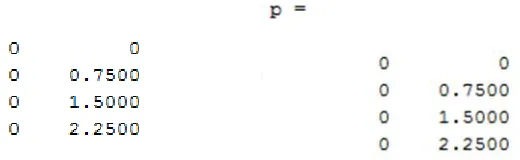
The QoS of the cognitive radio network is ensured by SINR maximisation at the transmitter side by using the MMSE beamformer which is a deterministic beamforming algorithm. MMSE technique minimizes the error with respect to a reference signal. It produces the weight vector without considering the signal or the environment. It randomly assigns the weights to each user. The weight vectors produced by the LMS algorithm are given by figure 1
Figure 2 shows the weight vectors generated by the MMSE algorithm. Transmit power calculated using the distributed beamforming algorithm with LMS and MMSE is given by figure 4 and figure 3. The values are generated after the optimization of transmit and receive beamforming vectors..
ISSN(Online): 2320-9801
ISSN (Print) : 2320-9798
I
nternational
J
ournal of
I
nnovative
R
esearch in
C
omputer
and
C
ommunication
E
ngineering
(An ISO 3297: 2007 Certified Organization)
Vol. 3, Issue 9, September 2015
estimation error as the difference between the desired response and the actual output. This estimation error is used to calculate the updated weight. Figure 5 shows the relation between total transmit power and minimum required SINR with number of users. Even though transmit power is reduced to minimum value, MMSE beamformer does not depend upon the nature of the incoming signal and the environment.
LMS algorithm iterates towards the MMSE solution if the environment is a static environment since the statistics of the noise and the incoming signals does not change. Thus the LMS algorithm iterate towards the fixed MMSE solution. This is shown in figure 6. LMS algorithm is initiated with an arbitrary value w(0) for the weight vector at n=0. The successive corrections of the weight vector eventually leads to the minimum value.
When the comparison of MMSE and LMS algorithm is made based on the power minimisation capability on a MIMO cognitive radio network, both algorithms shows the same performance under power minimisation.
Fig. 1.Weight vectors generated by the LMS algorithm.Fig.2. Weight vectors generated by the MMSE algorithm
ISSN(Online): 2320-9801
ISSN (Print) : 2320-9798
I
nternational
J
ournal of
I
nnovative
R
esearch in
C
omputer
and
C
ommunication
E
ngineering
(An ISO 3297: 2007 Certified Organization)
Vol. 3, Issue 9, September 2015
Fig.5Total transmit power vs SINR using MMSE Fig.6. Total transmit power vs SINR using LMS
VI.CONCLUSION AND FUTURE WORK
In this work, an adaptive algorithm is proposed for a MIMO cognitive radio network. The proposed LMS algorithm provides the adaptability property to the MIMO cognitive radio network. Since the work is carried out in a static environment, LMS algorithm iterates towards the MMSE solution. Thus, LMS algorithm provides the adaptive nature without compromising on the performance of the MMSE beamformer over the transmit power constraint.The main advantages of LMS algorithm includes:
-It estimates the gradient vector from the available data.
-It incorporates an iterative procedure which makes successive corrections to the weight vector. -It is relatively simple since it does not require correlation function calculation and matrix inversions. Hence the LMS algorithm outperforms the MMSE algorithm in a MIMO cognitive radio network.
REFERENCES
1. Young-Jin Kim, Hyoung-Jin Lim, Moon-Gun Song, and Gi-Hong Im, “Power EfficientTransceiver Designs for multi cell coordination in
MIMO Cognitive Radio Networks ", IEEE Trans. comm., Vol. 61, no. 10, Oct. 2013.
2. Y. J. Zhang and A. M. C. So, “Optimal spectrum sharing in MIMO cognitive radio networks via semi-definite programming", IEEE J. Sel. Areas Commun., vol. 29, no. 2, pp. 362{373, Feb. 2011.
3. H. Du, T. Ratnarajah, M. Pesavento, and C. B. Papadias, “Joint transceiver beamforming in MIMO cognitive radio network via secondorder
cone programming,", IEEE Trans.Signal Process., vol. 60, no. 2, pp. 781-792, Feb. 2012.
4. Y. J. Kim, C. H. Choi, and G. H. Im, “Space-time block coded transmission with phase feedback for two-user MIMO-MAC", in Proc. 2011
IEEE ICC
5. Rui Zhang and Ying-Chang Liang, “Exploiting multi-antennas for opportunistic spectrum sharing in cognitive radio networks", 18th Annual
IEEE International Symposium. 6.
BIOGRAPHY
Ms. Numa Joy, pursuing Master’s Degree in Communication Engineering at Amal Jyothi College of Engineering,
Kottayam, Kerala.She has obtained her Bachelor’s Degree from Mar Baselios Institute of Technology and Science, Kerala.