Electronic Theses and Dissertations
Theses, Dissertations, and Major Papers
1-1-2006
Fixed-width digital multipliers based on recursive architectures.
Fixed-width digital multipliers based on recursive architectures.
Kevin Biswas
University of Windsor
Follow this and additional works at:
https://scholar.uwindsor.ca/etd
Recommended Citation
Recommended Citation
Biswas, Kevin, "Fixed-width digital multipliers based on recursive architectures." (2006). Electronic Theses
and Dissertations. 7094.
https://scholar.uwindsor.ca/etd/7094
by
Kevin Biswas
A Thesis
Submitted to the Faculty o f Graduate Studies and Research
through Electrical Engineering
in Partial Fulfillment o f the Requirements for
the Degree o f Master o f Applied Science at the
University o f Windsor
Windsor, Ontario, Canada
2006
1*1
Published Heritage
Branch
Direction du
Patrimoine de I'edition
3 9 5 W ellington Street
O ttaw a ON K 1 A 0 N 4
C anad a
395, rue Wellington
Ottawa ON K1A 0N 4
Canada
Your file Votre reference
ISBN: 978-0-494-35955-6
Our file
Notre reference
ISBN: 978-0-494-35955-6
NOTICE:
The author has granted a non
exclusive license allowing Library
and Archives Canada to reproduce,
publish, archive, preserve, conserve,
communicate to the public by
telecommunication or on the Internet,
loan, distribute and sell theses
worldwide, for commercial or non
commercial purposes, in microform,
paper, electronic and/or any other
formats.
AVIS:
L'auteur a accorde une licence non exclusive
permettant a la Bibliotheque et Archives
Canada de reproduire, publier, archiver,
sauvegarder, conserver, transmettre au public
par telecommunication ou par I'lnternet, preter,
distribuer et vendre des theses partout dans
le monde, a des fins commerciales ou autres,
sur support microforme, papier, electronique
et/ou autres formats.
The author retains copyright
ownership and moral rights in
this thesis. Neither the thesis
nor substantial extracts from it
may be printed or otherwise
reproduced without the author's
permission.
L'auteur conserve la propriete du droit d'auteur
et des droits moraux qui protege cette these.
Ni la these ni des extraits substantiels de
celle-ci ne doivent etre imprimes ou autrement
reproduits sans son autorisation.
In compliance with the Canadian
Privacy Act some supporting
forms may have been removed
from this thesis.
While these forms may be included
in the document page count,
their removal does not represent
any loss of content from the
Conformement a la loi canadienne
sur la protection de la vie privee,
quelques formulaires secondaires
ont ete enleves de cette these.
Signal processing applications, in general, require a constant word size throughout
the processing system. This poses a problem for basic integer arithmetic operations,
where the result o f each operation has a tendency o f differing from the original operand
size. Multiplication is o f the biggest concern since each operation results in a product
that is potentially twice as large as the original operand widths. To alleviate the problem
o f expanding word widths, fixed-width multipliers are utilized.
This thesis will present some novel architectures for fixed-width recursive
multipliers. The high-performance recursive multiplier exhibits an inherent hierarchical
structure consisting o f several sub-multipliers, which makes it suitable for fixed-width
applications.
Four truncation schemes targeting the recursive multiplier have been
proposed, all o f which improve error statistics and generally reduce gate complexity,
propagation delay, and power consumption, with respect to the original full-width
multiplier. A fixed-width architecture targeting multi-level recursive multipliers will also
The work presented in this thesis would not have been possible without the
support from my colleagues, mentors and family. I am deeply indebted to all of them.
Firstly, I would like to express my sincere gratitude and appreciation to my
supervisor Dr. M ajid Ahmadi for his generous support and guidance. He has made, and
will continue to make, tremendous impact on me academically, socially and personally,
through his endless enthusiasm towards my work and excellent advice in all o f my
endeavours.
I would like to thank the faculty at the University o f Windsor, including my
internal reader, Dr. Huapeng Wu, and Dr. Maher Sid-Ahmed for their advice, guidance
and words o f inspiration. I would also like to thank my external reader, Dr. Arunita
Jaekel for her patience and support.
To Mr. Ashkan Hosseinzadeh Namin and Mr. Pedram Mokrian I also extend my
sincere gratitude and appreciation, not only for their sound technical advice, but for their
great friendship.
Finally to my parents, Olive and Nihar, my brother, Robert, and Nichole Jun, I
must extend my most sincere love and gratitude, for their unending support, patience and
A B STR A C T
...iii
D E D IC A TIO N
... iv
ACKNOW LEDGEM ENTS...v
L IST O F TA B LE S... viii
L IST O F FIG U RES...ix
CHAPTER
1. INTRODUCTION TO COMPUTER ARITHMETIC
1.1 Overview o f Computer A rithm etic... 1
1.2 Thesis H ighlights... 1
1.3 Thesis Organization...2
2. DIGITAL MULTIPLICATION OVERVIEW
2.1 Basics o f Digital Multiplication... 5
2.2 Sequential Multiplication... 6
2.3 Parallel M ultiplication... 8
2.4 Floating Point Number System and M ultiplication... 12
3. FIXED-WIDTH MULTIPLICATION
3.1 Overview o f Fixed-Width M ultiplication...15
3.2 Truncated M ultipliers...16
3.3 Truncation Schemes for Fixed-W idth M ultipliers...18
4. THE RECURSIVE MULTIPLIER
4.1 Overview o f the Recursive M ultiplication Algorithm ...25
4.2 Recursive Multiplication A rchitecture...27
5. FIXED-WIDTH RECURSIVE MULTIPLIER ARCHITECTURES
5.1 Proposed Truncation Schemes for Recursive M ultipliers... 31
5.2 Error Simulation and Analysis... 35
6.2 Simulation R esults... 44
7. FIXED-WIDTH MULTI-LEVEL RECURSIVE MULTIPLIERS
7.1 Multi-Level Recursive M ultiplication...46
7.2 Proposed Truncation Scheme for Multi-Level Recursive
M ultipliers... 47
7.3 Error Simulation and Complexity A nalysis... 48
8. CONCLUSIONS
8.1 Summary o f C ontributions...53
8.2 Concluding R em arks... 54
REFEREN CES...55
APPENDICES
Appendix A: C Code for Error Simulation Program s...58
Appendix B: Verilog HDL C ode... 68
Appendix C: Simulation Reports and Logs from Altera Quartus I I ...82
Table 3.1: Error Statistics for Constant Correction M ultipliers...20
Table 3.2: Complexity Savings From Truncation o f Array and Dadda M ultipliers
21
Table 5.1: Error Statistics for Proposed Fixed-Width Recursive M ultipliers...36
Table 5.2: Error Statistics for Different Fixed-Width M ultipliers... 37
Table 5.3: Complexity Savings Comparison o f Each Scheme (2
n
= 8 ) ... 40
Table 5.4: Complexity Savings Comparison for Larger M ultipliers (2
n
=16, 32,64).... 40
Table 5.5: Overall Performance Comparison o f Proposed Truncation Schem es... 41
Table 6.1: FPGA Simulation Results... 44
Table 7.1: Error Simulation Results for Fixed-Width Two-Level Recursive Multipliers49
Table 7.2: Maximum Positive Error for Different Levels o f Recursion... 51
Figure 2.1: Example o f Pen and Paper M ultiplication... 5
Figure 2.2: Partial Product Array for a 16-bit M ultiplication...6
Figure 2.3: Sequential Right-Shift M ultiplier... 7
Figure 2.4: Multiplication Performed Using Radix-4... 8
Figure 2.5: Standard Layout o f an Array M ultiplier...9
Figure 2.6: Flow Diagram o f a Column Compression M ultiplier...10
Figure 2.7: Dot Diagrams o f Dadda and Wallace M ultipliers... 11
Figure 2.8: IEEE Floating Point Standard Word W id th s... 13
Figure 2.9: A Floating Point Multiplication Scheme...13
Figure 3.1: Standard and Truncated Array M ultipliers... 17
Figure 3.2: Standard and Truncated Tree (Dadda) M ultipliers... 17
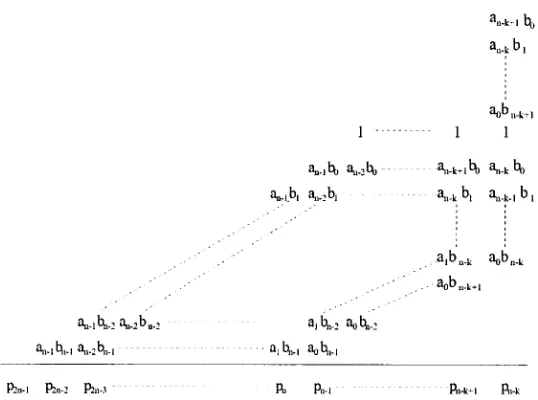
Figure 3.3: Truncated Partial Products Matrix with Constant Correction... 19
Figure 3.4: Truncated Partial Products Matrix with Data-Dependent Correction... 22
Figure 4.1: Block Diagram o f Recursive Multiplier A rchitecture... 27
Figure 4.2: Another Block Diagram o f Recursive Multiplier A rchitecture...27
Figure 4.3: Full Dot Diagram o f a Recursive Multiplier with «-bit Onput O perands
28
Figure 4.4: Delay Comparison o f Array, Dadda and Recursive M ultipliers...29
Figure 5.1: Fixed-W idth Recursive M ultiplier... 32
Figure 5.2: Proposal # 1 ... 33
Figure 5.3: Proposal # 2 ... 34
Figure 6.1: RTL Schematic Diagram o f a "32-bit Fixed-W idth Recursive Multiplier
Using Proposal #4 (16 correction bits)"... 43
Figure 7.1: Graphical Representation o f Truncation in a Two-Level Recursive
M ultiplier... 48
Figure 7.2: Graphical Representation o f Complexity Savings for
k ~
1,2, and 3 ...52
CHAPTER 1
INTRODUCTION TO COMPUTER ARITHMETIC
1.1 Overview of Computer Arithmetic
The computer has permeated our professional and private lives by simplifying
tasks which were once difficult or even impossible to carry out. Computers have a long
history, dating back several centuries, when mathematicians and scientists first developed
machines to help them manipulate and compute numbers [1]. The field o f computer
arithmetic was established at the birth o f these electronic computing machines. Today
the field is a sub-set o f computer architecture and deals with the implementation of
arithmetic algorithms in hardware and software for processor architectures and, more
specifically, arithmetic logic units (ALU). This thesis deals with the multiplication
architectures, which are critical components o f ALUs and other systems which perform
numerical processing. Specifically, multiplication in fixed-width applications will be
studied.
1.2 Thesis Highlights
This thesis will present a general investigation o f fixed-width multiplication and
truncation schemes, and will describe some novel architectures for fixed-width recursive
multipliers [2], The recursive multiplier, presented by Swartzlander et al. [3] exhibits an
inherent hierarchical structure consisting o f several sub-multipliers, which makes it
suitable for fixed-width applications. Four truncation schemes targeting the recursive
gate complexity, propagation delay, and power consumption with respect to the full-
width multiplier. Detailed error analysis and architectural complexity analysis have been
carried out for each design.
Hardware implementation o f the proposed fixed-width multiplier architectures has
been carried out in Altera Stratix EP1S10F484C5 FPGA. The resulting reductions in
propagation delay, power consumption and logic complexity with respect to the full-
width recursive multiplier have been tabulated and analyzed.
Further, the idea of fixed-width multipliers based on
multi-level
recursive
architectures has been studied in detail. The previous work regarding fixed-width single-
level recursive multiplication has been extended to the multi-level case, and error
analysis and complexity analysis have been carried out. N ew mathematical expressions
have been derived to estimate potential maximum error and complexity savings for the
general case o f
k
levels o f recursion.
1.3 Thesis Organization
The thesis will begin with a general overview o f digital multiplication, briefly
highlighting serial and parallel multiplication algorithms, in Chapter 2. Chapter 3 will
give an overview o f fixed-width multiplication and truncated multipliers. Further, some
o f the most well-known truncation schemes available will be described.
Chapter 4 is dedicated to the Recursive Multiplier. A n overview o f the recursive
or “divide and conquer” algorithm for multiplication proposed by Karatsuba and Ofman
(1962) [4] will be first given. Application o f the algorithm in the digital recursive
Chapter 5 will present novel architectures for fixed-width recursive multipliers.
Four new truncation schemes targeting recursive multipliers will be presented in this
chapter along with detailed error and complexity analysis. Chapter 6 will focus on
hardware implementation and simulation results o f proposed architectures. Chapter 7
investigates fixed-width multiplication using multi-level recursive architectures.
The
thesis will conclude with a highlight o f contributions and some closing remarks in
CHAPTER 2
DIGITAL MULTIPLICATION OVERVIEW
In modem digital systems, the component responsible for handling arithmetic
operations is the Arithmetic Logic Unit (ALU). These units mainly lie in the critical data
path o f the core data processing system elements. These include microprocessors (CPU),
digital signal processors (DSP), in addition to application specific (ASIC) and
programmable (FPGA) processing and addressing integrated circuits. Performance o f a
system, in regards to numerical applications, is directly related to the structure and design
o f the ALU.
The numerical operations carried out by the arithmetic unit may include, but are
not limited to: addition/subtraction, shift/extension, comparison, increment/decrement,
complement, trigonometric functions, multiplication, division, square root extraction,
logarithmic function, exponential function and hyperbolic functions [5].
One o f the critical functions carried out by the ALU is multiplication. Although it
is not the most fundamentally complex operation, digital multiplication is one o f the most
frequently used operations in signal processing and other applications. Because o f this,
digital multiplication is one o f the most widely studied areas in the field o f computer
2.1 Basics of Digital Multiplication
Generally speaking, digital multiplication involves a sequence o f additions carried
out on partial products. The means by which the partial products matrix is summed is the
key distinguishing factor amongst multiplication schemes [6].
The partial product array o f an
M
x
N
bit digital multiplication is determined
similarly to traditional pen and paper decimal multiplication. For example, multiplication
o f multiplier
X =
x„_2,
x„_3, ...
x2, x h x 0]
and multiplicand
A = [am_uam_2, a
m_3, ...
a2, ah
u„]
yields the final product
(n+m)-b\\
product:
P ~
P n
i m-2)P n m -h ■■■ Pt> P b P<)\ ~~
X „ . ] ( U m. | ,d m_
2,d m.3,
. . . ,d 2,
Cl/, Cl())
+X„_2(Clm_\, Clm.2, Clm.3,
. . . ,Ct2, Cl), Clo)
+ . . . +X ) ( d m.\, d m.
2 ,d m.3,
. . . ,d 2, d ) , d 0)
+X o ( d
m. ! ,d m.
2 ,d m_3,
. . . ,d 2, d ) , d o )
This multiplication can be illustrated in Figure 2.1, below.
a s
f l ja t
a g
x i
x 2
x i
x o
XgOs
X g flt
X f f i t
XgOg
X g fts
x 0a 2
x Sa l
x Ca 0
XgOs
XgOy
X g flj
XgOg
x 0°3
x 0a 2
x 0a l
x 0 °0
P ?
P i
P S
P 4
P i
P 2
P i
PO
Figure 2.1: Example o f Pen and Paper M ultiplication
A convenient notation for digital multiplication that visually represents the bits in
an algorithm is dot notation which was introduced in [7] [8].
The nature of the dot
in which they are manipulated, irregardless o f the value o f each bit. Figure 2.2 shows the
partial product array for a 16x16 multiplication [7].
ut
+
V
Product
Figure 2.2: Partial Product Array for a 16-bit M ultiplication [7]
2.2 Sequential Multiplication
Fundamentally, digital multiplication can be carried out through a sequence o f
shifts and additions o f the
multiplicand
to the partial product accumulator register based
on the values o f the individual bits comprising the
multiplier.
This primitive form o f
multiplication, known as shift-add multiplication, is very slow, despite having a very
simple implementation. The number o f cycles required to perform a full multiplication is
linearly proportional with the size o f the multiplier, and each cycle has a delay o f the
/ k
\ M U X
V"
k -b it A d d e rM u ltip lic a n d M u ltip lie r P a r ti a l P r o d u c t s
Figure 2.3: Sequential Right-Shift M ultiplier [6]
A variation o f the basic form o f digital multiplication is the high-radix
multiplication scheme. This form is similar to the shift-add algorithm mentioned before,
but differs in that more than one bit o f the multiplier is utilized on each clock cycle. Thus
the number o f clock cycles is reduced.
However, a requirement for this form o f
multiplication is the availability o f fixed multiples o f the multiplicand [5]. Figure 2.4
depicts the implementation o f a radix-4 multiplier where two bits o f the multiplier are
used in a clock cycle [6]. As can be seen, the multiples o f the multiplicand, A, 2A, and
3 A, need to be available. Thus the higher the radix o f a multiplier, the more stored values
will be required. Higher radix multipliers provide faster computation; but this is at the
expense o f additional hardware overhead consisting o f shift circuitry and storage registers
Partial Products
\ M U X
3A
OA 1A| 2A| (
i
2-bit shifts
Multiplier
\ /
k-bit Adder
Figure 2.4: Multiplication Performed Using Radix-4
2.3 Parallel Multiplication
As mentioned above, serial multiplication and the concept o f shift and add
algorithms is a primitive form o f multiplication techniques which offers simple
implementation, but lacks the performance o f parallel multipliers. Most modem high-
performance systems require faster algorithms for multiplication to reduce computation
latency as much as possible.
There are two distinct categories of parallel multipliers, namely, linear parallel
multipliers, and column compression multipliers (tree multipliers). The distinguishing
characteristic o f parallel multipliers is that partial products are generated simultaneously,
and can actually be considered a special case o f high-radix multiplication, where the
highest possible radix is used, i.e. radix-2i [6]. As well, parallel multipliers limit latency
associated with carry propagation to one final fast adder.
Linear parallel multipliers are more commonly known as array multipliers. The
term “linear” comes from the linear relationship that exists between operand size and
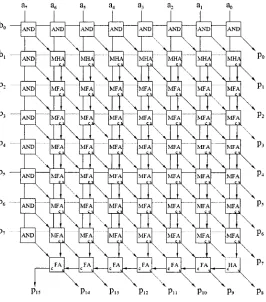
latency. The array multiplier exhibits a highly regular layout as shown in the 8-bit
design ideal for automated layout techniques, where bits o f the two input operands are
made available across the arrangement o f full adder cells. Basically the outputs o f the
adders trickle accordingly across the array until the edges o f the structure, where the
product bits are outputted. However, the limitation with the array scheme is that partial
products are introduced and reduced only one row at a time, not in parallel like in tree
multipliers. This results in slower performance. The delay o f the array multiplier has a
linear relationship, O(k), with respect to operand size.
a,
a6
a5
a4
a,
a;
a,
ao
A N D
MH.d
M F A M FA
FA H A
A N D A N D
M F A A N D
M FA
F A A N D
M FA
M FA
A N D
M FA A N D
A N D A N D
M FA M FA
M F A M FA
M F A M FA
M FA M F A
M F A
M F A
FA
M F A
M FA M FA M FA M F A
A N D
A ND
A N D M FA M F A
M FA M F A
FA F A
M F A M H A
M FA A N D
t>5 —r
A N DM F A
M FA A N D
F A M F A
M F A
P i 5 P l4 P 13 P l2 P l l PlO P 9 P s
Figure 2.5: Standard Layout o f an Array M ultiplier
(M FA = full adder + AND gate, MHA = half adder + AND gate)
The tree multiplier, unlike the array multiplier, offers the potential for only a
logarithmic increase in delay relative to operand size.
The foundation for these
Dadda, and Yu Ofman [10][[11]. In these designs, once bits o f the partial product array
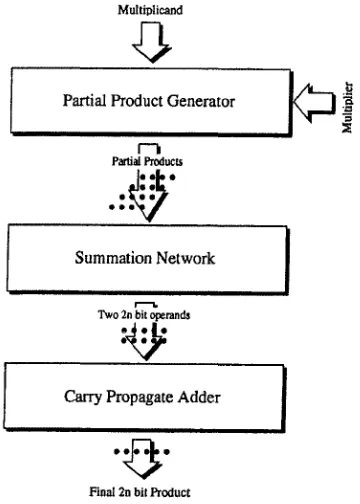
are generated (in parallel), they are passed onto a reduction network, which performs
column-wise compression of the bits, forming two final partial products. Subsequently, a
final fast adder is used to sum these last two terms. A flow diagram o f the column
compression multiplication process is shown in Figure 2.6 [7], Latency approximation of
a column compression multiplier shows that delay is logarithmic 0(log(A)) with operand
size, a significant improvement over array multipliers, in terms o f speed.
Multiplicand
Partial Products
Two 2n bit operands
Partial Product Generator
Carry Propagate Adder
Summation Network
Final 2n bit Product
Figure 2.6: Flow Diagram o f a Column Com pression M ultiplier
Wallace [10] initially proposed the method o f using Carry-Save Adder (CSA)
arrays to carry out the column-wise compression o f the partial product bits.
Consisting
o f a series o f non-interlinked Full-Adder blocks, CSA is the most commonly used form
the CSA column compression tree so that the minimum number o f counters is utilized
[11]. Wallace and Dadda multiplication schemes are depicted in Figure 2.7.
Despite the characteristic high speed performance o f column compression
multipliers, there are several drawbacks when taking into consideration their
implementation. Column compression multipliers exhibit a highly irregular architecture
leading to inefficient VLSI layout.
As process technologies delve into submicron
dimensions, irregular interconnections can potentially cause issues like clock skewing
and interconnect delay [12].
Column 22 21 20 19 18 17 16 15 14 13 12 11 10 9 8 7 6 5 4 3 2 1 0 Column 2221 20 1918 17 16 15 14 13 1211 10 9 8 7 6 5 4 3 2 1 0
Stage L
(3.2): 8 (2.2): 4
Stage 2 (3.2): 27 (2.2): 3
Stage 3 (3,2): 28 (22): 2
: x ////x
: : / / / x :
: : : > x ::
/ / / / / / / / / / / / .
;
y / / / / / / / / a
:
: :
/ / / / / / / y
: :
V / / / / / / / / / / / / / / A
:
V / / / / / / / / / / / / A
:
(w>7 •
V / / / / / / / / / / / / / / / / A
:
(2,2). 1
• * • • » • • • • » * ■ « • • • • • • •g |»
V / / / / / / / / / / / / / / / / / / A
Y / / / / / / / / / / A
X
/// / / / / / / / X
•
X
/ / / / / / / / / / X
*
Stage I:s :r X
/ / / / / / / / / / X
. .
Y / / / / / / / / / / A
A A A / / / / / / / / / A A
'
(3.2): 2 0 ...
(2.2): 6 ...
X X //////////X X
Stage 3££f A A / / / / / / / / / / A A
Stage 4 (3.2): 11
(2.2): 3 .
Y A / / / / / / / / / / / A A A
gvxx/x//x/x/x//xxxxx
2.4 Floating Point Number System and Multiplication
To achieve the levels o f precision demanded by modem systems, it becomes
necessary to have a number system that is capable o f representing real numbers. Fixed-
point systems, in which location o f the decimal point is pre-defined, suffer from limited
range and/or precision. To alleviate this issue, floating-point number systems are utilized
[5]. Unlike fixed-point representations, floating-point system allows for extremely large
or small numbers to be described with a high degree o f precision by using a dynamic
range.
According IEEE standard for binary floating-point systems [13], a floating-point
value is defined as:
x = ± f x b e
where x is the floating-point value, / is the fraction o f mantissa,
b
is the base (fixed at
b=
2) and
e
is the exponent. Floating point numbers have two distinct representations
according to the standard depending on operand size. Figure 2.8 depicts the differences
between the two floating point standards, in terms o f word structure. The sign (s),
exponent
(e),
and fraction/mantissa
(f)
form the 32 and 64 bit precision formats. The
mantissa is normalized to be in the range o f [1,2) so that the most significant bit (MSB) is
always a 1. In this way, the leading 1 is removed and considered a “hidden one”, thus
saving one bit in the representation.
To ensure a positive value, the signed integer
exponent is biased accordingly. The exponent is biased for 127 for single, and 1023 for
(a)
(b)
23
11
52
msb
Figure 2.8: IEEE Floating Point Standard W ord W idths for
(a) Single Precision and (b) Double Precision
Figure 2.9 shows a block diagram o f the multiplier implementation for floating
point numbers. As described above, floating-point numbers are composed o f a biased
non-negative integer exponent, and a fixed-point fractional representation o f the
mantissa. Thus, mathematical operations that are carried out on floating-point numbers
will use fixed-point arithmetic units with additional control and rounding circuitry to
accommodate for the dynamic range.
Because o f this, when designing arithmetic
hardware, much attention is placed on fixed-point integer units. Conversion to floating
point is made possible through additional circuitry. Figure 2.9 also shows the additional
blocks surrounding the integer multiplier component.
U n p a ck
A d d X B ias
Multiplier
SubA d d
\ Add
A d d
P ack X O R
R ig h t S hift
Normalize
R o u n d
Since the basics o f fixed-point arithmetic form the framework for floating point
calculations, the remainder o f this thesis will target integer arithmetic structures in
CHAPTER 3
FIXED-WIDTH MULTIPLICATION
3.1 Overview of Fixed-Width Multiplication
As previously mentioned, multiplication is one o f the most widely studied areas in
the field o f computer arithmetic, due to the frequency o f use in numerical applications,
such as signal processing. In many o f these applications, such as filtering, convolution,
Euclidean distance, and Fast Fourier Transform (FFT) [15] [23], a constant operand size is
required throughout the processing system. When designing arithmetic hardware for
such a system, constant operand size is an important constraint to take into consideration.
In certain signal processing applications, word sizes could grow significantly large. For
example in a complex FFT, if the initial word size is 16 bits real and 16 bits imaginary
and the sines/cosines are 16 bits each, maintaining full precision causes a growth o f 18
bits (17 bits for the complex multiply and 1 bit for the complex add) per stage. For a
1024 point FFT there are 10 stages producing a final data size o f 196 bits [16]. For
addition and subtraction, the problem is relatively easy to solve, as the result is
potentially only one bit larger than the operands (assuming that the operands are equal in
size). Rounding is accomplished by adding a ‘ 1 ’ to the least significant bit position and
truncating the sum at that position. In many cases the ‘ 1’ can be added as a carry into the
addition so that no extra hardware or time is required to produce a rounded sum or
difference [16]. However, o f all the arithmetic operations, multiplication is o f the biggest
concern, because the resulting product o f two operands could potentially have a word size
To alleviate the problem o f expanding word widths in multiplication, fixed-width
multipliers are utilized [17]. An
n
x
n
fixed-width digital multiplier generates only the
most significant
n
product bits with two «-bit inputs. If
X
and
Y
are two
n
-bit unsigned
numbers where,
A = f > , . - 2 '
and
Y = ^ y j -2J
1=0
j
= 0the product,
P,
o f
X
and
Y,
which is a weighted sum o f partial products, is therefore:
n- 1 n ^ l 2 n - \
i= 0
j =
0k=
0The fixed-width product is:
c
= Z
r
' 2‘
k=n
Thus a fixed-width multiplier can be easily realized by using only
p
2
n-
i,
■■■, p n
outputs o f
the full-width multiplier. In order to reduce the error due to truncation, output rounding
is often carried out. Before truncation, rounding is applied [14] by adding a ‘1’ at the
nA
least significant position o f the product o f the full-width multiplier.
3.2 Truncated Multipliers
Literature shows that the “fixed-width” property can be exploited to reduce
hardware complexity with respect to the full-width multiplier [9]. Truncated multipliers,
in which less significant columns o f the partial product matrix are removed, are often
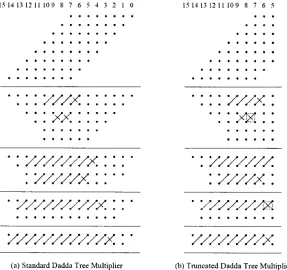
used in fixed-width applications. Example o f a truncated array multiplier and Dadda
b4
b,
MFA
MFA MFA MFA MFA MFA
MFA
MFA AND
P:
s.
Pi
V
P“1
P> b,
b,
b4
b,
P6
b7
P i s P m P l 3 P12 P i l Pifl P s
(a) Standard Array Multiplier
MFA
MFA
AND MFA RFA
l \ r r \
MFA AND
MFA
MFA MFA
P is P u P l 3 P12 P n P ic
(b) Tnm cated Array Multiplier
Figure 3.1: Standard and Truncated Array M ultipliers
15 14 13 12 11 10 9 8 7 6 5 4 3 2 1 0 15 14 13 12 1 1 10 9 8 7 6 5
XXXX
: x x :
xxxx
•: xxxxxxxx x x
: xxxxxx
x * •
• xxxxxxxxxx :: *
• • « • • • • • * • • •
xxxxxxxxxxxx: ■
*: xxxxxxx
: xxxxx:
• xxxxxxxx
xxxxxxxxx
(a ) S tand ard D a d d a T re e M u ltip lie r (b ) T ru n ca ted D a d d a T re e M u ltip lie r
3.3 Truncation Schemes for Fixed-Width Multipliers
Several truncation schemes have been developed— all o f which involve not
generating the complete partial products matrix and then applying some correction
scheme to reduce the error due to truncation as well as post-rounding. This subsection
examines some o f the schemes which currently exist for parallel multipliers.
Constant Correction Truncation Scheme
In [18], Schulte and Swartzlander, Jr. presents a technique for parallel
multiplication which computes the product o f two numbers by summing only the most
significant columns o f the multiplication matrix, along with a correction constant. This
correction constant is chosen such that average and mean square errors, with respect to
the full-width multiplication, are minimized.
In the conventional parallel full-width multiplier,
n2
partial product bits are
summed to produce the final 2
n
bit product. As mentioned before, the fixed-width
multiplier is formed by rounding the 2
n
result to
n
bits.
Substantial hardware savings can be achieved by truncated multiplication, where
only the
n+k
most significant columns o f the partial products matrix are summed.
Truncated multiplication involves two sources o f error, namely, reduction error and
rounding error.
Reduction error results from summing the partial products matrix
without the
n-k
least significant columns. Rounding error occurs because the product is
rounded to
n
bits. To compensate for these two sources o f errors, a correction constant is
added to the
n+k
most significant columns o f the partial products matrix, as shown in
presented in [19]. In this paper reduction error and rounding error are treated separately,
resulting in a poorly selected correction constant. Also, the constant is allowed to take on
arbitrary values, which is unfavourable for practical implementations. The correction
constant should be limited to the
n+k
most significant columns.
Ca-1 * - - - ...- Cu-k -l C u-k
^n-k+l^\) ^n-k ^3
an-ibi... (Vt bi Ak-ib
i
. a i b o k a 0b il k
. - ' a 0b n - M
K X i
A ’bn-2
-... --■■■■... 81 ba-2
r
A -
i
anA-i... a A i f'ohi-i
f t a - 1 f t a - 2 f t * 3 --- R . f t - 1 ---P U - 1 f t - k
Figure 3.3: Truncated Partial Products M atrix with Constant Correction
The value o f the computed product can be expressed in the following way:
P ' = P + F
+ F
+ C
r r ^ ^ reduct ^ ^ r o u n d ^ ’where
P
is the true product,
Ereduct
and
Eround
are the reduction and rounding errors, and C
is the correction constant. To minimize the average error o f the truncated multiplication,
or
P ’-P,
the correction constant is selected to be as close as possible to the negative o f the
expected value o f the sum o f the reduction error and the rounding error. Assuming that
the probability o f any input bit,
a,
or
bj,
being a one is 0.5, and a partial product bit, 0.25,
the following formula can be used in determining the correction constant, C [18]:
round(2n+k ■ Etotal)
2n+k
where
E „ ,
= - ^ " s ' («■ + D •
- (1 - 2~‘ )
Using exhaustive simulation, error statistics have been determined for multipliers o f size
n
= 8, and 16 bits. Average error, variance and maximum error have been tabulated, as
shown in Table 3.1. As can be seen, as
k
decreases, errors generally tend to increase.
Table 3.1: Error Statistics for Constant Correction M ultipliers
n
A
Eave
Variance
t-max
17
8
1
-9.766 x iff4
0.1667
2.5039
2
6.152 x 10"2
0.1040
1.2539
3
6.152 x 10'2
0.0903
0.7539
4
-1.660 x 1 O'2
0.0842
0.6289
5
-9.766 x 1 O'4
0.0834
0.5352
8
1.953 x 10‘J
0.0833
0.5000
16? ;
1
-3.815 x 10'b
0.2917
5.5000
2
6.250 x 10‘2
0.1354
2.7500
3
6.250 x 1 O'2
0.0983
1.5000
4
-1.563 x lO"4
0.0861
1.0000
5
-3.815 x 10'6
0.0839
0.7188
16
7.629 x 1 O'6
0.0833
0.5000
As described earlier, parallel multipliers are usually implemented as array or tree
(column compression) multipliers. Conventional
n
x
n
multipliers require
n2
AND gates,
n - 2n
full adders and n half adders. If the least significant
t
=
n-k
columns are omitted
from computation then hardware savings can be approximated as [18]:
AND gates, ——
—— Full adders, ( t- 1 ) H alf adders.
A typical
n
x
n
bit Dadda multiplier requires
n2
AND gates,
n2-4n+3
full adders and
n
- 1
half adders (for
ri>
2).
Similarly the hardware saved with a truncated Dadda multiplier
(f>l) is [18]:
AND gates,
Full add
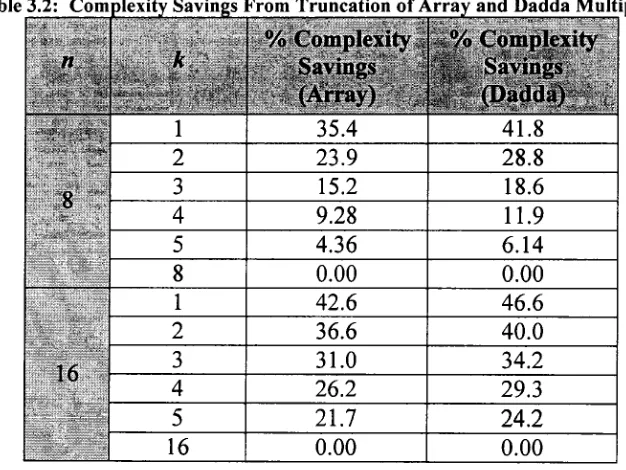
The following table (Table 3.2), taken from [18], shows hardware savings for various
sizes o f truncated multipliers with respect to a conventional multiplier utilizing true
rounding. This data is calculated based on the assumption that relatives sizes o f AND
gates, half adders and full adders are 1, 4 and 9, respectively. Complexity savings are
slightly higher for Dadda multipliers. As expected, a small value o f
k
results in larger
complexity savings.
Table 3.2: Com olcvity Savings From Truncation o f Array and Dadda M ultipliers
71
i*£ - -V
* - r.
* t '*<•
% Complexity
Savings
(Array)
% Complexity
Savings
(Dadda)
P
V
W
W
M
H
1
35.4
41.8
2
23.9
28.8
3
15.2
18.6
4
9.28
11.9
5
4.36
6.14
8
0.00
0.00
16
1
42.6
46.6
2
36.6
40.0
3
31.0
34.2
4
26.2
29.3
5
21.7
24.2
16
0.00
0.00
Data-Dependent (Variable) Correction Truncation Scheme
In the constant correction method for truncated multiplication, the correction term
does not depend on the values o f the bits in the truncated portion o f the partial products
matrix. Potentially, this could lead to relatively high errors, in the case that the all or the
majority o f truncated bits are a zero or a one.
In [20], King and Swartzlander, Jr. presents a correction method that uses the
This results in a variable correction term, which can further minimize distortion to the
result.
In the method o f constant correction, the maximum error occurs when truncated
bits (columns
n+k
+ 1 and beyond) are all zeros or all ones. If the truncated bits are all
zeros, then the final error with respect to the full-width multiplier would be equal to the
correction value. In this case, ideally, the correction value should be set to zero. If the
n+k+l
column contains the same number o f ones as zeros, then the constant proposed in
by Schulte and Swartzlander in [18] should be used. Finally, if the
n+k+l
column
contains all ones, the correction value should be changed to a maximum value. King and
Swartzlander use the number o f partial products available in the
n+k+l
column. The
correction term is simply added as a “Carry-in” to the
n+k
column, as shown in Figure
3.4.
a „ . k - i h ,
a o i , n -k » l
1
1
1
a»A a„A
a ^ A
bn
a.-i.b, a^b,
a,,.t b, a ^ b ,
. a,bu.k Etobjj.,.
.
- a0b„.^,
a» A : a^b..,
a, b,.: a A :
Vibi.! a,,A-i
a,^,., aA.i
P ’n -l p 2 n -2 P211-.I P u Pn-1 R i-k + l R i-k
Figure 3.4: Truncated Partial Products Matrix with Data-Dependent Correction
Results show that mean error, maximum error and variance are improved with
array multipliers, while constant correction schemes are more suitable for tree multipliers
[9]-Other Truncation Schemes
Since the work o f Swartzlander, Lim, Schulte, and King in the late 1990s, there
have been several new schemes, fundamentally based on the concepts o f constant and
variable correction, presented in literature.
A correction algorithm is developed in [21] by Jou et al. where the partial
products in the most significant column o f the truncated portion o f the matrix are
summed together. From this sum, a correction constant is calculated that approximates
the sum o f the dropped partial products. The method improves error over traditional
constant correction, however the implementation is based on a ripple architecture that is
slow in speed and consumes much power [15].
In [22], Van et al. propose a fixed-width multiplier architecture that is similar to
the constant correction method, where a constant is added to the remaining partial
products matrix after truncation. The correction factor, however, is not based on the sum
o f the most significant column o f the truncated portion, but rather is a function o f the
single partial products o f the subset.
Only signed multipliers are considered.
Implementation o f the error-compensation function is based on ripple architecture as
well.
In [15] Strollo et al. presents a new error-compensation network for fixed-width
multipliers, consisting o f two summation trees which are optimally chosen in order to
better accuracy with respect to previous methods, and implementation o f the error
correction network requires only a few gates with a tree architecture, and thus is best
suited for tree multipliers.
Literature shows that many truncation schemes have been proposed that generally
target only array and tree multipliers. The next chapters o f this thesis are dedicated to the
recursive multiplier, originally presented by Danysh and Swartzlander [3], It will be
shown that this multiplier’s hierarchical composition makes it very suitable for fixed-
width applications. The concepts o f truncation schemes described in this chapter will be
extended to this multiplier design, resulting in four novel fixed-width multiplier
CHAPTER 4
THE RECURSIVE MULTIPLIER
4.1 Overview of the Recursive Multiplication Algorithm
One o f the pioneering schemes for “divide and conquer” multiplication was
proposed by Karatsuba and Ofman in 1962 [4]. The Karatsuba-Ofman Algorithm (KOA)
computes the multiplication o f two long integers by executing multiplications and
additions on their divided parts.
It is possible to perform multiplication o f large numbers in significantly fewer
operations than the usual brute-force technique o f long multiplication. As discovered by
Karatsuba and Ofman, multiplication o f two «-digit numbers can be done with a bit
complexity (number o f single operations o f addition, subtraction and multiplication) o f
less than
n2.
The algorithm can be illustrated with the following example [24], using two
base
X
numbers,
Ni
and
N 2,
each consisting o f two digits:
N x - a 0 + axX
N 2 = bQ+bxX
Their product can thus be written as:
p
=
n x
-
n
2
=
a0b0 +
(
a0bx + axb0) X + axbxX 2
= p 0 + p xX + p 2X 2
Now let:
qQ = aQb0
The term
q\
can then be written in terms o f
po,p\,
an d
p 2:
< h = P i + P o + P 2
But, since
po
=
qo
and
p 2 = q2,
it follows that:
Po=<lo
A = 0 1 -0 0 - 0 2
Pi ~~
Thus the three digits o f
p
have been evaluated using three multiplications rather than
four.
When the concept is extended to multi-digit numbers, the trade-off o f more
additions and subtractions becomes evident.
Danysh and Swartzlander have utilized the fundamentals o f KOA in their digital
recursive multiplication algorithm presented in [3].
Mathematically, the recursive
algorithm is established around the fact that any 2
n
x 2
n
bit multiplication may be carried
out through four
n
x
n
bit sub-multiplications. Consider two unsigned 2/r-bit operands,
the multiplicand
A = A
h
x 2" +
A
l
and multiplier
X
=
X u
x 2" +
X L,
where the
subscripts denote the lower and upper
n
bits respectively. The multiplication o f
A
by
X
may then be given by:
Y = A - X
= K » 2
" +A
l
) - {
x h x
T + X l )
= A „ - X „
x2 1" + ( J
l- X
h+ A
h- X , )
x2 ’ + A
l- X 1.
Multiplication and addition are thus carried out on the divided components of
A
and
X,
4.2 Recursive Multiplication Architecture
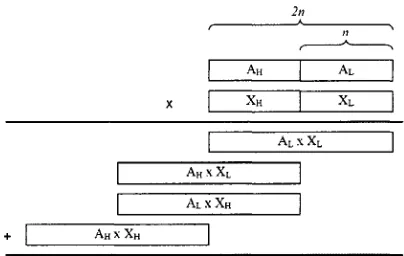
Block diagrams illustrating the same recursive multiplier architecture are shown
in Figures 4.1 and 4.2.
2n
•--- ‘-;
---____
| Ah j Al |
X | X H 1 X L |
| Al xXl |
|
A
h
x X
l
|
| A l x XH |
+ Ah x Xh
Figure 4.1: Block Diagram o f Recursive M ultiplier Architecture
I n
Aff x XL
A
h
x
X
h
A
l
X
XL
A
l
x X H
+
Figure 4.2: Another Block Diagram o f Recursive M ultiplier Architecture
As can be seen, the overall multiplication may be reduced to four smaller
multiplications, and this process may be repeated using even smaller multipliers for the
base multipliers. To minimize the resulting reduction delay introduced by subdividing
and parallelizing the process, the intermediary products o f the sub-multipliers should be
yield the final product. A dot diagram, for a typical recursive multiplier with «-bit
operands is shown in Figure 4.3.
n-bit multiplier
input operands
4 intermediary
n-bit products in
carry save form
i i
i 4 * 4 1 1 4
HALF-ADDER
J
Reduction Cells
I
V
: | 1'
i
■ • .i
.■
t <
H I'
1 '’ r T 1
-• 4 i >
11 ’
; H i ;
Final Carry-Out T
is omitted
2n-l
lti/2 -1
I
nf
2
Figure 4.3: Full Dot Diagram o f a Recursive M ultiplier with n-bit Onput Operands [5]
There are two significant benefits in using the recursive multiplier [3]. Firstly,
use o f the recursive multiplier allows for a highly regular design and scalability similar to
traditional array and modified Booth multipliers. Secondly, unlike array and modified
Booth multipliers, the recursive multiplier can achieve a delay o f 0 (lo g
n)
similar to fast
multipliers such as Dadda and Wallace. Traditional array and modified Booth multipliers
are capable o f only O
(n)
delay.
Figure 4.4 shows a graph illustrating this delay
comparison. The delays for a typical array multiplier, Dadda multiplier and recursive
multiplier may be estimated with the following expressions [3]:
^Anay = 1+ 3 (« -1 ) + 41og2(/I-1 )
Ajadda =1 + 3(2 log2
(n
-1 )) + 3 log2 (« + 1)
600
— D adda
— Recursive
500
400
a 300
200
100
-80
100
120
140
160
180
Multiplier Size (bits)
Figure 4.4: Delay Comparison of Array, Dadda and Recursive M ultipliers
Essentially, the recursive multiplier reaps the benefits o f both worlds:
the
regularity and scalability o f array and Booth multipliers, and the fast performance of
Dadda and Wallace tree multipliers. Even with the use o f array multipliers as the base
multiplier in the recursive hierarchy, a delay o f 0 (log
n)
is achieved. Use o f a faster
multiplier as the base case can slightly improve performance at the expense o f additional
complexity and irregularity.
P. Mokrian et al. presented a reconfigurable recursive multiplier architecture that
actually outperformed the typical high-performance Booth-recorded Wallace Tree
multiplier in terms o f delay (17% reduction), dynamic power consumption (20%
reduction) and area utilization (12% increase) [5].
The recursive multiplier provides a simple alternative to traditional Booth and
array multipliers with speed that is comparable or even faster than Wallace and Dadda
times. The multiplier is also scalable to higher bit precisions by simply duplicating sub
multipliers and adding additional levels o f reduction. A negative aspect o f the recursive
multiplier is its difficulty in handling 2 ’s complement numbers. However, since we are
interested in floating point implementations consisting o f fixed-point unsigned integer
multipliers, this disadvantage o f the recursive multiplier need not be an issue in this
study.
After examining the benefits o f the recursive multiplier, it was found that the very
regular composition o f the architecture allows it to be readily applied in systems
requiring fixed-width processing.
As described before, literature shows that many
truncation schemes are available for array and tree multipliers, but none specifically for
multipliers based on a recursive architecture. The ensuing chapters will present new
truncation schemes that target the recursive multiplier. The standard array multiplier will
be used as the base multiplier in all designs, which allows for more convenient
CHAPTER 5
FIXED-WIDTH RECURSIVE MULTIPLIER ARCHITECTURES
The preceding chapter provided an overview o f the recursive multiplication
algorithm (KOA), as well as the architecture for digital recursive multiplication,
presented by Danysh and Swartzlander.
The recursive multiplier has an inherent
hierarchical structure that consists o f several sub-multipliers, making it very suitable for
fixed-width applications. Itwill be shown that rather than modifying the sub-multipliers’
structure, a truncation scheme can simply remove one sub-multiplier and replace it with a
data-dependent correction term.
As mentioned before, fixed-width multipliers have been mainly targeting array
and tree structures [9]. Truncation schemes usually involve omitting a certain number o f
the least significant columns o f the partial products matrix and then adding a constant or
data-dependent correction term to the truncated partial products matrix to reduce the error
due to truncation. Generally, rounding is then applied to the multiplier’s output. In this
chapter, four new truncation schemes targeting the recursive multiplier are proposed.
The associated computation error is analyzed, and a summary o f complexity savings
incurred as a result o f truncation is given as well.
5.1 Proposed Truncation Schemes for Recursive Multipliers
As described before, the overall multiplication in a single-level recursive
multiplier is reduced to four smaller sub-multiplications. The product o f the multiplicand
Y = A X
= ( Ah x T + Al ) . ( X h x T + X l )
= AH - X H x 2 2n+ ( A L . X H + AH - X L) x T + AL - X L.
Graphically, a fixed-width recursive multiplier can be represented by Figure 5.1. It is
clear that the accumulation o f four sub-products yields a
An
bit result whereas the product
(denoted as
Y)
has only 2
n
bits. In this format, it is evident that the first sub-product,
A
l
X
l
(highlighted), is o f minor significance with respect to the rounded 2
n
bit product.
The truncation schemes to be presented thus target this particular component.
2n
_ A .
r
.X
)7
s
...
... -\
A
hA
lX
hX
l+
A
hx X
hY
A
hx X
lA
lx X
h---
Y---2n
Figure 5.1: Fixed-Width Recursive M ultiplier [2]
In all the proposed truncation schemes, the sub-multiplier
A
l
X
l
is removed and
subsequently, a data-dependent correction term is added. In the design process o f all
schemes, it was desirable that the new correction term be relatively easy to generate and,
at the same time, maintains some partial information regarding the magnitude o f the sub
paragraphs and illustrated in Figures 5.2-5.5. All schemes have a relatively short design
time.
In Proposal #1, we simply use
A
h
X
l
or
A
j
X
h
to replace the least significant
truncated term
A
l
X
l
-
In this fashion, some partial information regarding the magnitude of
the partial product is maintained, while no actual multiplication is carried out. The
advantage o f this scheme lies in the fact that the correction value is a significant term
already generated in the calculation, and thus no extra costs are created.
2 n
_______
K
_______
'
'
<>•'
A.
xh
A
hX
l|
4
A
jj
X
h
I
|
AjXff
|
Figure 5.2: Proposal #1
In Proposal #2, the average o f the two blocks,
AuXL
and
A
i
X
h
,
is placed in the
block o f
A
l
X
l
after truncation. This approach involves the addition o f four rows to the
partial product reduction tree o f the overall recursive structure, where the rows would be
A
h
X
l
/2 and
A
l
X
h
/2
in carry save format. This is simply a shifted version o f the two
previously generated sub-products, thus adding no significant complexity to the
architecture. The motivation behind this architecture is that a correction term with a high
A
r
A
l
AhXl + AlX „ 2
A
h
X
h
a l x h

![Figure 2.2: Partial Product Array for a 16-bit Multiplication [7]](https://thumb-us.123doks.com/thumbv2/123dok_us/1476875.1180814/17.611.148.497.163.370/figure-partial-product-array-bit-multiplication.webp)
![Figure 2.3: Sequential Right-Shift Multiplier [6]](https://thumb-us.123doks.com/thumbv2/123dok_us/1476875.1180814/18.611.223.421.74.210/figure-sequential-right-shift-multiplier.webp)