ISSN(Online): 2319-8753 ISSN (Print): 2347-6710
I
nternational
J
ournal of
I
nnovative
R
esearch in
S
cience,
E
ngineering and
T
echnology
(A High Impact Factor, Monthly, Peer Reviewed Journal)
Visit: www.ijirset.com Vol. 8, Issue 7, July 2019
The Study of Pylon Height Variation for Cost
Optimization of Extradosed Bridge
Tejashree G. Chitari*
1, Trupti N. Narkhede
*2ME Student, Department of Civil Engineering, MGM’s College of Engineering and Technology, Navi Mumbai,
Maharashtra, India*1
Assistant Professor, Department of Civil Engineering, MGM’s College of Engineering and Technology, Navi Mumbai,
Maharashtra, India2
ABSTRACT: The extradosed cable-stayed bridge is a new type of bridge developed in recent years. Extradosed bridges would be a midway between a cantilever constructed bridge and cable stayed bridge working part on the bending of the girder and part on the cable suspension of deck and combining some features of each one. In this paper the extradosed bridge is analysed using MIDAS civil software by varying the pylon height to get the optimum solution. And the effect of pylon height variation on the bridge deck and ultimately on the cost of the bridge is presented in this paper. And it is concluded that by increasing the pylon height means by decreasing the span to pylon height ratio the cost of the bridge is increases.
KEYWORDS: extradosed bridge, optimization, pylon height, MIDAS, cost of the bridge
I. INTRODUCTION
Bridge Engineering Has Become One of the most important needs for Today. There is a significant improvement in the area of construction methods of the bridges. Because of higher knowledge in area of prestressed concrete in recent decades’ new structural system have emerged and have been used in construction of bridges and viaduct. An example of this development is the case of bridge known as extradosed. An extradosed bridge employs a structure which combines the main elements of both a prestressed box girder bridge and a cable-stayed bridge.
The extradosed bridge concept is relatively new in the field of structural and bridge engineering. In extradosed bridge, cables are anchored with box girder which increases the compressive force of girder and allow the box girder to carry huge loads, this is the basic concept of extradosed bridge which allows it to work together with long span and lower tower height. Extradosed bridge also has large girder stiffness as compared to cable stayed bridges. In terms of cost, they can be competitive in comparison to even 200m long cable stayed bridge. The extradosed bridge also can be an attractive proposition for relatively small landmark structures.
1.1 Extradosed Bridge History:
ISSN(Online): 2319-8753 ISSN (Print): 2347-6710
I
nternational
J
ournal of
I
nnovative
R
esearch in
S
cience,
E
ngineering and
T
echnology
(A High Impact Factor, Monthly, Peer Reviewed Journal)
Visit: www.ijirset.com Vol. 8, Issue 7, July 2019
Mathivat was inspired by the design used by Swiss engineer Christian Menn for the Ganter Bridge which was completed in 1980. The entire design was based on cable stayed bridges, but it represents clearly the first example of an extradosed deck. Therefore, it can be said that Mathivat finished the Menn’s initial concept, naming the tendon “extradosed prestressing” as opposed to stay-cables.
1.2. General Specifications for extradosed bridge:
Type of connections between deck and piers:
There are two main types of connection between the deck and the piers, either fixed or simple supports. In an extradosed bridge, the manner in which the deck is fixed to the piers is the most appropriate providing when considering the live load action. This solution should always be adopted, except when the piers are too short to accommodate the displacements caused by creep, shrinkage and uniform temperature gradient of the deck.
Influence of side span length:
The span distribution in the bridge is usually conditioned by topographical, geological and water issues. Side span should be 0.6 to 0.8 of the main span, to balance the negative bending moment in deck on each pier side.
Tower height:
Mathivat was the first to define a recommended height for the towers of an extradosed bridge, by suggesting a span to tower height ratio of 15. After parametric studies one of the author komiya suggested a span to tower height ratio between 8 and 12 and chio cho in 2000 suggested the tower height should not exceed main span.
Cross section depth:
Mathivat suggested that the deck should have a span to cross-section depth ratio between 30 to 35 for a constant depth section. For variable cross section’s komiya suggested a span to cross-section depth ratio of 35 at the pier section and 55 at mid-span. On the other hand, one of the author chio cho suggests the ratios of 30 and 45, respectively.
Extradosed cable arrangement:
As for cable stayed bridges, there are three types of extradosed cables arrangements: the fan configuration, the harp and mix between the two creating a semi-fan configuration more often used.
II. LITERATURE REVIEW
Various researchers have presented different methods for optimising the extradosed bridge using different parameters and techniques.
Rohini R. Kavathekar and Dr. N.K.Patil (2018) has studied the characteristics of extradosed and cable stayed bride. In this paper spans of 100m, 150m, 200m, 250m, and 300m are considered for analysis. Different parameters are studied for extradosed and cable stayed bridge which includes response of deck, deck moment, study of pylon, how the response of bridge varies span wise, from aesthetics point of view feasible bridge structure, pylon height and span length to thickness of girder ratio. The parameters of extradosed bridge are compared with cable-stayed bridge.
ISSN(Online): 2319-8753 ISSN (Print): 2347-6710
I
nternational
J
ournal of
I
nnovative
R
esearch in
S
cience,
E
ngineering and
T
echnology
(A High Impact Factor, Monthly, Peer Reviewed Journal)
Visit: www.ijirset.com Vol. 8, Issue 7, July 2019
Vijay Parmar and K. B. Parikh (2015) discussed the effect of pylon height on cable stayed bridge. In this paper, different height of pylon was studied for cable-stayed bridge. Cable stayed bridges are now a day’s main option for long span bridges. To know the behaviour of cable stayed bridge all the parameters were kept constant except pylon height and cable inclination; this study is required. Some criteria for pylon height was given i.e. Span/5 to Span/4. Pylon is a column that is connected to all cables and transmits cable’s forces to foundation. By changing the height of column, it will also change the inclination of cable. In this paper, different height of pylon was taken to study which height of pylon is more effective. To observe behaviour of bridge by these changes, other parameters were kept constant like span (80), width of deck (20m) and cable connections (at 20m). Analysis was done in computer aided software. Different height of pylons was considered and results for Cable axial force, Pylon Axial Force, deck axial force, Deck shear force and deck moment was determined.
Xiaolei Wang et al. (2014) explained that the optimization methods which commonly used are based on the cable-stayed bridge and not entirely suit for the extradosed cable-stayed bridge. The paper puts forward a new optimization method, which applies the unknown coefficient functions aided by MIDAS/CIVIL, it takes the reasonable feasible range of dead moment solved by stress balanced method as the constraint condition, makes the square of unknown coefficients as objective function, and solves the cable force based on the effect matrix method thus to determine the cable force in reasonably completion state. This article has discussed different existing methods of how to determine the cable force in reasonably finished state of extradosed cable stayed bridge. Cable force solved with different objective function and that solved by new method are compared in this paper. And finally, the result shows better cable force obtained under the method which is used in this paper compared with the cable force under the other constraint and objective function.
III. PROBLEM FORMULATION
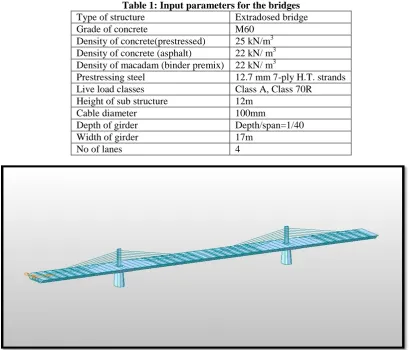
The bridge discussed is an extradosed cable-stayed bridge. Three-dimensional models are prepared using finite element software MIDAS Civil 2017. MIDAS Civil is selected because in this software any complex and unusual bridge sections can be modelled and analysed. Optimisation of the extradosed bridge will be done by the parametric study. Summary of models for the study
1. The models are prepared for Spans 80m, 100m, 120m, and 140m.
2. For each span the structure is modelled for Pylon height Ratios span/8, span/9, span/10 3. The height of substructure is kept constant at 12m with single pier structure for all the models. 4. Single plane stay configuration is used.
5. Superstructure used is multi-cell cell box girder. 3.1 Concept of Work:
ISSN(Online): 2319-8753 ISSN (Print): 2347-6710
I
nternational
J
ournal of
I
nnovative
R
esearch in
S
cience,
E
ngineering and
T
echnology
(A High Impact Factor, Monthly, Peer Reviewed Journal)
Visit: www.ijirset.com Vol. 8, Issue 7, July 2019
prestressed girder. According to Mathivat, the optimal ratio to tower height to span length should be on the order of 1/15 (Mathivat 1988). Although Mathivat did not provide a basis for this recommendation, Based on existing bridges tower heights have been used are slightly taller that recommended by Mathivat and a suggests typical H/L ratio of 1/10 would appear appropriate, or a H/L range between 1/7 to 1/13, based on the data from the population of existing extradosed prestressed bridges [2]. For modelling the tower height/span ratios selected are 1/8, 1/9 and 1/10. Using different parameters the models are prepared for varying cable distance and varying pylon height.
3.2 Methodology
The analysis of extradosed bridge is done in MIDAS civil 2017. In this study, we are considering live load as per IRC-6-2014. For material properties and permissible stress values the IRC-112-2011 is referred. Total 24 models are generated and analysed. The models are analysed by applying dead load, moving load class A and class 70R. Since it is a bridge structure all the loads on the structure are taken from IRC codes.
Table 1: Input parameters for the bridges
Type of structure Extradosed bridge
Grade of concrete M60
Density of concrete(prestressed) 25 kN/m3 Density of concrete (asphalt) 22 kN/ m3 Density of macadam (binder premix) 22 kN/ m3
Prestressing steel 12.7 mm 7-ply H.T. strands
Live load classes Class A, Class 70R
Height of sub structure 12m
Cable diameter 100mm
Depth of girder Depth/span=1/40
Width of girder 17m
No of lanes 4
ISSN(Online): 2319-8753 ISSN (Print): 2347-6710
I
nternational
J
ournal of
I
nnovative
R
esearch in
S
cience,
E
ngineering and
T
echnology
(A High Impact Factor, Monthly, Peer Reviewed Journal)
Visit: www.ijirset.com Vol. 8, Issue 7, July 2019
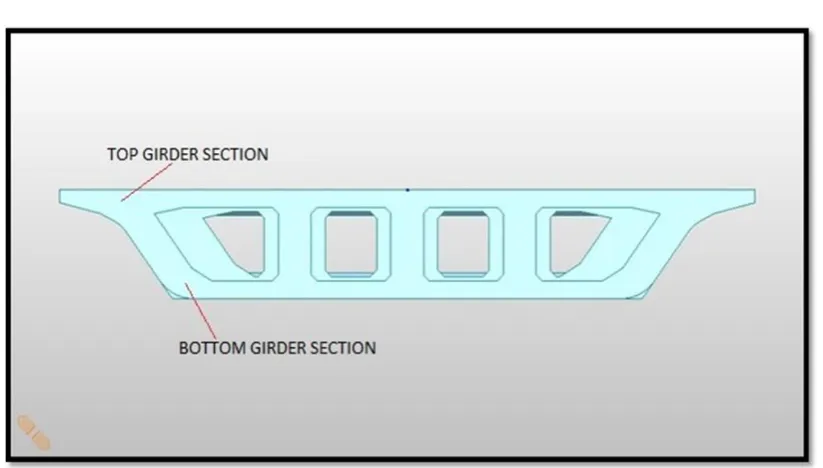
Figure No 2: Girder cross-section of the model
IV. RESULTS AND DISCUSSION
In the following table the compressive stress results for top and bottom girder stresses for the DL and DL+MVL conditions are presented for various spans viz. 80m, 100m, 120m, and 140m.
Table 2: Comparative stress results for different spans for varying pylon height and constant cable distance
Cable distance=6m
Span Pylon height
(H/L)
Compressive Stresses at Girder
Sections for DL(N/mm2)
Compressive Stresses at Girder Sections
for DL+MVL(N/mm2)
Top Bottom Top Bottom
80m
8m (H/L=1/10) 18.3 18.8 17.9 18.7
9m (H/L=1/9) 18.6 17.2 21.5 19.6
10m (H/L=1/8) 18.9 15.8 19.4 17.3
ISSN(Online): 2319-8753 ISSN (Print): 2347-6710
I
nternational
J
ournal of
I
nnovative
R
esearch in
S
cience,
E
ngineering and
T
echnology
(A High Impact Factor, Monthly, Peer Reviewed Journal)
Visit: www.ijirset.com Vol. 8, Issue 7, July 2019
100m 11m (H/L=1/9) 21.1 19.7 20.41 19.5
12.5m (H/L=1/8) 21.3 18.7 20.6 18.5
120m
12m (H/L=1/10) 21.9 21.7 22.3 21.9
13.5m (H/L=1/9) 22.1 20.7 21.8 20.6
15m (H/L=1/8) 22.4 19.5 21.6 19.8
140m
14m (H/L=1/10) 16.7 10.5 17.1 10.8
15.5m (H/L=1/9) 17.3 10.3 16.02 9.2
17.5m (H/L=1/8) 18.1 9.5 15.6 8.6
Following charts represents the variation of Compressive stress for varying pylon height for spans of 80m, 100m, 120m, and 140m.
ISSN(Online): 2319-8753 ISSN (Print): 2347-6710
I
nternational
J
ournal of
I
nnovative
R
esearch in
S
cience,
E
ngineering and
T
echnology
(A High Impact Factor, Monthly, Peer Reviewed Journal)
Visit: www.ijirset.com Vol. 8, Issue 7, July 2019
Chart No 2: Max Compressive stresses for the span of 100M
ISSN(Online): 2319-8753 ISSN (Print): 2347-6710
I
nternational
J
ournal of
I
nnovative
R
esearch in
S
cience,
E
ngineering and
T
echnology
(A High Impact Factor, Monthly, Peer Reviewed Journal)
Visit: www.ijirset.com Vol. 8, Issue 7, July 2019
Chart No 4: Max Compressive stresses for the span of 140M
The following table represents the material cost for each span viz. 80m, 100m, 120m and 140m and for varying pylon height when cable distance is kept constant
Table 3: Total material cost for different spans for varying pylon height and constant cable distance
Cable distance=6m
Span Pylon height (H/L) Cost of bridge In Rs
80m
8m (H/L=1/10) 19125808.03
9m (H/L=1/9) 19181567.95
10m (H/L=1/8) 19257576.11
100m
10m (H/L=1/10) 29820907.85
11m (H/L=1/9) 29895435.72
12.5m (H/L=1/8) 30002739.53
120m
12m (H/L=1/10) 35333133.33
13.5m (H/L=1/9) 35407865.28
ISSN(Online): 2319-8753 ISSN (Print): 2347-6710
I
nternational
J
ournal of
I
nnovative
R
esearch in
S
cience,
E
ngineering and
T
echnology
(A High Impact Factor, Monthly, Peer Reviewed Journal)
Visit: www.ijirset.com Vol. 8, Issue 7, July 2019
140m
14m (H/L=1/10) 36278695.7
15.5m (H/L=1/9) 36426011.62
17.5m (H/L=1/8) 36605003.51
Chart No 5: Cost for the span of 80M
ISSN(Online): 2319-8753 ISSN (Print): 2347-6710
I
nternational
J
ournal of
I
nnovative
R
esearch in
S
cience,
E
ngineering and
T
echnology
(A High Impact Factor, Monthly, Peer Reviewed Journal)
Visit: www.ijirset.com Vol. 8, Issue 7, July 2019
Chart No 7: Cost for the span of 120M
Chart No 8: Cost for the span of 140M
V. DISCUSSION
A. For DL when cable distance is kept constant and pylon height to span ratio is varying
ISSN(Online): 2319-8753 ISSN (Print): 2347-6710
I
nternational
J
ournal of
I
nnovative
R
esearch in
S
cience,
E
ngineering and
T
echnology
(A High Impact Factor, Monthly, Peer Reviewed Journal)
Visit: www.ijirset.com Vol. 8, Issue 7, July 2019
2. For all the models, for lower section of the girder it is observed that the stresses are decreasing when pylon height is increasing. And the stresses at lower section of the girder are within the limiting value of 21.6 N/mm2 for all the models.
3. For DL and DL+MVL condition it is observed that the compressive stress values for pylon height to span ratio (H/L) 10 for top and bottom girder section are showing the equivalent results for all the spans as compared to other ratios (i.e. H/L=9,H/L=8).
B. The cost of the bridge is decreasing when pylon height is decreasing (i.e. the pylon height to main span ratio is increasing) for constant cable distance.
VI. CONCLUSION
By using various load combination the extradosed bridge is successfully analysed to reveal the behaviour of structure for various parameters. The models are studied and few conclusions are made on the basis of all the above results are listed below
1. The extradosed bridges are best suited for the spans more than 100m. As observed from above results the 120m and 140m spans stresses results are better as compared to 80m and 100m spans.
2. It can be concluded that the height of pylon is directly proportional to the top girder section stresses and inversely proportional to the bottom girder section stresses when the cable distance is kept constant.
3. Typically, the pylon height to span ratio (H/L) of 10 gives equivalent section stress at top and bottom, thereby making it an economical choice.
4. The material cost of the bridge is directly proportional to the height of the pylon when the cable distance is kept constant.
6.1 Future Scope:
From the detailed study of optimisation technique and parameters of extradosed bridges, there are other aspects and parameters of extradosed bridges needs to be studied. Followings are the other aspects which can be researched for the further study.
1. In this study the extradosed bridges are analysed for different spans viz. 80m, 100m, 120m, 140m. For further study extradosed bridges can be analysed for higher spans viz. 160m, 180m, 200m etc.
2. For optimisation of bridge the parameters used are cable distance and pylon height, for further scope the study of parameters like girder depth, cable area, tower depth etc. can be used.
3. Cable stay configuration used for this project is central cable plane, for further scope cables in parallel planes and cables in inclined planes configuration can be used.
REFERENCES
1. Rohini R. Kavathekar, Dr. N.K.Patil “Characteristic Study on Cable-Stayed and Extradosed Bridge” International Journal for Research in Applied Science & Engineering Technology, 2018.
2. S.L. Stroh “Proportioning and design considerations for extradosed prestressed bridges” chapter 14th of sustainable bridge structure, 2015. 3. Vijay Parmar and K. B. Parikh “Effect of Pylon Height on Cable Stayed Bridge” IJSTE - International Journal of Science Technology &
Engineering | Volume 1, May 2015.
4. Xiaolei Wang, Tian Liang and Tiedong Qi1 “Study on Cable Force Optimization for Extradosed Cable-stayed Bridge under the Rational Completion Stage” Applied Mechanics and Materials Volumes 501-504, Trans Tech Publications, Switzerland, 2014,www.scientific.net. 5. Chang-Huan Kou, Tsung-Ta Wu, Pei-Yu Lin “Optimization of Cable Force of Extradosed Bridges” Applied Mechanics and Materials
Volumes 587-589, Trans Tech Publications, Switzerland 2014, www.scientific.net.
6. Hongtao Bi &Yan Li “The length optimization of non-stayed cable segment to low-pylon cable-stayed bridge” Key Engineering Materials Vol. 540, Trans Tech Publications, Switzerland, www.scientific.net, January 2013.
ISSN(Online): 2319-8753 ISSN (Print): 2347-6710
I
nternational
J
ournal of
I
nnovative
R
esearch in
S
cience,
E
ngineering and
T
echnology
(A High Impact Factor, Monthly, Peer Reviewed Journal)
Visit: www.ijirset.com Vol. 8, Issue 7, July 2019
8. Miguel Joao da Silva Barbara “STUDY OF EXTRADOSED BRIDGE” Department of civil engineering, Architecture and Georesources technical university of Lisbon-Portugal, Published on September 2011.
9. Fathy SAAD “Structural Optimization of Extradosed Bridges” Associate Professor Ain Shams University, Cairo, Egypt.
10. José Benjumea, Gustavo Chio, Esperanza Maldonado “Structural behavior and design criteria of extradosed bridges: general insight and state
of the art” 2010.
11. Konstantinos Kris Mermigas “Behaviour and Design of EXTRADOSED BRIDGES” Graduate Department of Civil Engineering University of Toronto, 2008.
12. S Ikeda, A Kasuga “Development of extradosed structures in the bridge construction” 25th Conference on OUR WORLD IN CONCRETE & STRUCTURES: 23 - 24 August 2000, Singapore. (http://cipremier.com/100025008)
13. L. M. C. SIMOES and J. H. O. NEGRAO “SIZING AND GEOMETRY OPTIMIZATION OF CABLE-STAYED BRIDGES”, Computers & Stuctures Vol. 52. No. 2, Elsevier Science Ltd., January 1993.