Skintone Detection Based on Steganography
using Wavelet Transform
Manisha G Kude
1, Manjusha S Borse
21
PG Student, Dept. of ETC Engineering, Kalyani Charitable Trust‘s- Late G. N. Sapkal College of Engineering, Nashik, Maharashtra, India
2 Assistant Professor, Dept. of ETC Engineering, Kalyani Charitable Trust‘s- Late G. N. Sapkal College of
Engineering, Nashik, Maharashtra, India
ABSTRACT: Steganography is the art of hiding the existence of data in another transmission medium to achieve secret communication. Steganography method used in this paper is based on biometrics. And the biometric feature used to implement Steganography is skin tone region of images. Here secret data is embedded within skin region of image that will provide an excellent secure location for data hiding. For this skin tone detection is performed using HSV (Hue, Saturation and Value) colour space. Additionally secret data embedding is performed using frequency domain approach - DWT (Discrete Wavelet Transform), DWT outperforms than DCT (Discrete Cosine Transform).This study shows that by adopting an object orienting steganography mechanism, in the sense that, a tendency to track skin tone objects in image will get a higher security.
KEYWORDS: Biometrics, Discrete Cosine Transform, Discrete Wavelet Transform, Skin tone, Steganography.
I. INTRODUCTION
Steganography is the art of hiding the existence of data in another transmission medium to achieve secret communication.It is the practice of concealing a file, message, image, or video within another file, message, image, or video. In this highly digitalized world, the Internet serves as an important role for data transmission and sharing. However, since it is a worldwide and publicized medium, some confidential data might be stolen, copied, modified, or destroyed by an unintended observer. Therefore, security problems become an essential issue. Encryption is a well-know procedure for secured data transmission [1]. Although encryption achieves certain security effects, they make the secret messages unreadable and unnatural.These unnatural messages usually attract some unintended observers‘ attention. This is the reason a new security approach called ―steganography‖ arises. Detecting human skin tone is of utmost importance in numerous applications such as, motion analysis and tracking, video surveillance, face and gesture recognition, human computer interaction, image and video indexing and retrieval, image editing, vehicle drivers‘ drowsiness detection, real time gait and gesturerecognition and steganography. Detecting human skin tone isregarded as a two-class classification problem, and took aconsiderable amount of attention from researchers in recent years[2, 3] especially those who deal with biometrics and computervision aspects. Information security is essential for confidential data transfer. Steganography contains two main branches: digital watermarking and steganography.The main purpose of steganography is to convey the information secretly by concealing the very existence of information in some other medium such as image, audio or video. The content used to embed information is called as cover object. The cover along with the hidden information is called as stego-object [4]. In this techniquecolor image is taken as cover and two grey scale images are considered as secret information. Secret images and stego keys are embedded in the cover image to get stego image. The major objective of steganography is to prevent some unintended observer from stealing or destroying the confidential information.
important techniques of steganography [5]. The spatial domain approach Most Significant Bits (MSBs) of payload pixels replaces the Least Significant Bits (LSBs) of cover image pixels and in transform domain approach, payload and/or cover image are converted into transform domain viz Discrete Cosine Transform (DCT), Discrete wavelet Transform (DWT) and Fast Fourier Transform (FFT) and the LSBs cover image coefficients are replaced by MSBs of payload coefficients. The Wavelet Transform provides atime-frequency representation of the signal. IWT is a more efficient approach to losslesscompression. The coefficients in this transform are represented by finite precision numbers whichallows for lossless encoding. This wavelet transform maps integers to integers. In case of DiscreteWavelet Transform, if the input consists of integers (as in the case of images), the resulting outputno longer consists of integers [6]. Thus the perfect reconstruction of the original image becomes difficult. However, with the introduction of Wavelet transforms that map integers to integers theoutput can be completely characterized with integers.
II. RELATED WORK
S. M. MasudKarim, et al., [7] proposed a new approach based on LSB using secret key. The secret key encrypts the hidden information and then it is stored into different position of LSB of image. This provides very good security. XIE Qing et al.,[8] proposed a method in which the information is hidden in all RGB planes based on HVS (Human Visual System). This degrades the quality of the stego image. In the method proposed by Sunny Sachdeva et al., [9] the Vector Quantization (VQ) table is used to hide the secret message which increases the capacity and also stego size. The method proposed by Rong-Jian Chen et al [10], presents the novel multi-bit bitwiseadaptive embedding algorithm for data hiding by evaluating the most similar value to replace theoriginal one. Sankar Roy et al., [11] proposed an improved steganography approach for hiding textmessages within lossless RGB images which will suffer from withstanding the signal processingoperations. Minimum deviation of fidelity based data embedding technique has been proposed by J. K.Mandal et al, [12] where two bits per byte have been replaced by choosing the position randomlybetween LSB and up to fourth bit towards MSB. A DWT based frequency domain steganographictechnique, termed as WTSIC is also proposed by the same authors, [13] where secretmessage/image bits stream are embedded in horizontal, vertical and diagonal components. AnjaliSejul, et al, [14] proposed an algorithm in which binary images are considered to be secret imageswhich are embedded inside the cover image by taking the HSV (Hue, Saturation, Value) values ofthe cover image into consideration. The secret image is inserted into the cover image by cropping.the cover image according to the skin tone detection and then applying the DWT. In this method the capacity is too low.Shejul and Kulkarni[15] proposed a DWT based approach for steganography using Biometrics in skin tone regions of image that provides secure location for hiding secret data is hidden in one of the high frequency subband of DWT by tracing skin pixels in that sub band. SaeedSarreshtedari et al., [16] proposed a method to achieve a higher quality of the stego image using BPCS (Bit Plane Complexity Segmentation) in the wavelet domain. The capacity of each DWT block is estimated using the BPCS.SaddafRubab et al., [17] proposed a complex method using DWT and Blowfish encryption technique to hide text message in color image. In the paper by KapreBhagyashri et al, [18] a new singular value decomposition (SVD) and DWT based water mark technique is proposed in full frequency band in YUV color space. NabinGhoshal et al., uses a steganographic scheme for colour image authentication (SSCIA) [19] where the watermark image is embedded using DFT. Adaptive 9728teganography is special case of two formermethods. It is also known as ―Statistics aware embedding‖[20] and ―Masking‖ [21]. This method takes statistical globalfeatures of the image before attempting to embed secret datain DCT or DWT coefficients. The statistics will dictate whereto make changes.
Social 9728teganography
In communities with social or government taboos or censorship, people use cultural 9728teganography—hiding messages in idiom, pop culture references, and other messages they share publicly and assume are monitored. This relies on social context to make the underlying messages visible only to certain readers [22]. Examples include:
Hiding a message in the title and context of a shared video or image
Misspelling names or words that are popular in the media in a given week, to suggest an alternate meaning
III. WAVELET BASED STEGANOGRAPHY
thought process is inherent in most steganographic techniques, the difference here is that by storing information in the wavelet coefficients, the change in the intensities in images will be imperceptible. This study shows only the effectiveness of storing data in grayscale (.pgm) files.
Algorithm
The Haar transformation returns many coefficients that are 0, or close to 0. After taking a Haar transform of some image, the idea is to hide bits in the coefficients that are below some threshold value, then save the Haar inverse of the modified data. Theoretically, since we are hiding bits in insignificant coefficients, this should not greatly modify the image.
Encoding:
1. Take the (2D Haar) wavelet transform of an image. 2. Find the coefficients below a threshold value. 3. Replace these bits with bits of data to be hidden. 4. Take the inverse transform.
5. Store it as a regular image, in any standard format, such as .pgm. Decoding:
1. Take the wavelet transform of the image.
2. Find the coefficients that are below a threshold value. 3. Extract the bits of data from these coefficients.
4. Combine the extracted data bits into an actual message. 5. Output the message or data.
Discrete Wavelet Transform
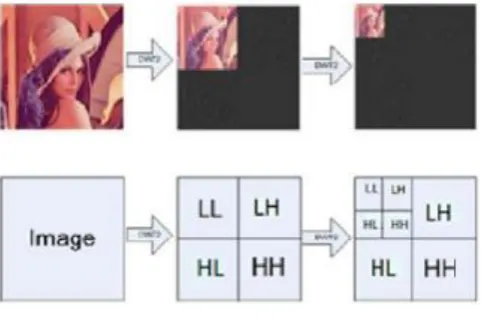
DWT is used for digital images. Many DWTs are available. Depending on the application appropriate one should be used. The simplest one is haar transform. To hide text message integer wavelet transform can be used. When DWT is applied to an image it is decomposed into 4 sub bands: LL, HL, LH and HH. LL part contains the most significant features. So if the information is hidden in LL part the stego image can withstand compression or other manipulations. But sometimes distortion may be produced in the stego image and then other sub bands can be used [4]. The decomposition of Lena image by 2 levels of 2D - DWT is shown in Figure 1.
Fig. 1. Level 2D – DWT
Integer Wavelet Transform
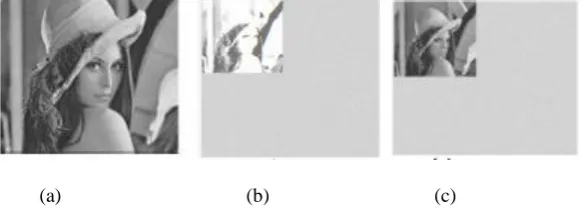
the case of IWT appears to be a close copy with smaller scale of the original image while in the case of DWT the resulting LL sub-band is distorted slightly, as shown in Figure 2.[6].
(a) (b) (c)
Fig. 2. (a) Original image Lena. (b) One level DWT in sub band LL (c) One level IWT in sub-band LL.
If the original image (I) is X pixels high and Y pixels wide, the level of each of the pixel at (i,j) is denoted by Ii,j.
The IWT coefficients are given by
LLi,j = ( I2i, 2j + I 2i+1, 2j) /2…. (1)
HLi,j = I2i+1, 2j - I2i, 2j…..(2)
LHi,j = I2i, 2j+1 - I2i, 2j….. (3)
HHi,j = I2i+1, 2j +1 - I2i, 2j….. (4)
The inverse transform is given by
I2i, 2j = LLi,j - HLi,j/2…. (5)
I2i, 2j +1 = LLi,j + (HLi,j+1)/2….. (6)
I2i+1, 2j = I2i, 2j +1 + LHi,j - HLi,j….. (7)
I2i+1, 2j+1 = I2i+1,2j + HHi,j - LHi,j…..(8)
where, 1 ≤ i ≤ X/2 , 1 ≤ j ≤ Y/2 and denotes floor value.
IV. PROPOSED METHOD
A. Encoding Process
Suppose C is original 24-bit color cover image of M×Nsize. It is denoted as:
C= {xij, yij, zij |1 ≤ i ≤ M, 1 ≤ j ≤ N, xij, yij, zij Є {0, 1,..,255}}
Let S is secret data. Here secret data considered is binaryimage of size a×b. As encoding process considers two cases,with cropping and without cropping, both cases are describedin detail below.
1) Case 1-With Cropping:
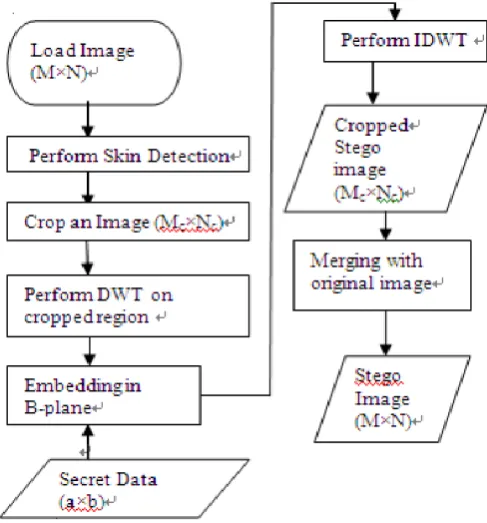
Flowchart for this case is shown in Fig. 3 and differentsteps are discussed in detail. Let size of cropped image isMc×Nc where Mc≤M and Nc≤N and Mc=Nc. i.e. Croppedregion must be exact square as we have to apply DWT lateron this region.
Fig. 3. Flowchart of With Cropping case of Embedding Process
a) Step 1: Once image is loaded, apply skin tone detectionon cover image. This will produce mask image that containsskin and non skin pixels. Skin tone detection is discussed incoming subsection.
b) Step 2: Ask user to perform cropping interactively onmask image (Mc×Nc). Then original image is also cropped ofsame area. Cropped area must be in an exact square form aswe have to perform DWT later and cropped area shouldcontain skin region such as face, hand etc since this will hidedata in skin pixels of one of the sub-band of DWT. Herecropping is performed for security reasons. Croppedrectangle will act as key at receiving side
d) Step 4: Perform embedding of secret data in one ofband that obtained earlier by tracing skin pixels inthat sub-band. Other than the low frequency sub-band (LL)any high frequency sub-band can be selected for embeddingas LL sub-band contains significant information. Embeddingin LL sub-band affects image quality greatly. It haschosen high frequency HH sub-band. While embedding,secret data will not be embedded in all pixels of DWTsub-band but to only those pixels that are skin pixels. So hereskin pixels are traced using skin mask detected earlier andsecret data is embedded. Embedding is performed in G-planeand B-plane but strictly not in R-plane as contribution of Rplane in skin color is more than G or B plane. So if we aremodifying R plane pixel values, decoder side doesn‘t retrievedata at all as skin detection at decoder side gives differentmask than encoder side.
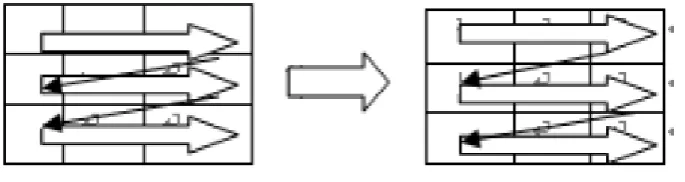
Embedding is done as per raster-scan order (as shown inFig.4) that embeds secret data coefficient by coefficient inselected sub-band [25], if coefficient is skin pixel. Whileembedding bits of one of the sub-band are replaced with bitsof secret data.
Fig. 4. Raster Scan Order
e) Step 5: Perform IDWT to combine 4 sub-bands.
f) Step 6: A cropped stego image of size Mc×Nc is obtainedin above step (step 5). This should be similar to originalimage after visual inspection but at this stage it is of size Mc×Nc, So we need to merge the cropped stego image withoriginal image to get the stego image of size M×N. Toperform merging we require coefficients of first and lastpixels of cropped area in original image so that r calculated.Thus a stego image is ready for quality evaluation.
Case 2- Without Cropping:
Most of embedding steps of this case are same as per withcropping case. Major difference in this case is that all thesteps of embedding are not performed on cropped region butperformed to whole image without applying any cropping.And other major difference is that actual embeddingalgorithm i.e. the way in which we are replacing bits of coverimage to bits of secret image (data) is different in this case.The main intention of using this different embeddingalgorithm is to hide data such that the histogram of the coverimage shouldn‘t not get modified after embedding, in otherwords first order statistics of the DWT coefficients should bepreserved. This requires an embedding procedure which doesnot modify the pixel values such that the corresponding binvalue in the histogram is changed. All the steps of encoding using this case arelisted below:
a) Step 1: Apply skin tone detection.
b) Step 2: Separate R, G, B planes and apply DWT to Bplane, this leads into 4 sub-bands denoted as HLL, HHL, HLH,HHH . As embedding is 5performed in one of the obtained highfrequency sub-band let it HH, skin pixels from this sub-bandare retrieved and stored in one matrix.
isthe basis for many of the random number generators in usetoday. Lehmer'sgenerators involve three integer parameters,a, c, and m, and an initial value, x0, called the seed. Asequence of integers is shown in Equation (3).
xk+1 = axk + c mod m……. (3)
Once pairs are formed secret message bits are embeddedbased on values of pixel pairs. Each message bit is relatedwith one pair. For embedding 0, check if the first pixel of pairis less than other pixel, if it is then don‘t change anythingotherwise swap gray level values. Similarly pixel value of 1can be embedded by making the value of first pixel greaterthan the second pixel. All skin pixels pairs chosen are skinpixels as we have to hide data in only skin pixels. Note thatvalues of pixels are altered but in this way that total count ofgray vales in image should remain same. As pixel gray valuesare not modified, count will remain same leading to anunchanged histogram. This embedding algorithm isdescribed below:
Input- matrix of only skin pixels, let it is S and secretmessage bits of size M
Output- Modified matrix of only skin pixels
Begin
1] Select non-overlapping, random pair from S.
Let it is p1,p2.
If count (message bits)=M then
goto End
Else
goto step 2
2] if p1=p2 then
goto step 1 (choose other pair.) 3] if p1≠ p2 then
goto step 4.
4] if message bit =0 then
if p1>p2 then
swap (p1,p2).
Choose next message bit.
Else Choose next message bit.
goto step 1.
5] if message bit=1 then
if p1<p2 then
swap(p1,p2)
Choose next message bit.
else Choose next message bit.
goto step 1.
End
This embedding algorithm is not used in with croppingcase as its main drawback is that is reduces payload by halfand because of cropping already have less region to hidedata in with cropping case.
image for quality evaluation.Next section gives introduction of skin tone detection andDWT performed in encoding process.
B. Skin Color Tone Detection using HSV
The goal of skin color detection is to build decision rulethat will discriminate between skin and non-skin pixels. Askin detector typically transforms a given pixel into anappropriate color space and then uses a skin classifier to labelthe pixel whether it is a skin or a non-skin pixel.The skin detection algorithm produces a mask, which issimply a black and white image. The black pixel values are 0(false) and the white pixel values are 1 (true). This mask ofones and zeros acts as a logic map for skin detection (i.e., if apixel is 1 this pixel location is likely skin).The simplest wayto decide whether a pixel is skin color or not is to explicitlydefine a boundary. RGB (Red, Green, Blue) matrix of thegiven color image can be converted into different colorspaces to yield distinguishable regions of skin or near skintone. Mainly two kinds of color spaces are available HSV(Hue, Saturation and Value) and YCbCr(Yellow, ChromaticBlue, Chromatic red) spaces. For this work HSV color spaceis chosen. It is experimentally found and theoretically proventhat the distribution of human skin color constantly resides ina certain range within the color space. Yang and Waibel[26] are able to achieve skin tracking by dimensionalreduction of the available color space.
In this technique, skin detection is performed using HSV colorspace. For this convert RGB image into HSV color space. InHSV, responsible vales for skin detection are Hue &Saturation so extract the Hue and Saturation dimensions intoseparate new variables (H & S). For skin detection thresholdshould be chosen as [H1, S1] & [H2, S2]. A pixel is classifiedas skin pixel if the values [H, S] fall within the threshold.Threshold is predefined range associated with the target skinpixel values. Most of the researchers determined threshold ash_range = [0, 0.11] and s_range = [0.2, 0.7]. Sobottaka andPitas [27] defined a face localization based on HSV. Theyfound that human flesh can be an approximation from asector out of a hexagon with the constraints:Smin= 0.23, Smax =0.68, Hmin =00 and Hmax=500
C. Discrete Wavelet Transform (DWT) and Haar-DWT
This is one of the frequency domain in whichSteganography can be implemented. In this work DWT isused as it performs better than the DCT. DCT is calculated onblocks of independent pixels, a coding error causesdiscontinuity between blocks resulting in annoying blockingartifact. This drawback of DCT is eliminated using DWT.DWT applies on entire image. DWT offers better energycompaction than DCT without any blocking artifact. DWTsplits component into numerous frequency bands called subbands known as
LL – Horizontally and vertically low pass
LH – Horizontally low pass and vertically high pass
HL - Horizontally high pass and vertically low pass
HH - Horizontally and vertically high pass
Since Human eyes are much more sensitive to the lowfrequency part (LL sub-band) it can hide secret message inother three parts without making any alteration in LLsub-band [28]. As other three sub-bands are high frequencysub-band they contain insignificant data. Hiding secret data in these sub-bands doesn‘t degrade image quality that much. Simplest DWT, Haar-DWT are used to transform images into frequency domain.
D. Decoding Process
All steps of Decoder are opposite to Encoder. 24 bit colorstego image of size M×N is input to decoding process.Decoding process for with and without cropping case isexplained below. Flowchart shows different steps for bothcases. This is shown in Fig. 5
1) Case 1- With Cropping:
Fig. 5. Flowchart of Decoding Process
2) Case 2- Without Cropping:
In this case without performing cropping extraction ofsecret data is performed. As encoder uses differentembedding algorithm than with cropping case, same logic ofembedding algorithm is used for decoding. This requiresfinding skin pixel pairs that are used for embedding. Thesepixel pairs are found by generating non-overlapping, randomsequence using Lehmer‘sCongruential generator. Oncecorrect pixel pairs are found, based on their values either oneor zero of secret data is decided.
V. EXPERIMENTAL RESULTS
The algorithm is tested in MATLAB with Cr component of the cover image. The results with different cover images and secret images are shown [29]. Original cover and secret images are shown in Figure 6 and Figure 7 respectively. Football is hidden in lena, earth is hidden in peppers and moon is hidden in baboon. The cover image size is 256x256 and secret image size is 128x128.
Fig. 7. Images which are used as secret images: (a) earth (b) football (c) moon
The stego and extracted secret images are shown in Figure 5 and Figure 6 respectively.
Fig. 8.Stego images: (a) football, (b) earth, (c) moon as secret images
Fig. 9. Extracted Secret images: (a) football (b) earth (c) moon
The PSNR in dB in all cases for stego and extracted secret images are tabulated in Tables 1 and 2 respectively.
Table 1. PSNR (in dB) of the stego image
COVER IMAGE (256x256)
SECRET IMAGE(128x128) football Earth Moon
Lena 44.3 44.4 44.2
Peppars 44.7 44.7 45.0
Table 2. PSNR (in dB) of the extracted secret image
COVER IMAGE (256x256)
SECRET IMAGE(128x128)
football Earth Moon
Lena 37.5 34.1 30.7
Peppars 30.4 28.6 26.7
Baboon 37.2 27.6 36.5
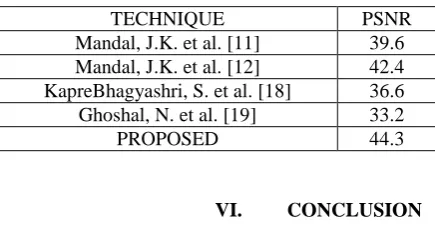
Table 3 compares the PSNR values in the proposed method and that in the other four methods. In all these the cover image considered is lena image and the secret images used are of comparable sizes.
Table 3. Comparison of PSNR (in dB) of the stego image in different methods
TECHNIQUE PSNR
Mandal, J.K. et al. [11] 39.6 Mandal, J.K. et al. [12] 42.4 KapreBhagyashri, S. et al. [18] 36.6 Ghoshal, N. et al. [19] 33.2
PROPOSED 44.3
VI. CONCLUSION
In this paper Biometric Steganography is presented that uses skin region of images in DWT domain for embedding secret data. By embedding data in only certain region (here skin region) and not in whole image security is enhanced. IWT is a more efficient approach to lossless compression. The coefficients in this transform are represented by finite precision numbers which allows for lossless encoding. Encryption is a well-know procedure for secured data transmission. Although encryption achieves certain security effects, they make the secret messages unreadable and unnatural. The results are compared with the results of similar techniques and it is found that the proposed technique is simple and gives better PSNR values than others.
REFERENCES
[1] Petitcolas, F.A.P.: ―Introduction to Information Hiding‖. In: Katzenbeisser, S and Petitcolas, F.A.P (ed.) (2000) Information hiding Techniques for Steganography and Digital Watermarking. Norwood: Artech House, INC.
[2]M. Corey, F. Farzam and J.H. Chong, The effect of linearizationof range in skin detection, in: Proceedings of IEEE InternationalConference on Information, Communications & SignalProcessing, 10-13 December 2007, pp. 1-5.
[3]U.A. Khan, M.I. Cheema and N.M. Sheikh, Adaptive videoencoding based on skin tone region detection, in: Proceedingsof IEEE Students Conference, 16-17 August 2002, vol (1), pp.129-34.
[4] Katzenbeisser, S. and Petitcolas, F.A.P., (2000) Information Hiding Techniques for Steganography and Digital Watermarking. Artech House, Inc., Boston, London.
[5] K B Shiva Kumar, K B Raja, SabyasachiPattnaik, ―Hybrid Domain in LSB Steganography‖, International Journal of Computer Applications (0975 – 8887) Volume 19– No.7, April 2011
[6] M. F. Tolba, M. A. Ghonemy, I. A. Taha, A. S. Khalifa, (2004) "Using Integer Wavelet Transforms in Colored Image-Stegnography",
International Journal on Intelligent Cooperative Information Systems, Volume 4, pp. 75-85.
[7] Masud, Karim S.M., Rahman, M.S., Hossain, M.I., (2011) ―A New Approach for LSB Based Image Steganography using Secret Key.‖, Proceedings of 14th International Conference on Computer and Information Technology, IEEE Conference Publications, pp 286 – 291.
[8] Xie, Qing.,Xie, Jianquan., Xiao, Yunhua., (2010) ―A High Capacity Information Hiding Algorithm in Color Image.‖, Proceedings of 2nd International Conference on E-Business and Information System Security, IEEE Conference Publications, pp 1-4.
[10] Chen, R. J., Peng, Y. C., Lin, J. J., Lai, J. L., Horng, S. J. Novel Multi-bit Bitwise Adaptive Embedding Algorithms with Minimum Error for Data Hiding. In Proceedings of 2010 Fourth International Conference on Network and System Security (NSS 2010), (Melbourne, Australia, 1-3 September 2010), IEEE Conference Publications, 306 – 311.
[11] Roy, S., Parekh, R., (2011) ―A Secure Keyless Image Steganography Approach for Lossless RGB Images.‖, Proceedings of International Conference on Communication, Computing & Security, ACM Publications, 573-576.
[12] Mandal, J.K., Sengupta, M., (2011) ―Steganographic Technique Based on Minimum Deviation of Fidelity (STMDF).‖, Proceedings of Second International Conference on Emerging Applications of Information Technology, IEEE Conference Publications, pp 298 – 301.
[13] Mandal, J.K., Sengupta, M., (2010) ―Authentication/Secret Message Transformation Through Wavelet Transform based Subband Image Coding (WTSIC).‖, Proceedings of International Symposium on Electronic System Design, IEEE Conference Publications, pp 225 – 229.
[14] Shejul, A. A., Kulkarni, U.L., (2011) ―A Secure Skin Tone based Steganography (SSTS) using Wavelet Transform‖, International Journal of Computer Theory and Engineering, Vol.3, No.1, pp. 16-22.
[15] Shejul, A.A. Kulkarni,‖ A DWT Based Approach for Steganography Using Biometrics.‖ International Conference on Data Storage and Data Engineering (DSDE), pp.39 – 43,201
[16] Sarreshtedari, S., Ghaemmaghami, S. High Capacity Image Steganography in Wavelet Domain. In Proceedings of 2010 7th IEEE Consumer Communications and Networking Conference (CCNC) (Las Vegas, Nevada, USA, 9 – 12 January 2010), IEEE Conference Publications, 1-5. [17] Rubab, S., Younus, M. Improved Image Steganography Technique for Colored Images using Wavelet Transform. International Journal of Computer Applications, Volume 39– No.14, February 2012, 29-32.
[18] KapreBhagyashri, S., Joshi, M.Y., ―All Frequency Band DWT-SVD Robust Watermarking Technique for Color Images in YUV Color Space‖, In Proceedings of 2011 IEEE International Conference on Computer Science and Automation Engineering (CSAE), (10-12 June 2011), IEEE Conference Publications, 295 - 299.
[19] Ghoshal, N., Mandal, J.K. A Steganographic Scheme for Colour Image Authentication (SSCIA). In Proceedings of International Conference on Recent Trends in Information Technology (ICRTIT2011), (Madras Institute of Technology, Chennai, India June 03 - 05, 2011), IEEE ConferencePublications, 826 – 831.
[20] Provos,N. and Honeyman, P: ―Hide and Seek: An introduction to steganography‖. IEEE security and privacy, 01 (3): 32-44,May-June 2003 [21] Johnson, N. F. and Jajodia, S.: ―Exploring Steganography: Seeing the Unseen.‖ IEEE Computer, 31 (2): 26-34, Feb 1998.
[22] Social Steganography: Scenario Magazine, 2013.
[23] Han-Yang Lo, SanjeevTopiwala, Joyce Wang, ―Wavelet based steganography and watermarking‖, Cornell University, computer science Department, CS 631, Spring 1998.
[24] A. Cheddad, J. Condell, K. Curran and P. McKevitt, ―Biometric inspired digital image Steganography‖, in: Proceedings of the 15th Annual IEEE
International Conference and Workshops on the Engg.of Computer-Based Systems (ECBS‘08), Belfast, 2008, pp. 159-168.
[25] Po-Yueh Chen and Hung-Ju Lin ―A DWT Based Approach for ImageSteganography‖, International Journal of Applied Science andEngineering, 2006. 4, 3: 275-290
[26] Yang, J., &Waibel, a. (1996). A real-time face tracker. Proceedings of the 3th IEEE Workshop on Applications of Computer Vision, Sarasota, Florida, 142-147
[27] Sobottka, K. and Pitas, I.:‖Extraction of facial regionsand features using color and shape information.‖ Proc. IEEE InternationalConference on Image Processing, pp. 483-486.(1996)
[28] Chen,P. Y.andLiao,E.C., :A new Algorithem for Haar WaveletTransform,‖ 2002 IEEE International Symposium on Intelligent SignalProcessing and Communication System, pp.453-457(2002).