ISSN(Online): 2320-9801
ISSN (Print): 2320-9798
I
nternational
J
ournal of
I
nnovative
R
esearch in
C
omputer
and
C
ommunication
E
ngineering
(An ISO 3297: 2007 Certified Organization)
Vol. 3, Issue 10, October 2015
Identifying the Authorized Users in the
Network with a New Methodology
Naga Durga Saile.K, Dr. R. Ch. A. Naidu, K.Navatha, K.Meghana
Asst.Professor, Dept of CSE, St.Martins Engineering College, Hyderabad, India Professor, Dept of CSE, St.Martins Engineering College, Hyderabad,,India Asst.Professor, Dept of CSE, St.Martins Engineering College, Hyderabad, India
M.Tech Student, Dept of CSE, VITS, Visakhapatnam,,India
ABSTRACT: Authentication is very important to identify the user in the network. To identify whether the system is used by a human or not we use the CAPTCHA.CAPTCHA is an acronym for completely automated public Turing test to tell computer and human apart. Due to the enormous growth of web applications, security over internet has become a challenging issue. Most of the web applications are facing the threat of internet bot .Internet bot is an automated script which executes over the web forms. During a last few decades research have been done on CAPTCHA systems. This paper gives the work done on CAPTCHA systems till date and here we propose a new method of Captcha that is helpful in performing and identifying the bot and a human.
KEYWORDS: Captcha, Automated Script, Internet, Security.
I.INTRODUCTION
With the emerging technologies and the advent of internet providing security is always been a vital issue. The latest advancements always make it tough to identify whether a robot is using the system or a human. The robot executes auto generated scripts on web applications and creating a security threat. Hence we need to provide much more security to identify a bot and a human. Mainly we have the security threat on web based transactions. Though we have several authentication methods like generating of OTP, 3 d secure etc. One of the technology that is been used is CAPTCHA. "Completely Automated Public Turing test to tell Computers and Humans Apart.” This Turing test helps in identifying that the human and a bot is different and the transactions that re performed are by human itself. This term was initially coined in 2003 by Luis von Ahn, Manuel Blum, Nicholas J. Hopper, and John Langford. The most common type of CAPTCHA was first invented in 1997 by Mark D. Lilli bridge, Martin Abadi, Krishna Bharat, and Andrei Z. Broder. There are different applications of Captcha like preventing spam comments in blogs, protecting registration in websites, Protecting Email ids from Spammers, preventing dictionary attacks, preventing from worms and spam’s. There are different methods in Captcha used in protecting the web applications.
II.RELATED WORK
These days all the web applications, e-commerce applications, social networking sites, blogs etc have been a part and parcel of day to day activities. Most of the websites mainly which perform financial transactions uses CAPTCHA. It is a technique that performs a Turing test which identifies the bots or automated generated scripts. If the user passes this test then he is given the access to perform further access in the website. There are different methods of identifying the bots and they are categorized in the following way.
Text based CAPTCHA:
Fig 1: Text Based Captcha and Re Captcha
Image Based CAPTCHA :
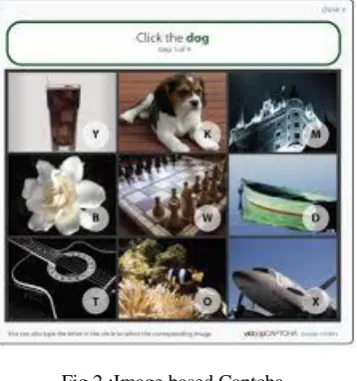
In this method the user needs to identify the images and a drop down of those images will be present and the user has to select from that drop down list the correct word of the image. Another way is the name of the image is given and the user have to select the image from the given database.
Fig 2 :Image based Captcha ASSIRA:
ISSN(Online): 2320-9801
ISSN (Print): 2320-9798
I
nternational
J
ournal of
I
nnovative
R
esearch in
C
omputer
and
C
ommunication
E
ngineering
(An ISO 3297: 2007 Certified Organization)
Vol. 3, Issue 10, October 2015
Multi Modal Captcha:
Another advancement in this technology is Multi Modal Captcha where image and text are combined. And also the name of the image is inscribed on the Captcha along with few other wrong names. The user has to identify the correct name on the image and place it on the text box available
Fig 4: Multi Modal Captcha DIC:
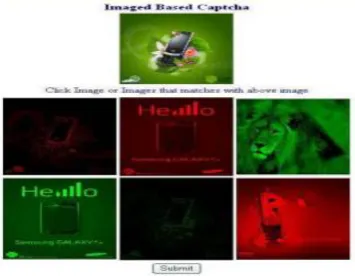
Dynamic image based CAPTCHA is another method where the user has to recognize the matching image exactly from the set of available other pictures available dynamically. There is also a limit for the number of attempts in this method not exceeding up to 5 attempts.
Fig 5: Dynamic image based Captcha
Puzzle Based Captcha:
.
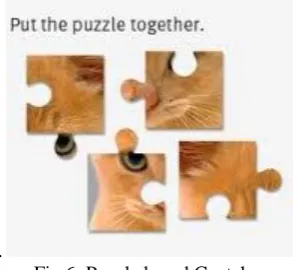
Fig 6: Puzzle based Captcha
Audio Based Captcha:
Audio Based CAPTCHA is where the user have to pass the test with audio or voice recognition.
Fig 7: Audio Based Captcha
III.PROPOSED MODEL
ISSN(Online): 2320-9801
ISSN (Print): 2320-9798
I
nternational
J
ournal of
I
nnovative
R
esearch in
C
omputer
and
C
ommunication
E
ngineering
(An ISO 3297: 2007 Certified Organization)
Vol. 3, Issue 10, October 2015
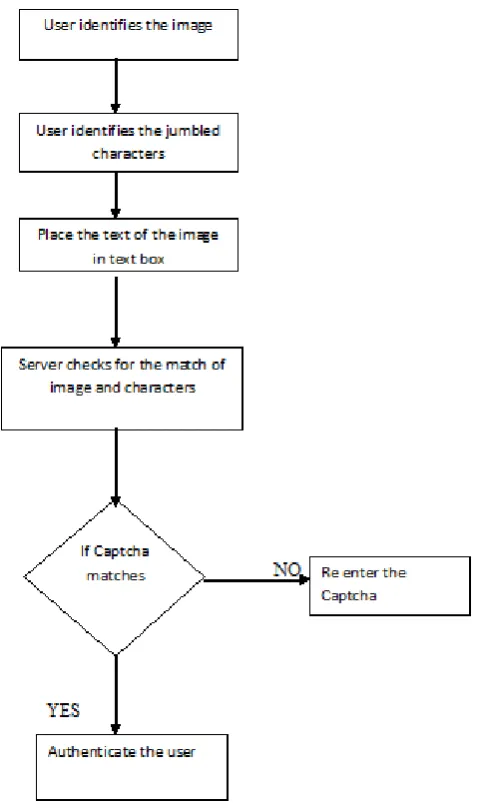
Fig 8: Flow chart of proposed Model
This methodology helps more secured way in finding the bots and human and also it overcomes the weakness of regular CAPTCHA which have conflicts in identifying the letters of different styles and numbers. Since it is easier to identify the images, anyone can easily identify the captcha and authenticate himself. The key guidelines for any CAPTCHA is accessibility, image security and script security are achieved in this model
The following weakness can be overcome in this proposed model
1) Digit vs digit: In many cases 8 may look like 6 or 9. Depending on what type of font is used by the system 7 may look like 1 and vice versa.
2) Letter vs letters: If distortion is applied for example “cl” can be confused with„d “nn” can be confused with „m or
„rn and “vv” can be confused with „w.
Here in our model it is easier to identify the digits and letters based on the images and makes the user process easier and time is not wasted or identifying the distorted letters and digits.
IV.CONCLUSION
Security with Captcha has become a key standard for all the web applications. In this paper, we proposed a new Captcha technique which over comes the weakness of the traditional and current using Captcha techniques. There are many research work carried on Captcha which is advancing in the field of artificial and machine learning. As we all know that technology is growing day by day there is a need to enhance ourselves in proving security which is a major threat for the digital world and a lot of research is needed in the field of security through machine learning.
REFERENCES
1. CAPTCHA Project, available at, http://www.captcha.net.
2. reCAPTCHA project, available at http://recaptcha.net
3. https://en.wikipedia.org/wiki/CAPTCHA
4. Volume 3, No. 6, June 2012 Journal of Global Research in Computer Science TECHNICAL NOTE Available Online at www.jgrcs.info ©
JGRCS 2010,SURVEY ON CAPTCHA SYSTEMS
5. Move & Select: 2-Layer CAPTCHA based on Cognitive Psychology for securing web services , Taken from ijens.org, available at
http://www.ijens.org/Vol_11_I_05/117005-8383-IJVIPNSIJE
6. 6.J.Yan and A. Ahmad. A Low-cost Attack on a Microsoft CAPCTHA. The 15th ACM Conference on Computer and Communications Security
(CCS), 2008
BIOGRAPHY
Naga Durga Saile.K completed her M.Tech from Gitam University Visakhapatnam,and she has 2 years of teaching experience. She is presently working in a CSE Dept as an Assistant Professor in St Martin’s Engineering College, Hyderabad. Her area of interest is Software Engineering, Network Security, Mobile Computing, and Database Management Systems.
ISSN(Online): 2320-9801
ISSN (Print): 2320-9798
I
nternational
J
ournal of
I
nnovative
R
esearch in
C
omputer
and
C
ommunication
E
ngineering
(An ISO 3297: 2007 Certified Organization)
Vol. 3, Issue 10, October 2015
ISTE, CSI. His area of interest is Network security, Computer networks, Digital Image processing, Data base management systems . He has life membership in professional bodies like ISTE, CSI.
K.Navatha completed her M.Tech from JNTU, Hyderabad and she has 4.5 years experience in teaching. She is presently working in a CSE Dept as an Assistant Professor in St Martin’s Engineering College, Hyderabad. Her area of interest is Software Engineering, Network Security, and Mobile Computing.