ISSN(Online): 2319-8753 ISSN (Print): 2347-6710
I
nternational
J
ournal of
I
nnovative
R
esearch in
S
cience,
E
ngineering and
T
echnology
(A High Impact Factor, Monthly, Peer Reviewed Journal)
Visit: www.ijirset.com
Vol. 8, Issue 5, May 2019
A Novel Network-based Spam Detection
Framework for Classification of Reviews
Shubham Korde, Piyush Wankhade, Yogesh Sonawane, N.G.Bhojne
B. E Students, Department of Computer Engineering, Sinhagad College of Engineering, Pune, India
Professor, Department of Computer Engineering, Sinhagad College of Engineering, Pune, India
ABSTRACT: Todays, a major part of everyone trusts on content in social media like opinions and feedbacks of a topic or a product. The liability that anyone can take off a survey give a brilliant chance to spammers to compose spam surveys about products and services for various interests. Recognizing these spammers and the spam content is a wildly debated issue of research and in spite of the fact that an impressive number of studies have been done as of late toward this end, yet so far the procedures set forth still scarcely distinguish spam reviews, and none of them demonstrate the significance of each extracted feature type. In this investigation, we propose a novel structure, named NetSpam, which uses spam highlights for demonstrating review datasets as heterogeneous information networks to design spam detection method into a classification issue in such networks. Utilizing the significance of spam features help us to acquire better outcomes regarding different metrics on review datasets. The outcomes demonstrate that NetSpam results the existing methods and among four categories of features; including behavioral, user-behavioral, review-linguistic, user-review-linguistic, the first type of features performs better than the other categories. The contribution work is when user search query it will display all top-k hotels as well as recommendation of the hotel.
KEYWORDS: Social Media, Social Network, Spammer, Spam Review, Fake Review, Heterogeneous Information Networks, Metapath.
I.INTRODUCTION
ISSN(Online): 2319-8753 ISSN (Print): 2347-6710
I
nternational
J
ournal of
I
nnovative
R
esearch in
S
cience,
E
ngineering and
T
echnology
(A High Impact Factor, Monthly, Peer Reviewed Journal)
Visit: www.ijirset.com
Vol. 8, Issue 5, May 2019
II.LITERATURE SURVEY
The pair wise features are first explicitly utilized to detect group colluders in online product review spam campaigns, which can reveal collusions in spam campaigns from a more fine-grained perspective. A novel detecting framework [1] named Fraud Informer is proposed to cooperate with the pair wise features which are intuitive and unsupervised. Advantages are: Pair wise features can be more robust model for correlating colluders to manipulate perceived reputations of the targets for their best interests to rank all the reviewers in the website globally so that top-ranked ones are more likely to be colluders. Disadvantage is difficult problem to automate.
The paper [2] proposes to build a network of reviewers appearing in different bursts and model reviewers and their co-occurrence in bursts as a Markov Random Field (MRF) and apply the Loopy Belief Propagation (LBP) method to induce whether a reviewer is a spammer or not in the graph. A novel assessment method to evaluate the detected spammers automatically using supervised classification of their reviews. Advantages are: High accuracy, the proposed method is effective. To detect review spammers in review bursts. To detect spammers automatically. Disadvantage is: a generic framework is not used for detect spammers.
In [3] paper, the challenges are: The detection of fraudulent behaviors, determining the trustworthiness of review sites, since some may have strategies that enable misbehavior, and creating effective review aggregation solutions. The TrueView score, in three different variants, as a proof of concept that the synthesis of multi-site views can provide important and usable information to the end user. Advantages are: develop novel features capable of finding cross-site discrepancies effectively, a hotel identity-matching method with 93% accuracy. Enable the site owner to detect misbehaving hotels. Enable the end user to trusted reviews. Disadvantage is difficult problem to automate.
In [4] paper describes unsupervised anomaly detection techniques over user behavior to distinguish probably bad behavior from normal behavior. To find diverse attacker schemes fake, compromised, and colluding Facebook identities with no a priori labeling while maintaining low false positive rates. Anomaly detection technique to forcefully identify anomalous likes on Facebook ads.Achieves a detection rate of over 66% (covering more than 94% of misbehavior) with less than 0.3% false positives. The attacker is trying to drain the budget of some advertiser by clicking on ads of that advertiser.
In [5] paper, a grouped classification algorithm called Multi-typed Heterogeneous Collective Classification (MHCC) and then extends it to Collective Positive and Unlabeled learning (CPU).The proposed models can markedly increase the F1 scores of strong baselines in both PU and non-PU learning environment. Advantages are: Proposed models can markedly increase the F1 scores of strong baselines in both PU and non-PU learning settings. Models only use language self-contained features; they can be smoothly generalized to other languages. Detects a large number of potential fake reviews hidden in the unlabeled set. Fake reviews hiding in the unlabeled reviews that Dianping’s algorithm did not capture. The ad-hoc labels of users and IPs used in MHCC may not be very specific as they are computed from labels of neighboring reviews.
III.OPEN ISSUES
ISSN(Online): 2319-8753 ISSN (Print): 2347-6710
I
nternational
J
ournal of
I
nnovative
R
esearch in
S
cience,
E
ngineering and
T
echnology
(A High Impact Factor, Monthly, Peer Reviewed Journal)
Visit: www.ijirset.com
Vol. 8, Issue 5, May 2019
reviews written to change users’ perception of how good a product or a service are considered as spam, and are often written in exchange for money.
Disadvantages:
There is no information filtering concept in online social network.
People believe on the written reviews in their decision-making processes, and positive/negative reviews encouraging/discouraging them in their selection of products and services.
Anyone create registration and gives comments as reviews for spammers to write fake reviews designed to misguide users’ opinion.
Less accuracy. More time complexity.
IV.PROPOSED METHODOLOGY
A novel proposed framework is to representative a given review dataset as a Heterogeneous Information Network (HIN) and to solve the issue of spam detection into a HIN classification issue. In particular, to show the review dataset as a HIN in which reviews are connected through different node types (such as features and users). A weighting algorithm is then employed to calculate each feature’s importance (or weight). These weights are used to calculate the very last labels for reviews using both unsupervised and supervised procedures. Based on our observations, defining two views for features (review-user and behavioral-linguistic), the classified features as review behavioral have more weights and yield better performance on spotting spam reviews in both semi-supervised and unsupervised approaches. The feature weights can be added or removed for labeling and hence time complexity can be scaled for a specific level of accuracy. Categorizing features in four major categories (review-behavioral, behavioral, review-linguistic, user-linguistic), helps us to understand how much each category of features is contributed to spam detection.
A. Architecture
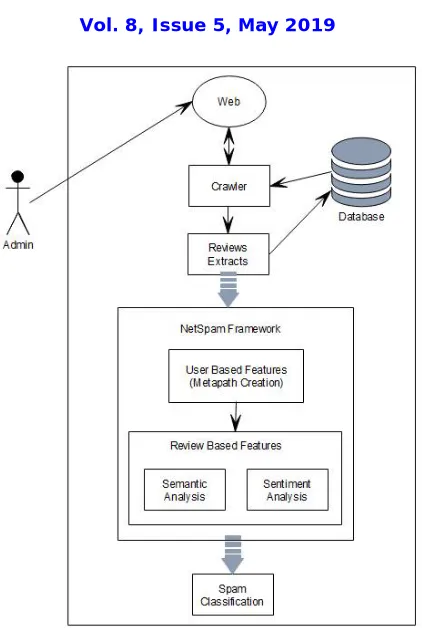
The Fig.1 shows the proposed system architecture.
1. NetSpam framework that is a novel network based approach which models review networks as heterogeneous information networks.
2. A new weighting method for spam features is proposed to determine the relative importance of each feature and shows how effective each of features are in identifying spams from normal reviews.
3. NetSpam framework improves the accuracy against the state-of-the art in points of time complexity, which extremely depends to the number of features utilized to detect a spam review.
ISSN(Online): 2319-8753 ISSN (Print): 2347-6710
I
nternational
J
ournal of
I
nnovative
R
esearch in
S
cience,
E
ngineering and
T
echnology
(A High Impact Factor, Monthly, Peer Reviewed Journal)
Visit: www.ijirset.com
Vol. 8, Issue 5, May 2019
Fig No 01 System Architecture Advantages:
1. To identify spam and spammers as well as different type of analysis on this topic.
2. Written reviews also help service providers to enhance the quality of their products and services. 3. To identify the spam user using positive and negative reviews in online social media.
4. To display only trusted reviews to the users.
B. Mathematical model
Spam Features:
User-Behavioral (UB) based features:
Burstiness: Spammers, usually write their spam reviews in short period of time for two reasons: first, because they want to impact readers and other users, and second because they are temporal users, they have to write as much as reviews they can in short time.
( ) = 0 ( − )∉(0, ) 1− ( − )∈(0, ) (1) Where,
− describes days between last and first review for = 28.
ISSN(Online): 2319-8753 ISSN (Print): 2347-6710
I
nternational
J
ournal of
I
nnovative
R
esearch in
S
cience,
E
ngineering and
T
echnology
(A High Impact Factor, Monthly, Peer Reviewed Journal)
Visit: www.ijirset.com
Vol. 8, Issue 5, May 2019
User-Linguistic (UL) based features:
Average Content Similarity, Maximum Content Similarity: Spammers, often write their reviews with same template and they prefer not to waste their time to write an original review. In result, they have similar reviews. Users have close calculated values take same values (in [0; 1]).
Review-Behavioral (RB) based features:
Early Time Frame: Spammers try to write their reviews a.s.a.p., in order to keep their review in the top reviews which other users visit them sooner.
( ) = 0 ( − )∉(0, )
1− ( − )∈(0, ) (2) Where,
− denotes days specified written review and first written review for a specific business. We have also = 7. Users with calculated value greater than 0.5 takes value 1 and others take 0.
Rate Deviation using threshold: Spammers, also tend to promote businesses they have contract with, so they rate these businesses with high scores. In result, there is high diversity in their given scores to different businesses which is the reason they have high variance and deviation.
( ) = 0 1− ∈ ∗ ℎ( )
> (3) Where,
is some threshold determined by recursive minimal entropy partitioning. Reviews are close to each other based on their calculated value, take same values (in [0; 1)).
Review-Linguistic (RL) based features:
Number of first Person Pronouns, Ratio of Exclamation Sentences containing ‘!’: First, studies show that spammers use second personal pronouns much more than first personal pronouns. In addition, spammers put ’!’ in their sentences as much as they can to increase impression on users and highlight their reviews among other ones. Reviews are close to each other based on their calculated value, take same values (in [0; 1]).
C. Algorithms
1. Sentiment Analysis Algorithm:
Input: Text File(comment or review) T, The sentiment lexicon L.
Output: = { , } and strength S where P: Positive, Ng: Negative, N: Neutral Initialization: SumPos = SumNeg =0, where,
SumPos: accumulates the polarity of positive tokens ti-smt in T, SumNeg: accumulates the polarity of negative tokens ti-smt in T, Begin
1. For each ∈ do 2. Search for in L
3. If ∈ − ℎ
4. SumPos←SumPos + ti−smt 5. Else if ∈ − ℎ
6. SumNeg←SumNeg + ti−smt 7. End If
8. End For
9. If > | |ℎ 10. Smt = P
ISSN(Online): 2319-8753 ISSN (Print): 2347-6710
I
nternational
J
ournal of
I
nnovative
R
esearch in
S
cience,
E
ngineering and
T
echnology
(A High Impact Factor, Monthly, Peer Reviewed Journal)
Visit: www.ijirset.com
Vol. 8, Issue 5, May 2019
14. S=SumNeg/(SumPos+SumNeg) 15. Else
16. Smt = N
17. S=SumPos/(SumPos+SumNeg) 18. End If
End
2. Index-based LSA (ILSA) Input:
Matrix U, = , index , query Q and parameter k; Output:
Top-r most similar sorted documents; Process:
Initialize <C,S>by setting C and S as ∅;
← ;
for ∈ ≠0 do
for< , PartialSim , >∈ do
obtainPartialSim , from< , PartialSim , >; if ∈ then
( )← ( ) + ( ) ,
∑( ( )) ;
else
( )← ( ) ,
∑( ( ))
;
← ∪{ }; ← ∪{ ( )}; end if
end for end for
returnGetSortedCenter( , < , >);
3. NetSpam Algorithm:
Input: review_dataset, spam_feature_list, pre_labeled_reviews Output: features_importance (W), spamicity_probability (Pr) Step 1: u, v: review, : spamicity probability of review u Step 2: ( ): initial probability of review u being spam Step 3: metapath based on feature l, L: features number Step 4: n: number of reviews connected to a review Step 5: : the level of spam certainty
Step 5: , : the metapath value
Step 6: Prior Knowledge Step 7: if semi-supervised mode Step 8: if ∈ _ _
Step 9: = ( )
Step 10: else Step 11: = 0
ISSN(Online): 2319-8753 ISSN (Print): 2347-6710
I
nternational
J
ournal of
I
nnovative
R
esearch in
S
cience,
E
ngineering and
T
echnology
(A High Impact Factor, Monthly, Peer Reviewed Journal)
Visit: www.ijirset.com
Vol. 8, Issue 5, May 2019
Step 13: = ∑ ( )
Step 14: Network Schema Definition
Step 15: schema = defining schema based on spam-feature-list Step 16: Metapath Definition and Creation
Step 17: for ∈ ℎ Step 18: for , ∈ _ Step 19: =⌊× ( )⌋
Step 20: =⌊× ( )⌋ Step 21: if =
Step 22: , =
Step 23: else Step 24: , = 0
Step 25: Classification - Weight Calculation Step 26: for ∈ ℎ
Step 27: do =∑ ∑∑ ∑ ,× × , Step 28: Classification - Labeling Step 29: for , ∈ _
Step 30: , = 1− ∏ 1− , ×
Step31: = ( , , , , … , , )
Step 32: return (W, Pr)
V. RESULT AND DISCUSSIONS
ISSN(Online): 2319-8753 ISSN (Print): 2347-6710
I
nternational
J
ournal of
I
nnovative
R
esearch in
S
cience,
E
ngineering and
T
echnology
(A High Impact Factor, Monthly, Peer Reviewed Journal)
Visit: www.ijirset.com
Vol. 8, Issue 5, May 2019
Fig.3 Feature weights for NetSpam Framework
TABLE I Weights of all features
Features DEV NR ETF BST RES PP1 ACS MCS Weight 0.0031 0.0034 0.0013 0.0027 0.0014 0.001 0.0035 0.0023
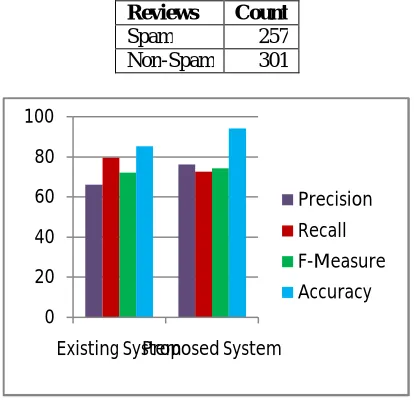
TABLE II Classification results of NetSpam Framework for hotel reviews
Reviews Count
Spam 257
Non-Spam 301
Fig. 4 Performance Analysis between existing and proposed system
The proposed NetSpam framework time complexity is ( ). The netspam framework accuracy is 94.06% which is better than SPaglePlus Algorithm accuracy is 85.14% on using TripAdvisor hotel dataset.
0 0.001 0.002 0.003 0.004
DEV NR ETF BST RES PP1 ACS MCS
W
ei
gh
t
Features
NetSpam Framework
DEV NR ETF BST RES PP1 ACS
0 20 40 60 80 100
Existing SystemProposed System
ISSN(Online): 2319-8753 ISSN (Print): 2347-6710
I
nternational
J
ournal of
I
nnovative
R
esearch in
S
cience,
E
ngineering and
T
echnology
(A High Impact Factor, Monthly, Peer Reviewed Journal)
Visit: www.ijirset.com
Vol. 8, Issue 5, May 2019
VI.CONCLUSION
This investigation presents a novel spam detection system in particular NetSpam in view of a metapath idea and another graph based strategy to name reviews depending on a rank-based naming methodology. The execution of the proposed structure is assessed by utilizing review datasets. Our perceptions demonstrate that ascertained weights by utilizing this metapath idea can be exceptionally powerful in recognizing spam surveys and prompts a superior execution. Furthermore, we found that even without a prepare set, NetSpam can figure the significance of each element and it yields better execution in the highlights' expansion procedure, and performs superior to anything past works, with just few highlights. In addition, in the wake of characterizing four fundamental classifications for highlights our perceptions demonstrate that the review behavioral classification performs superior to anything different classifications, regarding AP, AUC and in the ascertained weights. The outcomes likewise affirm that utilizing diverse supervisions, like the semi-administered strategy, have no detectable impact on deciding the vast majority of the weighted highlights, similarly as in various datasets. Contribution part in this project, for user when searches query he will get the top-k hotel lists as well as one recommendation hotel by using personalized recommendation algorithm.
REFERENCES
[1] Ch. Xu and J. Zhang. Combating product review spam campaigns via multiple heterogeneous pairwise features. In SIAM International Conference on Data Mining, 2014.
[2] G. Fei, A. Mukherjee, B. Liu, M. Hsu, M. Castellanos, and R. Ghosh. Exploiting burstiness in reviews for review spammer detection. In ICWSM, 2013.
[3] A. j. Minnich, N. Chavoshi, A. Mueen, S. Luan, and M. Faloutsos. Trueview: Harnessing the power of multiple review sites. In ACM WWW, 2015.
[4] B. Viswanath, M. Ahmad Bashir, M. Crovella, S. Guah, K. P. Gummadi, B. Krishnamurthy, and A. Mislove. Towards detecting anomalous user behavior in online social networks. In USENIX, 2014.