THE
GENETIC EVIDENCE OF A MULTIPLE (TRIPLE) ALLELO- TO SEX-LIMITED INHERITANCE’MORPJH SYSTEM I N BRUCHUS AND ITS RELATION
J. K. BREITENBECHER
University of Oklahoma, Norman, Oklahoma Received November 2, 1920 TABLE OF CONTENTS
INTRODUCTION.
...
:. ...
Life history and distribution.....
Origin of types and mutants.....
Description of species: The origin of the four color factors....
The tan type or wild form. . .
...
The red type or mutant.
...
The black type or mutant.....
The formulae....
Introduction.
...
The heredity of red, black, white, and tan types involving one pair of factors....
Back-cross tests and the heredity of the four body colors....
The genetic behavior of hybrid crosses involving three factors in relation to a multiple.allelomorph system.
.
...
Further proof of a multipl elomorph series by the genetic behavior of two hybrid DISCUSSION. ... ...CONCLUSIONS ... LITERATURE CITED. . ,
...
Methods of the experiment.. . .
Description qf types.
...
...
The white type or mutant
...
The experimental results. . .
...
crosses. . . ...
...
65 66 67 67 68 68 68 69 69 70 70 71 71 71 79 83
85 87 89
90
INTRODUCTION
This paper concerns the origin and genetic behavior of four different body colors, which have manifested themselves in my cultures of the so- called “four-spotted cowpea-weevil,” Bruchus quadrimaculatus, Fabr. The inheritance of these colors involves both allelomorphism and sex-limited inheritahce. These colors, red, black, white, and tan, are more apparent
1 Contribution from the Zoological Laboratory of the UNIVERSITY OF OKLAHOMA. The experiments, however, were carried on at WESTERN RESERVE UNIVERSITY and, in part, at the BIOLOGICAL LABORATORY, Cold Spring Harbor, Long Island.
66 J. K. BREITENBECHER
in the females, and less conspicuous in the males, because the latter usually have tan elytra. The males, however, carry the color factors, although they are not manifested to such a marked degree somatically. Experi- ments prove that these four color types compose a multiple allelomorph system, and that they also form an epistatic series. The order of dominance is red, black, white and tan.
During a search for insects which might be favorable for genetic studies, the possibilities of the Bruchidae were considered because several species were known to breed readily in stored seed and to produce several genera- tions each year. The first; experiments with these insects involved a culture of Bruchus obtectus, Say., the “common bean-weevil,” but these were given up because it was too difficult to distinguish the sexes. It was difficult to obtain living cultures of the so-called ‘fcowpea-weevil,7’ Bruchus chinensis, Linn., but it was comparatively easy to proctre living Bruchus quadrimac- ulatus, Fabr.
Several reasons may be given why these beetles are adapted for a study in genetics. It is not necessary to etherize them because they letisimulate when poured out of a culture bottle. Likewise, they breed rapidly and may produce a generation within twenty-five days if the temperature is maintained a t 30°C, and the relative humidity a t about 80 percent. Lastly, these weevils will breed on any species of cowpea, and bottles of any size may be used as containers.
LIFE HISTORY AND DISTRIBUTION
The adults deposit their eggs on the surface of the cowpea.
A
few days after oviposition the young larva emerges through an opening which it makes in the under side of the egg; it then burrows into the seed, where it feeds until it reaches the pupa stage. It requires about two weeks for the white, legless larva to attain full growth. At the end of about twenty days from time of egg-deposit the pupa state is reached, and this lasts about five days. At first the pupae are white, but after a few days they change to a light tan color. The adult insect emerges through a circular opening which it makes with its jaws. Usually within one day after emer- gence, the beetles mate and the females lay their eggs.Since its introduction, this insect has become widely distributed through- out the United States, Mexico, Brazil, the West Indies, and other warm countries. CHITTENDEN (1898) believes that it is probable that this insect, with its preferred food plant, the cowpea, was introduced from the orient. The weevil is found wherever its food plant grows. It will also breed
A MU1,TIPLE ALLELOMORPH SYSTEM I N BRUCHUS 67
METHODS OF THE EXPERIMENT
The Whippoorwill variety of the cowpea was used for food because it can be obtained at almost any seed store. This seed was put in flasks plugged with cotton and sterilized in an autoclave, to make certain the destruction of any eggs or larvae or adults which might contaminate the experiment. The seeds were then put into bottles which had been boiled for more than twenty minutes, after which they were plugged with cotton, preparatory to their use as breeding chambers. It was found that this species is subject to the attack of the mite, Pedzculoides verttrocosus, New., which destroys larvae and adults, but this parasite is easily controlled by the sterilization of the food and bottles. One pair of beetles was placed in each container and left until the young emerged. An oven regulated by a thermostat was used to maintain the desired temperature and great care was exercised to keep the proper humidity. The humidity when in excess, affects injuriously both cowpeas and weevils, while if the air is too dry the adults may die, or the eggs, larvae or pupae may be destroyed. A relative humidity of 80 percent proved the most satisfactory. Fresh cowpeas are absolutely essential. The stock cultures were carried on by placing ten females and ten males in a bottle. Virgin females may be obtained by opening infested seed or by using females that have emerged within twelve hours. It is a simple matter to distinguish males from females because of the remarkable sexual dimorphism exhibited in this species.
ORIGIN OF TYPES AND MUTANTS
The insects used were received from the TEXAS AGRICULTURAL EXPERI- MENT STATION. They were permitted to interbreed for several generations, to determine their genetic potentialities. The body color of this wild stock in both males and females was tan. I n the fourth generation a red female was observed; in the sixth generation a black female was discovered; and a white female appeared in the ninth generation. Other cultures of Bruchus from different parts of the United.States have been examined for these types. Professor Z. P. METCALF of the
NORTH
CAROLINA AGRICULTURAL EXPERIMENT STATION sent stock which already contained several red females and black females, but the tan or wild type greatly predominated. No white mutant originated during more than twenty-three generations. The North Carolina red type and black type were isolated and were found to have the same genetic behavior as the reds and blacks which had appar- ently appeared as mutants in the wild stock that came from Texas. Dur-68 J. K. BREITENBECHER
ing the summer of 1918, Adzuki beans which were badly infested with this weevil were obtained through the kindness of Dr. A. F. BLAKESLEE, but his stock, when examined, was all tan, and no evidence of any mutant was found during thirteen generations. Infested cowpeas which had been purchased a t a seed store in New York City, contained, among several hundred individuals, two black females.
DESCRIPTION OF SPECIES: THE ORIGIN OF THE FOUR COLOR FACTORS The family Bruchidae comprises three genera of insects : Spermophagus, Caryoborus, and Bruchus. HORN’S (1873) description of Bruchus quadri- maculatus, Fabr. follows:
Beneath equally clothed with whitish pubescence. Elytra ferruginous or pale brown with large lateral spot and apex broadly black. Head dark brown or black, densely punctured, front sub-cari- nate. Antennae as long as head and thorax, serrate in both sexes, four basal joints pale rufous, outer joints dark and nearly black. Thorax trapezoidal, broader at base than long, sides distinctly arcuate, base trisinuate, basal lobe emarginate and clothed with whitish hairs; color variable from ferruginous to black, coarsely punctured, subgranulate and feebly shining, sparsely clothed with cinereous hair. Scutellum with median impressed line and clothed with whitish hair. Elytra broader at base than thorax and longer than wide, sides feebly arcuate, humeri moderately prominent; striae punctured, intervals flat, densely punctu- late; color ferruginous with large lateral spot and apex black, clothed with whit- ish and cinereous pubescence. Pygidium nearly black with medium line of whitish. pubescence. Body beneath piceous, densely punctulate and sparsely but evenly clothed with cinereous hairs; abdomen pale brown. Anterior and middle legs pale rufous, hind legs pale brown. Hind femora armed with an acute tooth on the inner side and a broad triangular tooth on the outer side. Length 3 4 . 5 mm.”
No specific mention has been made in the literature indicating the existence of different types in this species, yet CHITTENDEN (1898) in describing this insect states that the ground color is black, with black, gray, and white pubescence, and WADE (1919) writes that there is an exceedingly wide range of color, which varies from a dark or almost black, to brown or reddish brown.
“Elongate oval, moderately shining.
DESCRIPTION O F TYPES
The tan type or wild form
The tan female has two black spots near the base of the elytra, similar The entire body is tan with the The pronotum and head are black, but the I n size it is smaller than the black mutants but larger to those in the red and the white types.
A MULTIPLE ALLELOMORPH SYSTEM IN BRUCHUS 69
than the reds and whites. The male is likewise tan except for the pronotum, head, and eyes, which are black. He has no spots on his elytra. Short white hairs cover the dorsal and ventral sides. The male and female correspond in color to RIDGEWAY’S “testaceous.” I n crosses with either red, black or white, tan is recessive. The formula is 77, which represents male and female of the wild type.
The red
type
07 mutantThe first appearance of the red type occurred in the fourth generation, where it was discovered in the wild stock which had been bred in large numbers. I n this type the females are red and the males vary from light red to tan. It required several generations before a type which bred true was segregated. This was accomplished by mating the first red female with a male of the wild stock, although it was doubtful whether this female was a virgin. The
F1
from this cross produced fifty-three red females and fifty-seven males which varied from light red to tan. This indicated that red was dominant to tan in the females. Ten males and ten females of this F1 generation were inbred. They produced 138 red females,57
tan females and 221 tan males in theFz
generation. This further indicated that fed is dominant to tan for the females. The next procedure was to obtain fifty virgin females and to mate them separately withFz
males. Each pair was placed in a separate bottle. Only two pairs bred true to the red type. Since the other cultures produced both red and tan females, they were discarded.The entire body of the red female is red except for the head and eyes, which are black. Her elytra are also red either with or without markings. Her color resembles
RIDGE
WAY’S “Hessian brown,” but our common hazel- nut approximates the color more closely. The elytra of the male and his entire body are of a red-tan color, except that his head and pronotum are black. It is evident that the sex-limited traits are least conspicuous for this type than for any other.This red mutant was discovered first and since it belongs to a multiple allelomorph series, it seems adiisable to use
RR,
as the formula for this type in both sexes. The red type is dominant to either the black, the white or the tan types, and it can be the allelomorph of any other color factor.The black type or mutant
When the black female, which was first discovered in the sixth generation of the wild or tan stock, was mated with a tan male of the wild stock, the offspring consisted of 27 black females and 29 tan males. These FI indi-
70 J. K. BREITENBECHER
viduals produced 153 black females, 61 tan females and 201 tan males. The result indicates that black is dominant to tan in the females. After many attempts, a homozygous strain for the black type was isolated. It has been bred true for more than forty generations. The black female differs from the tan female by being pure black in color and larger. The male of the black type differs from that of the tan male by being gray underneath and by having a black body. Tan predominates in the elytra of the male of the black type, and is similar to the tan of the wild type. Consequently, there is marked sexual dimorphism in the black type. It is advisable to use RbRb to indicate this mutant for both sexes, because it was the second
mutant discovered in the multiple allelomorph series. The results will prove that black is dominant to either white, or tan, but recessive to red.
The white type or mutant
The white female made her appearance in the ninth generation of inbred wild stock. This white female was mated with a tan male of the pure tan stock. .Four white females and seven tan males were procured. I n the F2 generation these produced 15 white females, 8 tan females, and 32 tan
males. Sev-
eral F2 pairs were mated, using virgin females, and after several cultures one of the pairs bred true for white. This stock has been bred homo- zygously for about thirty generations.
The female of the white type is covered with white pubescence, except for the head, pronotum and antennae, which are black. Her elytra may manifest two or more black spots. The male is gray in color except for his elytra which are of a light tan co€or. White is dominant to tan, but
recessive to red or black. It is a third member
of the multiple allelomorph series.
With reference t o size differences, the females are usually larger than the males in all four of the types. The adults vary in length from 3 to 5 mm. The black mutants are the largest and the white ones the smallest. The red mutant is larger than the tan or wild type, and both fall between the black and the white types.
This indicated that white is dominant to tan in the females.
The formula used is RwRw.
THE FORMULAE
A MULTIPLE ALLELOMORPH SYSTEM I N BRII'CHUS 71
Femates Males
Red type RR (red elytra and body) Black type RbRb (black elytra and body) White type RwRw (white elytra and body) Tan or wild type rr (tan elytra and body)
RR (reddish tan elytra and body) RbRb (tan elytra, dark gray body)
RwRw (light tan elytra, gray body) rr (tan elytra and body)
THE EXPERIMENTAL RESULTS Introduction
I n the tests and tables which follow all the males are classified as tan, because the elytra of the male usually resembles the tan of the wild type. But the body colors do show differences. Males of the red type usually manifest a red tinge; the black ones, too, show some black pubescence, and the white males are gray in color.
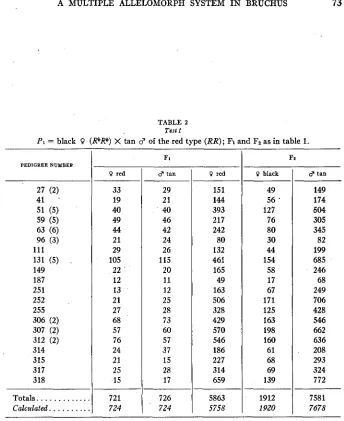
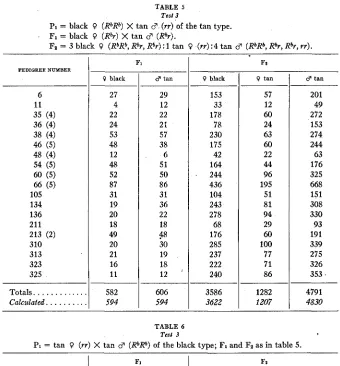
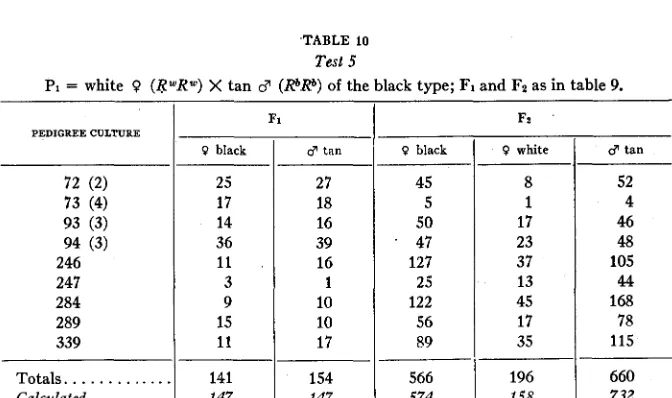
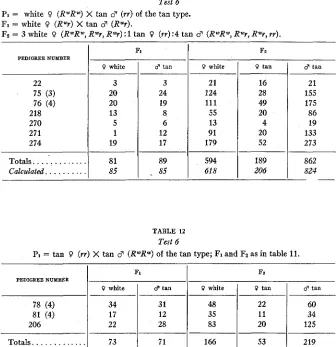
The first six tests (tables 1 to 12) deal with crosses involving these four factors. They prove that any color factor may pair with any other of this series as an allelomorph. The results from these six tests should prove that the dominant females, the recessive females, and the (tan) males in every instance, approximate a 3: 1
:4
phenotypic ratio in the Fz generation. The tests7
to 13 give the results obtained from various back-crosses. They prove that the color factors are carried by the males as well as by the females. The data to further prove that these factors form a multiple allelomorph system are given in tests 13 to 26.T h e heredity of red, black, white and tan types involving one
pair
of factorsConclusions from mass cultures (tests 1-6; tables 1-12)
The first six tests show that, when any two factors for the four body colors are brought together in pairs, Mendelian segregation takes place, and further, the order of dominance is red, black, white and tan. When two individuals, each carrying a different color factor, are crossed, their
F2
offspring approximate a 3:1:4 phenotype ratio.72 J. K. BREITENBECHER
PEDIGBEE NUMBER
1 (2)2
3 (2) ,28 (2)
40 (3) 42 (3) 43 50 (5) 58 (5)
95 (3) 2 62 152 153 154 193 194 256 257 269 .
308 309 (2) 311 (2) 321 (2) 322
Totals.
. . .
.<..
Calculated.
...
0 red
34 82 26 22 33 50 24 47 87 32 2 44 40 39 27 38 20 16 13 71 44 61 20 ,18 850 887 Fi
d tan
35 77 28 23 51 52 19 86 88 35 3 55 27 48 29 34 22 15 14 76 4 54 25 23 923 887
0 red
70 109 56 155 289 299 133 310 418 240 13 532 366 532 176 231 657 286 336 55 1 51 495 390 307 6992 6957 Fn
0 black
19 35 18 51 96 99 45 106 140 47 6 176 130 178 40 69 215 93 111 183
-
21173 183 101 2335 231 9
61 tan
A MULTIPLE ALLELOMORPH SYSTEM I N BRUCHUS 73
TABLE 2
Tesf I
P1 = black 0 (RbRb) X tan 3 of the red type (RR); F.1and Fz as in table 1.
PEDIGREE NUMBER
0 red
27 (2) 51 (5)
59 (5) 63 (6) 96 (3) 111 131 (5) 149 187 251 252 255 306 (2) 307 (2)
312 (2) 314 315 317 318
41 '
Totals.
. . .
. . ..
Calculated.. .
,. . .
..
33 19 40 49 44 21 29 105 22 12 13 21 27 68 57 76 24 21 25 15 721 724 Fi
8 tan
29 21 40 46 42 24 26 115 20 11 12 25 28 73 60 57 37 15 28 17 726 724
0 red
151 144 393 217 242 80 132 461 165 49 163 506 328 429 570 546 186 227 314 659 5863 5758 Fz
0 black
49 56 '
127 76 80 30 44 154 58 17 67 171 125 163 198 160 61 68 69 139 1912 1920
3 tan
~ 149 174 504 305 345 82 199 685 246 68 249 706 428 546 662 636 208 293 324 772 7581 7678
74
PEDIGREE NUMBER
5 19 52 56 (5)
86 (4) 102 104 144 145 146 147 210 214 216 330 ,
33 1 350 352
Totals.. . . .
.
. . .. . . .Calculated. . . .
. . .
.. .
J. K. BREITENBECHER
F1 F2
0 red d tan 0 red 0 tan d tan
53 57 138 61
.
22113 18 114 39 185
37 35 191 69 251
49 44 220 85 311
20 22 58 21 68
15 14 57 23 99
30 33 153 98 254
34 31 386 110 519
32 32 330 112 482
26 45 126 48 199
31 32 231 78 338
22 19 58 22 83
1 6 6 1 7
24 25 141 36 201
27 26 324 134 482
15 18 215 73 316
25 22 595 119 721
22 29 290 90 381
476 508 3633 1218 5118
492 492 ' 3738 1246 4984
PEDIGREE NUMBER
4 30 65 (5)
140 141 209 326 327 329 355
Totals.
.
.. . . .
. . .. . .
Calculated. . . ..
..
.
F1 FZ
0 red d tan 0 red 0 tan d tan
24 25 181 60 243
12 12 64 16 83
38 39 179 58 260
11 14 144 49 2 15
15 20 178 47 244
18 19 124 42 123
11 14 70 19 97
16 28 234 54 258
16 21 408 134 562
25 23 350 113 502
186 215 1932 592 2587
201 201 1917 639 2556
4 30 65 (5)
140 141 209 326 327 329 355
Totals.
.
.. . . .
. . .. . .
Calculated.. . . . ..
..
.I
24 12 38 11 15 18 11 16 16 25 ~-
186 215 1932 592 2587
201
1
2011
19171
6391
2556 25 12 39 14 20 19 14 28 21 23 F10 red
I
d tanPEDIGREE NUMBER
FZ
0 red
I
0 tanI
d tanTABLE 5 Test 3
pI = black 0 (RbRb) X tan 3 (rr) of the tan type.
FI = black 0 (Rbr) X tan 3 (Rbt9.
F~ 3 black p (RbRb, Rbr, Rbr) : 1 tan 0 (rr) : 4 tan 3 (RbRb, R b ~ , Rbf', rr).
9 tan
57 12 60 24 63 60 22 44 96 195 51 81 94 29 60 100 77 71 86
CT tan
201 49 272 153 274 244 63 176 325 668 151 308 330 93 191 339 275 326 353 '
65 23 8 9 98 18 31 37 82 20 61 4 41 239. 94 21 45 341 84 138 113 230 126 328 81 200
FI F t
PEDIQREE N m E R
0 black 0 black
153 33 178 78 230 175 42 164
. 244 436 104 243 278 68 176 285 237 222 240 d tan
29 12 22 21 57 38 6 51 50 86 31 36 22 18 30 19 18
12 .
48 6
11 35 (4) 36 (4) 38 (4) 46 ( 5 )
48 (4) 54 ( 5 )
60 ( 5 )
66 ( 5 )
105 134 136 211 213 (2) 310 313 323 325 27 4 22 24 53 48 12 48 52 87 31 19 20 18 49 20 21 16 11
Totals. . . . Calculated.
. . .
582 594 606 594 3586 3622
TABLE 6
Test 3
PI = tan 0 (rr) X tan 3 (RbRb) of the black type; FI and FZ as in table 5.
FI Fa
PEDIGREE NUMBER
9 black # tan 0 black o tan
I
CT tan48 21 14 10 68 15 39
' 20 33 27 13 3 18 62 25 21 19 71 13 39 17 25 26 14 4 19 181 69 23 31 230 52 97 102 272 9 1 274 86 122
Totals. . . . Calculated . . .
329 342 355 342 1632 1563
76 J. K. BREITENBECHER
~
FI
0 red d tan
PEDIGREE NUMAER
7 10 10
83 11 -12
87 (2) 24 18
89 (3) 37 33
100 13 18
156 25 26
157 26 23
158 30 32
159 2 4
160 23 27
161 32 39
162 28 26
231 15 14
232 32 33
234 35 31
235 30 * 32
348 47 40
418 41 9 Totals..
. . . .
. . . . ...
Celculated. . . . , .
.
. . .420 41 9
Fz
0 red 0 white d tan
47 12 61
63 30 95
129 64 195
220 74 301
37 14 54
276 92 383
233 81 311
118 37 163
37 14 52
77 23 106
301 114 416
80 28 108
94 33 147
455 152 603
319 146 472
199 77 370
686 262 980
3371 1253 4817
3540 1180 4720
FI
0 red 6 tan
PEDIGREE NUMBER
70 (2) 23 26
163 11 9
164 20 13
166 27 19
171 2 1
172 20 34
178 34 21
201 2 2
203 10 11
329 3 2
303 8 15
153 156 Totals..
. .
.. . . ..
...
Calculated. . .
.
. . .
156 160F2
0 red 0 white d tan
69 22 92
70 24 88
132 62 311 '
283 85 323
3 1 7
94 22 161
135 47 190
8 3 14
31 12 60
42 16 51
56 15 49
923 309 1346
A MULTIPLE AL1,ELOMORPH SYSTEM I N BRUCHUS
PEDIGREE N W B E R
74 (5)
92 (3) 173 177 186 199 249
90 (3) 91 (3)
77
0 black
43 23 62 22 33 29 17 15 25
TABLE 9
Test 5 PI = black Q (RbRb) X tan 3 (RwR") of the white type.
FI = black Q (RbR") X tan $ (RbRw).
F2 = 3 black 0 (RbRb, RbRw, RbRw):l white Q ( R w R w ) :4 tan 3 (RbRb, RbRw, RbRw, R w R w ) .
I
F1 Fz0 white
31 27 57 42 40 2 33 36 135
8 tan 8 tan 0 black
42 17 54 34 32 30 21 6 16 118 66 187 128 122 12 117 207 308 79 82 228 171 180 15
' 141
208 42 7 1766 1636
.TABLE 10 Test 5
PI = white 0 ( B W R w ) X tan 3 (RbRb) of the black type; FI and Fz as in table 9.
F1 F2
PEDIGREE CULTURE
0 black d tan 0 black 0 white d tan
72 (2) 73 (4) 93 (3) 94 (3) 246 247 284 289 339 25 17 14 36 11 3 9 15 11 27 18 16 39 16 1 10 10 17 45 5 50 47 127 25 122 56 89 8 1 17 23 37 13 45 17 35 52 4 46 48 105 44 168 78 115 Totals. . .
Calculated. . . 141 147
154 147 566 574 196 158 660 732
78
FI
0 white d tan
PEDIGREE NUMBER
22 3 3
75 (3) 20 24
76 (4) 20 19
218 13 8
270 5 6
271 1 12
274 19 17
Totals..
. . .
81 89 Calculated.. . . . 85 ~ 85J. K. BREITENBECHER
0 white
21 124 111 55 13 91 179 594 618 TABLE 11
Test 6 PI = white 9 (RwRw) X tan 8 (rr) of the tan type. F1 = white 0 (Rwr) X tan 3' (Rwr).
F2 = 3 white 0 ( R w R w , Rwr, Rwr):l tan 9 (rr):4 tan c? (RwRw, Rwr, Rwr, rr).
PEDIGREE N U m E R
78 (4) 81 (4) 206
Totals.. . . Calculated.. ...
FI
0 white 8 tan
34 31
17 12
22 28
73 71
7 2 72
Fz
Q tan 8 tan
16
28 49 20
4
20 52
21 155 175 86 19 133 273 189
206
862 824
-~
TABLE 12
Test 6
PI = tan 9 (rr) X tan 8 ( R W R W ) of the tan type; FI and FZ as in table 11.
F P
Q white
I
Q tanI
# tan48 35 83
22 11 20
60 34 125 166
A MULTIPLE ALLELOMORPH SYSTEM I N BRUCHUS
44 5
15 5
I 49
79
Back-cross tests and the heredity of the j o u r body colors
Conclusions from back-cross tests (tests
7
to 13; tables 13 to 19) These crosses show that any two of the four color factors may stand in relation of allelomorphs to each other. The results also demonstrate that the order of dominance, as previously given, is red, black, white, and tan. Polymorphism and sex-limited inheritance are also manifested. The following tests give further proof.TABLE 13
Test 7: Red, heterozygous for red and white, by homozygous red.
p1 = red 0 (RR") X tan 8' (RR) of the red type: five pairs mated.
F1 = red 0 (RR, RRW, totals 148): tan 8' (RR, RR", totals 121).
p1 = red 9 (RR) X tan 3 (RR") of a red-white combination: five pairs mated. F1 = red 0 (RR, RRw; totals 166):tan 3 (RR, RRw; totals 163).
Reciprocal cross
TABLE 14
Test 8: Red, heterozygous for red and white, by homozygous white.
P1 = red 0 (RR) X tan 3 (R"Rw) of the white type.
F1 = 1 red 0 (RRw):l white 0 ( R w R w ) : ~ tan 8'(RRw, R"Rw). CULTURE NUMREP
1046 1054 1055 1056 1057
Totals.
...
Calculated. ...
RED 0 (RRw)
16 2 9 5 18
50 53
19 6 6 9 11
111 51
53
1
106Reciprocal cross
P1 = white 0 (RwRw) X tan 3 (RRW) of a red-white combination. F1 = Same as above.
CULTURE hUMRER
2031 2036 2037 15611 15612 16170
Totals.
...
Calczlla f ed
...
RED 0 (RRw)
13 26 5 6 3 9
62 62
15 22 4 11 1 8
61 62
29 44 21 14 5 11
124 124
80
CULTUB.E KUldBER
1311 1004 1008 1026 1027 1028 1029
Totals. . .
. .
..
. . .Calculated. .
.
.. . .
. . .J. K. BREITENBECHER
RED 0 (RRb) ELACK 0 (RbRb) TAN cr* (RR*, R b E )
2 3 1
10 8 41
14 16 26
44 42 106
23 13 49
19 18 35
22
.
21 39134 121 297
138 138 276
TABLE 15
Test 9: Red, heterozygous for red and black, b y homozygous black. PI = red 0 (RRb) X tan 3 ( P R b ) of the black type.
FI = 1 red 0 (RRb): 1 biack 0 (RbRb):2 tan 3 (RRb, RbRb). CULTURE NUYBEB
1012 1013 1014 1029 1030 1031 1032 1047 1048 1521 1536 1577
RED 0 (RRb)
29 16
12 ,
30 19 18 3 12 20 7 20 22
31 21 24 22 26 19 1
10
5
21 28 14
26 42 53 25 45 39 1 25 28 15 42 25
Totals.
. . .
.
.
. .. . .
Calculated. . .
. .
. . ,.
368
Reciprocal cross
p1 = black 0 ( @ b ) X tan 3. (RRb) of a red-black combination.
TABLE 16
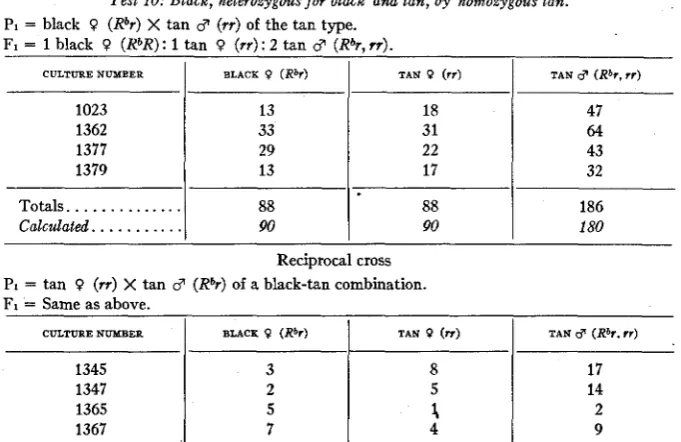
Test 10: Black, heterozygous for black and tan, by homozygous tan. PI = black 0 (PY) X tan 3 ( T T ) of the tan type.
F1 = 1 black 0 (KbR): 1 tan 0 ( T T ) : 2 tan 8 (Rbr, rr).
CULTURE NUMBER
1345 1347 1365 1367 13611 13614
Totals.
...
Calculated.
...
CULTURE NUYEER
TAN 0 ( W )
j
BLACK Q (Rad
3 2 5 7
9 11
6
32 33
32 32
1023 1362 1377 1379
CULTURE NUMBER
1041 1042 1043 1044 1045
Totals.
...
Calculated.
...
BLACK Q (RbRw) WHITE Q (RwRw)
14 12
12 10
16 22
18 16
12 13
13 33 29 13
C&TURE YWBER
1993 2005 2006 2007 2008
Totals.
...
Calculated.
...
18 31 22 17
BLACK Q (RsRw) WHlTE Q (RWRW) TAN d (RbRw, RWRW)
5 6 12
17 18 33
22 19 39
24 27 52
19 20 38
87 90 174
88 88 176
88
88 90
1
9047 64 43 32 186
180
TAN d ( R k . W )
64
64
Test 11: Black, heterozygous for black and white, by homozygous white.
...
73Totals.
Calculated ...
I
74'Reciprocal cross
Pl = white 0 (RwRw) X tan 3 (RbRw) of a black-white combination.
17 14 2 9 21 11
30 19 36 33 35 153
148
F1 = Same as above.
TABLE 18
Test 12: White, heterozygousfor white and tan, by homozygous tan. PI = white 0 (R?) X tan 3 ( r ) of the tan type.
F1 = 1 white 0 ( R w r ) : 1 tan 0 (rr) : 2 tan 3 ( R w r , rr ) .
CULTURE NUMBER
I
WRITE 9 ( R W ~ )1
TAN 0 (rr)I
TAN $ (Rwr, rr)CULTURE NUMBER 1034 1036 2019 2020 1049
Totals.
. . .
..
. . . Calculated. . . . .. .
.. .
.1058 1060 2016 2017 2018
WEITE 9 ( R w )
3 6 10 16 12 47 50 15 10 19 8 13 CULTURE NUMBER 2031 2032 2033 2034 2035
Totals.
.
. . .. .
. . . Calculated..
..
. . . ..
..
RED 0 (RY) TAN '? ( Y Y ) FAN d (RI, Y Y )
15 16 32
19 18 35
10 9 20
17 19 36
20 21 42
15 11 20 9 12
TAN 9 (rr)
20 19 12 13 16 80 80 29 23 40 18 24
TAN $ (RI, Y Y )
42 37 25 24 31 159 160 67 67 134
1
134Reciprocal cross PI = tan 0 ( r r ) X tan 3 (Rwr) of a white-tan combination. F1 = Same as above.
TAN '? (Yr)
4 13 '
6 17 11 51
I 50
6 19 19 34 22 100 100
I I I
165
81
1
82 831
164Totals.
. . . .
.. .
. . . Calculated. . .. .
..
. ..
.I
Reciprocal cross PI = tan 0 (rr) X tan 3 ( R r ) of a red-tan combination. F1 = Same as above.
CULTURE NUMBER 2036 2037 2038 2039 2040
Totals.
. . .
..
. Calculated.. . .
RED 0 (RY) .
21 18 14 12 16 81 80
A MULTIPLE ALLELOMORPH SYSTEM I N BRUCHUS 83
T h e genetic behavior of hybrid crosses involving three factors in relation
to
a multiple allelomorph seriesConclusions based on the preceding crosses involving three color factors (tests 13 to 24; tables 20 to 30)
When a Bruchid which is heterozygous for any two color factors, is mated with a homozygous individual carrying a third color factor, the progeny will approximate a 1 : 1 ratio or a 1 : 1 : 2 ratio. These ratios are, of course, typical sex-limited ones.
This group of tests furnishes proof that the four color factors form a system of multiple allelomorphs, for it is evident that only two of these factors can exist a t any one time in any one individual, and since the elytra colors are sex-limited, they are not manifested in the males.
TABLE 20
Test 14: W h i t e , heterozygous f o r white and tan, by homozygous red.
PI = white 0 (RWr)
x
tan 3 (RR) of the red type; two pairs mated. F1 = 1 red 0 (RRW, Rr; totals 32): 1 tan d (RR", Rr; totals 31).PI = red p (RR) X tan 3 (RWr) of a white-tan combination; five pairs mated. Fl = 1 red 0 (RR", Rr; totals 93) : 1 tan 3 (RRW, Rr; totals 68).
Reciprocal cross
TABLE 21
Test 15: Black, heterozygous for black and white, by homozygous tan.
PI = black 0 (RbRw) X tan 3 (rr) of the tan type; six pairs mated.
F1 = 1 black 0 (Rbr; totals 75) : 1 white 0 (Rwr; totals 96) :2 tan d (Rbr, Rwr; totals 184). P1 = tan p (rr) X tan 3 ( R b R w ) of a black-white combination; seven pairs mated.
F1 = 1 black 0 (Rbr; totals 5O):l white Q ( P r ; totals 50):2 tan d (Rbr, Rwr; totals 74).
\ Reciprocal cross
TABLE 22
Test 16: Black, heterozygous for black and tan, by homozygous white.
~ ~
PI = black p (Rbr) X tan 3 (RwR") of the white type; six pairs mated.
Fl = 1 black 9 (R*Rw; totals 122):l white Q (R?; totals 121):2 tan d" (RbRw,R'"r; totals 248).
Reciprocal cross PI = white 0 (RWRw) X tan
F1 = 1 black 9 (RbRw; totals 36):l white 0 (Rwr; totals 40):2 tan d (RbRw, R"r; totals 79). (Rbr) of a black-tan combination; two pairs mated.
TABLE 23
Test 17: Red, heterozygous for red and white, by homozygous tan.
PI = red 0 (RRW) X tan 3 (rr) of the tan type; seven pairs mated.
FI = 1 red 0 (Rr; totals 144):l white 0 (Rwr; totals 137):2 tan d (Rr, Rwr; totals 268). PI = tan 0 (rr) X tan 3 (RRW) of a red-white combination; five pairs mated.
FI = 1 red 0 (Rr; totals 78):l white 0 (RWr; totals 70):2 tan 3 (Rr, RWr; totals 184). Reciprocal cross
84 J. K. BREITENBECHER
TABLE 24
Test 18: Red, heterozygous for red and white, by homozygous black. p, = red 0 (RRw) X tan 3 (RbRb) of the black type; six pairs mated.
F1 = 1 red 0 (RRb; totals 104):l black 0 (RbRw; totals 90):2 tan 3 (RRb, RbRw; totals 197). Reciprocal cross
p1 = black 0 (RbRb) X tan 3 (RRw) of a red-white combination; four pairs mated.
F, = 1.red 0 (RRb; totals 53):l black 9 (RbRw; totals 51):2 tan 3 (RRb, RbR"; totals 121).
TABLE 25
Test 19: Red, heterozygous for red and black, by homozygous tan. p1 = red 0 (RRb) X tan 3 (rr) of the tan type; six pairs mated.
F1 = 1 red 0 (Rr; totals 97):l black 0 (Rbr: totals 79):2 tan 3 (Rr, R t ; totals 194).
p1 = tan 0 (rr) X tan 3 (RRb) of a red-black combination; three pairs mated. F1 = 1 red 0 (Rr; totals 34):l black 0 (Rbr; totals 22):2 tan 3 (Rr, Rbr; totals 48).
Reciprocal cross
TABLE 26
Test 20: Red, heterozygous for red and black, by homozygous white. p1 = red 0 (RRb) X tan 3 (RwRw) of the white type; four pairs mated.
Fl = 1 red 0 (RRW; totals 39):l black 0 (RbRw; totals 33):2 tan 3 (RR", RbRw; totals 76). Reciprocal cross
p1 = white Q (RwRw) X tan CT (RRb) of a red-bl-ck combination; four pairs mated.
F, = 1 red 0 (RRw; totals 36): 1 blsck 0 ( R b R w ; totals 36): 2 tan 8 (RI?", RbRw; totals 69).
TABLE 27
Test 21: Black, heterozygous for black and tan, by homozygous red. Pl = black 0 (Rbr) X tan d (RR) of the red type; five pairs mated.
F1 = 1 red 0 (RRb, Rr; totals 204): 1 tan 3 (RRb, Rr; totals 192).
p1 = red 0 (RR) X tan 3 (Rbr) of a black-tan combination; four pairs mated.
Fl i= 1 red 0 (Ma, Rr; totals 166): 1 tan 3 (RRb, Rr; totals 200). Reciprocal cross
TABLE 28
Test 22: Black, heterozygous for black and white, by homozygous red. P1 = black 0 (RbRw) X tan 3 (RR) of the red type; six pairs mated.
F1 = red 0 (RRb, RRu; totals 217):tan 3 (RRb, RRw; totals 227).
Pl = red 0 ( R R ) X tan 3 (RbRw) of a black-white combination; three pairs mated F, = 1 red 0 (RRb, RRw; totals 50): 1 tan 3 IRRb, RR"; totals 36).
Reciprocal cross
TABLE 29
Test 23: White, heterozygous for white and tan, by homozygous black. P1 = white 0 ( P r ) X tan 3 (RbRb) of the black type; two pairs mated. F1 = 1 black 0 (RbRw, Rbr; totals 51): 1 tan 3 (RbRw, Rbr; totals 40).
Pl = black 0 (RbRb) X tan 3 (R?) of a white-tan combination; seven pairs mated. Ft = 1 black 0 (RbRw, Rbr; totals 155): 1 tan 3 (RbRw, Kay; totals 142).
A MULTIPLE ,ALLELOMORPH SYSTEM I N BRUCHUS 85
TABLE 30
Test 24: Red, heterozygous f o r red and tan, by homozygozis black.
Pl = black 0 (RbRb) X tan 3 (Rr) of a red-tan combination; four pairs mated.
F1 = 1 red 0 (RRb; totals 56):l black 0 (Rbr; totals 61):2 tan 3 (RRb, Rbr; totals 123).
Further proof o j a multiple allelomorph series by the genetic behavior of two hybrid crosses
Conclusions based on hybrid crosses involving four factors for body color (tests 25 to 36; tables 31 to 42)
It is again evident from these tests that only. two of the factors for body color can exist a t any one time in any individual. This is a proof of a multiple allelomorph system. The reciprocal crosses prove that the males carry the same combinations as the females, although they are not con- spicuous in their phenotypes. The ratios derived from this group of tests are 1 : 1 : 2, 2 : 1 : 1 :4, and 3 : 1 :4; these ratios give evidence of sex-limitation.
TABLE 31
Test 25: Red, heterozygous for red and black, by white, heterozygous for white and tan.
P1 = red 0 (RRb) X tan 3 (Rwr); eleven pairs mated.
F1 = 1 red 0 (RR", Rr; totals 190):l black 0 (R*Rw, Rbr; totals 196):2 tan 3 (RRw, Rr,
Reciprocal cross PI = white 0 (Rwr) X tan 3 (RRb); nine pairs mated.
Fl = 1 red 0 (RRw, Rr; totals 167) : 1 black 0 (RbRw, Rbr; totals 119) :2 tan 3 (RR", Rr, RbRw, RbRw, Rbr; totals 311).
Rbr; totals 375).
TABLE 32
Test 26: Red, heterozygous for red and black, by black, heterozygous f o r black and white.
PI = red 0 (RRb) X tan 3 (RbRw); six pairs mated.
F1 = 1 red 0 (RRb, RR"; totals 88): 1 black 0 (RbRb, RbRw; totals 86):2 tan 3 (RRb, RR", RbRb, RbR"; totals 148).
Reciprocal cross P1 = black p (RbR") X tan CT (RRb); five pairs mated.
Fl = 1 red 0 (RRb, RR"; totals 95):l black 0 (RbRb, RbRw; totals 91):2 tan 3 (RRb, RR", RbRb, RbRw; totals 179).
TABLE 33
Test 27: Red, heterozygous for red and black, by black, heterozygous f o r black and tan.
P1 = red P (RI?) X tan 3 (Rbr); nine pairs mated.
F1 = 1 red 0 (RRb, Rr; totals 185):l black 0 (RbRb, R%; totals 182):2 tan CT (RRb, Rr, RbRb,
Reciprocal cross P1 = black 0 (Rbr) X tan 3 (RRb); nine pairs mated.
F1 = 1 red 0 (RRb, Rr; totals 176):l black 0 (RbRb, Rbr; totals 174):2 tan 3 (RRb, Rr, RbRb, Rbr; totals 346).
Rbr; totals 383).
86 J. K. BREITENBECHER
TABLE 34
Test 28: Whiie, heteroqgoats f o r white and tan, by red, heterozygous for red and iuhite. PI = white 0 (Rwr) X tan d ( R R w ) ; two pairs mated:
Fl = 1 red 0 (RRw, Rr; totals24):l white 0 (RwRW, Rwr; totals30):Z tan 3 (RR", Rr, R"RW, RWr; totals 89).
TABLE 35
Test 29: Red, heterozygous for red and tan, by black, heterozygous for black and tan. PI = red 9 (Rr) X tan 3 (Rbr); twelve pairs mated.
F1 = 2 red 0 (RRb, Rr; totals 161):l black 0 (Rbr; totals 83):l tan 0 (rr; totals 89):4 tan 3
Reciprocal cross PI = black 0 (Rbr) X tan d ( R r ) ; six pairs mated.
Fl = 2 red 0 (RRb, Rr; totals 151): 1 black 0 (Rbr; totals 49): 1 tan 0 (77; totals 61) :4 tan d
(RRb, Rr, Rbr, rr; totals 345).
(RRb, Rr, Rbr, rr; totals 249)
TABLE 36
Test 30: Red, heterozygousfor red and white, by black, heterozygous for black and tan. PI = red 0 (RR") X tan 6 (Rbr); eleven pairs mated.
Fl = 2 red 0 (RRb, Rr; totals 179):l black 0 (RbRw; totals 59 ): l white 0 (Rwr; totals 78):4 tan 8 (RRb, Rr, RbRw, Rwr; totals 320).
Reciprocal cross PI = black 0 (Rb7) X tan d (RR"); nine pairs mated.
F, = 2 red 0 (RRb, Rr; totals 154) : 1 black 0 (RbR"; totals 62) : 1 white 0 ( R V ; totals 67) : 4 tan 3 (Ripb, Rr, RbRw, Rwr; totals 307).
TABLE 31
Test 31: Black, heterozygousor black and white, by red, heterozygous for red and white. PI = black 0 (RbRw) X tan d (RR"); seven pairs mated.
F1 = 2 red 0 (RRb, RRW; totals 74) : 1 black 0 (RbRw; totals 40) : 1 white 0 (RwRw; totals 39) :4
tan 3 (RRb, RR", RbRw, RwR"; totals 198). Reciprocal cross PI = red 0 ( R R W ) X tan fl (RbR"); seven pairs mated.
F1 = 2 red 0 (RRb, RRw; totals 95): 1 black 0 (RbR"; totals 53) : 1 white 0 (RwRw; totals 48) :4
tan 3 (RRb, RRW, RbRw, RWRw; totals 236).
TABLE 38
Test 32: Black, heterozygous f o r black and tan, by white, heterozygous for white and tan. PI = black 0 (Rbr) X tan 3 ( R w r ) ; eight pairs mated.
F1 = 2 black 0 (RbRw, Rbr; totals 127):l white 0 (R"r; totals 51):l tan 0 (rr; totals 52) : 4
tan 3 (RbRw, Rbr, Rw7: rr; totals 245). Reciprocal cross
P1 = white 0 (Rwr) X tan d (Rbr); five pairs mated.
A MULTIPLE ALLELOMORPH SYSTEM IN BRUCHUS 87
TABLE 39
Test 33: Red, heterozygous for red and tan, by black. heterozygousfor block and white.
PI = red 0 (Rr) X tan d' (RbRw); fourteen pairs mated.
F1 = 2 red 0 (RRb, RR"; totals 159):l black 9 (Rbr; totals 79):l white 0 (Rwr; totals 68): 4
,
tan d' (RRb, RRw, Rbr, Rwr; totals 287).Reciprocal cross
PI = black 0 (RbRw) X tan 3 (Rr); one pair mated.
FI = 2 red 0 (RRb, RRw; totals 21) : 1 black 0 (Rbr; totals 9): 1 white 0 (Rwr; totals 11) :4 tan 8 (RRb, RRw, Rbr, R r ; totals 47).
TABLE 40
Test 34: W h i t e , heterozygous for white and tan, by red, heterozygous for red and tan.
PI = white 0 (Rwr) X tan 3 (Rr); one pair mated.
PI = 2 red 0 (RRw, Rr; totals 13) : 1 white 0 (Rwr; totals 6): 1 tan P ( r r ; totals 5) :4 tan d'
(RR", Rr, RWr, r r ; totals 19).
TABLE 41
Test 35: Red, heterozygous for red and white, by red, heterozygous f o r red and tan.
PI = red 0 (RR") X tan 3 (Rr); seven pairs.
F1 = 3 red 0 (RR, RR", Rr; totals 160): 1 white 0 (Rwr; totals 54): 4 tan 3 (RR, RR", Rr, Rwr; totals 214.)
Reciprocal cross PI = red 0 (Rr)
x
tan (RR"); one pair mated.F1 = 3 red 0 (RR, RRW, Rr; totals 5): 1 white 0 (Rwr; totals 2): 4 tan d' (RR, RR". Rr, RWr;
totals 11).
TABLE 42
Test 36: Red, heterozygous for red and tan, by red, heterozygous for red and black.
PI = red 9 (Rr) X tan 3 (RRb); seven pairs mated.
FI = 3 red 0 (RR, RRb, Rr; totals 167): 1 black 0 (Rbr; totals44): 4 tan d' (RR, RRb, RI, Rbr;
Reciprocal cross PI = red 0 (RRb) X tan 3 (Rr); one pair mated.
F1 = 3 red 0 (RR, R R b , Rr; totals 36): 1 black 0 (Rbr; totals 16): 4 tan 3 (RR, RRb, Rr, Rbr;
totals 234).
I
totals 54).
DISCUSSION
The following arguments, taken from MORGAN, STURTEVANT, MULLER and
BRIDGES
(1915) are in favor of a multiple allelomorph series:1. That multiple allelomorphs seem to affect the. same character. This is true for Bruchus, since the four body colors (red, black, white and tan) affect the entire color pattern.
2. That an individual may contain only two of the genes of the allelo- morphic series. These may be the same gene or different members of the allelomorphic series. This behavior is manifested in Bruchus.
88 J. K. BREITENBECHER
3. When any two mutant types of an allelomorphic series are crossed they give a type in the F1 that is like the dominant parent or intermediate, because neither brings in the normal allelomorph of the other; consequently the wild type is not reconstituted. This relationship holds for the red, black and white mutant types of Bruchus.
4.
There is no crossing over between the members of a multiple allelo- morph series since such genes occupy the same locus. No crossing over takes place between the four body colors of Bruchus.I n all these four respects the mutants of Bruchus fulfill the requirements of a multiple allelomorph series.
I n view of the observation that color dominance appears in the order of red, black, white and tan, it occurred to the writer that it might be interest- ing to note the correlation, if any, of this color dominance with5uch physi- ological traits as vigor, number of progeny, size and the like. As far as can be ascertained, the eggs of these four types are exactly similar in size and color. I n the mature beetles, it was discovered that the blacks have the greatest number of progeny, and are most vigorous; the reds follow next in number of offspring and vigor; the tans (or wild type) are next in order, while the white ones rank fourth, because of a seeming lack of vigor and reproductive power. The types in order of size, are black, tan, red and white. There is, further, a marked variation as regards color in these types; for the whites may approach the blacks and the reds may verge on the whites as well as on the tans. Great care is therefore necessary to avoid chance errors in classification.
The sexual dimorphism found in Bruchus is similar to one discovered in Drosophila. The following quotation from MORGAN (1916) is pertinent:
“A mutant appeared in which the eye color of the female was different from that of the male. The eye color of the female is a dark eosin color, that of the male yellowish eosin. From the beginning this difference was as marked as it is today. Breeding experiments show that eosin eye color differs from the red color of the eye of the wild fly by a single mutant factor. Here, then, at a single step a type appeared that was sexually dimorphic.”
A MULTIPLE ALLELOMORPH SYSTEM I N BRUCHUS 89
presence of the gene in the female produces no effect; consequently, the effect is sex-limited and its expression
is
determined by the rest of the hereditary complex in male *or female. This interpretation would likewise account for the results obtained in Bruchus. I n this connection, another quotation from MORGAN and his associates (MORGAN, STURTEVANT, MUL- LER and BRIDGES 1915) is noteworthy:“Thus while the accessory sexual organs, as well as the secondary sexual characters, map be modiiied by special differentiators that are not present in the sex chromosomes; yet the 5ex €actor also produces an effect on their develop- ment which is different according to whether the sex factor exists in single or double amount.”
The results obtained in Bruchus are very similar to the sex-limited inheritance found in Ayrshire cattle as interpreted by WENTWORTH (1916).
It
is of interest in this connection to quote the author:“Two general types of inheritance as related to sex exist, aside from the ordi- nary secondary sex Characters. Sex-linked inheritance depends on the great mass of hereditary factors that have been shown to be linked in transmission to the sex-determining factors; while sex-limited factors follow the simple Mendelian scheme of inheritance, but show a reversal of dominance in the two sexes.”
The nearest genetic evidence related to this problem is found in the observations on the Java butterfly
(Papilio memnon,
L.)
by JACOBSON. These results were discussed in detail by DE MEIJERE (1910), who applied Mendelian principles t? these experiments.To
quote MORGAN (1914) :“DE MEIJERE accounts for the results of matings in this species, recorded by JACOBSON, on the assumption of three factors, one for each type of female. The three factors are treated as allelomorphs, and therefore only two of them can be present in any individual, and since they are allelomorphs they pass into differ- ent gametes. The order of dominance is Achates, Agenor, Laomedon. The male carries the same factors, but they are not effective in him.”
The genetic behavior in Bruchus is somewhat similar to that obtained for Papilio, except that in the former four factors are involved and in the latter only three.
CONCLUSIONS
1. This paper presents the genetic basis of the inheritance of four body
2. The results prove for Bruchus that any color factor can be a n allelo- The order of dominance and elytra colors in Bruchus quadrimaculatus, Fabr.
morph with any other factor for body color. is red, black, white, and tan.
90 J. K. BKEITENBECHER
3. The four factors (R, Rb, R", and r ) for the four body colors (red, black,
4.
Sexual dimorphism is exhibited in this species.5 . The life-history studies indicate that this weevil is favorable for white and tan) constitute a multiple allelomorph system.
genetic researches.
LITERATURE CITED
CHITTENDEN, F. H., 1898 Insects injurious to beans and peas. Yearbook U. S. Dept. Agric.
DE MEIJERE, J. C. H., 1910 Uber Jacobson's Ziichtungsversuche beziiglich des Polymorphismus von Papilio memnon, L., 0 , und die Vererbung sekundarer Geschlechfsmerkmale. Zeitschr. indukt. Abstamm. U. Vererb. 3: 161-181.
FOOT, K., AND STROBELL, E.
c.,
1913 Preliminary note on the results of crossing two hemip- terous species with reference to the inheritance of an exclusively male character and its bearing on modern chromosome theories. Biol. Bull. 24: 187-204.HORN, GEO. H., 1873 Revision of the Bruchidae of the United States. Trans. Amer. Entom. MORGAN, T. H., 1914 Heredity and sex. 284 pp. New York: Columbia University Press.
(1898): 233-260.
SOC. 4: 311-342.
1916 A critique of the theory of evolution. 197 pp. Princeton: Princeton University
1919 The genetic and the operative evidence relating to secondary sexual characters. MORGAN, T. H., AND BRIDGES, C. B., 1913 Dilution effects in certain eye colors. Jour. Exp. MORGAN, T. H., STURTEVANT, A. H., MULLER, H. J., AND BRIDGES, C. B., 1915 The mechan- RIDGEWAY, ROBERT, 1912 Color standards and nomenclature. Washington, D. C.: Robert
WADE, OTIS, 1919 The four-spotted cowpea-weevil. Oklahoma Agric. Exper. Sta. Bull. 129, Press.
Camegie Inst. Washington Publ. 285. ZOOI. 15: 429-466.
ism of Mendelian heredity. 262 pp. New York: Henry Holt and Company. Ridgeway.