ISSN(Online): 2319-8753 ISSN (Print): 2347-6710
I
nternational
J
ournal of
I
nnovative
R
esearch in
S
cience,
E
ngineering and
T
echnology
(A High Impact Factor, Monthly, Peer Reviewed Journal)
Visit: www.ijirset.com
Vol. 7, Issue 11, November 2018
Design and Implementation of Intelligent
Recommendation System for Farmers using
CNN and RNN
Kalpit Vadnerkar1, Dr. Manoj E. Patil2
U.G. Student, Dept. of CSE, SSBT’s College of Engg. and Tech., Bambhori., Jalgaon, Maharashtra, India1
Associate Professor, Dept. of CSE, SSBT’s College of Engg. and Tech., Bambhori., Jalgaon, Maharashtra, India2
ABSTRACT: India, being a developing country has many issues, especially relating to the development of agriculture. Even though being an agricultural country at its core, the profession that is suffering the most is that of the farmer. Thorough researches have been performed by well-qualified people and found great results. These reports and thesis are readily available on the internet but there is no means to present it to a farmer in a way he can understand and make use of. The proposed solution provides this analysis at the fingertips of each farmer. Using the location of the user through the Global Positioning System (GPS), the soil type, groundwater information, weather forecast information, crop pattern and many other factors can be fetched through a live database. A pre-trained model of Convolutional Neural Networks (CNN) and Relational Neural Networks (RNN) can be created using the available multi-dimensional historical data. This model will identify the best alternative of crops which would yield a profuse harvest. It will also predicts the best time to seed or harvest the crops. A similar feature extractor will be used to identify insects or fungus growth on already planted plants. The CNN then will suggest the required pesticides or fungicides.
KEYWORDS: CNN, RNN, GPS
I. INTRODUCTION
With Sahyadri ranges running along the coast of Maharashtra, the state is geographically divided into two regions; the Konkan coastal plains which are paddy fields and coconut gardens and the great river basins formed by the rivers flowing out from the Western Ghats (Sahyadri). Agriculture is the mainstay of the state of Maharashtra. It is the main occupation of the people. Almost 82% of the rural population depends on agriculture for livelihood. Both food crops and cash crops are grown in the state. The main food crops of Maharashtra are mangoes, grapes, bananas, oranges, wheat, rice, jowar, bajra, and pulses. Cash crops include groundnut, cotton, sugarcane, turmeric, and tobacco.
The state experiences tropical conditions and rainfall is particularly concentrated to the Konkan and the hilly Sahyadri region. The rain pattern differs from region to region. Central Maharashtra experiences scattered rainfall almost one-third area receives scanty rainfall and is always in the grip of water scarcity and drought. Per Maharashtra state Agriculture Portal, the state has 24 per cent of drought-prone area of the country. Per reports, as high as ninety-nine talukas in the state are chronically drought affected.
Topography and the geology of the region is such that groundwater resources are limited and in groundwater rich areas, over-extraction of groundwater has been observed with emphasis on cash crops such as sugarcane, bananas, grapes, and oranges.
ISSN(Online): 2319-8753 ISSN (Print): 2347-6710
I
nternational
J
ournal of
I
nnovative
R
esearch in
S
cience,
E
ngineering and
T
echnology
(A High Impact Factor, Monthly, Peer Reviewed Journal)
Visit: www.ijirset.com
Vol. 7, Issue 11, November 2018
Banana (75%), Mandarin oranges(75%), Tomatoes(42%), Pomegranates, Alphonso Mangoes (90%) and seedless grapes (78%). The state leads the sugar industry sector with about 150 productive cooperative sugar mills.
Maharashtra is the first state to adopt 'Dry Land Farming Technology' with the mission to help its farmers. Farmers are being trained on the new techniques for farming, pond irrigation, micro irrigation, inter-cropping, double cropping, etc., in addition to providing them with improved short duration yield seeds, fertilizers, pesticides etc, This technology transfer from the 'Agricultural Universities' to the farmers is evident from the high yields.
The state is also a pioneer in co-operative water user associations; it stands first in the country with more than 60% of the area under drip irrigation. Efficient management of rain water and soil conservation is done to boost agricultural production from dry lands.
Research on agriculture and agricultural products needs to be conducted to tackle the diverse agro - climatic differences. Apart from that the transport and communication services, infrastructure development in the rural area has helped in developing the agricultural production of the state.
II. RELATEDWORK
Accurate data is of absolute primacy for the project to be useful for the farmers. Meticulous regional analysis and reports have been a prominent source. Vijesh V.K. scientist-B in the Ministry of water resources, Govt. of India, performed the analysis of groundwater quality, the yield of wells, soil resources and the status of agricultural development in the Ahmednagar, Jalgaon, Nandurbar and Dhule District. Such a district-wise analysis can be plotted on the map of India to extract meaningful insights. Similar work has been done for all the other districts of Maharashtra. The work of Halimatu Sadiyah Abdullahi, Ray E. Sheriff and Fatima Mahieddine in precision agriculture using Convolutional Neural Networks for Plant Image Recognition and Classification has contributed profusely in this research. The CNN representations for the problem of estimating plant health on a maize plantation was used with an average prediction accuracy of 99.58%. This model can be developed for different regions with separate soil composition, weather and other factors from one geographical region to another for making informed decisions on a plantation.
For detection of the disease of the plants or crop the images of the plants will be taken and will be uploaded. After getting the images these will go through the following stages.
Analyzing these images give information that can influence management decision on the farm for immediate treatment on from pre-planting to post-harvest stages. Information obtained from the images can be derived from its shape, height, texture, colour, growth rate to develop a pattern to model a farmland, plant leaf. Research into image analysis for Agricultural use has been active for over a decade now with several methods of data analysis.
Artificial neural network (ANN) in machine learning is an information processing systems and intelligent programs inspired by biological neural networks consisting of the computational system of structure, processing method and learning ability. ANN is characterized by a large number of very simple processing neuron-like processing elements, a large number of weighted connections between elements, distributed representation of knowledge over the connections. Knowledge is acquired by the network through the learning process. Different network architectures require different learning algorithms. There is the supervised learning where the network is provided with the correct output for every input pattern. The weights are determined to allow the network to produce results as closely as possible to the known or set output results. The backpropagation belongs to this category for checking errors back in the process.
ISSN(Online): 2319-8753 ISSN (Print): 2347-6710
I
nternational
J
ournal of
I
nnovative
R
esearch in
S
cience,
E
ngineering and
T
echnology
(A High Impact Factor, Monthly, Peer Reviewed Journal)
Visit: www.ijirset.com
Vol. 7, Issue 11, November 2018
In this paper, a new approach is used for classifying and recognizing the health state of the plantation and immediately generating treatment solutions on the go. There are two contributions in this paper; convolution Neural Network (CNN) is used to classify and recognize different classes of the plant images, detect plant diseases and determine the rate of growth of plantations at the same time respectively by extracting all features during the analysis and these features are automatically learned to facilitate the development of systems that learn from one end to the other. Also, the results are visualized to enable generation of treatment plans for immediate application on the plantations and to also provide insight on how the models perceive the leaves on the images. The novelty of this approach is in its simplicity and ability to detect different features during analysis accurately and efficiently: both the healthy leaves and its background images are aligned with other classes which effectively enables the model to distinguish healthy from unhealthy plants while mapping the problem areas on the farm.
With precision Agriculture, implementation of management decisions on the farm like the right application of resources; fertilizer, herbicide, water or nutrients for preparing the soil to make it fertile can be made easily and at the right time, quantity and location with the results from the image analysis. This will lead to maximizing production and informing on crop health and disease detection. For an automated farm operation, the results of the processed images obtained from the sensors are immediately sent to the farm machinery or unmanned ground vehicles with the prescribed amount of treatment for immediate application on the farm. There have been other image processing techniques used to achieve this aim, CNN outperforms these techniques by presenting more accurate results efficiently. Authors have reviewed, presented and recognized the growing need to develop sensors and image analysis to suit these purposes while implementing various technologies to increase agricultural production and maintaining the environment at the same time.
Hulya Yalcin et al proposed a CNN architecture to classify the different types of plants from image sequences. The results obtained was compared with others from using SVM classifier with different kernels as well as feature descriptors of LBP and GIST and the performance of CNN achieved an accuracy of 97.47% which outperforms the other methods with an accuracy between 74.92 to 89.94%.
Also, T. Rumpf et al developed a procedure for detecting and differentiating diseases on sugar beets using a similar technique using support vector machine and vegetation spectral indices. The discrimination between healthy sugar beet leaves resulted in classification accuracy of 97% with the multiple classifications between healthy leaves and leaves with symptoms of three diseases achieved an average accuracy of 86% but the results did not achieve the desired level of accuracy and not in real time.
In the report by Y. Lanthier et al, a comparative study was carried out between both the supervised pixel-oriented and the object-oriented classification based on image segmentation in precision agriculture using hyperspectral images. Images were acquired using the CASI sensor and statistical comparison is used to determine the mean difference to neighbour objects confirmed that the segments had minimum mixing effects in respect to other segmentation levels and neighbouring ground entities. The results achieved were fast and accurate specific for certain crops but not capable of detecting multiple features in the processing. Recently, some authors have also used neural network and SVM to diagnose plant diseases using image processing by training a network to develop a model to identify plant leaves. The images of the leaves are converted to RGB to Hue Intensity Saturation or lab colour space and the leaf disease segmentation is done by using hierarchical clustering.
ISSN(Online): 2319-8753 ISSN (Print): 2347-6710
I
nternational
J
ournal of
I
nnovative
R
esearch in
S
cience,
E
ngineering and
T
echnology
(A High Impact Factor, Monthly, Peer Reviewed Journal)
Visit: www.ijirset.com
Vol. 7, Issue 11, November 2018
results achieved having a precision of between 91 – 98% for separate class tests and an average performance of 96.3% on 13 different types of plant diseases out of healthy leaves with the ability to differentiate the leaves from their surroundings. The model was based on a single classifier developed to only detect plant diseases for the plantation. CNN was also used by (Krizhevsku, 2012) to achieve a top 5 error of 16.4% for image classification with a thousand categories of data classes. The error rate has since reduced significantly with the availability of the large dataset of images (over 10,000) collected by the plant village made freely available on the internet
III. PROPOSEDMETHODOLOGY
Combination of Recurrent and Convolutional Neural Networks
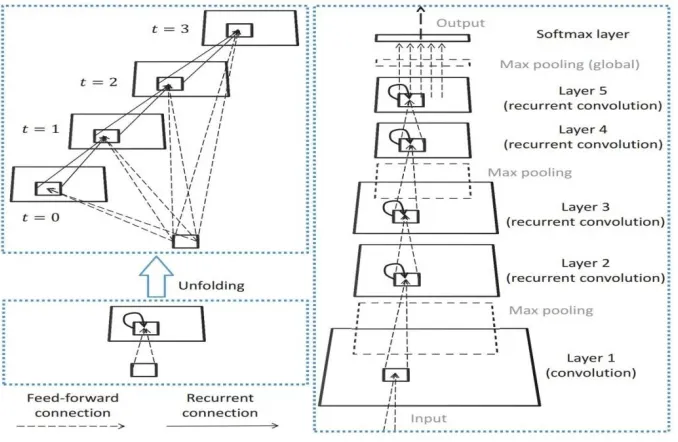
Recurrent and Convolutional Neural Networks can be combined in different ways. In some paper, Recurrent Convolutional Neural Networks is proposed. There is a little confusion about these networks and especially the abbreviation RCNN. This abbreviation refers in some papers to Region-Based CNN, in others to Recursive CNN and in some to Recurrent CNN. Furthermore not all described Recurrent CNN have the same architecture. In the following, two approaches are described in more detail. The first approach is described in the paper of Andrej Karpathy and Li Fei-Fei: They connect a CNN and RNN in series and use this for labelling a scene with a whole sentence. The second approach from Ming Liang and Xiaolin Hu mixes a CNN with an RNN and use this architecture for better object detection. In a mixed CNN and RNN architecture, the positive features of an RNN are used to improve the CNN. Liang and Hu are describing an architecture for object detection and a similar architecture for scene labelling is proposed. In these papers, the combined network is called RCNN. The key module of this RCNN are the recurrent convolution layers (RCL), which introduce recurrent connection into a convolution layer. With these connections the network can evolve over time through the input is static and each unit is influenced by its neighbouring units. This property integrates the context information of an image, which is important for object detection. The importance of context information is shown in figure 8. In this figure, it is very hard to recognize the mouth or the nose without the context.
ISSN(Online): 2319-8753 ISSN (Print): 2347-6710
I
nternational
J
ournal of
I
nnovative
R
esearch in
S
cience,
E
ngineering and
T
echnology
(A High Impact Factor, Monthly, Peer Reviewed Journal)
Visit: www.ijirset.com
Vol. 7, Issue 11, November 2018
Following figure shows the architecture of proposed Agricultural Expert system. Here the agricultural data is used to train the system.
The knowledge engineer creates a rule-based mapping of facts for the symbolic representation of the live multidimensional database. This Structured and procedural knowledge representation is termed as the knowledge base (KB) of the agricultural expert system. Using the KB the inference engine, subsuming the Convolutional and Relational Neural Networks derives meaningful and useful insights or inferences for the agricultural process. These insights are displayed to the farmers in their regional language through an amiable user interface. The farmers can give feedback through this interface and the system trains and evolves through each case study for more robust and accurate analysis and results.
IV.CONCLUSION
By using the proposed expert system farmers will be able to get the information about the crops,diseases on the plants, the probable and most promising crop for the current traced location and the probable crop yield very easily and quickly.
REFERENCES
[1] R. Bongiovanni and J. Lowenberg-Deboer, “Precision agriculture and sustainability,” Precis. Agric., vol. 5, no. 4, pp. 359–387, 2004.J. V Stafford, “Implementing Precision Agriculture in the 21st Century,” J. Agric. Eng. Res., vol. 76, no. 3, pp. 267–275, 2000.
[2] A. McBratney, B. Whelan, T. Ancev, and J. Bouma, “Future directions of precision agriculture,” Precis. Agric., vol. 6, no. 1, pp. 7–23, 2005. [3] N. Zhang, M. Wang, and N. Wang, “Precision agriculture - A worldwide overview,” Comput. Electron. Agric., vol. 36, no. 2– 3, pp. 113–132,
2002.
[4] H. S. Abdullahi, F. Mahieddine, and R. E. Sheriff, “Wireless and Satellite Systems,” vol. 154, no. January 2016, pp. 388–400, 2015.
[5] E. S. Government of Alberta, Alberta Agriculture and Rural Development, Policy and Environment, “What Is Precision Farming?” Taber, Alberta, Canada, 1997.
[6] T. Blaschke, “Object based image analysis for remote sensing,” ISPRS Journal of Photogrammetry and Remote Sensing, vol. 65,no. 1. pp. 2– 16, 2010.
[7] C. Brown, “GIS, GPS, and Remote Sensing Technologies in Extension Services Where to Start, What to Know,” pp. 1–6, 2016.
[8] T. Shi, “Ecological agriculture in China: Bridging the gap between rhetoric and practice of sustainability,” Ecol. Econ., vol. 42, no. 3, pp. 359– 368, 2002.
[9] C. Zhang and J. M. Kovacs, “The application of small unmanned aerial systems for precision agriculture: A review,” Precis.Agric., vol. 13, no. 6, pp. 693–712, 2012.