Design and Simulation of 100kw Grid
Connected Solar PV System Using
MATLAB/Simulink
V. Venkata Swathi1*, G.Chandra Sekhar2, P.V.V.Pawan kumar3
P.G. Student, Department of Electrical Engineering, GMRIT, Rajam, Srikakulam, India1
Professor, Department of Electrical Engineering, GMRIT, Rajam, Srikakulam, India2
Assistant Professor, Department of Power Engineering, GMRIT, Rajam, Srikakulam, India3
ABSTRACT:In this paper presents the Simulation 100kW grid-connected solar PV system using MATLAB/SIMULINK. Solar array characteristics depend on the solar radiation and temperature these are in non-linear nature its power should vary continuously with weather changing conditions. In this condition, MPPT is used to track the maximum power from the solar array. This Performance evaluation of this system is discussed and then control the output current of the inverter using hysteresis current controller.
KEYWORDS:PV array, MPPT Algorithm, DC-DC Converter, DC-AC Inverter, System Control, Grid-tied.
I. INTRODUCTION
Solar energy is an important source of the electricity production [1]. In the photovoltaic system, photovoltaic arrays or modules made up of semiconducting materials it allows sunlight then it converts directly into electricity. Photovoltaic arrays can provide safe, maintenance-free, reliable and environmentally friendly [2]. In this PV generation system, conversion efficiency is low for the electrical power generation. The electric power generation of the solar arrays changes continuously with climate changing conditions their generated power output is always changing with environmental conditions [3].
Photovoltaic generated power supplied to the grid acquisition is more and more visibility, while the world’s power demand is rising [4]. A grid is an interconnected network for delivering electricity from producers to end users. The grid-connected system consisting of generating stations it produces electrical power, distribution lines these are connected to individual end users and high-voltage transmission lines which are connected to a grid. The main advantage of the grid-connected system is the more effective utilization of generated power [5]. The main objective of this paper, the 100kW system is connected to the grid and then observes the performance evaluation of this system using a hysteresis current controller to limit current of the inverter.
ISSN(Online): 2319-8753 ISSN (Print): 2347-6710
International Journal of Innovative Research in Science,
Engineering and Technology
(A High Impact Factor, Monthly, Peer Reviewed Journal) Visit: www.ijirset.com
Vol. 7, Issue 9, September 2018
and excellent performance[8] especially for low-cost implementations and the proposed algorithm gives faster response than the conventional algorithms. [13]. It isa simple MPPT setup resulting in a highly efficient system[19].
After detection of text, how text region is filled using an Inpainting technique that is given in Section III. Section IV presents experimental results showing results of images tested. Finally, Section V presents conclusion.
II. PROPOSEDSYSTEMSTRUCTURE
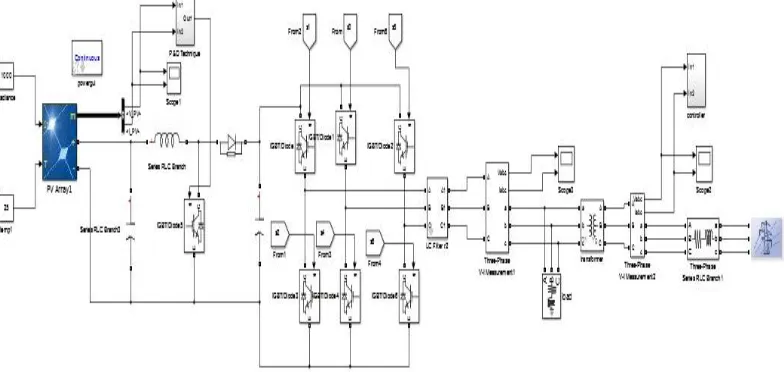
In this paper proposed system consisting of PV array, DC-DC converter, MPPT controller, DC-AC converter, hysteresis current controller and grid connecting equipment. In grid connected PV system with the hysteresis current controller (HCC), which controls the inverter for interfacing the grid. The PV array generated voltage is an increase using DC-DC boost converter then it is fed to three phase inverters. This inverter controlling purpose using hysteresis current controller. These all system block diagram arrangement is shown in fig.1.
Fig. 1. The basic block diagram of the proposed system
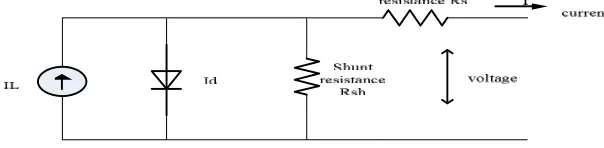
A. PV array modeling
Fig. 3. Output voltage, current and power at different temperatures
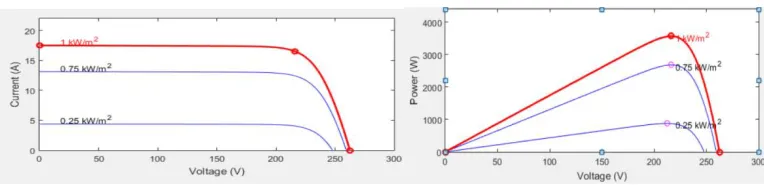
Fig. 4. Output voltage, current and power at different irradiance
B. MPPT controller
ISSN(Online): 2319-8753 ISSN (Print): 2347-6710
International Journal of Innovative Research in Science,
Engineering and Technology
(A High Impact Factor, Monthly, Peer Reviewed Journal) Visit: www.ijirset.com
Vol. 7, Issue 9, September 2018
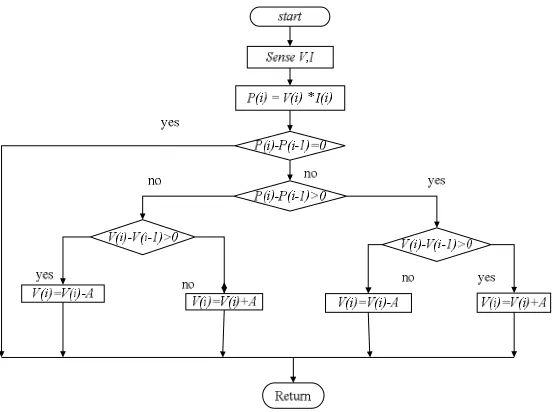
Fig. 5. State-flow chart of P&O MPPT technique
Fig. 6. Perturb and observe (P&O) technique developed in MATLAB
Fig. 7. PV array with boost converter
D. Three phase inverters
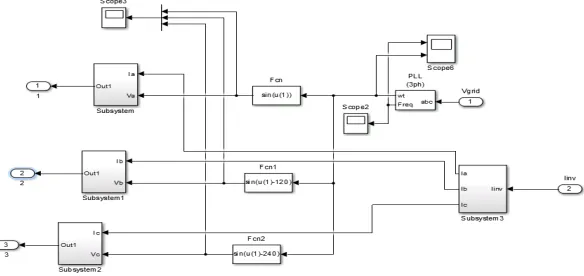
The Boost converter is fed to an inverter. It is an electrical device which converts DC source to AC source. Three phase inverters are generally used for high power applications. In inverter design IGBT (insulated gate bipolar transistor) power switches are used to high voltage capability, fast switching compared to other switches and in this paper inverter controlling purpose hysteresis current controller is used. In power electronic circuits, these current control methods play very important role, which are broadly useful in ac motor drives and continuous ac power supplies where the main objective is to produce a sinusoidal ac output[15]. The main advantages of hysteresis current controller are fast response, high tracking accuracy and simplicity. This controlling technique can be implemented by constant switching frequency or variable switching frequency. Constant switching frequency is obtained by modified bandwidth depending on inductance value. In variable switching frequency a constant bandwidth HCC technique controls the current in defined bandwidth [16].
ISSN(Online): 2319-8753 ISSN (Print): 2347-6710
International Journal of Innovative Research in Science,
Engineering and Technology
(A High Impact Factor, Monthly, Peer Reviewed Journal) Visit: www.ijirset.com
Vol. 7, Issue 9, September 2018
E. Transformer
Transformers consist of two coils primary coil and secondary coil. The Primary coil of the transformer receives energy from the AC source; secondary coil receives energy from the primary winding and delivers it to the load and Transformers are either step-up this means it delivers high voltage to the load or step down this means it delivers lower voltage to the load according to the turns ratio can be defined as the number of turns of the secondary to the primary [14] these equations are shown in [1, 2&3].The main function of transformer is change the ratio of voltage to current delivered from a voltage source to meet the characteristics of the load, in this case keeping the power constant.
2 2 1 1
n
V
V
n
[1] 1 2 1 2n
n
[2]1 1 2 2
V I
V I
[3]
Fig. 10. Output voltage and current of PV array
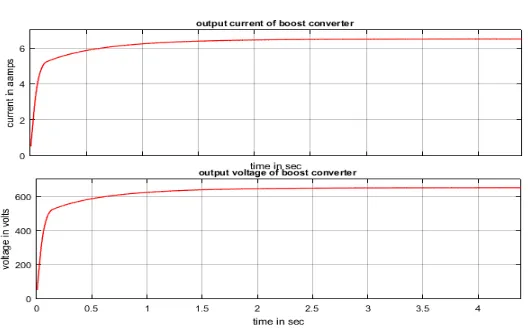
Fig. 11. Voltage and current from the boost converter
ISSN(Online): 2319-8753 ISSN (Print): 2347-6710
International Journal of Innovative Research in Science,
Engineering and Technology
(A High Impact Factor, Monthly, Peer Reviewed Journal) Visit: www.ijirset.com
Vol. 7, Issue 9, September 2018
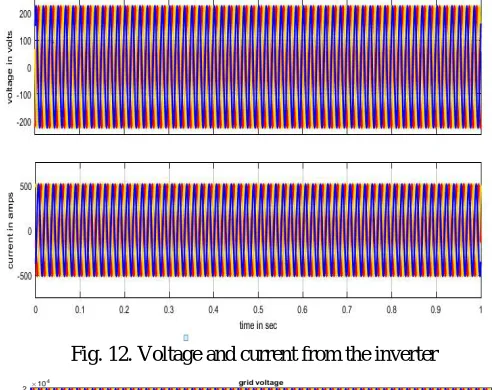
Fig. 12. Voltage and current from the inverter
Fig. 13. Represents grid voltage &grid current
IV.CONCLUSION
[7] Rajyaguru, Vipul C. "Design and Simulation of Grid Connected PV System."4..8, 2016.
[8] Reeya Pandya, Monika Vardia” Grid-Connected Pv System WithMppt Control And P&O Technique” Vol-2 Issue-1 2016.
[9] Faranda, Roberto, and Sonia Leva. "A Comparative Study of MPPT techniques for PV Systems." 7th WSEAS International Conference on Application of Electrical Engineering (AEE’08), Trondheim, Norway. 2008.
[10] Lamnadi, M., et al. "comparative study of ic, p&o and flc method of mppt algorithm for grid connected pv module." Journal of Theoretical & Applied Information Technology 89.1, 2016.
[11] Mamatha, Gangavarapu. "Perturb and observe MPPT algorithm implementation for PV applications." International Journal of Computer Science and Information Technologies6.2 1884-1887, 2015.
[12] Atiq, Jawairia, and Prashant Kumar Soori. "Modelling of a Grid Connected Solar PV System Using MATLAB/Simulink." International Journal of Simulation--Systems, Science & Technology 17.41, 2016.
[13] Roman, Eduardo, et al. "Intelligent PV module for grid-connected PV systems." IEEE Transactions on Industrial electronics 53.4 1066-1073, 2006.
[14] AbdelHady, Rameen. "Modeling and simulation of a micro grid-connected solar PV system." Water Science 31.1 1-10, 2017. [15] Miloševic, Mirjana. "Hysteresis current control in three-phase voltage source inverter." (2003).
[16] Isen, Evren. "Modelling and Simulation of Hysteresis Current Controlled Single-Phase Grid-Connected Inverter." Proc. 17th International Conference on Electrical and Power Engineering, Holland. 2015.
[17] Nelson A. Patel ,Jaydeep C. Baria” A Hysteresis Current Control Technique for Electronics Convertor” Vol. 5, Issue 2, February 2016. [18] Jitendra Kasera,Vinod Kumar,Dr. R.R. Joshi,Jai Kumar Maherchandani”Design of Grid Connected Photovoltaic System Employing
Increamental Conductance MPPT Algotithm” Journal of Electrical Engineering.12, 172-177, 2012.
[19] Patel, Ajay, Vikas Kumar, and Yogendra Kumar. "Perturb and observe maximum power point tracking for photovoltaic cell." Innovative Systems Design and Engineering 4.6 9-15, 2013.